
Joshua 19:8

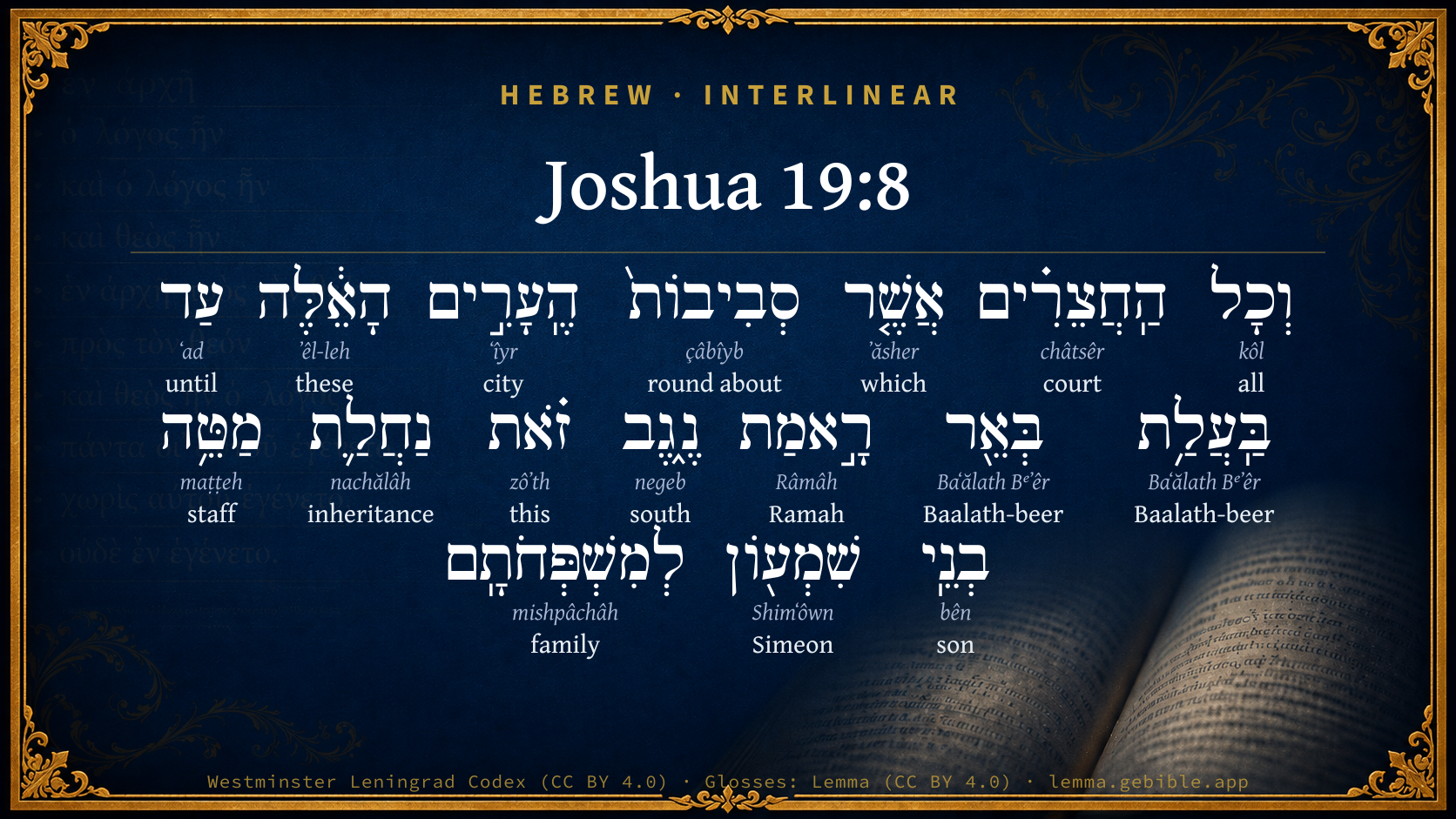
Hebrew (Westminster Leningrad Codex) Joshua 19:8 appears in the Hebrew Old Testament. The text above is from the Westminster Leningrad Codex. Each word links to its Strong’s number, a concise gloss, and parsing drawn from the Open Scriptures Hebrew Bible morphology. Click any word for its full Brown-Driver-Briggs (BDB) entry.
Download image
Cite this verse

Joshua 19:8 (World English Bible). Public Domain. Lemma interlinear Bible study tool, https://lemma.gebible.app/v/joshua/19/8.

Show BibTeX & RIS
BibTeX
RIS
English Translation
and all the villages that were round about these cities to Baalath Beer, Ramah of the South. This is the inheritance of the tribe of the children of Simeon according to their families.
World English Bible · Public Domain
Highlights
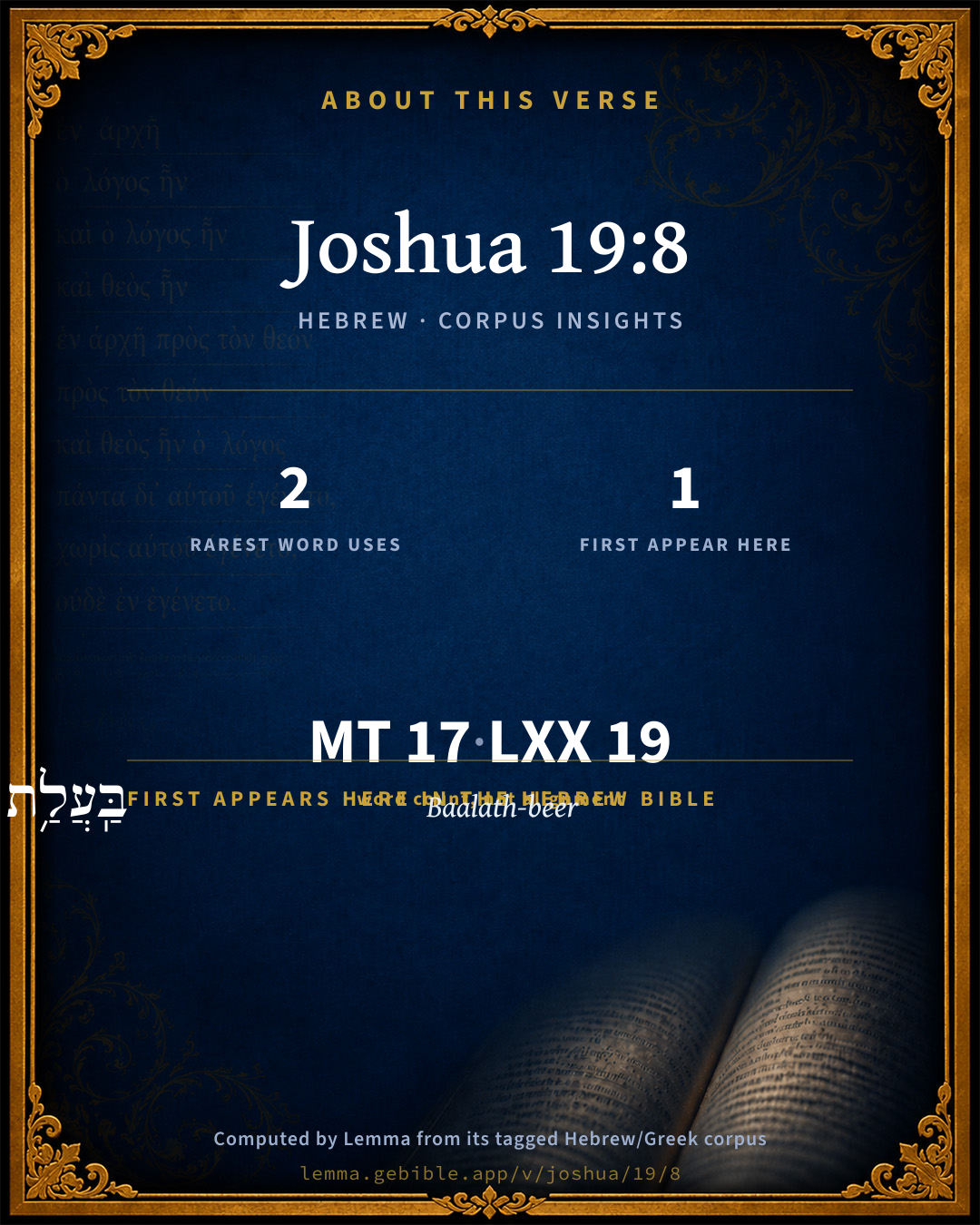
  • 1 first appearance in the Hebrew Bible
Full analysis ↓
Download a study sheet

One document with this verse’s original text, its word-by-word gloss line, the meaning frame, cross-references with their text, attributed commentary, and full source and license credits — printable, and it pastes into notes with its structure intact.

This verse Autodidact and up

Study sheet (.html) Plain text (.txt)

A passage Seminary Student

Up to 50 verses in one chapter. A passage sheet keeps up to 6 commentary sources and 12 cross-references per verse, in the order this page ranks them, and says so on the sheet whenever that leaves anything out. Ask for a single verse and you get the Autodidact verse sheet above.

Everything on this page stays free to read, with no account — the sheet is a download of what is already on screen, not access to it.

Want to remove ads? Support Godless Engineer
Compare translations 3

The same verse in 3 English versions, stacked beneath the original-language interlinear above. Click any original word for its lexicon entry.

Each is an independent rendering of the whole verse — the interlinear is not word-aligned to these translations.

Highlighted words mark where these versions differ — a whole-verse word diff, not a word-by-word alignment.

  • World English Bible Public Domain
    and all the villages that were round about these cities to Baalath Beer, Ramah of the South. This is the inheritance of the tribe of the children of Simeon according to their families.
  • King James Version Public Domain
    And all the villages that were round about these cities to Baalathbeer, Ramath of the south. This is the inheritance of the tribe of the children of Simeon according to their families.
  • unfoldingWord Literal Text CC BY-SA 4.0
    and all of the villages that around these cities unto Baalath Beer (Ramah of the Negev). This the inheritance of the tribe of the sons of Simeon according to their clans.

unfoldingWord Literal Text — © unfoldingWord, licensed CC BY-SA 4.0. Word-aligned USFM3 via Door43 (git.door43.org/unfoldingWord/en_ult).

Versions to compare (up to 4)

3 of 4 selected

Show all 18 translations

Every available English version of this verse, each an independent rendering of the whole verse.

  • World English Bible Public Domain
    and all the villages that were round about these cities to Baalath Beer, Ramah of the South. This is the inheritance of the tribe of the children of Simeon according to their families.
  • Berean Standard Bible Public Domain
    and all the villages surrounding these cities as far as Baalath-beer (Ramah of the Negev). This was the inheritance of the clans of the tribe of Simeon.
  • Majority Standard Bible Public Domain
    and all the villages surrounding these cities as far as Baalath-beer (Ramah of the Negev). This was the inheritance of the clans of the tribe of Simeon.
  • King James Version Public Domain
    And all the villages that were round about these cities to Baalathbeer, Ramath of the south. This is the inheritance of the tribe of the children of Simeon according to their families.
  • American Standard Version (1901) Public Domain
    and all the villages that were round about these cities to Baalath-beer, Ramah of the South. This is the inheritance of the tribe of the children of Simeon according to their families.
  • Revised Version (1885) Public Domain
    and all the villages that were round about these cities to Baalath-beer, Ramah of the South. This is the inheritance of the tribe of the children of Simeon according to their families.
  • Geneva Bible (1599) Public Domain
    And all the villages that were round about these cities, vnto Baalathbeer, and Ramath Southward: this is the inheritance of the tribe of the children of Simeon according to their families.
  • Douay-Rheims (1899) Public Domain
    And all the villages round about these cities to Baalath Beer Ramath to the south quarter. This is the inheritance of the children of Simeon according to their kindreds,
  • Young's Literal Translation Public Domain
    also all the villages which `are' round about these cities, unto Baalath-Beer, Ramoth of the south. This `is' the inheritance of the tribe of the sons of Simeon, for their families;
  • Literal Standard Version CC BY-SA 4.0
    also all the villages which [are] around these cities, to Ba‘alath-Beer, Ramoth of the south. This [is] the inheritance of the tribe of the sons of Simeon, for their families;
  • Unlocked Literal Bible CC BY-SA 4.0
    These were together, including their the villages around these cities as far as Baalath Beer (the same as Ramah in the Negev). This was the inheritance of the tribe of Simeon, clan by clan.
  • unfoldingWord Literal Text CC BY-SA 4.0
    and all of the villages that around these cities unto Baalath Beer (Ramah of the Negev). This the inheritance of the tribe of the sons of Simeon according to their clans.
  • Darby Bible Public Domain
    and all the hamlets that are round these cities to Baalath-beer, [that is] Ramah of the south. This is the inheritance of the tribe of the children of Simeon according to their families.
  • World Messianic Bible Public Domain
    and all the villages that were around these cities to Baalath Beer, Ramah of the South. This is the inheritance of the tribe of the children of Simeon according to their families.
  • Webster's Bible Public Domain
    And all the villages that were around these cities to Baalath-beer, Ramath of the south. This is the inheritance of the tribe of the children of Simeon according to their families.
  • Free Bible Version CC BY-SA 4.0
    as well as all the villages around these towns as far as Baalath-beer (or Ramah of the Negev). This was the land allotted to the tribe of Simeon, by families.
  • Bible in Basic English Public Domain
    And all the unwalled places round about these towns as far as Baalath-beer-ramah to the south. This is the heritage of the tribe of Simeon by their families.
  • JPS Tanakh (1917) Public Domain
    and all the villages that were round about these cities to Baalath-beer, as far as Ramah of the South. This is the inheritance of the tribe of the children of Simeon according to their families.

Literal Standard Version (2020), Covenant Press — licensed CC BY-SA 4.0. Text via the HelloAO Bible API (eBible.org). Unlocked Literal Bible (unfoldingWord) — licensed CC BY-SA 4.0. Text via the HelloAO Bible API (eBible.org). unfoldingWord Literal Text — © unfoldingWord, licensed CC BY-SA 4.0. Word-aligned USFM3 via Door43 (git.door43.org/unfoldingWord/en_ult). Free Bible Version, Dr. Jonathan Gallagher — licensed CC BY-SA 4.0. Text via the HelloAO Bible API (eBible.org).

Word by word

More ways to search: Search by grammar → Find every occurrence → Compare this word →

Practice this passage: Drill this verse → Learn its vocabulary →

בַּֽעֲלַ֥ת
Baʻălath Bᵉʼêr
H1192
“Baalath-beer”
Noun, Proper
Part of Speech
Noun
Type
Proper
Full BDB Definition

Origin: from H1172 and H875

TWOT: None

Baalath-beer = "mistress of the well" - a town in the south part of Judah, given to Simeon, which also bore the name of 'Ramath-negeb'
  1. וְכָל kôl H3605 “and · all of” Conjunction + Noun, Common, Masculine, Singular, Construct
  2. הַֽחֲצֵרִ֗ים châtsêr H2691 “the · courts” Particle, Definite Article + Noun, Common, Both, Plural, Absolute
  3. אֲשֶׁ֤ר ʼăsher H834 “which” Particle, Relative
  4. סְבִיבוֹת֙ çâbîyb H5439 “surroundings of” Noun, Common, Both, Plural, Construct
  5. הֶֽעָרִ֣ים ʻîyr H5892 “the · cities” Particle, Definite Article + Noun, Common, Feminine, Plural, Absolute
  6. הָאֵ֔לֶּה ʼêl-leh H428 “the · these” Particle, Definite Article + Pronoun, Demonstrative, Common, Plural
  7. עַד ʻad H5704 “until” Preposition
  8. בְּאֵ֖ר Baʻălath Bᵉʼêr H1192 “Baalath-beer” Noun, Proper
  9. רָ֣אמַת Râmâh H7414 “Ramah” Noun, Proper
  10. נֶ֑גֶב negeb H5045 “south” Noun, Common, Masculine, Singular, Absolute
  11. זֹ֗את zôʼth H2063 “this” Pronoun, Demonstrative, Feminine, Singular
  12. נַחֲלַ֛ת nachălâh H5159 “inheritance of” Noun, Common, Feminine, Singular, Construct
  13. מַטֵּ֥ה maṭṭeh H4294 “staff of” Noun, Common, Masculine, Singular, Construct
  14. בְנֵֽי bên H1121 “sons of” Noun, Common, Masculine, Plural, Construct
  15. שִׁמְע֖וֹן Shimʻôwn H8095 “Simeon” Noun, Proper
  16. לְמִשְׁפְּחֹתָֽם mishpâchâh H4940 “to/for · families · their” Preposition + Noun, Common, Feminine, Plural, Construct + Suffix, Personal, 3rd Person, Masculine, Plural

About this verse

These counts appear in no published source. They are computed here, from the morphology-tagged text and Lemma’s own curated glosses. What Lemma adds →

17
words
16
distinct lemmas
Historical
section

Notable vocabulary

The rarest word here is בַּֽעֲלַ֥ת Baalath-beer H1192 — appearing just 2 times in the whole Hebrew Bible.

First appearance in Scripture

This word makes its first canonical appearance in the Hebrew Bible here:

  • בַּֽעֲלַ֥ת Baalath-beer H1192

Grammatical profile

  • 13 nouns
  • 2 pronouns
  • 1 preposition
  • 1 particle

Repetition

A word recurs within this verse — often emphatic in Hebrew:

  • בַּֽעֲלַ֥ת Baalath-beer H1192 ×2

Hebrew & Septuagint length

In English translation the verse runs 33 words from the Hebrew and 30 from the Septuagint (LXX English) — closely comparable.

A rough comparison of the two English renderings, which tokenize alike — not a word-level alignment.

Word counts can differ between the Hebrew and the Greek without any difference in meaning — e.g. the Hebrew direct-object marker אֵת has no separate Greek word, and Greek often adds the article ὁ.

In the original languages it is 17 Hebrew tokens and 19 Greek tokens — but the two are counted differently (Hebrew bundles its prefixes and suffixes into one token; the Greek is in lemma form), so that isn’t a like-for-like length.

Cross-references

2

Topical passages linked to Joshua 19:8 in the Treasury of Scripture Knowledge — connected by theme and wording, ordered by reader-vote popularity; previews shown in the World English Bible.

  • 1 Chronicles 4:33 and all their villages that were round about the same cities, to Baal. These were their habitations, and they have their genealogy.
  • 1 Samuel 30:27 To those who were in Bethel, and to those who were in Ramoth of the South, and to those who were in Jattir,

Cross-references courtesy of OpenBible.info (CC BY 4.0).

Hebrew and Greek witnesses Masoretic Hebrew ↔ Greek Septuagint

The same verse in the two great witnesses to the Old Testament, shown verse-for-verse.

These are two independent witnesses, not word-aligned to each other, and the Septuagint is shown in lemma (dictionary) form.

Hebrew Joshua 19:8 Masoretic · Westminster Leningrad Codex

וְכָל הַֽחֲצֵרִ֗ים אֲשֶׁ֤ר סְבִיבוֹת֙ הֶֽעָרִ֣ים הָאֵ֔לֶּה עַד בַּֽעֲלַ֥ת בְּאֵ֖ר רָ֣אמַת נֶ֑גֶב זֹ֗את נַחֲלַ֛ת מַטֵּ֥ה בְנֵֽי שִׁמְע֖וֹן לְמִשְׁפְּחֹתָֽם

and all the villages that were round about these cities to Baalath Beer, Ramah of the South. This is the inheritance of the tribe of the children of Simeon according to their families.

World English Bible · Public Domain

Greek LXX Joshua 19:8 Septuagint · lemma form

κύκλος ὁ πόλις αὐτός ἕως βαρεκ πορεύομαι βαμεθ κατά λίψ οὗτος ὁ κληρονομία φυλή υἱός συμεων κατά δῆμος αὐτός

round about their cities as far as Balec as men go to Bameth southward: this is the inheritance of the tribe of the children of Symeon according to their families.

LXX2012 (modern English Septuagint) · Public Domain

Hebrew: Westminster Leningrad Codex (CC BY 4.0). Greek: Septuagint (public domain); English from LXX2012 (modern English Septuagint) (Public Domain). How the Septuagint differs from the Hebrew →

Targum (Aramaic paraphrase)

1

The Targum is the ancient Jewish Aramaic paraphrase of the Hebrew Scriptures — an interpretive translation, not the Hebrew text itself. Onkelos (literal) and Pseudo-Jonathan (expansive) render the Torah, and Jonathan the Prophets. Coverage is partial: where no permissively-licensed English translation exists for a verse, only the Aramaic is shown. This is verse-level text, not a word-by-word alignment to the Hebrew.

  1. Targum Jonathan Prophets (Joshua–Malachi)
    וְכָל פַּצְחַיָא דִי בְּסַחְרָנוּת קִרְוַיָא הָאִלֵין עַד בַּעֲלַת בְּאֵר רָאמַת דָרוֹמָא דָא אַחְסָנַת שִׁבְטָא דִבְנֵי שִׁמְעוֹן לְזַרְעֲיַתְהוֹן:

    (no public-domain English translation for this verse)

    Targum Jonathan — Aramaic: “Mikraot Gedolot” (public domain). English: “Sefaria Community Translation” (CC0 1.0 (public-domain dedication)); “London "Chaldee Paraphrase," 1871” (public domain). Text via Sefaria.

Commentary

Notes on Joshua 19:8 from classic Christian and Jewish commentators (each source and its license shown beneath its notes). The classic Christian expositions comment on the surrounding passage and are grouped to its opening verse, so a note may address several verses; the Jewish commentaries on the Tanakh (Rashi and others) are per-verse, so they appear only where the commentator wrote on this verse.

Lemma curates 59 commentaries, every one of them public domain or Creative Commons licensed, each selected and text-cleaned for this edition rather than reprinted as found. About our sources →

Geneva Bible (1599)

Geneva Bible translators

Or, Ramath Negeb.

Geneva Bible (1599) marginal notes — public domain. Text via Bolls.life.

Adam Clarke's Commentary

Verse 8. Baalath-beer] The well of the mistresses. Probably so called from some superstitious or impure worship set up there.

Adam Clarke's Commentary on the Bible (1810–1826) — public domain. Text from a community e-Sword/MySword module.

The Cambridge Bible for Schools and Colleges

gen. ed. J. J. S. Perowne

8. and all the villages that were round about] i.e. Simeon, not merely certain cities in the territory of Judah, but the whole country round the cities named, together with all the villages that were situated near them.

to Baalath-beer] See above, ch. Jos_15:24 or 29, = Baal in 1Ch_4:33.

Ramath of the south] Ramath, like Ramah and Ramoth, = a “height.” This Ramath of the Negeb, or the South, is thought to be another name for Baalath-beer, and has been by some identified with the present ruins of Kurnub, situated on the slope of a low range of hills about 20 miles south-east of Beer-sheba.

The Cambridge Bible for Schools and Colleges (gen. ed. J. J. S. Perowne; Cambridge University Press, 1878–1918) — public domain. Text from a community e-Sword module.

John Gill's Exposition

Out of the portion of the children of Judah was the inheritance of the children of Simeon,.... Which is the reason why no description is given of the border of their inheritance, because that is before given in the account of the lot of Judah:

for the part of the children of Judah was too much for them: they had more cities than they could fill with people, and more land than they could cultivate; they had an hundred fourteen cities with their villages:

therefore the children of Simeon had their inheritance within the inheritance of them; the one being a small tribe, and the other large, and for the reasons given; See Gill on Jos 19:1.

John Gill's Exposition of the Whole Bible (1746–1763) — public domain (CC PDM 1.0). Text via the HelloAO Bible API.

Whedon's Commentary on the Bible

Daniel D. Whedon

8. All the villages — All the surrounding villages and country that were subject to the cities named.

Daniel D. Whedon (gen. ed.), Commentary on the Old and New Testaments (1874–1909) — public domain. Text from a community e-Sword module.

unfoldingWord translationNotes

Door43 World Missions Community

This was the inheritance of the tribe of Simeon

The land and cities that the tribe of Simeon received are spoken of as if they were an inheritance that they received as a permanent possession. AT: "This was the land and the cities that the tribe of Simeon received as an inheritance" (See: Metaphor)

clan by clan

This can be stated in active form. AT: "which Joshua gave to their clans" (See: Active or Passive)

the portion of land assigned to the tribe of Judah

This can be stated in active form. AT: "the portion of land which Joshua assigned to the tribe of Judah" (See: Active or Passive)

the middle of their portion

"the middle of Judah's portion of land"

translationWords

Ramah

Negev

inherit

tribe

Simeon

clan

unfoldingWord translationNotes — © Distant Shores Media and the Door43 World Missions Community, licensed CC BY-SA 4.0. Source: git.door43.org/Door43/en_tn.

Lesson kit

Teaching starters — assembled from the data on this page, not authored interpretation. Every prompt links to the verse data it draws on. Edit before teaching.

Joshua, in the Historical, opens this verse with 17 words (16 distinct Hebrew lemmas). Its most distinctive word is Baʻălath Bᵉʼêr (“Baalath-beer”). A historical commentator’s framing appears above. Read the whole chapter for the surrounding context.

Discussion questions

  1. How does “Baalath-beer” (Baʻălath Bᵉʼêr) shape what this verse is saying?
  2. The word “Baalath-beer” first appears here in Scripture. What is being introduced at this debut?
  3. 1 Chronicles 4:33 shares this passage’s theme. How do the two illuminate each other?
  4. “Baalath-beer” occurs 2× in this one verse. What is the effect of the repetition?
  5. These translations render this verse differently; the difference is in the English rendering, not the original. What questions does that raise?
  6. Reading how Geneva Bible (1599) and Adam Clarke's Commentary read this verse, where do the two commentators agree and where do they part?

Things to notice

Reading settings

Reading text

Shown beneath each verse's original-language words.

Old Testament
Old Testament edition

Read the OT as the Masoretic Hebrew (MT) or the Greek Septuagint (LXX).

English shown for the Greek Septuagint (in the Hebrew ↔ Greek comparison).

Comparing translations? Open the Compare panel on any verse page to stack up to four side by side.