Deuteronomy 9:6

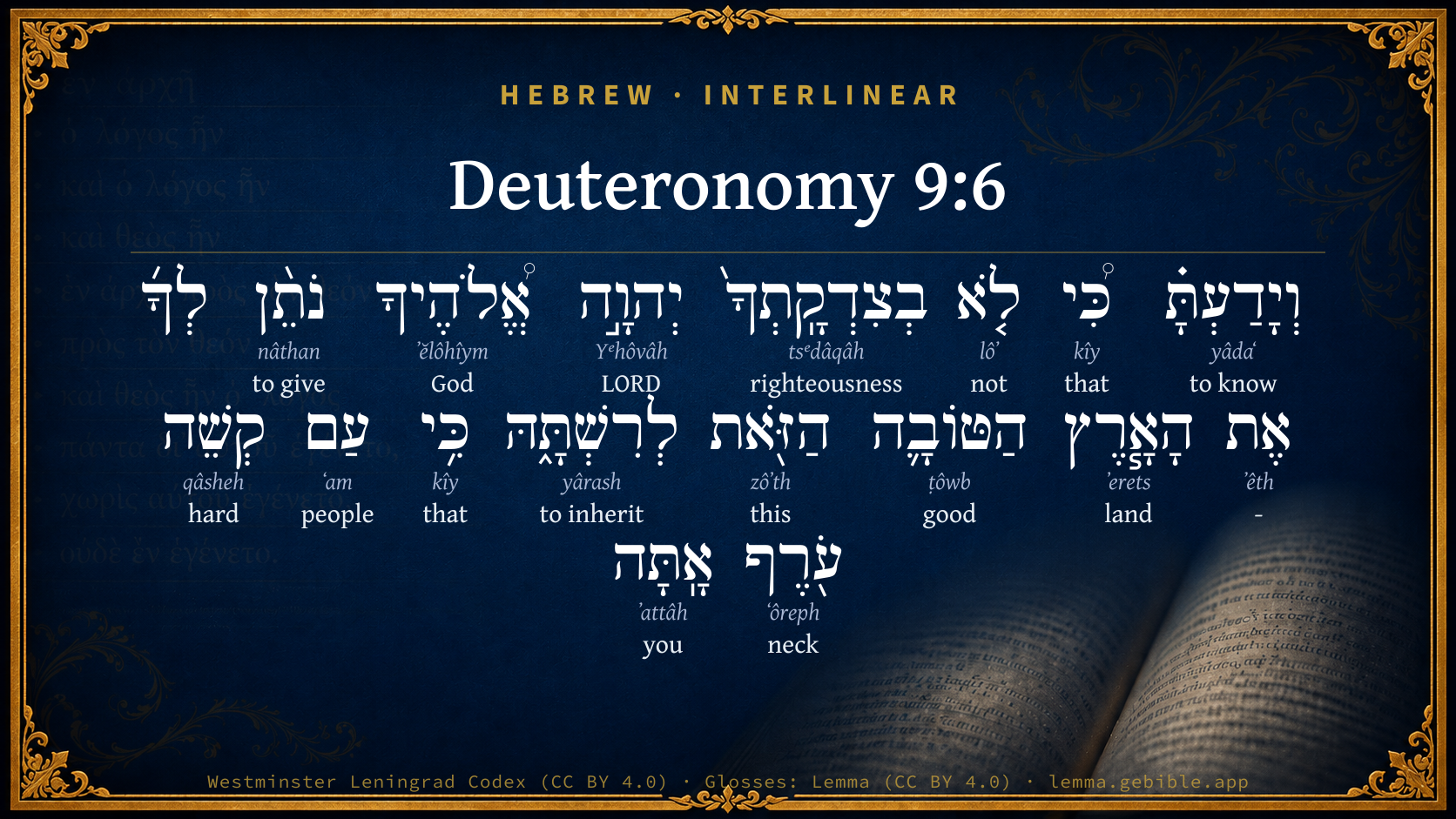
Hebrew (Westminster Leningrad Codex) Deuteronomy 9:6 appears in the Hebrew Old Testament. The text above is from the Westminster Leningrad Codex. Each word links to its Strong’s number, a concise gloss, and parsing drawn from the Open Scriptures Hebrew Bible morphology. Click any word for its full Brown-Driver-Briggs (BDB) entry.
Download image
Cite this verse

Deuteronomy 9:6 (World English Bible). Public Domain. Lemma interlinear Bible study tool, https://lemma.gebible.app/v/deuteronomy/9/6.

Show BibTeX & RIS
BibTeX
RIS
English Translation
Know therefore, that Yahweh your God doesn't give you this good land to possess it for your righteousness; for you are a stiff-necked people.
World English Bible · Public Domain
Download a study sheet

One document with this verse’s original text, its word-by-word gloss line, the meaning frame, cross-references with their text, attributed commentary, and full source and license credits — printable, and it pastes into notes with its structure intact.

This verse Autodidact and up

Study sheet (.html) Plain text (.txt)

A passage Seminary Student

Up to 50 verses in one chapter. A passage sheet keeps up to 6 commentary sources and 12 cross-references per verse, in the order this page ranks them, and says so on the sheet whenever that leaves anything out. Ask for a single verse and you get the Autodidact verse sheet above.

Everything on this page stays free to read, with no account — the sheet is a download of what is already on screen, not access to it.

Want to remove ads? Support Godless Engineer
Compare translations 3

The same verse in 3 English versions, stacked beneath the original-language interlinear above. Click any original word for its lexicon entry.

Each is an independent rendering of the whole verse — the interlinear is not word-aligned to these translations.

Highlighted words mark where these versions differ — a whole-verse word diff, not a word-by-word alignment.

  • World English Bible Public Domain
    Know therefore, that Yahweh your God doesn't give you this good land to possess it for your righteousness; for you are a stiff-necked people.
  • King James Version Public Domain
    Understand therefore, that the LORD thy God giveth thee not this good land to possess it for thy righteousness; for thou art a stiffnecked people.
  • unfoldingWord Literal Text CC BY-SA 4.0
    And you shall know that not in your righteousness is Yahweh your God giving to you this good land to possess, for you a people stiff of neck.

unfoldingWord Literal Text — © unfoldingWord, licensed CC BY-SA 4.0. Word-aligned USFM3 via Door43 (git.door43.org/unfoldingWord/en_ult).

Versions to compare (up to 4)

3 of 4 selected

Show all 18 translations

Every available English version of this verse, each an independent rendering of the whole verse.

  • World English Bible Public Domain
    Know therefore, that Yahweh your God doesn't give you this good land to possess it for your righteousness; for you are a stiff-necked people.
  • Berean Standard Bible Public Domain
    Understand, then, that it is not because of your righteousness that the LORD your God is giving you this good land to possess, for you are a stiff-necked people.
  • Majority Standard Bible Public Domain
    Understand, then, that it is not because of your righteousness that the LORD your God is giving you this good land to possess, for you are a stiff-necked people.
  • King James Version Public Domain
    Understand therefore, that the LORD thy God giveth thee not this good land to possess it for thy righteousness; for thou art a stiffnecked people.
  • American Standard Version (1901) Public Domain
    Know therefore, that Jehovah thy God giveth thee not this good land to possess it for thy righteousness; for thou art a stiffnecked people.
  • Revised Version (1885) Public Domain
    Know therefore, that the LORD thy God giveth thee not this good land to possess it for thy righteousness; for thou art a stiffnecked people.
  • Geneva Bible (1599) Public Domain
    Vnderstand therefore, that ye Lord thy God giueth thee not this good land to possesse it for thy righteousnes: for thou art a stifnecked people.
  • Douay-Rheims (1899) Public Domain
    Know therefore that the Lord thy God giveth thee not this excellent land in possession for thy justices, for thou art a very stiffnecked people.
  • Young's Literal Translation Public Domain
    and thou hast known, that not for thy righteousness is Jehovah thy God giving to thee this good land to possess it, for a people stiff of neck thou `art'.
  • Literal Standard Version CC BY-SA 4.0
    and you have known that [it is] not in your righteousness [that] your God YHWH is giving this good land to you to possess it, for you [are] a people stiff of neck.
  • Unlocked Literal Bible CC BY-SA 4.0
    Know therefore, that Yahweh your God is not giving you this good land to possess because of your righteousness, for you are a stubborn people.
  • unfoldingWord Literal Text CC BY-SA 4.0
    And you shall know that not in your righteousness is Yahweh your God giving to you this good land to possess, for you a people stiff of neck.
  • Darby Bible Public Domain
    Know therefore that Jehovah thy God doth not give thee this good land to possess it for thy righteousness; for thou art a stiff-necked people.
  • World Messianic Bible Public Domain
    Know therefore that the LORD your God doesn’t give you this good land to possess for your righteousness, for you are a stiff-necked people.
  • Webster's Bible Public Domain
    Understand therefore, that the LORD thy God giveth thee not this good land to possess it for thy righteousness; for thou art a stiff-necked people.
  • Free Bible Version CC BY-SA 4.0
    You'd better believe that it's not because you're such good people that the Lord your God is giving you this good land to own, because you are stubborn, hard-hearted people.
  • Bible in Basic English Public Domain
    Be certain then that the Lord your God is not giving you this good land as a reward for your righteousness; for you are a stiff-necked people.
  • JPS Tanakh (1917) Public Domain
    Know therefore that it is not for thy righteousness that the LORD thy God giveth thee this good land to possess it; for thou art a stiffnecked people.

Literal Standard Version (2020), Covenant Press — licensed CC BY-SA 4.0. Text via the HelloAO Bible API (eBible.org). Unlocked Literal Bible (unfoldingWord) — licensed CC BY-SA 4.0. Text via the HelloAO Bible API (eBible.org). unfoldingWord Literal Text — © unfoldingWord, licensed CC BY-SA 4.0. Word-aligned USFM3 via Door43 (git.door43.org/unfoldingWord/en_ult). Free Bible Version, Dr. Jonathan Gallagher — licensed CC BY-SA 4.0. Text via the HelloAO Bible API (eBible.org).

Word by word

More ways to search: Search by grammar → Find every occurrence → Compare this word →

Practice this passage: Drill this verse → Learn its vocabulary →

עֹ֖רֶף
ʻôreph
H6203
“neck”
Noun, Common, Masculine, Singular, Absolute
Part of Speech
Noun
Type
Common
Gender
Masculine
Number
Singular
State
Absolute
Full BDB Definition

Origin: from H6202

TWOT: 1700a

neck, back of the neck, back - back of the neck - of fleeing foe - of apostasy (figuratively) - stiff of neck, obstinate (figuratively)
  1. וְיָדַעְתָּ֗ yâdaʻ H3045 “and · to know” Conjunction + Verb, Qal, Sequential Perfect, 2nd Person, Masculine, Singular
  2. כִּ֠י kîy H3588 “that” Conjunction
  3. לֹ֤א lôʼ H3808 “not” Particle, Negative
  4. בְצִדְקָֽתְךָ֙ tsᵉdâqâh H6666 “in/at · righteousness · your” Preposition + Noun, Common, Feminine, Singular, Construct + Suffix, Personal, 2nd Person, Masculine, Singular
  5. יְהוָ֣ה Yᵉhôvâh H3068 “LORD” Noun, Proper
  6. אֱ֠לֹהֶיךָ ʼĕlôhîym H430 “God(s) · your” Noun, Common, Masculine, Plural, Construct + Suffix, Personal, 2nd Person, Masculine, Singular
  7. נֹתֵ֨ן nâthan H5414 “giving” Verb, Qal, Participle Active, Masculine, Singular, Absolute
  8. אֶת ʼêth H853 “-” Particle, Direct Object
  9. הָאָ֧רֶץ ʼerets H776 “the · land” Particle, Definite Article + Noun, Common, Both, Singular, Absolute
  10. הַטּוֹבָ֛ה ṭôwb H2896 “the · good” Particle, Definite Article + Adjective, Adjective, Feminine, Singular, Absolute
  11. הַזֹּ֖את zôʼth H2063 “the · this” Particle, Definite Article + Pronoun, Demonstrative, Feminine, Singular
  12. לְרִשְׁתָּ֑הּ yârash H3423 “to inherit · her” Preposition + Verb, Qal, Infinitive Construct + Suffix, Personal, 3rd Person, Feminine, Singular
  13. כִּ֥י kîy H3588 “that” Conjunction
  14. עַם ʻam H5971 “people” Noun, Common, Masculine, Singular, Absolute
  15. קְשֵׁה qâsheh H7186 “hard of” Adjective, Adjective, Masculine, Singular, Construct
  16. אָֽתָּה ʼattâh H859 “you” Pronoun, Personal, 2nd Person, Masculine, Singular

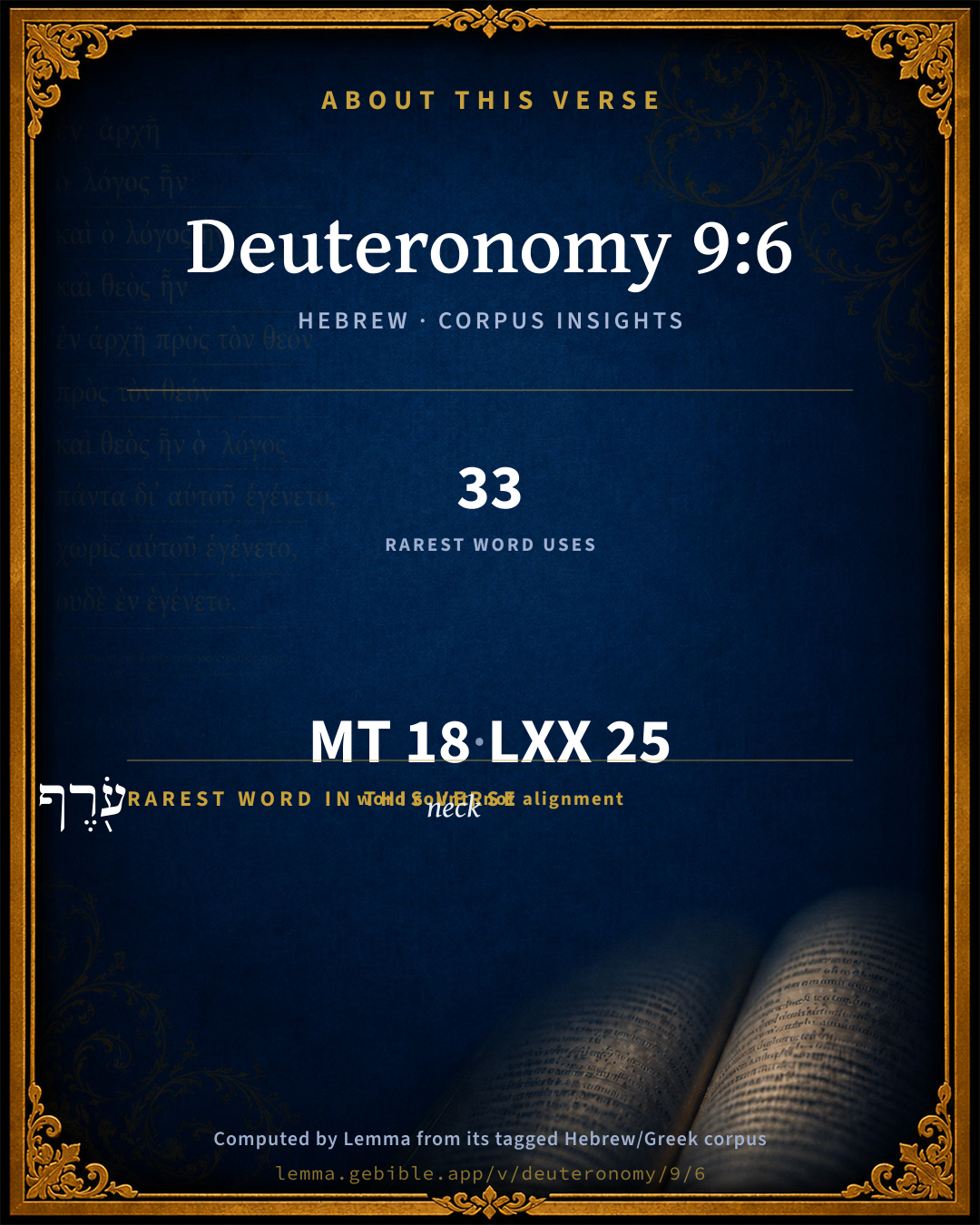
About this verse

These counts appear in no published source. They are computed here, from the morphology-tagged text and Lemma’s own curated glosses. What Lemma adds →

18
words
16
distinct lemmas
Pentateuch
section

Shared distinctive vocabulary

עֹ֖רֶף neck H6203 occurs in 32 verses of the Hebrew Bible. Also found in:

Grammatical profile

  • 3 verbs
  • 6 nouns
  • 2 adjectives
  • 2 pronouns
  • 1 preposition
  • 2 conjunctions
  • 2 particles

Verb forms

  • וְיָדַעְתָּ֗ Qal · Sequential Perfect
  • נֹתֵ֨ן Qal · Participle Active
  • לְרִשְׁתָּ֑הּ Qal · Infinitive Construct

Repetition

A word recurs within this verse — often emphatic in Hebrew:

  • כִּ֠י that H3588 ×2

Hebrew & Septuagint length

In English translation the verse runs 24 words from the Hebrew and 29 from the Septuagint (LXX English) — closely comparable.

A rough comparison of the two English renderings, which tokenize alike — not a word-level alignment.

Word counts can differ between the Hebrew and the Greek without any difference in meaning — e.g. the Hebrew direct-object marker אֵת has no separate Greek word, and Greek often adds the article ὁ.

In the original languages it is 18 Hebrew tokens and 25 Greek tokens — but the two are counted differently (Hebrew bundles its prefixes and suffixes into one token; the Greek is in lemma form), so that isn’t a like-for-like length.

Cross-references

16

Topical passages linked to Deuteronomy 9:6 in the Treasury of Scripture Knowledge — connected by theme and wording, ordered by reader-vote popularity; previews shown in the World English Bible.

  • Deuteronomy 10:16 Circumcise therefore the foreskin of your heart, and be no more stiff-necked.
  • Deuteronomy 9:13 Furthermore Yahweh spoke to me, saying, I have seen this people, and, behold, it is a stiff-necked people:
  • Deuteronomy 31:27 For I know your rebellion, and your stiff neck: behold, while I am yet alive with you this day, you have been rebellious against Yahweh; and how much more after my death?
  • Acts 7:51 "You stiff-necked and uncircumcised in heart and ears, you always resist the Holy Spirit! As your fathers did, so you do.
  • Exodus 32:9 Yahweh said to Moses, "I have seen these people, and, behold, they are a stiff-necked people.
  • Exodus 33:3 to a land flowing with milk and honey: for I will not go up in the midst of you, for you are a stiff-necked people, lest I consume you in the way."
  • Exodus 34:9 He said, "If now I have found favor in your sight, Lord, please let the Lord go in the midst of us; although this is a stiff-necked people; pardon our iniquity and our sin, and take us for your inheritance."
  • Deuteronomy 9:3–4 Know therefore this day, that Yahweh your God is he who goes over before you as a devouring fire; he will destroy them, and he will bring them down before you: so shall you drive them out, and make them to perish quickly, as Yahweh has spoken to you.
  • 2 Chronicles 30:8 Now don't you be stiff-necked, as your fathers were; but yield yourselves to Yahweh, and enter into his sanctuary, which he has sanctified forever, and serve Yahweh your God, that his fierce anger may turn away from you.
  • 2 Chronicles 36:13 He also rebelled against king Nebuchadnezzar, who had made him swear by God: but he stiffened his neck, and hardened his heart against turning to Yahweh, the God of Israel.
  • Psalms 78:8 And might not be as their fathers, A stubborn and rebellious generation, A generation that didn't make their hearts loyal, Whose spirit was not steadfast with God.
  • Isaiah 48:3–4 I have declared the former things from of old; yes, they went forth out of my mouth, and I shown them: suddenly I did them, and they happened.
  • Ezekiel 2:4 The children are impudent and stiff-hearted: I do sent you to them; and you shall tell them, Thus says the Lord Yahweh.
  • Ezekiel 20:44 You shall know that I am Yahweh, when I have dealt with you for my name's sake, not according to your evil ways, nor according to your corrupt doings, you house of Israel, says the Lord Yahweh.
  • Zechariah 7:11–12 But they refused to listen, and turned their backs, and stopped their ears, that they might not hear.
  • Romans 5:20–21 The law came in besides, that the trespass might abound; but where sin abounded, grace did abound more exceedingly;

Cross-references courtesy of OpenBible.info (CC BY 4.0).

Hebrew and Greek witnesses Masoretic Hebrew ↔ Greek Septuagint

The same verse in the two great witnesses to the Old Testament, shown verse-for-verse.

These are two independent witnesses, not word-aligned to each other, and the Septuagint is shown in lemma (dictionary) form.

Hebrew Deuteronomy 9:6 Masoretic · Westminster Leningrad Codex

וְיָדַעְתָּ֗ כִּ֠י לֹ֤א בְצִדְקָֽתְךָ֙ יְהוָ֣ה אֱ֠לֹהֶיךָ נֹתֵ֨ן לְךָ֜ אֶת הָאָ֧רֶץ הַטּוֹבָ֛ה הַזֹּ֖את לְרִשְׁתָּ֑הּ כִּ֥י עַם קְשֵׁה עֹ֖רֶף אָֽתָּה

Know therefore, that Yahweh your God doesn't give you this good land to possess it for your righteousness; for you are a stiff-necked people.

World English Bible · Public Domain

Greek LXX Deuteronomy 9:6 Septuagint · lemma form

καί γιγνώσκω σήμερον ὅτι οὐ διά ὁ δικαιοσύνη σύ κύριος ὁ θεός σύ δίδωμι σύ ὁ γῆ ὁ ἀγαθός οὗτος κληρονομέω ὅτι λαός σκληροτράχηλος εἰμί

And you shall know today, that it is not for your righteousnesses the Lord your God gives you this good land to inherit, for you are a stiff-necked people.

LXX2012 (modern English Septuagint) · Public Domain

Hebrew: Westminster Leningrad Codex (CC BY 4.0). Greek: Septuagint (public domain); English from LXX2012 (modern English Septuagint) (Public Domain). How the Septuagint differs from the Hebrew →

Targum (Aramaic paraphrase)

2

The Targum is the ancient Jewish Aramaic paraphrase of the Hebrew Scriptures — an interpretive translation, not the Hebrew text itself. Onkelos (literal) and Pseudo-Jonathan (expansive) render the Torah, and Jonathan the Prophets. Coverage is partial: where no permissively-licensed English translation exists for a verse, only the Aramaic is shown. This is verse-level text, not a word-by-word alignment to the Hebrew.

  1. Targum Onkelos Torah (Genesis–Deuteronomy)
    וְתִדַע אֲרֵי לָא בְזָכוּתָךְ יְיָ אֱלָהָךְ יָהֵב לָךְ יָת אַרְעָא טַבְתָא הָדָא לְמֵירְתַהּ אֲרֵי עַם קְשֵׁי קְדַל אַתְּ

    (no public-domain English translation for this verse)

    Targum Onkelos — Aramaic: “Onkelos Genesis” (public domain); “Onkelos Exodus” (public domain); “Onkelos Leviticus” (public domain); “Onkelos Numbers” (public domain); “Onkelos Deuteronomy” (public domain). English: “Sefaria Community Translation” (CC0 1.0 (public-domain dedication)); “J.W. Etheridge. The Targums of Onkelos and Jonathan Ben Uzziel on the Pentateuch. London: Longmans, Green, 1862” (public domain). Text via Sefaria.

  2. Targum Pseudo-Jonathan Torah (Genesis–Deuteronomy)
    וְתִנְדְּעוּן אֲרוּם לָא בִּזְכוּתְכוֹן יְיָ אֱלָהָכוֹן יָהֵיב לְכוֹן יַת אַרְעָא מְשַׁבְּחָא הֲדָא לְמֵירְתָהּ אֲרוּם עַם קְשֵׁי קְדַל אַתּוּן

    Know, therefore, that it is not on account of your merit that the Lord your God giveth you this glorious land to possess it; for a hardjnecked people are you.

    Targum Pseudo-Jonathan — Aramaic: “Targum Jonathan on Genesis” (public domain); “Targum Jonathan on Exodus” (public domain); “Targum Jonathan on Leviticus” (public domain); “Targum Jonathan on Numbers” (public domain); “Targum Jonathan on Deuteronomy” (public domain). English: “The Targum of Jonathan ben Uzziel, trans. J. W. Etheridge, London, 1862” (public domain). Text via Sefaria.

Commentary

Notes on Deuteronomy 9:6 from classic Christian and Jewish commentators (each source and its license shown beneath its notes). The classic Christian expositions comment on the surrounding passage and are grouped to its opening verse, so a note may address several verses; the Jewish commentaries on the Tanakh (Rashi and others) are per-verse, so they appear only where the commentator wrote on this verse.

Lemma curates 59 commentaries, every one of them public domain or Creative Commons licensed, each selected and text-cleaned for this edition rather than reprinted as found. About our sources →

Trapp's Complete Commentary

John Trapp

Deu 9:6 Understand therefore, that the LORD thy God giveth thee not this good land to possess it for thy righteousness; for thou [art] a stiffnecked people.

Ver. 6. Understand therefore.] We are wondrous apt to wind ourselves into the fool’s paradise of a sublime dotage, upon our own worth and righteousness; otherwise, what need so many words here to one and the same purpose? The Scripture doth not use to kill flies with beetles, to cleave straws with wedges of iron, to spend many words where is no need.

John Trapp, A Commentary or Exposition upon All the Books of the Old and New Testament (1647–1656) — public domain. Text from a community e-Sword module.

Tyndale Open Study Notes

Tyndale Open Resources

9:6 Stubborn (literally stiff-necked) describes a draft animal that is unwilling to bend its neck to the yoke (Exod 32:9; 33:3, 5; Isa 48:4). Sadly, Israel was not just occasionally stubborn; stubbornness was the nation’s characteristic behavior and attitude.

Tyndale Open Study Notes — © Tyndale Open Resources, licensed CC BY-SA 4.0. Text via the HelloAO Bible API.

Geneva Bible (1599)

Geneva Bible translators

Like stubborn oxen which will not endure their master’s yoke.

Geneva Bible (1599) marginal notes — public domain. Text via Bolls.life.

Ellicott's Commentary for English Readers

(6) Understand therefore.—Literally, and thou knowest. Three times the formula occurs in these verses. “The children of Anak thou knowest; and thou knowest the Lord thy God; and (thirdly) thou knowest thyself too.”

A stiffnecked people.—The metaphor seems to be taken from a camel or other beast of burden, who hardens his neck, and will not bend it for the driver.

A Bible Commentary for English Readers, edited by Charles John Ellicott (1878–1897) — public domain. Text from a community e-Sword module.

The Cambridge Bible for Schools and Colleges

gen. ed. J. J. S. Perowne

6. Know therefore] See on Deu_7:9 : the verse begins by giving the conclusion of the previous proof, but adds also another—

for thou art a stiffnecked people] Apparently first used of Israel (in connection with the golden calf) in J, Exo_33:3; Exo_34:9 (Exo_32:9; Exo_33:5 are editorial); then here and Deu_9:13 : cp. Deu_10:16, Deu_31:27. Cp. Isa_48:4 : thou art obstinate, thy neck is an iron sinew: the figure is of an animal refusing to turn in the direction his rider desires.

The Cambridge Bible for Schools and Colleges (gen. ed. J. J. S. Perowne; Cambridge University Press, 1878–1918) — public domain. Text from a community e-Sword module.

John Gill's Exposition

Understand therefore that the Lord thy God giveth thee not this good land to possess it for thy righteousness,.... This is again repeated to impress it upon their minds, that it was not for any goodness of theirs, but as a gift of divine goodness to them, that they were put into the possession of the good land, which greatly exceeded any merits of theirs, and was entirely owing to the kindness of God to them, and not to any righteousness of theirs; and this he frequently inculcates, that they might have a thorough understanding of it. And so the doctrines of justification by the righteousness of Christ, and not man's, and of salvation by the grace of God, and not the works of men, are points of knowledge and understanding; and to lead men into an acquaintance with them is the general design of the Gospel; and he cannot be reckoned an understanding man, but ignorant of God and his righteousness, of the law and the spirituality of it, of Christ and the way of salvation by him, of the Spirit and of spiritual things, of the Gospel and its doctrines, nor can he be wise unto salvation, who expects to get to heaven by his own works of righteousness; and it might be added, that he is ignorant of himself, of his state and condition, of his sinfulness and vileness, and of the nature of his best works; as the Israelites in a good measure seemed to be, whose conviction is laboured in the following part of this chapter:

for thou art a stiffnecked people; refractory and unruly, like an heifer unaccustomed to the yoke, that draws back from it, and wriggles its neck out of it; so untoward and perverse were this people, and disobedient to the commands of God; wherefore there was no show of reason that they were put into the possession of Canaan for their righteousness; and to make it appear that they were such a people as here described, several instances are given.

John Gill's Exposition of the Whole Bible (1746–1763) — public domain (CC PDM 1.0). Text via the HelloAO Bible API.

Matthew Poole's English Annotations

Rebellious and perverse, and so destitute of all pretence of righteousness; such were the people, but there were divers particular persons amongst them truly righteous and holy, and yet even their righteousness is denied to be the procuring cause of this land.

Matthew Poole's English Annotations on the Holy Bible (1683–1685) — public domain. Text from a community e-Sword/MySword module.

The Pulpit Commentary

Stiffnecked, hard of neck; stubborn, obstinate, rebellious.

Vers. 6-12. A six-weeks" religion; or, emotional religiousness not vital godliness.

The homiletic treatment of the incidents referred to in Deu_9:1-29; Deu_10:1-5, will require a careful comparison of these chapters with thefuller account in Exodus 32-34. The special object, however, which Moses has here in view, is to show how entirely God"s mercy to Israel was a self-moved one, and that it was not due to any virtue on the part of the people, So far from that, they had been wayward from the first. Even in Horeb (for such is rather the force of the particle rendered "also" in ver. 8), "Even in Horeb, ye provoked the Lord to wrath." Here is suggested our first study of this sad incident in Israel"s history. Its occurrence was on this wise

About fifty days after leaving Egypt, they were gathered beneath fount Sinai, to receive the Law from the Great Supreme. They reverently watched when Moses went up; they saw the bounds put, beyond which they must not pass; they trembled at the majesty which was before and above them, and awaited the words which should be spoken. The words of the vow went up from their lips, "All that the Lord hath spoken we will do." Having received the Law, Moses went down and rehearsed it to them. A second time they responded, All that," etc. This was not enough. The Law was to be written, and read over to them, that their vow might be neither blind nor rash. And a third time the same response was returned. Whereupon the covenant was ratified with blood, which was sprinkled on the book and all the people, saying, "This is the blood of the covenant, etc. (Exo_24:3-8) It seemed as if a fair start had been made. Egypt had been conquered, the people had thankfully accepted the new state of things on which they had entered, and nothing was wanting but the carrying out of that allegiance they had so repeatedly vowed. Moses, however, has yet to be a while in solitude with God, to receive further instructions; hence, having made arrangements for the conduct of affairs in his absence, he again ascends the mount, and is there for forty days. Unable to understand the reasons for so long a delay, the people think that Moses has disappointed them, or that he is lost on the mountain, or has perished in the flame! The thought, once conceived, gathers strength, and the very people who a few weeks before had seemed so impressible for good, are now as inflammable for evil! They rush upon Aaron, saying, "Up," etc. They wish for something to strike the senses. The pure conception of an unseen God they were not cultured enough to retain. Aaron was far too easily wrought upon by them. If it be thought that he expected the people"s love of finery to be stronger than their idolatrous propensity, and that they would withdraw their demand when he made his for their ear-rings, etc., we save Aaron"s principle, but at the expense of his judgment. Anyway, the calf is made. It is not the calf, however, that they worship, for they proclaim a feast to Jehovah; it is the second commandment they are breaking, not the first. Alas! alas! their triple vow, ratified with blood, they break, and in less than six weeks they are openly and riotously setting at naught the very Law they had sworn to obey! How can such a fearfully rapid retrogression be accounted for? If we regard it as a mere piece of history, with which we have no concern, we shall miss the intent of the writer. (for see 1Co_10:1-12) Here are men who at one moment bid so fair, yet so shortly after upsetting all! The theme thus opened up to the preacher is surely this Emotional religiousness not vital godliness." No one with much knowledge of human nature, and certainly few pastors of any lengthened experience, can have failed to observe cases far too nearly resembling that before us, of a merely transient emotion in religion, raising the hopes of anxious observers one day, only to disappoint them ere many days are over, and compelling the plaintive words, "Your goodness is like the morning cloud and the early dew, it goeth away!" And, maybe, the change is as inexplicable to themselves as it is disheartening to others. It may be helpful if we try to remove the perplexity by a study of several inquiries which such cases suggest.

I HOW FAR DOES THIS EMOTIONAL RELIGIOUSNESS GO? There may be a" receiving the Word with joy;" giving to it, not only a respectful attention, but even mental credence, gladsome admiration, and a profound conviction that the gospel message exactly meets the need of guilty, sinful man. And when the beauty, purity, and triumphant issue of a genuine Christian life are set forth, there may be an eager desire awakened to know its blessedness, and an inward resolution formed to serve the Lord. The young inquirer seems, perhaps, at such a stage to have been wafted, as by a Divine breath, to a region of halcyon calm, and with the sincerity and dash of a Peter says, "Now I am saved; though all men should deny Christ, yet I never will!" And such a case is looked at with tender, glad, yet anxious hopefulness, by some that are watching for souls more than they that watch for the morning. And yet, notwithstanding all, there is a grievous defect, not yet apparent to human eye, but destined ere long to reveal itself to the bitter disappointment of many a thoughtful friend!

II WHAT IS THERE DEFECTIVE IN THIS CASE? There is:

1. Defective knowledge of self.

2. Defective knowledge of what the Christian life is, as one of "patient continuance in well-doing.

3. Defective knowledge of the truth as it is in Jesus.

4. A non-apprehension of the Lord Jesus Christ as the sole Source of life, energy, and power.

5. Emotion is mistaken for principle, and feelings about religion for a real surrender of heart and life to God.

III SEVERE TESTS AWAIT SUCH A ONE. (cf. Mat_13:20; Luk_14:27, Luk_14:28) Days in which all things run smoothly are not those which test of what stuff men are made. No one"s life, however, is made up of smooth days only. There are occasions which put every part of a man on the rack. And there are testing times in store for the young emotionalist.

1. Affliction for the Word"s sake will come.

2. Persecution may come.

3. Skepticism, or cross-currents of public sentiment may disturb.

4. Or abounding worldliness may bring a chill or even a blight.

Some trial or other will surely come to test each and all. It may come suddenly as a storm of wind on a lake, or may act slowly yet surely as the waters wear away the stones. Somehow or other, come it will; and where there is profession without possession, sad will be the end, for

IV SUCH TESTS WILL BE FATAL. Only forty days after their vow, Israel broke down. The terrors of Sinai could not maintain Israel"s loyalty. Nor will even the pathos of Calvary, of itself, avail now. The following results will follow, sooner or later, if beneath the outward vow there has been no surrender of heart and life to God.

1. Emotion will die out. Men cannot live at fever heat; it is not desirable that they should. If beneath the emotion there is living principle, though the emotion lessen, that will strengthen. But if there is no such living principle, the emotion will leave naught behind it but sadder lack of it than ever.

2. External membership will come to be rested in, as if it "covered a multitude of sins.

3. There will be a growing indifference to the higher and more spiritual work of the Christian life both in private, social, and Church duties.

4. There may even be a collapse into a state of more thorough worldliness than before any profession whatever was made; and "the last state of that man is worse than the first." Of all the members of Christian congregations, those are the hardest to move who made a profession in a swell of emotion, without quickening of conscience or the renewal of the heart!

V WHAT IS NEEDED IN SUCH CASES?

1. Deep and genuine conviction of sin and repentance before God; a quickening unto righteousness, which is born of the Spirit.

2. Heart-surrender to God; this cannot be brought about through being borne along in a crowd as on a wave of religious ecstasy, any more than the patients in a hospital can be cured en masse.

3. New life towards God, created, sustained, perpetually increased by the supply of the Spirit of Jesus Christ, renewed by faith, and aided by communion with God.

CONCLUSION. Let all beware of trusting to "frames and feelings." Emotion is not devotion. And on the other hand, let us take care not to fall into the opposite error. "Ah," say some, "see what comes of religious excitement. It is time there was a protest against it!" But we make no protest whatever against excitement, but against mere excitement, which is a very different thing. Because a blaze cannot be kept up without fuel, that is no reason why, with plenty of fuel constantly supplied, a fire should not be kept ablaze! It is true that if there is naught but emotion, it must die out and be followed by a collapse; but that is no reason for letting real life be attended with so little emotion, that others see scarcely any signs of the life at all. Ah! what we all want, and always want (and, thank God, what we may always have), is a fullness of life, direct from him, which only he can give, and which, through the cross, and by the power of the Spirit, can alone be maintained, perfected, and glorified!

The Pulpit Commentary (1880–1919), ed. H.D.M. Spence-Jones & Joseph S. Exell — public domain. Text from a community e-Sword module.

John Wesley's Explanatory Notes

Stiff-necked - Rebellious and perverse, and so destitute of all pretense of righteousness. And thus our gaining possession of the heavenly Canaan, must be ascribed to God's power, not our own might, and to God's Grace, not our own merit. In him we must glory.

John Wesley, Explanatory Notes Upon the Whole Bible (1754–1765) — public domain. Text via the GEBible commentary corpus.

unfoldingWord translationNotes

Door43 World Missions Community

General Information:

Moses continues to speak to the Israelites as if they are one person. (See: Forms of You)

translationWords

know

possess

stiff-necked

unfoldingWord translationNotes — © Distant Shores Media and the Door43 World Missions Community, licensed CC BY-SA 4.0. Source: git.door43.org/Door43/en_tn.

Sforno

Rabbi Ovadia Sforno

For you are a stubborn people. It is impossible that a stubborn people will be righteous and upright. One who is stubborn will follow his thoughts and ideas even if teachers show him clearly that they are not good, and will cause him to fail. He will not pay attention to this teacher, and will act as though his neck is set with iron, so that he is unable to turn to either side, and will continue to go after his own ideas.

Sforno on the Tanakh — English translation: “Yalkut, Sifsei Chachomim Chumash, Metsudah Publications, 2009” (CC BY 4.0). Text via Sefaria.

Lesson kit

Teaching starters — assembled from the data on this page, not authored interpretation. Every prompt links to the verse data it draws on. Edit before teaching.

Deuteronomy, in the Pentateuch, opens this verse with 18 words (16 distinct Hebrew lemmas). Its most distinctive word is ʻôreph (“neck”). A historical commentator’s framing appears above. Read the whole chapter for the surrounding context.

Discussion questions

  1. How does “neck” (ʻôreph) shape what this verse is saying?
  2. Genesis 49:8 shares the word «neck» with this verse. How do the two illuminate each other?
  3. “that” occurs 2× in this one verse. What is the effect of the repetition?
  4. These translations render this verse differently; the difference is in the English rendering, not the original. What questions does that raise?
  5. The verb «וְיָדַעְתָּ֗» is Qal Sequential Perfect. How does its form color the action?
  6. Reading how Trapp's Complete Commentary and Tyndale Open Study Notes read this verse, where do the two commentators agree and where do they part?

Things to notice

Reading settings

Reading text

Shown beneath each verse's original-language words.

Old Testament
Old Testament edition

Read the OT as the Masoretic Hebrew (MT) or the Greek Septuagint (LXX).

English shown for the Greek Septuagint (in the Hebrew ↔ Greek comparison).

Comparing translations? Open the Compare panel on any verse page to stack up to four side by side.