Leviticus 6:14

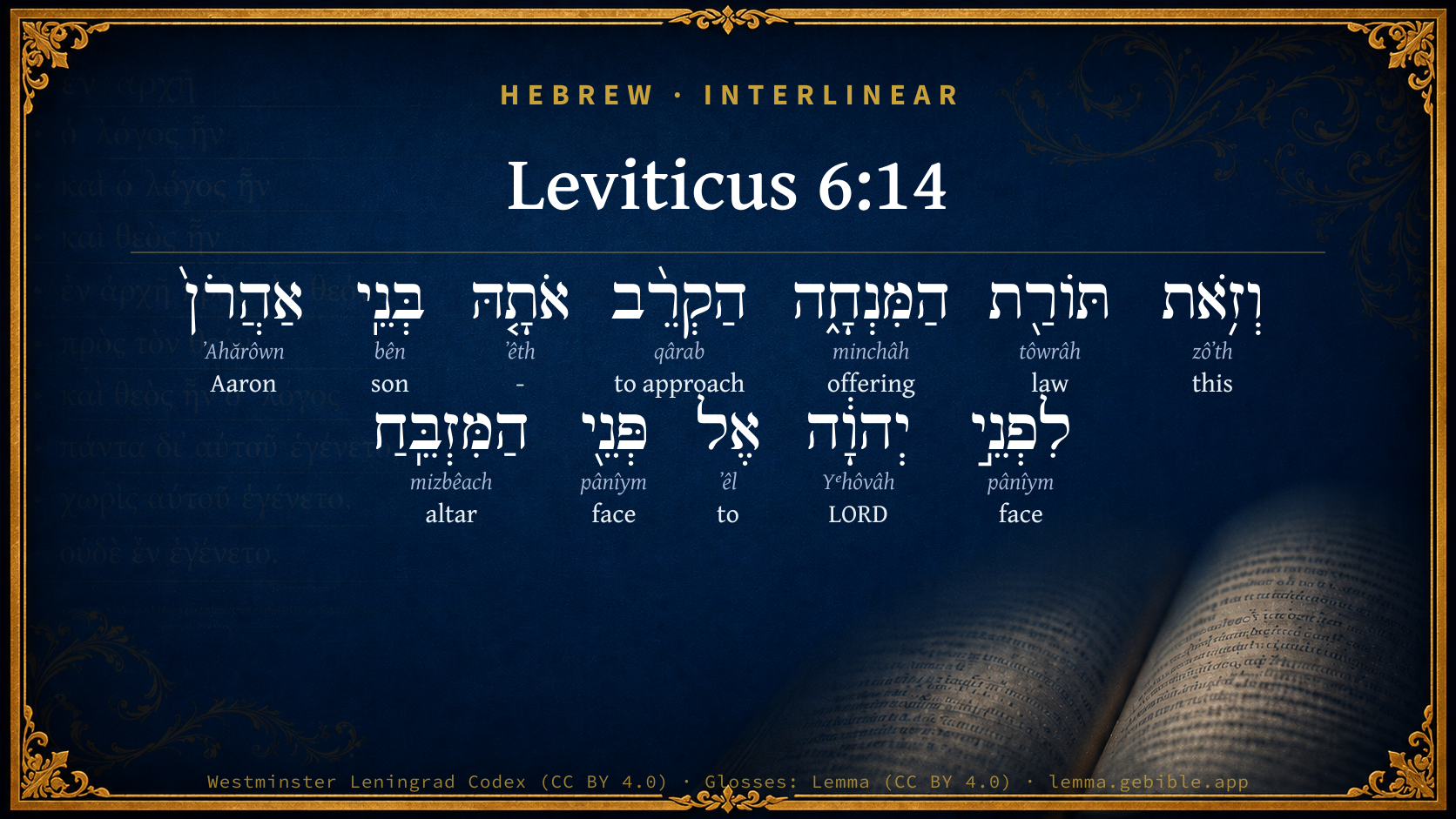
Hebrew (Westminster Leningrad Codex) Leviticus 6:14 appears in the Hebrew Old Testament. The text above is from the Westminster Leningrad Codex. Each word links to its Strong’s number, a concise gloss, and parsing drawn from the Open Scriptures Hebrew Bible morphology. Click any word for its full Brown-Driver-Briggs (BDB) entry.
Download image
Cite this verse

Leviticus 6:14 (World English Bible). Public Domain. Lemma interlinear Bible study tool, https://lemma.gebible.app/v/leviticus/6/14.

Show BibTeX & RIS
BibTeX
RIS
English Translation
"'This is the law of the meal offering: the sons of Aaron shall offer it before Yahweh, before the altar.
World English Bible · Public Domain
Download a study sheet

One document with this verse’s original text, its word-by-word gloss line, the meaning frame, cross-references with their text, attributed commentary, and full source and license credits — printable, and it pastes into notes with its structure intact.

This verse Autodidact and up

Study sheet (.html) Plain text (.txt)

A passage Seminary Student

Up to 50 verses in one chapter. A passage sheet keeps up to 6 commentary sources and 12 cross-references per verse, in the order this page ranks them, and says so on the sheet whenever that leaves anything out. Ask for a single verse and you get the Autodidact verse sheet above.

Everything on this page stays free to read, with no account — the sheet is a download of what is already on screen, not access to it.

Want to remove ads? Support Godless Engineer
Compare translations 3

The same verse in 3 English versions, stacked beneath the original-language interlinear above. Click any original word for its lexicon entry.

Each is an independent rendering of the whole verse — the interlinear is not word-aligned to these translations.

Highlighted words mark where these versions differ — a whole-verse word diff, not a word-by-word alignment.

  • World English Bible Public Domain
    "'This is the law of the meal offering: the sons of Aaron shall offer it before Yahweh, before the altar.
  • King James Version Public Domain
    And this is the law of the meat offering: the sons of Aaron shall offer it before the LORD, before the altar.
  • unfoldingWord Literal Text CC BY-SA 4.0
    And this the law of the grain offering: Present it, sons of Aaron, to the face of Yahweh, toward the face of the altar.

unfoldingWord Literal Text — © unfoldingWord, licensed CC BY-SA 4.0. Word-aligned USFM3 via Door43 (git.door43.org/unfoldingWord/en_ult).

Versions to compare (up to 4)

3 of 4 selected

Show all 18 translations

Every available English version of this verse, each an independent rendering of the whole verse.

  • World English Bible Public Domain
    "'This is the law of the meal offering: the sons of Aaron shall offer it before Yahweh, before the altar.
  • Berean Standard Bible Public Domain
    Now this is the law of the grain offering: Aaron’s sons shall present it before the LORD in front of the altar.
  • Majority Standard Bible Public Domain
    Now this is the law of the grain offering: Aaron’s sons shall present it before the LORD in front of the altar.
  • King James Version Public Domain
    And this is the law of the meat offering: the sons of Aaron shall offer it before the LORD, before the altar.
  • American Standard Version (1901) Public Domain
    And this is the law of the meal-offering: the sons of Aaron shall offer it before Jehovah, before the altar.
  • Revised Version (1885) Public Domain
    And this is the law of the meal offering: the sons of Aaron shall offer it before the LORD, before the altar.
  • Geneva Bible (1599) Public Domain
    Also this is the lawe of the meate offring, which Aarons sonnes shall offer in the presence of the Lord, before the altar.
  • Douay-Rheims (1899) Public Domain
    This is the law of the sacrifice and libations, which the children of Aaron shall offer before the Lord, and before the altar.
  • Young's Literal Translation Public Domain
    `And this `is' a law of the present: sons of Aaron have brought it near before Jehovah unto the front of the altar,
  • Literal Standard Version CC BY-SA 4.0
    And this [is] a law of the present: sons of Aaron have brought it near before YHWH to the front of the altar,
  • Unlocked Literal Bible CC BY-SA 4.0
    This is the law of the grain offering. The sons of Aaron will offer it before Yahweh before the altar.
  • unfoldingWord Literal Text CC BY-SA 4.0
    And this the law of the grain offering: Present it, sons of Aaron, to the face of Yahweh, toward the face of the altar.
  • Darby Bible Public Domain
    And this is the law of the oblation: [one of] the sons of Aaron shall present it before Jehovah, before the altar.
  • World Messianic Bible Public Domain
    “‘This is the law of the meal offering: the sons of Aaron shall offer it before the LORD, before the altar.
  • Webster's Bible Public Domain
    \\6:21\\In a pan it shall be made with oil; and when it is baked, thou shalt bring it in: and the baked pieces of the meat-offering shalt thou offer for a sweet savor to the LORD.
  • Free Bible Version CC BY-SA 4.0
    These are the regulations for the grain offering: Aaron's sons are to present it before the Lord, in front of the altar.
  • Bible in Basic English Public Domain
    Let it be made with oil on a flat plate; when it is well mixed and cooked, let it be broken and taken in as a meal offering, for a sweet smell to the Lord.
  • JPS Tanakh (1917) Public Domain
    (6-7) And this is the law of the meal-offering: the sons of Aaron shall offer it before the LORD, in front of the altar.

Literal Standard Version (2020), Covenant Press — licensed CC BY-SA 4.0. Text via the HelloAO Bible API (eBible.org). Unlocked Literal Bible (unfoldingWord) — licensed CC BY-SA 4.0. Text via the HelloAO Bible API (eBible.org). unfoldingWord Literal Text — © unfoldingWord, licensed CC BY-SA 4.0. Word-aligned USFM3 via Door43 (git.door43.org/unfoldingWord/en_ult). Free Bible Version, Dr. Jonathan Gallagher — licensed CC BY-SA 4.0. Text via the HelloAO Bible API (eBible.org).

Word by word

More ways to search: Search by grammar → Find every occurrence → Compare this word →

Practice this passage: Drill this verse → Learn its vocabulary →

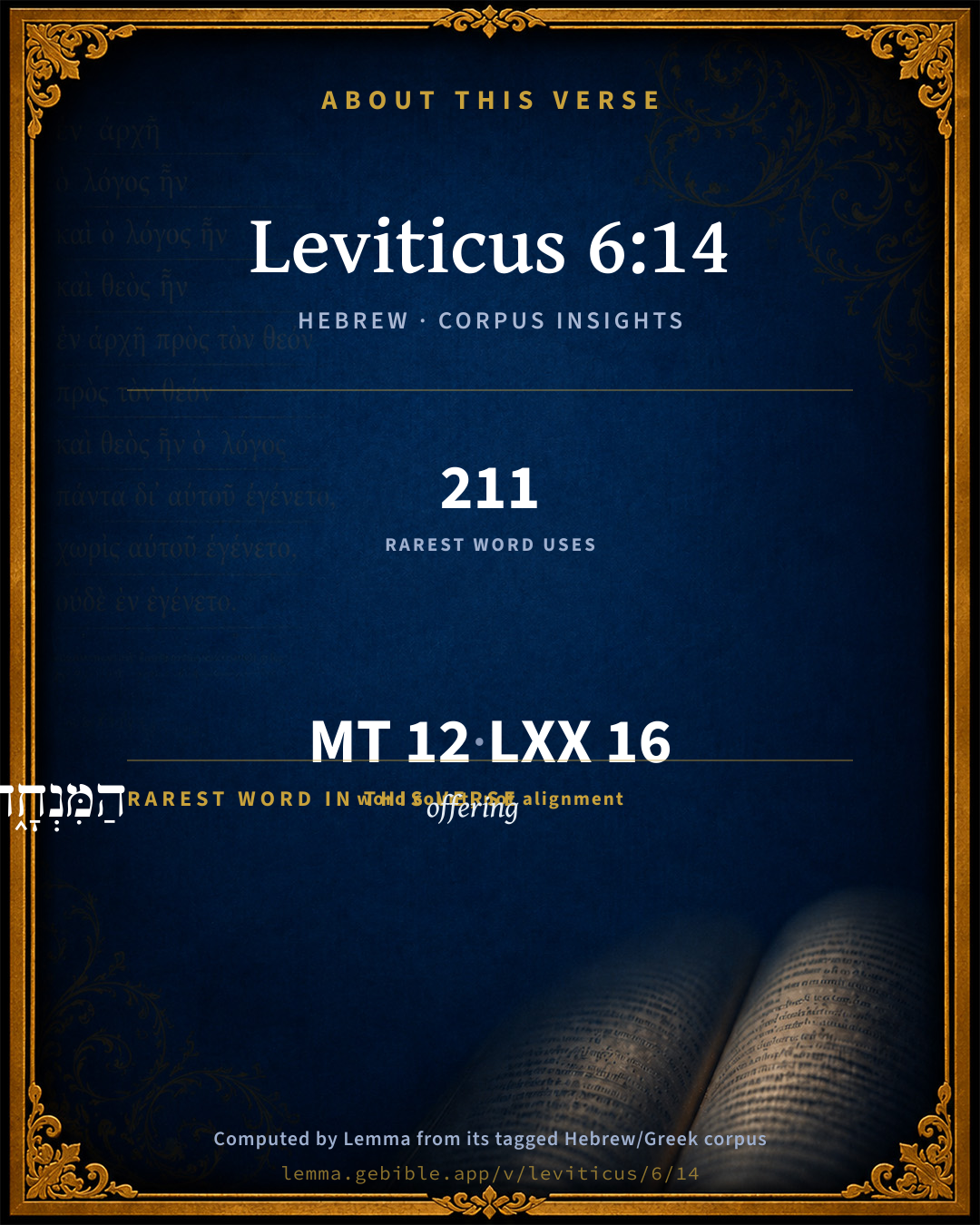
הַמִּנְחָ֑ה
minchâh
H4503
“the · offering”
Particle, Definite Article + Noun, Common, Feminine, Singular, Absolute
Part of Speech
Particle + Noun
Type
Common
Gender
Feminine
Number
Singular
State
Absolute
Full BDB Definition

Origin: from an unused root meaning to apportion, i.e. bestow

TWOT: 1214a

gift, tribute, offering, present, oblation, sacrifice, meat offering - gift, present - tribute - offering (to God) - grain offering
  1. וְזֹ֥את zôʼth H2063 “and · this” Conjunction + Pronoun, Demonstrative, Feminine, Singular
  2. תּוֹרַ֖ת tôwrâh H8451 “law of” Noun, Common, Feminine, Singular, Construct
  3. הַקְרֵ֨ב qârab H7126 “to approach” Verb, Hiphil, Infinitive Absolute
  4. אֹתָ֤הּ ʼêth H853 “- · her” Particle, Direct Object + Suffix, Personal, 3rd Person, Feminine, Singular
  5. בְּנֵֽי bên H1121 “sons of” Noun, Common, Masculine, Plural, Construct
  6. אַהֲרֹן֙ ʼAhărôwn H175 “Aaron” Noun, Proper
  7. לִפְנֵ֣י pânîym H6440 “to/for · face(s) of” Preposition + Noun, Common, Both, Plural, Construct
  8. יְהוָ֔ה Yᵉhôvâh H3068 “LORD” Noun, Proper
  9. אֶל ʼêl H413 “to” Preposition
  10. פְּנֵ֖י pânîym H6440 “face(s) of” Noun, Common, Both, Plural, Construct
  11. הַמִּזְבֵּֽחַ mizbêach H4196 “the · altar” Particle, Definite Article + Noun, Common, Masculine, Singular, Absolute

About this verse

These counts appear in no published source. They are computed here, from the morphology-tagged text and Lemma’s own curated glosses. What Lemma adds →

12
words
11
distinct lemmas
Pentateuch
section

Grammatical profile

  • 1 verb
  • 8 nouns
  • 1 pronoun
  • 1 preposition
  • 1 particle

Verb forms

  • הַקְרֵ֨ב Hiphil · Infinitive Absolute

Repetition

A word recurs within this verse — often emphatic in Hebrew:

  • לִפְנֵ֣י face H6440 ×2

Hebrew & Septuagint length

In English translation the verse runs 20 words from the Hebrew and 21 from the Septuagint (LXX English) — closely comparable.

A rough comparison of the two English renderings, which tokenize alike — not a word-level alignment.

Word counts can differ between the Hebrew and the Greek without any difference in meaning — e.g. the Hebrew direct-object marker אֵת has no separate Greek word, and Greek often adds the article ὁ.

In the original languages it is 12 Hebrew tokens and 16 Greek tokens — but the two are counted differently (Hebrew bundles its prefixes and suffixes into one token; the Greek is in lemma form), so that isn’t a like-for-like length.

Cross-references

5

Topical passages linked to Leviticus 6:14 in the Treasury of Scripture Knowledge — connected by theme and wording, ordered by reader-vote popularity; previews shown in the World English Bible.

  • Leviticus 2:1–2 "'When anyone offers an offering of a meal offering to Yahweh, his offering shall be of fine flour; and he shall pour oil on it, and put frankincense on it.
  • Numbers 15:4 then shall he who offers his offering offer to Yahweh a meal-offering of a tenth part [of an ephah] of fine flour mixed with the fourth part of a hin of oil:
  • John 6:32 Jesus therefore said to them, "Most assuredly, I tell you, it wasn't Moses who gave you the bread out of heaven, but my Father gives you the true bread out of heaven.
  • Numbers 15:6 Or for a ram, you shall prepare for a meal-offering two tenth parts [of an ephah] of fine flour mixed with the third part of a hin of oil:
  • Numbers 15:9 then shall he offer with the bull a meal-offering of three tenth parts [of an ephah] of fine flour mixed with half a hin of oil:

Cross-references courtesy of OpenBible.info (CC BY 4.0).

Hebrew and Greek witnesses Masoretic Hebrew ↔ Greek Septuagint

The same verse in the two great witnesses to the Old Testament, shown verse-for-verse.

These are two independent witnesses, not word-aligned to each other, and the Septuagint is shown in lemma (dictionary) form.

Hebrew Leviticus 6:14 Masoretic · Westminster Leningrad Codex

וְזֹ֥את תּוֹרַ֖ת הַמִּנְחָ֑ה הַקְרֵ֨ב אֹתָ֤הּ בְּנֵֽי אַהֲרֹן֙ לִפְנֵ֣י יְהוָ֔ה אֶל פְּנֵ֖י הַמִּזְבֵּֽחַ

"'This is the law of the meal offering: the sons of Aaron shall offer it before Yahweh, before the altar.

World English Bible · Public Domain

Greek LXX Leviticus 6:14 Septuagint · lemma form

ἐπί τήγανον ἐν ἔλαιον ποιέω φυράω φέρω αὐτός ἑλικτός θυσία ἐκ κλάσμα θυσία ὀσμή εὐωδία κύριος

This is the law of the sacrifice, which the sons of Aaron shall bring near before the Lord, before the altar.

LXX2012 (modern English Septuagint) · Public Domain

On this verse, Keil & Delitzsch discusses the Septuagint’s reading. Read the note in Commentary ↓

Hebrew: Westminster Leningrad Codex (CC BY 4.0). Greek: Septuagint (public domain); English from LXX2012 (modern English Septuagint) (Public Domain). How the Septuagint differs from the Hebrew →

Targum (Aramaic paraphrase)

2

The Targum is the ancient Jewish Aramaic paraphrase of the Hebrew Scriptures — an interpretive translation, not the Hebrew text itself. Onkelos (literal) and Pseudo-Jonathan (expansive) render the Torah, and Jonathan the Prophets. Coverage is partial: where no permissively-licensed English translation exists for a verse, only the Aramaic is shown. This is verse-level text, not a word-by-word alignment to the Hebrew.

  1. Targum Onkelos Torah (Genesis–Deuteronomy)
    עַל מַסְרֵיתָא בִּמְשַׁח תִּתְעֲבֵד רְבִיכָא תַיְתִנַהּ תּוּפִינֵי מִנְחַת בִּצוּעִין תְּקָרֵב לְאִתְקַבָּלָא בְרַעֲוָא קֳדָם יְיָ

    (no public-domain English translation for this verse)

    Targum Onkelos — Aramaic: “Onkelos Genesis” (public domain); “Onkelos Exodus” (public domain); “Onkelos Leviticus” (public domain); “Onkelos Numbers” (public domain); “Onkelos Deuteronomy” (public domain). English: “Sefaria Community Translation” (CC0 1.0 (public-domain dedication)); “J.W. Etheridge. The Targums of Onkelos and Jonathan Ben Uzziel on the Pentateuch. London: Longmans, Green, 1862” (public domain). Text via Sefaria.

  2. Targum Pseudo-Jonathan Torah (Genesis–Deuteronomy)
    עַל מַסְרִיתָא בִּמְשַׁח זֵיתָא פְּתִיכָא תִּתְעֲבֵיד מְטַגְנָא תָּעִיל יָתֵהּ מְרַסְקָא מִנְחַת רִיסוּקוּן תִּקְרַב לְאִתְקַבָּלָא בְּרַעֲוָא קֳדָם יְיָ

    Thou shalt make it upon a pan, mixed with olive oil shalt thou offer it; in divided pieces shalt thou offer the mincha, to be received with acceptance before the Lord,

    Targum Pseudo-Jonathan — Aramaic: “Targum Jonathan on Genesis” (public domain); “Targum Jonathan on Exodus” (public domain); “Targum Jonathan on Leviticus” (public domain); “Targum Jonathan on Numbers” (public domain); “Targum Jonathan on Deuteronomy” (public domain). English: “The Targum of Jonathan ben Uzziel, trans. J. W. Etheridge, London, 1862” (public domain). Text via Sefaria.

Commentary

Notes on Leviticus 6:14 from classic Christian and Jewish commentators (each source and its license shown beneath its notes). The classic Christian expositions comment on the surrounding passage and are grouped to its opening verse, so a note may address several verses; the Jewish commentaries on the Tanakh (Rashi and others) are per-verse, so they appear only where the commentator wrote on this verse.

Lemma curates 59 commentaries, every one of them public domain or Creative Commons licensed, each selected and text-cleaned for this edition rather than reprinted as found. About our sources →

Jamieson, Fausset & Brown

Robert Jamieson, A. R. Fausset & David Brown

THE LAW OF THE MEAT OFFERING. (Lev 6:14-18)

this is the law of the meat offering--Though this was a provision for the priests and their families, it was to be regarded as "most holy"; and the way in which it was prepared was: on any meat offerings being presented, the priest carried them to the altar, and taking a handful from each of them as an oblation, he salted and burnt it on the altar; the residue became the property of the priests, and was the food of those whose duty it was to attend on the service. They themselves as well as the vessels from which they ate were typically holy, and they were not at liberty to partake of the meat offering while they labored under any ceremonial defilement.

Jamieson, Fausset & Brown — Commentary Critical and Explanatory on the Whole Bible (1871) — public domain (CC PDM 1.0). Text via the HelloAO Bible API.

Ellicott's Commentary for English Readers

(14) And this is the law of the meat offering.—In Lev_2:1-3, where this meat offering is spoken of, the people are told of what the mincha is to consist, and what portion of it was the perquisite of the officiating priest. In the section before us (Lev_6:14-18) additional directions are given to the priests about the eating of the portions which belong to them and about the treatment of the residue.

The sons of Aaron shall offer it.—Though in the chapter before us it literally means Aaron’s own sons, the phrase is intended to comprise his lineal descendants who succeeded to the priestly office. They, and they only, shall offer the sacrifices, but not a layman.

Before the altar.—Or, in or at the fore part of the altar. That is, at the south-easterly corner of the altar. (See Lev_2:8.)

A Bible Commentary for English Readers, edited by Charles John Ellicott (1878–1897) — public domain. Text from a community e-Sword module.

Trapp's Complete Commentary

John Trapp

Lev 6:14 And this [is] the law of the meat offering: the sons of Aaron shall offer it before the LORD, before the altar.

Ver. 14. The law of the meat offering.] Besides what is set down in Lev 2:1-2. Thus one text explains another; as the diamond is brightened with its own dust.

John Trapp, A Commentary or Exposition upon All the Books of the Old and New Testament (1647–1656) — public domain. Text from a community e-Sword module.

Keil & Delitzsch

C. F. Keil & F. Delitzsch

The Law of the Meat-Offering. - The regulations in Lev 6:14, Lev 6:15, are merely a repetition of Lev 2:2 and Lev 2:3; but in Lev 6:16-18 the new instructions are introduced with regard to what was left and had not been burned upon the altar. The priests were to eat this as unleavened, i.e., to bake it without leaven, and to eat it in a holy place, viz., in the court of the tabernacle. תּאכל מצות in Lev 6:16 is explained by "it shall not be baken with leaven" in Lev 6:17. It was the priests' share of the firings of Jehovah (see Lev 1:9), and as such it was most holy (see Lev 2:3), like the sin-offering and trespass-offering (Lev 6:25, Lev 6:26; Lev 7:6), and only to be eaten by the male members of the families of the priests. This was to be maintained as a statute for ever (see at Lev 3:17). Every one that touches them (the most holy offerings) becomes holy." יקדּשׁ does not mean he shall be holy, or shall sanctify himself (lxx, Vulg., Luth., a Lap., etc.), nor he is consecrated to the sanctuary and is to perform service there (Theodor., Knobel, and others). In this provision, which was equally applicable to the sin-offering (Lev 6:27), to the altar of the burnt-offering (Exo 29:37), and to the most holy vessels of the tabernacle (Exo 30:29), the word is not to be interpreted by Num 17:2-3, or Deu 22:9, or by the expression "shall be holy" in Lev 27:10, Lev 27:21, and Num 18:10, but by Isa 65:5, "touch me not, for I am holy." The idea is this, every layman who touched these most holy things became holy through the contact, so that henceforth he had to guard against defilement in the same manner as the sanctified priests (Lev 21:1-8), though without sharing the priestly rights and prerogatives. This necessarily placed him in a position which would involve many inconveniences in connection with ordinary life.

Keil & Delitzsch — Biblical Commentary on the Old Testament (1861–1891) — public domain (CC PDM 1.0). Text via the HelloAO Bible API. (Old Testament only.)

The Expositor's Bible

THE DAILY MEAL OFFERING

Lev_6:14-23

"And this is the law of the meal offering: the sons of Aaron shall offer it before the Lord, before the altar. And he shall take up therefrom his handful, of the fine flour of the meal offering and of the oil thereof, and all the frankincense which is upon the meal offering, and shall burn it upon the altar for a sweet savour, as the memorial thereof, unto the Lord. And that which is left thereof shall Aaron and his sons eat: it shall be eaten without leaven in a holy place: in the court of the tent of meeting they shall eat it. It shall not be baken with leaven. I have given it as their portion of My offerings made by fire; it is most holy, as the sin offering, and as the guilt offering. Every male among the children of Aaron shall eat of it, as a due forever throughout your generations, from the offerings of the Lord made by fire: whosoever toucheth them shall be holy. And the Lord spake unto Moses, saying, This is the oblation of Aaron and of his sons, which they shall offer unto the Lord in the day when he is anointed; the tenth part of an ephah of fine flour for a meal offering perpetually, half of it in the morning, and half thereof in the evening. On a baking pan it shall be made with oil; when it is soaked, thou shalt bring it in: in baken pieces shalt thou offer the meal offering for a sweet savour unto the Lord. And the anointed priest that shall be in his stead from among his sons shall offer it: by a statute forever it shall be wholly burnt unto the Lord. And every meal offering of the priest shall be wholly burnt: it shall not be eaten."

As there were not only the burnt offerings of the individual Israelite, but also a daily burnt offering, morning and evening, presented by the priest as the representative of the collective nation, so also with the meal offering. The law concerning this daily meal offering is given in Lev_6:19-23. The amount in this case was prescribed, being apparently the amount regarded as a days portion of food-"the tenth part of an ephah of fine flour," half of which was to be offered in the morning and half in the evening, made on a baking pan with oil, "for a sweet savour unto the Lord." Unlike the meal offering of the individual, it is said, "by a statute forever, it shall be wholly burnt unto the Lord Every meal offering of the priest shall be wholly burnt; it shall not be eaten." This single variation from the ordinance of chapter 4 is simply an application of the principle which governs all the sacrifices except the peace offering, that he who offered any sacrifice could never himself eat of it; and as the priest in this case was the offerer, the symbolism required that he should himself have nothing of the offering, as being wholly given by him to the Lord. And this meal offering was to be presented, not merely, as some have inferred from Lev_6:20, on the day of the anointing of the high priest, but, as is expressly said, "perpetually."

The typical meaning of the meal offering, and, in particular, of this daily meal offering, which, as we learn from Exodus 30, was offered with the daily burnt offering, is very clear. Every meal offering pointed to Christ in His consecration of all His works to the Father. And as the daily burnt offering presented by Aaron and his sons typified our heavenly High Priest as offering His person in daily consecration unto God in our behalf, so, in the daily meal offering, wholly burnt upon the altar, we see Him in like manner offering unto God in perfect consecration, day by day, perpetually, all His works for our acceptance. To the believer, often sorely oppressed with the sense of the imperfection of his own consecration of his daily works, in that because of this the Father is not glorified by him as He should be, how exceedingly comforting this view of Christy For that which, at the best, we do so imperfectly and interruptedly, He does in our behalf perfectly, and with never-failing constancy; thus at once perfectly glorifying the Father, and also, through the virtue of the boundless merit of this consecration, constantly procuring for us daily grace unto the life eternal.

William Robertson Nicoll, ed., The Expositor's Bible (London: Hodder & Stoughton, 1887–1910) — public domain. 65 of 66 books (1 Corinthians is not separately keyed, as that volume carries no machine-parseable verse references); section-level commentary keyed to the opening verse. Introductory and overview sections not keyed to a specific passage are excluded.

Matthew Henry's Commentary

The meat-offering was either that which was offered by the people or that by the priests at their consecration. Now,

I. As to the common meat-offering,

1. Only a handful of it was to be burnt upon the altar; all the rest was allowed to the priests for their food. The law of the burnt-offerings was such as imposed upon the priests a great deal of care and work, but allowed them little profit; for the flesh was wholly burnt, and the priests had nothing but the skin. But to make them amends the greatest part of the meat-offering was their own. The burning of a handful of it upon the altar (Lev 6:15) was ordered before, Lev 2:2, Lev 2:9. Here the remainder of it is consigned to the priests, the servants of God's house: I have given it unto them for their portion of my offerings, Lev 6:17. Note, (1.) It is the will of God that his ministers should be well provided for with food convenient; and what is given to them he accepts as offered to himself, if it be done with a single eye. (2.) All Christians, being spiritual priests, do themselves share in the spiritual sacrifices they offer. It is not God that is the gainer by them; the handful burnt upon the altar was not worth speaking of, in comparison with the priests' share; we ourselves are the gainers by our religious services. Let God have all the frankincense, and the priests shall have the flour and the oil; what we give to God the praise and glory of we may take to ourselves the comfort and benefit of.

2. The laws concerning the eating of it were, (1.) That it must be eaten unleavened, Lev 6:16. What was offered to God must have no leaven in it, and the priests must have it as the altar had it, and no otherwise. Thus must we keep the feasts of the Lord with the unleavened bread of sincerity and truth. (2.) It must be eaten in the court of the tabernacle (here called the holy place), in some room prepared by the side of the court for this purpose. It was a great crime to carry any of it out of the court. The very eating of it was a sacred rite, by which they were to honour God, and therefore it must be done in a religious manner, and with a holy reverence, which was preserved by confining it to the holy place. (3.) The males only must eat of it, Lev 6:18. Of the less holy things, as the first-fruits and tithes, and the shoulder and breasts of the peace-offerings, the daughters of the priests might eat, for they might be carried out of the court; but this was of the most holy things, which being to be eaten only in the tabernacle, the sons of Aaron only might eat of it. (4.) The priests only that were clean might eat of it: Every one that toucheth them shall be holy, Lev 6:18. Holy things for holy persons. Some read it, Every thing that toucheth it shall be holy: Al the furniture of the table on which these holy things were eaten must be appropriated to that use only, and never after used as common things.

II. As to the consecration meat-offering, which was offered for the priests themselves, it was to be wholly burnt, and none of it eaten, Lev 6:23. It comes in here as an exception to the foregoing law. It should seem that this law concerning the meat-offering of initiation did not only oblige the high priest to offer it, and on that day only that he was anointed, and so for his successors in the day they were anointed; but the Jewish writers say that by this law every priest, on the day he first entered upon his ministry, was bound to offer this meat-offering, - that the high priest was bound to offer it every day of his life, from the day in which he was anointed, - and that it was to be offered besides the meat-offering that attended the morning and evening sacrifice, because it is said here to be a meat-offering perpetual, Lev 6:20. Josephus says, "The high priest sacrificed twice every day at his own charges, and this was his sacrifice." Note, Those whom God has advanced above others in dignity and power ought to consider that he expects more from them than from others, and should attend to every intimation of service to be done for him. The meat-offering of the priest was to be baked as if it were to be eaten, and yet it must be wholly burnt. Though the priest that ministered was to be paid for serving the people, yet there was no reason that he should be paid for serving the high priest, who was the father of the family of the priests, and whom therefore any priest should take a pleasure in serving gratis. Nor was it fit that the priests should eat of the offerings of a priest; for as the sins of the people were typically transferred to the priests, which was signified by their eating of their offerings (Hos 4:8), so the sins of the priests must be typically transferred to the altar, which therefore must eat up all their offerings. We are all undone, both ministers and people, if we must bear our own iniquity; nor could we have had any comfort or hope if God had not laid on his dear Son the iniquity of us all, and he is both the priest and the alter.

Matthew Henry's Commentary on the Whole Bible (1708–1710) — public domain (CC PDM 1.0). Text via the HelloAO Bible API.

Adam Clarke's Commentary

Verse 14. The meat-offering] See Clarke on Le 2:1, &c.

Adam Clarke's Commentary on the Bible (1810–1826) — public domain. Text from a community e-Sword/MySword module.

The Cambridge Bible for Schools and Colleges

gen. ed. J. J. S. Perowne

(2) The Meal-Offering (14–18)

The injunctions of Lev_2:2-3 are repeated, almost in the same words in Lev_6:15-16 (as far as ‘his sons eat’): in what follows, the place of eating is fixed—the court of the tent of meeting. In Lev_6:17 note the use of the first person, and the reference to the Sin-Offering and Guilt-Offering.

The Meal-Offering was ‘most holy,’ and could be eaten only by the male descendants of Aaron.

The Cambridge Bible for Schools and Colleges (gen. ed. J. J. S. Perowne; Cambridge University Press, 1878–1918) — public domain. Text from a community e-Sword module.

John Gill's Exposition

And this is the law of the meat offering,.... Or the rules to be observed concerning that, for which, though directions are given, Lev 2:1, &c. yet is here repeated with some additions to it:

the sons of Aaron shall offer it before the Lord; being brought unto them by the children of Israel:

before the altar; or at the face of it, for what was properly offered was burnt upon it, as in the following verse Lev 6:15, for it should be rather rendered "in", or "on the altar" (n); the face of it is the top of it, on which every sacrifice was offered, and not before it.

(n) "in altari", Noldius, p. 82. No. 391.

John Gill's Exposition of the Whole Bible (1746–1763) — public domain (CC PDM 1.0). Text via the HelloAO Bible API.

Albert Barnes' Notes on the Bible

See Lev 2:1-10; Exo 29:40-41.

Lev 6:16

With unleavened bread shall it be eaten - This should be, it (the remainder) shall be eaten unleavened.

Albert Barnes' Notes on the Bible (1834–1885) — public domain. Text from a community e-Sword/MySword module.

Haydock's Catholic Bible Commentary

Sacrifice of flour, monee, chap. ii. 1. --- And libations. These words are added, to shew that oil and wine accompanied this sacrifice.

George Leo Haydock (1774–1849), Haydock's Catholic Family Bible and Commentary, 1859 edition — public domain. Excludes Psalms (Douay-Rheims chapter numbering differs from Protestant) and Deuterocanonical books (Catholic canon only).

Matthew Poole's English Annotations

The law of the meat-offering, to wit, of that which was offered alone, and that by any of the people, not by the priest, for then it must have been all burnt. This law, delivered Le 2, is here repeated for the sake of some additions here made to it; as it is a common practice of law-makers, when they make additional laws, to recite such laws to which such additions belong.

Matthew Poole's English Annotations on the Holy Bible (1683–1685) — public domain. Text from a community e-Sword/MySword module.

Whedon's Commentary on the Bible

Daniel D. Whedon

14. The meat offering — See Lev_2:1, note.

Daniel D. Whedon (gen. ed.), Commentary on the Old and New Testaments (1874–1909) — public domain. Text from a community e-Sword module.

The Pulpit Commentary

Vers. 14-18. The further ritual of the meat offering. (see note on Lev_2:1) The greater part of it is to be given to the priests, and they and the males of their families are to eat it without adding leaven to it. With unleavened bread shall it be eaten (verse 16) should rather be rendered, Unleavened shall it be eaten. Not only is it most holy itself, but every one (or rather everything) that toucheth the offerings shall be holy. The touch of the offering conveys the character of holiness to the thing touched, which must, therefore, itself be treated as holy.

Vers. 14-23. The law of the meat offering.

As the law of the burnt offering, laid down in the preceding paragraph, viz. in relation to the service of the priest, was before mentioned, more particularly in respect to the offerer, so is the law of the meat, or more properly the bread, offering, here introduced for a similar reason, after being formerly mentioned likewise (see chapter 2). The subject is presented in two aspects, and we have to consider

I THE LAW OF THE BREAD OFFERING OF THE PEOPLE, In this case:

1. A memorial of it was burnt upon the altar.

(1) The memorial represented the whole. The bulk consisted of at least an omer, or about three of our quarts, of fine flour, of which a handful was taken for the memorial. There was with the omer of flour, a log, or little more than a half pint, of oil, of which a fitting quantity was added to the handful of flour. The memorial was completed by the addition of all the frankincense. As the name of a thing stands for the thing, so did the memorial stand for the whole offering; it was like a quit rent, a discharge for all demands on the estate.

(2) It was burnt upon the altar for a sweet savour unto the Lord. It could not be that to him in a physical sense; this expression must be morally interpreted.

(a) It was a thank offering, and gratitude from his intelligent offspring is ever pleasing to his goodness. (Psa_27:6 Rom_12:1 1Th_5:18)

(b) It was placed on the altar of burnt offerings, and mingled among the sacrifices offered, to make atonement for sin, and so, coming up as it were "through Jesus Christ" in whom the Father is ever well pleased, it becomes "acceptable". (1Pe_2:5)

2. The remainder was eaten by Aaron and his sons.

(1) Aaron ate of it, who was the type of Christ; and his sons also, who were types of Christians. So Jesus and his disciples together ate the Passover. (Luk_22:15) And he gave to his disciples the bread and wine of his Eucharist.

(2) The bread offering, was to be eaten without leaven. This substance was regarded as an emblem of evil dispositions, malice, wickedness, insincerity. (1Co_5:6-8) These must be absent from those who feast with Jesus.

(3) It was to be eaten in the holy place. This holy place was not the innermost court, which was a type of "heaven itself". (Heb_9:24) It is explained to be the "court of the tabernacle of the congregation," which was a figure of the Church in its earthly aspect the kingdom of heaven upon earth. Those who elect to worship God outside his Church, are not following out his instructions.

(4) The males only must eat of it. The daughters of the priests were permitted to eat of the "holy things," such as might be carried out of the court, such as the tithes and firstfruits, and the shoulder and breast of the peace offerings. But of the "most holy things" eaten in the sanctuary they may not eat. It was the Seed of the woman who is most holy, not the woman herself; the son, not the daughter, therefore, was holy unto God. Now that most holy Seed has come, the distinction between male and female is abolished. (Gal_3:28)

(5) The priest must not eat it unless he be clean. "Every one that toucheth it shall be holy" (verse 18). To eat and drink unworthily of the Christian Eucharist is a serious thing. (see 1Co_11:27-34)

II THE LAW OF THE BREAD OFFERING OF THE PRIESTS. In this case:

1. The whole was offered upon the altar.

(1) Here was no "memorial," as in the offering of the people. The omer of fine flour was all burnt upon the altar (verse 23). "Had the priests been permitted to live on their own offerings, as they did on those of the people, it would have been as if they had offered nothing, as they would have taken again to themselves what they appeared to give unto the Lord" (A. Clarke).

(2) It was offered in two portions: half in the morning, and the complement at night (verse 20). And as it is called a "meat offering perpetual," it is generally understood that the high priest repeated this offering daily throughout his pontificate.

(3) This he appears to have done not for himself only, but on behalf of the priesthood in general. This seems expressed in the words, "This is the offering of Aaron and of his sons, which they shall offer unto the Lord in the day when he is anointed," etc. (verse 20). Here "they" offer it; but afterwards we read, "And the priest of his sons that is anointed in his stead," viz. as high priest at his demise, "shall offer it" (verse 22). Taken together, these passages show that the high priest offered it for the priesthood in general.

2. None of it was to be eaten by the priests.

(1) It appears to have been of the nature of the sin offering; for there is no frankincense offered with it. This was the case with the poor man"s sin offering. (see Lev_5:11) In sin there is nothing grateful to God.

(2) By his eating of the sin offerings, the typical transfer of the sins of the people to the priest was signified. (see Lev_10:17) It would not be proper, therefore, for him to eat the sin offering in which he was personally concerned. He must rather see his sin transferred to the altar, and there consumed along with the lamb of the daily sacrifice. So may we see our sins consumed. J.A.M.

Vers. 14-18. "Fellowship with the Father.

In these renewed directions (see chapter 2) concerning the meat offering, we have the striking expression, "I have given it unto them for their portion of my offerings" (verse 17). So that this sacrifice, beside furnishing an opportunity to the people of acknowledging their indebtedness to God as the generous Giver of all blessings, provided an opportunity to the priests of fellowship with God, He shared these "his offerings" with his ministers, and they ate with him "in the holy place" (verse 16), within the precincts of his house. "And truly our fellowship is with the Father, and with his Son Jesus Christ". (1Jn_1:3) In Divine and human fellowship under the gospel, there is

I FEASTING TOGETHER. The truest Christian counterpart of the sacred service described in the text is found in the Lord"s Supper, There we, who arc all "priests unto God", (Rev_1:6 1Pe_2:5, 1Pe_2:9) meet at the table of the Lord, (1Co_10:21) and eat and drink in his presence, rejoicing in his redeeming love, renewing before him our vows.

II SPEAKING ONE TO ANOTHER.

1. God to man in

a. the pages of revelation;

b. the words of those whom his Spirit prompts to remind us of his will or to explain it;

c. the direct communications of his Spirit,

2. Man to God in

a. the accents of praise;

b. the breath of supplication.

III REJOICING IN ONE ANOTHER.

1. God in man . (Deu_32:9 Psa_35:27 Psa_147:11 Hab_3:18 Eph_5:27 Rev_21:2)

2. Man in God . (Psa_16:5 Psa_89:16 Psa_149:2 Php_3:3 4:4)

IV WORKING TOGETHER. We are "workers together with him"; (2Co_6:1) "labourers together with God". (1Co_3:9) While God is working in us and through us, he is also working with us; united with us in working out the reconciliation and regeneration of the world. C.

Vers. 14-18. Meat offering.

"All the males of the sons of Aaron shall eat of it," with unleavened bread, in the court of the tabernacle of the congregation. "It is most holy, as is the sin offering, and as the trespass offering." "Every one that toucheth them shall be holy.

I THE MINISTRY OF RELIGION SHOULD BE FULFILLED IN THE SPIRIT OF THANKFUL DEVOTION.

1. The best of the Church should be consecrated to its highest positions.

2. Their service should be rendered as a delight.

3. Their religious earnestness and cheerfulness should be cultivated by fellowship and brotherhood.

4. They should be closely united with the people, not separated from them by spiritual pride and a misanthropic asceticism.

II HOLINESS THE IMPERATIVE REQUIREMENT OF GOD"S MINISTERS. Not mere ceremonial holiness.

1. Holiness of character and life.

2. Holiness in the service of the sanctuary purity of worship, singleness of heart, orderliness and decency, with simplicity and manifest sincerity.

III THE SANCTIFYING INFLUENCE OF A TRUE AND PURE WORSHIP EXTENDS THROUGH SOCIETY. Every one holy by contact with the holy.

1. The persuasive effect of a real and well-sustained religious service. The common mistake is to suppose that morality leads of itself to religion or may be substituted for it.

2. The true order of life is set before us here in the Law of Moses: the nearer to God, the holier; the more closely connected with the worship of God, the more separated from and defended against the impurities of the world.

3. The reaction of the holy life on the sanctuary. The revival of religion must be a reciprocal action of the Church on the ministry, and of the ministry on the Church. R.

The Pulpit Commentary (1880–1919), ed. H.D.M. Spence-Jones & Joseph S. Exell — public domain. Text from a community e-Sword module.

John Wesley's Explanatory Notes

Of the meal-offering - Of that which was offered alone, and that by any of the people, not by the priest, for then it must have been all burnt. This law before delivered, is here repeated for the sake of some additions made to it.

John Wesley, Explanatory Notes Upon the Whole Bible (1754–1765) — public domain. Text via the GEBible commentary corpus.

Kretzmann's Popular Commentary

Paul E. Kretzmann

Of Meat-offerings.

v. 14. And this is the law of the meat-offering, as far as the priests were concerned: The sons of Aaron shall offer it before the Lord, before the altar. Cf Lev 2:2-8.

v. 15. And he, the officiating priest, shall take of it his handful, of the flour of the meat-offering, as much as his hand would hold, and of the oil thereof, and all the frankincense which is upon the meat-offering, and shall burn it upon the altar, of burnt offering, for a sweet savor, even the memorial of it, unto the Lord.

v. 16. And the remainder thereof shall Aaron and his sons eat, this ordinance being an addition to the directions which had been given before; with unleavened bread, or as unleavened bread, shall it be eaten in the Holy Place, no leaven or yeast being permitted in the preparation of this bread; in the court of the Tabernacle of the Congregation they shall eat it, where they were stationed when on duty.

v. 17. It shall not be baken with leaven. I have given it unto them for their portion of My offerings made by fire; it is most holy, as is the sin-offering and as the trespass-offering. The entire offering was consecrated to the Lord, and He chose to give the greater portion of it to the priests for their maintenance.

v. 18. All the males among the children of Aaron shall eat of it, even such as were too young or too old to be actively engaged in the priestly functions. It shall be a statute forever in your generations concerning the offerings of the Lord made by fire; every one that toucheth them shall be holy. Only those that were set apart for the service of the Lord were permitted to partake of them, and any layman that touched them henceforth had the duty to keep himself from all uncleanness, just like the priests themselves. All Christians are priests of the most holy God and will therefore guard against defilement of every kind.

Paul E. Kretzmann, Popular Commentary of the Bible (1921–1924) — public domain. Text from a community e-Sword module.

unfoldingWord translationNotes

Door43 World Missions Community

to produce a sweet aroma

Yahweh being pleased with the sincere worshiper who offered the sacrifice is spoken of as if God were pleased with the aroma of the sacrifice. See how you translated a similar phrase in Leviticus 1:9. (See: Metaphor)

a representative offering

The handful of the grain offering represents the whole grain offering. This means the whole offering belongs to Yahweh. See how you translated this in Leviticus 2:2.

translationWords

law, laws

grain offering

Aaron

Yahweh

altar

priest

oil

incense

unfoldingWord translationNotes — © Distant Shores Media and the Door43 World Missions Community, licensed CC BY-SA 4.0. Source: git.door43.org/Door43/en_tn.

Rashi

Rabbi Shlomo Yitzchaki (Rashi)

מרבכת means, scalded with hot oil to saturation (cf. Sifra, Tzav, Chapter 4 6).

תפיני means, many times baken: after it has been scalded he bakes it in the oven and then again fries it in a pan (cf. Menachot 50b).

מנחת פתים THE BROKEN PIECES — This teaches that it requires breaking into pieces (cf. Sifra, Tzav, Chapter 4 6; Menachot 75b).

Rashi on the Tanakh — English translations: “The Judaica Press complete Tanach with Rashi, translated by A. J. Rosenberg” (CC BY 4.0); “Pentateuch with Rashi's commentary by M. Rosenbaum and A.M. Silbermann, 1929-1934” (public domain); “The Metsudah Tanach series, Lakewood, N.J” (CC BY 4.0); and “The Book of Joshua, Metsudah Publications, 1997” (CC BY 4.0). Text via Sefaria.

Lesson kit

Teaching starters — assembled from the data on this page, not authored interpretation. Every prompt links to the verse data it draws on. Edit before teaching.

Leviticus, in the Pentateuch, opens this verse with 12 words (11 distinct Hebrew lemmas). Its most distinctive word is minchâh (“offering”). A historical commentator’s framing appears above. Read the whole chapter for the surrounding context.

Discussion questions

  1. How does “offering” (minchâh) shape what this verse is saying?
  2. How does Leviticus 2:1–2, which shares this passage’s theme, read alongside this verse?
  3. What does the repetition of “face” (2× in this one verse) do in this verse?
  4. The translations on this page render this verse differently — a whole-verse word diff, not a word-by-word alignment. What might account for the different wordings?
  5. «הַקְרֵ֨ב» is a Hiphil Infinitive Absolute verb. How does that grammatical form shape the action described?
  6. Compare how Jamieson, Fausset & Brown and Ellicott's Commentary for English Readers read this verse. Where do they agree or differ?

Things to notice

Reading settings

Reading text

Shown beneath each verse's original-language words.

Old Testament
Old Testament edition

Read the OT as the Masoretic Hebrew (MT) or the Greek Septuagint (LXX).

English shown for the Greek Septuagint (in the Hebrew ↔ Greek comparison).

Comparing translations? Open the Compare panel on any verse page to stack up to four side by side.