
Genesis 28:15

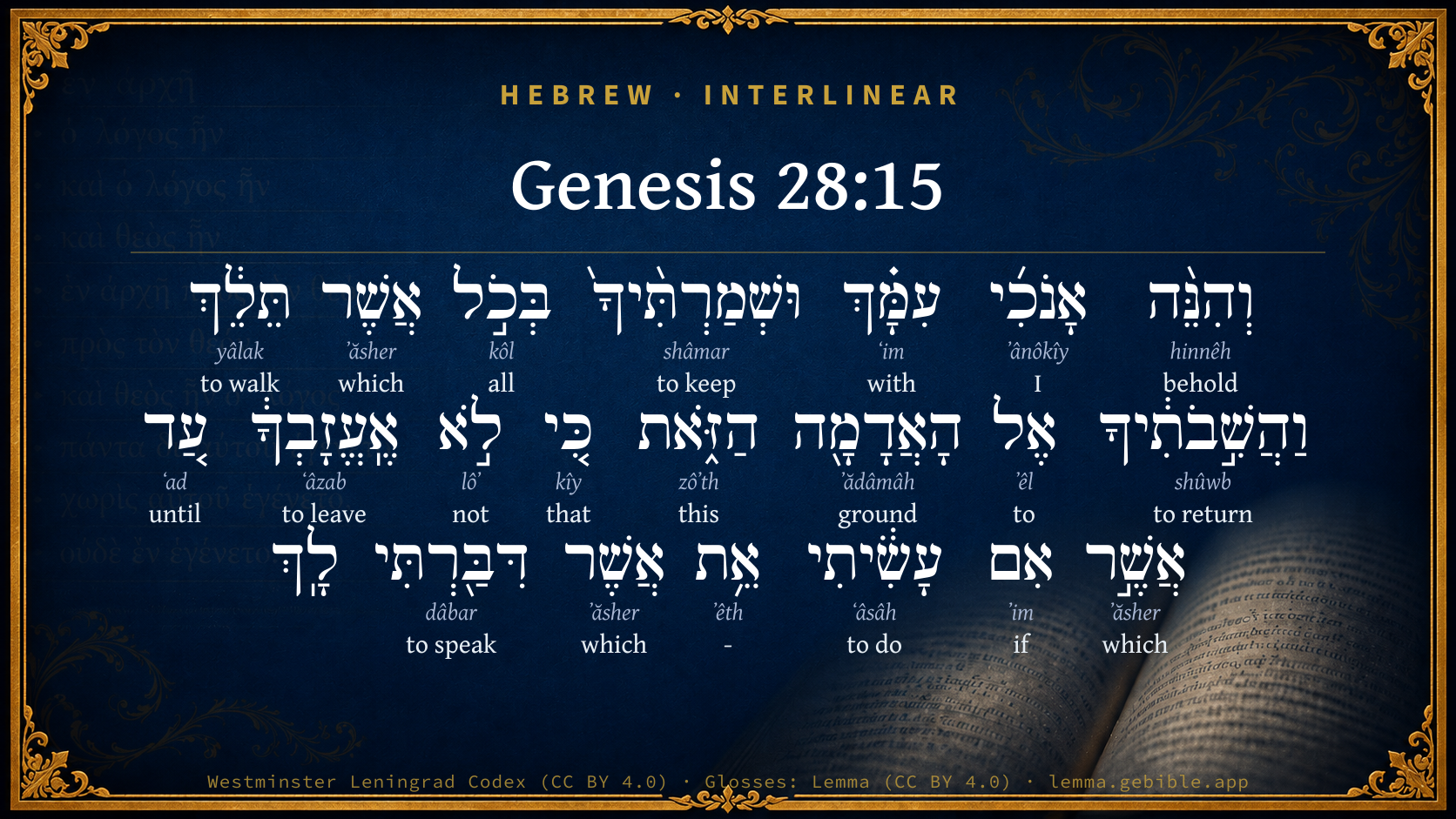
Hebrew (Westminster Leningrad Codex) Genesis 28:15 appears in the Hebrew Old Testament. The text above is from the Westminster Leningrad Codex. Each word links to its Strong’s number, a concise gloss, and parsing drawn from the Open Scriptures Hebrew Bible morphology. Click any word for its full Brown-Driver-Briggs (BDB) entry.
Download image
Cite this verse

Genesis 28:15 (World English Bible). Public Domain. Lemma interlinear Bible study tool, https://lemma.gebible.app/v/genesis/28/15.

Show BibTeX & RIS
BibTeX
RIS
English Translation
Behold, I am with you, and will keep you, wherever you go, and will bring you again into this land. For I will not leave you, until I have done that which I have spoken of to you."
World English Bible · Public Domain
Download a study sheet

One document with this verse’s original text, its word-by-word gloss line, the meaning frame, cross-references with their text, attributed commentary, and full source and license credits — printable, and it pastes into notes with its structure intact.

This verse Autodidact and up

Study sheet (.html) Plain text (.txt)

A passage Seminary Student

Up to 50 verses in one chapter. A passage sheet keeps up to 6 commentary sources and 12 cross-references per verse, in the order this page ranks them, and says so on the sheet whenever that leaves anything out. Ask for a single verse and you get the Autodidact verse sheet above.

Everything on this page stays free to read, with no account — the sheet is a download of what is already on screen, not access to it.

Want to remove ads? Support Godless Engineer
Compare translations 3

The same verse in 3 English versions, stacked beneath the original-language interlinear above. Click any original word for its lexicon entry.

Each is an independent rendering of the whole verse — the interlinear is not word-aligned to these translations.

Highlighted words mark where these versions differ — a whole-verse word diff, not a word-by-word alignment.

  • World English Bible Public Domain
    Behold, I am with you, and will keep you, wherever you go, and will bring you again into this land. For I will not leave you, until I have done that which I have spoken of to you."
  • King James Version Public Domain
    And, behold, I am with thee, and will keep thee in all places whither thou goest, and will bring thee again into this land; for I will not leave thee, until I have done that which I have spoken to thee of.
  • unfoldingWord Literal Text CC BY-SA 4.0
    And behold, I with you, and I will watch over you in every that you go, and I will bring you back to this land. For I will not leave you until I have done what I have spoken to you.”

unfoldingWord Literal Text — © unfoldingWord, licensed CC BY-SA 4.0. Word-aligned USFM3 via Door43 (git.door43.org/unfoldingWord/en_ult).

Versions to compare (up to 4)

3 of 4 selected

Show all 18 translations

Every available English version of this verse, each an independent rendering of the whole verse.

  • World English Bible Public Domain
    Behold, I am with you, and will keep you, wherever you go, and will bring you again into this land. For I will not leave you, until I have done that which I have spoken of to you."
  • Berean Standard Bible Public Domain
    Look, I am with you, and I will watch over you wherever you go, and I will bring you back to this land. For I will not leave you until I have done what I have promised you.”
  • Majority Standard Bible Public Domain
    Look, I am with you, and I will watch over you wherever you go, and I will bring you back to this land. For I will not leave you until I have done what I have promised you.”
  • King James Version Public Domain
    And, behold, I am with thee, and will keep thee in all places whither thou goest, and will bring thee again into this land; for I will not leave thee, until I have done that which I have spoken to thee of.
  • American Standard Version (1901) Public Domain
    And, behold, I am with thee, and will keep thee, whithersoever thou goest, and will bring thee again into this land. For I will not leave thee, until I have done that which I have spoken to thee of.
  • Revised Version (1885) Public Domain
    And, behold, I am with thee, and will keep thee whithersoever thou goest, and will bring thee again into this land; for I will not leave thee, until I have done that which I have spoken to thee of.
  • Geneva Bible (1599) Public Domain
    And lo, I am with thee, and wil keepe thee whithersoeuer thou goest, and will bring thee againe into this lande: for I will not forsake thee vntill I haue performed that, that I haue promised thee.
  • Douay-Rheims (1899) Public Domain
    And I will be thy keeper whithersoever thou goest, and will bring thee back into this land: neither will I leave thee, till I shall have accomplished all that I have said.
  • Young's Literal Translation Public Domain
    `And lo, I `am' with thee, and have kept thee whithersoever thou goest, and have caused thee to turn back unto this ground; for I leave thee not till that I have surely done that which I have spoken to thee.'
  • Literal Standard Version CC BY-SA 4.0
    And behold, I [am] with you, and have kept you wherever you go, and have caused you to return to this ground; for I do not leave you until I have surely done that which I have spoken to you.”
  • Unlocked Literal Bible CC BY-SA 4.0
    Behold, I am with you, and I will keep you wherever you go. I will bring you into this land again; for I will not leave you. I will do all that I have promised to you.”
  • unfoldingWord Literal Text CC BY-SA 4.0
    And behold, I with you, and I will watch over you in every that you go, and I will bring you back to this land. For I will not leave you until I have done what I have spoken to you.”
  • Darby Bible Public Domain
    And behold, I am with thee, and will keep thee in all [places] to which thou goest, and will bring thee again into this land; for I will not leave thee until I have done what I have spoken to thee of.
  • World Messianic Bible Public Domain
    Behold, I am with you, and will keep you, wherever you go, and will bring you again into this land. For I will not leave you until I have done that which I have spoken of to you.”
  • Webster's Bible Public Domain
    And behold, I am with thee, and will keep thee in all places whither thou goest, and will bring thee again into this land: for I will not leave thee, until I have done that which I have declared to thee.
  • Free Bible Version CC BY-SA 4.0
    Listen! I am with you and will take care of you wherever you go. I will bring you back to this country. I won't leave you because I'm going to do what I've promised you.”
  • Bible in Basic English Public Domain
    And truly, I will be with you, and will keep you wherever you go, guiding you back again to this land; and I will not give you up till I have done what I have said to you.
  • JPS Tanakh (1917) Public Domain
    And, behold, I am with thee, and will keep thee whithersoever thou goest, and will bring thee back into this land; for I will not leave thee, until I have done that which I have spoken to thee of.'

Literal Standard Version (2020), Covenant Press — licensed CC BY-SA 4.0. Text via the HelloAO Bible API (eBible.org). Unlocked Literal Bible (unfoldingWord) — licensed CC BY-SA 4.0. Text via the HelloAO Bible API (eBible.org). unfoldingWord Literal Text — © unfoldingWord, licensed CC BY-SA 4.0. Word-aligned USFM3 via Door43 (git.door43.org/unfoldingWord/en_ult). Free Bible Version, Dr. Jonathan Gallagher — licensed CC BY-SA 4.0. Text via the HelloAO Bible API (eBible.org).

Word by word

More ways to search: Search by grammar → Find every occurrence → Compare this word →

Practice this passage: Drill this verse → Learn its vocabulary →

אֶֽעֱזָבְךָ֔
ʻâzab
H5800
“to leave · you”
Verb, Qal, Imperfect, 1st Person, Common, Singular + Suffix, Personal, 2nd Person, Masculine, Singular
Part of Speech
Verb
Stem
Qal
Form
Imperfect
Person
1st Person
Gender
Common
Number
Singular
Full BDB Definition

Origin: a primitive root

TWOT: 1594 , 1595

to leave, loose, forsake - (Qal) to leave - to depart from, leave behind, leave, let alone - to leave, abandon, forsake, neglect, apostatise - to let loose, set free, let go, free - (Niphal) - to be left to - to be forsaken - (Pual) to be deserted - to restore, repair - (Qal) to repair
  1. וְהִנֵּ֨ה hinnêh H2009 “and · behold” Conjunction + Particle, Demonstrative
  2. אָנֹכִ֜י ʼânôkîy H595 “I” Pronoun, Personal, 1st Person, Common, Singular
  3. עִמָּ֗ךְ ʻim H5973 “with · you” Preposition + Suffix, Personal, 2nd Person, Feminine, Singular
  4. וּשְׁמַרְתִּ֨יךָ֙ shâmar H8104 “and · to keep · you” Conjunction + Verb, Qal, Sequential Perfect, 1st Person, Common, Singular + Suffix, Personal, 2nd Person, Masculine, Singular
  5. בְּכֹ֣ל kôl H3605 “in/at · all” Preposition + Noun, Common, Masculine, Singular, Absolute
  6. אֲשֶׁר ʼăsher H834 “which” Particle, Relative
  7. תֵּלֵ֔ךְ yâlak H3212 “to walk” Verb, Qal, Imperfect, 2nd Person, Masculine, Singular
  8. וַהֲשִׁ֣בֹתִ֔יךָ shûwb H7725 “and · to return · you” Conjunction + Verb, Hiphil, Sequential Perfect, 1st Person, Common, Singular + Suffix, Personal, 2nd Person, Masculine, Singular
  9. אֶל ʼêl H413 “to” Preposition
  10. הָאֲדָמָ֖ה ʼădâmâh H127 “the · ground” Particle, Definite Article + Noun, Common, Feminine, Singular, Absolute
  11. הַזֹּ֑את zôʼth H2063 “the · this” Particle, Definite Article + Pronoun, Demonstrative, Feminine, Singular
  12. כִּ֚י kîy H3588 “that” Conjunction
  13. לֹ֣א lôʼ H3808 “not” Particle, Negative
  14. עַ֚ד ʻad H5704 “until” Preposition
  15. אֲשֶׁ֣ר ʼăsher H834 “which” Particle, Relative
  16. אִם ʼim H518 “if” Conjunction
  17. עָשִׂ֔יתִי ʻâsâh H6213 “to do” Verb, Qal, Perfect, 1st Person, Common, Singular
  18. אֵ֥ת ʼêth H853 “-” Particle, Direct Object
  19. אֲשֶׁר ʼăsher H834 “which” Particle, Relative
  20. דִּבַּ֖רְתִּי dâbar H1696 “to speak” Verb, Piel, Perfect, 1st Person, Common, Singular

About this verse

These counts appear in no published source. They are computed here, from the morphology-tagged text and Lemma’s own curated glosses. What Lemma adds →

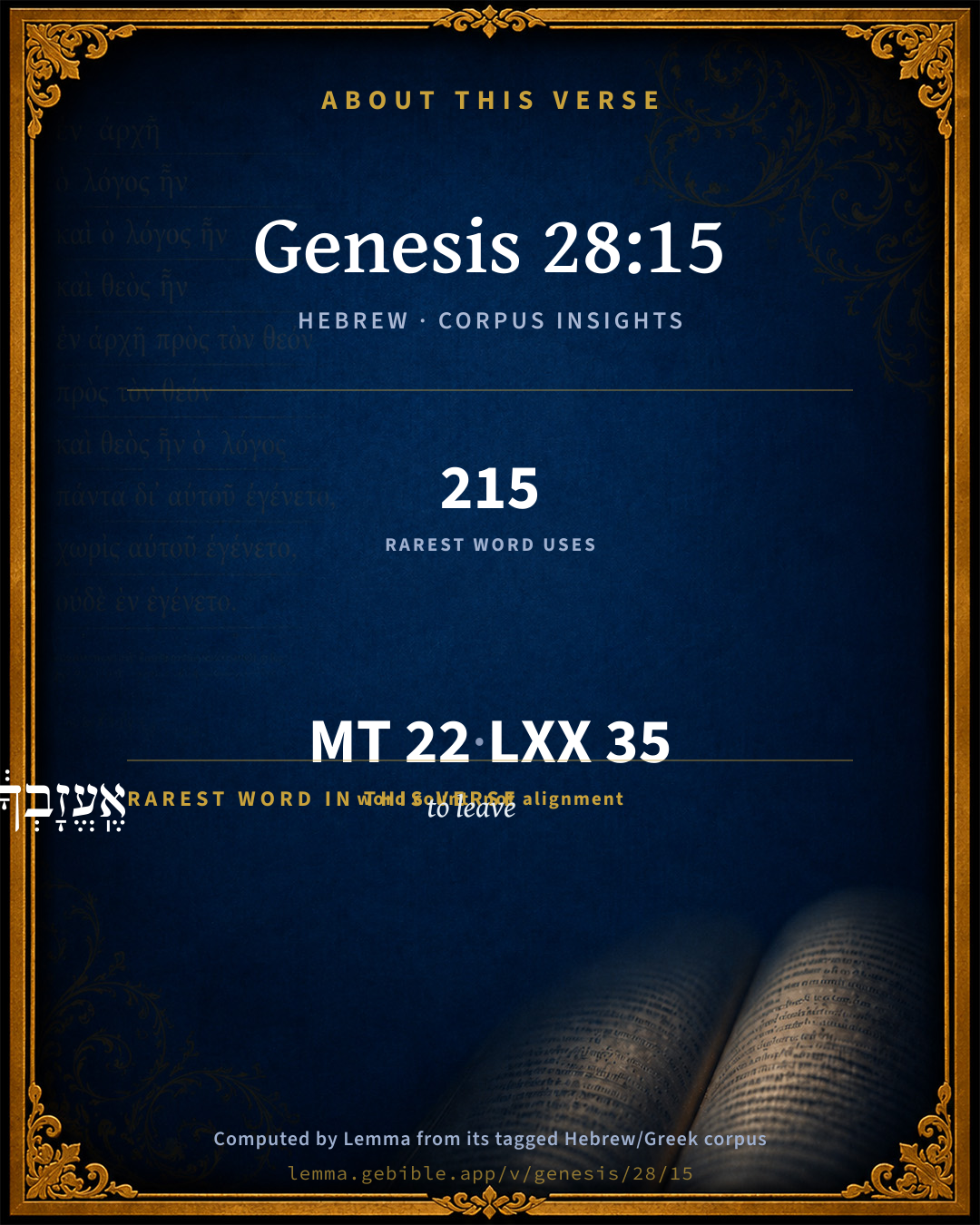
22
words
19
distinct lemmas
Pentateuch
section

Grammatical profile

  • 6 verbs
  • 2 nouns
  • 2 pronouns
  • 4 prepositions
  • 2 conjunctions
  • 6 particles

Verb forms

  • וּשְׁמַרְתִּ֨יךָ֙ Qal · Sequential Perfect
  • תֵּלֵ֔ךְ Qal · Imperfect
  • וַהֲשִׁ֣בֹתִ֔יךָ Hiphil · Sequential Perfect
  • אֶֽעֱזָבְךָ֔ Qal · Imperfect
  • עָשִׂ֔יתִי Qal · Perfect
  • דִּבַּ֖רְתִּי Piel · Perfect

Repetition

A word recurs within this verse — often emphatic in Hebrew:

  • אֲשֶׁר which H834 ×3

Hebrew & Septuagint length

In English translation the verse runs 38 words from the Hebrew and 44 from the Septuagint (LXX English) — closely comparable.

A rough comparison of the two English renderings, which tokenize alike — not a word-level alignment.

Word counts can differ between the Hebrew and the Greek without any difference in meaning — e.g. the Hebrew direct-object marker אֵת has no separate Greek word, and Greek often adds the article ὁ.

In the original languages it is 22 Hebrew tokens and 35 Greek tokens — but the two are counted differently (Hebrew bundles its prefixes and suffixes into one token; the Greek is in lemma form), so that isn’t a like-for-like length.

Cross-references

34

Topical passages linked to Genesis 28:15 in the Treasury of Scripture Knowledge — connected by theme and wording, ordered by reader-vote popularity; previews shown in the World English Bible.

  • Joshua 1:5 There shall not any man be able to stand before you all the days of your life. As I was with Moses, so I will be with you; I will not fail you, nor forsake you.
  • Isaiah 41:10 Don't you be afraid, for I am with you; don't be dismayed, for I am your God; I will strengthen you; yes, I will help you; yes, I will uphold you with the right hand of my righteousness.
  • Jeremiah 1:19 They shall fight against you; but they shall not prevail against you: for I am with you, says Yahweh, to deliver you.
  • Deuteronomy 31:6 Be strong and of good courage, don't be afraid, nor be scared of them: for Yahweh your God, he it is who does go with you; he will not fail you, nor forsake you.
  • Genesis 26:24 Yahweh appeared to him the same night, and said, "I am the God of Abraham your father. Don't be afraid, for I am with you, and will bless you, and multiply your seed for my servant Abraham's sake."
  • Genesis 31:3 Yahweh said to Jacob, "Return to the land of your fathers, and to your relatives, and I will be with you."
  • Psalms 121:5–8 Yahweh is your keeper. Yahweh is your shade on your right hand.
  • Hebrews 13:5–6 Be free from the love of money, content with such things as you have, for he has said, "I will in no way leave you, neither will I in any way forsake you."
  • Genesis 26:3 Sojourn in this land, and I will be with you, and will bless you. For to you, and to your seed, I will give all these lands, and I will establish the oath which I swore to Abraham your father.
  • Isaiah 43:2 When you pass through the waters, I will be with you; and through the rivers, they shall not overflow you: when you walk through the fire, you shall not be burned, neither shall the flame kindle on you.
  • Matthew 24:35 Heaven and earth will pass away, but my words will not pass away.
  • 1 Kings 8:57 Yahweh our God be with us, as he was with our fathers: let him not leave us, nor forsake us;
  • John 10:28–29 I give eternal life to them. They will never perish, and no one will snatch them out of my hand.
  • Psalms 46:7 Yahweh of Hosts is with us. The God of Jacob is our refuge. Selah.
  • Matthew 18:20 For where two or three are gathered together in my name, there I am in the midst of them."
  • Matthew 28:20 teaching them to observe all things that I commanded you. Behold, I am with you always, even to the end of the age." Amen.
  • Romans 8:31–32 What then shall we say about these things? If God is for us, who can be against us?
  • Genesis 28:20–21 Jacob vowed a vow, saying, "If God will be with me, and will keep me in this way that I go, and will give me bread to eat, and clothing to put on,
  • Genesis 48:21 Israel said to Joseph, "Behold, I am dying, but God will be with you, and bring you again to the land of your fathers.
  • Numbers 23:19 God is not a man, that he should lie, Neither the son of man, that he should repent: Has he said, and will he not do it? Or has he spoken, and will he not make it good?
  • 1 Timothy 4:8 For bodily exercise has some value, but godliness has value for all things, having the promise of the life which is now, and of that which is to come.
  • Joshua 23:14–16 Behold, this day I am going the way of all the earth: and you know in all your hearts and in all your souls, that not one thing has failed of all the good things which Yahweh your God spoke concerning you; all are happen to you, not one thing has failed of it.
  • Genesis 39:21 But Yahweh was with Joseph, and showed kindness to him, and gave him favor in the sight of the keeper of the prison.
  • Judges 6:16 Yahweh said to him, Surely I will be with you, and you shall strike the Midianites as one man.
  • Psalms 46:11 Yahweh of Hosts is with us. The God of Jacob is our refuge. Selah.
  • Isaiah 8:10 Take counsel together, and it shall be brought to nothing; speak the word, and it shall not stand: for God is with us.
  • Genesis 35:6–7 So Jacob came to Luz, which is in the land of Canaan (the same is Bethel), he and all the people who were with him.
  • Genesis 39:2 Yahweh was with Joseph, and he was a prosperous man. He was in the house of his master the Egyptian.
  • Genesis 48:16 the angel who has redeemed me from all evil, bless the lads, and let my name be named on them, and the name of my fathers Abraham and Isaac. Let them grow into a multitude in the midst of the earth."
  • Exodus 3:12 He said, "Certainly I will be with you. This will be the token to you, that I have sent you: when you have brought forth the people out of Egypt, you shall serve God on this mountain."
  • Isaiah 7:14 Therefore the Lord himself will give you a sign. Behold, the virgin will conceive, and bear a son, and shall call his name Immanuel.
  • Jude 1:1 Jude, a servant of Jesus Christ, and brother of James, to those who are called, sanctified by God the Father, and kept for Jesus Christ:
  • Genesis 32:9 Jacob said, "God of my father Abraham, and God of my father Isaac, Yahweh, who said to me, 'Return to your country, and to your relatives, and I will do you good.'
  • Genesis 46:4 I will go down with you into Egypt. I will also surely bring you up again. Joseph will close your eyes."

Cross-references courtesy of OpenBible.info (CC BY 4.0).

Hebrew and Greek witnesses Masoretic Hebrew ↔ Greek Septuagint

The same verse in the two great witnesses to the Old Testament, shown verse-for-verse.

These are two independent witnesses, not word-aligned to each other, and the Septuagint is shown in lemma (dictionary) form.

Hebrew Genesis 28:15 Masoretic · Westminster Leningrad Codex

וְהִנֵּ֨ה אָנֹכִ֜י עִמָּ֗ךְ וּשְׁמַרְתִּ֨יךָ֙ בְּכֹ֣ל אֲשֶׁר תֵּלֵ֔ךְ וַהֲשִׁ֣בֹתִ֔יךָ אֶל הָאֲדָמָ֖ה הַזֹּ֑את כִּ֚י לֹ֣א אֶֽעֱזָבְךָ֔ עַ֚ד אֲשֶׁ֣ר אִם עָשִׂ֔יתִי אֵ֥ת אֲשֶׁר דִּבַּ֖רְתִּי לָֽךְ

Behold, I am with you, and will keep you, wherever you go, and will bring you again into this land. For I will not leave you, until I have done that which I have spoken of to you."

World English Bible · Public Domain

Greek LXX Genesis 28:15 Septuagint · lemma form

καί ἰδού ἐγώ μετά σύ διαφυλάσσω σύ ἐν ὁ ὁδός πᾶς οὗ ἐάν πορεύομαι καί ἀποστρέφω σύ εἰς ὁ γῆ οὗτος ὅτι οὐ μή σύ ἐν καταλείπω ἕως ὁ ποιέω ἐγώ πᾶς ὅσος λαλέω σύ

And behold I am with you to preserve you continually in all the way wherein you shall go; and I will bring you back to this land; for I will not desert you, until I have done all that I have said to you.

LXX2012 (modern English Septuagint) · Public Domain

On this verse, Adam Clarke's Commentary discusses the Septuagint’s reading. Read the note in Commentary ↓

Hebrew: Westminster Leningrad Codex (CC BY 4.0). Greek: Septuagint (public domain); English from LXX2012 (modern English Septuagint) (Public Domain). How the Septuagint differs from the Hebrew →

Targum (Aramaic paraphrase)

2

The Targum is the ancient Jewish Aramaic paraphrase of the Hebrew Scriptures — an interpretive translation, not the Hebrew text itself. Onkelos (literal) and Pseudo-Jonathan (expansive) render the Torah, and Jonathan the Prophets. Coverage is partial: where no permissively-licensed English translation exists for a verse, only the Aramaic is shown. This is verse-level text, not a word-by-word alignment to the Hebrew.

  1. Targum Onkelos Torah (Genesis–Deuteronomy)
    וְהָא מֵימְרִי בְּסַעְדָךְ וְאֶטְרִנָךְ בְּכָל אֲתַר דִּי תְהַךְ וַאֲתֵיבִנָּךְ לְאַרְעָא הָדָא אֲרֵי לָא אֶשְׁבְּקִנָּךְ עַד דִּי אֶעְבֵּיד יָת דִּי מַלֵּלִית לָךְ

    (no public-domain English translation for this verse)

    Targum Onkelos — Aramaic: “Onkelos Genesis” (public domain); “Onkelos Exodus” (public domain); “Onkelos Leviticus” (public domain); “Onkelos Numbers” (public domain); “Onkelos Deuteronomy” (public domain). English: “Sefaria Community Translation” (CC0 1.0 (public-domain dedication)); “J.W. Etheridge. The Targums of Onkelos and Jonathan Ben Uzziel on the Pentateuch. London: Longmans, Green, 1862” (public domain). Text via Sefaria.

  2. Targum Pseudo-Jonathan Torah (Genesis–Deuteronomy)
    וְהָא מֵימְרִי בְּסַעֲדָךְ וְאַטְרִינָךְ בְּכָל אֲתַר דִתְהַךְ וְאָתֵבִינָךְ לְאַרְעָא הָדָא אֲרוּם לָא אַשְׁבְּקִינָךְ עַד זְמַן דִי אַעֲבֵיד יַת דְמַלֵילִית לָךְ

    And, behold, My Word is for thy help, and will keep thee in every place where thou shalt go, and will bring thee (again) to this land; for I will not leave thee until the time when I have performed all that I have told thee.

    Targum Pseudo-Jonathan — Aramaic: “Targum Jonathan on Genesis” (public domain); “Targum Jonathan on Exodus” (public domain); “Targum Jonathan on Leviticus” (public domain); “Targum Jonathan on Numbers” (public domain); “Targum Jonathan on Deuteronomy” (public domain). English: “The Targum of Jonathan ben Uzziel, trans. J. W. Etheridge, London, 1862” (public domain). Text via Sefaria.

Commentary

Notes on Genesis 28:15 from classic Christian and Jewish commentators (each source and its license shown beneath its notes). The classic Christian expositions comment on the surrounding passage and are grouped to its opening verse, so a note may address several verses; the Jewish commentaries on the Tanakh (Rashi and others) are per-verse, so they appear only where the commentator wrote on this verse.

Lemma curates 59 commentaries, every one of them public domain or Creative Commons licensed, each selected and text-cleaned for this edition rather than reprinted as found. About our sources →

Trapp's Complete Commentary

John Trapp

Gen 28:15 And, behold, I [am] with thee, and will keep thee in all [places] whither thou goest, and will bring thee again into this land; for I will not leave thee, until I have done [that] which I have spoken to thee of.

Ver. 15. {See Trapp on "Gen 28:14"}

John Trapp, A Commentary or Exposition upon All the Books of the Old and New Testament (1647–1656) — public domain. Text from a community e-Sword module.

The Biblical Illustrator

Joseph S. Exell

Gen_28:15

I will not leave thee, until I have done all that which I have spoken to thee of

Renewed pledges

There are two very observable facts which may be gathered from the joint study of the Bible and our own hearts.

1. That we are prone to distrust the promises of God, though we know Him to be unchangeable.

2. That God so condescends to our weakness that He reduplicates His pledges, in order, as it were, to compel us into confidence.

I. God speaks to His people of sin blotted out; He speaks of the thorough reconciliation which Christ has effected between Himself and the sinner; He speaks of His presence as accompanying the pilgrim through the wilderness; of His grace as sufficient for every trial which may or can be encountered. The things of which God speaks to His people spread themselves through the whole of the unmeasured hereafter, and it must follow that the pledge of our not being left until the things spoken of are done is tantamount to an assurance that we shall never be left and never forsaken.

II. The text is thus a kind of mighty guarantee, giving such a force to every declaration of God, that nothing but an unbelief the most obstinate can find ground for doubt or perplexity. It does not stand by itself, but comes in as an auxiliary in declaring Gods glorious intention. It is a provision against human faithlessness, words which may well be urged when a man is tempted with the thought that, after all, a thing spoken of is not a thing done, and which bid him throw from him the thought that God is not bound to perform whatever He has promised. (H. Melvill, B. D.)

Gods purpose and its fulfilment

1. God has a plan or scheme of life for every one of us, and His purposes embrace every part of that plan.

2. No words of God about our life will be left unfulfilled.

3. There is no unfinished life. The promise is a promise of--

(1) Presence.

(2) Intercourse.

(3) Fellowship. (S. Martin.)

The companionship of God

I. In what does the treasure of Gods companionship consist? It consists--

1. In the consciousness of Gods personality.

2. In the precious possessions he gives us--love, reason, conscience, will. To our conscience new light is given; to our love new spheres are open; our will receives new strength from the new example of His love and grace.

II. While these faculties are taken up the companionship of God becomes a reality of our daily life and our exceeding great reward. And then, besides, and with all this, we have the consciousness of communion with the Incarnate Word--Jesus Christ, the same yesterday, to-day, and for ever; we know what to do and where to find Him. In this life we are to walk by faith. Our capacities are not intended to be satisfied here, but they shall be satisfied hereafter. (Bishop King.)

A fourfold comfort

Against his fourfold cross, here is a fourfold comfort.

1. Against the loss of his friends, I will be with thee.

2. Of his country, I will give thee this land.

3. Against his poverty, Thou shalt spread abroad to the east, west, &c.

4. His solitariness; angels shall attend thee, and thy seed shall be as the dust, &c. And who can count the dust of Jacob, said Balsam Num_23:10). Now, whatsoever God spake herewith Jacob, He spake with us, as well as with him, saith Hoses (Hoses. 12:4). (J. Trapp.)

Purpose in a promise

Every true mans life is charged with a purpose of God, which will mould it and master it, so as that it may best work out His glory. He who notes the fall of the sparrow sees, numbers, and knows each human soul. He has intrusted it with a certain office and privilege. He has created it that it might glorify Him. He has endowed that soul with existence that it might be guided into His all-wise purpose, and afterwards received to share with Him His glory.

I. Observe, then, carefully in the first place, that this being the chief end of man, there will always have to be some secondary and subordinate ends. These must be reckoned in; for they all tend towards the main end, and indeed receive their entire value from their connection with that.

II. Observe, furthermore, that if there be so many subordinate purposes in the one purpose of God, there must of necessity be many instruments also.

III. Observe, in the third place, that with a purpose so complicated as Gods is, in order to introduce every mans life into it, it will be possible that in some cases more than half the years which any given person lives will have to be spent just in rendering him ready to come in efficiently at the exact point when he is needed.

IV. Observe, once more, that if these varied instruments employed in carrying out the grand purpose are so many, and need so much preparation, there will be an evident necessity that a large number of teachers and trainers shall be kept at Gods service in instructing them. (C. S.Robinson, D. D.)

The Keeper of Israel

I. THE COMPANY. Jehovah Himself.

II. THE OFFICE. The Keeper of Israel.

III. THE MARCH. All places whither thou goest.

IV. THE ENGAGEMENT. I will not leave thee, until I have done that which I have spoken to thee of. (J. Irons.)

Jacobs protector

I. GODS PRESENCE.

II. PROTECTION.

III. GUIDANCE.

IV. FAITHFULNESS. (C. Clayton, M. A.)

Four choice sentences

I. First, turn to the twenty-eighth chapter of Genesis, at the fifteenth verse, and read of PRESENT BLESSING. The Lord said to His servant Jacob, Behold, I am with thee.

1. Jacob was the inheritor of a great blessing from his fathers, for this sentence was spoken in connection with the following words, I am the Lord God of Abraham thy father, and the God of Isaac. It is an inexpressible privilege, to be able to look back to father and grandfather, and perhaps farther still, and to say, We come of a house which has served the Lord as far back as history can inform us. Descended from Christians, we have a greater honour than being descended from princes. There is no heraldry like the heraldry of the saints. Be not satisfied unless you yourself obtain such mercy as God gave to your ancestors, and hear the Lord saying, I am with thee.

2. This mercy was brought home to Jacob at a time when he greatly needed it. He had just left his fathers house, and he felt himself alone. He was coming into special trial, and then it was that he received a fuller understanding of the privilege which God had in store for him. Let me read the words to you--I am with thee. That God should send His angel with Jacob to protect him would have been much; but it is nothing compared with, I am with thee. This includes countless blessings, but it is in itself a great deal more than all the blessings we can conceive of. There are many fruits that come of it, but the tree that yields them is better than the fruit.

3. Why, when God is with a man there is a familiarity of condescension that is altogether unspeakable: it ensures an infinite love. I am with thee. God will not dwell with those He hates.

4. I am with thee--it means practical help. Whatever we undertake, God is with us in the undertaking; whatever we endure, God is with us in the enduring; whithersoever we wander, God is with us in our wandering. If God be for us, who can be against us? If God be with us, can we ever be exiled or banished? If God be with us, what can we not do? If God be with us, what can we not endure?

II. Now turn to the thirty-first chapter of Genesis, at the third verse, and read these words--I will be with thee. We will call this FUTURE BLESSING. It is almost unnecessary to take this second text; for if it is written, I am with thee, you may depend upon it that He will be with us, for God does not forsake His people.

III. I want to go a step further, and come, in the third place, to EXPERIENCED BLESSINGS. Let us look at Jacobs experience. Did Jacob find God to be with him? Turn to the thirty-first chapter again, and read the fifth verse. Up to as far as the time that he was about to leave Laban, he says--The God of my father hath been with me. I have read that testimony with great joy. I thought of Jacob thus--Well, you certainly were not eminent for grace while with Laban. You were plotting and scheming--you against Laban and Laban against you; and yet your witness is, The God of my father hath been with me. This is all the more encouraging as coming from you. Jacob seems to say of his God: It was He that gave me my wife and my children; it was He that prospered me in the teeth of those who tried to rob me; the God of my father hath been with me notwithstanding all my shortcomings. I trust that some of you can bear the like witness. Though you have net been all that you could wish in the Christian life, yet you can say, The God of my father has been with me. Now, we will look at him a little further on, in the thirty-fifth chapter, and the third verse: there we shall find him saying--Let us arise, and go up to Bethel; and I will make there an altar unto God, who answered me in the day of my distress, and was with me in the way which I went. As I have already said, he left Labans house; and it was a very venturesome journey, but God was with him: Jacob tells us that so it was. Poor Jacob was full of fear when he heard that Esau was coming to meet him. You can see that by the way in which he divided his flocks and his herds, and set apart so large a present for Esau. But God does not leave His people because of their fears. I am so thankful for that. There was a night of wrestling with Jacob. On that day, too, I have no doubt, Jacob was very much cast down, because he remembered his sin. He knew he had ill-treated Esau, and robbed him of the blessing; but, for all that, he came with a repentant heart to submit himself before his brother and to do what he could to please him. Because of this, God was with him. At the close of his life we find Jacob more fully than ever confessing that the presence of God had been with him. I read you the passage where he wished that the God that had been with him might be with his grandsons in the selfsame way--the forty-eighth chapter, at the fifteenth and sixteenth verses. He blessed Joseph, and said, God, before whom my fathers Abraham and Isaac did walk, the God which fed me all my life long unto this day, the Angel which redeemed me from all evil, bless the lads. There is his last testimony to the faithfulness of God. He had lost Rachel--oh, how it stung his heart! but he says, God redeemed me from all evil. There had come a great famine in the land; but he says that God had fed him all his life long. He had lost Joseph, and that had been a great sorrow; but now, in looking back, he sees that even then God was redeeming him from all evil. He said once, Joseph is not, and Simeon is not, and ye will take Benjamin away; all these things are against me; but now he eats his words, and says, The Lord hath redeemed me from all evil. He now believes that God had been always with him, had fed him always, and redeemed him always, and blessed him always. Now, mark you, if you trust in God, this shall be your verdict at the close of life.

IV. We have had present blessing; we have had future blessing; we have had experienced blessing three times over; and now we go to TRANSMITTED BLESSING; for we find Jacob transmitting the blessing to his son and to his grandson. Read in the forty-eighth chapter, at the twenty-first verse Behold, I die: but God shall be with you. I commenced by noticing the blessing which passed on from Abraham to Isaac; and now we see that Jacob hands it on to Joseph, Manasseh, and to Ephraim--I die: but God shall be with you. Blessed be the everlasting God--if Abraham dies, there is Isaac; and if Isaac dies, there is Jacob; and if Jacob dies, there is Joseph; and if Joseph dies, Ephraim and Manasseh survive. The Lord shall never lack a champion to bear His standard high among the sons of men. Only let us pray God to raise up more faithful ministers. That ought to be our prayer day and night. (C. H. Spurgeon.)

The Biblical Illustrator, edited by Joseph S. Exell (c. 1880s–1900s) — public domain. Text from a community e-Sword module.

Joseph Benson's Commentary

Gen 28:15. Behold, I am with thee — Wherever we are, we are safe, if we have God’s favourable presence with us. He knew not, but God foresaw, what hardships he would meet with in his uncle’s service, and therefore promiseth to preserve him in all places. God gives his people graces and comforts accommodated to the events that shall be, as well as to those that are. He was now going an exile into a place far distant, but God promiseth him to bring him again to this land. He seemed to be forsaken of all his friends, but God gives him this assurance, I will not leave thee.

Joseph Benson's Commentary on the Old and New Testaments (1811–1818) — public domain. Text from a community e-Sword module.

Tyndale Open Study Notes

Tyndale Open Resources

28:15 I am with you: The promise of God’s presence meant that God would protect and provide for Jacob in a special way. God’s promise to be with his people is repeated throughout Scripture (see also 26:24), prompting a response of worship and confidence in those who have faith (28:16-22).

Tyndale Open Study Notes — © Tyndale Open Resources, licensed CC BY-SA 4.0. Text via the HelloAO Bible API.

Adam Clarke's Commentary

Verse 15. And, behold, I am with thee] For I fill the heavens and the earth. "My WORD shall be thy help." - Targum. And will keep thee in all places, εν τη οδω παση, in all this way. - Septuagint. I shall direct, help, and support thee in a peculiar manner, in thy present journey, be with thee while thou sojournest with thy uncle, and will bring thee again into this land; so that in all thy concerns thou mayest consider thyself under my especial providence, for I will not leave thee. Thy descendants also shall be my peculiar people, whom I shall continue to preserve as such until I have done that which I have spoken to thee of-until the Messiah shall be born of thy race, and all the families of the earth - the Gentiles, be blessed through thee; the Gospel being preached to them, and they, with the believing Jews, made ONE FOLD under ONE SHEPHERD, and one Bishop or Overseer of souls. And this circumstantial promise has been literally and punctually fulfilled.

Adam Clarke's Commentary on the Bible (1810–1826) — public domain. Text from a community e-Sword/MySword module.

John Calvin's Commentaries

15. I am with thee, and will keep thee. God now promptly anticipates the temptation which might steal over the mind of holy Jacob; for though he is, for a time, thrust out into a foreign land, God declares that he will be his keeper until he shall have brought him back again. He then extends his promise still further; saying, that he will never desert him till all things are fulfilled. There was a twofold use of this promise: first, it retained his mind in the faith of the divine covenant; and, secondly, it taught him that it could not be well with him unless he were a partaker of the promised inheritance.

John Calvin's Commentaries (1540-1563) — public domain. Text from the Calvin Translation Society English edition (1840s-50s) via the Christian Classics Ethereal Library (ccel.org). Calvin's coverage is partial (roughly two-thirds of the Bible); uncommented books and verses are honest gaps, never fabricated. The 19th-century editor's footnotes and remarks are omitted so the notes are faithfully Calvin's own voice.

The Cambridge Bible for Schools and Colleges

gen. ed. J. J. S. Perowne

15. I am with thee] Cf. Gen_26:24, Gen_31:3. The personal promise to Jacob consists of (1) Divine Presence (with thee): (2) Divine preservation (keep thee): (3) Divine restoration (bring again): (4) Divine fulfilment of promise (until I have done).

The Cambridge Bible for Schools and Colleges (gen. ed. J. J. S. Perowne; Cambridge University Press, 1878–1918) — public domain. Text from a community e-Sword module.

John Gill's Exposition

And, behold, I am with thee,.... Though alone, at a distance from his father's house, no friend to keep him company, or servant to attend him; but the presence of God here promised is abundantly more than an equivalent for all this:

and will keep thee in all places, whither thou goest; from beasts of prey, in lonesome places through which he might travel; from thieves and robbers, to whom he might be exposed; from his brother Esau, and all his ill designs against him; and from being always under the bondage of Laban, into which he would be brought:

and will bring thee again into this land: the land of Canaan, which was entailed on him and his seed for an inheritance; but, as he would now soon be out of it, and continue in another land for many years, as he did, which would make it look very unpromising that he and his seed should inherit it, this is said unto him:

for I will not leave thee, until I have done that which I have spoken to thee of; made good all his promises to him: and the sense is, not that he would then leave him when he had done so, but as not before, so never after; for God never does, nor never will, utterly forsake his people.

John Gill's Exposition of the Whole Bible (1746–1763) — public domain (CC PDM 1.0). Text via the HelloAO Bible API.

Matthew Poole's English Annotations

Nor ever after; for so the word until is frequently used, as 2Sa 6:23; Mat 1:25; not so as to exclude the time following, but so as to include all the foregoing time, wherein the thing spoken of might be most suspected or feared; as here the worst and most dangerous state in which Jacob was, or was like to be, was this time of his banishment from his country and kindred, against which he is therefore particularly armed and comforted in these words.

Matthew Poole's English Annotations on the Holy Bible (1683–1685) — public domain. Text from a community e-Sword/MySword module.

The Pulpit Commentary

And, behold, I am with thee, spoken to Isaac (cf. 26:24); again to Jacob; (Gen_31:3) afterwards to Christ"s disciples (Mat_28:20) and will keep thee in all places whither thou goest, literally, in all thou goest in all thy goings (cf. Psa_121:5, Psa_121:7, Psa_121:8) and will bring thee again into this land; equivalent to an intimation that his present journey to Padan-aram was not without the Divine sanction, though apparently it had been against the will of God that Isaac should leave the promised land (vide Gen_14:6, Gen_14:8) for I will not leave thee, a promise afterwards repeated to Israel, (Deu_31:6, Deu_31:8) to Joshua, (Gen_1:5) to Solomon, (1Ch_28:20) to the poor and needy, (Isa_41:17) to Christians (Heb_13:7) until I have done that which I have spoken to thee of cf. Balaam"s testimony to the Divine faithfulness, (Num_23:19) and Joshua"s, (Gen_21:4-5) and Solomon"s. (1Ki_8:56) It is impossible, in connection with this sublime theophany granted to Jacob at Bethel, not to recall the similar Divine manifestation vouchsafed to Abraham beneath the starry firmament at (Hebron). (vide Gen_15:1)

HOMILIES BY J.F. MONTGOMERY Ver. 15.

God"s providential care.

I am with thee, and will keep thee in all places whither thou goest." Among things believed; but not sufficiently realized, is the truth of God"s constant overruling care. We can trace cause and effect a little way, then lose the chain, and feel as if it went no further, as if events had no special cause. This a common evil in the life of Christians. Its root, walking by sight more than by faith. Jacob what made him try craft? Did not trust God fully. Had no habit of faith. But God had not forgotten him. And as he slept on the stone at Bethel the reality of God"s presence was made known to him (Isa_43:2; Mat_28:20) and recorded for our learning.

I GOD DOES ALWAYS WATCH OVER AND GUIDE. The ladder was not a new thing; it had existed always. The vision showed what exists everywhere. (2Ki_6:17) The ladder shows the truth which should stamp our lives. God is love, and love means care. This is for all. Not our love that causes it. Our love, trust, life spring from that truth. The living God is close to us. His hand touches our life at every point. How is it that we are unconscious of this?

II GOD"S WORKING IS HIDDEN AND SILENT. Jacob was startled to find him near. Because year by year the world goes on as before, unbelievers deny God"s active presence, worldly men think not of it, and even godly men sometimes forget, for we cannot see the top of the ladder. But God, there, directs all.

III HIS PURPOSES ARE ACCOMPLISHED BY MANY AGENTS. Many angels, messengers (Psa_104:4; Heb_1:14) natural agents, the elements, &c.; human agents, men good and bad alike carrying out his will; spiritual beings. (Psa_91:11) How often those who pray for spiritual blessings forget that common things also are ruled by God. Thus a great door of communion is closed.

IV BUT THERE IS SO MUCH CONFUSION IN THE WORLD. We often cannot trace God"s hand. How often is trust confounded, wise schemes frustrated, earnest self-denial in vain; prayers, real and intense, without apparent answer. Nay, these are but seeming confusions, to teach the lesson of faith. Through all these, by all these, God"s purposes are surely carried out. One great truth is the key of all the love of God revealed in Christ. This is the ladder from which he proclaims, "Lo, I am with thee" (cf. Rom_8:32) He who wrought out redemption, can he fail?

V GOD"S GOVERNANCE IS FOR OUR SALVATION, in the fullest sense of the word, giving us the victory over evil. God was with Jacob. He had been from the first, though not recognized. He was so to the end. Not giving uninterrupted prosperity. Many a fault and many a painful page in his history; but through all these he was led on. The word to each who will receive it I am with thee." Not because of thy faith, still less of thy goodness. Oh that every Christian would practice trust; (Psa_5:3) hearing our Father"s voice, "Commit thy way unto the Lord," and gladly believing "the Lord is my Shepherd. M.

The Pulpit Commentary (1880–1919), ed. H.D.M. Spence-Jones & Joseph S. Exell — public domain. Text from a community e-Sword module.

John Wesley's Explanatory Notes

Behold I am with thee - Wherever we are, we are safe, if we have God's favourable presence with us. He knew not, but God foresaw what hardships he would meet with in his uncle's service, and therefore promiseth to preserve him in all places. God knows how to give his people graces and comforts accommodated to the events that shall be, as well as to those that are. He was now going as an exile into a place far distant, but God promiseth him to bring him again to this land. He seemed to be forsaken of all his friends, but God gives him this assurance, I will not leave thee.

John Wesley, Explanatory Notes Upon the Whole Bible (1754–1765) — public domain. Text via the GEBible commentary corpus.

Rashi

Rabbi Shlomo Yitzchaki (Rashi)

אנכי עמך I AM WITH THEE — God promised him this because he was in terror of Esau and Laban.

עד אשר אם עשיתי UNTIL I HAVE DONE — The word אם is here used in the sense of כי (cf. Gittin 90a).

דברתי לך means I have spoken in thy interest and concerning thee: whatever I promised to Abraham regarding his seed it was in reference to you that I promised it and not in reference to Esau, for I did not say to him “Isaac shall be called thy seed” (which would have signified that all Isaac’s descendants would be regarded, also, as Abraham’s) but I said (21:12) ביצחק “In Isaac” and not all the issue of Isaac”. In the same way wherever לי or לך or לו or להם are used after a verbal form of דבר, they are used in the sense of “concerning”. This verse proves that this is so, since it cannot mean “I have spoken to thee” as He had never spoken to Jacob before this occasion.

Rashi on the Tanakh — English translations: “The Judaica Press complete Tanach with Rashi, translated by A. J. Rosenberg” (CC BY 4.0); “Pentateuch with Rashi's commentary by M. Rosenbaum and A.M. Silbermann, 1929-1934” (public domain); “The Metsudah Tanach series, Lakewood, N.J” (CC BY 4.0); and “The Book of Joshua, Metsudah Publications, 1997” (CC BY 4.0). Text via Sefaria.

Radak

Rabbi David Kimhi (Radak)

והנה, even though you are presently fleeing, do not be afraid for אנכי, I will be with you, ושמרתיך בכל אשר תלך, both on your way out and eventually, on your way home.

כי לא אעזבך עד אשר אם עשיתי, so that in effect I will never abandon you. This promise was to stand by him and his descendants during his entire life, as well as during that of his children.

אשר אם, this apparently superfluous repetition is meant to reinforce the promise.

Radak on the Tanakh — English translations: “Sefaria Community Translation” (CC0 1.0 (public-domain dedication)); “Eliyahu Munk, HaChut Hameshulash” (CC BY 4.0); “Rabbi Mike Feuer, Jerusalem Anthology” (CC BY 4.0); and “R. David Kimhi on the first book of Psalms, Translated by R.G. Finch, London, 1919” (public domain). Text via Sefaria.

Lesson kit

Teaching starters — assembled from the data on this page, not authored interpretation. Every prompt links to the verse data it draws on. Edit before teaching.

Genesis, in the Pentateuch, opens this verse with 22 words (19 distinct Hebrew lemmas). Its most distinctive word is ʻâzab (“to leave”). A historical commentator’s framing appears above. Read the whole chapter for the surrounding context.

Discussion questions

  1. What does “to leave” (ʻâzab) contribute to the verse as a whole?
  2. Joshua 1:5 shares this passage’s theme. How do the two illuminate each other?
  3. “which” occurs 3× in this one verse. What is the effect of the repetition?
  4. These translations render this verse differently. What is at stake in choosing one wording over another?
  5. The verb «וּשְׁמַרְתִּ֨יךָ֙» is Qal Sequential Perfect. How does its form color the action?
  6. Reading how Trapp's Complete Commentary and The Biblical Illustrator read this verse, where do the two commentators agree and where do they part?

Things to notice

Reading settings

Reading text

Shown beneath each verse's original-language words.

Old Testament
Old Testament edition

Read the OT as the Masoretic Hebrew (MT) or the Greek Septuagint (LXX).

English shown for the Greek Septuagint (in the Hebrew ↔ Greek comparison).

Comparing translations? Open the Compare panel on any verse page to stack up to four side by side.