Leviticus 7:37

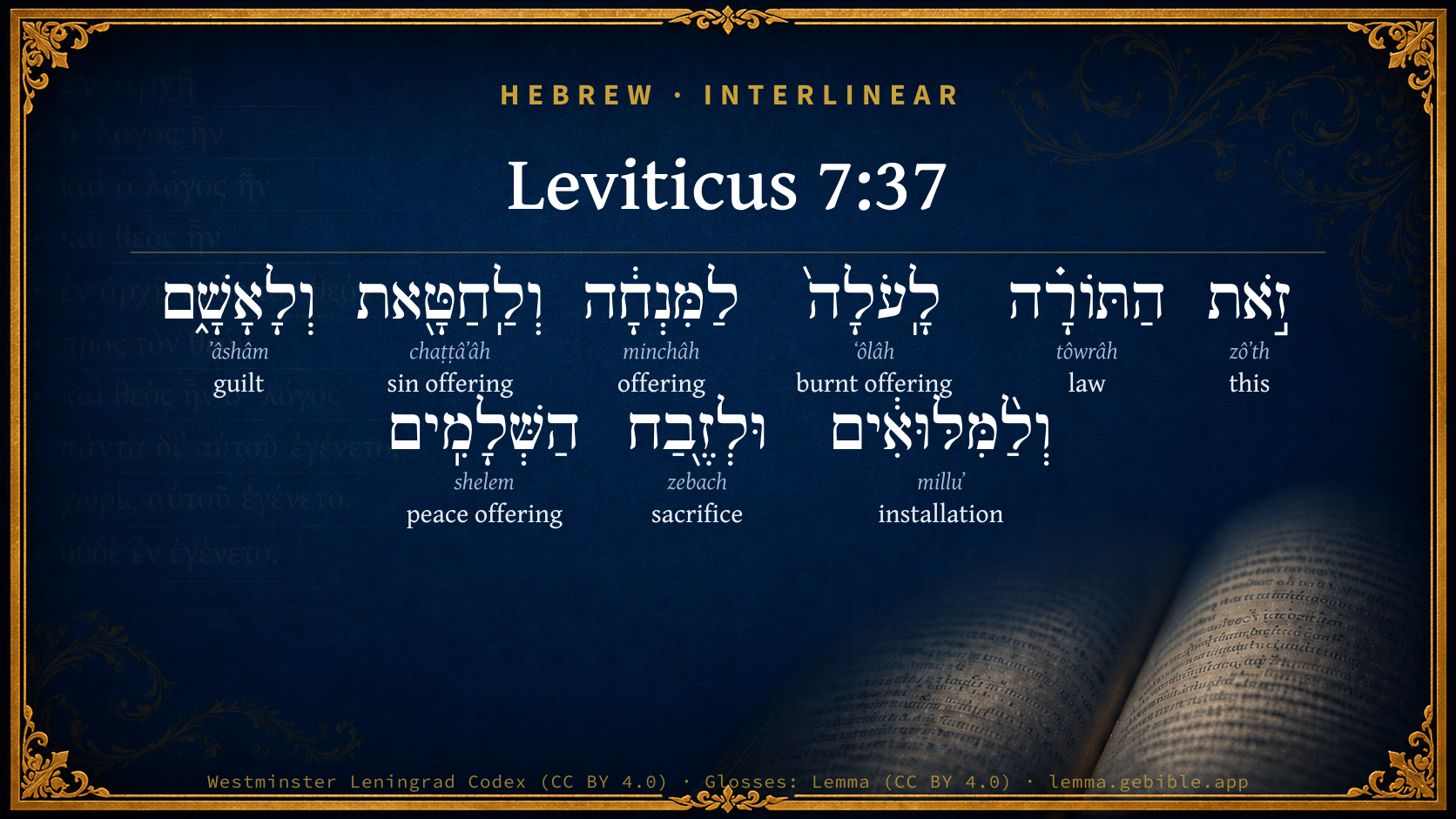
Hebrew (Westminster Leningrad Codex) Leviticus 7:37 appears in the Hebrew Old Testament. The text above is from the Westminster Leningrad Codex. Each word links to its Strong’s number, a concise gloss, and parsing drawn from the Open Scriptures Hebrew Bible morphology. Click any word for its full Brown-Driver-Briggs (BDB) entry.
Download image
Cite this verse

Leviticus 7:37 (World English Bible). Public Domain. Lemma interlinear Bible study tool, https://lemma.gebible.app/v/leviticus/7/37.

Show BibTeX & RIS
BibTeX
RIS
English Translation
This is the law of the burnt offering, of the meal offering, and of the sin offering, and of the trespass offering, and of the consecration, and of the sacrifice of peace offerings;
World English Bible · Public Domain
Download a study sheet

One document with this verse’s original text, its word-by-word gloss line, the meaning frame, cross-references with their text, attributed commentary, and full source and license credits — printable, and it pastes into notes with its structure intact.

This verse Autodidact and up

Study sheet (.html) Plain text (.txt)

A passage Seminary Student

Up to 50 verses in one chapter. A passage sheet keeps up to 6 commentary sources and 12 cross-references per verse, in the order this page ranks them, and says so on the sheet whenever that leaves anything out. Ask for a single verse and you get the Autodidact verse sheet above.

Everything on this page stays free to read, with no account — the sheet is a download of what is already on screen, not access to it.

Want to remove ads? Support Godless Engineer
Compare translations 3

The same verse in 3 English versions, stacked beneath the original-language interlinear above. Click any original word for its lexicon entry.

Each is an independent rendering of the whole verse — the interlinear is not word-aligned to these translations.

Highlighted words mark where these versions differ — a whole-verse word diff, not a word-by-word alignment.

  • World English Bible Public Domain
    This is the law of the burnt offering, of the meal offering, and of the sin offering, and of the trespass offering, and of the consecration, and of the sacrifice of peace offerings;
  • King James Version Public Domain
    This is the law of the burnt offering, of the meat offering, and of the sin offering, and of the trespass offering, and of the consecrations, and of the sacrifice of the peace offerings;
  • unfoldingWord Literal Text CC BY-SA 4.0
    This the law of the burnt offering, of the grain offering and of the sin offering and of the guilt offering and of the ordination offering and of the sacrifice of the peace offerings,

unfoldingWord Literal Text — © unfoldingWord, licensed CC BY-SA 4.0. Word-aligned USFM3 via Door43 (git.door43.org/unfoldingWord/en_ult).

Versions to compare (up to 4)

3 of 4 selected

Show all 18 translations

Every available English version of this verse, each an independent rendering of the whole verse.

  • World English Bible Public Domain
    This is the law of the burnt offering, of the meal offering, and of the sin offering, and of the trespass offering, and of the consecration, and of the sacrifice of peace offerings;
  • Berean Standard Bible Public Domain
    This is the law of the burnt offering, the grain offering, the sin offering, the guilt offering, the ordination offering, and the peace offering,
  • Majority Standard Bible Public Domain
    This is the law of the burnt offering, the grain offering, the sin offering, the guilt offering, the ordination offering, and the peace offering,
  • King James Version Public Domain
    This is the law of the burnt offering, of the meat offering, and of the sin offering, and of the trespass offering, and of the consecrations, and of the sacrifice of the peace offerings;
  • American Standard Version (1901) Public Domain
    This is the law of the burnt-offering, of the meal-offering, and of the sin-offering, and of the trespass-offering, and of the consecration, and of the sacrifice of peace-offerings;
  • Revised Version (1885) Public Domain
    This is the law of the burnt offering, of the meal offering, and of the sin offering, and of the guilt offering, and of the consecration, and of the sacrifice of peace offerings;
  • Geneva Bible (1599) Public Domain
    This is also the lawe of the burnt offring of the meate offring, and of the sinne offring, and of the trespasse offring, and of the consecrations, and of the peace offrings,
  • Douay-Rheims (1899) Public Domain
    This is the law of holocaust, and of the sacrifice for sin, and for trespass, and for consecration, and the victims of peace offerings:
  • Young's Literal Translation Public Domain
    This `is' the law for burnt-offering, for present, and for sin-offering, and for guilt-offering, and for consecrations, and for a sacrifice of the peace-offerings,
  • Literal Standard Version CC BY-SA 4.0
    This [is] the law for burnt-offering, for present, and for sin-offering, and for guilt-offering, and for consecrations, and for a sacrifice of the peace-offerings,
  • Unlocked Literal Bible CC BY-SA 4.0
    This is the law of the burnt offering, of the grain offering, of the sin offering, of the guilt offering, of the consecration offering, and of the sacrifice of peace offerings,
  • unfoldingWord Literal Text CC BY-SA 4.0
    This the law of the burnt offering, of the grain offering and of the sin offering and of the guilt offering and of the ordination offering and of the sacrifice of the peace offerings,
  • Darby Bible Public Domain
    This is the law of the burnt-offering, of the oblation, and of the sin-offering, and of the trespass-offering, and of the consecration-offering, and of the sacrifice of peace-offering,
  • World Messianic Bible Public Domain
    This is the law of the burnt offering, the meal offering, the sin offering, the trespass offering, the consecration, and the sacrifice of peace offerings
  • Webster's Bible Public Domain
    This is the law of the burnt-offering, of the meat-offering, and of the sin-offering, and of the trespass-offering, and of the consecrations, and of the sacrifice of the Peace-offerings;
  • Free Bible Version CC BY-SA 4.0
    These are the regulations regarding the burnt offering, the grain offering, the sin offering, the guilt offering, the ordination offering, and the peace offering.
  • Bible in Basic English Public Domain
    These are the laws for the burned offering, the meal offering, and the offering for wrongdoing; and for the making of priests, and for the giving of peace-offerings;
  • JPS Tanakh (1917) Public Domain
    This is the law of the burnt-offering, of the meal-offering, and of the sin-offering, and of the guilt-offering, and of the consecration-offering, and of the sacrifice of peace-offerings;

Literal Standard Version (2020), Covenant Press — licensed CC BY-SA 4.0. Text via the HelloAO Bible API (eBible.org). Unlocked Literal Bible (unfoldingWord) — licensed CC BY-SA 4.0. Text via the HelloAO Bible API (eBible.org). unfoldingWord Literal Text — © unfoldingWord, licensed CC BY-SA 4.0. Word-aligned USFM3 via Door43 (git.door43.org/unfoldingWord/en_ult). Free Bible Version, Dr. Jonathan Gallagher — licensed CC BY-SA 4.0. Text via the HelloAO Bible API (eBible.org).

Word by word

More ways to search: Search by grammar → Find every occurrence → Compare this word →

Practice this passage: Drill this verse → Learn its vocabulary →

וְלַ֨מִּלּוּאִ֔ים
milluʼ
H4394
“and · to/for the · installations”
Conjunction + Preposition, Determined + Noun, Common, Masculine, Plural, Absolute
Part of Speech
Conjunction + Preposition + Noun
Type
Common
Gender
Masculine
Number
Plural
State
Absolute
Full BDB Definition

Origin: from H4390

TWOT: 1195e

setting, installation - setting, stones for setting - installation (of priests)
  1. זֹ֣את zôʼth H2063 “this” Pronoun, Demonstrative, Feminine, Singular
  2. הַתּוֹרָ֗ה tôwrâh H8451 “the · law” Particle, Definite Article + Noun, Common, Feminine, Singular, Absolute
  3. לָֽעֹלָה֙ ʻôlâh H5930 “to/for the · burnt offering” Preposition, Determined + Noun, Common, Feminine, Singular, Absolute
  4. לַמִּנְחָ֔ה minchâh H4503 “to/for the · offering” Preposition, Determined + Noun, Common, Feminine, Singular, Absolute
  5. וְלַֽחַטָּ֖את chaṭṭâʼâh H2403 “and · to/for the · sin offering” Conjunction + Preposition, Determined + Noun, Common, Feminine, Singular, Absolute
  6. וְלָאָשָׁ֑ם ʼâshâm H817 “and · to/for the · guilt” Conjunction + Preposition, Determined + Noun, Common, Masculine, Singular, Absolute
  7. וּלְזֶ֖בַח zebach H2077 “and · to/for · sacrifice of” Conjunction + Preposition + Noun, Common, Masculine, Singular, Construct
  8. הַשְּׁלָמִֽים shelem H8002 “the · peace offerings” Particle, Definite Article + Noun, Common, Masculine, Plural, Absolute

About this verse

These counts appear in no published source. They are computed here, from the morphology-tagged text and Lemma’s own curated glosses. What Lemma adds →

9
words
9
distinct lemmas
Pentateuch
section

Notable vocabulary

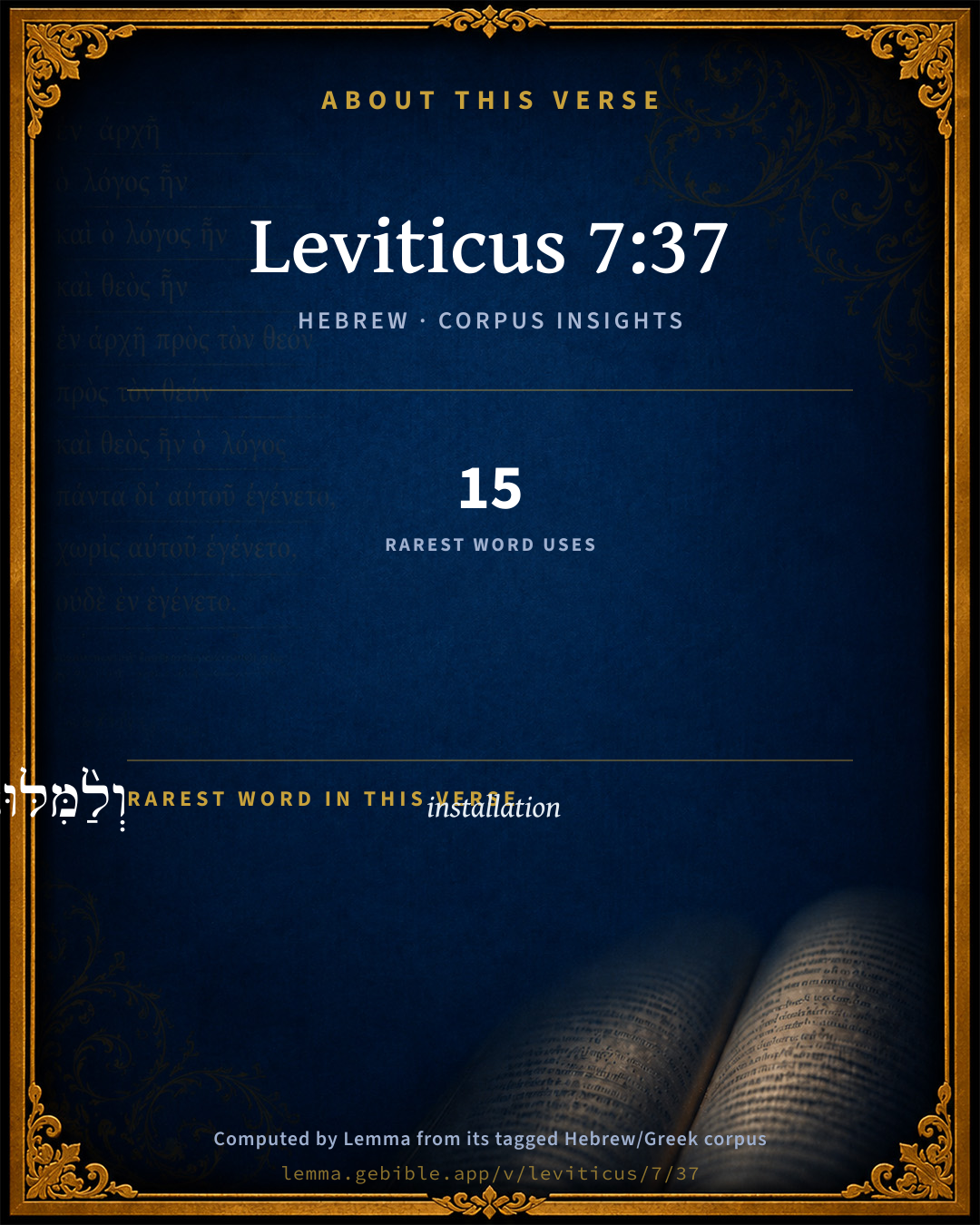
The rarest word here is וְלַ֨מִּלּוּאִ֔ים installation H4394 — appearing just 15 times in the whole Hebrew Bible.

Shared distinctive vocabulary

וְלַ֨מִּלּוּאִ֔ים installation H4394 occurs in 15 verses of the Hebrew Bible. Also found in:

Grammatical profile

  • 8 nouns
  • 1 pronoun

Cross-references

6

Topical passages linked to Leviticus 7:37 in the Treasury of Scripture Knowledge — connected by theme and wording, ordered by reader-vote popularity; previews shown in the World English Bible.

  • Exodus 29:1 "This is the thing that you shall do to them to make them holy, to minister to me in the priest's office: take one young bull and two rams without blemish,
  • Exodus 29:38–42 "Now this is that which you shall offer on the altar: two lambs a year old day by day continually.
  • Leviticus 1:1–5:6 Yahweh called to Moses, and spoke to him out of the Tent of Meeting, saying,
  • Leviticus 6:9–18 "Command Aaron and his sons, saying, 'This is the law of the burnt offering: the burnt offering shall be on the hearth on the altar all night until the morning; and the fire of the altar shall be kept burning on it.
  • Leviticus 6:20–7:7 "This is the offering of Aaron and of his sons, which they shall offer to Yahweh in the day when he is anointed: the tenth part of an ephah of fine flour for a meal offering perpetually, half of it in the morning, and half of it in the evening.
  • Leviticus 7:11–21 "'This is the law of the sacrifice of peace offerings, which one shall offer to Yahweh.

Cross-references courtesy of OpenBible.info (CC BY 4.0).

Hebrew and Greek witnesses Masoretic Hebrew ↔ Greek Septuagint

The same verse in the two great witnesses to the Old Testament, shown verse-for-verse.

These are two independent witnesses, not word-aligned to each other, and the Septuagint is shown in lemma (dictionary) form.

Hebrew Leviticus 7:37 Masoretic · Westminster Leningrad Codex

זֹ֣את הַתּוֹרָ֗ה לָֽעֹלָה֙ לַמִּנְחָ֔ה וְלַֽחַטָּ֖את וְלָאָשָׁ֑ם וְלַ֨מִּלּוּאִ֔ים וּלְזֶ֖בַח הַשְּׁלָמִֽים

This is the law of the burnt offering, of the meal offering, and of the sin offering, and of the trespass offering, and of the consecration, and of the sacrifice of peace offerings;

World English Bible · Public Domain

Greek LXX Leviticus 7:37 Septuagint · lemma form

οὗτος ὁ νόμος ὁ ὁλοκαύτωμα καί θυσία καί περί ἁμαρτία καί ὁ πλημμέλεια καί ὁ τελείωσις καί ὁ θυσία ὁ σωτήριον

No English rendering of this Greek verse — the small residue in the structurally divergent books.

Hebrew: Westminster Leningrad Codex (CC BY 4.0). Greek: Septuagint (public domain); English from a public-domain English Septuagint. How the Septuagint differs from the Hebrew →

Targum (Aramaic paraphrase)

2

The Targum is the ancient Jewish Aramaic paraphrase of the Hebrew Scriptures — an interpretive translation, not the Hebrew text itself. Onkelos (literal) and Pseudo-Jonathan (expansive) render the Torah, and Jonathan the Prophets. Coverage is partial: where no permissively-licensed English translation exists for a verse, only the Aramaic is shown. This is verse-level text, not a word-by-word alignment to the Hebrew.

  1. Targum Onkelos Torah (Genesis–Deuteronomy)
    דָא אוֹרַיְתָא לַעֲלָתָא לְמִנְחָתָא וּלְחַטָּאתָא וְלַאֲשָׁמָא וּלְקוּרְבָּנַיָא וּלְנִכְסַת קוּדְשַׁיָא

    (no public-domain English translation for this verse)

    Targum Onkelos — Aramaic: “Onkelos Genesis” (public domain); “Onkelos Exodus” (public domain); “Onkelos Leviticus” (public domain); “Onkelos Numbers” (public domain); “Onkelos Deuteronomy” (public domain). English: “Sefaria Community Translation” (CC0 1.0 (public-domain dedication)); “J.W. Etheridge. The Targums of Onkelos and Jonathan Ben Uzziel on the Pentateuch. London: Longmans, Green, 1862” (public domain). Text via Sefaria.

  2. Targum Pseudo-Jonathan Torah (Genesis–Deuteronomy)
    דָא אוֹרַיְיתָא לַעֲלָתָא דְאַתְיָא לְכַפָּרָא עַל הִרְהוּרֵי לִבָּא לְמִנְחָתָא וּלְחַטָאתָא וּלְאֲשָׁמָא וּלְאַשְׁלְמוּתָא וּלְנִכְסַת קוּדְשַׁיָא

    This is the law of the burnt offering which is brought to atone for the thoughts of the heart; of the mincha, of the sin offering, of the trespass offering, and of the peace offering, or the hallowed sacrifices

    Targum Pseudo-Jonathan — Aramaic: “Targum Jonathan on Genesis” (public domain); “Targum Jonathan on Exodus” (public domain); “Targum Jonathan on Leviticus” (public domain); “Targum Jonathan on Numbers” (public domain); “Targum Jonathan on Deuteronomy” (public domain). English: “The Targum of Jonathan ben Uzziel, trans. J. W. Etheridge, London, 1862” (public domain). Text via Sefaria.

Commentary

Notes on Leviticus 7:37 from classic Christian and Jewish commentators (each source and its license shown beneath its notes). The classic Christian expositions comment on the surrounding passage and are grouped to its opening verse, so a note may address several verses; the Jewish commentaries on the Tanakh (Rashi and others) are per-verse, so they appear only where the commentator wrote on this verse.

Lemma curates 59 commentaries, every one of them public domain or Creative Commons licensed, each selected and text-cleaned for this edition rather than reprinted as found. About our sources →

The Biblical Illustrator

Joseph S. Exell

Lev_7:37-38

This is the law . . . to offer their oblations.

The gospel of the sacrifices

I. There was a divine institution and command of god, for the offerings and sacrifices which were under the law.

1. An offering in general is anything presented to the Lord to become peculiarly His, and to be typical of Christ and gospel mysteries.

2. The legal offerings were set apart for God, with respect to Christ and His great sacrifice and offering up of Himself unto God for us.

3. Some have distinguished them into three sorts.

(1) Such as were offered at the brazen altar, or the altar of burnt-offering, which represented the death and sufferings of Jesus Christ.

(2) Such as were offered in the sanctuary, more near to the Holy of Holies, viz., the shewbread and the incense at the altar of incense; which had respect to His intercession for us at the throne of grace, in the virtue and by the merit of that sacrifice which He before had shed and offered up.

(3) Such as were offered in the Holy of Holies; which represented the full attainment of the ends of both the former, viz., our full access unto and communion with God through the influence both of the death and oblation as likewise of the prayers and intercession of Christ for us.

4. The sacrifices that were offered at the brazen altar are commonly distributed into two sorts--sacrifices of expiation, and sacrifices of thanksgiving. It is the former sort whereof the text speaks.

(1) These propitiatory sacrifices were offerings most holy to the Lord; for atonement, or for appeasing of His wrath; by the destruction of the sacrifice; to shadow forth the true atonement and expiation of sin, by the death of Jesus, and our reconciliation to and communion with God through Him.

(2) For further rules of illustration, take these propositions--

(a) The institution of sacrifices was presently after the sin and fall of man; but the renewed institution and further direction and regulation of them was by Moses unto Israel.

(b) In this renewed institution and regulation of their offerings and sacrifices, there were sundry adjuncts and ceremonies, some whereof were required and some severely forbidden to be added to them, all which were mystical and significant,

1. Adjuncts required. Sacrifices to be offered only at this ore altar. Salt. Music. Incense. Many ceremonious actions,

2. Adjuncts forbidden. In general, any conformity or compliance with the pagans in their rites and ceremonies. In particular, leaven and honey.

(c) The occasions upon which they were to be offered,

1. When under guilt of sin.

2. For the obtaining of any needful mercy,

3. To testify their joy and thankfulness for mercies received,

4. In the instituted seasons of them.

II. The sacrifices of propitiation under the law, may be referred to there six kinds or sorts--burnt-offering, meat-offering, peace-offering, sin-offering, trespass-offering, and offering of consecrations.

1. There were some things in which these all agreed.

(1) They were all offered at the brazen altar.

(2) They were all holy of holinesses.

(3) They were all offerings made by fire.

(4) They were all propitiatory.

2. The difference consisted--

(1) Partly in the different matter of them. An ox or a sheep in some; flowers and wine in others.

(2) Partly in the particular ends and designs and occasions of them.

(3) Principally in the different ceremonies accompanying them.

Lessons:

1. Keep close to the rule of Divine institution in matters of worship.

2. See the worth and value of the sacrifice of Jesus Christ, and the necessity of it, fur the justification and salvation of lost sinners. (S. Mather.)

The Biblical Illustrator, edited by Joseph S. Exell (c. 1880s–1900s) — public domain. Text from a community e-Sword module.

Keil & Delitzsch

C. F. Keil & F. Delitzsch

With Lev 7:37 and Lev 7:38 the whole of the sacrificial law (ch. 1-7) is brought to a close. Among the sacrifices appointed, the fill-offering (המּלּוּאים) is also mentioned here; though it is not first instituted in these chapters, but in Exo 29:19-20 (Exo 29:22, Exo 29:26, Exo 29:27, Exo 29:31). The name may be explained from the phrase to "fill the hand," which is not used in the sense of installing a man, or giving him authority, like בּיד נתן "commit into his hand" in Isa 22:21 (Knobel), but was applied primarily to the ceremony of consecrating the priests, as described in Lev 8:25., and was restricted to the idea of investiture with the priesthood (cf. Lev 8:33; Lev 16:32; Exo 28:41; Exo 29:9, Exo 29:29, Exo 29:33, Exo 29:35; Num 3:3; Jdg 17:5, Jdg 17:12). This gave rise to the expression "to fill the hand for Jehovah," i.e., to provide something to offer to Jehovah (Ch1 29:5; Ch2 29:31, cf. Exo 32:29). Hence מלּוּאים denotes the filling of the hand with sacrificial gifts to be offered to Jehovah, and as used primarily of the particular sacrifice through which the priests were symbolically invested at their consecration with the gifts they were to offer, and were empowered, by virtue of this investiture, to officiate at the sacrifices; and secondly, in a less restricted sense, of priestly consecration generally (Lev 8:33, "the days of your consecration"). The allusion to the place in Lev 7:38, viz., "in the wilderness of Sinai," points on the one hand back to Exo 19:1, and on the other hand forward to Num 26:63-64, and Num 36:13, "in the plains of Moab" (cf. Num 1:1, Num 1:19, etc.).

The sacrificial law, therefore, with the five species of sacrifices which it enjoins, embraces every aspect in which Israel was to manifest its true relation to the Lord its God. Whilst the sanctification of the whole man in self-surrender to the Lord was shadowed forth in the burnt-offerings, the fruits of this sanctification in the meat-offerings, and the blessedness of the possession and enjoyment of saving grace in the peace-offerings, the expiatory sacrifices furnished the means of removing the barrier which sins and trespasses had set up between the sinner and the holy God, and procured the forgiveness of sin and guilt, so that the sinner could attain once more to the unrestricted enjoyment of the covenant grace. For, provided only that the people of God drew near to their God with sacrificial gifts, in obedience to His commandments and in firm reliance upon His word, which had connected the forgiveness of sin, strength for sanctification, and the peace of fellowship with Him, with these manifestations of their piety, the offerers would receive in truth the blessings promised them by the Lord. Nevertheless these sacrifices could not make those who drew near to God with them and in them "perfect as pertaining to the conscience" (Heb 9:9; Heb 10:1), because the blood of bulls and of goats could not possibly take away sin (Heb 10:4). The forgiveness of sin which the atoning sacrifices procured, was only a πάρεσις of past sins through the forbearance of God (Rom 3:25-26), in anticipation of the true sacrifice of Christ, of which the animal sacrifices were only a type, and by which the justice of God is satisfied, and the way opened fore the full forgiveness of sin and complete reconciliation with God. So also the sanctification and fellowship set forth by the burnt-offerings and peace-offerings, were simply a sanctification of the fellowship already established by the covenant of the law between Israel and its covenant God, which pointed forward to the true sanctification and blessedness that grow out of the righteousness of faith, and expand through the operation of the Holy Spirit into the true righteousness and blessedness of the divine peace of reconciliation. The effect of the sacrifices was in harmony with the nature of the old covenant. The fellowship with God, established by this covenant, was simply a faint copy of that true and living fellowship with God, which consists in God's dwelling in our hearts through His Spirit, transforming our spirit, soul, and body more and more into His own image and His divine nature, and making us partakers of the glory and blessedness of His divine life. However intimately the infinite and holy God connected Himself with His people in the earthly sanctuary of the tabernacle and the altar of burnt-offering, yet so long as this sanctuary stood, the God who was enthroned in the most holy place was separated by the veil from His people, who could only appear before Him in the fore-court, as a proof that the sin which separates unholy man from the holy God had not yet been taken out of the way. Just as the old covenant generally was not intended to secure redemption from sin, but the law was designed to produce the knowledge of sin; so the desire for reconciliation with God was not to be truly satisfied by its sacrificial ordinances, but a desire was to be awakened for that true sacrifice which cleanses from all sins, and the way to be prepared for the appearing of the Son of God, who would exalt the shadows of the Mosaic sacrifices into a substantial reality by giving up His own life as a propitiation for the sins of the whole world, and thus through the one offering of His own holy body would perfect all the manifold sacrifices of the Old Testament economy.

Keil & Delitzsch — Biblical Commentary on the Old Testament (1861–1891) — public domain (CC PDM 1.0). Text via the HelloAO Bible API. (Old Testament only.)

Geneva Bible (1599)

Geneva Bible translators

Which sacrifice was offered when the Priests were consecrated, Exod. 29:22.

Geneva Bible (1599) marginal notes — public domain. Text via Bolls.life.

Ellicott's Commentary for English Readers

(37) This is the law . . . —This and the following verse sum up the whole sacrificial law contained in Leviticus 1-8

The burnt offering.—Described in Lev_1:3-17, with its supplement, Lev_6:8-13.

The meat offering.—Described in Lev_2:1-16, with its supplement, Lev_6:14-18.

The sin offering.—Described in Lev_4:1-35, with its supplement, Lev_6:24-30.

The trespass offering.—Described in Lev_5:1-13, with its supplements, Lev_5:14-19, Lev_6:1-7, Lev_7:1-10.

And of the consecrations.—Better, and of the offering of consecration, that is, the meat offering which the high priest is to bring on his consecration to the pontifical office, described in Lev_6:19-23.

The peace offering.—Described in Lev_3:1-17, with its supplements, Lev_7:11-21; Lev_7:28-36.

A Bible Commentary for English Readers, edited by Charles John Ellicott (1878–1897) — public domain. Text from a community e-Sword module.

The Cambridge Bible for Schools and Colleges

gen. ed. J. J. S. Perowne

37, 38. These verses seem at first sight to form a general conclusion to chs. 1–7, but as the order in which the sacrifices are mentioned is closely connected with that in Lev_6:8 to Lev_8:34, it must be regarded as a conclusion to that section1[50]. The words ‘and of the consecration’ probably are intended as a reterence to Lev_6:19-23; whether it is to be regarded as an addition depends upon the view taken of that section, and of the words ‘in the day when he is anointed’ in Lev_6:20 (see pp. 30 ff.).

[50] It is possible that the last clause of Lev_7:38 may refer to chs. 1–6:7.

Note. The priests’ portions as prescribed under the separate offerings are as follows:

(a) That which remains of the Meal-Offerings, Lev_2:3; Lev_2:10; Lev_6:16-18; Lev_7:9-10; Lev_7:14 (brought as part of the Peace-Offering); Lev_24:9, the shewbread.

(b) The remainder of the Sin-Offerings, except of those whereof any of the blood is brought into the tent of meeting; Lev_5:13, Lev_6:26; Lev_6:29-30.

(c) The remainder of the Guilt-Offerings, Lev_7:6-7; and the ‘restitution for guilt’ where there is no kinsman to whom restitution may be made, Num_5:8.

(d) The skin of the Burnt-Offering, Lev_7:7.

(e) Of the Peace-Offerings, the wave breast for Aaron and his sons, and the heave thigh for the priest who offers the blood and the fat, Lev_7:29-34.

The Cambridge Bible for Schools and Colleges (gen. ed. J. J. S. Perowne; Cambridge University Press, 1878–1918) — public domain. Text from a community e-Sword module.

John Gill's Exposition

Which the Lord commanded Moses in Mount Sinai,.... Or "by" or "near" (t) Mount Sinai; for the above laws were not given to Moses when on the mount, but after the tabernacle was erected, and out of it, as appears from Lev 1:1 and to which what follows agrees:

in the day that he commanded the children of Israel to offer their oblations unto the Lord in the wilderness of Sinai; where they were when the above laws were delivered to them, and which wilderness had its name from the mount near to which they now were, and where the tabernacle was pitched, from whence the Lord spoke; and so the Targum of Jonathan paraphrases it,"in the tabernacle which they made for him in the wilderness of Sinai;''there they were ordered to offer their oblations of every sort, as before directed. It should be observed, that this is to be understood of the command given in the wilderness to offer sacrifices, but not of the sacrifices themselves then offered, which were not done while there; see Jer 7:22.

(t) "by the mount"; so Patrick in loc.

Next: Leviticus Chapter 8

John Gill's Exposition of the Whole Bible (1746–1763) — public domain (CC PDM 1.0). Text via the HelloAO Bible API.

Albert Barnes' Notes on the Bible

Of the consecrations - That is, of the sacrifices which were to be offered in the consecration of the priests. See the marginal references.

Albert Barnes' Notes on the Bible (1834–1885) — public domain. Text from a community e-Sword/MySword module.

Haydock's Catholic Bible Commentary

Law. Six sorts of sacrifices are here specified, holocausts, flour-offerings, sin and trespass-offerings, those for the consecration of priests, and the peace-offerings.

George Leo Haydock (1774–1849), Haydock's Catholic Family Bible and Commentary, 1859 edition — public domain. Excludes Psalms (Douay-Rheims chapter numbering differs from Protestant) and Deuterocanonical books (Catholic canon only).

Matthew Poole's English Annotations

Of the consecration, i.e. of the sacrifice offered at the consecration of the priests.

Matthew Poole's English Annotations on the Holy Bible (1683–1685) — public domain. Text from a community e-Sword/MySword module.

Whedon's Commentary on the Bible

Daniel D. Whedon

37. Burnt offering — Chap. 1, notes, and Lev_6:8-13, notes.

Meat offering — Chap. 2, and Lev_6:14-18, notes.

Sin offering — Chap. 4, notes, and Lev_6:25-30.

Trespass offering — Chapter Lev_5:1 to Lev_6:7; Lev_7:1-7, notes.

The consecrations — This consisted in filling the hands of the priests with the things which they were to offer. See Num_3:3, note. It is an expressive mode of inducting them into office. This ordinance is not distinctly spoken of in the previous chapters except in part in Lev_6:19-23, but the offerings of which the consecration is made up have been already detailed, as will be seen in chap. 8.

Peace offerings — Chaps. 3, Lev_7:11-34. notes. “The sacrificial law, therefore, with the five species of sacrifices which it enjoins, embraces every aspect in which Israel was to manifest its true relation to the Lord its God. While the expiatory sacrifices furnished the means of removing the barrier which sins and trespasses had set up between the sinner and the holy God, and procured the forgiveness of sin and guilt, so that the sinner could attain once more to the unrestricted enjoyment of the covenanted grace, the sanctification of the whole man in self-surrender to the Lord was shadowed forth in the burnt offerings, the fruits of this sanctification in the meat offerings, and the blessedness of the possession and enjoyment of saving grace in the peace offerings. Nevertheless the sacrifices could not make those who drew near to God with them and in them “perfect as pertaining to the conscience,” (Heb_9:9; Heb_10:1,) because the blood of bulls and of goats could not possibly take away sin. Heb_10:4. The forgiveness of sin which the atoning sacrifices procured was only a παρεσις (a passing by) of past sins through the forbearance of God, (Rom_3:25-26,) in anticipation of the true sacrifice of Christ, of which the animal sacrifices were only a type, and by which the justice of God is satisfied, and the way opened for full forgiveness of sin and complete reconciliation to God.” — Keil. See Introduction, 5, 6, 7.

Daniel D. Whedon (gen. ed.), Commentary on the Old and New Testaments (1874–1909) — public domain. Text from a community e-Sword module.

The Pulpit Commentary

Vers. 37, 38. Conclusion of Part I The law of the burnt offering is contained in Lev_1:1-17 Lev_6:8-13: of the meat offering, in Lev_2:1-16 Lev_6:14-23: of the sin offering, in Lev_4:1-35 Lev_5:1-13 Lev_6:24-30: of the trespass offering, in Lev_5:14-19 Lev_6:1-7 Lev_7:1-6: of the consecrations, in Lev_6:19-23, supplementing Exo_29:1-37: of the sacrifice of the peace offerings, in Lev_3:1-17 Lev_7:11-21 Lev_7:28-34. Together, the sacrifices teach the lessons of self-surrender, loyalty, atonement, satisfaction, dedication, peace.

The Pulpit Commentary (1880–1919), ed. H.D.M. Spence-Jones & Joseph S. Exell — public domain. Text from a community e-Sword module.

John Wesley's Explanatory Notes

Of the consecrations - That is, of the sacrifice offered at the consecration of the priests.

John Wesley, Explanatory Notes Upon the Whole Bible (1754–1765) — public domain. Text via the GEBible commentary corpus.

unfoldingWord translationNotes

Door43 World Missions Community

Connecting Statement

This is the end of a speech started in verse Leviticus 7:29.

translationWords

law, laws

burnt offering

grain offering

sin offering

guilt offering

consecrate

peace offering

Yahweh

command

Moses

Sinai

Israel

desert

unfoldingWord translationNotes — © Distant Shores Media and the Door43 World Missions Community, licensed CC BY-SA 4.0. Source: git.door43.org/Door43/en_tn.

Rashi

Rabbi Shlomo Yitzchaki (Rashi)

ולמלואים AND FOR THE CONSECRATION OFFERING that was offered on the day that they were installed in the priestly office (cf. Exodus 28:41).

Rashi on the Tanakh — English translations: “The Judaica Press complete Tanach with Rashi, translated by A. J. Rosenberg” (CC BY 4.0); “Pentateuch with Rashi's commentary by M. Rosenbaum and A.M. Silbermann, 1929-1934” (public domain); “The Metsudah Tanach series, Lakewood, N.J” (CC BY 4.0); and “The Book of Joshua, Metsudah Publications, 1997” (CC BY 4.0). Text via Sefaria.

Lesson kit

Teaching starters — assembled from the data on this page, not authored interpretation. Every prompt links to the verse data it draws on. Edit before teaching.

Leviticus, in the Pentateuch, opens this verse with 9 words (9 distinct Hebrew lemmas). Its most distinctive word is milluʼ (“installation”). A historical commentator’s framing appears above. Read the whole chapter for the surrounding context.

Discussion questions

  1. What does “installation” (milluʼ) contribute to the verse as a whole?
  2. How does Exodus 25:7, which shares the word «installation», read alongside this verse?
  3. The translations on this page render this verse differently — a whole-verse word diff, not a word-by-word alignment. What might account for the different wordings?
  4. Compare how The Biblical Illustrator and Keil & Delitzsch read this verse. Where do they agree or differ?

Things to notice

Reading settings

Reading text

Shown beneath each verse's original-language words.

Old Testament
Old Testament edition

Read the OT as the Masoretic Hebrew (MT) or the Greek Septuagint (LXX).

English shown for the Greek Septuagint (in the Hebrew ↔ Greek comparison).

Comparing translations? Open the Compare panel on any verse page to stack up to four side by side.