
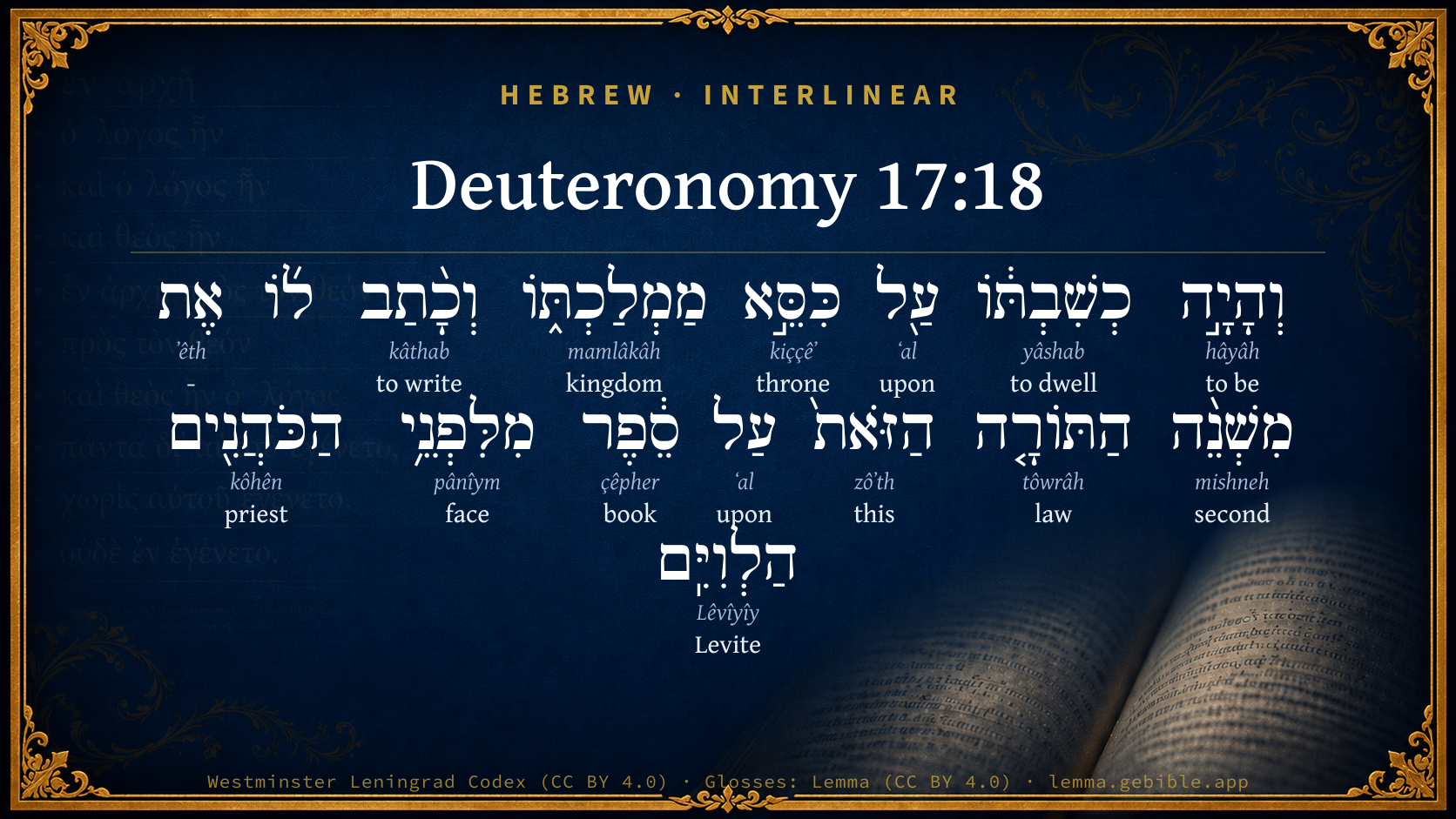
Deuteronomy 17:18

Hebrew (Westminster Leningrad Codex) Deuteronomy 17:18 appears in the Hebrew Old Testament. The text above is from the Westminster Leningrad Codex. Each word links to its Strong’s number, a concise gloss, and parsing drawn from the Open Scriptures Hebrew Bible morphology. Click any word for its full Brown-Driver-Briggs (BDB) entry.
Download image
Cite this verse

Deuteronomy 17:18 (World English Bible). Public Domain. Lemma interlinear Bible study tool, https://lemma.gebible.app/v/deuteronomy/17/18.

Show BibTeX & RIS
BibTeX
RIS
English Translation
It shall be, when he sits on the throne of his kingdom, that he shall write him a copy of this law in a book, out of [that which is] before the priests the Levites:
World English Bible · Public Domain
Download a study sheet

One document with this verse’s original text, its word-by-word gloss line, the meaning frame, cross-references with their text, attributed commentary, and full source and license credits — printable, and it pastes into notes with its structure intact.

This verse Autodidact and up

Study sheet (.html) Plain text (.txt)

A passage Seminary Student

Up to 50 verses in one chapter. A passage sheet keeps up to 6 commentary sources and 12 cross-references per verse, in the order this page ranks them, and says so on the sheet whenever that leaves anything out. Ask for a single verse and you get the Autodidact verse sheet above.

Everything on this page stays free to read, with no account — the sheet is a download of what is already on screen, not access to it.

Want to remove ads? Support Godless Engineer
Compare translations 3

The same verse in 3 English versions, stacked beneath the original-language interlinear above. Click any original word for its lexicon entry.

Each is an independent rendering of the whole verse — the interlinear is not word-aligned to these translations.

Highlighted words mark where these versions differ — a whole-verse word diff, not a word-by-word alignment.

  • World English Bible Public Domain
    It shall be, when he sits on the throne of his kingdom, that he shall write him a copy of this law in a book, out of [that which is] before the priests the Levites:
  • King James Version Public Domain
    And it shall be, when he sitteth upon the throne of his kingdom, that he shall write him a copy of this law in a book out of that which is before the priests the Levites:
  • unfoldingWord Literal Text CC BY-SA 4.0
    And it will be, when he sits on the throne of his kingdom, then he shall write for himself in a scroll a copy of this law from to the faces of the priests, the Levites,

unfoldingWord Literal Text — © unfoldingWord, licensed CC BY-SA 4.0. Word-aligned USFM3 via Door43 (git.door43.org/unfoldingWord/en_ult).

Versions to compare (up to 4)

3 of 4 selected

Show all 18 translations

Every available English version of this verse, each an independent rendering of the whole verse.

  • World English Bible Public Domain
    It shall be, when he sits on the throne of his kingdom, that he shall write him a copy of this law in a book, out of [that which is] before the priests the Levites:
  • Berean Standard Bible Public Domain
    When he is seated on his royal throne, he must write for himself a copy of this instruction on a scroll in the presence of the Levitical priests.
  • Majority Standard Bible Public Domain
    When he is seated on his royal throne, he must write for himself a copy of this instruction on a scroll in the presence of the Levitical priests.
  • King James Version Public Domain
    And it shall be, when he sitteth upon the throne of his kingdom, that he shall write him a copy of this law in a book out of that which is before the priests the Levites:
  • American Standard Version (1901) Public Domain
    And it shall be, when he sitteth upon the throne of his kingdom, that he shall write him a copy of this law in a book, out of `that which is' before the priests the Levites:
  • Revised Version (1885) Public Domain
    And it shall be, when he sitteth upon the throne of his kingdom, that he shall write him a copy of this law in a book, out of that which is before the priests the Levites:
  • Geneva Bible (1599) Public Domain
    And when he shall sit vpon the throne of his kingdo, then shall he write him this Law repeted in a booke, by the Priests of the Leuites.
  • Douay-Rheims (1899) Public Domain
    But after he is raised to the throne of his kingdom, he shall copy out to himself the Deuteronomy of this law in a volume, taking the copy of the priests of the Levitical tribe,
  • Young's Literal Translation Public Domain
    `And it hath been, when he sitteth on the throne of his kingdom, that he hath written for himself the copy of this law, on a book, from `that' before the priests the Levites,
  • Literal Standard Version CC BY-SA 4.0
    And it has been, when he sits on the throne of his kingdom, that he has written a copy of this law for himself, on a scroll, from [that] before the priests, the Levites,
  • Unlocked Literal Bible CC BY-SA 4.0
    When he sits on the throne of his kingdom, he must write for himself in a scroll a copy of this law, from the law that is before the priests, who are Levites.
  • unfoldingWord Literal Text CC BY-SA 4.0
    And it will be, when he sits on the throne of his kingdom, then he shall write for himself in a scroll a copy of this law from to the faces of the priests, the Levites,
  • Darby Bible Public Domain
    And it shall be, when he sitteth upon the throne of his kingdom, that he shall write for himself a copy of this law in a book out of that which is before the priests, the Levites;
  • World Messianic Bible Public Domain
    It shall be, when he sits on the throne of his kingdom, that he shall write himself a copy of this law in a book, out of that which is before the Levitical priests.
  • Webster's Bible Public Domain
    And it shall be when he sitteth upon the throne of his kingdom, that he shall write him a copy of this law in a book out of that which is before the priests the Levites.
  • Free Bible Version CC BY-SA 4.0
    Once he is king and sits on his royal throne, he must make a copy for himself of these instructions, writing them on a scroll in the presence of the Levitical priests.
  • Bible in Basic English Public Domain
    And when he has taken his place on the seat of his kingdom, he is to make in a book a copy of this law, from that which the priests, the Levites, have in their care:
  • JPS Tanakh (1917) Public Domain
    And it shall be, when he sitteth upon the throne of his kingdom, that he shall write him a copy of this law in a book, out of that which is before the priests the Levites.

Literal Standard Version (2020), Covenant Press — licensed CC BY-SA 4.0. Text via the HelloAO Bible API (eBible.org). Unlocked Literal Bible (unfoldingWord) — licensed CC BY-SA 4.0. Text via the HelloAO Bible API (eBible.org). unfoldingWord Literal Text — © unfoldingWord, licensed CC BY-SA 4.0. Word-aligned USFM3 via Door43 (git.door43.org/unfoldingWord/en_ult). Free Bible Version, Dr. Jonathan Gallagher — licensed CC BY-SA 4.0. Text via the HelloAO Bible API (eBible.org).

Word by word

More ways to search: Search by grammar → Find every occurrence → Compare this word →

Practice this passage: Drill this verse → Learn its vocabulary →

מִשְׁנֵ֨ה
mishneh
H4932
“second of”
Noun, Common, Masculine, Singular, Construct
Part of Speech
Noun
Type
Common
Gender
Masculine
Number
Singular
State
Construct
Full BDB Definition

Origin: from H8138

TWOT: 2421c

double, copy, second, repetition - double - copy (of law) - second (in order) - second rank - second in age - second quarter or district
  1. וְהָיָ֣ה hâyâh H1961 “and · to be” Conjunction + Verb, Qal, Sequential Perfect, 3rd Person, Masculine, Singular
  2. כְשִׁבְתּ֔וֹ yâshab H3427 “like/as · to dwell · him” Preposition + Verb, Qal, Infinitive Construct + Suffix, Personal, 3rd Person, Masculine, Singular
  3. עַ֖ל ʻal H5921 “upon” Preposition
  4. כִּסֵּ֣א kiççêʼ H3678 “throne of” Noun, Common, Masculine, Singular, Construct
  5. מַמְלַכְתּ֑וֹ mamlâkâh H4467 “kingdom · his” Noun, Common, Feminine, Singular, Construct + Suffix, Personal, 3rd Person, Masculine, Singular
  6. וְכָ֨תַב kâthab H3789 “and · to write” Conjunction + Verb, Qal, Sequential Perfect, 3rd Person, Masculine, Singular
  7. אֶת ʼêth H853 “-” Particle, Direct Object
  8. הַתּוֹרָ֤ה tôwrâh H8451 “the · law” Particle, Definite Article + Noun, Common, Feminine, Singular, Absolute
  9. הַזֹּאת֙ zôʼth H2063 “the · this” Particle, Definite Article + Pronoun, Demonstrative, Feminine, Singular
  10. עַל ʻal H5921 “upon” Preposition
  11. סֵ֔פֶר çêpher H5612 “book” Noun, Common, Masculine, Singular, Absolute
  12. מִלִּפְנֵ֥י pânîym H6440 “from · to/for · face(s) of” Preposition + Preposition + Noun, Common, Both, Plural, Construct
  13. הַכֹּהֲנִ֖ים kôhên H3548 “the · priests” Particle, Definite Article + Noun, Common, Masculine, Plural, Absolute
  14. הַלְוִיִּֽם Lêvîyîy H3881 “the · Levites” Particle, Definite Article + Noun, Gentilic, Masculine, Plural, Absolute

About this verse

These counts appear in no published source. They are computed here, from the morphology-tagged text and Lemma’s own curated glosses. What Lemma adds →

16
words
14
distinct lemmas
Pentateuch
section

Shared distinctive vocabulary

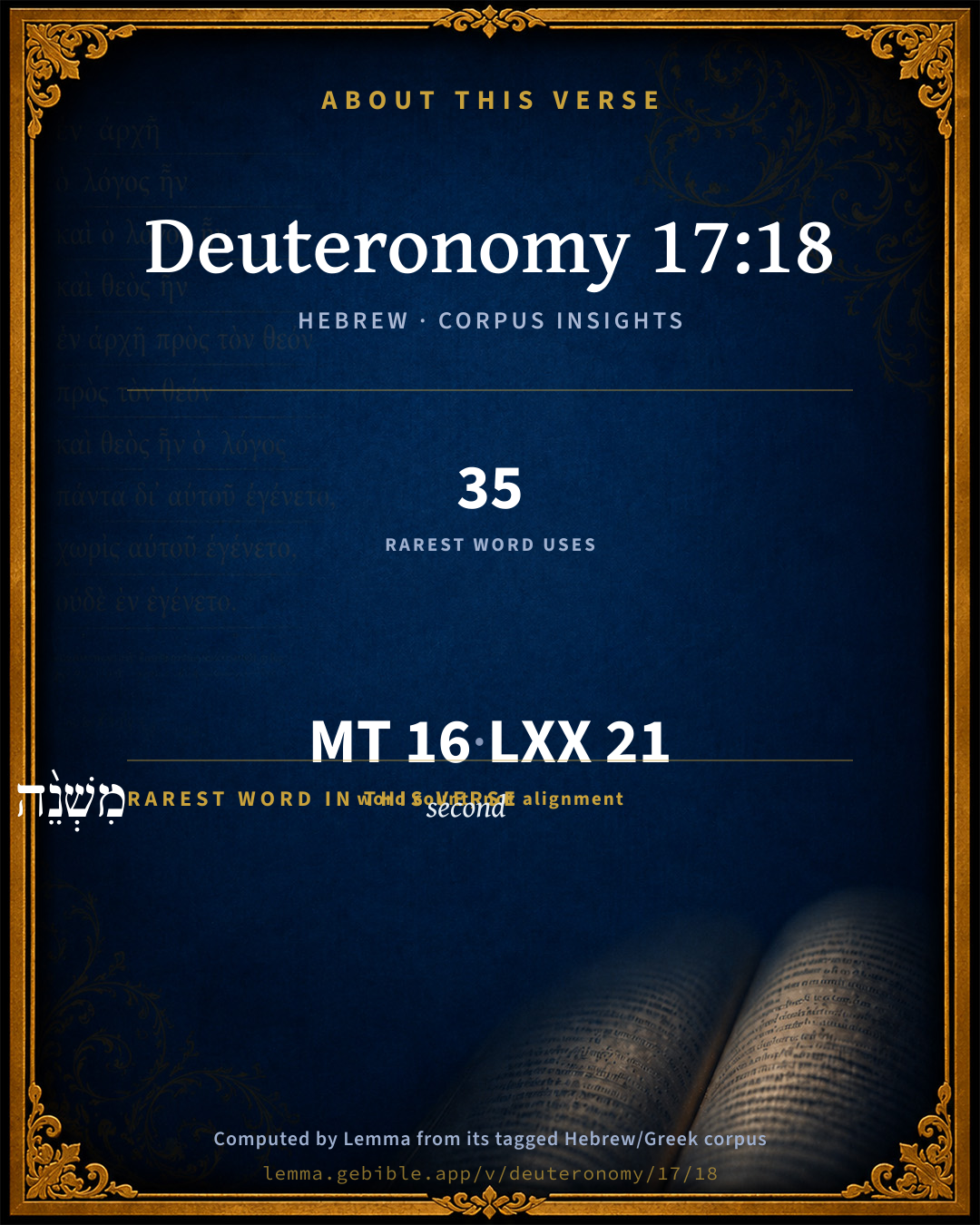
מִשְׁנֵ֨ה second H4932 occurs in 34 verses of the Hebrew Bible. Also found in:

Grammatical profile

  • 3 verbs
  • 8 nouns
  • 1 pronoun
  • 3 prepositions
  • 1 particle

Verb forms

  • וְהָיָ֣ה Qal · Sequential Perfect
  • כְשִׁבְתּ֔וֹ Qal · Infinitive Construct
  • וְכָ֨תַב Qal · Sequential Perfect

Repetition

A word recurs within this verse — often emphatic in Hebrew:

  • עַ֖ל upon H5921 ×2

Hebrew & Septuagint length

In English translation the verse runs 35 words from the Hebrew and 31 from the Septuagint (LXX English) — closely comparable.

A rough comparison of the two English renderings, which tokenize alike — not a word-level alignment.

Word counts can differ between the Hebrew and the Greek without any difference in meaning — e.g. the Hebrew direct-object marker אֵת has no separate Greek word, and Greek often adds the article ὁ.

In the original languages it is 16 Hebrew tokens and 21 Greek tokens — but the two are counted differently (Hebrew bundles its prefixes and suffixes into one token; the Greek is in lemma form), so that isn’t a like-for-like length.

Cross-references

5

Topical passages linked to Deuteronomy 17:18 in the Treasury of Scripture Knowledge — connected by theme and wording, ordered by reader-vote popularity; previews shown in the World English Bible.

  • Deuteronomy 31:9 Moses wrote this law, and delivered it to the priests the sons of Levi, who bore the ark of the covenant of Yahweh, and to all the elders of Israel.
  • Deuteronomy 31:24–26 It happened, when Moses had made an end of writing the words of this law in a book, until they were finished,
  • 2 Kings 11:12 Then he brought out the king's son, and put the crown on him, and [gave him] the testimony; and they made him king, and anointed him; and they clapped their hands, and said, [Long] live the king.
  • 2 Kings 22:8 Hilkiah the high priest said to Shaphan the scribe, I have found the book of the law in the house of Yahweh. Hilkiah delivered the book to Shaphan, and he read it.
  • 2 Chronicles 34:15 Hilkiah answered Shaphan the scribe, I have found the book of the law in the house of Yahweh. Hilkiah delivered the book to Shaphan.

Cross-references courtesy of OpenBible.info (CC BY 4.0).

Hebrew and Greek witnesses Masoretic Hebrew ↔ Greek Septuagint

The same verse in the two great witnesses to the Old Testament, shown verse-for-verse.

These are two independent witnesses, not word-aligned to each other, and the Septuagint is shown in lemma (dictionary) form.

Hebrew Deuteronomy 17:18 Masoretic · Westminster Leningrad Codex

וְהָיָ֣ה כְשִׁבְתּ֔וֹ עַ֖ל כִּסֵּ֣א מַמְלַכְתּ֑וֹ וְכָ֨תַב ל֜וֹ אֶת מִשְׁנֵ֨ה הַתּוֹרָ֤ה הַזֹּאת֙ עַל סֵ֔פֶר מִלִּפְנֵ֥י הַכֹּהֲנִ֖ים הַלְוִיִּֽם

It shall be, when he sits on the throne of his kingdom, that he shall write him a copy of this law in a book, out of [that which is] before the priests the Levites:

World English Bible · Public Domain

Greek LXX Deuteronomy 17:18 Septuagint · lemma form

καί εἰμί ὅταν καταἵζω ἐπί ὁ ἀρχή αὐτός καί γράφω ἑαυτοῦ ὁ δευτερονόμιον οὗτος εἰς βιβλίον παρά ὁ ἱερεύς ὁ λευίτης

And when he shall be established in his government, then shall he write for himself this repetition of the law into a book by the hands of the priests the Levites;

LXX2012 (modern English Septuagint) · Public Domain

On this verse, Adam Clarke's Commentary discusses the Septuagint’s reading. Read the note in Commentary ↓

Hebrew: Westminster Leningrad Codex (CC BY 4.0). Greek: Septuagint (public domain); English from LXX2012 (modern English Septuagint) (Public Domain). How the Septuagint differs from the Hebrew →

Targum (Aramaic paraphrase)

2

The Targum is the ancient Jewish Aramaic paraphrase of the Hebrew Scriptures — an interpretive translation, not the Hebrew text itself. Onkelos (literal) and Pseudo-Jonathan (expansive) render the Torah, and Jonathan the Prophets. Coverage is partial: where no permissively-licensed English translation exists for a verse, only the Aramaic is shown. This is verse-level text, not a word-by-word alignment to the Hebrew.

  1. Targum Onkelos Torah (Genesis–Deuteronomy)
    וִיהֵי כְמִתְּבֵהּ עַל כָּרְסָא מַלְכוּתֵהּ וְיִכְתּוֹב לֵהּ יָת פַּתְשֶׁגֶן אוֹרַיְתָא הָדָא עַל סִפְרָא מִן קֳדָם כָּהֲנַיָא לֵוָאֵי

    (no public-domain English translation for this verse)

    Targum Onkelos — Aramaic: “Onkelos Genesis” (public domain); “Onkelos Exodus” (public domain); “Onkelos Leviticus” (public domain); “Onkelos Numbers” (public domain); “Onkelos Deuteronomy” (public domain). English: “Sefaria Community Translation” (CC0 1.0 (public-domain dedication)); “J.W. Etheridge. The Targums of Onkelos and Jonathan Ben Uzziel on the Pentateuch. London: Longmans, Green, 1862” (public domain). Text via Sefaria.

  2. Targum Pseudo-Jonathan Torah (Genesis–Deuteronomy)
    וִיהֵי אִין נְיַיח הוּא בְּמִצְוָותָא דְאוֹרַיְיתָא יָתֵיב לְרוֹחֲצָן עַל כּוּרְסֵי מַלְכוּתֵיהּ וְיִכְתְּבוּן לֵיהּ סָבַיָא יַת פַּרְשָׁא אוֹרַיְיתָא הָדָא עַל סִפְרָא מִן קֳדָם כַּהֲנַיָא דְּמִן שֵׁבֶט לֵוִי

    And it shall be that if he be steadfast in the commandments of the law he shall sit upon the throne of his kingdom in security. And let the elders write for him the section (pharasha) of this law in a book before the priests of the tribe of Levi;

    Targum Pseudo-Jonathan — Aramaic: “Targum Jonathan on Genesis” (public domain); “Targum Jonathan on Exodus” (public domain); “Targum Jonathan on Leviticus” (public domain); “Targum Jonathan on Numbers” (public domain); “Targum Jonathan on Deuteronomy” (public domain). English: “The Targum of Jonathan ben Uzziel, trans. J. W. Etheridge, London, 1862” (public domain). Text via Sefaria.

Commentary

Notes on Deuteronomy 17:18 from classic Christian and Jewish commentators (each source and its license shown beneath its notes). The classic Christian expositions comment on the surrounding passage and are grouped to its opening verse, so a note may address several verses; the Jewish commentaries on the Tanakh (Rashi and others) are per-verse, so they appear only where the commentator wrote on this verse.

Lemma curates 59 commentaries, every one of them public domain or Creative Commons licensed, each selected and text-cleaned for this edition rather than reprinted as found. About our sources →

Trapp's Complete Commentary

John Trapp

Deu 17:18 And it shall be, when he sitteth upon the throne of his kingdom, that he shall write him a copy of this law in a book out of [that which is] before the priests the Levites:

Ver. 18. He shall write him a copy.] The Jews say, that if printing had been found out then, yet was the king bound to write two copies of the law with his own hand, one to keep in the treasury, and another to carry about him. This book of God was David’s delight. {Psa 119:70} Alphonsus, king of Aragon, is reported to have read over the Bible fourteen times, with Lyra’s notes upon it. Charles the Wise, of France, not only caused the Bible to be translated into French, as our King Alfred translated the Psalter himself into his Saxon tongue, but was also very studious in the Holy Scripture. And that peerless princess, Queen Elizabeth, as she passed in triumphal state through the streets of London after her coronation, when the Bible was presented to her at the little conduit in Cheapside, received the same with both her hands, and kissing it, laid it to her breasts, saying, that the same had ever been her chiefest delight, and should be the rule whereby she meant to frame her government. {a}

{a} Speed’s Hist.

John Trapp, A Commentary or Exposition upon All the Books of the Old and New Testament (1647–1656) — public domain. Text from a community e-Sword module.

The Biblical Illustrator

Joseph S. Exell

Deu_17:18-19

He shall read therein.

How we may read the Scriptures with most spiritual profit

The Holy Scripture is, as Austin saith, a golden epistle sent to us from God. This is to be read diligently. Ignorance of Scripture is the mother of error, not devotion. Ye do err, not knowing the Scriptures (Mat_22:29). We are commanded to search the Scriptures (Joh_5:39). The Greek word signifies to search as for a vein of silver. How diligently doth a child read over his fathers will and testament, and a citizen peruse his charter! With the like diligence should we read Gods Word, which is our Magna Charta for heaven. It is a mercy the Bible is not prohibited. Trajan, the emperor, forbade the Jews to read in the book of the law. But there is no danger of touching this tree of Holy Scriptures; if we do not eat of this tree of knowledge we shall surely die.

I. Remove those things which will hinder your profiting.

1. Remove the love of every sin. The body cannot thrive in a fever; nor can the soul under the feverish heat of lust.

2. Take heed of the thorns which will choke the Word read. A covetous man is a pluralist; he hath such diversity of secular employments, that he can scarce find time to read; or if he doth, what solecisms doth he commit in reading! While his eye is upon the Bible, his heart is upon the world; it is not the writings of the apostles he is so much taken with, as the writings in his account book. Is this man likely to profit? You may as soon extract oils and syrups out of a flint, as he any real benefit out of Scripture.

3. Take heed of jesting with Scripture. This is playing with fire.

II. Prepare your hearts to the reading of the Word. The heart is an instrument that needs putting in tune. This preparation to reading consists in two things--

1. In summoning our thoughts together to attend that solemn work we are going about. The thoughts are stragglers; therefore rally them together.

2. In purging out those unclean affections which do indispose us to reading. Many come rashly to the reading of the Word; and no wonder, if they come without preparation, that they go away without profit.

III. Read the scripture with reverence. Think every line you read God is speaking to you. When Ehud told Eglon he had a message to him from God, he arose from his throne (Jdg_3:20). The Word written is a message to us from Jehovah; with what veneration should we receive it!

IV. Read the books of scripture in order. Though occurrences may sometimes divert our method, yet for a constant course it is best to observe an order in reading. Order is a help to memory: we do not begin to read a friends letter in the middle.

V. Get a right understanding of Scripture (Psa_119:73). If the Word shoot above our head, it can never hit our heart.

VI. Read the Word with seriousness. Well may we be serious if we consider the importance of those truths which are bound up in this sacred volume. It is not a vain thing for you, because it is your life (chap. 32:47). If a letter were to be broken open and read, wherein a mans whole estate were concerned, how serious would he be in reading of it! In the Scripture our salvation is concerned; it treats of the love of Christ, a serious subject (Tit_3:4).

VII. Labour to remember what you read. The memory should be like the chest in the ark, where the law was put. Some can better remember a piece of news than a line of Scripture; their memories are like those ponds where the frogs live, but the fish die.

VIII. Meditate upon what you read. Meditation is the bellows of the affections: While I was musing the fire burned (Psa_39:3). The reason we come away so cold from reading the Word is, because we do not warm ourselves at the fire of meditation.

IX. Come to the reading of Scripture with humble hearts. An arrogant person disdains the counsels of the Word, and hates the reproofs; is he likely to profit? God giveth grace unto the humble (Jam_4:6). The most eminent saints have been but of low stature in their own eyes; like the sun in the zenith, they showed least when they were at the highest.

X. Give credence to the Word written. Believe it to be of God; see the name of God in every line. The Romans, that they might gain credit to their laws, reported that they were inspired by the gods at Rome. Believe the Scripture to be Divinely inspired. Whence should the Scripture come, if not from God?

1. Sinners could not be the authors of Scripture. Would they indite such holy lines? or inveigh so fiercely against those sins which they love?

2. Saints could not be the authors of Scripture. How could it stand with their sanctity to counterfeit Gods name, and put Thus saith the Lord to a book of their own devising?

3. Angels could not be the authors of Scripture. What angel in heaven durst personate God, and say, I am the Lord? Believe the pedigree of Scripture to be sacred, and to come from the Father of lights.

XI. Highly prize the Scriptures (Psa_119:72). St. Gregory calls the Bible the heart and soul of God. It is the library of the Holy Ghost. It is the compass by which the rudder of our wheel is to be steered; it is the field in which Christ, the Pearl of price, is hid; it is a rock of diamonds; it is a sacred eye-salve; it mends their eyes that look upon it; it is a spiritual optic-glass in which the glory of God is resplendent; it is the universal medicine for the soul.

XII. Get an ardent love to the word. Prizing relates to judgment, love to the affections. Consider how I love Thy precepts (Psa_119:159; Rom_7:22). He is likely to grow rich who delights in his trade; a lover of learning will be a scholar. St. Austin tells us, before his conversion he took no pleasure in the Scriptures, but afterwards they were his chaste delights.

XIII. Come to the reading of the Word with honest hearts.

1. Willing to know the whole counsel of God.

2. Desirous of being made better by it.

XIV. Learn to apply scripture. Take every word as spoken to yourselves.

XV. Observe the preceptive part of the Word, as well as the permissive. Such as east their eye upon the promise, with a neglect of the command, are not edified by Scripture; they look more after comfort than duty. The body may be swelled with wind as well as flesh: a man may be filled with false comfort, as well as that which is genuine and real.

XVI. Let your thoughts dwell upon the most material passages of Scripture. The bee fastens on those flowers where she may suck most sweetness. Though the whole contexture of Scripture is excellent, yet some parts of it may have a greater emphasis, and be more quick and pungent.

XVII. Compare yourselves with the word. See how the Scripture and your hearts agree, how your dial goes with this sun. Are your hearts, as it were, a transcript of Scripture? Is the Word copied out into your hearts?

XVIII. Take special notice of those scriptures which speak to your particular case. Were a consumptive person to read Galen or Hippocrates, he would chiefly observe what they writ about a consumption. Great regard is to be had to those paragraphs of Scripture which are most apposite to ones present case. I shall instance only in three cases--

1. Affliction.

2. Desertion.

3. Sin.

XIX. Take special notice of the examples in scripture. Make the examples of others living sermons to you.

1. Observe the examples of Gods judgments upon sinners. They have been hanged up in chains in terrorem.

2. Observe the examples of Gods mercy to saints. Jeremy, was preserved in the dungeon, the three children in the furnace, Daniel in the lions den. These examples are props to faith, spurs to holiness.

XX. Leave not off reading in the bible till you find your hearts warmed.

XXI. Set upon the practice of what you read. I have done Thy commandments (Psa_119:166). A student in physic doth not satisfy himself to read over a system or body of physic, but he falls upon practising physic: the life-blood of religion lies in the practical part. So, in the text: He shall read in the book of the law all the days of his life; that he may learn to keep all the words of this law and these statutes, to do them. Christians should be walking Bibles.

XXII. Make use of Christs prophetical office. He is the Lion of the tribe of Judah, to whom it is given to open the book of God, and to loose the seven seals thereof (Rev_5:5). Christ doth so teach as He doth quicken.

XXIII. Tread often upon the threshold of the sanctuary. Ministers are Gods interpreters; it is their work to expound dark places of Scripture. We read of pitchers, and lamps within the pitchers (Jdg_7:16). Ministers are earthen pitchers (2Co_4:7). But these pitchers have lamps within them, to light souls in the dark.

XXIV. Pray that God will make you profit. I am the Lord thy God, which teacheth thee to profit (Isa_48:17). Make Davids prayer: Open Thou mine eyes, that I may behold wondrous things out of Thy law (Psa_119:18). Pray to God to take off the veil on the Scripture, that you may understand it; and the veil on your heart, that you may believe it. Pray that God will not only give you His Word as a rule of holiness, but His grace as a principle of holiness. I shall conclude all with two corollaries--

1. Content not yourselves with the bare reading of Scripture, but labour to find some spiritual increment and profit. Get the Word transcribed into your hearts: The law of his God is in his heart (Psa_37:31). Never leave till you are assimilated into the Word. Such as profit by reading of the Book of God are the best Christians alive; they answer Gods cost, they credit religion, they save their souls.

2. You who have profited by reading the Holy Scriptures, adore Gods distinguishing grace. (T. Watson, M. A.)

.

The Biblical Illustrator, edited by Joseph S. Exell (c. 1880s–1900s) — public domain. Text from a community e-Sword module.

Joseph Benson's Commentary

Deu 17:18-19. He shall write — With his own hand, say the Jews. Out of that which is before the priests — Out of that original, which was carefully kept by the priests in the sanctuary, that it might be a perfect copy, and that it might have the greater influence upon him, coming to him as from the hand and presence of God. He shall read therein — Diligently and constantly: neither the greatness of his place, nor the weight and multitude of his business, shall excuse or hinder him; all the days of his life — It is not enough to have Bibles, but we must use them, yea, use them daily. Our souls must have constant meals of that manna, which, if well digested, will afford them true nourishment and strength.

Joseph Benson's Commentary on the Old and New Testaments (1811–1818) — public domain. Text from a community e-Sword module.

Tyndale Open Study Notes

Tyndale Open Resources

17:18 This body of instruction (literally this torah) refers to the book of Deuteronomy or perhaps only to this passage concerning the Israelite monarchy. For torah, see study note on 4:44.

Tyndale Open Study Notes — © Tyndale Open Resources, licensed CC BY-SA 4.0. Text via the HelloAO Bible API.

Geneva Bible (1599)

Geneva Bible translators

Meaning, the Deuteronomy.

He shall cause it to be written by them, or he shall write it by their example.

Geneva Bible (1599) marginal notes — public domain. Text via Bolls.life.

Jamieson, Fausset & Brown

Robert Jamieson, A. R. Fausset & David Brown

he shall write him a copy of this law in a book--The original scroll of the ancient Scriptures was deposited in the sanctuary under the strict custody of the priests (see on Deu 31:26; Kg2 22:8). Each monarch, on his accession, was to be furnished with a true and faithful copy, which he was to keep constantly beside him, and daily peruse it, that his character and sentiments being cast into its sanctifying mould, he might discharge his royal functions in the spirit of faith and piety, of humility and a love or righteousness.

Jamieson, Fausset & Brown — Commentary Critical and Explanatory on the Whole Bible (1871) — public domain (CC PDM 1.0). Text via the HelloAO Bible API.

Adam Clarke's Commentary

Verse 18. He shall write him a copy of this law] משנה התורה הזאת mishneh hattorah hazzoth, an iteration or duplicate of this law; translated by the Septuagint, το δευτερονομιον τουτο this deuteronomy. From this version both the Vulgate Latin and all the modern versions have taken the name of this book; and from the original word the Jews call it Mishneh. See the preface to this book.

Out of that which is before the priests the Levites] It is likely this means, that the copy which the king was to write out was to be taken from the autograph kept in the tabernacle before the Lord, from which, as a standard, every copy was taken and with which doubtless every copy was compared; and it is probable that the priests and Levites had the revising of every copy that was taken off, in order to prevent errors from creeping into the sacred text.

Adam Clarke's Commentary on the Bible (1810–1826) — public domain. Text from a community e-Sword/MySword module.

Ellicott's Commentary for English Readers

(18) He shall write him a copy of this law.—This phrase is the source of the Greek title of the book, Deuteronomion, or in English, Deuteronomy. The word appears also in Jos_8:32. The English conveys the right sense of the word, which primarily denotes repetition. In Hebrew it is Mishneh, the name afterwards given to the “text” of the Talmud, of which the idea is to repeat the law; though it is a somewhat peculiar repetition, in which minutiœ are chiefly dealt with, and weightier matters left out.

There are traces of this direction (1) in the coronation of Joash (2Ch_23:11, “they gave him the testimony;” (2) in the reign of Jehoshaphat, who had the Book of the Law taught to his people (2Ch_17:9); and (3) in the delivery of the book when discovered in the Temple to Josiah (2Ch_34:18), and in the effect of the perusal of it upon that king. But it is singular that we do not hear of the Book of the Law in connection with David and Solomon. Possibly, as David was a prophet himself, and not only a king, it may be thought unnecessary to make special mention of his study of the law. In many things he acted upon the direct commands of God to himself or to his seers.

We must not forget that the true king of Israel is He whose special mission it was “to fulfil the law and the prophets.” “Lo, I come, in the volume of the book it is written of me, I delight to do thy will, O my God: yea, thy law is within my heart.”

A Bible Commentary for English Readers, edited by Charles John Ellicott (1878–1897) — public domain. Text from a community e-Sword module.

The Cambridge Bible for Schools and Colleges

gen. ed. J. J. S. Perowne

18. a copy of this law] Lit. a duplicate of what was before, or in charge of, the priests (Deu_31:9; Deu_31:26). Here we have the beginning of that confidence in written revelation and the canon which brought so much good and evil to the religious life of Israel. On the mistranslation of this phrase by the LXX in the title they gave to the whole book see Introd. § 1.

The Cambridge Bible for Schools and Colleges (gen. ed. J. J. S. Perowne; Cambridge University Press, 1878–1918) — public domain. Text from a community e-Sword module.

John Gill's Exposition

And it shall be, when he sitteth upon the throne of his kingdom,.... When he is settled on it, and is even amidst all the pomp and glory of it: that he shall write him a copy of this law in a book; which copy the Septuagint and Vulgate Latin versions interpret of this book of Deuteronomy, which is a summary abstract and repetition of the various laws of God to the people of Israel; though the Jewish writers commonly understand it of the whole Pentateuch, the five books of Moses; which perhaps may be enlarging it too much, as it would be reducing it to too little to restrain it to this law concerning kings, as the Targum of Jonathan. The word "Mishneh", rendered "copy", signifies "double"; hence some take it to mean a double exemplar or copy of the law he was obliged to write out, whereby it would be the more imprinted on his mind, and he would be furnished with it for his use at home and abroad, as the Jewish writers observe; so Jarchi by the copy understands two books of the law, one to be left in his treasury, the other to go out and in with him. The same is said in the Talmud (m), and with which Maimonides (n) agrees, whose words are,"at the time a king sits on the throne of his kingdom, he writes for himself a book of the law, besides what his fathers left him; and he copies it out of the book of the court by the order of the sanhedrim of seventy one; if his fathers have left him none, or it is lost, he writes two books of the law, one he leaves in the house of his treasures, which he is commanded, as everyone of Israel is, and the second never departs from him;''but one may seem sufficient on all occasions, and for all purposes; and this was to be wrote out of that which is before the priests and Levites; the original copy of it, which was deposited in the side of the ark; see Deu 31:26.

(m) T. Bab. Sanhedrn, fol. 21. 2. (n) Ut supra (Maimon. Hilchot Sanhedrin, c. 2.), sect. 1.

John Gill's Exposition of the Whole Bible (1746–1763) — public domain (CC PDM 1.0). Text via the HelloAO Bible API.

Albert Barnes' Notes on the Bible

It is in striking consistency with the dignity which everywhere throughout the Mosaic legislation surrounds the chosen people of God, that even if they will be “like as all the nations about” Deu 17:14, and be governed by a king, care should nevertheless be taken that he shall be no Oriental despot. He is to be of no royal caste, but “one from among thy brethren” Deu 17:15; he is to bear himself as a kind of “primus inter pares,” his heart “not being lifted up above his brethren” Deu 17:20; he is, like his subjects, to be bound by the fundamental laws and institutions of the nation, and obliged, as they were, to do his duty in his station of life with constant reference thereto. The spirit of the text is that of Mat 23:9.

A copy of this law - The whole Pentateuch, or, at any rate, the legal portion of the Pentateuch.

A book ... before the priests the Levites - Compare the marginal reference.

Albert Barnes' Notes on the Bible (1834–1885) — public domain. Text from a community e-Sword/MySword module.

Haydock's Catholic Bible Commentary

Of this law, perhaps from the 14th verse to the end of the chapter (Haydock) or the whole Book of Deuteronomy, which contains an abridgment of the law, (Josue viii. 32.; Menochius) or even the five books, which were formerly written without any division, and went under the name of the law. (Grotius; &c.) --- Hebrew seems favourable to this last opinion, (Calmet) "he shall write a copy of this law in a book, out of that which is kept by the priests," unless Moses might only require that he should have a copy of what he was then delivering. (Haydock) --- Some say that the king was obliged to take two copies, one of which he was to have always about him. It is not certain whether he was obliged to write himself, as Philo asserts, or another might do it for him. The diadem and the law were presented to Joas, when he ascended the throne, 2 Paralipomenon xxiii. 11. (Calmet) --- If (Haydock) Josias had not seen a copy of the law before the 18th year of his reign, this precept must have been very ill observed, 4 Kings xxii. 11. (Calmet) --- But, very probably, that book, which Helcias discovered in the temple, was the autograph of Moses, and therefore made a deeper impression upon all who saw and heard it read, than if it had been read than if it had been only an ordinary copy. This copy might have been mislaid or secreted in those troublesome times; and then the high priest brought it to light again, he as well as the king and all the people, were filled with joy and amazement. (Haydock) --- It was the custom of the Jews to present a copy of the law to their kings, when they first sat upon the throne; and hence, perhaps, they make a similar present to the Pope, when he goes to take possession of the Lateran church. (Morus.) --- They presented one to Innocent II when he made his entry into Paris, 1146, and another to king Louis the Fat, as Suger informs us. (Calmet) --- Priests. Temporal princes who desire to become virtuous and wise, will ever take the law of God at the priest’s hands. (Worthington)

George Leo Haydock (1774–1849), Haydock's Catholic Family Bible and Commentary, 1859 edition — public domain. Excludes Psalms (Douay-Rheims chapter numbering differs from Protestant) and Deuterocanonical books (Catholic canon only).

Matthew Poole's English Annotations

He shall write; either with his own hand, as the Jews say; or, at least, by his command and procurement.

Out of that which is before the priests the Levites, i.e. out of the original, which was carefully kept by the priests in the sanctuary, Deu 31:26; 2Ki 22:8, partly that it might be a true and perfect copy, and partly that it might have the greater authority and influence upon him, coming to him as from the hand and presence of God.

Matthew Poole's English Annotations on the Holy Bible (1683–1685) — public domain. Text from a community e-Sword/MySword module.

Whedon's Commentary on the Bible

Daniel D. Whedon

18. A copy of this law — Moses designs to provide for a holy king. The people might be like the nations around them in having a king, but the king was to be unlike the rulers of other nations. With this law to teach him, if properly heeded, his heart would not be lifted up above his brethren. He would turn aside from the commandment neither to the right nor to the left. The king whom Jehovah is to choose appears in marked contrast with the Eastern despots, who arrogated to themselves supremacy above all. They demanded adoration as if they were divine. The heart of Israel’s king is not to be so lifted up.

Daniel D. Whedon (gen. ed.), Commentary on the Old and New Testaments (1874–1909) — public domain. Text from a community e-Sword module.

The Pulpit Commentary

A copy of this law; literally, a double of this Law, i.e. not, as the LXX have it, "This reiteration of the Law" (tomion touto), but a duplicate or copy of the Pentateuchal Law. The Jews understand by "double" that two copies of the Law were to be made by the king (Maimon., "De Regibus," e. 3. but this is unnecessary: every copy of a law is a double of it. Oat of that which is before the priests. The priests were the custodians of the written Law; (Deu_31:26) and from the text of their codex was the king"s copy to be written.

The Pulpit Commentary (1880–1919), ed. H.D.M. Spence-Jones & Joseph S. Exell — public domain. Text from a community e-Sword module.

John Wesley's Explanatory Notes

He shall write - With his own hand, as the Jews say. Out of that - Out of the original, which was carefully kept by the priests in the sanctuary, that it might be a perfect copy, and that it might have the greater influence upon him, coming to him as from the hand and presence of God.

John Wesley, Explanatory Notes Upon the Whole Bible (1754–1765) — public domain. Text via the GEBible commentary corpus.

Keil & Delitzsch

C. F. Keil & F. Delitzsch

And thirdly, instead of hanging his heart upon these earthly things, when he at upon his royal throne he was to have a copy of the law written out by the Levitical priests, that he might keep the law by him, and read therein all the days of his life. כּתב does not involve writing with his own hand (Philo), but simply having it written. הזּאת התּורה משׁנה does not mean τὸ δευτερονόμιον τοῦτο (lxx), "this repetition of the law," as הזּאת cannot stand for הזּה; but a copy of this law, as most of the Rabbins correctly explain it in accordance with the Chaldee version, though they make mishneh to signify duplum, two copies (see Hvernick, Introduction). - Every copy of a book is really a repetition of it. "From before the priests," i.e., of the law which lies before the priests or is kept by them. The object of the daily reading in the law (Deu 17:19 and Deu 17:20) was "to learn the fear of the Lord, and to keep His commandments" (cf. Deu 5:25; Deu 6:2; Deu 14:23), that his heart might not be lifted up above his brethren, that he might not become proud (Deu 8:14), and might not turn aside from the commandments to the right hand or to the left, that he and his descendants might live long upon the throne.

Keil & Delitzsch — Biblical Commentary on the Old Testament (1861–1891) — public domain (CC PDM 1.0). Text via the HelloAO Bible API. (Old Testament only.)

unfoldingWord translationNotes

Door43 World Missions Community

When he sits on the throne of his kingdom

Here "throne" represents the person's power and authority as king. To sit on the throne means to become king. AT: "When he becomes king" (See: Metonymy)

he must write for himself in a scroll a copy of this law

Possible meanings are 1) "he must personally write in a scroll a copy of this law for himself" or 2) "he must appoint someone to write in a scroll a copy of this law for him"

from the law that is before the priests, who are Levites

"from the copy of the law that the Levitical priests keep"

so as to keep all the words of this law and these statutes, to observe them

These two phrases mean basically the same thing and emphasize that the king must obey all of God's law. (See: Parallelism)

translationWords

throne

kingdom

scroll

law

priest

Levi

life

honor

Yahweh

God

word

statute

unfoldingWord translationNotes — © Distant Shores Media and the Door43 World Missions Community, licensed CC BY-SA 4.0. Source: git.door43.org/Door43/en_tn.

Rashi

Rabbi Shlomo Yitzchaki (Rashi)

והיה כשבתו AND IT SHALL BE WHEN HE SITTETH [UPON THE THRONE OF HIS KINGDOM] — if he acts thus (as prescribed in the previous verses) he is worthy that his kingdom should endure (Sifrei Devarim 160:1).

את משנה התורה [HE SHALL WRITE HIM] A משנה תורה — i.e. two scrolls of the Law, one that is placed in his treasury and the other that goes out and comes in with him (i.e. a small scroll which he carries everywhere with him) (Sanhedrin 21b). Onkelos, however, renders משנה by פתשגן, a copy; he thus interpreted the word משנה in the sense of שנן, repeating and uttering.

Rashi on the Tanakh — English translations: “The Judaica Press complete Tanach with Rashi, translated by A. J. Rosenberg” (CC BY 4.0); “Pentateuch with Rashi's commentary by M. Rosenbaum and A.M. Silbermann, 1929-1934” (public domain); “The Metsudah Tanach series, Lakewood, N.J” (CC BY 4.0); and “The Book of Joshua, Metsudah Publications, 1997” (CC BY 4.0). Text via Sefaria.

Lesson kit

Teaching starters — assembled from the data on this page, not authored interpretation. Every prompt links to the verse data it draws on. Edit before teaching.

Deuteronomy, in the Pentateuch, opens this verse with 16 words (14 distinct Hebrew lemmas). Its most distinctive word is mishneh (“second”). A historical commentator’s framing appears above. Read the whole chapter for the surrounding context.

Discussion questions

  1. What does “second” (mishneh) contribute to the verse as a whole?
  2. Genesis 41:43 shares the word «second» with this verse. How do the two illuminate each other?
  3. “upon” occurs 2× in this one verse. What is the effect of the repetition?
  4. These translations render this verse differently; the difference is in the English rendering, not the original. What questions does that raise?
  5. The verb «וְהָיָ֣ה» is Qal Sequential Perfect. How does its form color the action?
  6. Reading how Trapp's Complete Commentary and The Biblical Illustrator read this verse, where do the two commentators agree and where do they part?

Things to notice

Reading settings

Reading text

Shown beneath each verse's original-language words.

Old Testament
Old Testament edition

Read the OT as the Masoretic Hebrew (MT) or the Greek Septuagint (LXX).

English shown for the Greek Septuagint (in the Hebrew ↔ Greek comparison).

Comparing translations? Open the Compare panel on any verse page to stack up to four side by side.