Numbers 31:21

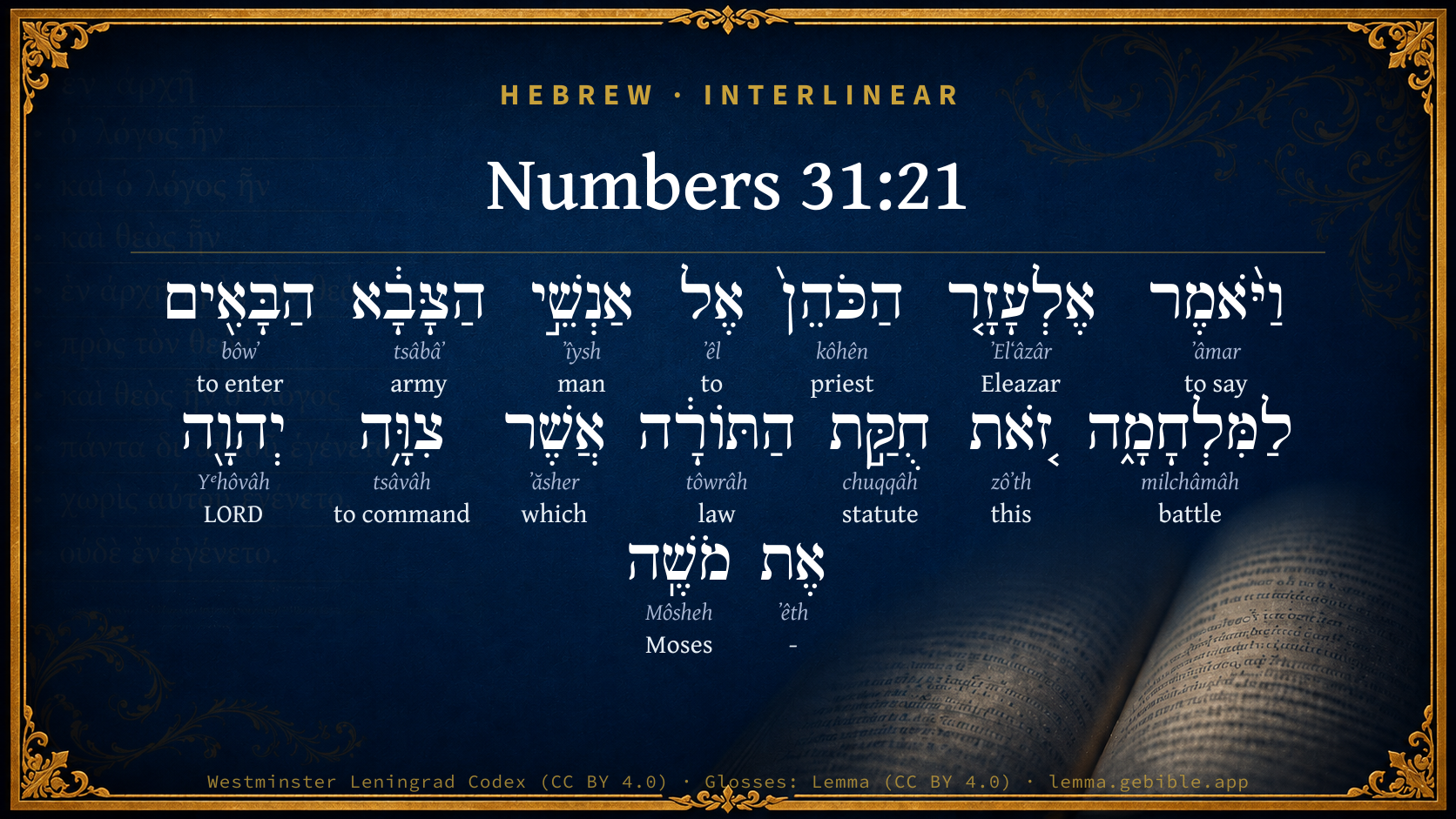
Hebrew (Westminster Leningrad Codex) Numbers 31:21 appears in the Hebrew Old Testament. The text above is from the Westminster Leningrad Codex. Each word links to its Strong’s number, a concise gloss, and parsing drawn from the Open Scriptures Hebrew Bible morphology. Click any word for its full Brown-Driver-Briggs (BDB) entry.
Download image
Cite this verse

Numbers 31:21 (World English Bible). Public Domain. Lemma interlinear Bible study tool, https://lemma.gebible.app/v/numbers/31/21.

Show BibTeX & RIS
BibTeX
RIS
English Translation
Eleazar the priest said to the men of war who went to the battle, This is the statute of the law which Yahweh has commanded Moses:
World English Bible · Public Domain
Download a study sheet

One document with this verse’s original text, its word-by-word gloss line, the meaning frame, cross-references with their text, attributed commentary, and full source and license credits — printable, and it pastes into notes with its structure intact.

This verse Autodidact and up

Study sheet (.html) Plain text (.txt)

A passage Seminary Student

Up to 50 verses in one chapter. A passage sheet keeps up to 6 commentary sources and 12 cross-references per verse, in the order this page ranks them, and says so on the sheet whenever that leaves anything out. Ask for a single verse and you get the Autodidact verse sheet above.

Everything on this page stays free to read, with no account — the sheet is a download of what is already on screen, not access to it.

Want to remove ads? Support Godless Engineer
Compare translations 3

The same verse in 3 English versions, stacked beneath the original-language interlinear above. Click any original word for its lexicon entry.

Each is an independent rendering of the whole verse — the interlinear is not word-aligned to these translations.

Highlighted words mark where these versions differ — a whole-verse word diff, not a word-by-word alignment.

  • World English Bible Public Domain
    Eleazar the priest said to the men of war who went to the battle, This is the statute of the law which Yahweh has commanded Moses:
  • King James Version Public Domain
    And Eleazar the priest said unto the men of war which went to the battle, This is the ordinance of the law which the LORD commanded Moses;
  • unfoldingWord Literal Text CC BY-SA 4.0
    And Eleazar the priest said to the men of the army who had gone to the battle, “This is a statute of the law that Yahweh has commanded Moses:

unfoldingWord Literal Text — © unfoldingWord, licensed CC BY-SA 4.0. Word-aligned USFM3 via Door43 (git.door43.org/unfoldingWord/en_ult).

Versions to compare (up to 4)

3 of 4 selected

Show all 18 translations

Every available English version of this verse, each an independent rendering of the whole verse.

  • World English Bible Public Domain
    Eleazar the priest said to the men of war who went to the battle, This is the statute of the law which Yahweh has commanded Moses:
  • Berean Standard Bible Public Domain
    Then Eleazar the priest said to the soldiers who had gone into battle, “This is the statute of the law which the LORD has commanded Moses:
  • Majority Standard Bible Public Domain
    Then Eleazar the priest said to the soldiers who had gone into battle, “This is the statute of the law which the LORD has commanded Moses:
  • King James Version Public Domain
    And Eleazar the priest said unto the men of war which went to the battle, This is the ordinance of the law which the LORD commanded Moses;
  • American Standard Version (1901) Public Domain
    And Eleazar the priest said unto the men of war that went to the battle, This is the statute of the law which Jehovah hath commanded Moses:
  • Revised Version (1885) Public Domain
    And Eleazar the priest said unto the men of war which went to the battle, This is the statute of the law which the LORD hath commanded Moses:
  • Geneva Bible (1599) Public Domain
    And Eleazar ye Priest sayd vnto the men of warre, which went to the battel, This is the ordinance of the law which the Lord commanded Moses,
  • Douay-Rheims (1899) Public Domain
    Eleazar also the priest spoke to the men of the army, that had fought, in this manner: This is the ordinance of the law, which the Lord hath commanded Moses:
  • Young's Literal Translation Public Domain
    And Eleazar the priest saith unto the men of the host who go in to battle, `This `is' the statute of the law which Jehovah hath commanded Moses:
  • Literal Standard Version CC BY-SA 4.0
    And Eleazar the priest says to the men of war who go to battle, “This [is] the statute of the law which YHWH has commanded Moses:
  • Unlocked Literal Bible CC BY-SA 4.0
    Eleazar the priest said to the soldiers who had gone to war, “This is a decreed law that Yahweh has given to Moses:
  • unfoldingWord Literal Text CC BY-SA 4.0
    And Eleazar the priest said to the men of the army who had gone to the battle, “This is a statute of the law that Yahweh has commanded Moses:
  • Darby Bible Public Domain
    And Eleazar the priest said to the men of war that had gone to the battle, This is the statute of the law which Jehovah hath commanded Moses.
  • World Messianic Bible Public Domain
    Eleazar the priest said to the men of war who went to the battle, “This is the statute of the law which the LORD has commanded Moses.
  • Webster's Bible Public Domain
    And Eleazar the priest said to the men of war who went to the battle, This is the ordinance of the law which the LORD commanded Moses;
  • Free Bible Version CC BY-SA 4.0
    Eleazar the priest told the soldiers who had gone into battle, “These are the legal regulations that the Lord has ordered Moses to be carried out:
  • Bible in Basic English Public Domain
    Then Eleazar the priest said to the men of war who had been to the fight, This is the rule of the law which the Lord has given to Moses:
  • JPS Tanakh (1917) Public Domain
    And Eleazar the priest said unto the men of war that went to the battle: 'This is the statute of the law which the LORD hath commanded Moses:

Literal Standard Version (2020), Covenant Press — licensed CC BY-SA 4.0. Text via the HelloAO Bible API (eBible.org). Unlocked Literal Bible (unfoldingWord) — licensed CC BY-SA 4.0. Text via the HelloAO Bible API (eBible.org). unfoldingWord Literal Text — © unfoldingWord, licensed CC BY-SA 4.0. Word-aligned USFM3 via Door43 (git.door43.org/unfoldingWord/en_ult). Free Bible Version, Dr. Jonathan Gallagher — licensed CC BY-SA 4.0. Text via the HelloAO Bible API (eBible.org).

Word by word

More ways to search: Search by grammar → Find every occurrence → Compare this word →

Practice this passage: Drill this verse → Learn its vocabulary →

אֶלְעָזָ֤ר
ʼElʻâzâr
H499
“Eleazar”
Noun, Proper
Part of Speech
Noun
Type
Proper
Full BDB Definition

Origin: from H410 and H5826

TWOT: None

Eleazar = "God has helped" - the high priest son of Aaron - Abinadab's son who cared for the ark - the priest who rebuilt and dedicated the restored walls of Jerusalem in time of Ezra - one of David's mighty warriors - a Levite - one of the line of Parosh
  1. וַיֹּ֨אמֶר ʼâmar H559 “and · to say” Conjunction + Verb, Qal, Sequential Imperfect, 3rd Person, Masculine, Singular
  2. הַכֹּהֵן֙ kôhên H3548 “the · priest” Particle, Definite Article + Noun, Common, Masculine, Singular, Absolute
  3. אֶל ʼêl H413 “to” Preposition
  4. אַנְשֵׁ֣י ʼîysh H376 “men of” Noun, Common, Masculine, Plural, Construct
  5. הַצָּבָ֔א tsâbâʼ H6635 “the · army” Particle, Definite Article + Noun, Common, Both, Singular, Absolute
  6. הַבָּאִ֖ים bôwʼ H935 “the · entering” Particle, Definite Article + Verb, Qal, Participle Active, Masculine, Plural, Absolute
  7. לַמִּלְחָמָ֑ה milchâmâh H4421 “to/for the · battle” Preposition, Determined + Noun, Common, Feminine, Singular, Absolute
  8. זֹ֚את zôʼth H2063 “this” Pronoun, Demonstrative, Feminine, Singular
  9. חֻקַּ֣ת chuqqâh H2708 “statute of” Noun, Common, Both, Singular, Construct
  10. הַתּוֹרָ֔ה tôwrâh H8451 “the · law” Particle, Definite Article + Noun, Common, Feminine, Singular, Absolute
  11. אֲשֶׁר ʼăsher H834 “which” Particle, Relative
  12. צִוָּ֥ה tsâvâh H6680 “to command” Verb, Piel, Perfect, 3rd Person, Masculine, Singular
  13. יְהוָ֖ה Yᵉhôvâh H3068 “LORD” Noun, Proper
  14. אֶת ʼêth H853 “-” Particle, Direct Object
  15. מֹשֶֽׁה Môsheh H4872 “Moses” Noun, Proper

About this verse

These counts appear in no published source. They are computed here, from the morphology-tagged text and Lemma’s own curated glosses. What Lemma adds →

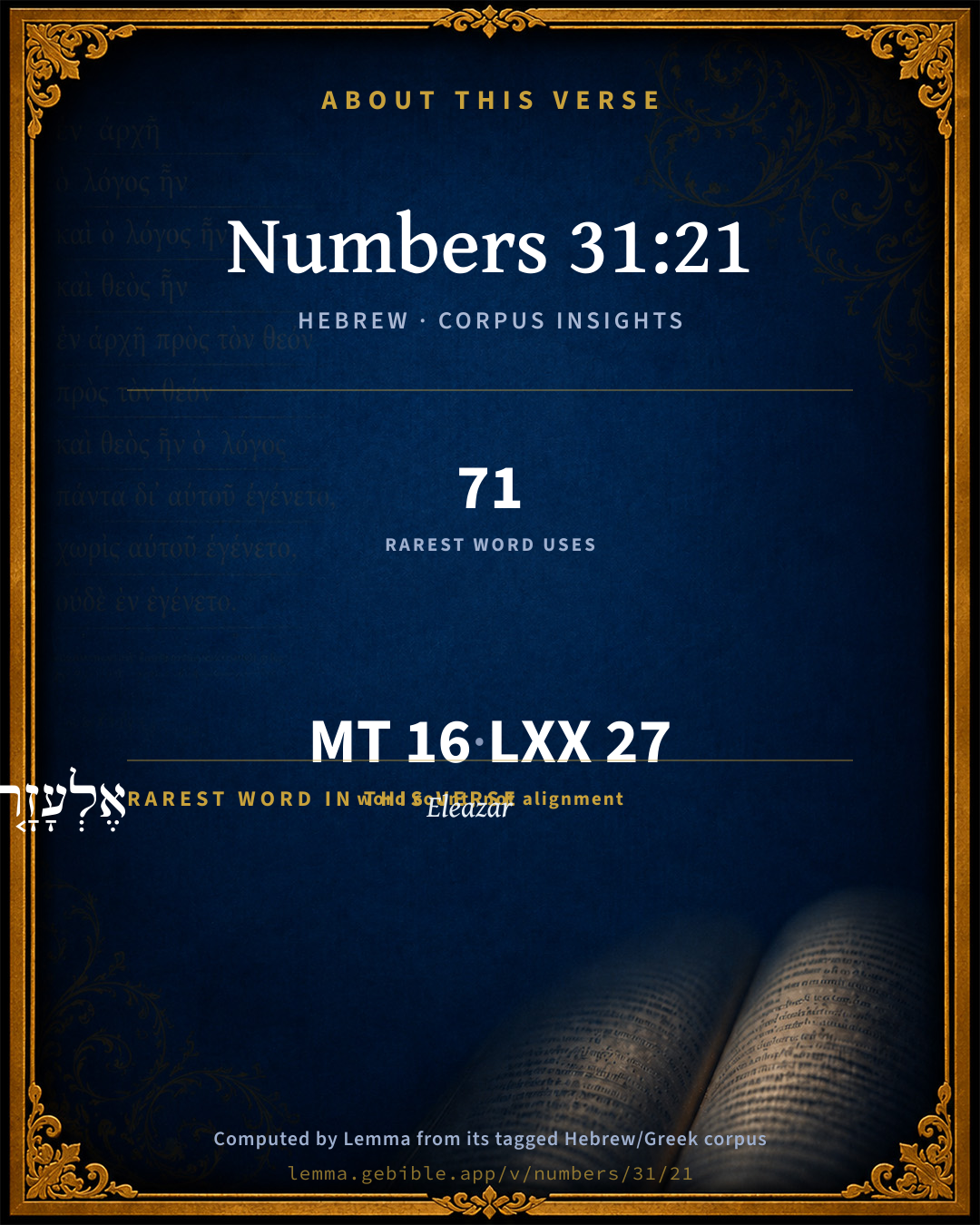
16
words
16
distinct lemmas
Pentateuch
section

Grammatical profile

  • 3 verbs
  • 9 nouns
  • 1 pronoun
  • 1 preposition
  • 2 particles

Verb forms

  • וַיֹּ֨אמֶר Qal · Sequential Imperfect
  • הַבָּאִ֖ים Qal · Participle Active
  • צִוָּ֥ה Piel · Perfect

Hebrew & Septuagint length

In English translation the verse runs 26 words from the Hebrew and 29 from the Septuagint (LXX English) — closely comparable.

A rough comparison of the two English renderings, which tokenize alike — not a word-level alignment.

Word counts can differ between the Hebrew and the Greek without any difference in meaning — e.g. the Hebrew direct-object marker אֵת has no separate Greek word, and Greek often adds the article ὁ.

In the original languages it is 16 Hebrew tokens and 27 Greek tokens — but the two are counted differently (Hebrew bundles its prefixes and suffixes into one token; the Greek is in lemma form), so that isn’t a like-for-like length.

Cross-references

1

Topical passages linked to Numbers 31:21 in the Treasury of Scripture Knowledge — connected by theme and wording, ordered by reader-vote popularity; previews shown in the World English Bible.

  • Numbers 30:16 These are the statutes, which Yahweh commanded Moses, between a man and his wife, between a father and his daughter, being in her youth, in her father's house.

Cross-references courtesy of OpenBible.info (CC BY 4.0).

Hebrew and Greek witnesses Masoretic Hebrew ↔ Greek Septuagint

The same verse in the two great witnesses to the Old Testament, shown verse-for-verse.

These are two independent witnesses, not word-aligned to each other, and the Septuagint is shown in lemma (dictionary) form.

Hebrew Numbers 31:21 Masoretic · Westminster Leningrad Codex

וַיֹּ֨אמֶר אֶלְעָזָ֤ר הַכֹּהֵן֙ אֶל אַנְשֵׁ֣י הַצָּבָ֔א הַבָּאִ֖ים לַמִּלְחָמָ֑ה זֹ֚את חֻקַּ֣ת הַתּוֹרָ֔ה אֲשֶׁר צִוָּ֥ה יְהוָ֖ה אֶת מֹשֶֽׁה

Eleazar the priest said to the men of war who went to the battle, This is the statute of the law which Yahweh has commanded Moses:

World English Bible · Public Domain

Greek LXX Numbers 31:21 Septuagint · lemma form

καί εἶπον ελεαζαρ ὁ ἱερεύς πρός ὁ ἀνήρ ὁ δύναμις ὁ ἔρχομαι ἐκ ὁ παράταξις ὁ πόλεμος οὗτος ὁ δικαίωμα ὁ νόμος ὅς συντάσσω κύριος ὁ μωυσῆς

And Eleazar the priest said to the men of the host that came from the battle-array, This is the ordinance of the law which the Lord has commanded Moses.

LXX2012 (modern English Septuagint) · Public Domain

Hebrew: Westminster Leningrad Codex (CC BY 4.0). Greek: Septuagint (public domain); English from LXX2012 (modern English Septuagint) (Public Domain). How the Septuagint differs from the Hebrew →

Targum (Aramaic paraphrase)

2

The Targum is the ancient Jewish Aramaic paraphrase of the Hebrew Scriptures — an interpretive translation, not the Hebrew text itself. Onkelos (literal) and Pseudo-Jonathan (expansive) render the Torah, and Jonathan the Prophets. Coverage is partial: where no permissively-licensed English translation exists for a verse, only the Aramaic is shown. This is verse-level text, not a word-by-word alignment to the Hebrew.

  1. Targum Onkelos Torah (Genesis–Deuteronomy)
    וַאֲמַר אֶלְעָזָר כַּהֲנָא לְגַבְרֵי חֵילָא דַאֲתוֹ לִקְרָבָא דָא גְזֵירַת אוֹרַיְיתָא דִי פַקֵיד יְיָ יָת משֶׁה

    (no public-domain English translation for this verse)

    Targum Onkelos — Aramaic: “Onkelos Genesis” (public domain); “Onkelos Exodus” (public domain); “Onkelos Leviticus” (public domain); “Onkelos Numbers” (public domain); “Onkelos Deuteronomy” (public domain). English: “Sefaria Community Translation” (CC0 1.0 (public-domain dedication)); “J.W. Etheridge. The Targums of Onkelos and Jonathan Ben Uzziel on the Pentateuch. London: Longmans, Green, 1862” (public domain). Text via Sefaria.

  2. Targum Pseudo-Jonathan Torah (Genesis–Deuteronomy)
    וַאֲמַר אֶלְעָזָר כַּהֲנָא לְגוּבְרֵי חֵילָא דְאָתוּ מִן סִדְרֵי קְרָבָא דָא אַחֲוָויַת גְזֵירַת אוֹרַיְיתָא דְפַקֵיד יְיָ יַת משֶׁה

    And Elazar the priest said to the men of the host who had returned from the war: This is the manifestation of the decree of the law which the Lord hath commanded to Mosheh.

    Targum Pseudo-Jonathan — Aramaic: “Targum Jonathan on Genesis” (public domain); “Targum Jonathan on Exodus” (public domain); “Targum Jonathan on Leviticus” (public domain); “Targum Jonathan on Numbers” (public domain); “Targum Jonathan on Deuteronomy” (public domain). English: “The Targum of Jonathan ben Uzziel, trans. J. W. Etheridge, London, 1862” (public domain). Text via Sefaria.

Commentary

Notes on Numbers 31:21 from classic Christian and Jewish commentators (each source and its license shown beneath its notes). The classic Christian expositions comment on the surrounding passage and are grouped to its opening verse, so a note may address several verses; the Jewish commentaries on the Tanakh (Rashi and others) are per-verse, so they appear only where the commentator wrote on this verse.

Lemma curates 59 commentaries, every one of them public domain or Creative Commons licensed, each selected and text-cleaned for this edition rather than reprinted as found. About our sources →

Geneva Bible (1599)

Geneva Bible translators

Or, contained in the law.

Geneva Bible (1599) marginal notes — public domain. Text via Bolls.life.

The Cambridge Bible for Schools and Colleges

gen. ed. J. J. S. Perowne

21–24. Further injunctions given by Eleazar, drawing a distinction between objects which could not stand purification by fire, and metals which could.

The Cambridge Bible for Schools and Colleges (gen. ed. J. J. S. Perowne; Cambridge University Press, 1878–1918) — public domain. Text from a community e-Sword module.

John Gill's Exposition

And ye shall wash your clothes on the seventh day,.... As the leper did, Lev 14:9,

and ye shall be clean, and afterward ye shall come into the camp; into the camp of Israel, into the camp of the Levites, and into the camp of God, the tabernacle.

John Gill's Exposition of the Whole Bible (1746–1763) — public domain (CC PDM 1.0). Text via the HelloAO Bible API.

The Pulpit Commentary

And Eleazar the priest said, This is the ordinance of the law (hrwOTh tQju, "law-statute, as in Num_19:2) which the Lord commanded Moses. There is something peculiar in this expression which points to the probability, either that this paragraph (verses 21-24) was added after the death of Moses, or that "the law was already beginning, even in the lifetime of Moses, to assume the position which it after. wards held that, viz., of a fixed code to be interpreted and applied by the living authority of the priesthood. This is the earliest instance of the high priest declaring to the people what the law of God as delivered to Moses was, and then applying and enlarging that law to meet the present circumstances. It is no doubt possible that Eleazar referred the matter to Moses, but it would seem on the face of the narrative that he spoke on his own authority as high priest. When we compare the ceremonial of the later Jews, so precisely and minutely ordered for every conceivable contingency, with the Mosaic legislation itself, it is evident that the process of authoritative amplification must have been going on from the first; but it is certainly strange to find that process begun while Moses himself was alive and active.

The Pulpit Commentary (1880–1919), ed. H.D.M. Spence-Jones & Joseph S. Exell — public domain. Text from a community e-Sword module.

Keil & Delitzsch

C. F. Keil & F. Delitzsch

To this end Eleazar, whose duty it was as high priest to see that the laws of purification were properly observed, issued fuller instructions with reference to the purification of the different articles, in accordance with the law in ch. 19. למּלחמה הבּאים, those who came to the war, i.e., who went into the battle (see at Num 10:9). "The ordinance of the law:" as in Num 19:2. The metal (gold, silver, copper, tin, lead), all that usually comes into the fire, i.e., that will bear the fire, was to be drawn through the fire, that it might become clean, and was then to be sprinkled with water of purification (Num 19:9); but everything that would not bear the fire was to be drawn through water. - The washing of clothes on the seventh day was according to the rule laid down in Num 19:19.

Keil & Delitzsch — Biblical Commentary on the Old Testament (1861–1891) — public domain (CC PDM 1.0). Text via the HelloAO Bible API. (Old Testament only.)

unfoldingWord translationNotes

Door43 World Missions Community

General Information:

Eleazar teaches the soldiers the customs of becoming ceremonially clean before Yahweh after going to war.

gold, silver, bronze, iron, tin, and lead

metals that were used during that time period

that resists fire

"that will not burn"

put it through the fire

"put it into the fire"

water of cleansing

This refers to water that someone has mixed with ashes from a sin offering. See: Numbers 19:17-19.

then you will become clean

These are the customs of becoming ceremonially clean before Yahweh.

translationWords

Eleazar

decree

law, laws

Moses

gold

silver

bronze

clean

unfoldingWord translationNotes — © Distant Shores Media and the Door43 World Missions Community, licensed CC BY-SA 4.0. Source: git.door43.org/Door43/en_tn.

Rashi

Rabbi Shlomo Yitzchaki (Rashi)

ויאמר אלעזר הכהן וגו׳ AND ELEAZAR THE PRIEST SAID etc. — Because Moses fell into anger (Numbers 31:14) he fell into error: there escaped him the laws concerning the removal of uncleanness absorbed by vessels which have contained the food of heathens. This, too, do you find was the case on the eighth day of the installing of the priests, as it is said, (Leviticus 10:16) “And Moses was angry with Eleazar and Ithamar”, — he fell into anger, he fell into error (cf. 10:16 that he made an error regarding the שעיר החטאת which Aaron refused to eat). Similarly, also, when he said, (Numbers 20:10, Numbers 20:11) “Hear, now, ye rebels”, … “he smote the rock”; it was through his anger that he made the mistake (Sifrei Bamidbar 157:9; cf. Pesachim 66b).

אשר צוה ה׳ וגו׳ [AND ELEAZAR SAID … THIS IS THE ORDINANCE OF THE LAW] WHICH THE LORD HATH COMMANDED [MOSES] — he associated the decision with his teacher (cf. Sifrei Bamidbar 157:9).

Rashi on the Tanakh — English translations: “The Judaica Press complete Tanach with Rashi, translated by A. J. Rosenberg” (CC BY 4.0); “Pentateuch with Rashi's commentary by M. Rosenbaum and A.M. Silbermann, 1929-1934” (public domain); “The Metsudah Tanach series, Lakewood, N.J” (CC BY 4.0); and “The Book of Joshua, Metsudah Publications, 1997” (CC BY 4.0). Text via Sefaria.

Ibn Ezra

Rabbi Abraham ibn Ezra

Elozor the kohein said. The statute of the Red Heifer was given to Elozor, so Moshe told them to purify in general terms and Elozor explained the details.

Ibn Ezra on the Tanakh — English translations: “Sefaria Community Translation” (CC0 1.0 (public-domain dedication)); “Yalkut, Sifsei Chachomim Chumash, Metsudah Publications, 2009” (CC BY 4.0); and “Commentary of Ibn Ezra on Isaiah - trans. by M. Friedlander, 1873” (public domain). Text via Sefaria.

Lesson kit

Teaching starters — assembled from the data on this page, not authored interpretation. Every prompt links to the verse data it draws on. Edit before teaching.

Numbers, in the Pentateuch, opens this verse with 16 words (16 distinct Hebrew lemmas). Its most distinctive word is ʼElʻâzâr (“Eleazar”). A historical commentator’s framing appears above. Read the whole chapter for the surrounding context.

Discussion questions

  1. How does “Eleazar” (ʼElʻâzâr) shape what this verse is saying?
  2. How does Numbers 30:16, which shares this passage’s theme, read alongside this verse?
  3. The translations on this page render this verse differently — a whole-verse word diff, not a word-by-word alignment. What might account for the different wordings?
  4. «וַיֹּ֨אמֶר» is a Qal Sequential Imperfect verb. How does that grammatical form shape the action described?
  5. Compare how Geneva Bible (1599) and The Cambridge Bible for Schools and Colleges read this verse. Where do they agree or differ?

Things to notice

Reading settings

Reading text

Shown beneath each verse's original-language words.

Old Testament
Old Testament edition

Read the OT as the Masoretic Hebrew (MT) or the Greek Septuagint (LXX).

English shown for the Greek Septuagint (in the Hebrew ↔ Greek comparison).

Comparing translations? Open the Compare panel on any verse page to stack up to four side by side.