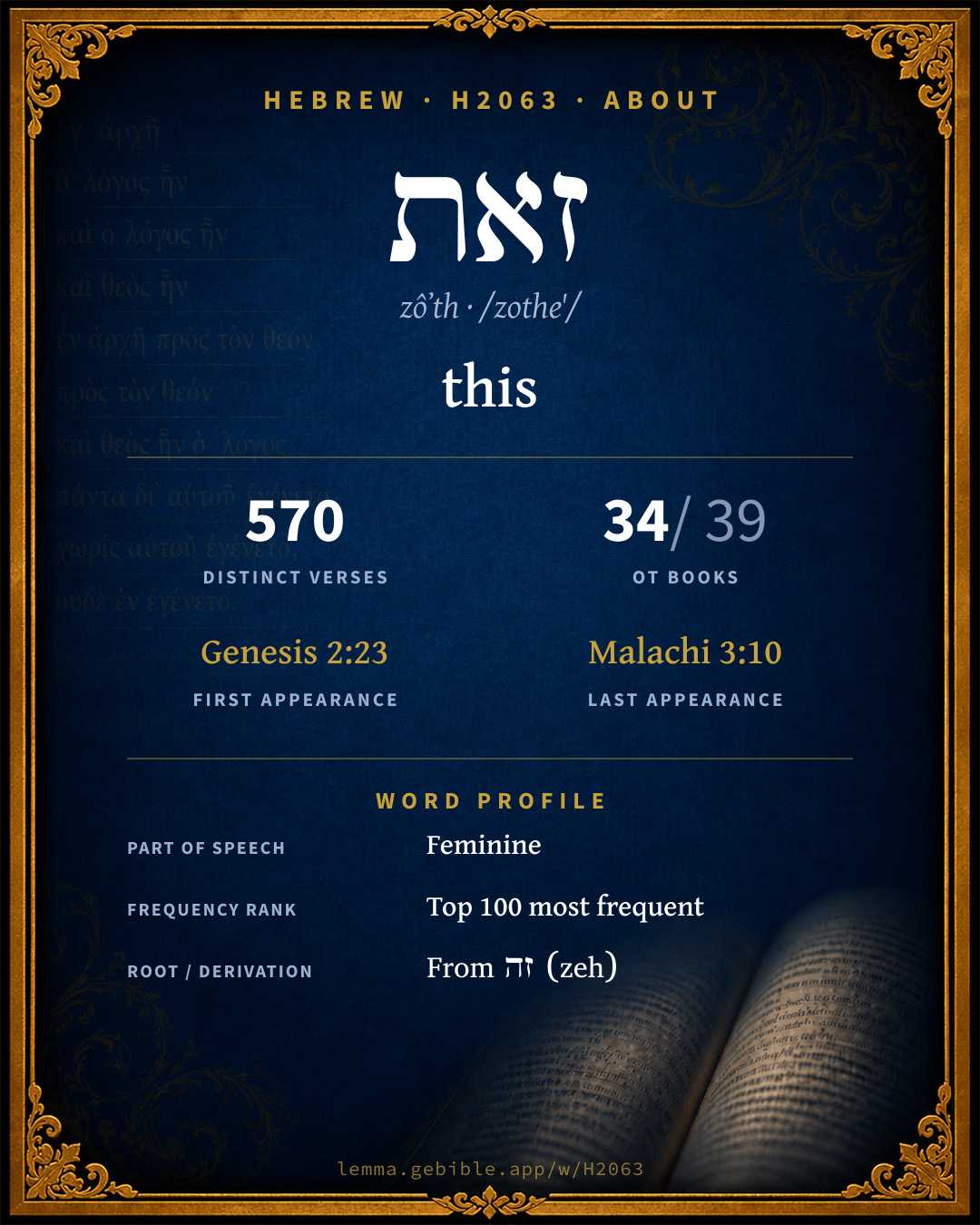
זֹאת
this
also: this one, here, which, this...that fuller range ↓
Full lexicon entry — Brown-Driver-Briggs (BDB)
From Brown-Driver-Briggs (BDB)
Where this word appears
Grammar key — what these labels mean
Part of speech
- Pronoun
- A word standing in for a noun (“he,” “this,” “who”).
Gender
- Feminine
- Grammatically feminine.
Number
- Singular
- One.
Every verse where H2063 appears in the Book of Leviticus — 24 distinct verses. Click any verse to open its interlinear word-by-word view. Verse text shown in the World English Bible for context — . Each verse’s Hebrew form is shown with its reference; the English is not keyword-highlighted, since the data carries no word-level English alignment. Use “Compare translations” on any verse to read it across multiple English versions. This concordance covers the Hebrew Bible; Septuagint (Greek Old Testament) occurrences are not indexed here.
Leviticus
- Leviticus 6:9 זֹ֥את pron dem fs "Command Aaron and his sons, saying, 'This is the law of the burnt offering: the burnt offering shall be on the hearth on the altar all night until the morning; and the fire of the altar shall be kept burning on it.
- Leviticus 6:14 וְ/זֹ֥את conj + pron dem fs "'This is the law of the meal offering: the sons of Aaron shall offer it before Yahweh, before the altar.
- Leviticus 6:25 זֹ֥את pron dem fs "Speak to Aaron and to his sons, saying, 'This is the law of the sin offering: in the place where the burnt offering is killed, the sin offering shall be killed before Yahweh. It is most holy.
- Leviticus 7:1 וְ/זֹ֥את conj + pron dem fs "'This is the law of the trespass offering. It is most holy.
- Leviticus 7:11 וְ/זֹ֥את conj + pron dem fs "'This is the law of the sacrifice of peace offerings, which one shall offer to Yahweh.
- Leviticus 7:35 זֹ֣את pron dem fs This is the anointing portion of Aaron, and the anointing portion of his sons, out of the offerings of Yahweh made by fire, in the day when he presented them to minister to Yahweh in the priest's office;
- Leviticus 7:37 זֹ֣את pron dem fs This is the law of the burnt offering, of the meal offering, and of the sin offering, and of the trespass offering, and of the consecration, and of the sacrifice of peace offerings;
- Leviticus 11:2 זֹ֤את pron dem fs "Speak to the children of Israel, saying, 'These are the living things which you may eat among all the animals that are on the earth.
- Leviticus 11:46 זֹ֣את pron dem fs "'This is the law of the animal, and of the bird, and of every living creature that moves in the waters, and of every creature that creeps on the earth,
- Leviticus 12:7 זֹ֤את pron dem fs and he shall offer it before Yahweh, and make atonement for her; and she shall be cleansed from the fountain of her blood. "'This is the law for her who bears, whether a male or a female.
- Leviticus 13:59 זֹ֠את pron dem fs This is the law of the plague of mildew in a garment of wool or linen, either in the warp, or the woof, or in anything of skin, to pronounce it clean, or to pronounce it unclean.
- Leviticus 14:2 זֹ֤את pron dem fs "This shall be the law of the leper in the day of his cleansing. He shall be brought to the priest,
- Leviticus 14:32 זֹ֣את pron dem fs This is the law for him in whom is the plague of leprosy, who is not able to afford the sacrifice for his cleansing.
- Leviticus 14:54 זֹ֖את pron dem fs This is the law for any plague of leprosy, and for an itch,
- Leviticus 14:57 זֹ֥את pron dem fs to teach when it is unclean, and when it is clean. This is the law of leprosy.
- Leviticus 15:3 וְ/זֹ֛את conj + pron dem fs This shall be his uncleanness in his discharge: whether his body runs with his discharge, or his body has stopped from his discharge, it is his uncleanness.
- Leviticus 15:32 זֹ֥את pron dem fs This is the law of him who has a discharge, and of him who has an emission of semen, so that he is unclean thereby;
- Leviticus 16:3 בְּ/זֹ֛את prep + pron dem fs "Herewith shall Aaron come into the sanctuary: with a young bull for a sin offering, and a ram for a burnt offering.
- Leviticus 16:34 זֹּ֨את pron dem fs "This shall be an everlasting statute for you, to make atonement for the children of Israel once in the year because of all their sins." It was done as Yahweh commanded Moses.
- Leviticus 17:7 זֹּ֥את pron dem fs They shall no more sacrifice their sacrifices to the goat idols, after which they play the prostitute. This shall be a statute forever to them throughout their generations.'
- Leviticus 25:13 הַ/זֹּ֑את ptcl def.art + pron dem fs "'In this Year of Jubilee each of you shall return to his property.
- Leviticus 26:16 זֹּ֣את pron dem fs I also will do this to you: I will appoint terror over you, even consumption and fever, that shall consume the eyes, and make the soul to pine away; and you will sow your seed in vain, for your enemies will eat it.
- Leviticus 26:27 בְּ/זֹ֔את prep + pron dem fs "'If you in spite of this won't listen to me, but walk contrary to me;
- Leviticus 26:44 זֹ֠את pron dem fs Yet for all that, when they are in the land of their enemies, I will not reject them, neither will I abhor them, to destroy them utterly, and to break my covenant with them; for I am Yahweh their God;
About this entry
At a glance — auto-summarized from this page’s data, not written by a person. Every figure links to its source below. This summary describes the numbers; it doesn’t interpret them.
The Hebrew word זאת centers on the idea of “this.” Lexicons map it across 21 senses — beyond “this” it also covers “this one”, “here”, and “which”. It appears 570 verses across 34 books of the Hebrew Bible, among its most common vocabulary. Its earliest occurrence is Genesis 2:23. For the data behind this summary, explore the sense tree and the renderings breakdown below.
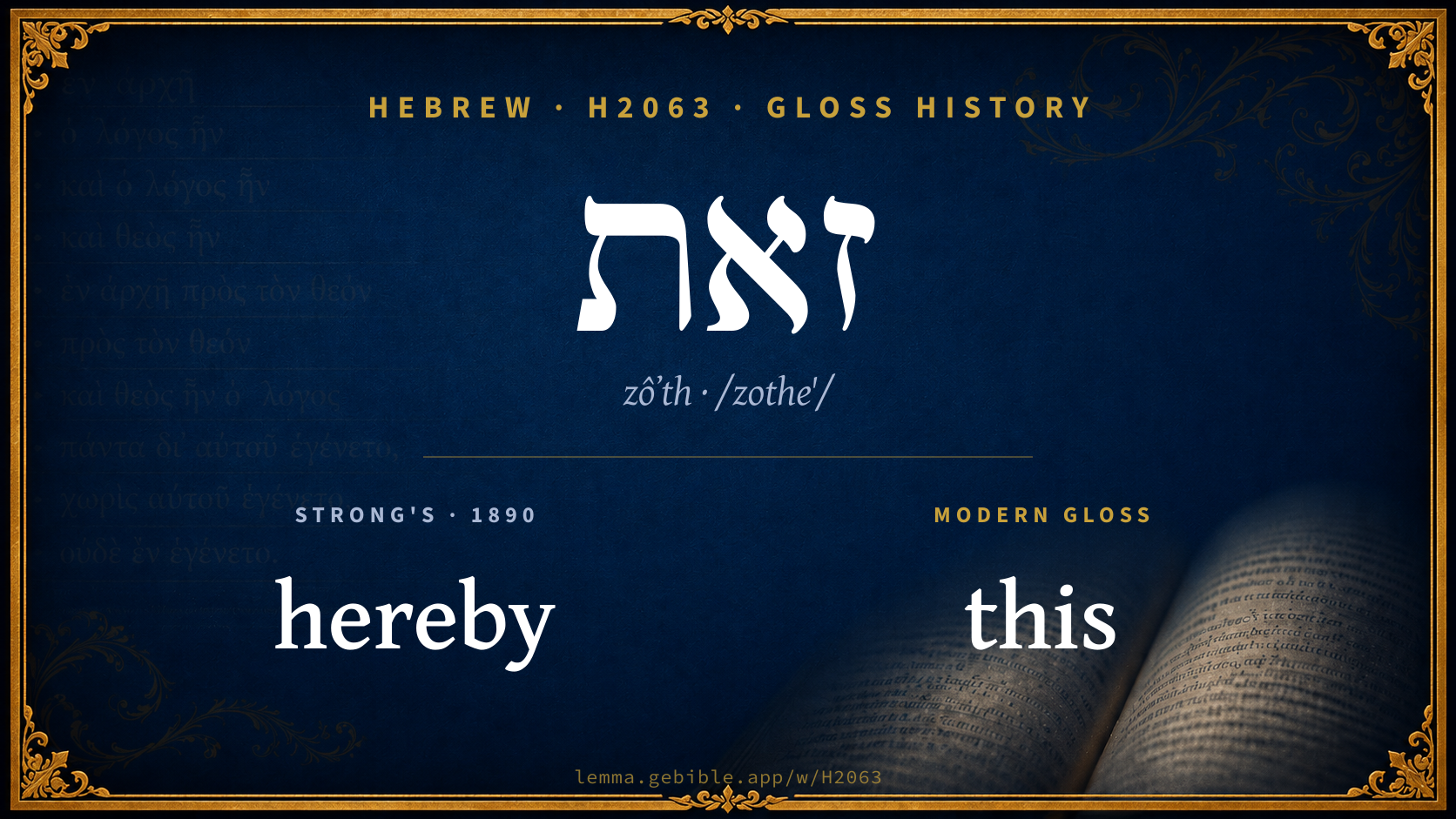
Gloss history
Strong's 1890 vs modern scholarship
About this word
Strong's H2063 catalogs a Hebrew word from the Hebrew Old Testament.
These counts are not copied from any lexicon or concordance. They are computed here, from the morphology-tagged Hebrew Old Testament. What Lemma adds →
- 570
- distinct verses
- The word appears in 570 distinct verses.
- 34 / 39
- OT books
- The word appears in 34 of 39 Old Testament books.
- #79
- by frequency
- Top 100 most frequent Hebrew words (rank 79 of 8,640 Hebrew words by occurrence).
View all 570 occurrences in the concordance →
Most concentrated in
- Jeremiah 90 verses 16%
- Deuteronomy 50 verses 9%
- Genesis 48 verses 8%
By section of the Old Testament
By traditional corpus
Conventional, traditional groupings — biblical authorship is debated, so this is a traditional corpus grouping, not an authorship claim. Each share is this word’s portion of its verses in that division of the Hebrew canon. Each figure is a share of the word’s 570 distinct verses.
- Prophets (Nevi'im) 300 verses · 53%
- Torah (Pentateuch) 171 verses · 30%
- Writings (Ketuvim) 99 verses · 17%
How translations render this word
Counts come from each version’s own published word-to-Strong’s tagging or interlinear alignment — an approximate guide to how each version renders this word, not a word-level alignment the data otherwise carries. Because each total is that version’s own tagged count, the per-version totals vary from one another and need not match the appearance or distinct-verse counts above. These counts may also differ from a printed concordance because Lemma counts each distinctly tagged rendering and does not collapse phrase taggings into a single head-word total. This is a fixed set of word-tagged versions (KJV, ASV, BSB, ULT) and does not change with the reading translation you choose elsewhere. Each version’s license is shown beside its name below (and on Sources).
- King James Version: This 9×, It 2×, She 2×
- American Standard Version: This 4×, After this 2×, Herewith 2×
- Berean Standard Bible: This 438×, Is this 12×, These 8×
- unfoldingWord Literal Text: This 467×, Is 37×, Like this 21×
King James Version Public Domain
Renders H2063 across 41 tagged occurrences — most commonly:
Plus 26 renderings that appear only once — usually multi-word phrases or single function words the recovered tagging swept in, not distinct renderings.
American Standard Version Public Domain
Renders H2063 across 41 tagged occurrences — most commonly:
Plus 25 renderings that appear only once — usually multi-word phrases or single function words the recovered tagging swept in, not distinct renderings.
Berean Standard Bible Public Domain
Renders H2063 across 559 tagged occurrences — most commonly:
Plus other, less common renderings. Plus 38 renderings that appear only once — usually multi-word phrases or single function words the recovered tagging swept in, not distinct renderings. Not rendered by a distinct English word in 45 further occurrences.
unfoldingWord Literal Text CC BY-SA 4.0
Renders H2063 across 615 tagged occurrences — most commonly:
Plus 21 renderings that appear only once — usually multi-word phrases or single function words the recovered tagging swept in, not distinct renderings.
21 senses in BDB, in lexicon order
The 21 senses BDB distinguishes for this word, in lexicon order (not ranked by frequency or importance). The full entry — with sub-senses — is in the Lexicon Entry tab.
- this, this one, here, which, this...that, the one...the other, such
(alone)
- this one
- this...that, the one...the other, another
(appos to subst)
- this
(as predicate)
- this, such
(enclitically)
- then
- who, whom
- how now, what now
- what now
- wherefore now
This word has an unusually long lexicon entry — 21 senses across its verb stems. The first 10 are shown above in lexicon order; the remaining 11 senses (more of the same, repeated under each stem) and the full sub-sense tree are in the Lexicon Entry tab.
Word origin
Derived from זה (zeh) (H2089) — lamb, sheep.
Jastrow Dictionary
A second Hebrew/Aramaic lexicon for comparison, covering Aramaic and post-biblical (Talmudic, Targumic, Midrashic) usage that the biblical-Hebrew BDB does not. Matched by lemma rather than by Strong’s number, so a lemma may carry more than one Jastrow headword (shown separately below), and the entries cover usage well beyond the Bible.
זֹאת
- , v. זֶה
A Dictionary of the Targumim, the Talmud Babli and Yerushalmi, and the Midrashic Literature (Marcus Jastrow; London, Luzac, 1903) — Public Domain. Digitized via Sefaria. Digitized via Sefaria. Full attribution on Sources.
Forms in the corpus
The 94 distinct written forms H2063 takes in the Hebrew Bible, most frequent first — each parse links to that state’s occurrences in the concordance. Hebrew forms include their vowel points and cantillation, so a single lemma takes many written forms.
| Form | Parsing | Example | Uses |
|---|---|---|---|
| הַ/זֹּ֔את | Pronoun, Demonstrative, Feminine, Singular | Daniel 10:8 | 67 |
| הַ/זֹּ֖את | Pronoun, Demonstrative, Feminine, Singular | Daniel 9:13 | 48 |
| הַ/זֹּ֑את | Pronoun, Demonstrative, Feminine, Singular | Deuteronomy 5:3 | 46 |
| הַ/זֹּֽאת | Pronoun, Demonstrative, Feminine, Singular | Deuteronomy 4:22 | 41 |
| זֹ֣את | Pronoun, Demonstrative, Feminine, Singular | Amos 4:12 | 32 |
| זֹ֑את | Pronoun, Demonstrative, Feminine, Singular | Amos 7:3 | 27 |
| הַ/זֹּאת֙ | Pronoun, Demonstrative, Feminine, Singular | Deuteronomy 3:18 | 22 |
| זֹ֥את | Pronoun, Demonstrative, Feminine, Singular | Deuteronomy 14:4 | 21 |
| זֹ֗את | Pronoun, Demonstrative, Feminine, Singular | Genesis 29:27 | 20 |
| זֹ֖את | Pronoun, Demonstrative, Feminine, Singular | Exodus 12:43 | 19 |
| הַ/זֹּ֛את | Pronoun, Demonstrative, Feminine, Singular | Deuteronomy 3:12 | 17 |
| זֹ֤את | Pronoun, Demonstrative, Feminine, Singular | Deuteronomy 34:4 | 16 |
| זֹאת֙ | Pronoun, Demonstrative, Feminine, Singular | Amos 8:8 | 15 |
| זֹ֛את | Pronoun, Demonstrative, Feminine, Singular | Amos 2:11 | 13 |
| זֹ֔את | Pronoun, Demonstrative, Feminine, Singular | Deuteronomy 32:6 | 12 |
| זֹֽאת | Pronoun, Demonstrative, Feminine, Singular | Deuteronomy 32:27 | 11 |
| הַ/זֹּ֗את | Pronoun, Demonstrative, Feminine, Singular | Deuteronomy 6:25 | 9 |
| זֹ֚את | Pronoun, Demonstrative, Feminine, Singular | Ezekiel 5:5 | 9 |
| זֹּ֣את | Pronoun, Demonstrative, Feminine, Singular | Exodus 14:5 | 8 |
| הַ/זֹּ֜את | Pronoun, Demonstrative, Feminine, Singular | Deuteronomy 19:9 | 7 |
| וְ/זֹ֣את | Pronoun, Demonstrative, Feminine, Singular | Deuteronomy 6:1 | 6 |
| זֹּֽאת | Pronoun, Demonstrative, Feminine, Singular | Amos 9:12 | 6 |
| וְ/זֹ֥את | Pronoun, Demonstrative, Feminine, Singular | Leviticus 6:14 | 5 |
| זֹ֭את | Pronoun, Demonstrative, Feminine, Singular | Job 5:27 | 5 |
| זֹּ֑את | Pronoun, Demonstrative, Feminine, Singular | Exodus 13:14 | 5 |
| בְּ/זֹאת֙ | Pronoun, Demonstrative, Feminine, Singular | 1 Samuel 11:2 | 4 |
| הַ/זֹּאת֒ | Pronoun, Demonstrative, Feminine, Singular | Deuteronomy 31:9 | 4 |
| וְ/זֹאת֙ | Pronoun, Demonstrative, Feminine, Singular | Exodus 25:3 | 4 |
| זֹּ֔את | Pronoun, Demonstrative, Feminine, Singular | Genesis 20:6 | 4 |
| זֹּ֖את | Pronoun, Demonstrative, Feminine, Singular | Genesis 12:18 | 4 |
| כָּ/זֹֽאת | Pronoun, Demonstrative, Feminine, Singular | Ezra 9:13 | 4 |
| בְּ/זֹ֖את | Pronoun, Demonstrative, Feminine, Singular | Ezekiel 16:29 | 3 |
| בְּ/זֹ֣את | Pronoun, Demonstrative, Feminine, Singular | Exodus 7:17 | 3 |
| וְ/זֹ֛את | Pronoun, Demonstrative, Feminine, Singular | 2 Samuel 7:19 | 3 |
| זֹ֕את | Pronoun, Demonstrative, Feminine, Singular | Amos 8:4 | 3 |
| זֹ֡את | Pronoun, Demonstrative, Feminine, Singular | Isaiah 54:17 | 3 |
| זֹּאת֙ | Pronoun, Demonstrative, Feminine, Singular | Exodus 14:11 | 3 |
| כָּ/זֹ֑את | Pronoun, Demonstrative, Feminine, Singular | 1 Chronicles 29:14 | 3 |
| הֲ/זֹ֣את | Pronoun, Demonstrative, Feminine, Singular | Job 20:4 | 2 |
| הֲ/זֹ֥את | Pronoun, Demonstrative, Feminine, Singular | Isaiah 23:7 | 2 |
| הַ/זֹּ֤את | Pronoun, Demonstrative, Feminine, Singular | Deuteronomy 31:21 | 2 |
| הַ/זֹּ֧את | Pronoun, Demonstrative, Feminine, Singular | Genesis 19:20 | 2 |
| הַ/זֹּאת֮ | Pronoun, Demonstrative, Feminine, Singular | 1 Samuel 14:45 | 2 |
| וְ/זֹ֖את | Pronoun, Demonstrative, Feminine, Singular | Deuteronomy 4:44 | 2 |
| וְ/זֹ֤את | Pronoun, Demonstrative, Feminine, Singular | 1 Kings 3:22 | 2 |
| וְ/כָ/זֹ֖את | Pronoun, Demonstrative, Feminine, Singular | 2 Samuel 17:15 | 2 |
| וְ/כָ/זֹ֥את | Pronoun, Demonstrative, Feminine, Singular | 2 Samuel 17:15 | 2 |
| וְ/כָ/זֹאת֙ | Pronoun, Demonstrative, Feminine, Singular | 2 Kings 5:4 | 2 |
| זֹ֠את | Pronoun, Demonstrative, Feminine, Singular | Leviticus 13:59 | 2 |
| זֹ֨את | Pronoun, Demonstrative, Feminine, Singular | Hosea 5:1 | 2 |
| זֹּ֥את | Pronoun, Demonstrative, Feminine, Singular | Judges 2:2 | 2 |
| כָּ/זֹ֔את | Pronoun, Demonstrative, Feminine, Singular | Esther 4:14 | 2 |
| כָּ/זֹ֖את | Pronoun, Demonstrative, Feminine, Singular | 1 Samuel 4:7 | 2 |
| כָּ/זֹ֣את | Pronoun, Demonstrative, Feminine, Singular | 1 Kings 7:37 | 2 |
| כָּ/זֹ֤את | Pronoun, Demonstrative, Feminine, Singular | 2 Kings 5:4 | 2 |
| בָ/זֹ֛את | Pronoun, Demonstrative, Feminine, Singular | 1 Chronicles 27:24 | 1 |
| בְּ/זֹ֔את | Pronoun, Demonstrative, Feminine, Singular | Leviticus 26:27 | 1 |
| בְּ/זֹ֛את | Pronoun, Demonstrative, Feminine, Singular | Leviticus 16:3 | 1 |
| בְּ/זֹ֞את | Pronoun, Demonstrative, Feminine, Singular | Jeremiah 9:24 | 1 |
| בְּ֝/זֹ֗את | Pronoun, Demonstrative, Feminine, Singular | Psalms 27:3 | 1 |
The 60 most common forms are shown; 34 rarer forms follow in the full concordance.
Septuagint verse parallels
This word appears in 532 verses that also exist in the Greek Old Testament (Septuagint), out of the 570 Hebrew verses it occurs in. You can read those verses in Greek by switching the Old Testament edition to the Septuagint.
Read these verses in the Septuagint
- Genesis 2:23
- Exodus 7:17
- Leviticus 6:9
- Numbers 4:4
- Deuteronomy 1:5
- Joshua 1:13
- Judges 1:27
- Ruth 1:19
- 1 Samuel 2:20
- 2 Samuel 1:17
- 1 Kings 3:17
- 2 Kings 3:18
This is a verse-level parallel only — the same verses exist in both the Hebrew and Greek Old Testaments. No word-level Hebrew↔Greek correspondence is claimed: the data carries no such alignment, so no Greek word is shown as this Hebrew word’s translation. Coverage is not total — the Septuagint omits the deuterocanon and renumbers the Psalms, so some Hebrew verses have no direct Greek parallel.