
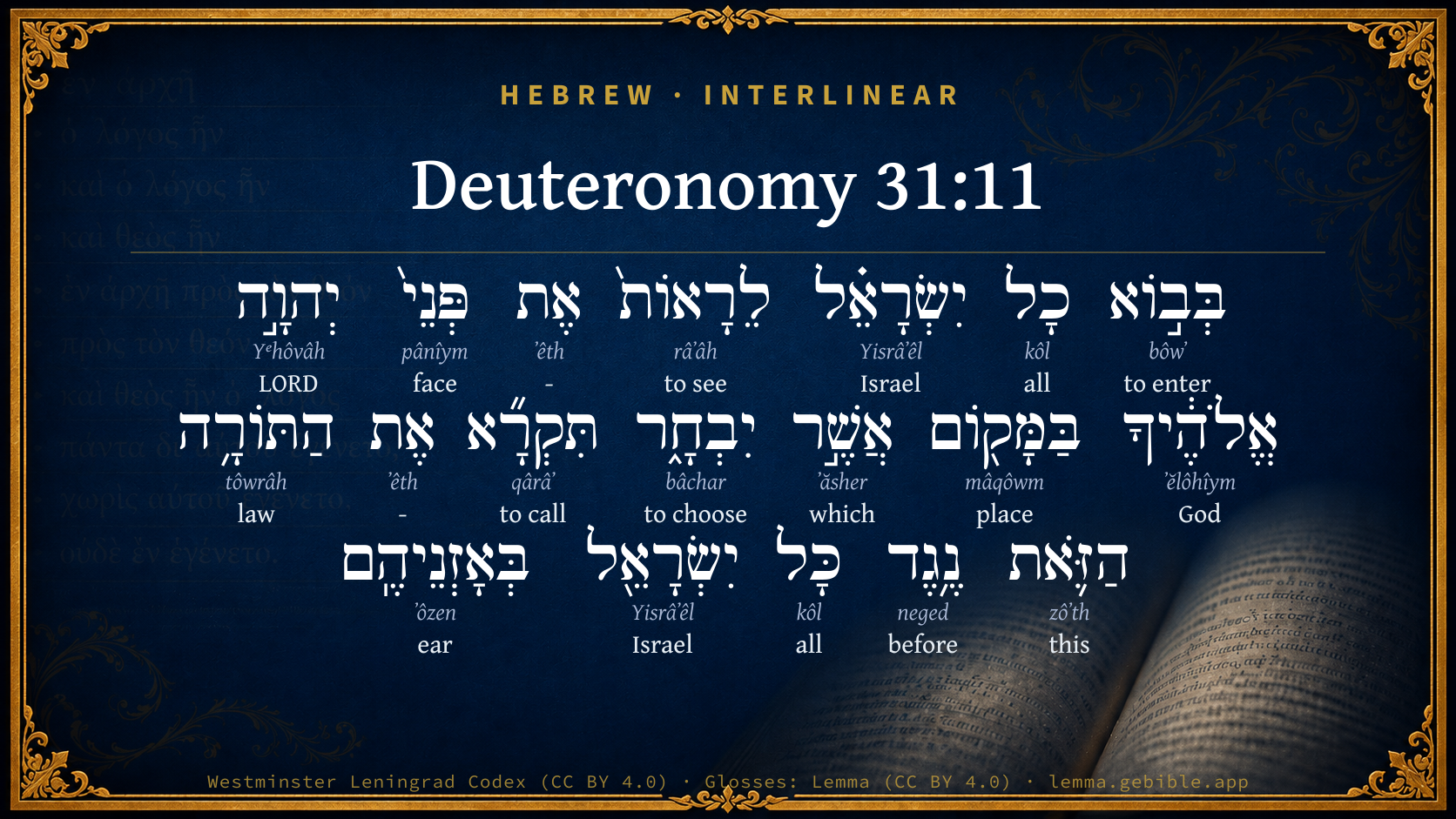
Deuteronomy 31:11

Hebrew (Westminster Leningrad Codex) Deuteronomy 31:11 appears in the Hebrew Old Testament. The text above is from the Westminster Leningrad Codex. Each word links to its Strong’s number, a concise gloss, and parsing drawn from the Open Scriptures Hebrew Bible morphology. Click any word for its full Brown-Driver-Briggs (BDB) entry.
Download image
Cite this verse

Deuteronomy 31:11 (World English Bible). Public Domain. Lemma interlinear Bible study tool, https://lemma.gebible.app/v/deuteronomy/31/11.

Show BibTeX & RIS
BibTeX
RIS
English Translation
when all Israel is come to appear before Yahweh your God in the place which he shall choose, you shall read this law before all Israel in their hearing.
World English Bible · Public Domain
Download a study sheet

One document with this verse’s original text, its word-by-word gloss line, the meaning frame, cross-references with their text, attributed commentary, and full source and license credits — printable, and it pastes into notes with its structure intact.

This verse Autodidact and up

Study sheet (.html) Plain text (.txt)

A passage Seminary Student

Up to 50 verses in one chapter. A passage sheet keeps up to 6 commentary sources and 12 cross-references per verse, in the order this page ranks them, and says so on the sheet whenever that leaves anything out. Ask for a single verse and you get the Autodidact verse sheet above.

Everything on this page stays free to read, with no account — the sheet is a download of what is already on screen, not access to it.

Want to remove ads? Support Godless Engineer
Compare translations 3

The same verse in 3 English versions, stacked beneath the original-language interlinear above. Click any original word for its lexicon entry.

Each is an independent rendering of the whole verse — the interlinear is not word-aligned to these translations.

Highlighted words mark where these versions differ — a whole-verse word diff, not a word-by-word alignment.

  • World English Bible Public Domain
    when all Israel is come to appear before Yahweh your God in the place which he shall choose, you shall read this law before all Israel in their hearing.
  • King James Version Public Domain
    When all Israel is come to appear before the LORD thy God in the place which he shall choose, thou shalt read this law before all Israel in their hearing.
  • unfoldingWord Literal Text CC BY-SA 4.0
    when all Israel shall come to appear the face of Yahweh your God in the place that he will choose, you shall read this law before all Israel in their ears.

unfoldingWord Literal Text — © unfoldingWord, licensed CC BY-SA 4.0. Word-aligned USFM3 via Door43 (git.door43.org/unfoldingWord/en_ult).

Versions to compare (up to 4)

3 of 4 selected

Show all 18 translations

Every available English version of this verse, each an independent rendering of the whole verse.

  • World English Bible Public Domain
    when all Israel is come to appear before Yahweh your God in the place which he shall choose, you shall read this law before all Israel in their hearing.
  • Berean Standard Bible Public Domain
    when all Israel comes before the LORD your God at the place He will choose, you are to read this law in the hearing of all Israel.
  • Majority Standard Bible Public Domain
    when all Israel comes before the LORD your God at the place He will choose, you are to read this law in the hearing of all Israel.
  • King James Version Public Domain
    When all Israel is come to appear before the LORD thy God in the place which he shall choose, thou shalt read this law before all Israel in their hearing.
  • American Standard Version (1901) Public Domain
    when all Israel is come to appear before Jehovah thy God in the place which he shall choose, thou shalt read this law before all Israel in their hearing.
  • Revised Version (1885) Public Domain
    when all Israel is come to appear before the LORD thy God in the place which he shall choose, thou shalt read this law before all Israel in their hearing.
  • Geneva Bible (1599) Public Domain
    When all Israel shall come to appeare before the Lord thy God, in the place which he shall chuse, thou shalt reade this Lawe before all Israel that they may heare it.
  • Douay-Rheims (1899) Public Domain
    When all Israel come together, to appear in the sight of the Lord thy God in the place which the Lord shall choose, thou shalt read the words of this law before all Israel, in their hearing,
  • Young's Literal Translation Public Domain
    in the coming in of all Israel to see the face of Jehovah in the place which He chooseth, thou dost proclaim this law before all Israel, in their ears.
  • Literal Standard Version CC BY-SA 4.0
    in the coming in of all Israel to see the face of YHWH in the place which He chooses, you proclaim this law before all Israel in their ears.
  • Unlocked Literal Bible CC BY-SA 4.0
    when all Israel has come to appear before Yahweh your God in the place that he will choose for his sanctuary, you will read this law before all Israel in their hearing.
  • unfoldingWord Literal Text CC BY-SA 4.0
    when all Israel shall come to appear the face of Yahweh your God in the place that he will choose, you shall read this law before all Israel in their ears.
  • Darby Bible Public Domain
    when all Israel cometh to appear before Jehovah thy God in the place which he will choose, thou shalt read this law before all Israel in their ears.
  • World Messianic Bible Public Domain
    when all Israel has come to appear before the LORD your God in the place which he will choose, you shall read this law before all Israel in their hearing.
  • Webster's Bible Public Domain
    When all Israel is come to appear before the LORD thy God in the place which he shall choose, thou shalt read this law before all Israel in their hearing.
  • Free Bible Version CC BY-SA 4.0
    when all the Israelites come before the Lord your God at the place he will choose, you are to read this law for everyone to hear.
  • Bible in Basic English Public Domain
    When all Israel has come before the Lord your God in the place named by him, let a reading be given of this law in the hearing of all Israel.
  • JPS Tanakh (1917) Public Domain
    when all Israel is come to appear before the LORD thy God in the place which He shall choose, thou shalt read this law before all Israel in their hearing.

Literal Standard Version (2020), Covenant Press — licensed CC BY-SA 4.0. Text via the HelloAO Bible API (eBible.org). Unlocked Literal Bible (unfoldingWord) — licensed CC BY-SA 4.0. Text via the HelloAO Bible API (eBible.org). unfoldingWord Literal Text — © unfoldingWord, licensed CC BY-SA 4.0. Word-aligned USFM3 via Door43 (git.door43.org/unfoldingWord/en_ult). Free Bible Version, Dr. Jonathan Gallagher — licensed CC BY-SA 4.0. Text via the HelloAO Bible API (eBible.org).

Word by word

More ways to search: Search by grammar → Find every occurrence → Compare this word →

Practice this passage: Drill this verse → Learn its vocabulary →

נֶ֥גֶד
neged
H5048
“before”
Preposition
Part of Speech
Preposition
Full BDB Definition

Origin: from H5046

TWOT: 1289a

what is conspicuous, what is in front of (substantive) - in front of, straight forward, before, in sight of (adverb) - in front of oneself, straightforward (adverb) - before your face, in your view or purpose (adverb) - what is in front of, corresponding to (with preposition) - in front of, before (with preposition) - in the sight or presence of (with preposition) - parallel to (with preposition) - over, for (with preposition) - in front, opposite (with preposition) - at a distance (with preposition) - from the front of, away from (preposition) - from before the eyes of, opposite to, at a distance from (preposition) - from before, in front of (preposition) - as far as the front of (preposition)
  1. בְּב֣וֹא bôwʼ H935 “in/at · to enter” Preposition + Verb, Qal, Infinitive Construct
  2. כָל kôl H3605 “all of” Noun, Common, Masculine, Singular, Construct
  3. יִשְׂרָאֵ֗ל Yisrâʼêl H3478 “Israel” Noun, Proper
  4. לֵרָאוֹת֙ râʼâh H7200 “to see” Preposition + Verb, Niphal, Infinitive Construct
  5. אֶת ʼêth H853 “-” Particle, Direct Object
  6. פְּנֵי֙ pânîym H6440 “face(s) of” Noun, Common, Both, Plural, Construct
  7. יְהוָ֣ה Yᵉhôvâh H3068 “LORD” Noun, Proper
  8. אֱלֹהֶ֔יךָ ʼĕlôhîym H430 “God(s) · your” Noun, Common, Masculine, Plural, Construct + Suffix, Personal, 2nd Person, Masculine, Singular
  9. בַּמָּק֖וֹם mâqôwm H4725 “in/at the · place” Preposition, Determined + Noun, Common, Masculine, Singular, Absolute
  10. אֲשֶׁ֣ר ʼăsher H834 “which” Particle, Relative
  11. יִבְחָ֑ר bâchar H977 “to choose” Verb, Qal, Imperfect, 3rd Person, Masculine, Singular
  12. תִּקְרָ֞א qârâʼ H7121 “to call” Verb, Qal, Imperfect, 2nd Person, Masculine, Singular
  13. אֶת ʼêth H853 “-” Particle, Direct Object
  14. הַתּוֹרָ֥ה tôwrâh H8451 “the · law” Particle, Definite Article + Noun, Common, Feminine, Singular, Absolute
  15. הַזֹּ֛את zôʼth H2063 “the · this” Particle, Definite Article + Pronoun, Demonstrative, Feminine, Singular
  16. כָּל kôl H3605 “all of” Noun, Common, Masculine, Singular, Construct
  17. יִשְׂרָאֵ֖ל Yisrâʼêl H3478 “Israel” Noun, Proper
  18. בְּאָזְנֵיהֶֽם ʼôzen H241 “in/at · ears · their” Preposition + Noun, Common, Feminine, Dual, Construct + Suffix, Personal, 3rd Person, Masculine, Plural

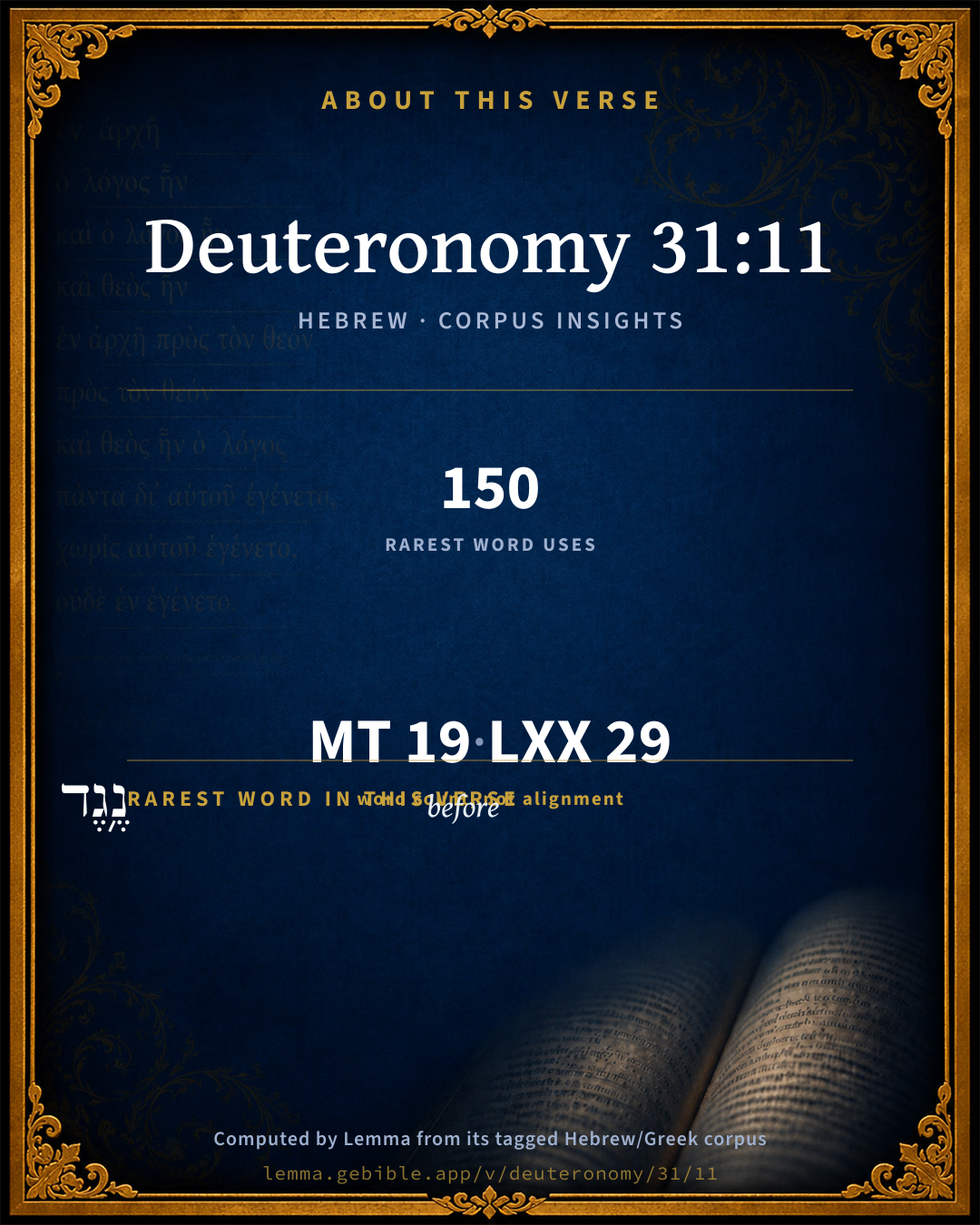
About this verse

These counts appear in no published source. They are computed here, from the morphology-tagged text and Lemma’s own curated glosses. What Lemma adds →

19
words
16
distinct lemmas
Pentateuch
section

Grammatical profile

  • 4 verbs
  • 10 nouns
  • 1 pronoun
  • 1 preposition
  • 3 particles

Verb forms

  • בְּב֣וֹא Qal · Infinitive Construct
  • לֵרָאוֹת֙ Niphal · Infinitive Construct
  • יִבְחָ֑ר Qal · Imperfect
  • תִּקְרָ֞א Qal · Imperfect

Repetition

Words recur within this verse — often emphatic in Hebrew:

  • כָל all H3605 ×2
  • יִשְׂרָאֵ֗ל Israel H3478 ×2

Hebrew & Septuagint length

In English translation the verse runs 29 words from the Hebrew and 31 from the Septuagint (LXX English) — closely comparable.

A rough comparison of the two English renderings, which tokenize alike — not a word-level alignment.

Word counts can differ between the Hebrew and the Greek without any difference in meaning — e.g. the Hebrew direct-object marker אֵת has no separate Greek word, and Greek often adds the article ὁ.

In the original languages it is 19 Hebrew tokens and 29 Greek tokens — but the two are counted differently (Hebrew bundles its prefixes and suffixes into one token; the Greek is in lemma form), so that isn’t a like-for-like length.

Cross-references

14

Topical passages linked to Deuteronomy 31:11 in the Treasury of Scripture Knowledge — connected by theme and wording, ordered by reader-vote popularity; previews shown in the World English Bible.

  • 2 Kings 23:2 The king went up to the house of Yahweh, and all the men of Judah and all the inhabitants of Jerusalem with him, and the priests, and the prophets, and all the people, both small and great: and he read in their ears all the words of the book of the covenant which was found in the house of Yahweh.
  • Joshua 8:34–35 Afterward he read all the words of the law, the blessing and the curse, according to all that is written in the book of the law.
  • Deuteronomy 16:16–17 Three times in a year shall all your males appear before Yahweh your God in the place which he shall choose: in the feast of unleavened bread, and in the feast of weeks, and in the feast of tents; and they shall not appear before Yahweh empty:
  • Exodus 23:16–17 And the feast of harvest, the first fruits of your labors, which you sow in the field: and the feast of harvest, at the end of the year, when you gather in your labors out of the field.
  • Exodus 34:24 For I will drive out nations before you and enlarge your borders; neither shall any man desire your land when you go up to appear before Yahweh, your God, three times in the year.
  • Deuteronomy 12:5 But to the place which Yahweh your God shall choose out of all your tribes, to put his name there, even to his habitation shall you seek, and there you shall come;
  • Nehemiah 8:1–8 All the people gathered themselves together as one man into the broad place that was before the water gate; and they spoke to Ezra the scribe to bring the book of the law of Moses, which Yahweh had commanded to Israel.
  • Nehemiah 8:13 On the second day were gathered together the heads of fathers' [houses] of all the people, the priests, and the Levites, to Ezra the scribe, even to give attention to the words of the law.
  • Nehemiah 9:3 They stood up in their place, and read in the book of the law of Yahweh their God a fourth part of the day; and [another] fourth part they confessed, and worshiped Yahweh their God.
  • Psalms 84:7 They go from strength to strength. Everyone of them appears before God in Zion.
  • Luke 4:16–17 He came to Nazareth, where he had been brought up. He entered, as was his custom, into the synagogue on the Sabbath day, and stood up to read.
  • Acts 13:15 After the reading of the law and the prophets, the rulers of the synagogue sent to them, saying, "Brothers, if you have any word of exhortation for the people, speak."
  • Acts 15:21 For Moses from generations of old has in every city those who preach him, being read in the synagogues every Sabbath."
  • Nehemiah 8:18 Also day by day, from the first day to the last day, he read in the book of the law of God. They kept the feast seven days; and on the eighth day was a solemn assembly, according to the ordinance.

Cross-references courtesy of OpenBible.info (CC BY 4.0).

Hebrew and Greek witnesses Masoretic Hebrew ↔ Greek Septuagint

The same verse in the two great witnesses to the Old Testament, shown verse-for-verse.

These are two independent witnesses, not word-aligned to each other, and the Septuagint is shown in lemma (dictionary) form.

Hebrew Deuteronomy 31:11 Masoretic · Westminster Leningrad Codex

בְּב֣וֹא כָל יִשְׂרָאֵ֗ל לֵרָאוֹת֙ אֶת פְּנֵי֙ יְהוָ֣ה אֱלֹהֶ֔יךָ בַּמָּק֖וֹם אֲשֶׁ֣ר יִבְחָ֑ר תִּקְרָ֞א אֶת הַתּוֹרָ֥ה הַזֹּ֛את נֶ֥גֶד כָּל יִשְׂרָאֵ֖ל בְּאָזְנֵיהֶֽם

when all Israel is come to appear before Yahweh your God in the place which he shall choose, you shall read this law before all Israel in their hearing.

World English Bible · Public Domain

Greek LXX Deuteronomy 31:11 Septuagint · lemma form

ἐν ὁ συνπορεύομαι πᾶς ἰσραήλ ὁράω ἐνώπιον κύριος ὁ θεός σύ ἐν ὁ τόπος ὅς ἄν ἐκλέγω κύριος ἀναγιγνώσκω ὁ νόμος οὗτος ἐναντίον πᾶς ἰσραήλ εἰς ὁ οὖς αὐτός

when all Israel come together to appear before the Lord your God, in the place which the Lord shall choose, you⌃ shall read this law before all Israel in their ears,

LXX2012 (modern English Septuagint) · Public Domain

On this verse, The Cambridge Bible for Schools and Colleges discusses the Septuagint’s reading. Read the note in Commentary ↓

Hebrew: Westminster Leningrad Codex (CC BY 4.0). Greek: Septuagint (public domain); English from LXX2012 (modern English Septuagint) (Public Domain). How the Septuagint differs from the Hebrew →

Targum (Aramaic paraphrase)

2

The Targum is the ancient Jewish Aramaic paraphrase of the Hebrew Scriptures — an interpretive translation, not the Hebrew text itself. Onkelos (literal) and Pseudo-Jonathan (expansive) render the Torah, and Jonathan the Prophets. Coverage is partial: where no permissively-licensed English translation exists for a verse, only the Aramaic is shown. This is verse-level text, not a word-by-word alignment to the Hebrew.

  1. Targum Onkelos Torah (Genesis–Deuteronomy)
    בְּמֵיתֵי כָל יִשְׂרָאֵל לְאִתְחֲזָאָה קֳדָם יְיָ אֱלָהָךְ בְּאַתְרָא דִי יִתִּרְעֵי תִּקְרֵי יָת אוֹרַיְתָא הָדָא קֳדָם כָּל יִשְׂרָאֵל וְתַשְׁמְעִנוּן

    (no public-domain English translation for this verse)

    Targum Onkelos — Aramaic: “Onkelos Genesis” (public domain); “Onkelos Exodus” (public domain); “Onkelos Leviticus” (public domain); “Onkelos Numbers” (public domain); “Onkelos Deuteronomy” (public domain). English: “Sefaria Community Translation” (CC0 1.0 (public-domain dedication)); “J.W. Etheridge. The Targums of Onkelos and Jonathan Ben Uzziel on the Pentateuch. London: Longmans, Green, 1862” (public domain). Text via Sefaria.

  2. Targum Pseudo-Jonathan Torah (Genesis–Deuteronomy)
    בְּמֵיתֵי כָּל יִשְרָאֵל לְאִתְחַמָאָה קֳדָם יְיָ אֱלָהָכוֹן בְּאַתְרָא דְיִתְרְעֵי תִּיקְרוּן יַת אוֹרַיְיתָא הָדָא קֳבֵיל כָּל יִשְרָאֵל בְּמִשְׁמְעֲהוֹן

    when all Israel cometh to appear before the Lord your God, in the place that He will choose, you shall read this law before all Israel while they listen.

    Targum Pseudo-Jonathan — Aramaic: “Targum Jonathan on Genesis” (public domain); “Targum Jonathan on Exodus” (public domain); “Targum Jonathan on Leviticus” (public domain); “Targum Jonathan on Numbers” (public domain); “Targum Jonathan on Deuteronomy” (public domain). English: “The Targum of Jonathan ben Uzziel, trans. J. W. Etheridge, London, 1862” (public domain). Text via Sefaria.

Commentary

Notes on Deuteronomy 31:11 from classic Christian and Jewish commentators (each source and its license shown beneath its notes). The classic Christian expositions comment on the surrounding passage and are grouped to its opening verse, so a note may address several verses; the Jewish commentaries on the Tanakh (Rashi and others) are per-verse, so they appear only where the commentator wrote on this verse.

Lemma curates 59 commentaries, every one of them public domain or Creative Commons licensed, each selected and text-cleaned for this edition rather than reprinted as found. About our sources →

Trapp's Complete Commentary

John Trapp

Deu 31:11 When all Israel is come to appear before the LORD thy God in the place which he shall choose, thou shalt read this law before all Israel in their hearing.

Ver. 11. Thou shalt read this law.] Which was nevertheless "read in their synagogues every Sabbath day." {Act 15:21} And by this reading, at the feast of Tabernacles, every seventh year, the original copy written by Moses, they might perceive that those copies that they had amongst them were right and authentic. It was ill ordered in our English Bibles of the new translation, that between the printers’ haste and correctors’ oversight, such foul errors have been lately committed, as Judas printed for Jesus in the great Bible. The Turkish Koran is written and to be read in Arabic, under pain of death not to mistake a letter, {a} which is as easily done in this tongue as in any.

{a} Lightfoot’s Miscellanies.

John Trapp, A Commentary or Exposition upon All the Books of the Old and New Testament (1647–1656) — public domain. Text from a community e-Sword module.

Geneva Bible (1599)

Geneva Bible translators

Before the Ark of the covenant, which was the sign of God’s presence, and the figure of Christ.

Geneva Bible (1599) marginal notes — public domain. Text via Bolls.life.

The Cambridge Bible for Schools and Colleges

gen. ed. J. J. S. Perowne

11. appear before, etc.] Rather see the face of, as in Deu_16:16; thy God, Sam. LXX A and other codd, your God LXX B.

in the place, etc.] See on Deu_12:5.

thou shalt read this law] The Sg. address is striking; for according to Deu_31:9 Moses is addressing the priests and elders; nor because of the following before all Israel can the whole nation be here addressed. We are left therefore with the supposition that the charge described in this passage was originally addressed to one individual, and the context Deu_31:1-8; Deu_31:14 ff. make it probable that this was Joshua. Yet the text is uncertain: Sam. has he or one shall read (not, as Steuern. and Berth. say, shall be read, for the vb. is followed by an accusative); the LXX codd. (with few exceptions) have Pl. ye shall read, as also in next v.; this, however, may be due to harmonising. On this law see on Deu_31:9.

The Cambridge Bible for Schools and Colleges (gen. ed. J. J. S. Perowne; Cambridge University Press, 1878–1918) — public domain. Text from a community e-Sword module.

John Gill's Exposition

Gather the people together, men, and women, and children,.... At the three grand festivals in other years, only males were obliged to appear; women might if they would, but they were not bound to it; but at this time all of every age and sex were to be summoned and assembled together; and it is said (z), when the king read in the book of the law, all the people were obliged to come and bring their families, as it is said Deu 31:12; "gather the people", &c. and as it could not be done when it happened on the sabbath day, the reading of the section was put off to the day following:

and thy stranger that is within thy gates; not only the proselyte of righteousness, but the proselyte of the gate that renounced idolatry, for his further conviction and thorough conversion to the religion of the true God; or, as the Targum of Jonathan expresses it, that they might see the honour and glory of the law. The end is more fully expressed as follows:

that they may hear; all the laws which God had given:

and that they may learn; and attain unto the true knowledge and right understanding of them:

and fear the Lord your God; serve and worship him internally and externally, according to these laws:

and observe to do all the words of this law; so take notice of them as to put them in practice; and reading them in such a solemn and reverent manner made them the more servable, and raised the greater attention to them, to the importance of them; otherwise they were read in their families, and on sabbath days in their synagogues; see Deu 6:7 Act 13:15.

(z) Bartenora in Misn. Megillah, c. 1. sect. 3.

John Gill's Exposition of the Whole Bible (1746–1763) — public domain (CC PDM 1.0). Text via the HelloAO Bible API.

Albert Barnes' Notes on the Bible

Compare the marginal references. It is not to be supposed that the whole of the Pentateuch was read, nor does the letter of the command require that it should be so. This reading could not be primarily designed for the information and instruction of the people, since it only took place once in seven years; but was evidently a symbolic transaction, intended, as were so many others, to impress on the people the conditions on which they held possession of their privileges and blessings.

Albert Barnes' Notes on the Bible (1834–1885) — public domain. Text from a community e-Sword/MySword module.

Haydock's Catholic Bible Commentary

Thou shalt. Septuagint, "you shall read." Josephus says, the high priest had to perform this office; while the Rabbins assert, that the chief magistrate, Moses, and his successors, the kings of Juda, had to read the law publicly. The princes did this in the court of the temple, designed for the women, as they also were bound to hear it. We find that Josias read aloud in the temple the words of the covenant, which have been lately discovered, 4 Kings xxiii. 2. (Calmet) --- But Esdras, a Levite, did the like; (1 Esdras viii. 2,) and the command seems to be directed chiefly to the priests, from whose number Moses was not excluded, Psalm xcviii. 6. (Haydock)

George Leo Haydock (1774–1849), Haydock's Catholic Family Bible and Commentary, 1859 edition — public domain. Excludes Psalms (Douay-Rheims chapter numbering differs from Protestant) and Deuterocanonical books (Catholic canon only).

Matthew Poole's English Annotations

Thyself in part, for the Jews tell us that the king was in person to read some part of it; or, at least, thou shalt cause it to be read by the priests or Levites, for he could not read it himself in the hearing of all Israel, but this was to be done by several persons, and to the people met in several congregations. See Neh 8:1, &c.

Matthew Poole's English Annotations on the Holy Bible (1683–1685) — public domain. Text from a community e-Sword/MySword module.

Whedon's Commentary on the Bible

Daniel D. Whedon

11. Thou shalt read this law — This was a formal reading of the law in a general assembly of the whole nation gathered to the place that Jehovah should appoint. In Neh_8:18, we learn that at the feast of tabernacles Ezra read in the book of the law of God day by day from the first day unto the last day. Later, the reading was on the first day of the feast, and only portions of Deuteronomy were read.

Daniel D. Whedon (gen. ed.), Commentary on the Old and New Testaments (1874–1909) — public domain. Text from a community e-Sword module.

John Wesley's Explanatory Notes

Thou shalt read - Thou shalt cause it to be read by the priest or Levites; for he could not read it himself in the hearing of all Israel, but this was to be done by several persons, and so the people met in several congregations.

John Wesley, Explanatory Notes Upon the Whole Bible (1754–1765) — public domain. Text via the GEBible commentary corpus.

Rashi

Rabbi Shlomo Yitzchaki (Rashi)

תקרא את התורה הזאת [WHEN ALL ISRAEL IS COME TO APPEAR BEFORE THE LORD …] THOU SHALT READ THIS LAW [BEFORE ALL ISRAEL] — The king read from the beginning of the section “These are the words” (Deuteronomy 1:1), — as is set forth in Treatise Sotah 41a — upon a wooden platform that was erected in the forecourt.

Rashi on the Tanakh — English translations: “The Judaica Press complete Tanach with Rashi, translated by A. J. Rosenberg” (CC BY 4.0); “Pentateuch with Rashi's commentary by M. Rosenbaum and A.M. Silbermann, 1929-1934” (public domain); “The Metsudah Tanach series, Lakewood, N.J” (CC BY 4.0); and “The Book of Joshua, Metsudah Publications, 1997” (CC BY 4.0). Text via Sefaria.

Lesson kit

Teaching starters — assembled from the data on this page, not authored interpretation. Every prompt links to the verse data it draws on. Edit before teaching.

Deuteronomy, in the Pentateuch, opens this verse with 19 words (16 distinct Hebrew lemmas). Its most distinctive word is neged (“before”). A historical commentator’s framing appears above. Read the whole chapter for the surrounding context.

Discussion questions

  1. The word neged carries the sense “before.” How does it shape the verse?
  2. How does 2 Kings 23:2, which shares this passage’s theme, read alongside this verse?
  3. What does the repetition of “all” (2× in this one verse) do in this verse?
  4. The translations on this page render this verse differently — a whole-verse word diff, not a word-by-word alignment. What might account for the different wordings?
  5. «בְּב֣וֹא» is a Qal Infinitive Construct verb. How does that grammatical form shape the action described?
  6. Compare how Trapp's Complete Commentary and Geneva Bible (1599) read this verse. Where do they agree or differ?

Things to notice

Reading settings

Reading text

Shown beneath each verse's original-language words.

Old Testament
Old Testament edition

Read the OT as the Masoretic Hebrew (MT) or the Greek Septuagint (LXX).

English shown for the Greek Septuagint (in the Hebrew ↔ Greek comparison).

Comparing translations? Open the Compare panel on any verse page to stack up to four side by side.