
Exodus 17:14

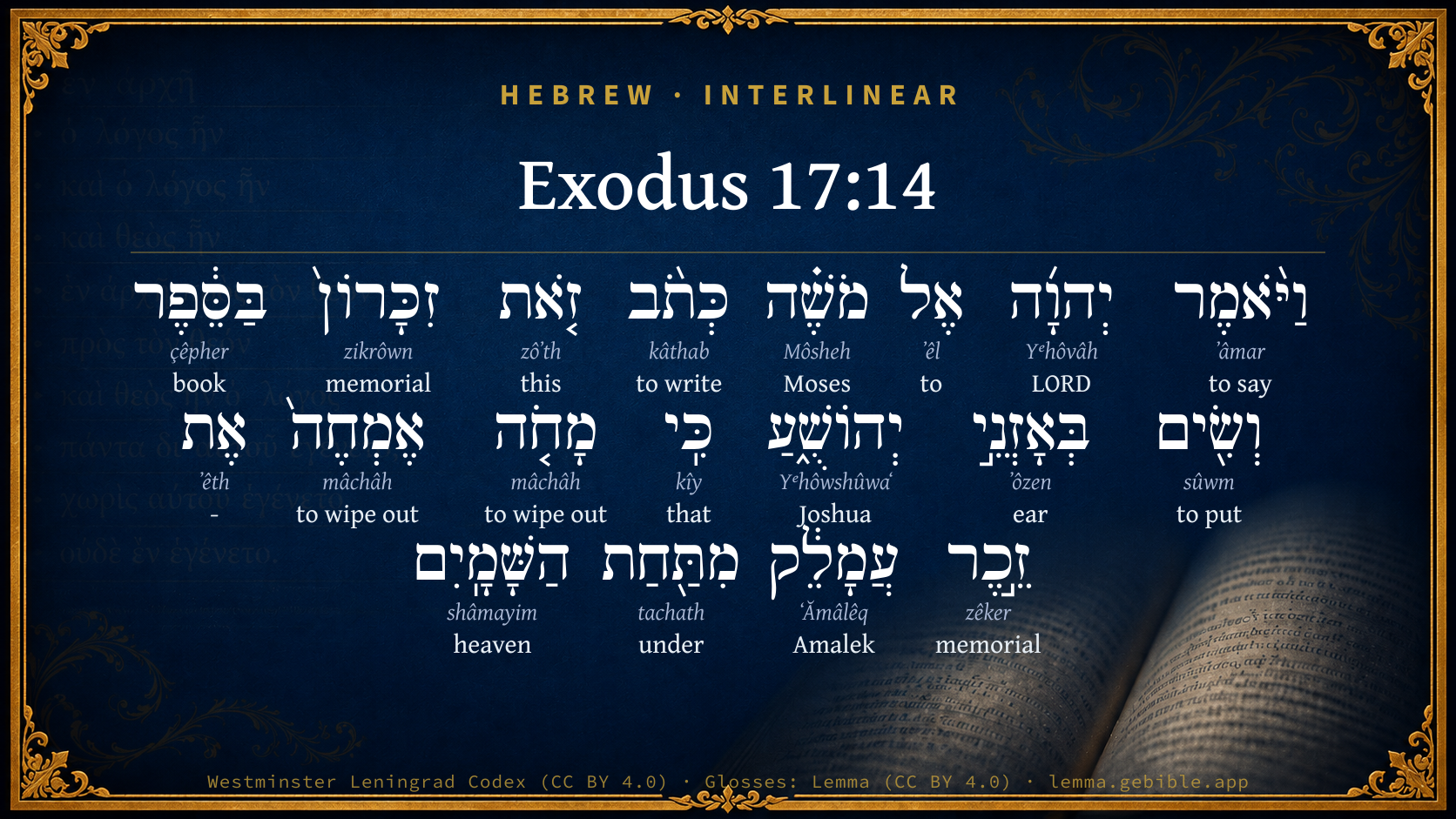
Hebrew (Westminster Leningrad Codex) Exodus 17:14 appears in the Hebrew Old Testament. The text above is from the Westminster Leningrad Codex. Each word links to its Strong’s number, a concise gloss, and parsing drawn from the Open Scriptures Hebrew Bible morphology. Click any word for its full Brown-Driver-Briggs (BDB) entry.
Download image
Cite this verse

Exodus 17:14 (World English Bible). Public Domain. Lemma interlinear Bible study tool, https://lemma.gebible.app/v/exodus/17/14.

Show BibTeX & RIS
BibTeX
RIS
English Translation
Yahweh said to Moses, "Write this for a memorial in a book, and rehearse it in the ears of Joshua: that I will utterly blot out the memory of Amalek from under the sky."
World English Bible · Public Domain
Highlights
  • 1 first appearance in the Hebrew Bible
Full analysis ↓
Download a study sheet

One document with this verse’s original text, its word-by-word gloss line, the meaning frame, cross-references with their text, attributed commentary, and full source and license credits — printable, and it pastes into notes with its structure intact.

This verse Autodidact and up

Study sheet (.html) Plain text (.txt)

A passage Seminary Student

Up to 50 verses in one chapter. A passage sheet keeps up to 6 commentary sources and 12 cross-references per verse, in the order this page ranks them, and says so on the sheet whenever that leaves anything out. Ask for a single verse and you get the Autodidact verse sheet above.

Everything on this page stays free to read, with no account — the sheet is a download of what is already on screen, not access to it.

Want to remove ads? Support Godless Engineer
Compare translations 3

The same verse in 3 English versions, stacked beneath the original-language interlinear above. Click any original word for its lexicon entry.

Each is an independent rendering of the whole verse — the interlinear is not word-aligned to these translations.

Highlighted words mark where these versions differ — a whole-verse word diff, not a word-by-word alignment.

  • World English Bible Public Domain
    Yahweh said to Moses, "Write this for a memorial in a book, and rehearse it in the ears of Joshua: that I will utterly blot out the memory of Amalek from under the sky."
  • King James Version Public Domain
    And the LORD said unto Moses, Write this for a memorial in a book, and rehearse it in the ears of Joshua: for I will utterly put out the remembrance of Amalek from under heaven.
  • unfoldingWord Literal Text CC BY-SA 4.0
    And Yahweh said to Moses, “Write this memory in the book and put it in the ears of Joshua, because I will certainly blot out the memory of Amalek from under the skies.”

unfoldingWord Literal Text — © unfoldingWord, licensed CC BY-SA 4.0. Word-aligned USFM3 via Door43 (git.door43.org/unfoldingWord/en_ult).

Versions to compare (up to 4)

3 of 4 selected

Show all 18 translations

Every available English version of this verse, each an independent rendering of the whole verse.

  • World English Bible Public Domain
    Yahweh said to Moses, "Write this for a memorial in a book, and rehearse it in the ears of Joshua: that I will utterly blot out the memory of Amalek from under the sky."
  • Berean Standard Bible Public Domain
    Then the LORD said to Moses, “Write this on a scroll as a reminder and recite it to Joshua, because I will utterly blot out the memory of Amalek from under heaven.”
  • Majority Standard Bible Public Domain
    Then the LORD said to Moses, “Write this on a scroll as a reminder and recite it to Joshua, because I will utterly blot out the memory of Amalek from under heaven.”
  • King James Version Public Domain
    And the LORD said unto Moses, Write this for a memorial in a book, and rehearse it in the ears of Joshua: for I will utterly put out the remembrance of Amalek from under heaven.
  • American Standard Version (1901) Public Domain
    And Jehovah said unto Moses, Write this for a memorial in a book, and rehearse it in the ears of Joshua: that I will utterly blot out the remembrance of Amalek from under heaven.
  • Revised Version (1885) Public Domain
    And the LORD said unto Moses, Write this for a memorial in a book, and rehearse it in the ears of Joshua: that I will utterly blot out the remembrance of Amalek from under heaven.
  • Geneva Bible (1599) Public Domain
    And the Lord sayde to Moses, Write this for a remembrance in the booke, and rehearse it to Ioshua: for I will vtterly put out the remembrance of Amalek from vnder heauen.
  • Douay-Rheims (1899) Public Domain
    And the Lord said to Moses: Write this for a memorial in a book, and deliver it to the ears of Josue: for I will destroy the memory of Amalec from under heaven.
  • Young's Literal Translation Public Domain
    And Jehovah saith unto Moses, `Write this, a memorial in a Book, and set `it' in the ears of Joshua, that I do utterly wipe away the remembrance of Amalek from under the heavens;'
  • Literal Standard Version CC BY-SA 4.0
    And YHWH says to Moses, “Write this, a memorial in a Scroll, and set [it] in the ears of Joshua, that I utterly wipe away the remembrance of Amalek from under the heavens”;
  • Unlocked Literal Bible CC BY-SA 4.0
    Yahweh said to Moses, “Write this in a book and read it in Joshua's hearing, because I will completely blot out the memory of Amalek from under the skies.”
  • unfoldingWord Literal Text CC BY-SA 4.0
    And Yahweh said to Moses, “Write this memory in the book and put it in the ears of Joshua, because I will certainly blot out the memory of Amalek from under the skies.”
  • Darby Bible Public Domain
    And Jehovah said to Moses, Write this [for] a memorial in the book, and rehearse [it] in the ears of Joshua, that I will utterly blot out the remembrance of Amalek from under the heavens.
  • World Messianic Bible Public Domain
    The LORD said to Moses, “Write this for a memorial in a book, and rehearse it in the ears of Joshua: that I will utterly blot out the memory of Amalek from under the sky.”
  • Webster's Bible Public Domain
    And the LORD said to Moses, Write this for a memorial in a book, and rehearse it in the ears of Joshua: for I will utterly blot out the remembrance of Amalek from under heaven.
  • Free Bible Version CC BY-SA 4.0
    The Lord told Moses, “Write all this down on a scroll as a reminder and read it out loud to Joshua, because I'm going to completely wipe out the Amalekites so nobody on earth will remember them.”
  • Bible in Basic English Public Domain
    And the Lord said to Moses, Make a record of this in a book, so that it may be kept in memory, and say it again in the ears of Joshua: that all memory of Amalek is to be completely uprooted from the earth.
  • JPS Tanakh (1917) Public Domain
    And the LORD said unto Moses: 'Write this for a memorial in the book, and rehearse it in the ears of Joshua: for I will utterly blot out the remembrance of Amalek from under heaven.'

Literal Standard Version (2020), Covenant Press — licensed CC BY-SA 4.0. Text via the HelloAO Bible API (eBible.org). Unlocked Literal Bible (unfoldingWord) — licensed CC BY-SA 4.0. Text via the HelloAO Bible API (eBible.org). unfoldingWord Literal Text — © unfoldingWord, licensed CC BY-SA 4.0. Word-aligned USFM3 via Door43 (git.door43.org/unfoldingWord/en_ult). Free Bible Version, Dr. Jonathan Gallagher — licensed CC BY-SA 4.0. Text via the HelloAO Bible API (eBible.org).

Word by word

More ways to search: Search by grammar → Find every occurrence → Compare this word →

Practice this passage: Drill this verse → Learn its vocabulary →

זֵ֣כֶר
zêker
H2143
“memorial of”
Noun, Common, Masculine, Singular, Construct
Part of Speech
Noun
Type
Common
Gender
Masculine
Number
Singular
State
Construct
Full BDB Definition

Origin: from H2142

TWOT: 551a

memorial, remembrance - remembrance, memory - memorial
  1. וַיֹּ֨אמֶר ʼâmar H559 “and · to say” Conjunction + Verb, Qal, Sequential Imperfect, 3rd Person, Masculine, Singular
  2. יְהוָ֜ה Yᵉhôvâh H3068 “LORD” Noun, Proper
  3. אֶל ʼêl H413 “to” Preposition
  4. מֹשֶׁ֗ה Môsheh H4872 “Moses” Noun, Proper
  5. כְּתֹ֨ב kâthab H3789 “write” Verb, Qal, Imperative, 2nd Person, Masculine, Singular
  6. זֹ֤את zôʼth H2063 “this” Pronoun, Demonstrative, Feminine, Singular
  7. זִכָּרוֹן֙ zikrôwn H2146 “memorial” Noun, Common, Masculine, Singular, Absolute
  8. בַּסֵּ֔פֶר çêpher H5612 “in/at the · book” Preposition, Determined + Noun, Common, Masculine, Singular, Absolute
  9. וְשִׂ֖ים sûwm H7760 “and · put” Conjunction + Verb, Qal, Imperative, 2nd Person, Masculine, Singular
  10. בְּאָזְנֵ֣י ʼôzen H241 “in/at · ears of” Preposition + Noun, Common, Feminine, Dual, Construct
  11. יְהוֹשֻׁ֑עַ Yᵉhôwshûwaʻ H3091 “Joshua” Noun, Proper
  12. כִּֽי kîy H3588 “that” Conjunction
  13. מָחֹ֤ה mâchâh H4229 “to wipe out” Verb, Qal, Infinitive Absolute
  14. אֶמְחֶה֙ mâchâh H4229 “to wipe out” Verb, Qal, Imperfect, 1st Person, Common, Singular
  15. אֶת ʼêth H853 “-” Particle, Direct Object
  16. עֲמָלֵ֔ק ʻĂmâlêq H6002 “Amalek” Noun, Proper
  17. מִתַּ֖חַת tachath H8478 “from · under” Preposition + Preposition
  18. הַשָּׁמָֽיִם shâmayim H8064 “the · heaven(s)” Particle, Definite Article + Noun, Common, Masculine, Plural, Absolute

About this verse

These counts appear in no published source. They are computed here, from the morphology-tagged text and Lemma’s own curated glosses. What Lemma adds →

19
words
18
distinct lemmas
Pentateuch
section

Notable vocabulary

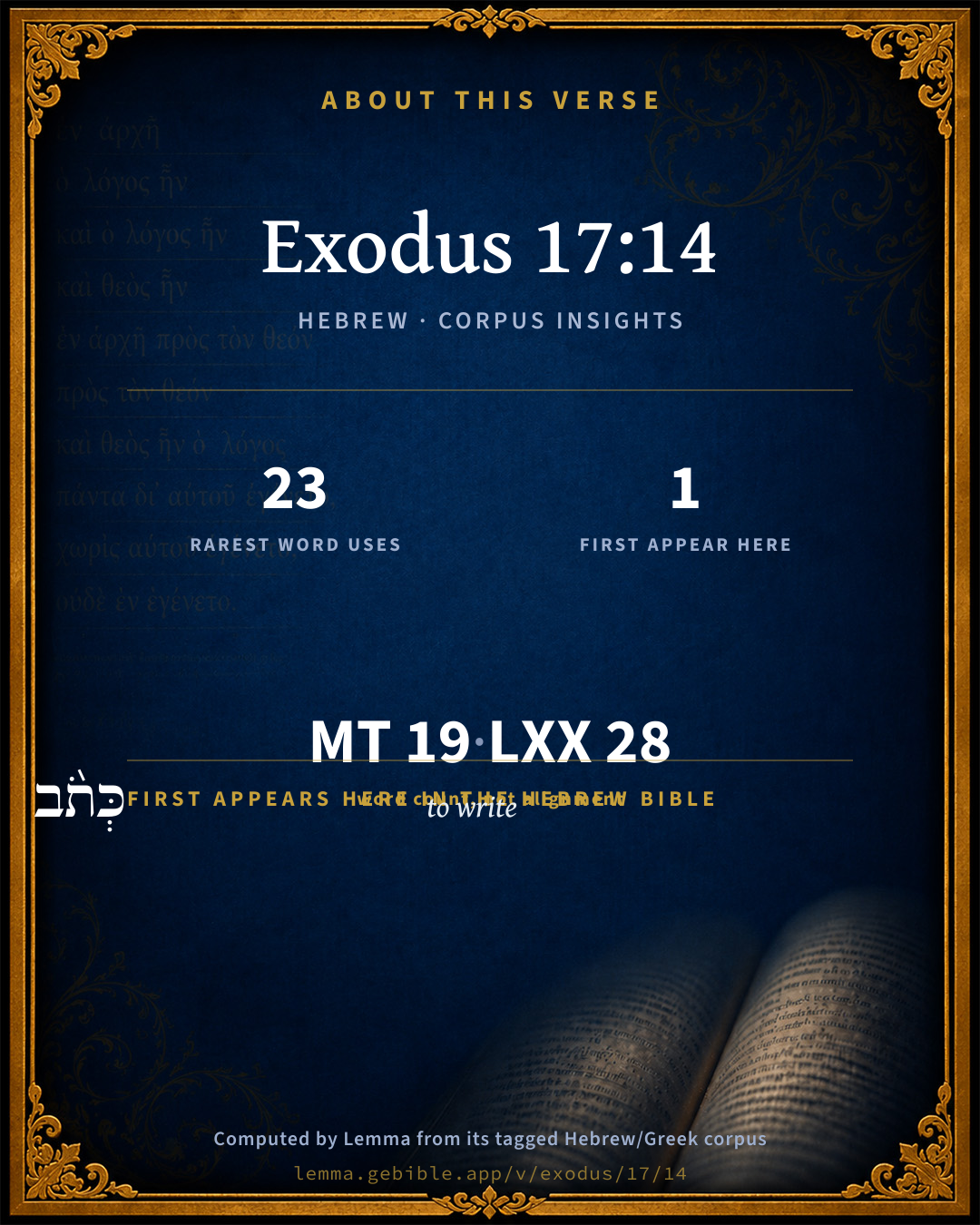
The rarest word here is זֵ֣כֶר memorial H2143 — appearing just 23 times in the whole Hebrew Bible.

First appearance in Scripture

This word makes its first canonical appearance in the Hebrew Bible here:

  • כְּתֹ֨ב to write H3789

Shared distinctive vocabulary

זֵ֣כֶר memorial H2143 occurs in 23 verses of the Hebrew Bible. Also found in:

Grammatical profile

  • 5 verbs
  • 9 nouns
  • 1 pronoun
  • 2 prepositions
  • 1 conjunction
  • 1 particle

Verb forms

  • וַיֹּ֨אמֶר Qal · Sequential Imperfect
  • כְּתֹ֨ב Qal · Imperative
  • וְשִׂ֖ים Qal · Imperative
  • מָחֹ֤ה Qal · Infinitive Absolute
  • אֶמְחֶה֙ Qal · Imperfect

Repetition

A word recurs within this verse — often emphatic in Hebrew:

  • מָחֹ֤ה to wipe out H4229 ×2

Hebrew & Septuagint length

In English translation the verse runs 34 words from the Hebrew and 35 from the Septuagint (LXX English) — closely comparable.

A rough comparison of the two English renderings, which tokenize alike — not a word-level alignment.

Word counts can differ between the Hebrew and the Greek without any difference in meaning — e.g. the Hebrew direct-object marker אֵת has no separate Greek word, and Greek often adds the article ὁ.

In the original languages it is 19 Hebrew tokens and 28 Greek tokens — but the two are counted differently (Hebrew bundles its prefixes and suffixes into one token; the Greek is in lemma form), so that isn’t a like-for-like length.

Cross-references

25

Topical passages linked to Exodus 17:14 in the Treasury of Scripture Knowledge — connected by theme and wording, ordered by reader-vote popularity; previews shown in the World English Bible.

  • Exodus 34:27 Yahweh said to Moses, "Write you these words: for in accordance with these words I have made a covenant with you and with Israel."
  • 1 Samuel 30:1 It happened, when David and his men were come to Ziklag on the third day, that the Amalekites had made a raid on the South, and on Ziklag, and had struck Ziklag, and burned it with fire,
  • 1 Samuel 30:17 David struck them from the twilight even to the evening of the next day: and there not a man of them escaped, except four hundred young men, who rode on camels and fled.
  • Numbers 24:20 He looked at Amalek, and took up his parable, and said, Amalek was the first of the nations; But his latter end shall come to destruction.
  • Numbers 33:2 Moses wrote their goings out according to their journeys by the commandment of Yahweh: and these are their journeys according to their goings out.
  • Deuteronomy 25:17–19 Remember what Amalek did to you by the way as you came forth out of Egypt;
  • 2 Samuel 8:12 of Syria, and of Moab, and of the children of Ammon, and of the Philistines, and of Amalek, and of the spoil of Hadadezer, son of Rehob, king of Zobah.
  • Exodus 12:14 This day shall be to you for a memorial, and you shall keep it a feast to Yahweh: throughout your generations you shall keep it a feast by an ordinance forever.
  • Exodus 13:9 It shall be for a sign to you on your hand, and for a memorial between your eyes, that the law of Yahweh may be in your mouth; for with a strong hand Yahweh has brought you out of Egypt.
  • Exodus 24:4 Moses wrote all the words of Yahweh, and rose up early in the morning, and built an altar under the mountain, and twelve pillars for the twelve tribes of Israel.
  • 1 Samuel 15:2–3 Thus says Yahweh of Hosts, I have marked that which Amalek did to Israel, how he set himself against him in the way, when he came up out of Egypt.
  • 1 Samuel 15:7–8 Saul struck the Amalekites, from Havilah as you go to Shur, that is before Egypt.
  • Deuteronomy 31:9 Moses wrote this law, and delivered it to the priests the sons of Levi, who bore the ark of the covenant of Yahweh, and to all the elders of Israel.
  • Joshua 4:7 then you shall tell them, Because the waters of the Jordan were cut off before the ark of the covenant of Yahweh; when it passed over the Jordan, the waters of the Jordan were cut off: and these stones shall be for a memorial to the children of Israel forever.
  • 1 Samuel 15:18 and Yahweh sent you on a journey, and said, 'Go, and utterly destroy the sinners the Amalekites, and fight against them until they are consumed.'
  • 1 Samuel 27:8–9 David and his men went up, and made a raid on the Geshurites, and the Girzites, and the Amalekites; for those [nations] were the inhabitants of the land, who were of old, as you go to Shur, even to the land of Egypt.
  • 2 Samuel 1:1 It happened after the death of Saul, when David was returned from the slaughter of the Amalekites, and David had abode two days in Ziklag;
  • 2 Samuel 1:8–16 He said to me, Who are you? I answered him, I am an Amalekite.
  • 1 Chronicles 4:43 They struck the remnant of the Amalekites who escaped, and have lived there to this day.
  • Ezra 9:14 shall we again break your commandments, and join in affinity with the peoples that do these abominations? would not you be angry with us until you had consumed us, so that there should be no remnant, nor any to escape?
  • Job 18:17 His memory shall perish from the earth. He shall have no name in the street.
  • Job 19:23 "Oh that my words were now written! Oh that they were inscribed in a book!
  • Psalms 9:6 The enemy is overtaken by endless ruin. The very memory of the cities which you have overthrown has perished.
  • Proverbs 10:7 The memory of the righteous is blessed, But the name of the wicked will rot.
  • Haggai 2:2–3 "Speak now to Zerubbabel, the son of Shealtiel, governor of Judah, and to Joshua, the son of Jehozadak, the high priest, and to the remnant of the people, saying,

Cross-references courtesy of OpenBible.info (CC BY 4.0).

Hebrew and Greek witnesses Masoretic Hebrew ↔ Greek Septuagint

The same verse in the two great witnesses to the Old Testament, shown verse-for-verse.

These are two independent witnesses, not word-aligned to each other, and the Septuagint is shown in lemma (dictionary) form.

Hebrew Exodus 17:14 Masoretic · Westminster Leningrad Codex

וַיֹּ֨אמֶר יְהוָ֜ה אֶל מֹשֶׁ֗ה כְּתֹ֨ב זֹ֤את זִכָּרוֹן֙ בַּסֵּ֔פֶר וְשִׂ֖ים בְּאָזְנֵ֣י יְהוֹשֻׁ֑עַ כִּֽי מָחֹ֤ה אֶמְחֶה֙ אֶת זֵ֣כֶר עֲמָלֵ֔ק מִתַּ֖חַת הַשָּׁמָֽיִם

Yahweh said to Moses, "Write this for a memorial in a book, and rehearse it in the ears of Joshua: that I will utterly blot out the memory of Amalek from under the sky."

World English Bible · Public Domain

Greek LXX Exodus 17:14 Septuagint · lemma form

εἶπον δέ κύριος πρός μωυσῆς καταγράφω οὗτος εἰς μνημόσυνον ἐν βιβλίον καί δίδωμι εἰς ὁ οὖς ἰησοῦς ὅτι ἀλοιφή ἐκἀλείφω ὁ μνημόσυνον αμαληκ ἐκ ὁ ὑπό ὁ οὐρανός

And the Lord said to Moses, Write this for a memorial in a book, and speak this in the ears of Joshua; for I will utterly blot out the memorial of Amalec from under heaven.

LXX2012 (modern English Septuagint) · Public Domain

On this verse, Ellicott's Commentary for English Readers discusses the Septuagint’s reading. Read the note in Commentary ↓

Hebrew: Westminster Leningrad Codex (CC BY 4.0). Greek: Septuagint (public domain); English from LXX2012 (modern English Septuagint) (Public Domain). How the Septuagint differs from the Hebrew →

Targum (Aramaic paraphrase)

2

The Targum is the ancient Jewish Aramaic paraphrase of the Hebrew Scriptures — an interpretive translation, not the Hebrew text itself. Onkelos (literal) and Pseudo-Jonathan (expansive) render the Torah, and Jonathan the Prophets. Coverage is partial: where no permissively-licensed English translation exists for a verse, only the Aramaic is shown. This is verse-level text, not a word-by-word alignment to the Hebrew.

  1. Targum Onkelos Torah (Genesis–Deuteronomy)
    וַאֲמַר יְיָ לְמשֶׁה כְּתָב דָא דוּכְרָנָא בְּסִפְרָא וְשַׁוִי קֳדָם יְהוֹשֻׁעַ אֲרֵי מִמְחָא אֶמְחֵי יָת דוּכְרָנָא דַעֲמָלֵק מִתְּחוֹת שְׁמַיָא:

    (no public-domain English translation for this verse)

    Targum Onkelos — Aramaic: “Onkelos Genesis” (public domain); “Onkelos Exodus” (public domain); “Onkelos Leviticus” (public domain); “Onkelos Numbers” (public domain); “Onkelos Deuteronomy” (public domain). English: “Sefaria Community Translation” (CC0 1.0 (public-domain dedication)); “J.W. Etheridge. The Targums of Onkelos and Jonathan Ben Uzziel on the Pentateuch. London: Longmans, Green, 1862” (public domain). Text via Sefaria.

  2. Targum Pseudo-Jonathan Torah (Genesis–Deuteronomy)
    וַאֲמַר יְיָ לְמשֶׁה כְּתוֹב דָּא דוּכְרָנָא בְּסֵפֶר סָבַיָיא דְמִלְקַדְמִין וְשַׁוִּי פִּתְגָמַיָא הָאִינוּן בְּמִשְׁמָעֵיהּ דִּיהוֹשֻׁעַ אֲרוּם מִימְחָא אֶמְחֵי יַת דּוּכְרָן עֲמָלֵק מִתְּחוֹת שְׁמַיָא

    And the Lord said unto Mosheh, Write this memorial in the book of the elders that were of old, and these words in the hearing, of Jehoshua, that blotting, I will blot out the memory of Amalek from under the heavens.

    Targum Pseudo-Jonathan — Aramaic: “Targum Jonathan on Genesis” (public domain); “Targum Jonathan on Exodus” (public domain); “Targum Jonathan on Leviticus” (public domain); “Targum Jonathan on Numbers” (public domain); “Targum Jonathan on Deuteronomy” (public domain). English: “The Targum of Jonathan ben Uzziel, trans. J. W. Etheridge, London, 1862” (public domain). Text via Sefaria.

Commentary

Notes on Exodus 17:14 from classic Christian and Jewish commentators (each source and its license shown beneath its notes). The classic Christian expositions comment on the surrounding passage and are grouped to its opening verse, so a note may address several verses; the Jewish commentaries on the Tanakh (Rashi and others) are per-verse, so they appear only where the commentator wrote on this verse.

Lemma curates 59 commentaries, every one of them public domain or Creative Commons licensed, each selected and text-cleaned for this edition rather than reprinted as found. About our sources →

Trapp's Complete Commentary

John Trapp

Exo 17:14 And the LORD said unto Moses, Write this [for] a memorial in a book, and rehearse [it] in the ears of Joshua: for I will utterly put out the remembrance of Amalek from under heaven.

Ver. 14. In a book.] Or, In the book that thou art now in writing, viz., the Pentateuch, the most ancient book that is extant.

I will utterly put out, &c,] The portion of wicked men is to be "forgotten in the city where they had so done." {Ecc 8:10} Their memory dies with them: or, if it be preserved, it stinks in keeping, and remains as a curse and perpetual disgrace.

John Trapp, A Commentary or Exposition upon All the Books of the Old and New Testament (1647–1656) — public domain. Text from a community e-Sword module.

The Biblical Illustrator

Joseph S. Exell

Exo_17:14

I will utterly put out the remembrance of Amalek.

Lessons

1. Jehovahs victories over His Churchs enemies He giveth in charge to be recorded.

2. Writing and tradition are both Gods ways of recording His works for future ages.

3. Gods book is the best record of His mighty works done for His Church.

4. A memorial would God have kept by the records of Gods works to men.

5. God hath irreconcilable displeasure against some enemies above the rest.

6. Blotting out of the names of such enemies will God make, who would blot out the name of His Church. (G. Hughes, B. D.)

Destruction of Amalek

I. It is probable that from this time Moses began to keep a journal of striking and useful occurrences. Great men have frequently done the same for intellectual, and good men for religious, purposes.

II. Whatever may be said of the particular mode, the thing itself is of importance. If we are to be affected with transactions and feelings, they must be in some way secured and retained.

III. A reason is assigned for the recording and rehearsing of this transaction in a dreadful menace. The threatening was executed partially by Saul; but fully by David.

IV. The scriptures cannot be broken. Whatever improbabilities appear--whatever difficulties stand in the way--whatever delays intervene--Gods counsels of old are faithfulness and truth; not a lot of His Word shall fail. (W. Jay.)

Use of history

Lucius Lucullus, being appointed captain-general over the Roman forces against Mithridates, had not great experience or knowledge in war, but only what he had gotten by reading history, yet proved a discreet and valiant commander, and vanquished at that time two of the greatest princes in the East. Thus it is that history is, and may be, the director of meanest men in any of their actions, how others have behaved themselves upon several occasions, and what hath followed thereupon; it is a trusty counsellor of state, by whose advice and direction a commonwealth may be framed, governed, reformed, and preserved, an army may be ordered, enemies vanquished, and victory obtained. In it, as in a glass, we see and behold Gods providence guiding and ruling the world, and mens actions which arrive often at unexpected events, and even sometimes reach unto such ends as are quite contrary to the actors intentions; it is a punisher of vice, presenting aged folly green and fresh to posterity; not suffering sin to die, much less to be buried in oblivion; it is also a rewarder of virtue, reserving worthy deeds for imitation; a good work, though it die in doing, is a reward to itself, yet that some dull natures might be stirred up the more, and all benefited by seeing gracious steps before them, this only is exempted by a firm decree from the stroke of death, to live in history. (J. Crompton.)

The Biblical Illustrator, edited by Joseph S. Exell (c. 1880s–1900s) — public domain. Text from a community e-Sword module.

Tyndale Open Study Notes

Tyndale Open Resources

17:14-16 By their unprovoked attack on the people through whom God was extending his blessing, the Amalekites incurred the unending wrath of God. God’s hand can be extended in blessing, or it can be extended in curse. Those who reject the hand of blessing experience the curse (see 1 Sam 15).

Tyndale Open Study Notes — © Tyndale Open Resources, licensed CC BY-SA 4.0. Text via the HelloAO Bible API.

Geneva Bible (1599)

Geneva Bible translators

In the book of the Law.

Hebrew, put it in the ears of Joshua.

Geneva Bible (1599) marginal notes — public domain. Text via Bolls.life.

Jamieson, Fausset & Brown

Robert Jamieson, A. R. Fausset & David Brown

Write this for a memorial--If the bloody character of this statute seems to be at variance with the mild and merciful character of God, the reasons are to be sought in the deep and implacable vengeance they meditated against Israel (Psa 83:4).

Next: Exodus Chapter 18

Jamieson, Fausset & Brown — Commentary Critical and Explanatory on the Whole Bible (1871) — public domain (CC PDM 1.0). Text via the HelloAO Bible API.

Adam Clarke's Commentary

Verse 14. Write this for a memorial in a book] This is the first mention of writing on record: what it signified, or how it was done, we cannot tell. But it is evident that either this passage is introduced here instead of De 25:17, by way of anticipation, or that by the words כתב שפר kethob and sepher was intended only a monumental declaration of the defeat of Amalek by Joshua, by some action or symbolical representation; for it is immediately subjoined, "And Moses built an altar, and called the name of it Jehovah-nissi." See Dr. A. Bayley, and see the note on chap. xxx. It is very likely that the first regular alphabetical writing in the world was that written by the finger of God himself on the two tables of stone. What is said here was probably by way of anticipation, or means some other method of registering events than by alphabetical characters, if we allow that God gave the first specimen of regular writing on the tables of stone, which did not take place till some time after this.

Rehearse it in the ears of Joshua] Thus showing that Joshua was to succeed Moses, and that this charge should be given to every succeeding governor.

I will utterly put out the remembrance of Amalek] This threatening was accomplished by SAUL, 1Sa 15:3, c. four hundred and twelve years after. Judgment is God's strange work; but it must take place when the sins which incensed it are neither repented of nor forsaken. This people, by their continued transgressions, proved themselves totally unworthy of a political existence; and therefore said God to Saul, Go, and utterly destroy the SINNERS the Amalekites; 1Sa 15:18. So their continuance in sin was the cause of their final destruction.

Adam Clarke's Commentary on the Bible (1810–1826) — public domain. Text from a community e-Sword/MySword module.

Ellicott's Commentary for English Readers

(14) Write this for a memorial in a book.—Heb., in the book. That “book” existed long prior to Moses is implied in his quotation of them (Gen_5:1; Num_21:14), and has of late years been abundantly proved by the discoveries made of Egyptian papyruses dating from a time long anterior to the Jewish lawgiver. The expression used in the present place, if it may be trusted,[59] “the book,” is remarkable, and seems to imply that a book already existed at the date of the engagement, in which God’s dealings with His people were entered from time to time. (See Introduction to Speaker’s Commentary, vol. i., p. 1.) This book was probably the germ of the existing Pentateuch, which was composed in many portions, and at intervals, as occasion arose.

[59] Bĕsêpher, “in a book,” and bassêpher. “in the book, differ only in the pointing, which, resting solely on tradition cannot be entirely depended on. The LXX. omit the article.

I will utterly put out the remembrance of Amalek.—The extermination of Amalek, here prophesied, was afterwards laid as a positive command upon the Israelites (Deu_25:19), and was accomplished in part by Saul and David (1Sa_14:48; 1Sa_15:7; 1Sa_27:8; 1Sa_30:17; 2Sa_8:12), but finally and completely in the reign of Hezekiah (1Ch_4:43). Amalek’s sin was, that after all the signs and wonders which had shown the Israelites to be God’s peculiar people, he braved God’s displeasure by attacking them (Deu_25:18). To this audacity and contempt of Jehovah’s power he added a cruel pitilessness, when he fell upon the rear of an almost unarmed host, at a time when they were “faint and weary.”

A Bible Commentary for English Readers, edited by Charles John Ellicott (1878–1897) — public domain. Text from a community e-Sword module.

The Cambridge Bible for Schools and Colleges

gen. ed. J. J. S. Perowne

14. this] the preceding incident.

in a book] The Heb., as pointed, is, in the book, whence it has often been supposed that the reference is to the history which Moses had already begun to write. But though this might be the meaning of the Heb., it is certainly not the necessary meaning: ‘the Hebrew always writes in the book, Num_5:23, 1Sa_10:25, Jer_32:10, Job_19:23 (cf. Est_9:25 Heb.)’ (Di.); an object being conceived as definite in Heb. not only because it is already known or has been mentioned before, but also because it is taken for a particular purpose, and so made definite in the speaker’s or writer’s mind. See numerous examples in G.-K. § 126r, s: e.g. Exo_16:32 the omerful, Exo_21:20 with the rod, Num_21:9 put it on the pole, Jos_2:15 with the cord, &c.; in all such cases we naturally say a.

rehearse] Heb. place; the meaning being, impress it upon Joshua. ‘Rehearse,’ at least as understood now, is not very suitable. It means properly (from Fr. reherser) to harrow over again, fig. to go over repeatedly: in Jdg_5:11, 1Sa_17:31, it is used in the sense of tell, recite.

for (marg.) &c.] The memory of the incident is to be preserved, because, on account of the unfriendliness shewn in it by Amalek, it is Jehovah’s purpose to blot out their name from under heaven.

I will utterly blot out, &c.] Repeated, in the form of an injunction laid upon Israel, in Deu_25:19. To ‘blot out from under heaven,’ also, Deu_9:14; Deu_29:20.

14, 15. Provision made for the remembrance of the victory to be handed down to future generations.

The Cambridge Bible for Schools and Colleges (gen. ed. J. J. S. Perowne; Cambridge University Press, 1878–1918) — public domain. Text from a community e-Sword module.

John Gill's Exposition

And the Lord said unto Moses,.... After the battle was over, and the Israelites had got the victory:

write this for a memorial in a book: not in loose papers, but in a book, that it might continue; meaning that the account of this battle with Amelek should be put down in the annals or journal of Moses, in the book of the law he was writing, or was about to write, and would write, as he did, see Jos 1:7 that so it might be kept in memory, and transmitted to the latest posterity; it being on the one hand an instance of great impiety, inhumanity, and rashness, in Amalek, and on the other a display of the goodness, kindness, and power of God on the behalf of his people: and

rehearse it in the ears of Joshua; who was a principal person concerned in this battle, and therefore, when the account was written and rehearsed, could bear witness to the truth of it, as well as he was to be the chief person that should be concerned in introducing the Israelites into the land of Canaan, and subduing the Canaanites; and therefore this, and what follows, was to be rehearsed to him, as the rule of his conduct toward them, and particularly Amalek:

for I will utterly put out the remembrance of Amelek from under heaven; so that they shall be no more a nation, and their name never mentioned, unless with disgrace and contempt. This was fulfilled partly by Saul, Sa1 15:8 and more completely by David, Sa1 30:17, and the finishing stroke the Jews give to Mordecai and Esther, as the Targum of Jerusalem on Exo 17:6.

John Gill's Exposition of the Whole Bible (1746–1763) — public domain (CC PDM 1.0). Text via the HelloAO Bible API.

Albert Barnes' Notes on the Bible

In a book - in the book, i. e. the book which contained the history of God’s dealings with His people. Moses was further instructed to impress the command especially on the mind of Joshua, as the leader to whom the first step toward its accomplishment would be entrusted on the conquest of Canaan. The work was not actually completed until the reign of Hezekiah, 1Ch 4:43.

Albert Barnes' Notes on the Bible (1834–1885) — public domain. Text from a community e-Sword/MySword module.

Haydock's Catholic Bible Commentary

Of Josue, and of all who shall govern after him, that they may remember to execute my decree of extermination, against these cruel Amalecites, who have first dared to oppose the progress of my dejected people. (Haydock) --- Moses mentions, that they particularly attacked the feeble and stragglers, (Deuteronomy xxv. 18,) though their army was very formidable, Judith iv. 13. Saul received an express order to destroy this nation; and he made such havoc among them, that they never rose again to any importance, and were confounded with the Idumeans, 1 Kings xv. 3. (Calmet)

George Leo Haydock (1774–1849), Haydock's Catholic Family Bible and Commentary, 1859 edition — public domain. Excludes Psalms (Douay-Rheims chapter numbering differs from Protestant) and Deuterocanonical books (Catholic canon only).

Matthew Poole's English Annotations

In a book; even in this book, which Moses was to write by God’s inspiration and appointment. See Exo 34:27; Deu 31:9,22. In the ears of Joshua, thy successor, and the captain of my people, that he and all succeeding governors may watch all occasions to execute this command.

I will utterly put out the remembrance of Amalek, i.e. I will utterly destroy them; for a person or people dead or destroyed are soon forgotten, Psa 31:12, and the grave is called the land of forgetfulness, Psa 88:12. Or thus, Though they are now a numerous and flourishing people, and in great repute, I will make them few and inglorious, for such are little minded or remembered; for this is not to be understood absolutely of a speedy and utter extinction of them, for he supposeth their being from generation to generation, Exo 17:16, but comparatively. From under heaven; from the face of the whole earth.

Matthew Poole's English Annotations on the Holy Bible (1683–1685) — public domain. Text from a community e-Sword/MySword module.

Whedon's Commentary on the Bible

Daniel D. Whedon

14. Write — This is the first time that this word occurs in the Bible. Until quite recently the existence of the art of writing in the time of Moses was frequently disputed by the opponents of revelation; but it is now settled that the Phenicians, whose alphabet was the same as that of the Hebrews, practiced writing at least as early as the time of Moses. The best idea of the form of the letters can be obtained from the fac simile of the famous Moabite stone discovered in 1868, which contains an inscription of Mesha, king of Moab, (2Ki_3:4, which see,) vaunting his victories over Omri, king of Israel, in the tenth century B.C., the oldest alphabetic inscription as yet known. (“The Moabite Stone,” by Dr. Ginsburg, London, 1871.) Writing is here spoken of as if familiar to the Israelites, and it will be noticed, not mere monumental writing, as of a few words upon a stone, but in a book, upon papyrus, which denotes much advancement in the art.

In a book — In the (well-known) book; our translation improperly omits the article. (Gesenius, Gr., § 109, 3, Rem. 1; Ewald, Lehrb., § 277, a.) It was the book wherein was kept the record of this wonderful history, wherein all God’s statutes were written down. It was doubtless the book used by Moses, or his scribes, in the composition of the Pentateuch, if not the Pentateuch itself.

In the ears of Joshua — Because he was to be the military leader, and to execute this commission upon Amalek.

I will utterly put out — Literally, wiping I will wipe out; fearfully graphic words. Amalek was a nation which had “filled the measure of its iniquities,” and God appointed Israel to blot it from being.

Daniel D. Whedon (gen. ed.), Commentary on the Old and New Testaments (1874–1909) — public domain. Text from a community e-Sword module.

The Pulpit Commentary

Write this in a book. The original has, "Write this in the book." It is clear that a book already existed, in which Moses entered events of interest, and that now he was divinely commanded to record in it the great victory over Amalek, and the threat uttered against them. The record was to be for a memorial

1. that the victory itself might be held in remembrance through all future ages, as a very signal instance of God"s mercy; and

2. that when the fulfilment of the threat came, (1Ch_4:43) God might have his due honour, and his name be glorified. Rehearse it in the ears of Joshua. "Hand down," i.e. , to thy successor, Joshua, the tradition of perpetual hostility with Amalek, and the memory of the promise now made, that the whole nation shall be utterly blotted out from under heaven. (Compare Deu_25:19) The special sin of Amalek was,

1. That he attacked God"s people, not fearing God (ib, verse 18);

2. That he had no compassion on his own kindred: and

3. That he fell on them when they were already suffering affliction, andwere "feeble, and faint and weary" (ib).

Vers. 14 16. God"s mercies need memorial, and obtain it in several ways.

Deliverance from Amalek was a great and noticeable mercy. It was.

1. UNDESERVED, as the people had just been murmuring against God,and threatening to stone his prophet (vers. 3-4).

2. TIMELY. Defeat, or even an indecisive success, would have broughtupon the Israelites a host of enemies, under whose combined or continuous attacks they must have succumbed. The complete discomfiture of the powerful Amalek struck terror into the hearts of the neighbouring peoples, and induced them to leave Israel for nearly forty years unmolested.

3. WONDERFUL. Amalek was warlike, accustomed to contend with the great nation of the Egyptians; Israel had had all warlike aspirations checked and kept down by above 400 years of servitude and peace. Amalek was no doubt well armed; Israel can have possessed few weapons. Amalek knew the country, could seize the passes, and select a fitting moment for attack; to all Israel, except Moses and Aaron, (Exo_4:27) the country was strange, the passes unknown, and perhaps the very idea of their being attacked unforeseen and unexpected. The attack actually came close upon the great suffering from thirst, when Israel was "feeble" and "faint and weary". (Deu_25:18) So signal a mercy deserved special remembrance. Men soon forget the favours they receive at God"s hands. That this favour might not be forgotten, God required two things:

4. That a record of it should be inserted in his book. There is no other memorial comparable with this, whether we consider the honour of it, since to obtain record there, an event must be indeed an important one; or the enduringness, since God"s book will continue to the world"s end; or the celebrity, since it is read by all nations. And God"s special command for the insertion, stamps the event with an extra mark of dignity,

5. That it should be handed on traditionally to Joshua, and through him to others. Tradition is one of the modes by which God maintains the knowledge of his truth in the world, and is at no time wholly superseded by the written Word, since there are at all times persons in the world too young or too illiterate to have direct access to the Word, who must receive their religious instruction orally from teachers. Tradition alone would be a very unsafe guide; but tradition, checked by a book, is of no little value in enlarging the sphere of religious knowledge, and amplifying and rendering more intelligible the written record. To the two modes of securing continued remembrance of the defeat of Amalek required by God, Moses added a third the erection of a material monument, to which he gave a commemorative name. Many victories have been thus commemorated, as those of Marathon, Blenheim, Trafalgar, Waterloo, etc.; but no erector of such a memorial has ever given to his work so noble and heart-stirring a name as Moses gave. "The Lord is my banner under no other standard will I serve or fight no other leader will I acknowledge no other lord shall have dominion over me. "The Lord is my banner under this banner I engaged Amalek he, and he alone, gave me the victory through him, and him alone, do I look to discomfit my other enemies. Be the enemies material or spiritual, external or internal, to him only do I trust to sustain me against them. None other name is there under heaven, through whom salvation is to be obtained, the adversary baffled, Amalek put to confusion.

The Pulpit Commentary (1880–1919), ed. H.D.M. Spence-Jones & Joseph S. Exell — public domain. Text from a community e-Sword module.

Keil & Delitzsch

C. F. Keil & F. Delitzsch

As this battle and victory were of such significance, Moses was to write it for a memorial בּסּפר, in "the book" appointed for a record of the wonderful works of God, and "to put it into the ears of Joshua," i.e., to make known to him, and impress upon him, that Jehovah would utterly put out the remembrance of Amalek from under heaven; not "in order that he might carry out this decree of God on the conquest of Canaan, as Knobel supposes, but to strengthen his confidence in the help of the Lord against all the enemies of Israel. In Deu 25:19 the Israelites are commanded to exterminate Amalek, when God should have given them rest in the land of Canaan from all their enemies round about.

Exo 17:15-16

To praise God for His help, Moses built an altar, which he called "Jehovah my banner," and said, when he did so, "The hand on the throne (or banner) of Jah! War to the Lord from generation to generation!" There is nothing said about sacrifices being offered upon this altar. It has been conjectured, therefore, that as a place of worship and thank-offering, the altar with its expressive name was merely to serve as a memorial to posterity of the gracious help of the Lord, and that the words which were spoken by Moses were to serve as a watchword for Israel, keeping this act of God in lively remembrance among the people in all succeeding generations. כּי (Exo 17:16) merely introduces the words as in Gen 4:23, etc. The expression יהּ על־כּס יד is obscure, chiefly on account of the ἁπ λεγ. כּס. In the ancient versions (with the exception of the Septuagint, in which יה כץ is treated as one word, and rendered κρυφαία) כּס is taken to be equivalent to כּסּה (Kg1 10:19; Job 26:9) for כּסּא, and the clause is rendered "the hand upon the throne of the Lord." But whilst some understand the laying of the hand (sc., of God) upon the throne to be expressive of the attitude of swearing, others regard the hand as symbolical of power. There are others again, like Clericus, who suppose the hand to denote the hand laid by the Amalekites upon the throne of the Lord, i.e., on Israel. But if כּס signifies throng or adytum arcanum, the words can hardly be understood in any other sense than "the hand lifted up to the throne of Jehovah in heaven, war to the Lord," etc.; and thus understood, they can only contain an admonition to Israel to follow the example of Moses, and wage war against Amalek with the hands lifted up to the throne of Jehovah. Modern expositors, however, for the most part regard כּס as a corruption of נס, "the hand on the banner of the Lord." But even admitting this, though many objections may be offered to its correctness, we must not understand by "the banner of Jehovah" the staff of Moses, but only the altar with the name Jehovah-nissi, as the symbol or memorial of the victorious help afforded by God in the battle with the Amalekites.

Keil & Delitzsch — Biblical Commentary on the Old Testament (1861–1891) — public domain (CC PDM 1.0). Text via the HelloAO Bible API. (Old Testament only.)

unfoldingWord translationNotes

Door43 World Missions Community

I will completely blot out the memory of Amalek

God speaks of destroying Amalek as if he were removing people's memory of Amalek. When a group of people is completely destroyed, there is nothing to remind people about them. AT: "I will completely destroy Amalek" (See: Metaphor)

a hand was lifted up

People would raise their hand when they made a promise or pledge, so raising the hand represents making a promise. AT: "a promise was made" (See: Metonymy)

a hand was lifted up

This can be stated in active form. AT: "Yahweh lifted up his hand" or "Yahweh made a solemn promise" (See: Active or Passive)

Amalek

This refers to the Amalekites. AT: Amalekites" (See: Metonymy)

translationWords

Yahweh

Moses

Joshua

heaven

altar

call

generation

unfoldingWord translationNotes — © Distant Shores Media and the Door43 World Missions Community, licensed CC BY-SA 4.0. Source: git.door43.org/Door43/en_tn.

Rashi

Rabbi Shlomo Yitzchaki (Rashi)

כתב זאת זכרון WRITE THIS FOR A MEMORIAL, that Amalek came to wage war against Israel before any other nation.

ושים באזני יהושע AND PUT INTO THE EARS OF JOSHUA, who will bring Israel into the Holy Land, that he must command Israel to pay him his recompense. Here it was intimated to Moses (by the mere statement that Joshua should in some future time carry out the injunction to destroy Amalek) that Joshua would bring Israel into the Holy Land (cf. (Mekhilta).

כי מחה אמחה BECAUSE I WOULD UTTERLY BLOT OUT [THE REMEMBRANCE OF AMALEK] — the reason why I admonish you thus is because (כי) I desire to blot it out.

Rashi on the Tanakh — English translations: “The Judaica Press complete Tanach with Rashi, translated by A. J. Rosenberg” (CC BY 4.0); “Pentateuch with Rashi's commentary by M. Rosenbaum and A.M. Silbermann, 1929-1934” (public domain); “The Metsudah Tanach series, Lakewood, N.J” (CC BY 4.0); and “The Book of Joshua, Metsudah Publications, 1997” (CC BY 4.0). Text via Sefaria.

Ramban (Nachmanides)

Rabbi Moshe ben Nachman (Ramban / Nachmanides)

WRITE THIS FOR A MEMORIAL IN THE BOOK. Rabbi Abraham ibn Ezra commented that “this was a known book, namely, the book of the wars of the Eternal, which contained the history of the wars which G-d fought for those that fear Him, and it is possible that the history began from the time of Abraham.” There is nothing in these words of his but an opportunity [to say something without due consideration]. ), Ramban agrees with Ibn Ezra’s comment, by way of the plain meaning of Scripture. This is because it distinctly says there, the book of the wars of the Eternal. Here, however, it just says in the book. Hence Ramban rejects Ibn Ezra’s interpretation that here too it refers to that book of the wars of the Eternal, which is no longer extant, and he proposes his own interpretation, as explained in the text.The correct interpretation appears to me to be that the word, baseifer (in the book), alludes to the Book of the Law, something like that which is written, Take this Book of the Law. He is thus stating: “Write this in the Book of My Law so that the children of Israel should remember what Amalek did, for I will utterly blot out his remembrance, and I will lay My vengeance upon him by the hand of My people Israel.” This is the commandment we find written in the Book of Deuteronomy: Remember what Amalek did unto thee. He said, and rehearse it in the ears of Joshua, to command him to remind Israel of all the travail that had come upon them because of Amalek, for he [Joshua] knows and is witness. G-d is thus hinting that after the conquest of the Land, they would blot out Amalek, for the first commandment upon them was to destroy the seven nations and take possession of the Land. This is Scripture’s intent in what is said there: And it shall be when the Eternal thy G-d hath given thee rest from all thine enemies… that thou shalt blot out the remembrance of Amalek., 25:19. Now had it been like this in the days of Joshua the son of Nun, he would have urged them on to blot out Amalek, but in his days, a good deal of the Land remained to be possessed, and the time for the fulfilling of the commandment did not come until the reign of Saul.

Ramban (Nachmanides) on the Tanakh — English translation: “Commentary on the Torah by Ramban (Nachmanides). Translated and annotated by Charles B. Chavel. New York, Shilo Pub. House, 1971-1976” (CC BY 4.0). Text via Sefaria.

Lesson kit

Teaching starters — assembled from the data on this page, not authored interpretation. Every prompt links to the verse data it draws on. Edit before teaching.

Exodus, in the Pentateuch, opens this verse with 19 words (18 distinct Hebrew lemmas). Its most distinctive word is zêker (“memorial”). A historical commentator’s framing appears above. Read the whole chapter for the surrounding context.

Discussion questions

  1. What does “memorial” (zêker) contribute to the verse as a whole?
  2. This is the first place “to write” appears in Scripture (first appears here). What does its debut here establish?
  3. How does Exodus 3:15, which shares the word «memorial», read alongside this verse?
  4. What does the repetition of “to wipe out” (2× in this one verse) do in this verse?
  5. The translations on this page render this verse differently — a whole-verse word diff, not a word-by-word alignment. What might account for the different wordings?
  6. «וַיֹּ֨אמֶר» is a Qal Sequential Imperfect verb. How does that grammatical form shape the action described?
  7. Compare how Trapp's Complete Commentary and The Biblical Illustrator read this verse. Where do they agree or differ?

Things to notice

Reading settings

Reading text

Shown beneath each verse's original-language words.

Old Testament
Old Testament edition

Read the OT as the Masoretic Hebrew (MT) or the Greek Septuagint (LXX).

English shown for the Greek Septuagint (in the Hebrew ↔ Greek comparison).

Comparing translations? Open the Compare panel on any verse page to stack up to four side by side.