
Joshua 24:27

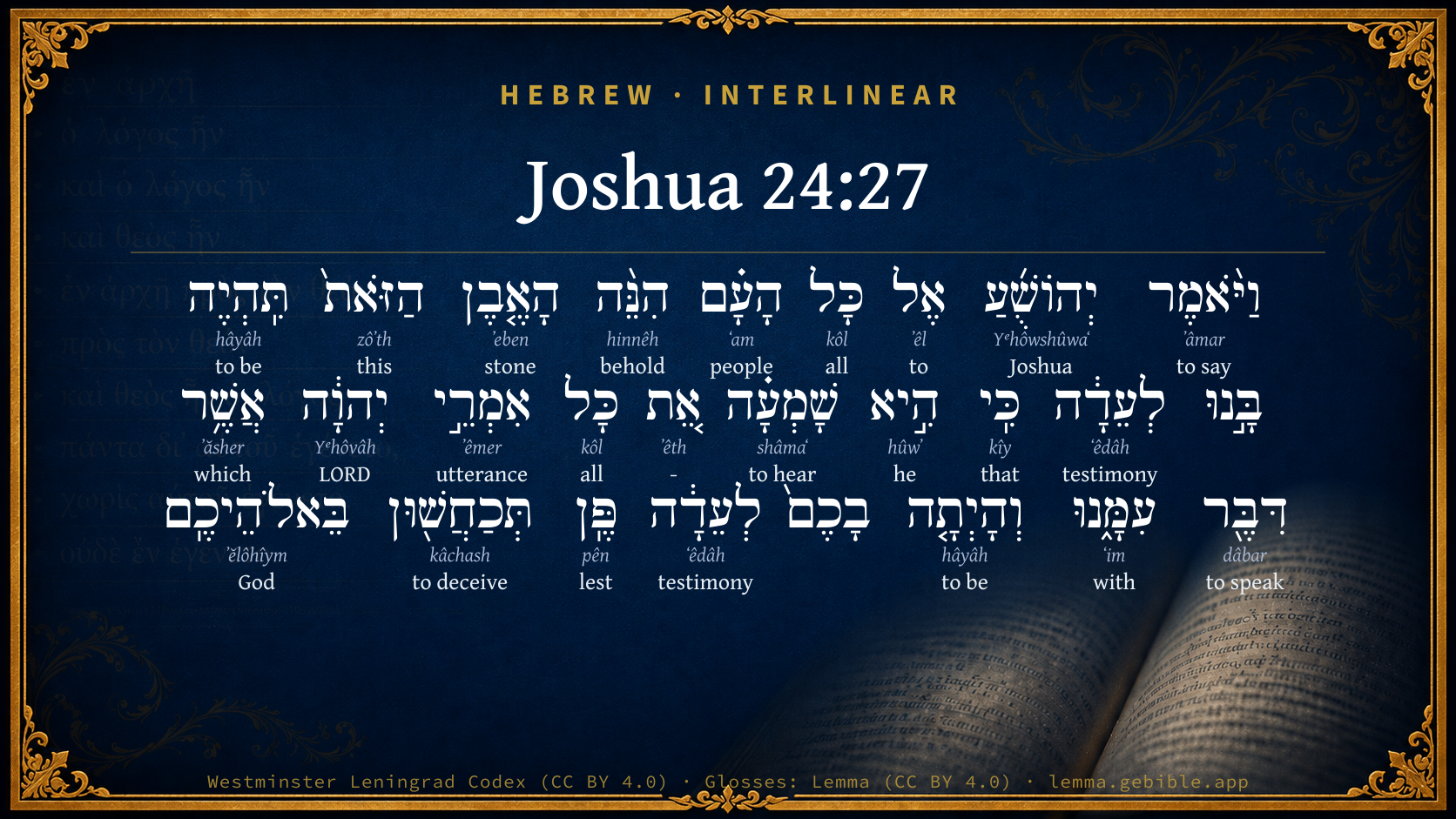
Hebrew (Westminster Leningrad Codex) Joshua 24:27 appears in the Hebrew Old Testament. The text above is from the Westminster Leningrad Codex. Each word links to its Strong’s number, a concise gloss, and parsing drawn from the Open Scriptures Hebrew Bible morphology. Click any word for its full Brown-Driver-Briggs (BDB) entry.
Download image
Cite this verse

Joshua 24:27 (World English Bible). Public Domain. Lemma interlinear Bible study tool, https://lemma.gebible.app/v/joshua/24/27.

Show BibTeX & RIS
BibTeX
RIS
English Translation
Joshua said to all the people, Behold, this stone shall be a witness against us; for it has heard all the words of Yahweh which he spoke to us: it shall be therefore a witness against you, lest you deny your God.
World English Bible · Public Domain
Download a study sheet

One document with this verse’s original text, its word-by-word gloss line, the meaning frame, cross-references with their text, attributed commentary, and full source and license credits — printable, and it pastes into notes with its structure intact.

This verse Autodidact and up

Study sheet (.html) Plain text (.txt)

A passage Seminary Student

Up to 50 verses in one chapter. A passage sheet keeps up to 6 commentary sources and 12 cross-references per verse, in the order this page ranks them, and says so on the sheet whenever that leaves anything out. Ask for a single verse and you get the Autodidact verse sheet above.

Everything on this page stays free to read, with no account — the sheet is a download of what is already on screen, not access to it.

Want to remove ads? Support Godless Engineer
Compare translations 3

The same verse in 3 English versions, stacked beneath the original-language interlinear above. Click any original word for its lexicon entry.

Each is an independent rendering of the whole verse — the interlinear is not word-aligned to these translations.

Highlighted words mark where these versions differ — a whole-verse word diff, not a word-by-word alignment.

  • World English Bible Public Domain
    Joshua said to all the people, Behold, this stone shall be a witness against us; for it has heard all the words of Yahweh which he spoke to us: it shall be therefore a witness against you, lest you deny your God.
  • King James Version Public Domain
    And Joshua said unto all the people, Behold, this stone shall be a witness unto us; for it hath heard all the words of the LORD which he spake unto us: it shall be therefore a witness unto you, lest ye deny your God.
  • unfoldingWord Literal Text CC BY-SA 4.0
    And Joshua said to all of the people, “Behold, this stone will be for a witness against us, for it has heard all of the words of Yahweh that he spoke to us. And it will be for a witness against you, lest you deal falsely with your God.”

unfoldingWord Literal Text — © unfoldingWord, licensed CC BY-SA 4.0. Word-aligned USFM3 via Door43 (git.door43.org/unfoldingWord/en_ult).

Versions to compare (up to 4)

3 of 4 selected

Show all 18 translations

Every available English version of this verse, each an independent rendering of the whole verse.

  • World English Bible Public Domain
    Joshua said to all the people, Behold, this stone shall be a witness against us; for it has heard all the words of Yahweh which he spoke to us: it shall be therefore a witness against you, lest you deny your God.
  • Berean Standard Bible Public Domain
    And Joshua said to all the people, “You see this stone. It will be a witness against us, for it has heard all the words the LORD has spoken to us, and it will be a witness against you if you ever deny your God.”
  • Majority Standard Bible Public Domain
    And Joshua said to all the people, “You see this stone. It will be a witness against us, for it has heard all the words the LORD has spoken to us, and it will be a witness against you if you ever deny your God.”
  • King James Version Public Domain
    And Joshua said unto all the people, Behold, this stone shall be a witness unto us; for it hath heard all the words of the LORD which he spake unto us: it shall be therefore a witness unto you, lest ye deny your God.
  • American Standard Version (1901) Public Domain
    And Joshua said unto all the people, Behold, this stone shall be a witness against us; for it hath heard all the words of Jehovah which he spake unto us: it shall be therefore a witness against you, lest ye deny your God.
  • Revised Version (1885) Public Domain
    And Joshua said unto all the people, Behold, this stone shall be a witness against us; for it hath heard all the words of the LORD which he spake unto us: it shall be therefore a witness against you, lest ye deny your God.
  • Geneva Bible (1599) Public Domain
    And Ioshua saide vnto all the people, Beholde, this stone shall be a witnesse vnto vs: for it hath heard all the wordes of the Lord which he spake with vs: it shall be therefore a witnesse against you, lest yee denie your God.
  • Douay-Rheims (1899) Public Domain
    And he said to all the people: Behold this stone shall be a testimony unto you, that it hath heard all the words of the Lord, which he hath spoken to you: lest perhaps hereafter you will deny it, and lie to the Lord your God.
  • Young's Literal Translation Public Domain
    And Joshua saith unto all the people, `Lo, this stone is against us for a witness, for it hath heard all the sayings of Jehovah which He hath spoken with us, and it hath been against you for a witness, lest ye lie against your God.'
  • Literal Standard Version CC BY-SA 4.0
    And Joshua says to all the people, “Behold, this stone is for a witness against us, for it has heard all the sayings of YHWH which He has spoken with us, and it has been for a witness against you, lest you lie against your God.”
  • Unlocked Literal Bible CC BY-SA 4.0
    Joshua said to all the people, “Look, this stone will be a testimony against us. It has heard all the words Yahweh said to us. So it will be a witness against you, should you ever deny your God.”
  • unfoldingWord Literal Text CC BY-SA 4.0
    And Joshua said to all of the people, “Behold, this stone will be for a witness against us, for it has heard all of the words of Yahweh that he spoke to us. And it will be for a witness against you, lest you deal falsely with your God.”
  • Darby Bible Public Domain
    And Joshua said unto all the people, Behold, this stone shall be a witness unto us, for it hath heard all the words of Jehovah which he spoke unto us; and it shall be a witness against you, lest ye deny your God.
  • World Messianic Bible Public Domain
    Joshua said to all the people, “Behold, this stone shall be a witness against us, for it has heard all the LORD’s words which he spoke to us. It shall be therefore a witness against you, lest you deny your God.”
  • Webster's Bible Public Domain
    And Joshua said to all the people, Behold, this stone shall be a witness to us; for it hath heard all the words of the LORD which he spoke to us, it shall be therefore a witness to you, lest ye deny your God.
  • Free Bible Version CC BY-SA 4.0
    Joshua said to the people, “Look at this stone. It stands here as a witness against us for it has heard everything the Lord has told us, and it will be a witness against you if you ever deny what you have promised your God.”
  • Bible in Basic English Public Domain
    And Joshua said to all the people, See now, this stone is to be a witness against us; for all the words of the Lord have been said to us in its hearing: so it will be a witness against you if you are false to the Lord your God.
  • JPS Tanakh (1917) Public Domain
    And Joshua said unto all the people: 'Behold, this stone shall be a witness against us; for it hath heard all the words of the LORD which He spoke unto us; it shall be therefore a witness against you, lest ye deny your God.'

Literal Standard Version (2020), Covenant Press — licensed CC BY-SA 4.0. Text via the HelloAO Bible API (eBible.org). Unlocked Literal Bible (unfoldingWord) — licensed CC BY-SA 4.0. Text via the HelloAO Bible API (eBible.org). unfoldingWord Literal Text — © unfoldingWord, licensed CC BY-SA 4.0. Word-aligned USFM3 via Door43 (git.door43.org/unfoldingWord/en_ult). Free Bible Version, Dr. Jonathan Gallagher — licensed CC BY-SA 4.0. Text via the HelloAO Bible API (eBible.org).

Word by word

More ways to search: Search by grammar → Find every occurrence → Compare this word →

Practice this passage: Drill this verse → Learn its vocabulary →

תְּכַחֲשׁ֖וּן
kâchash
H3584
“to deceive”
Verb, Piel, Imperfect, 2nd Person, Masculine, Plural + Suffix, n
Part of Speech
Verb
Stem
Piel
Form
Imperfect
Person
2nd Person
Gender
Masculine
Number
Plural
Full BDB Definition

Origin: a primitive root

TWOT: 975

to deceive, lie, fail, grow lean, be disappointing, be untrue, be insufficient, be found liars, belie, deny, dissemble, deal falsely - (Qal) to become lean - (Niphal) to cringe, feign obedience - (Piel) - to deceive, deny falsely - to act deceptively - to cringe - to disappoint, fail - (Hithpael) to cringe, feign obedience
  1. וַיֹּ֨אמֶר ʼâmar H559 “and · to say” Conjunction + Verb, Qal, Sequential Imperfect, 3rd Person, Masculine, Singular
  2. יְהוֹשֻׁ֜עַ Yᵉhôwshûwaʻ H3091 “Joshua” Noun, Proper
  3. אֶל ʼêl H413 “to” Preposition
  4. כָּל kôl H3605 “all of” Noun, Common, Masculine, Singular, Construct
  5. הָעָ֗ם ʻam H5971 “the · people” Particle, Definite Article + Noun, Common, Masculine, Singular, Absolute
  6. הִנֵּ֨ה hinnêh H2009 “behold” Particle, Demonstrative
  7. הָאֶ֤בֶן ʼeben H68 “the · stone” Particle, Definite Article + Noun, Common, Feminine, Singular, Absolute
  8. הַזֹּאת֙ zôʼth H2063 “the · this” Particle, Definite Article + Pronoun, Demonstrative, Feminine, Singular
  9. תִּֽהְיֶה hâyâh H1961 “to be” Verb, Qal, Imperfect, 3rd Person, Feminine, Singular
  10. לְעֵדָ֔ה ʻêdâh H5713 “to/for · testimony” Preposition + Noun, Common, Feminine, Singular, Absolute
  11. כִּֽי kîy H3588 “that” Conjunction
  12. הִ֣יא hûwʼ H1931 “he” Pronoun, Personal, 3rd Person, Feminine, Singular
  13. שָׁמְעָ֗ה shâmaʻ H8085 “to hear” Verb, Qal, Perfect, 3rd Person, Feminine, Singular
  14. אֵ֚ת ʼêth H853 “-” Particle, Direct Object
  15. כָּל kôl H3605 “all of” Noun, Common, Masculine, Singular, Construct
  16. אִמְרֵ֣י ʼêmer H561 “utterances of” Noun, Common, Masculine, Plural, Construct
  17. יְהוָ֔ה Yᵉhôvâh H3068 “LORD” Noun, Proper
  18. אֲשֶׁ֥ר ʼăsher H834 “which” Particle, Relative
  19. דִּבֶּ֖ר dâbar H1696 “to speak” Verb, Piel, Perfect, 3rd Person, Masculine, Singular
  20. עִמָּ֑נוּ ʻim H5973 “with · us” Preposition + Suffix, Personal, 1st Person, Common, Plural
  21. וְהָיְתָ֤ה hâyâh H1961 “and · to be” Conjunction + Verb, Qal, Sequential Perfect, 3rd Person, Feminine, Singular
  22. לְעֵדָ֔ה ʻêdâh H5713 “to/for · testimony” Preposition + Noun, Common, Feminine, Singular, Absolute
  23. פֶּֽן pên H6435 “lest” Conjunction
  24. בֵּאלֹהֵיכֶֽם ʼĕlôhîym H430 “in/at · God(s) · your” Preposition + Noun, Common, Masculine, Plural, Construct + Suffix, Personal, 2nd Person, Masculine, Plural

About this verse

These counts appear in no published source. They are computed here, from the morphology-tagged text and Lemma’s own curated glosses. What Lemma adds →

27
words
22
distinct lemmas
Historical
section

Notable vocabulary

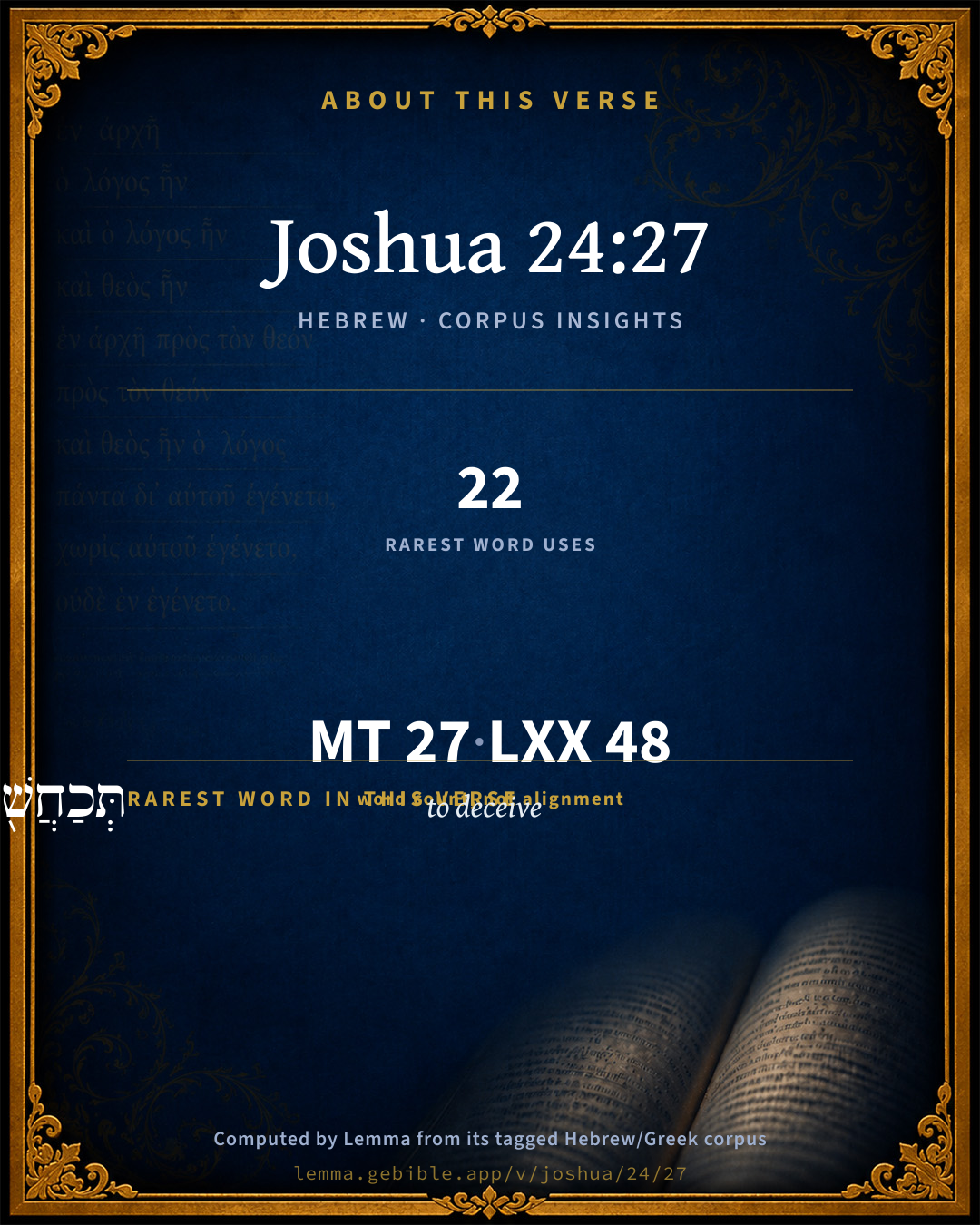
The rarest word here is תְּכַחֲשׁ֖וּן to deceive H3584 — appearing just 22 times in the whole Hebrew Bible.

Shared distinctive vocabulary

תְּכַחֲשׁ֖וּן to deceive H3584 occurs in 22 verses of the Hebrew Bible. Also found in:

Grammatical profile

  • 6 verbs
  • 10 nouns
  • 2 pronouns
  • 4 prepositions
  • 2 conjunctions
  • 3 particles

Verb forms

  • וַיֹּ֨אמֶר Qal · Sequential Imperfect
  • תִּֽהְיֶה Qal · Imperfect
  • שָׁמְעָ֗ה Qal · Perfect
  • דִּבֶּ֖ר Piel · Perfect
  • וְהָיְתָ֤ה Qal · Sequential Perfect
  • תְּכַחֲשׁ֖וּן Piel · Imperfect

Repetition

Words recur within this verse — often emphatic in Hebrew:

  • כָּל all H3605 ×2
  • תִּֽהְיֶה to be H1961 ×2
  • לְעֵדָ֔ה testimony H5713 ×2

Hebrew & Septuagint length

In English translation the verse runs 42 words from the Hebrew and 64 from the Septuagint (LXX English) — the Septuagint runs noticeably longer here. See the side-by-side →

A rough comparison of the two English renderings, which tokenize alike — not a word-level alignment.

Word counts can differ between the Hebrew and the Greek without any difference in meaning — e.g. the Hebrew direct-object marker אֵת has no separate Greek word, and Greek often adds the article ὁ.

In the original languages it is 27 Hebrew tokens and 48 Greek tokens — but the two are counted differently (Hebrew bundles its prefixes and suffixes into one token; the Greek is in lemma form), so that isn’t a like-for-like length.

Cross-references

19

Topical passages linked to Joshua 24:27 in the Treasury of Scripture Knowledge — connected by theme and wording, ordered by reader-vote popularity; previews shown in the World English Bible.

  • Luke 19:40 He answered them, "I tell you that if these were silent, the stones would cry out."
  • Joshua 22:34 The children of Reuben and the children of Gad called the altar [Ed]: For, [said they], it is a witness between us that Yahweh is God.
  • Deuteronomy 31:26 Take this book of the law, and put it by the side of the ark of the covenant of Yahweh your God, that it may be there for a witness against you.
  • Joshua 22:27–28 but it shall be a witness between us and you, and between our generations after us, that we may do the service of Yahweh before him with our burnt offerings, and with our sacrifices, and with our peace-offerings; that your children may not tell our children in time to come, You have no portion in Yahweh.
  • Matthew 10:33 But whoever denies me before men, him I will also deny before my Father who is in heaven.
  • Deuteronomy 31:21 It shall happen, when many evils and troubles are come on them, that this song shall testify before them as a witness; for it shall not be forgotten out of the mouths of their seed: for I know their imagination which they frame this day, before I have brought them into the land which I swore.
  • Deuteronomy 32:1 Give ear, you heavens, and I will speak; Let the earth hear the words of my mouth.
  • 1 Samuel 7:12 Then Samuel took a stone, and set it between Mizpah and Shen, and called the name of it Ebenezer, saying, Hitherto has Yahweh helped us.
  • Job 31:23 For calamity from God is a terror to me, By reason of his majesty I can do nothing.
  • Proverbs 30:9 Lest I be full, deny you, and say, 'Who is Yahweh?' Or lest I be poor, and steal, And so dishonor the name of my God.
  • Isaiah 1:2 Hear, heavens, And listen, earth; for Yahweh has spoken: I have nourished and brought up children, And they have rebelled against me.
  • 2 Timothy 2:12–13 If we endure, We will also reign with him. If we deny him, He also will deny us.
  • Genesis 31:44–52 Now come, let us make a covenant, you and I; and let it be for a witness between me and you."
  • Deuteronomy 4:26 I call heaven and earth to witness against you this day, that you shall soon utterly perish from off the land whereunto you go over the Jordan to possess it; you shall not prolong your days on it, but shall utterly be destroyed.
  • Deuteronomy 30:19 I call heaven and earth to witness against you this day, that I have set before you life and death, the blessing and the curse: therefore choose life, that you may live, you and your seed;
  • Deuteronomy 31:19 Now therefore write you this song for you, and teach you it the children of Israel: put it in their mouths, that this song may be a witness for me against the children of Israel.
  • Titus 1:16 They profess that they know God, but by their works they deny him, being abominable, disobedient, and unfit for any good work.
  • Habakkuk 2:11 For the stone will cry out of the wall, and the beam out of the woodwork will answer it.
  • Revelation 3:8 "I know your works (behold, I have set before you an open door, which no one can shut), that you have a little power, and kept my word, and didn't deny my name.

Cross-references courtesy of OpenBible.info (CC BY 4.0).

Hebrew and Greek witnesses Masoretic Hebrew ↔ Greek Septuagint

The same verse in the two great witnesses to the Old Testament, shown verse-for-verse.

Here the Septuagint runs noticeably longer than the Hebrew — LXX2012 (modern English Septuagint) 64 words vs World English Bible 42. A rough length comparison of the two English translations, not a word-level alignment — read both below.

These are two independent witnesses, not word-aligned to each other, and the Septuagint is shown in lemma (dictionary) form.

Hebrew Joshua 24:27 Masoretic · Westminster Leningrad Codex

וַיֹּ֨אמֶר יְהוֹשֻׁ֜עַ אֶל כָּל הָעָ֗ם הִנֵּ֨ה הָאֶ֤בֶן הַזֹּאת֙ תִּֽהְיֶה בָּ֣נוּ לְעֵדָ֔ה כִּֽי הִ֣יא שָׁמְעָ֗ה אֵ֚ת כָּל אִמְרֵ֣י יְהוָ֔ה אֲשֶׁ֥ר דִּבֶּ֖ר עִמָּ֑נוּ וְהָיְתָ֤ה בָכֶם֙ לְעֵדָ֔ה פֶּֽן תְּכַחֲשׁ֖וּן בֵּאלֹהֵיכֶֽם

Joshua said to all the people, Behold, this stone shall be a witness against us; for it has heard all the words of Yahweh which he spoke to us: it shall be therefore a witness against you, lest you deny your God.

World English Bible · Public Domain

Greek LXX Joshua 24:27 Septuagint · lemma form

καί εἶπον ἰησοῦς πρός ὁ λαός ἰδού ὁ λίθος οὗτος εἰμί ἐν σύ εἰς μαρτύριον ὅτι αὐτός ἀκούω πᾶς ὁ λέγω αὐτός ὑπό κύριος ὅς τις λαλέω πρός ἐγώ σήμερον καί εἰμί οὗτος ἐν σύ εἰς μαρτύριον ἐπί ἔσχατος ὁ ἡμέρα ἡνίκα ἐάν ψεύδω κύριος ὁ θεός ἐγώ

And Joshua said to the people, Behold, this stone shall be among you for a witness, for it has heard all the words that have been spoken to it by the Lord; for he has spoken to you this day; and this stone shall be among you for a witness in the last days, whenever you⌃ shall deal falsely with the Lord my God.

LXX2012 (modern English Septuagint) · Public Domain

Hebrew: Westminster Leningrad Codex (CC BY 4.0). Greek: Septuagint (public domain); English from LXX2012 (modern English Septuagint) (Public Domain). How the Septuagint differs from the Hebrew →

Targum (Aramaic paraphrase)

1

The Targum is the ancient Jewish Aramaic paraphrase of the Hebrew Scriptures — an interpretive translation, not the Hebrew text itself. Onkelos (literal) and Pseudo-Jonathan (expansive) render the Torah, and Jonathan the Prophets. Coverage is partial: where no permissively-licensed English translation exists for a verse, only the Aramaic is shown. This is verse-level text, not a word-by-word alignment to the Hebrew.

  1. Targum Jonathan Prophets (Joshua–Malachi)
    וַאֲמַר יְהוֹשֻׁעַ לְכָל עַמָא הָא אַבְנָא הָדָא תְּהֵי לָנָא כִּתְרֵין לוּחֵי אֶבֶן קְיָמָא אֲרֵי יָתָהּ עֲבַדְנָא לְסַהֲדוּ אֲרֵי פִּתְגָמַיָא דִכְתִיבִין עֲלָהּ מֵעֵין כָּל פִּתְגָמַיָא דִי מַלֵיל עִמָנָא וּתְהֵי בְכוֹן לְדָכְרָן וּלְסַהֲדוּ דִילְמָא תְכַדְבוּן קֳדָם אֱלָהָכוֹן:

    (no public-domain English translation for this verse)

    Targum Jonathan — Aramaic: “Mikraot Gedolot” (public domain). English: “Sefaria Community Translation” (CC0 1.0 (public-domain dedication)); “London "Chaldee Paraphrase," 1871” (public domain). Text via Sefaria.

Commentary

Notes on Joshua 24:27 from classic Christian and Jewish commentators (each source and its license shown beneath its notes). The classic Christian expositions comment on the surrounding passage and are grouped to its opening verse, so a note may address several verses; the Jewish commentaries on the Tanakh (Rashi and others) are per-verse, so they appear only where the commentator wrote on this verse.

Lemma curates 59 commentaries, every one of them public domain or Creative Commons licensed, each selected and text-cleaned for this edition rather than reprinted as found. About our sources →

Trapp's Complete Commentary

John Trapp

Jos 24:27 And Joshua said unto all the people, Behold, this stone shall be a witness unto us; for it hath heard all the words of the LORD which he spake unto us: it shall be therefore a witness unto you, lest ye deny your God.

Ver. 27. Behold, this stone shall be a witness unto us.] It shall represent your covenant to your consciences, and convince you of singular perfidy, in case you falsify. We read in Livy that a certain governor of the people called Aequi, bade the Roman ambassadors tell their tale to the oak that stood next them, saying that he had somewhat else to do than to give them audience. To whom they replied, Et haec sacrata quercus audiat faedus a vobis violatum, Then let this holy oak hear and bear witness that ye have broken your covenant.

John Trapp, A Commentary or Exposition upon All the Books of the Old and New Testament (1647–1656) — public domain. Text from a community e-Sword module.

Joseph Benson's Commentary

Jos 24:27. It hath heard — It shall be as sure a witness against you as if it had heard. This is a common figure, whereby the sense of hearing is often ascribed to the heavens and the earth, and other senseless creatures.

Joseph Benson's Commentary on the Old and New Testaments (1811–1818) — public domain. Text from a community e-Sword module.

Tyndale Open Study Notes

Tyndale Open Resources

24:27 This stone has heard: See study note on 22:27.

Tyndale Open Study Notes — © Tyndale Open Resources, licensed CC BY-SA 4.0. Text via the HelloAO Bible API.

Geneva Bible (1599)

Geneva Bible translators

Rather than man’s dissimulation should not be punished, the dumb creatures shall cry for vengeance.

Geneva Bible (1599) marginal notes — public domain. Text via Bolls.life.

Adam Clarke's Commentary

Verse 27. This stone - hath heard all the words] That is, the stone itself, from its permanency, shall be in all succeeding ages as competent and as substantial a witness as one who had been present at the transaction, and heard all the words which on both sides were spoken on the occasion.

Adam Clarke's Commentary on the Bible (1810–1826) — public domain. Text from a community e-Sword/MySword module.

The Cambridge Bible for Schools and Colleges

gen. ed. J. J. S. Perowne

27. this stone shall be a witness] So in Gen_31:48; Gen_31:52, Laban says to Jacob, “This heap is a witness between me and thee this day;” and in Deu_31:19; Deu_31:21; Deu_31:26, Moses says, “Write ye this song for you … that this song may be a witness for me against the children of Israel.”

for it hath heard] By a poetical prosopopœia Joshua describes the stone as hearing the words of God, since it had been set up for the purpose of reminding the people of the promise which they had made unto the Lord, and, in case they should be unfaithful, of bearing witness against them.

lest ye deny your God] “Ne forte postea negare velitis et mentiri Domino Deo vestro,” Vulgate. “Lest perauenture çe wolden denye aftirward, and lye to çoure Lord God,” Wyclif. Comp. Jos_7:11 (Heb.); Job_31:28; Pro_30:9; Lev_19:11-12.

The Cambridge Bible for Schools and Colleges (gen. ed. J. J. S. Perowne; Cambridge University Press, 1878–1918) — public domain. Text from a community e-Sword module.

John Gill's Exposition

And Joshua said unto all the people,.... The chief of them now gathered together, and who represented the whole body:

behold, this stone shall be a witness unto us; of the covenant now made, and the agreement entered into, as the heap of stones were between Jacob and Laban, Gen 31:45,

for it hath heard all the words of the Lord which he spake unto us; this is said by a figure called "prosopopaeia", frequent in Scripture, by which inanimate creatures are represented as hearing, seeing, and speaking, and may signify, that should the Israelites break this covenant, and disobey the commands of the Lord they had promised to keep, they would be as stupid and senseless as this stone, or more so, which would rise in judgment against them. Nachmanides (d) a Jewish commentator, interprets this stone of the Messiah, the same as in Gen 49:24,

it shall be therefore a witness unto you, lest ye deny your God; for a memorial and testimony to prevent them from going into atheism, a denying of the true God, or into apostasy from him, and into idolatry and false worship. The Targum of which is,"behold, this stone shall be to us as the two tables of stone of the covenant, for we made it for a testimony; for the words which are written upon it are the sum of all the words of the Lord which he spake unto us, and it shall be unto you for a memorial, and for a testimony, lest ye lie before the Lord.''

(d) Apud Masium in loc.

John Gill's Exposition of the Whole Bible (1746–1763) — public domain (CC PDM 1.0). Text via the HelloAO Bible API.

Haydock's Catholic Bible Commentary

It hath heard. This is a figure of speech, by which sensation is attributed to inanimate things; and they are called upon, as it were, to bear witness in favour of the great Creator, whom they on their part constantly obey, (Challoner) which is the best manner of hearing. They rise up to our confusion. (Theodoret, q. 19.) (Worthington) --- The oriental writers delight in these strong figurative expressions, which are not confined to poetry. Jesus Christ says, that if the children were silent, the stones would cry out, Luke xix. 40. See Numbers xiii. 33., and Genesis iv. 10. (Calmet) --- Lest. Hebrew, "it shall be therefore a witness unto you, lest you deny your God;" or literally, "lie unto your Elohim." (Haydock) --- The expression often means to revolt and prove faithless, Deuteronomy xxxiii. 29., &c.

George Leo Haydock (1774–1849), Haydock's Catholic Family Bible and Commentary, 1859 edition — public domain. Excludes Psalms (Douay-Rheims chapter numbering differs from Protestant) and Deuterocanonical books (Catholic canon only).

Matthew Poole's English Annotations

It hath heard; it shall be as sure a witness against you as if it had heard. This is a common figure, called prosopopaie, whereby the sense of hearing is oft ascribed to the heavens and the earth, and other senseless creatures, as Deu 32:1; Isa 1:2; Jer 2:12.

Matthew Poole's English Annotations on the Holy Bible (1683–1685) — public domain. Text from a community e-Sword/MySword module.

The Pulpit Commentary

A witness. (see note on Jos_22:27) For it hath heard. Joshua speaks by a poetical figure of the stone, as though it had intelligence. The stone was taken from the very place where they stood, and within earshot of the words which had been spoken. Thus it became a more forcible memorial of what had occurred than if it had been brought from far. Ye deny your God. To deny is to say that He is not. The Hebrew implies "to deny concerning Him," to contest the truth of what has been revealed of His essence, and to disparage or deny the great things He had done for His people. The whole scene must have been a striking one. The aged warrior, full of years and honours, venerable from his piety and courage and implicit obedience, addresses in the measured, perhaps tremulous, accents of age the representatives of the whole people he has led so long and so well. Around him are the ancient memories of his race. Here Abraham pitched his tent in his wanderings through Canaan. Here was the first altar built to the worship of the one true God of the land. Here Jacob had buried the teraphim, and solemnly engaged his household in the worship of the true God. Here was the second foothold the children of Abraham obtained in the promised land (see ver. 32), a foretaste of their future inheritance. The bare heights of Ebal soared above them on one side, the softer outlines of Gerizim rose above them on the other; and on their sides, the plaster fresh and the letters distinct and clear, were to be seen the blessings and the curses foretold of those who kept and those who broke the law. In the midst, Shechem, in a situation, as we have seen, of rare beauty, bore witness to the fulfilment of God"s promise that the land of their inheritance should be "a good land," a "land flowing with milk and honey." No other place could combine so many solemn memories; none could more adequately remind them of the fulness of blessing God had in store for those who would obey His word; none could be fitter to impress upon them the duty of worshipping God, and Him alone.

The Pulpit Commentary (1880–1919), ed. H.D.M. Spence-Jones & Joseph S. Exell — public domain. Text from a community e-Sword module.

John Wesley's Explanatory Notes

It hath heard - It shall be as sure a witness against you, as if it had heard. This is a common figure, whereby the sense of hearing is often ascribed to the heavens and the earth, and other senseless creatures.

John Wesley, Explanatory Notes Upon the Whole Bible (1754–1765) — public domain. Text via the GEBible commentary corpus.

unfoldingWord translationNotes

Door43 World Missions Community

people

This refers to the Israelites.

this stone will be a testimony ... It has heard all the words

The stone that Joshua set up is spoken of as if it were a person who heard what was spoken and would be able to testify about what was said. (See: Personification)

should you ever

"if you ever"

translationWords

Joshua

testimony

Yahweh

testimony

God

inherit

unfoldingWord translationNotes — © Distant Shores Media and the Door43 World Missions Community, licensed CC BY-SA 4.0. Source: git.door43.org/Door43/en_tn.

Rashi

Rabbi Shlomo Yitzchaki (Rashi)

Behold this stone will be witness against us, etc. [Here Rashi quotes from Targum Yonasan]: This stone will be for us as the two stone tablets of the covenant, for we have made it for a witness, since the words written on it [the stone] are almost similar to all the words of God that He spoke to us. This verse can also be explained according to its plain meaning: for it [the stone] has heard the words that I have spoken to you, on behalf of the Omnipresent.

Rashi on the Tanakh — English translations: “The Judaica Press complete Tanach with Rashi, translated by A. J. Rosenberg” (CC BY 4.0); “Pentateuch with Rashi's commentary by M. Rosenbaum and A.M. Silbermann, 1929-1934” (public domain); “The Metsudah Tanach series, Lakewood, N.J” (CC BY 4.0); and “The Book of Joshua, Metsudah Publications, 1997” (CC BY 4.0). Text via Sefaria.

Lesson kit

Teaching starters — assembled from the data on this page, not authored interpretation. Every prompt links to the verse data it draws on. Edit before teaching.

Joshua, in the Historical, opens this verse with 27 words (22 distinct Hebrew lemmas). Its most distinctive word is kâchash (“to deceive”). The Greek Septuagint runs longer here. A historical commentator’s framing appears above. Read the whole chapter for the surrounding context.

Discussion questions

  1. How does “to deceive” (kâchash) shape what this verse is saying?
  2. How does Genesis 18:15, which shares the word «to deceive», read alongside this verse?
  3. What does the repetition of “all” (2× in this one verse) do in this verse?
  4. The Septuagint runs longer here than the Hebrew. What might account for the difference?
  5. The translations on this page render this verse differently — a whole-verse word diff, not a word-by-word alignment. What might account for the different wordings?
  6. «וַיֹּ֨אמֶר» is a Qal Sequential Imperfect verb. How does that grammatical form shape the action described?
  7. Compare how Trapp's Complete Commentary and Joseph Benson's Commentary read this verse. Where do they agree or differ?

Things to notice

Reading settings

Reading text

Shown beneath each verse's original-language words.

Old Testament
Old Testament edition

Read the OT as the Masoretic Hebrew (MT) or the Greek Septuagint (LXX).

English shown for the Greek Septuagint (in the Hebrew ↔ Greek comparison).

Comparing translations? Open the Compare panel on any verse page to stack up to four side by side.