
Joshua 11:16

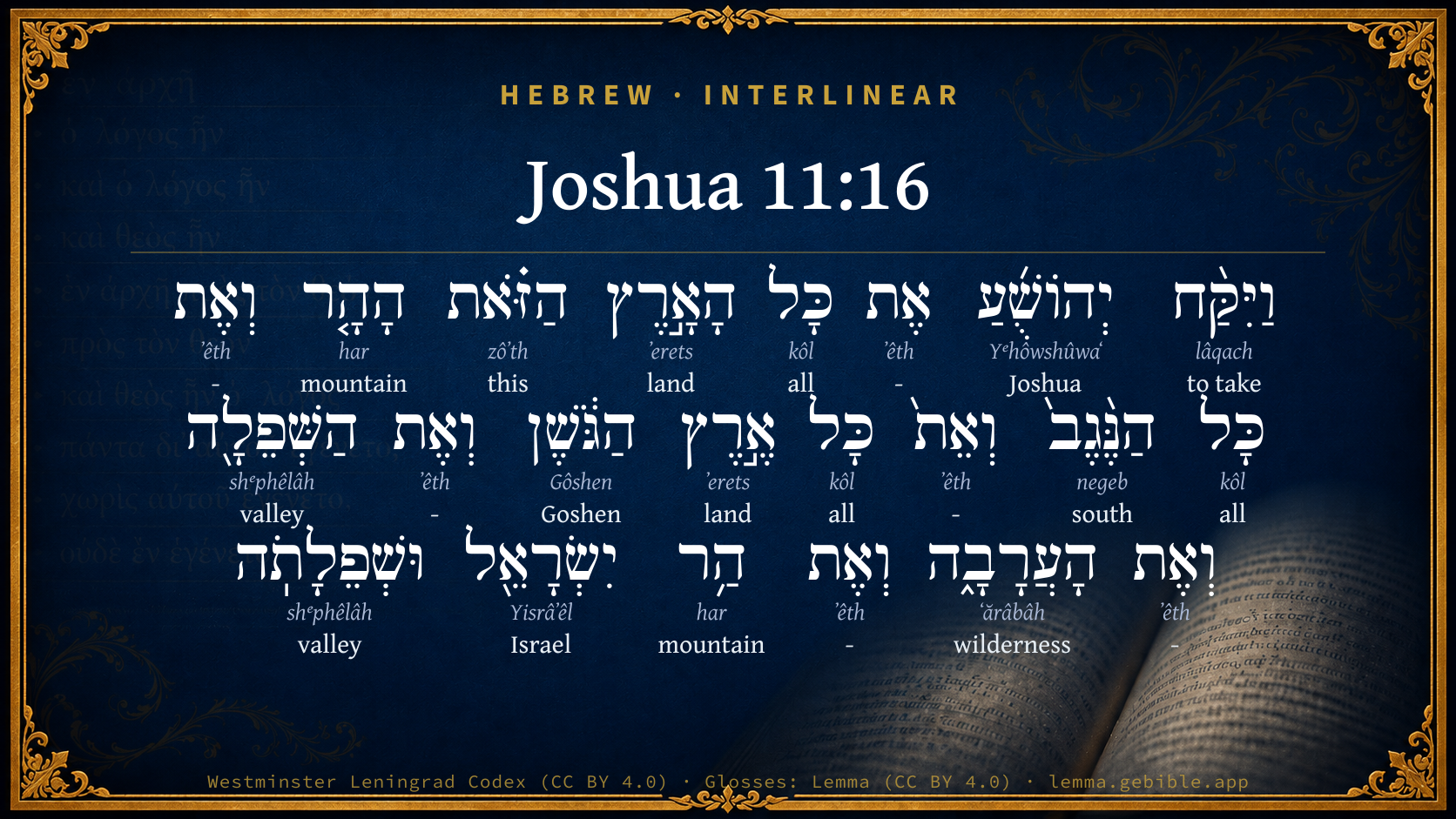
Hebrew (Westminster Leningrad Codex) Joshua 11:16 appears in the Hebrew Old Testament. The text above is from the Westminster Leningrad Codex. Each word links to its Strong’s number, a concise gloss, and parsing drawn from the Open Scriptures Hebrew Bible morphology. Click any word for its full Brown-Driver-Briggs (BDB) entry.
Download image
Cite this verse

Joshua 11:16 (World English Bible). Public Domain. Lemma interlinear Bible study tool, https://lemma.gebible.app/v/joshua/11/16.

Show BibTeX & RIS
BibTeX
RIS
English Translation
So Joshua took all that land, the hill-country, and all the South, and all the land of Goshen, and the lowland, and the Arabah, and the hill-country of Israel, and the lowland of the same;
World English Bible · Public Domain
Download a study sheet

One document with this verse’s original text, its word-by-word gloss line, the meaning frame, cross-references with their text, attributed commentary, and full source and license credits — printable, and it pastes into notes with its structure intact.

This verse Autodidact and up

Study sheet (.html) Plain text (.txt)

A passage Seminary Student

Up to 50 verses in one chapter. A passage sheet keeps up to 6 commentary sources and 12 cross-references per verse, in the order this page ranks them, and says so on the sheet whenever that leaves anything out. Ask for a single verse and you get the Autodidact verse sheet above.

Everything on this page stays free to read, with no account — the sheet is a download of what is already on screen, not access to it.

Want to remove ads? Support Godless Engineer
Compare translations 3

The same verse in 3 English versions, stacked beneath the original-language interlinear above. Click any original word for its lexicon entry.

Each is an independent rendering of the whole verse — the interlinear is not word-aligned to these translations.

Highlighted words mark where these versions differ — a whole-verse word diff, not a word-by-word alignment.

  • World English Bible Public Domain
    So Joshua took all that land, the hill-country, and all the South, and all the land of Goshen, and the lowland, and the Arabah, and the hill-country of Israel, and the lowland of the same;
  • King James Version Public Domain
    So Joshua took all that land, the hills, and all the south country, and all the land of Goshen, and the valley, and the plain, and the mountain of Israel, and the valley of the same;
  • unfoldingWord Literal Text CC BY-SA 4.0
    And Joshua captured all of this land: the hill country and all of the Negev and all of the land of Goshen and the lowland and the Arabah and the hill country of Israel and its lowland,

unfoldingWord Literal Text — © unfoldingWord, licensed CC BY-SA 4.0. Word-aligned USFM3 via Door43 (git.door43.org/unfoldingWord/en_ult).

Versions to compare (up to 4)

3 of 4 selected

Show all 18 translations

Every available English version of this verse, each an independent rendering of the whole verse.

  • World English Bible Public Domain
    So Joshua took all that land, the hill-country, and all the South, and all the land of Goshen, and the lowland, and the Arabah, and the hill-country of Israel, and the lowland of the same;
  • Berean Standard Bible Public Domain
    So Joshua took this entire region: the hill country, all the Negev, all the land of Goshen, the western foothills, the Arabah, and the mountains of Israel and their foothills,
  • Majority Standard Bible Public Domain
    So Joshua took this entire region: the hill country, all the Negev, all the land of Goshen, the western foothills, the Arabah, and the mountains of Israel and their foothills,
  • King James Version Public Domain
    So Joshua took all that land, the hills, and all the south country, and all the land of Goshen, and the valley, and the plain, and the mountain of Israel, and the valley of the same;
  • American Standard Version (1901) Public Domain
    So Joshua took all that land, the hill-country, and all the South, and all the land of Goshen, and the lowland, and the Arabah, and the hill-country of Israel, and the lowland of the same;
  • Revised Version (1885) Public Domain
    So Joshua took all that land, the hill country, and all the South, and all the land of Goshen, and the lowland, and the Arabah, and the hill country of Israel, and the lowland of the same;
  • Geneva Bible (1599) Public Domain
    So Ioshua tooke all this land of the mountaines, and all the South, and all the lande of Goshen, and the lowe countrey, and the plaine, and the mountaine of Israel, and the lowe countrey of the same,
  • Douay-Rheims (1899) Public Domain
    So Josue took all the country of the hills, and of the south, and the land of Gosen, and the plains and the west country, and the mountain of Israel, and the plains thereof:
  • Young's Literal Translation Public Domain
    And Joshua taketh all this land: the hill-country, and all the south, and all the land of Goshen, and the low country, and the plain, even the hill-country of Israel and its low lands,
  • Literal Standard Version CC BY-SA 4.0
    And Joshua takes all this land: the hill-country, and all the south, and all the land of Goshen, and the low country, and the plain, even the hill-country of Israel and its low lands,
  • Unlocked Literal Bible CC BY-SA 4.0
    Joshua took all that land, the hill country, all the Negev, all the land of Goshen, the foothills, the Jordan River valley, the hill country of Israel, and the lowlands.
  • unfoldingWord Literal Text CC BY-SA 4.0
    And Joshua captured all of this land: the hill country and all of the Negev and all of the land of Goshen and the lowland and the Arabah and the hill country of Israel and its lowland,
  • Darby Bible Public Domain
    And Joshua took all that land, the mountain and all the south, and all the land of Goshen, and the lowland, and the plain, and the mountain of Israel, and its lowland;
  • World Messianic Bible Public Domain
    So Joshua captured all that land, the hill country, all the South, all the land of Goshen, the lowland, the Arabah, the hill country of Israel, and the lowland of the same,
  • Webster's Bible Public Domain
    So Joshua took all that land, the hills, and all the south country, and all the land of Goshen, and the valley, and the plain, and the mountain of Israel, and the valley of the same;
  • Free Bible Version CC BY-SA 4.0
    So Joshua conquered the whole land—the hill country, the Negev, all the land of Goshen, the western foothills, the Jordan Valley, the mountains of Israel, and the eastern foothills.
  • Bible in Basic English Public Domain
    So Joshua took all that land, the hill-country and all the South, and all the land of Goshen, and the lowland and the Arabah, the hill-country of Israel and its lowland;
  • JPS Tanakh (1917) Public Domain
    So Joshua took all that land, the hill-country, and all the South, and all the land of Goshen, and the Lowland, and the Arabah, and the hill-country of Israel, and the Lowland of the same;

Literal Standard Version (2020), Covenant Press — licensed CC BY-SA 4.0. Text via the HelloAO Bible API (eBible.org). Unlocked Literal Bible (unfoldingWord) — licensed CC BY-SA 4.0. Text via the HelloAO Bible API (eBible.org). unfoldingWord Literal Text — © unfoldingWord, licensed CC BY-SA 4.0. Word-aligned USFM3 via Door43 (git.door43.org/unfoldingWord/en_ult). Free Bible Version, Dr. Jonathan Gallagher — licensed CC BY-SA 4.0. Text via the HelloAO Bible API (eBible.org).

Word by word

More ways to search: Search by grammar → Find every occurrence → Compare this word →

Practice this passage: Drill this verse → Learn its vocabulary →

הַגֹּ֔שֶׁן
Gôshen
H1657
“the · Goshen”
Particle, Definite Article + Noun, Proper
Part of Speech
Particle + Noun
Type
Proper
Full BDB Definition

Origin: probably of Egyptian origin

TWOT: 390

Goshen = "drawing near" - a region in northern Egypt, east of the lower Nile, where the children of Israel lived from the time of Joseph to the time of Moses - a district in southern Palestine between Gaza and Gibeon - a town in the mountains of Judah probably in the district of Goshen
  1. וַיִּקַּ֨ח lâqach H3947 “and · to take” Conjunction + Verb, Qal, Sequential Imperfect, 3rd Person, Masculine, Singular
  2. יְהוֹשֻׁ֜עַ Yᵉhôwshûwaʻ H3091 “Joshua” Noun, Proper
  3. אֶת ʼêth H853 “-” Particle, Direct Object
  4. כָּל kôl H3605 “all of” Noun, Common, Masculine, Singular, Construct
  5. הָאָ֣רֶץ ʼerets H776 “the · land” Particle, Definite Article + Noun, Common, Both, Singular, Absolute
  6. הַזֹּ֗את zôʼth H2063 “the · this” Particle, Definite Article + Pronoun, Demonstrative, Feminine, Singular
  7. הָהָ֤ר har H2022 “the · mountain” Particle, Definite Article + Noun, Common, Masculine, Singular, Absolute
  8. וְאֶת ʼêth H853 “and · -” Conjunction + Particle, Direct Object
  9. כָּל kôl H3605 “all of” Noun, Common, Masculine, Singular, Construct
  10. הַנֶּ֨גֶב֙ negeb H5045 “the · south” Particle, Definite Article + Noun, Common, Masculine, Singular, Absolute
  11. וְאֵת֙ ʼêth H853 “and · -” Conjunction + Particle, Direct Object
  12. כָּל kôl H3605 “all of” Noun, Common, Masculine, Singular, Construct
  13. אֶ֣רֶץ ʼerets H776 “land of” Noun, Common, Both, Singular, Construct
  14. וְאֶת ʼêth H853 “and · -” Conjunction + Particle, Direct Object
  15. הַשְּׁפֵלָ֖ה shᵉphêlâh H8219 “the · valley” Particle, Definite Article + Noun, Common, Feminine, Singular, Absolute
  16. וְאֶת ʼêth H853 “and · -” Conjunction + Particle, Direct Object
  17. הָעֲרָבָ֑ה ʻărâbâh H6160 “the · wilderness” Particle, Definite Article + Noun, Common, Feminine, Singular, Absolute
  18. וְאֶת ʼêth H853 “and · -” Conjunction + Particle, Direct Object
  19. הַ֥ר har H2022 “mountain of” Noun, Common, Masculine, Singular, Construct
  20. יִשְׂרָאֵ֖ל Yisrâʼêl H3478 “Israel” Noun, Proper
  21. וּשְׁפֵלָתֹֽה shᵉphêlâh H8219 “and · valley · his” Conjunction + Noun, Common, Feminine, Singular, Construct + Suffix, Personal, 3rd Person, Masculine, Singular

About this verse

These counts appear in no published source. They are computed here, from the morphology-tagged text and Lemma’s own curated glosses. What Lemma adds →

22
words
12
distinct lemmas
Historical
section

Notable vocabulary

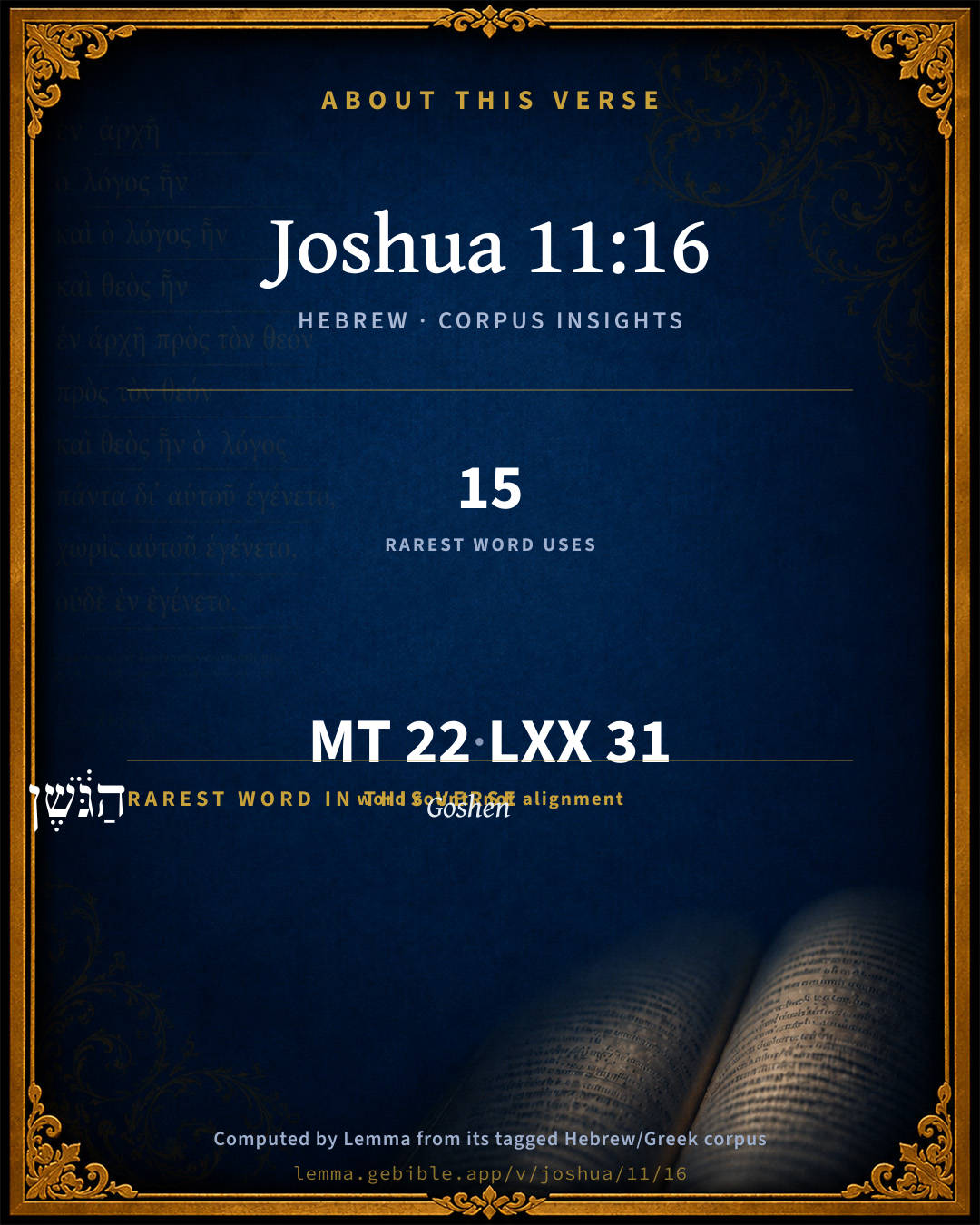
The rarest word here is הַגֹּ֔שֶׁן Goshen H1657 — appearing just 15 times in the whole Hebrew Bible.

Shared distinctive vocabulary

הַגֹּ֔שֶׁן Goshen H1657 occurs in 14 verses of the Hebrew Bible. Also found in:

Grammatical profile

  • 1 verb
  • 14 nouns
  • 1 pronoun
  • 6 particles

Verb forms

  • וַיִּקַּ֨ח Qal · Sequential Imperfect

Repetition

Words recur within this verse — often emphatic in Hebrew:

  • כָּל all H3605 ×3
  • הָאָ֣רֶץ land H776 ×2
  • הָהָ֤ר mountain H2022 ×2
  • הַשְּׁפֵלָ֖ה valley H8219 ×2

Hebrew & Septuagint length

In English translation the verse runs 35 words from the Hebrew and 40 from the Septuagint (LXX English) — closely comparable.

A rough comparison of the two English renderings, which tokenize alike — not a word-level alignment.

Word counts can differ between the Hebrew and the Greek without any difference in meaning — e.g. the Hebrew direct-object marker אֵת has no separate Greek word, and Greek often adds the article ὁ.

In the original languages it is 22 Hebrew tokens and 31 Greek tokens — but the two are counted differently (Hebrew bundles its prefixes and suffixes into one token; the Greek is in lemma form), so that isn’t a like-for-like length.

Cross-references

11

Topical passages linked to Joshua 11:16 in the Treasury of Scripture Knowledge — connected by theme and wording, ordered by reader-vote popularity; previews shown in the World English Bible.

  • Joshua 10:41 Joshua struck them from Kadesh-barnea even to Gaza, and all the country of Goshen, even to Gibeon.
  • Joshua 11:21 Joshua came at that time, and cut off the Anakim from the hill-country, from Hebron, from Debir, from Anab, and from all the hill-country of Judah, and from all the hill-country of Israel: Joshua utterly destroyed them with their cities.
  • Joshua 12:8 in the hill-country, and in the lowland, and in the Arabah, and in the slopes, and in the wilderness, and in the South; the Hittite, the Amorite, and the Canaanite, the Perizzite, the Hivite, and the Jebusite:
  • Genesis 15:18–21 In that day Yahweh made a covenant with Abram, saying, "To your seed have I given this land, from the river of Egypt to the great river, the river Euphrates:
  • Numbers 34:2–13 Command the children of Israel, and tell them, When you come into the land of Canaan (this is the land that shall fall to you for an inheritance, even the land of Canaan according to the borders of it),
  • Deuteronomy 34:2–3 and all Naphtali, and the land of Ephraim and Manasseh, and all the land of Judah, to the hinder sea,
  • Joshua 9:1 It happened, when all the kings who were beyond the Jordan, in the hill-country, and in the lowland, and on all the shore of the great sea in front of Lebanon, the Hittite, and the Amorite, the Canaanite, the Perizzite, the Hivite, and the Jebusite, heard of it;
  • Joshua 11:2 and to the kings who were on the north, in the hill-country, and in the Arabah south of Chinneroth, and in the lowland, and in the heights of Dor on the west,
  • Ezekiel 17:23 in the mountain of the height of Israel will I plant it; and it shall bring forth boughs, and bear fruit, and be a goodly cedar: and under it shall dwell all birds of every wing; in the shade of the branches of it shall they dwell.
  • Ezekiel 36:1–3 You, son of man, prophesy to the mountains of Israel, and say, You mountains of Israel, hear the word of Yahweh.
  • Ezekiel 36:8 But you, mountains of Israel, you shall shoot forth your branches, and yield your fruit to my people Israel; for they are at hand to come.

Cross-references courtesy of OpenBible.info (CC BY 4.0).

Hebrew and Greek witnesses Masoretic Hebrew ↔ Greek Septuagint

The same verse in the two great witnesses to the Old Testament, shown verse-for-verse.

These are two independent witnesses, not word-aligned to each other, and the Septuagint is shown in lemma (dictionary) form.

Hebrew Joshua 11:16 Masoretic · Westminster Leningrad Codex

וַיִּקַּ֨ח יְהוֹשֻׁ֜עַ אֶת כָּל הָאָ֣רֶץ הַזֹּ֗את הָהָ֤ר וְאֶת כָּל הַנֶּ֨גֶב֙ וְאֵת֙ כָּל אֶ֣רֶץ הַגֹּ֔שֶׁן וְאֶת הַשְּׁפֵלָ֖ה וְאֶת הָעֲרָבָ֑ה וְאֶת הַ֥ר יִשְׂרָאֵ֖ל וּשְׁפֵלָתֹֽה

So Joshua took all that land, the hill-country, and all the South, and all the land of Goshen, and the lowland, and the Arabah, and the hill-country of Israel, and the lowland of the same;

World English Bible · Public Domain

Greek LXX Joshua 11:16 Septuagint · lemma form

καί λαμβάνω ἰησοῦς πᾶς ὁ γῆ ὁ ὀρεινή καί πᾶς ὁ ναγεβ καί πᾶς ὁ γῆ γοσομ καί ὁ πεδεινός καί ὁ πρός δυσμή καί ὁ ὄρος ἰσραήλ καί ὁ ταπεινός

And Joshua took all the hill country, and all the land of Nageb, and all the land of Gosom, and the plain country, and that toward the west, and the mountain of Israel and the low country by the mountain;

LXX2012 (modern English Septuagint) · Public Domain

Hebrew: Westminster Leningrad Codex (CC BY 4.0). Greek: Septuagint (public domain); English from LXX2012 (modern English Septuagint) (Public Domain). How the Septuagint differs from the Hebrew →

Targum (Aramaic paraphrase)

1

The Targum is the ancient Jewish Aramaic paraphrase of the Hebrew Scriptures — an interpretive translation, not the Hebrew text itself. Onkelos (literal) and Pseudo-Jonathan (expansive) render the Torah, and Jonathan the Prophets. Coverage is partial: where no permissively-licensed English translation exists for a verse, only the Aramaic is shown. This is verse-level text, not a word-by-word alignment to the Hebrew.

  1. Targum Jonathan Prophets (Joshua–Malachi)
    וְאַחְסִין יְהוֹשֻׁעַ יַת כָּל אַרְעָא הָדָא טוּרָא וְיַת כָּל דָרוֹמָא וְיַת כָּל אַרְעָא דְגוֹשֶׁן וְיַת שְׁפֶלְתָּא וְיַת מֵישְׁרָא וְיַת טוּרָא דְיִשְׂרָאֵל וּשְׁפֵלָתֵיהּ:

    (no public-domain English translation for this verse)

    Targum Jonathan — Aramaic: “Mikraot Gedolot” (public domain). English: “Sefaria Community Translation” (CC0 1.0 (public-domain dedication)); “London "Chaldee Paraphrase," 1871” (public domain). Text via Sefaria.

Commentary

Notes on Joshua 11:16 from classic Christian and Jewish commentators (each source and its license shown beneath its notes). The classic Christian expositions comment on the surrounding passage and are grouped to its opening verse, so a note may address several verses; the Jewish commentaries on the Tanakh (Rashi and others) are per-verse, so they appear only where the commentator wrote on this verse.

Lemma curates 59 commentaries, every one of them public domain or Creative Commons licensed, each selected and text-cleaned for this edition rather than reprinted as found. About our sources →

Trapp's Complete Commentary

John Trapp

Jos 11:16 So Joshua took all that land, the hills, and all the south country, and all the land of Goshen, and the valley, and the plain, and the mountain of Israel, and the valley of the same;

Ver. 16. So Joshua took all that land.] Here we have Joshua’s victories summed up: who quickly sheathed his sword, but never laid it off, as Seneca saith of Caesar.

John Trapp, A Commentary or Exposition upon All the Books of the Old and New Testament (1647–1656) — public domain. Text from a community e-Sword module.

Joseph Benson's Commentary

Jos 11:16. All that land — Of Canaan, whose parts here follow. The hill — Or, the mountain, that is, the mountainous country, namely, of Judea. A considerable part of Judea was called the hilly or the mountainous country, Luk 1:39; Luk 1:65. The south country — That is, not only the mountainous part, but all the country of Judea, which lay in the southern part of Canaan, and often comes under the name of the south. The vale — The low countries. The plain — The fields, or campaign grounds. The mountain of Israel — It is very uncertain whether the mountainous country of Israel, in general, be meant by this expression, or whether a particular place be not rather intended. Many think it probable that Beth-el is meant, where God appeared to Jacob as he went to Padan-Aram, and promised to give him this land, (Gen 28:11,) and where he dwelt, by God’s direction, after his return; where God appeared to him again, repeated the same promise, and changed his name from Jacob to Israel, Gen 35:1; Gen 35:9-10.

Joseph Benson's Commentary on the Old and New Testaments (1811–1818) — public domain. Text from a community e-Sword module.

Whedon's Commentary on the Bible

Daniel D. Whedon

SUMMARY OF JOSHUA’S CONQUESTS, Jos_11:16-23.

The historian, having finished the account of Joshua’s Northern Campaign, here adds, as if concluding his record of the conquest, a general summary of all his work.

16. Took all that land — The whole land of Canaan.

Hills… south country… Goshen… valley — Comp. Jos_10:40-41, notes.

The plain — The Arabah, the valley of the Jordan and the Dead Sea.

The mountain of Israel — The northern part of the great mountain range which runs through Palestine from north to south. Compare note on Jos_9:1. In Jos_11:21 this phrase is used in contrast with mountains of Judah, the southern part of the same range.

Valley of the same — That is, valley of Israel, not merely the plain of Philistia, but that of Jezreel also.

Daniel D. Whedon (gen. ed.), Commentary on the Old and New Testaments (1874–1909) — public domain. Text from a community e-Sword module.

Keil & Delitzsch

C. F. Keil & F. Delitzsch

Retrospective View of the Conquest of the Whole Land. - Jos 11:16, Jos 11:17. Joshua took all this land, namely, those portions of Southern Canaan that have already been mentioned in Jos 10:40-41; also the Arabah, and the mountains of Israel and its lowlands (see Jos 11:2), i.e., the northern part of the land (in the campaign described in Jos 11:1-15), that is to say, Canaan in all its extent, "from the bald mountain which goeth up to Seir" in the south, "to Baal-gad, in the valley of Lebanon under Hermon." The "bald mountain" (Halak), which is mentioned here and in Jos 12:7 as the southern boundary of Canaan, is hardly the row of white cliffs which stretches obliquely across the Arabah eight miles below the Dead Sea and forms the dividing line that separates this valley into el-Ghor and el-Araba (Rob. Pal. ii. pp. 489, 492), or the present Madara, a strange-looking chalk-hill to the south-west of the pass of Sufah (Rob. ii. p. 589), a steep bare mountain in a barren plain, the sides of which consist of stone and earth of a leaden ashy hue (Seetzen, R. iii. pp. 14, 15); but in all probability the northern edge of the Azazimeh mountain with its white and glistening masses of chalk. Baal-gad, i.e., the place or town of Baal, who was there worshipped as Gad (see Isa 65:11), also called Baal-hermon in Jdg 3:3 and Ch1 5:23, is not Baalbek, but the Paneas or Caesarea Philippi of a later time, the present Banjas (see at Num 34:8-9). This is the opinion of v. Raumer and Robinson, though Van de Velde is more disposed to look for Baal-gad in the ruins of Kalath (the castle of) Bostra, or of Kalath Aisafa, the former an hour and a half, the latter three hours to the north of Banjas, the situation of which would accord with the biblical statements respecting Baal-gad exceedingly well. The "valley of Lebanon" is not Coele-Syria, the modern Beka, between Lebanon and Antilibanus, but the valley at the foot of the southern slope of Jebel Sheik (Hermon).

Keil & Delitzsch — Biblical Commentary on the Old Testament (1861–1891) — public domain (CC PDM 1.0). Text via the HelloAO Bible API. (Old Testament only.)

Geneva Bible (1599)

Geneva Bible translators

That is, Samaria.

Geneva Bible (1599) marginal notes — public domain. Text via Bolls.life.

Jamieson, Fausset & Brown

Robert Jamieson, A. R. Fausset & David Brown

So Joshua took all that land--Here follows a general view of the conquest. The division of the country there into five parts; namely, the hills, the land of Goshen, that is, a pastoral land near Gibeon (Jos 10:41); the valley, the plains and the mountains of Israel, i. e., Carmel, rests upon a diversity of geographical positions, which is characteristic of the region.

Jamieson, Fausset & Brown — Commentary Critical and Explanatory on the Whole Bible (1871) — public domain (CC PDM 1.0). Text via the HelloAO Bible API.

Adam Clarke's Commentary

Verse 16. The mountain of Israel, and the valley of the same] This place has given considerable trouble to commentators; and it is not easy to assign such a meaning to the place as may appear in all respects satisfactory.

1. If we consider this verse and the 21st to have been added after the times in which the kingdoms of Israel and Judah were divided, the difficulty is at once removed.

2. The difficulty will be removed if we consider that mountain and valley are put here for mountains and valleys, and that these include all mountains and valleys which were not in the lot that fell to the tribe of Judah. Or,

3. If by mountain of Israel we understand Beth-el, where God appeared to Jacob, afterwards called Israel, and promised him the land of Canaan, a part of the difficulty will be removed. But the first opinion seems best founded; for there is incontestable evidence that several notes have been added to this book since the days of Joshua. See the preface.

Adam Clarke's Commentary on the Bible (1810–1826) — public domain. Text from a community e-Sword/MySword module.

John Calvin's Commentaries

16. So Joshua took all that land, etc In the uninterrupted series of victories, when the land, of its own accord, spewed out its old inhabitants, to give free possession to the Israelites, it was visibly manifest, as is said in the Psalm, (Psalm 44:3)

“They got not the land in possession by their own sword, neither did their own arm save them; but thy right hand, and thine arm, and the light of thy countenance, because thou had a favor unto them.”

The design of enumerating the places and districts is to let us know that the work which God had begun he continued to carry on without interruption. But it is a mistake to suppose: as some do, that by the name Israel a certain mountain is meant. For it will be plain, from the end of the chapter, (Joshua 11:21) that the term is applied indiscriminately to the mountainous part of Israel and Judah. There is therefore an enlarge in the enumeration, because the mountains of the ten tribes are tacitly compared with the mountains of Judah. Accordingly, an antithesis is to be understood. In the other mountain (Joshua 11:17) the surname is ambiguous. Some understand it to mean division, as if it had been cut in two; others to mean smooth, as it was destitute of trees, just as a head is rendered smooth by baldness. As the point is uncertain, and of little importance, the reader is at liberty to make his choice.

John Calvin's Commentaries (1540-1563) — public domain. Text from the Calvin Translation Society English edition (1840s-50s) via the Christian Classics Ethereal Library (ccel.org). Calvin's coverage is partial (roughly two-thirds of the Bible); uncommented books and verses are honest gaps, never fabricated. The 19th-century editor's footnotes and remarks are omitted so the notes are faithfully Calvin's own voice.

The Cambridge Bible for Schools and Colleges

gen. ed. J. J. S. Perowne

16–20. General Retrospect of the Conquest of Palestine

16. So Joshua took] The sacred writer pauses to survey and sum up the conquests of the Israelitish leader.

the hills] The country is contemplated under a sevenfold division, (i) the cities; (ii) the south country; (iii) the land of Goshen (comp. Jos_10:41); (iv) the valley; (v) the plain; (vi) the mountain of Israel; (vii) the valley of the same.

The Cambridge Bible for Schools and Colleges (gen. ed. J. J. S. Perowne; Cambridge University Press, 1878–1918) — public domain. Text from a community e-Sword module.

John Gill's Exposition

So Joshua took all that land,.... The whole land of Canaan, described as follows, both as to the southern and northern parts of it:

the hills; the hill country of Judea, of which see Luk 1:39,

and all the south country; where lived the five kings; and those of other places, the account of the taking of which we have in the preceding chapter, Jos 10:40,

and all the land of Goshen; see Jos 10:41,

and the valley, and the plain; the low places and campaign fields which lay between the hills and mountains; particularly all the plain and campaign country near Eleutheropolis, towards the north and west, Jerom says, in his day, was called "Sephela", or "the vale" (a):

and the mountain of Israel, and the valley of the same; by which may be meant Jerusalem, situated on a mountain, and is so called, Eze 17:23; and its valley may be the valley of Hinnom or of Jehoshaphat, as they were after called, which were near it: some think the hill of Samaria or the mountains about that are meant.

(a) De loc. Heb. fol. 94. M.

John Gill's Exposition of the Whole Bible (1746–1763) — public domain (CC PDM 1.0). Text via the HelloAO Bible API.

Haydock's Catholic Bible Commentary

So. Here follows a recapitulation of the victories of Josue. --- Israel, or of Ephraim, which was the chief tribe of the kingdom of Israel: after the commencement of which, this seems to have been inserted; (Calmet) or having designated the southern parts by the name of Juda, (ver. 21,) the more northern countries are called the mountain of Israel, which refers particularly to Samaria, or Bethel, which might receive the appellation of Israel, among his descendants, from the vision of the ladder, with which that patriarch was favoured. (Haydock)

George Leo Haydock (1774–1849), Haydock's Catholic Family Bible and Commentary, 1859 edition — public domain. Excludes Psalms (Douay-Rheims chapter numbering differs from Protestant) and Deuterocanonical books (Catholic canon only).

Matthew Poole's English Annotations

All that land, of Cannaan, whose parts here follow. The hill, or, the mountain, i.e. the mountainous country, to wit, of Judea, as may seem,

1. Because in the following enumeration he begins in the south parts, where there was an eminent mountain, Num 13:17.

2. Because a considerable part of Judea was called the hilly or the mountainous country, Luk 1:39,65, which is not likely to be omitted in this particular description of the land; the rather because Hebron, one of the places taken by Joshua, Jos 10:36,37 was in the mountain of Judah, Jos 20:7.

3. Because this is here distinguished from the mountain of Israel, and therefore most likely to be the mountain of Judah, especially if you compare this with Jos 10:21, where having mentioned the mountain in general, from which Joshua cut off the Anakims, he comes to particularize, and names only two, all the mountain of Judah, and all the mountain of Israel. All the south country, i.e. not only the mountainous part, but all the country of Judea, which lay in the southern part of Canaan, and oft comes under the name of the south, as Num 13:22,29; 21:1; Jos 10:40; 18:5, &c. the land of Goshen; of which see Jos 10:41. The vale; the low countries.

The plain; the fields or champaign grounds.

The mountain of Israel; either,

1. Some one particular and eminent mountain, possibly the hill of Samaria, mentioned 1Ki 16:24; or rather,

2. The mountains or mountainous country of Israel. See the second note on this verse. The vale of the same, i.e. of Israel.

Matthew Poole's English Annotations on the Holy Bible (1683–1685) — public domain. Text from a community e-Sword/MySword module.

The Pulpit Commentary

All that land. Rather, "all this land;" the land, that is, which has been spoken of in all the previous narrative. It must not be pressed to mean the utter destruction of all the Canaanites, and the undisturbed possession of the country. The hills. The mountain country of Judah, in the south. The same word is translated "mountain" immediately afterwards, to the confusion of the sense, which contrasts the mountains of Israel with the mountains of Judah (see ver. 21). This would seem at first sight to lead to the conclusion that the Book of Joshua was composed after the jealousy between Judah and the rest of Israel had sprung up in the time of David. (see 2Sa 19) But Dr. Edersheim has suggested another explanation. Judah, he says, (see Jos_14:6 Jos_15:1) entered upon their inheritance, while the other tribes were still in Gilgal. In the same way Mount Ephraim is so called because it was given to that tribe, and occupied by them shortly after. While as the remaining seven tribes remained without their inheritance (Reuben and Gad as well as Manasseh and Ephraim being now provided for), the rest of the mountains were known as the mountains of Israel. This explanation is ingenious, but hardly satisfactory. Ephraim (see Jud_1:8:1, 2 12:1) early acquired a preponderance over the other tribes. We should therefore expect a threefold division of the mountain district, the mountains of Judah, of Joseph, and of Israel, especially as Ephraim was the next after Judah to enter upon its inheritance. The internal evidence seems to prove that the Book of Joshua was written by one of the tribe of Judah, or by a Levite residing within the borders of that tribe. Perhaps this affords the best explanation, but is quite possible that the whole mountain district of Palestine is here meant. The south. The Negeb, or dry country. (see Jos_10:40) The valley. The Shephelah, or lowlands. (see note on Jos_9:1) This must have extended from Gaza northward to Joppa, while the Shephelah of Israel mentioned immediately below must be the lowland tract from Joppa to Mount Carmel. The plain. The Arabah. (see note on Jos_3:16) And the valley of the same. Rather, his (i.e., Israel"s) lowland.

The Pulpit Commentary (1880–1919), ed. H.D.M. Spence-Jones & Joseph S. Exell — public domain. Text from a community e-Sword module.

John Wesley's Explanatory Notes

All that land - Of Canaan, whose parts here follow. The hill - Or, the mountain, that is, the mountainous country, namely, of Judea. A considerable part of Judea was called the hilly or the mountainous country, Luke i, 39, 65. The south country - That is, not only the mountainous part, but all the country of Judea, which lay in the southern part of Canaan, and often comes under the name of the south. The vale - The low countries. The plain - The fields or campaign grounds. The mountain of Israel - The mountains or mountainous country of Israel.

John Wesley, Explanatory Notes Upon the Whole Bible (1754–1765) — public domain. Text via the GEBible commentary corpus.

Kretzmann's Popular Commentary

Paul E. Kretzmann

The Conquest of Western Palestine

v. 16. So Joshua took all that land, the hills, the mountainous sections of Canaan proper, and all the south country, the great steppes of Judah, and all the land of Goshen, the foothills country toward the west, and the valley, the plains in the central and northwestern section, and the plain, probably that of Sharon, and the mountain of Israel, Ephraim, in the center of the land, and the valley of the same, its lowland on the west;

v. 17. even from the Mount Halak that goeth up to Seir, the smooth or bald mountain in the Azazimeh range in the south, whose chalk cliffs probably gave it the name, even unto Baal-gad, in the Valley of Lebanon, under Mount Hermon, in the extreme north; and all their kings he took, and smote them and slew them. Thus the entire campaign, lasting some seven years, is summarized.

v. 18. Joshua made war a long time with all these kings.

v. 19. There was not a city that made peace with the children of Israel save the Hivites, the inhabitants of Gibeon, Jos 9:3-7; all other they, the children of Israel, took in battle.

v. 20. For it was of the Lord, it was His dispensation, to harden their hearts that they should come against Israel in battle, that He might destroy them utterly, and that they might have no favor, no compassionate sympathy from Him, but that He might destroy them, as the Lord commanded Moses, Deu 20:16-17. Theirs was an obduration, a hardening of heart, like that of Pharaoh, Exo 4:21.

v. 21. And at that time, in the course of the conquest of the entire country, came Joshua and cut off the Anakim, the race of giants, Num 13:28 ff. from the mountains, from Hebron, from Debir, Jos 10:36-38, from Anab, another city south of Hebron, and from all the mountains of Judah, and from all the mountains of Israel; Joshua destroyed them utterly with their cities. This account supplements that of the preceding chapter and shows that the giant race was by no means unconquerable, as the spies had reported on their return to the camp of Israel in Kadesh-barnea.

v. 22. There was none of the Anakim left in the land of the children of Israel; only in Gaza, in Gath, the city of Goliath, and in Ashdod, the city of the idol Dagon, these three being cities of Philistia, there remained.

v. 23. So Joshua took the whole land, according to all that the Lord said unto Moses; and Joshua gave it for an inheritance unto Israel according to their divisions by their tribes, as related in the subsequent account. And the land rested from war, not because all the Canaanites had been exterminated or even all their cities taken, but because their power was broken, their dominion a thing of the past, and Israel master of the entire land. The remnants of the heathen nations might easily have been conquered and annihilated, if Israel had but remained faithful to Jehovah, for with His help, in His power, everything is possible.

Paul E. Kretzmann, Popular Commentary of the Bible (1921–1924) — public domain. Text from a community e-Sword module.

unfoldingWord translationNotes

Door43 World Missions Community

Mount Halak ... Baal Gad

These are the names of places. (See: How to Translate Names)

translationWords

Joshua

Negev

Goshen

Jordan River

Israel

Edom

Lebanon

Mount Hermon

king

unfoldingWord translationNotes — © Distant Shores Media and the Door43 World Missions Community, licensed CC BY-SA 4.0. Source: git.door43.org/Door43/en_tn.

Lesson kit

Teaching starters — assembled from the data on this page, not authored interpretation. Every prompt links to the verse data it draws on. Edit before teaching.

Joshua, in the Historical, opens this verse with 22 words (12 distinct Hebrew lemmas). Its most distinctive word is Gôshen (“Goshen”). A historical commentator’s framing appears above. Read the whole chapter for the surrounding context.

Discussion questions

  1. How does “Goshen” (Gôshen) shape what this verse is saying?
  2. How does Genesis 45:10, which shares the word «Goshen», read alongside this verse?
  3. What does the repetition of “all” (3× in this one verse) do in this verse?
  4. These translations render this verse differently; the difference is in the English rendering, not the original. What questions does that raise?
  5. «וַיִּקַּ֨ח» is a Qal Sequential Imperfect verb. How does that grammatical form shape the action described?
  6. Compare how Trapp's Complete Commentary and Joseph Benson's Commentary read this verse. Where do they agree or differ?

Things to notice

Reading settings

Reading text

Shown beneath each verse's original-language words.

Old Testament
Old Testament edition

Read the OT as the Masoretic Hebrew (MT) or the Greek Septuagint (LXX).

English shown for the Greek Septuagint (in the Hebrew ↔ Greek comparison).

Comparing translations? Open the Compare panel on any verse page to stack up to four side by side.