Numbers 8:24

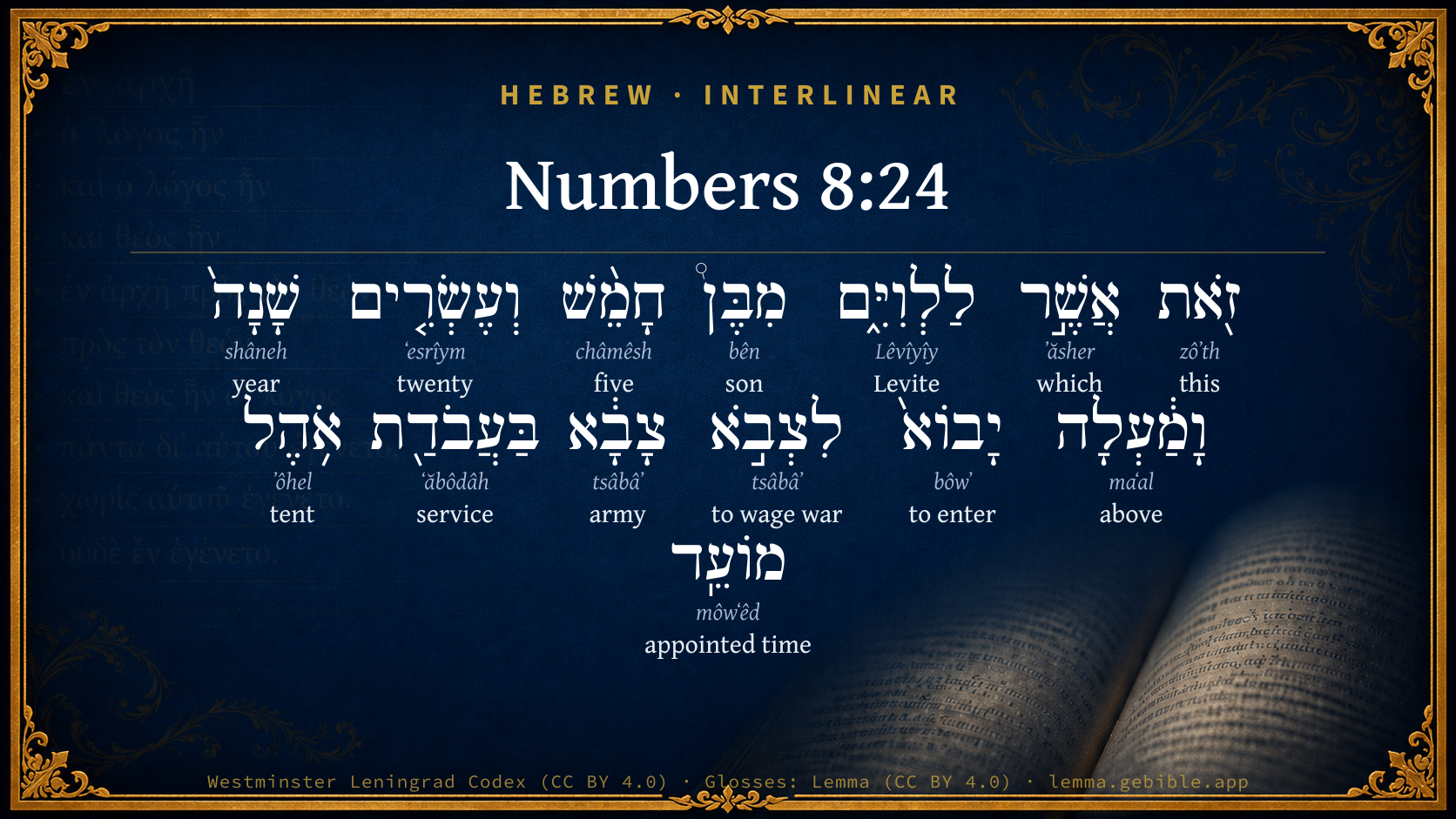
Hebrew (Westminster Leningrad Codex) Numbers 8:24 appears in the Hebrew Old Testament. The text above is from the Westminster Leningrad Codex. Each word links to its Strong’s number, a concise gloss, and parsing drawn from the Open Scriptures Hebrew Bible morphology. Click any word for its full Brown-Driver-Briggs (BDB) entry.
Download image
Cite this verse

Numbers 8:24 (World English Bible). Public Domain. Lemma interlinear Bible study tool, https://lemma.gebible.app/v/numbers/8/24.

Show BibTeX & RIS
BibTeX
RIS
English Translation
"This is that which belongs to the Levites: from twenty-five years old and upward they shall go in to wait on the service in the work of the Tent of Meeting;
World English Bible · Public Domain
Download a study sheet

One document with this verse’s original text, its word-by-word gloss line, the meaning frame, cross-references with their text, attributed commentary, and full source and license credits — printable, and it pastes into notes with its structure intact.

This verse Autodidact and up

Study sheet (.html) Plain text (.txt)

A passage Seminary Student

Up to 50 verses in one chapter. A passage sheet keeps up to 6 commentary sources and 12 cross-references per verse, in the order this page ranks them, and says so on the sheet whenever that leaves anything out. Ask for a single verse and you get the Autodidact verse sheet above.

Everything on this page stays free to read, with no account — the sheet is a download of what is already on screen, not access to it.

Want to remove ads? Support Godless Engineer
Compare translations 3

The same verse in 3 English versions, stacked beneath the original-language interlinear above. Click any original word for its lexicon entry.

Each is an independent rendering of the whole verse — the interlinear is not word-aligned to these translations.

Highlighted words mark where these versions differ — a whole-verse word diff, not a word-by-word alignment.

  • World English Bible Public Domain
    "This is that which belongs to the Levites: from twenty-five years old and upward they shall go in to wait on the service in the work of the Tent of Meeting;
  • King James Version Public Domain
    This is it that belongeth unto the Levites: from twenty and five years old and upward they shall go in to wait upon the service of the tabernacle of the congregation:
  • unfoldingWord Literal Text CC BY-SA 4.0
    “This what for the Levites: From a son of 25 years and upward he shall come to fight in the army in the service of the tent of meeting.

unfoldingWord Literal Text — © unfoldingWord, licensed CC BY-SA 4.0. Word-aligned USFM3 via Door43 (git.door43.org/unfoldingWord/en_ult).

Versions to compare (up to 4)

3 of 4 selected

Show all 18 translations

Every available English version of this verse, each an independent rendering of the whole verse.

  • World English Bible Public Domain
    "This is that which belongs to the Levites: from twenty-five years old and upward they shall go in to wait on the service in the work of the Tent of Meeting;
  • Berean Standard Bible Public Domain
    “This applies to the Levites: Men twenty-five years of age or older shall enter to perform the service in the work at the Tent of Meeting.
  • Majority Standard Bible Public Domain
    “This applies to the Levites: Men twenty-five years of age or older shall enter to perform the service in the work at the Tent of Meeting.
  • King James Version Public Domain
    This is it that belongeth unto the Levites: from twenty and five years old and upward they shall go in to wait upon the service of the tabernacle of the congregation:
  • American Standard Version (1901) Public Domain
    This is that which belongeth unto the Levites: from twenty and five years old and upward they shall go in to wait upon the service in the work of the tent of meeting:
  • Revised Version (1885) Public Domain
    This is that which belongeth unto the Levites: from twenty and five years old and upward they shall go in to wait upon the service in the work of the tent of meeting:
  • Geneva Bible (1599) Public Domain
    This also belongeth to the Leuites: from fiue and twentie yeere olde and vpwarde, they shall goe in, to execute their office in the seruice of the Tabernacle of the Congregation.
  • Douay-Rheims (1899) Public Domain
    This is the law of the Levites: From twenty-five years old and upwards, they shall go in to minister in the tabernacle of the covenant.
  • Young's Literal Translation Public Domain
    `This `is' that which `is' the Levites': from a son of five and twenty years and upward he doth go in to serve the host in the service of the tent of meeting,
  • Literal Standard Version CC BY-SA 4.0
    “This [is] who [is] for the Levites: from a son of twenty-five years and upward he goes in to serve the host in the service of the Tent of Meeting,
  • Unlocked Literal Bible CC BY-SA 4.0
    “All of this is for the Levites who are twenty-five years old and more. They must join the company to serve in the tent of meeting.
  • unfoldingWord Literal Text CC BY-SA 4.0
    “This what for the Levites: From a son of 25 years and upward he shall come to fight in the army in the service of the tent of meeting.
  • Darby Bible Public Domain
    This is that which concerneth the Levites: from twenty-five years old and upward shall he come to labour in the work of the service of the tent of meeting.
  • World Messianic Bible Public Domain
    “This is what is assigned to the Levites: from twenty-five years old and upward they shall go in to wait on the service in the work of the Tent of Meeting;
  • Webster's Bible Public Domain
    This is it that belongeth to the Levites: from twenty and five years old and upward they shall go in to wait upon the service of the tabernacle of the congregation:
  • Free Bible Version CC BY-SA 4.0
    “This rule applies to the Levites. Those twenty-five or older shall serve at the Tent of Meeting.
  • Bible in Basic English Public Domain
    This is the rule for the Levites: those of twenty-five years old and over are to go in and do the work of the Tent of meeting;
  • JPS Tanakh (1917) Public Domain
    'This is that which pertaineth unto the Levites: from twenty and five years old and upward they shall go in to perform the service in the work of the tent of meeting;

Literal Standard Version (2020), Covenant Press — licensed CC BY-SA 4.0. Text via the HelloAO Bible API (eBible.org). Unlocked Literal Bible (unfoldingWord) — licensed CC BY-SA 4.0. Text via the HelloAO Bible API (eBible.org). unfoldingWord Literal Text — © unfoldingWord, licensed CC BY-SA 4.0. Word-aligned USFM3 via Door43 (git.door43.org/unfoldingWord/en_ult). Free Bible Version, Dr. Jonathan Gallagher — licensed CC BY-SA 4.0. Text via the HelloAO Bible API (eBible.org).

Word by word

More ways to search: Search by grammar → Find every occurrence → Compare this word →

Practice this passage: Drill this verse → Learn its vocabulary →

לִצְבֹ֣א
tsâbâʼ
H6633
“to wage war”
Preposition + Verb, Qal, Infinitive Construct
Part of Speech
Preposition + Verb
Stem
Qal
Form
Infinitive Construct
Full BDB Definition

Origin: a primitive root

TWOT: 1865

to go forth, wage war, fight, serve - (Qal) - to wage war, fight, go forth to war - to serve (at sacred tent) - (Hiphil) to cause to go forth, muster
  1. זֹ֖את zôʼth H2063 “this” Pronoun, Demonstrative, Feminine, Singular
  2. אֲשֶׁ֣ר ʼăsher H834 “which” Particle, Relative
  3. לַלְוִיִּ֑ם Lêvîyîy H3881 “to/for the · Levites” Preposition, Determined + Noun, Gentilic, Masculine, Plural, Absolute
  4. מִבֶּן֩ bên H1121 “from · son of” Preposition + Noun, Common, Masculine, Singular, Construct
  5. חָמֵ֨שׁ châmêsh H2568 “five” Adjective, Cardinal number, Feminine, Singular, Absolute
  6. וְעֶשְׂרִ֤ים ʻesrîym H6242 “and · twenty” Conjunction + Adjective, Cardinal number, Both, Plural, Absolute
  7. שָׁנָה֙ shâneh H8141 “year” Noun, Common, Feminine, Singular, Absolute
  8. וָמַ֔עְלָה maʻal H4605 “and · above · toward” Conjunction + Adverb + Suffix, Demonstrative
  9. יָבוֹא֙ bôwʼ H935 “to enter” Verb, Qal, Imperfect, 3rd Person, Masculine, Singular
  10. צָבָ֔א tsâbâʼ H6635 “army” Noun, Common, Both, Singular, Absolute
  11. בַּעֲבֹדַ֖ת ʻăbôdâh H5656 “in/at · service of” Preposition + Noun, Common, Feminine, Singular, Construct
  12. אֹ֥הֶל ʼôhel H168 “tent of” Noun, Common, Masculine, Singular, Construct
  13. מוֹעֵֽד môwʻêd H4150 “appointed time” Noun, Common, Masculine, Singular, Absolute

About this verse

These counts appear in no published source. They are computed here, from the morphology-tagged text and Lemma’s own curated glosses. What Lemma adds →

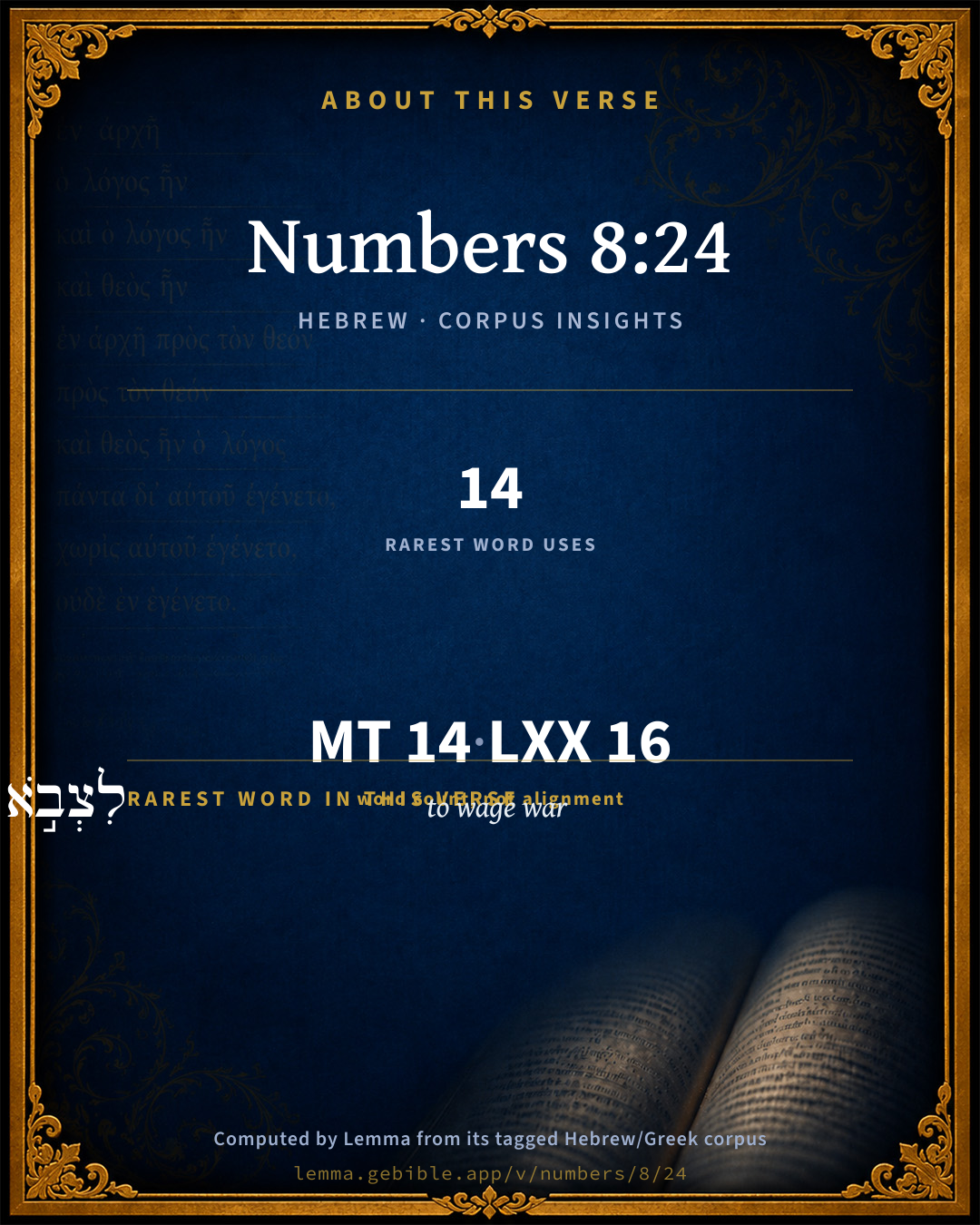
14
words
14
distinct lemmas
Pentateuch
section

Notable vocabulary

The rarest word here is לִצְבֹ֣א to wage war H6633 — appearing just 14 times in the whole Hebrew Bible.

Shared distinctive vocabulary

לִצְבֹ֣א to wage war H6633 occurs in 12 verses of the Hebrew Bible. Also found in:

Grammatical profile

  • 2 verbs
  • 7 nouns
  • 2 adjectives
  • 1 pronoun
  • 1 adverb
  • 1 particle

Verb forms

  • יָבוֹא֙ Qal · Imperfect
  • לִצְבֹ֣א Qal · Infinitive Construct

Hebrew & Septuagint length

In English translation the verse runs 31 words from the Hebrew and 26 from the Septuagint (LXX English) — closely comparable.

A rough comparison of the two English renderings, which tokenize alike — not a word-level alignment.

Word counts can differ between the Hebrew and the Greek without any difference in meaning — e.g. the Hebrew direct-object marker אֵת has no separate Greek word, and Greek often adds the article ὁ.

In the original languages it is 14 Hebrew tokens and 16 Greek tokens — but the two are counted differently (Hebrew bundles its prefixes and suffixes into one token; the Greek is in lemma form), so that isn’t a like-for-like length.

Cross-references

10

Topical passages linked to Numbers 8:24 in the Treasury of Scripture Knowledge — connected by theme and wording, ordered by reader-vote popularity; previews shown in the World English Bible.

  • Numbers 4:3 from thirty years old and upward even until fifty years old, all who enter into the service, to do the work in the Tent of Meeting.
  • 1 Chronicles 23:3 The Levites were numbered from thirty years old and upward: and their number by their polls, man by man, was thirty-eight thousand.
  • Numbers 4:23 from thirty years old and upward until fifty years old shall you number them; all who enter in to wait on the service, to do the work in the Tent of Meeting.
  • 1 Chronicles 23:24–27 These were the sons of Levi after their fathers' houses, even the heads of the fathers' [houses] of those of those who were counted, in the number of names by their polls, who did the work for the service of the house of Yahweh, from twenty years old and upward.
  • 1 Chronicles 28:12–13 and the pattern of all that he had by the Spirit, for the courts of the house of Yahweh, and for all the surrounding rooms, for the treasuries of the house of God, and for the treasuries of the dedicated things;
  • 1 Corinthians 9:7 What soldier ever serves at his own expense? Who plants a vineyard, and doesn't eat of its fruit? Or who feeds a flock, and doesn't drink from the flock's milk?
  • 2 Corinthians 10:4 for the weapons of our warfare are not of the flesh, but mighty before God to the throwing down of strongholds,
  • 2 Timothy 2:3–5 You therefore must endure hardship, as a good soldier of Christ Jesus.
  • 1 Timothy 1:18 This charge I commit to you, my child Timothy, according to the prophecies which led the way to you, that by them you may wage the good warfare;
  • 1 Timothy 6:12 Fight the good fight of faith. Lay hold of the eternal life to which you were called, and you confessed the good confession in the sight of many witnesses.

Cross-references courtesy of OpenBible.info (CC BY 4.0).

Hebrew and Greek witnesses Masoretic Hebrew ↔ Greek Septuagint

The same verse in the two great witnesses to the Old Testament, shown verse-for-verse.

These are two independent witnesses, not word-aligned to each other, and the Septuagint is shown in lemma (dictionary) form.

Hebrew Numbers 8:24 Masoretic · Westminster Leningrad Codex

זֹ֖את אֲשֶׁ֣ר לַלְוִיִּ֑ם מִבֶּן֩ חָמֵ֨שׁ וְעֶשְׂרִ֤ים שָׁנָה֙ וָמַ֔עְלָה יָבוֹא֙ לִצְבֹ֣א צָבָ֔א בַּעֲבֹדַ֖ת אֹ֥הֶל מוֹעֵֽד

"This is that which belongs to the Levites: from twenty-five years old and upward they shall go in to wait on the service in the work of the Tent of Meeting;

World English Bible · Public Domain

Greek LXX Numbers 8:24 Septuagint · lemma form

οὗτος εἰμί ὁ περί ὁ λευίτης ἀπό καί ἐπάνω εἰςἔρχομαι ἐνεργέω ἐν ὁ σκηνή ὁ μαρτύριον

This is the ordinance for the Levites; From five and twenty years old and upward, they shall go in to minister in the tabernacle of witness.

LXX2012 (modern English Septuagint) · Public Domain

Hebrew: Westminster Leningrad Codex (CC BY 4.0). Greek: Septuagint (public domain); English from LXX2012 (modern English Septuagint) (Public Domain). How the Septuagint differs from the Hebrew →

Targum (Aramaic paraphrase)

2

The Targum is the ancient Jewish Aramaic paraphrase of the Hebrew Scriptures — an interpretive translation, not the Hebrew text itself. Onkelos (literal) and Pseudo-Jonathan (expansive) render the Torah, and Jonathan the Prophets. Coverage is partial: where no permissively-licensed English translation exists for a verse, only the Aramaic is shown. This is verse-level text, not a word-by-word alignment to the Hebrew.

  1. Targum Onkelos Torah (Genesis–Deuteronomy)
    דָא דִי לְלֵוָאֵי מִבַּר חָמֵשׁ וְעַשְׂרִין שְׁנִין וּלְעֵלָא יֵיתֵי לְחֲיָלָא חֵילָא בְּפוּלְחַן מַשְׁכַּן זִמְנָא

    (no public-domain English translation for this verse)

    Targum Onkelos — Aramaic: “Onkelos Genesis” (public domain); “Onkelos Exodus” (public domain); “Onkelos Leviticus” (public domain); “Onkelos Numbers” (public domain); “Onkelos Deuteronomy” (public domain). English: “Sefaria Community Translation” (CC0 1.0 (public-domain dedication)); “J.W. Etheridge. The Targums of Onkelos and Jonathan Ben Uzziel on the Pentateuch. London: Longmans, Green, 1862” (public domain). Text via Sefaria.

  2. Targum Pseudo-Jonathan Torah (Genesis–Deuteronomy)
    דָא אַחְוַויְיתָא דִי לְלֵיוָאֵי דְלָא מוּפְסָלִין בְּמוּמְהוֹן בְּרַם מִבַּר עֶשְרִין וְחָמֵשׁ שְׁנִין וּלְעֵילָא יֵיתֵי לְחַיְילָא חֵילָא בְּפוּלְחַן מַשְׁכַּן זִמְנָא

    This is the instruction for the Levites who are not disqualified (profaned) by their blemishes: from one of twenty-five years and upward, he shall come, according to his company, to the service of the tabernacle of ordinance

    Targum Pseudo-Jonathan — Aramaic: “Targum Jonathan on Genesis” (public domain); “Targum Jonathan on Exodus” (public domain); “Targum Jonathan on Leviticus” (public domain); “Targum Jonathan on Numbers” (public domain); “Targum Jonathan on Deuteronomy” (public domain). English: “The Targum of Jonathan ben Uzziel, trans. J. W. Etheridge, London, 1862” (public domain). Text via Sefaria.

Commentary

Notes on Numbers 8:24 from classic Christian and Jewish commentators (each source and its license shown beneath its notes). The classic Christian expositions comment on the surrounding passage and are grouped to its opening verse, so a note may address several verses; the Jewish commentaries on the Tanakh (Rashi and others) are per-verse, so they appear only where the commentator wrote on this verse.

Lemma curates 59 commentaries, every one of them public domain or Creative Commons licensed, each selected and text-cleaned for this edition rather than reprinted as found. About our sources →

Trapp's Complete Commentary

John Trapp

Num 8:24 This [is it] that [belongeth] unto the Levites: from twenty and five years old and upward they shall go in to wait upon the service of the tabernacle of the congregation:

Ver. 24. From twenty-five years.] {See Trapp on "Num 4:30"}

John Trapp, A Commentary or Exposition upon All the Books of the Old and New Testament (1647–1656) — public domain. Text from a community e-Sword module.

Jamieson, Fausset & Brown

Robert Jamieson, A. R. Fausset & David Brown

from twenty and five years old, &c.--(Compare Num 4:3). They entered on their work in their twenty-fifth year, as pupils and probationers, under the superintendence and direction of their senior brethren; and at thirty they were admitted to the full discharge of their official functions.

Jamieson, Fausset & Brown — Commentary Critical and Explanatory on the Whole Bible (1871) — public domain (CC PDM 1.0). Text via the HelloAO Bible API.

Adam Clarke's Commentary

Verse 24. From twenty and five years old] See Clarke on Nu 4:3, where the two terms of twenty-five and thirty years are reconciled.

Adam Clarke's Commentary on the Bible (1810–1826) — public domain. Text from a community e-Sword/MySword module.

Ellicott's Commentary for English Readers

(24) From twenty and five years old and upward.—This regulation may be understood as referring to the age at which the Levites were to enter upon their duties after the people had taken possession of the land of Canaan, and it appears to have remained in force until the time of David, who substituted the age of twenty for that of twenty-five, because the necessity of carrying the Tabernacle and its furniture from place to place, which arose but seldom after the entrance into Canaan, finally ceased after the removal of the ark to Mount Zion. The time of service during the wanderings in the wilderness was from thirty to fifty (Num_4:3; Num_4:23; Num_4:30), during which time the constant removal of the Tabernacle required the services of men in the full vigour of life. The chronological order of events is not always observed in this book, and the directions contained in Num_8:23-26 may have been given at a later period, but inserted here in connection with the account of the appointment of the Levites to their office. On the other hand, it is quite possible that from the first the Levites entered upon the lighter parts of their office at the age of twenty-five years, but were not employed before they were thirty years of age in the more onerous duties of removing the Tabernacle, or in bearing on their shoulders the sacred vessels, as in the case of the Kohathites.

To wait upon the service.—Literally, to war the warfare, or to serve the (military) service. Similarly, in the following verse, he shall return from the warfare of the service.

A Bible Commentary for English Readers, edited by Charles John Ellicott (1878–1897) — public domain. Text from a community e-Sword module.

The Cambridge Bible for Schools and Colleges

gen. ed. J. J. S. Perowne

24. that which belongeth unto the Levites] An elliptical expression: that which [thou shall do] With regard to the Levites.

from twenty and five years old] In Num_4:3 the age is from thirty years. See note there.

to wait upon the service] R.V. marg. ‘to war the warfare.’ See on Num_4:3.

The Cambridge Bible for Schools and Colleges (gen. ed. J. J. S. Perowne; Cambridge University Press, 1878–1918) — public domain. Text from a community e-Sword module.

John Gill's Exposition

And from the age of fifty years they shall cease waiting upon the service thereof,.... The heavy service of it:

and shall serve no more; by bearing and carrying the vessels of the sanctuary upon their shoulders, as Jarchi interprets it; this, according to the Jewish writers, was only in force while the tabernacle was in the wilderness, and was moved from place to place: but when it had a fixed habitation, and that laborious service of bearing and carrying the vessels of it ceased, years made no difference in the Levites, or disqualified them for service; for it is said (x), that the Levites were not bound by this law, but in the time of the tabernacle; but when it was at Shiloh, and at Jerusalem, where there was no bearing and carrying upon the shoulder, the Levites were not rejected on account of years, only for their voice, when they had lost that, and could not sing.

(x) Maimon. & Bartenora in Misn. Cholin, c. 1. sect. 6.

John Gill's Exposition of the Whole Bible (1746–1763) — public domain (CC PDM 1.0). Text via the HelloAO Bible API.

Albert Barnes' Notes on the Bible

Twenty and five years old and upward - The permanent limit as distinguished from the temporary Num 4:3, Num 4:23, Num 4:30, though David found it necessary to extend the period of the Levites’ service by causing it to commence at 20 years of age 1Ch 23:24-28. This rule continued in force from the time of David downward (compare on 2Ch 31:17; Ezr 3:8).

Albert Barnes' Notes on the Bible (1834–1885) — public domain. Text from a community e-Sword/MySword module.

Matthew Poole's English Annotations

From twenty and five years old. See Poole "Num 4:3".

Matthew Poole's English Annotations on the Holy Bible (1683–1685) — public domain. Text from a community e-Sword/MySword module.

Whedon's Commentary on the Bible

Daniel D. Whedon

24. Wait upon the service — Literally, war the warfare. This is often referred to by St. Paul. 1Co_9:7; 2Co_10:4; 1Ti_1:18; 1Ti_6:12; 2Ti_2:3-5. It signifies service involving strenuous efforts and hardships. The widespread establishment of synagogues in later ages afforded to both priests and Levites a broad field of labour. For though they were not required to teach in the synagogue, yet whenever they were present precedence was given to them. The Levites seldom appear in the New Testament except as the type of a formal worship without sympathy and without love. They had ceased “to war a good warfare.” See Luk_10:32.

Daniel D. Whedon (gen. ed.), Commentary on the Old and New Testaments (1874–1909) — public domain. Text from a community e-Sword module.

The Pulpit Commentary

From twenty and five years old and upward. A short time before the minimum age had been fixed at thirty. (Num_4:3) That direction, however, concerned the transport of the tabernacle and its belongings; this was a permanent regulation designed for the ordinary labours of the sanctuary at a time when the Levites would be scattered throughout their cities, and could only serve by courses. For the latter purpose many more would be required; and indeed they were found insufficient as it was in the latter days of David, when the wealth and devotion of the kingdom were fast increasing. (see on 1Ch_23:24-27) To wait upon the service. Literally, "to war the warfare;" the idea of the militia sacra is kept up.

The Pulpit Commentary (1880–1919), ed. H.D.M. Spence-Jones & Joseph S. Exell — public domain. Text from a community e-Sword module.

Rashi

Rabbi Shlomo Yitzchaki (Rashi)

זאת אשר ללוים THIS IS THAT WHICH BELONGETH TO THE LEVITES [FROM TWENTY FIVE YEARS etc.] — This suggests: years (the question of age) can disqualify them for the service (i.e. if they are younger than 25 and older than 50 years), but bodily blemishes cannot disqualify them, [as in the case of priests] (Sifrei Bamidbar 62; Chullin 24a).

מבן חמש ועשרים FROM TWENTY AND FIVE [YEARS] AND UPWARD [THEY SHALL GO IN TO WAIT UPON THE SERVICE] — But in another passage, it states, (Numbers 4:3) “from thirty years old [and upwards … all that enter into the host to do the work in the tabernacle]”! How are these apparently contradictory passages to be reconciled? In the following way: From twenty five years on he (the Levite) comes to learn the laws regulating the service, and he studies for five years, and at the age of thirty he may actually do the service. — From here we may derive the principle that a pupil who does not see an auspicious omen (i. e. success) in his study during five years will never see it. (Sifrei Bamidbar 62; Chullin 24a.)

Rashi on the Tanakh — English translations: “The Judaica Press complete Tanach with Rashi, translated by A. J. Rosenberg” (CC BY 4.0); “Pentateuch with Rashi's commentary by M. Rosenbaum and A.M. Silbermann, 1929-1934” (public domain); “The Metsudah Tanach series, Lakewood, N.J” (CC BY 4.0); and “The Book of Joshua, Metsudah Publications, 1997” (CC BY 4.0). Text via Sefaria.

Lesson kit

Teaching starters — assembled from the data on this page, not authored interpretation. Every prompt links to the verse data it draws on. Edit before teaching.

Numbers, in the Pentateuch, opens this verse with 14 words (14 distinct Hebrew lemmas). Its most distinctive word is tsâbâʼ (“to wage war”). A historical commentator’s framing appears above. Read the whole chapter for the surrounding context.

Discussion questions

  1. What does “to wage war” (tsâbâʼ) contribute to the verse as a whole?
  2. Exodus 38:8 shares the word «to wage war» with this verse. How do the two illuminate each other?
  3. The translations on this page render this verse differently — a whole-verse word diff, not a word-by-word alignment. What might account for the different wordings?
  4. The verb «יָבוֹא֙» is Qal Imperfect. How does its form color the action?
  5. Reading how Trapp's Complete Commentary and Jamieson, Fausset & Brown read this verse, where do the two commentators agree and where do they part?

Things to notice

Reading settings

Reading text

Shown beneath each verse's original-language words.

Old Testament
Old Testament edition

Read the OT as the Masoretic Hebrew (MT) or the Greek Septuagint (LXX).

English shown for the Greek Septuagint (in the Hebrew ↔ Greek comparison).

Comparing translations? Open the Compare panel on any verse page to stack up to four side by side.