
Deuteronomy 29:9

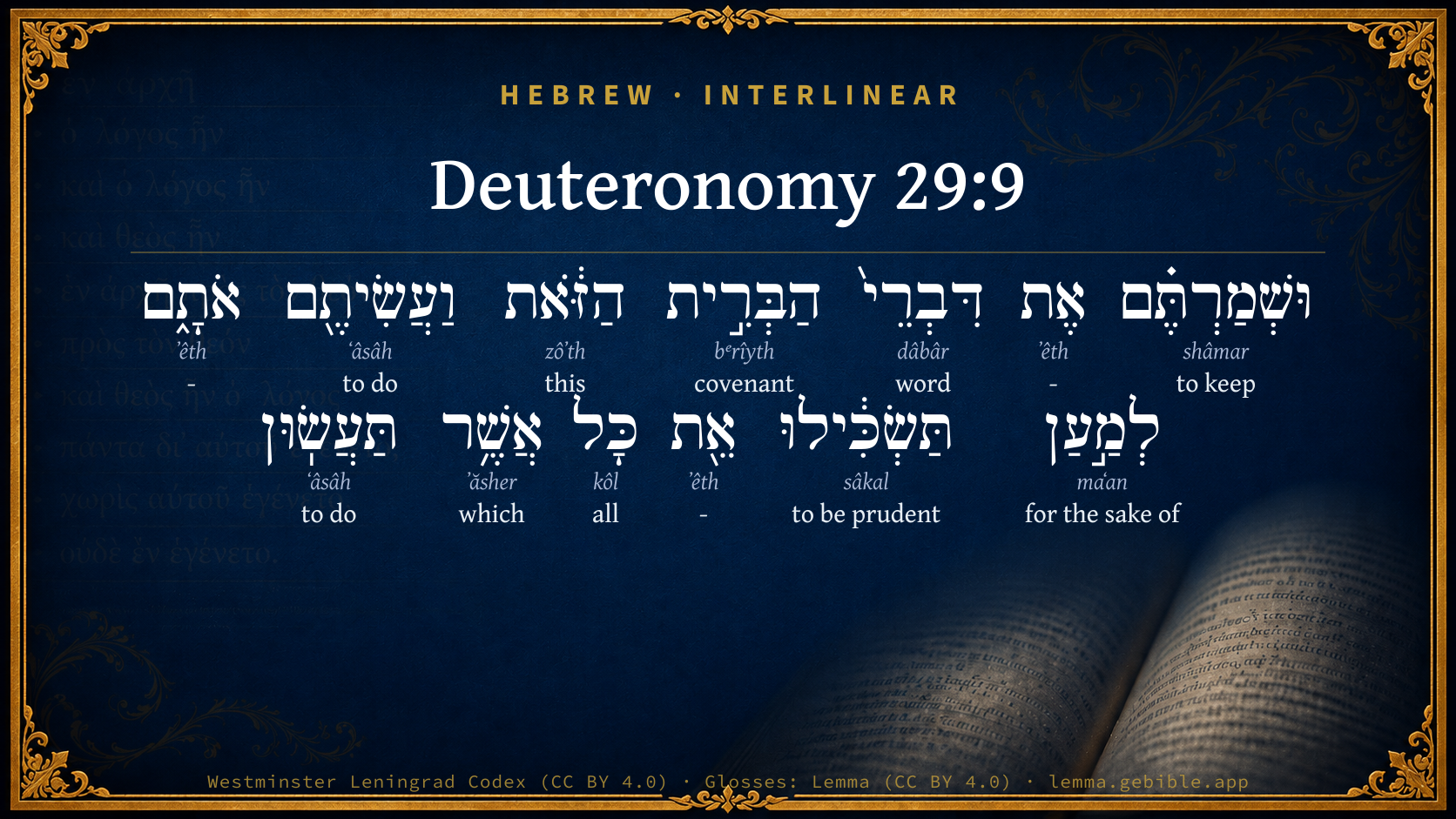
Hebrew (Westminster Leningrad Codex) Deuteronomy 29:9 appears in the Hebrew Old Testament. The text above is from the Westminster Leningrad Codex. Each word links to its Strong’s number, a concise gloss, and parsing drawn from the Open Scriptures Hebrew Bible morphology. Click any word for its full Brown-Driver-Briggs (BDB) entry.
Download image
Cite this verse

Deuteronomy 29:9 (World English Bible). Public Domain. Lemma interlinear Bible study tool, https://lemma.gebible.app/v/deuteronomy/29/9.

Show BibTeX & RIS
BibTeX
RIS
English Translation
Keep therefore the words of this covenant, and do them, that you may prosper in all that you do.
World English Bible · Public Domain
Download a study sheet

One document with this verse’s original text, its word-by-word gloss line, the meaning frame, cross-references with their text, attributed commentary, and full source and license credits — printable, and it pastes into notes with its structure intact.

This verse Autodidact and up

Study sheet (.html) Plain text (.txt)

A passage Seminary Student

Up to 50 verses in one chapter. A passage sheet keeps up to 6 commentary sources and 12 cross-references per verse, in the order this page ranks them, and says so on the sheet whenever that leaves anything out. Ask for a single verse and you get the Autodidact verse sheet above.

Everything on this page stays free to read, with no account — the sheet is a download of what is already on screen, not access to it.

Want to remove ads? Support Godless Engineer
Compare translations 3

The same verse in 3 English versions, stacked beneath the original-language interlinear above. Click any original word for its lexicon entry.

Each is an independent rendering of the whole verse — the interlinear is not word-aligned to these translations.

Highlighted words mark where these versions differ — a whole-verse word diff, not a word-by-word alignment.

  • World English Bible Public Domain
    Keep therefore the words of this covenant, and do them, that you may prosper in all that you do.
  • King James Version Public Domain
    Keep therefore the words of this covenant, and do them, that ye may prosper in all that ye do.
  • unfoldingWord Literal Text CC BY-SA 4.0
    And you shall keep the words of this covenant and do them so that you may prosper in everything that you do.

unfoldingWord Literal Text — © unfoldingWord, licensed CC BY-SA 4.0. Word-aligned USFM3 via Door43 (git.door43.org/unfoldingWord/en_ult).

Versions to compare (up to 4)

3 of 4 selected

Show all 18 translations

Every available English version of this verse, each an independent rendering of the whole verse.

  • World English Bible Public Domain
    Keep therefore the words of this covenant, and do them, that you may prosper in all that you do.
  • Berean Standard Bible Public Domain
    So keep and follow the words of this covenant, that you may prosper in all you do.
  • Majority Standard Bible Public Domain
    So keep and follow the words of this covenant, that you may prosper in all you do.
  • King James Version Public Domain
    Keep therefore the words of this covenant, and do them, that ye may prosper in all that ye do.
  • American Standard Version (1901) Public Domain
    Keep therefore the words of this covenant, and do them, that ye may prosper in all that ye do.
  • Revised Version (1885) Public Domain
    Keep therefore the words of this covenant, and do them, that ye may prosper in all that ye do.
  • Geneva Bible (1599) Public Domain
    Keepe therefore the wordes of this couenant and doe them, that ye may prosper in all that ye shall doe.
  • Douay-Rheims (1899) Public Domain
    Keep therefore the words of this covenant, and fulfil them: that you may understand all that you do.
  • Young's Literal Translation Public Domain
    and ye have kept the words of this covenant, and done them, so that ye cause all that ye do to prosper.
  • Literal Standard Version CC BY-SA 4.0
    and you have kept the words of this covenant and done them, so that you cause all that you do to prosper.
  • Unlocked Literal Bible CC BY-SA 4.0
    Therefore keep the words of this covenant and do them, so that you may prosper in everything that you do.
  • unfoldingWord Literal Text CC BY-SA 4.0
    And you shall keep the words of this covenant and do them so that you may prosper in everything that you do.
  • Darby Bible Public Domain
    Ye shall keep then the words of this covenant, and do them, that ye may prosper in all that ye do.
  • World Messianic Bible Public Domain
    Therefore keep the words of this covenant and do them, that you may prosper in all that you do.
  • Webster's Bible Public Domain
    Keep therefore the words of this covenant, and do them, that ye may prosper in all that ye do.
  • Free Bible Version CC BY-SA 4.0
    So make sure you keep and follow the terms of this agreement in order that you may be successful in everything you do.
  • Bible in Basic English Public Domain
    So keep the words of this agreement and do them, so that it may be well for you in everything you do.
  • JPS Tanakh (1917) Public Domain
    (29-8) Observe therefore the words of this covenant, and do them, that ye may make all that ye do to prosper.

Literal Standard Version (2020), Covenant Press — licensed CC BY-SA 4.0. Text via the HelloAO Bible API (eBible.org). Unlocked Literal Bible (unfoldingWord) — licensed CC BY-SA 4.0. Text via the HelloAO Bible API (eBible.org). unfoldingWord Literal Text — © unfoldingWord, licensed CC BY-SA 4.0. Word-aligned USFM3 via Door43 (git.door43.org/unfoldingWord/en_ult). Free Bible Version, Dr. Jonathan Gallagher — licensed CC BY-SA 4.0. Text via the HelloAO Bible API (eBible.org).

Word by word

More ways to search: Search by grammar → Find every occurrence → Compare this word →

Practice this passage: Drill this verse → Learn its vocabulary →

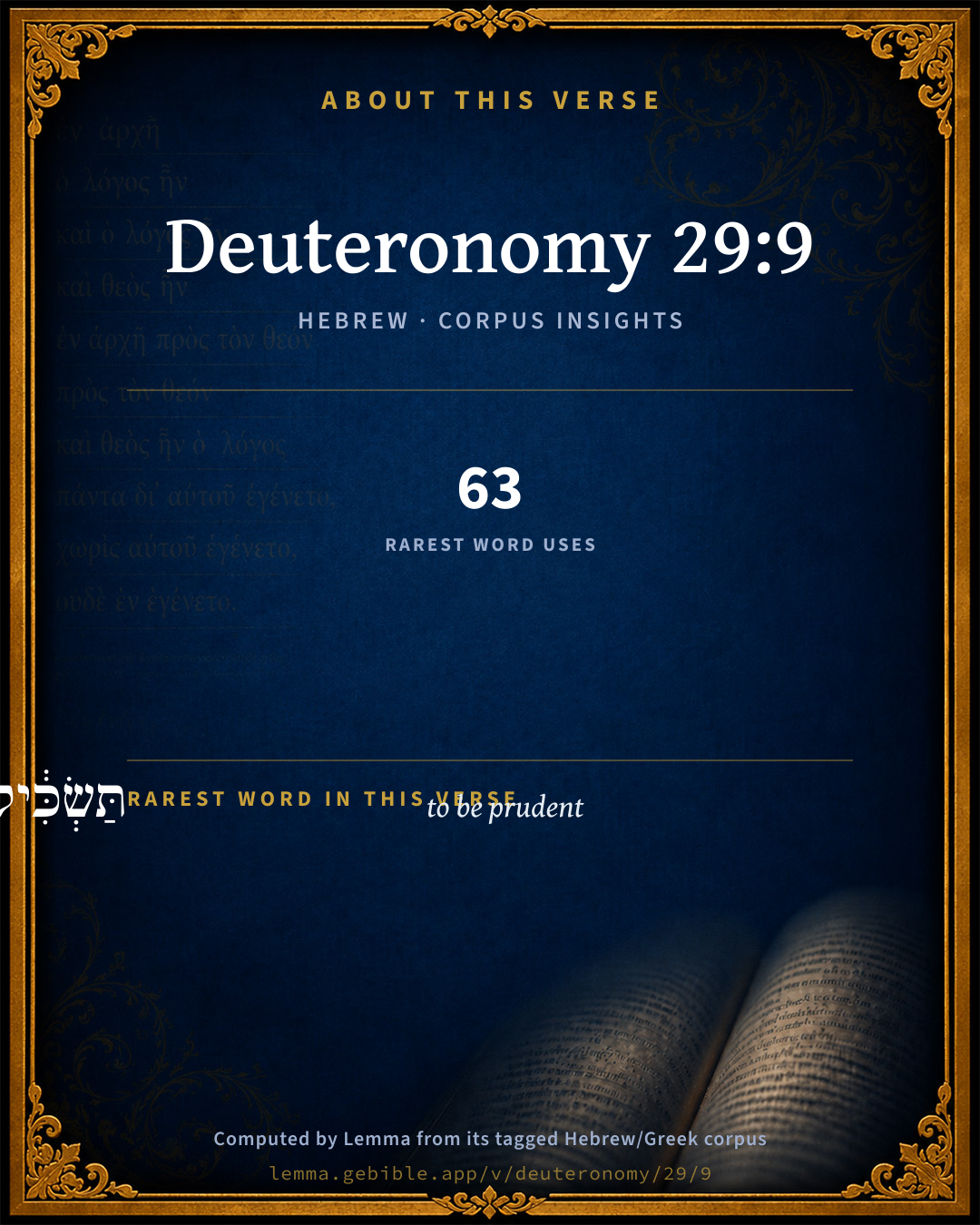
תַּשְׂכִּ֔ילוּ
sâkal
H7919
“to be prudent”
Verb, Hiphil, Imperfect, 2nd Person, Masculine, Plural
Part of Speech
Verb
Stem
Hiphil
Form
Imperfect
Person
2nd Person
Gender
Masculine
Number
Plural
Full BDB Definition

Origin: a primitive root

TWOT: 2263 , 2264

to be prudent, be circumspect, wisely understand, prosper - (Qal) to be prudent, be circumspect - (Hiphil) - to look at or upon, have insight - to give attention to, consider, ponder, be prudent - to have insight, have comprehension - insight, comprehension (substantive) - to cause to consider, give insight, teach - the teachers, the wise - to act circumspectly, act prudently, act wisely - to prosper, have success - to cause to prosper - (Piel) to lay crosswise, cross (hands)
  1. וּשְׁמַרְתֶּ֗ם shâmar H8104 “and · to keep” Conjunction + Verb, Qal, Sequential Perfect, 2nd Person, Masculine, Plural
  2. אֶת ʼêth H853 “-” Particle, Direct Object
  3. דִּבְרֵי֙ dâbâr H1697 “words of” Noun, Common, Masculine, Plural, Construct
  4. הַבְּרִ֣ית bᵉrîyth H1285 “the · covenant” Particle, Definite Article + Noun, Common, Feminine, Singular, Absolute
  5. הַזֹּ֔את zôʼth H2063 “the · this” Particle, Definite Article + Pronoun, Demonstrative, Feminine, Singular
  6. וַעֲשִׂיתֶ֖ם ʻâsâh H6213 “and · to do” Conjunction + Verb, Qal, Sequential Perfect, 2nd Person, Masculine, Plural
  7. אֹתָ֑ם ʼêth H853 “- · them” Particle, Direct Object + Suffix, Personal, 3rd Person, Masculine, Plural
  8. לְמַ֣עַן maʻan H4616 “for the sake of” Preposition
  9. אֵ֖ת ʼêth H853 “-” Particle, Direct Object
  10. כָּל kôl H3605 “all of” Noun, Common, Masculine, Singular, Construct
  11. אֲשֶׁ֥ר ʼăsher H834 “which” Particle, Relative
  12. תַּעֲשֽׂוּן ʻâsâh H6213 “to do” Verb, Qal, Imperfect, 2nd Person, Masculine, Plural + Suffix, n

About this verse

These counts appear in no published source. They are computed here, from the morphology-tagged text and Lemma’s own curated glosses. What Lemma adds →

13
words
10
distinct lemmas
Pentateuch
section

Grammatical profile

  • 4 verbs
  • 3 nouns
  • 1 pronoun
  • 1 preposition
  • 4 particles

Verb forms

  • וּשְׁמַרְתֶּ֗ם Qal · Sequential Perfect
  • וַעֲשִׂיתֶ֖ם Qal · Sequential Perfect
  • תַּשְׂכִּ֔ילוּ Hiphil · Imperfect
  • תַּעֲשֽׂוּן Qal · Imperfect

Repetition

A word recurs within this verse — often emphatic in Hebrew:

  • וַעֲשִׂיתֶ֖ם to do H6213 ×2

Hebrew & Septuagint length

In English translation the verse runs 19 words from the Hebrew and 23 from the Septuagint (LXX English) — closely comparable.

A rough comparison of the two English renderings, which tokenize alike — not a word-level alignment.

Word counts can differ between the Hebrew and the Greek without any difference in meaning — e.g. the Hebrew direct-object marker אֵת has no separate Greek word, and Greek often adds the article ὁ.

Cross-references

11

Topical passages linked to Deuteronomy 29:9 in the Treasury of Scripture Knowledge — connected by theme and wording, ordered by reader-vote popularity; previews shown in the World English Bible.

  • 1 Kings 2:3 and keep the charge of Yahweh your God, to walk in his ways, to keep his statutes, [and] his commandments, and his ordinances, and his testimonies, according to that which is written in the law of Moses, that you may prosper in all that you do, and wherever you turn yourself.
  • Deuteronomy 4:6 Keep therefore and do them; for this is your wisdom and your understanding in the sight of the peoples, who shall hear all these statutes, and say, Surely this great nation is a wise and understanding people.
  • Joshua 1:7 Only be strong and very courageous, to observe to do according to all the law, which Moses my servant commanded you: don't turn from it to the right hand or to the left, that you may have good success wherever you go.
  • Luke 11:28 But he said, "On the contrary, blessed are those who hear the word of God, and keep it."
  • Deuteronomy 29:1 These are the words of the covenant which Yahweh commanded Moses to make with the children of Israel in the land of Moab, besides the covenant which he made with them in Horeb.
  • Hebrews 13:20–21 Now may the God of peace, who brought again from the dead the great shepherd of the sheep with the blood of an eternal covenant, our Lord Jesus,
  • Jeremiah 50:5 They shall inquire concerning Zion with their faces turned toward it, [saying], Come you, and join yourselves to Yahweh in an everlasting covenant that shall not be forgotten.
  • Psalms 25:10 All the paths of Yahweh are loving kindness and truth To such as keep his covenant and his testimonies.
  • Psalms 103:17–18 But Yahweh's loving kindness is from everlasting to everlasting with those who fear him, His righteousness to children's children;
  • Isaiah 56:1–2 Thus says Yahweh, Keep you justice, and do righteousness; for my salvation is near to come, and my righteousness to be revealed.
  • Isaiah 56:4–7 For thus says Yahweh of the eunuchs who keep my Sabbaths, and choose the things that please me, and hold fast my covenant:

Cross-references courtesy of OpenBible.info (CC BY 4.0).

Hebrew and Greek witnesses Masoretic Hebrew ↔ Greek Septuagint

The same verse in the two great witnesses to the Old Testament, shown verse-for-verse.

These are two independent witnesses, not word-aligned to each other, and the Septuagint is shown in lemma (dictionary) form.

Hebrew Deuteronomy 29:9 Masoretic · Westminster Leningrad Codex

וּשְׁמַרְתֶּ֗ם אֶת דִּבְרֵי֙ הַבְּרִ֣ית הַזֹּ֔את וַעֲשִׂיתֶ֖ם אֹתָ֑ם לְמַ֣עַן תַּשְׂכִּ֔ילוּ אֵ֖ת כָּל אֲשֶׁ֥ר תַּעֲשֽׂוּן

Keep therefore the words of this covenant, and do them, that you may prosper in all that you do.

World English Bible · Public Domain

Greek LXX Deuteronomy 29:9 Septuagint · lemma form

σύ ἵστημι πᾶς σήμερον ἐναντίον κύριος ὁ θεός σύ ὁ ἀρχίφυλος σύ καί ὁ γερουσία σύ καί ὁ κριτής σύ καί ὁ σύ πᾶς ἀνήρ ἰσραήλ

And you⌃ shall take heed to do all the words of this covenant, that you⌃ may understand all things that you⌃ shall do.

LXX2012 (modern English Septuagint) · Public Domain

On this verse, John Gill's Exposition discusses the Septuagint’s reading. Read the note in Commentary ↓

Hebrew: Westminster Leningrad Codex (CC BY 4.0). Greek: Septuagint (public domain); English from LXX2012 (modern English Septuagint) (Public Domain). How the Septuagint differs from the Hebrew →

Targum (Aramaic paraphrase)

2

The Targum is the ancient Jewish Aramaic paraphrase of the Hebrew Scriptures — an interpretive translation, not the Hebrew text itself. Onkelos (literal) and Pseudo-Jonathan (expansive) render the Torah, and Jonathan the Prophets. Coverage is partial: where no permissively-licensed English translation exists for a verse, only the Aramaic is shown. This is verse-level text, not a word-by-word alignment to the Hebrew.

  1. Targum Onkelos Torah (Genesis–Deuteronomy)
    אַתּוּן קָיְמִין יוֹמָא דֵין כֻּלְכוֹן קֳדָם יְיָ אֱלָהֲכוֹן רֵישֵׁיכוֹן שִׁבְטֵיכוֹן סָבֵיכוֹן וְסָרְכֵיכוֹן כָּל אֱנַשׁ יִשְׂרָאֵל

    You stand today, all of you, before Hashem your God. Your heads, your tribes, your elders, your rulers, all men of Israel.

    Targum Onkelos — Aramaic: “Onkelos Genesis” (public domain); “Onkelos Exodus” (public domain); “Onkelos Leviticus” (public domain); “Onkelos Numbers” (public domain); “Onkelos Deuteronomy” (public domain). English: “Sefaria Community Translation” (CC0 1.0 (public-domain dedication)); “J.W. Etheridge. The Targums of Onkelos and Jonathan Ben Uzziel on the Pentateuch. London: Longmans, Green, 1862” (public domain). Text via Sefaria.

  2. Targum Pseudo-Jonathan Torah (Genesis–Deuteronomy)
    אתם אָמַר משֶׁה נְבִיָא לָא בְטוּמְרָא אֲנָא מַסְהִיד בְּכוֹן אֱלָהֵן כַּד אַתּוּן מְעַתְּדוּן יוֹמָנָא כּוּלְכוֹן קֳדָם יְיָ אֱלָהָכוֹן רֵישֵׁי סַנְהֶדְרִין דִלְכוֹן וַאֲמַרְכְּלֵי שִׁבְטֵיכוֹן סָבֵיכוֹן וְסַרְכֵיכוֹן כָּל אֵינַשׁ יִשְרָאֵל

    MOSHEH the prophet said: I have called you not in secret, but while standing this day all of you before the Lord your God; the princes of your sanhedrin, the chiefs of your tribes, your elders and your officers, all men of Israel,

    Targum Pseudo-Jonathan — Aramaic: “Targum Jonathan on Genesis” (public domain); “Targum Jonathan on Exodus” (public domain); “Targum Jonathan on Leviticus” (public domain); “Targum Jonathan on Numbers” (public domain); “Targum Jonathan on Deuteronomy” (public domain). English: “The Targum of Jonathan ben Uzziel, trans. J. W. Etheridge, London, 1862” (public domain). Text via Sefaria.

Commentary

Notes on Deuteronomy 29:9 from classic Christian and Jewish commentators (each source and its license shown beneath its notes). The classic Christian expositions comment on the surrounding passage and are grouped to its opening verse, so a note may address several verses; the Jewish commentaries on the Tanakh (Rashi and others) are per-verse, so they appear only where the commentator wrote on this verse.

Lemma curates 59 commentaries, every one of them public domain or Creative Commons licensed, each selected and text-cleaned for this edition rather than reprinted as found. About our sources →

Trapp's Complete Commentary

John Trapp

Deu 29:9 Keep therefore the words of this covenant, and do them, that ye may prosper in all that ye do.

Ver. 9. That ye may prosper.] Piety is the right and ready way to prosperity. Sulla, surnamed Felix, accounted it not the least part of his happiness that Metellus, surnamed Pius, was his friend. Godliness is the best friend to happiness.

John Trapp, A Commentary or Exposition upon All the Books of the Old and New Testament (1647–1656) — public domain. Text from a community e-Sword module.

Ellicott's Commentary for English Readers

(9) Keep therefore the words of this covenant . . . that ye may prosper.—Comp. Jos_1:8 (Note); Psa_1:3.

A Bible Commentary for English Readers, edited by Charles John Ellicott (1878–1897) — public domain. Text from a community e-Sword module.

The Cambridge Bible for Schools and Colleges

gen. ed. J. J. S. Perowne

9. Keep … and do] See on Deu_4:6; and cp. Deu_4:1, Deu_5:1.

the words of this covenant] See above on Deu_29:1 and on Deu_4:13. prosper] But the vb. also covers the deal wisely of the R.V. margin.

‘Originally a mental process or quality—has insight, is farseeing—it includes the effect of this—understands so as to get on, deals wisely so as to succeed, is practical both in his way of working, and in being sure of his end. Ewald has found an almost exact equivalent in German: “hat Geschick,” for “Geschick” means both “skill” or “address” and “fate” or “destiny.” ’ (Isaiah xl.–lxvi., Expositor’s Bible, p. 346 on Isa_52:13.) In the Hex. only here, and elsewhere (except for one or two passages) only in later writings.

The Cambridge Bible for Schools and Colleges (gen. ed. J. J. S. Perowne; Cambridge University Press, 1878–1918) — public domain. Text from a community e-Sword module.

John Gill's Exposition

Keep therefore the words of this covenant, and do them,.... To do which they were laid under great obligations, through the goodness of God to them, in giving them victory over the two kings, and delivering their countries into their hands, as well as by all the favours bestowed on them in the wilderness, where they were sufficiently supplied with food, drink, and raiment; all which is made use of as a motive and argument to engage them to observe and keep the covenant the Lord made with them:

that ye may prosper in all that ye do: in all their occupations and businesses of life, in their manufactures and commerce, in the culture of their fields and vineyards, and in whatsoever they were employed in a lawful way; the word used has sometimes, the signification of acting wisely and prudently, as in Isa 52:13; hence the Septuagint version is, "that ye may understand all that ye do"; and so the Jerusalem Targum.

John Gill's Exposition of the Whole Bible (1746–1763) — public domain (CC PDM 1.0). Text via the HelloAO Bible API.

Albert Barnes' Notes on the Bible

That ye may prosper - literally, “that ye may act wisely.” The connection of the two ideas of wisdom in conduct and prosperity in circumstances is noteworthy.

Albert Barnes' Notes on the Bible (1834–1885) — public domain. Text from a community e-Sword/MySword module.

Haydock's Catholic Bible Commentary

Understand. Hebrew, "succeed in all your undertakings." (Calmet)

George Leo Haydock (1774–1849), Haydock's Catholic Family Bible and Commentary, 1859 edition — public domain. Excludes Psalms (Douay-Rheims chapter numbering differs from Protestant) and Deuterocanonical books (Catholic canon only).

The Pulpit Commentary

That ye may prosper in all that ye do. The verb here used (lyKichi) means primarily to look at, to consider or attend to, hence to become intelligent, to be prudent, to act wisely, and so to have success, to prosper. It is the prosperity which comes from wise and prudent action that God commends to his people. (cf. Jos_1:7, Jos_1:8)

The Pulpit Commentary (1880–1919), ed. H.D.M. Spence-Jones & Joseph S. Exell — public domain. Text from a community e-Sword module.

Keil & Delitzsch

C. F. Keil & F. Delitzsch

These benefits from the Lord demanded obedience and fidelity. "Keep the words of this covenant," etc. (cf. Deu 8:18). השׂכּיל, to act wisely (as in Deu 32:29), bearing in mind, however, that Jehovah Himself is the wisdom of Israel (Deu 4:6), and the search for this wisdom brings prosperity and salvation (cf. Jos 1:7-8).

Keil & Delitzsch — Biblical Commentary on the Old Testament (1861–1891) — public domain (CC PDM 1.0). Text via the HelloAO Bible API. (Old Testament only.)

Rashi

Rabbi Shlomo Yitzchaki (Rashi)

אתם נצבים YE ARE STANDING THIS DAY [ALL OF YOU BEFORE THE LORD] — This teaches that Moses assembled them in the presence of the Omnipresent on the day of his death, in order to initiate them into a covenant with Him.

ראשיכם שבטיכם means as much as ראשיכם לשבטיכם YOUR HEADS OF YOUR TRIBES.

זקניכם ושטריכם YOUR ELDERS AND YOUR OFFICERS — The more prominent were in front (i.e. they stood before the Lord in the order of their rank), and afterwards: “all the men of Israel”.

Rashi on the Tanakh — English translations: “The Judaica Press complete Tanach with Rashi, translated by A. J. Rosenberg” (CC BY 4.0); “Pentateuch with Rashi's commentary by M. Rosenbaum and A.M. Silbermann, 1929-1934” (public domain); “The Metsudah Tanach series, Lakewood, N.J” (CC BY 4.0); and “The Book of Joshua, Metsudah Publications, 1997” (CC BY 4.0). Text via Sefaria.

Ramban (Nachmanides)

Rabbi Moshe ben Nachman (Ramban / Nachmanides)

YE ARE STANDING THIS DAY ALL OF YOU BEFORE THE ETERNAL YOUR G-D. The meaning thereof is that you are standing and ready before G-d to be initiated into His covenant. For, in order to accept the Torah with its interpretation, they had gathered before him [Moses], or they may have stood before the ark of G-d. The covenant was the oath and imprecation which he mentioned — that thou shouldest enter into the covenant of the Eternal thy G-d, and into His oath. It is possible that he made another covenant with them like the first covenant which he made with them at Mount Sinai, namely, that he offered a burnt-offering on their behalf, and took half of the blood to sprinkle upon the altar and he sprinkled half of the blood upon the people, but it was unnecessary for him to mention this. And by way of the Truth, [the mystic teachings of the Cabala], I have already informed you of [the secret of] this covenant.

RASHEICHEM SHIVTEICHEM.’ In the opinion of Rabbi Abraham ibn Ezra this means rasheichem rashei shivteichem (“your heads, the heads of your tribes”), cannot mean “your heads of.” Therefore Ibn Ezra adds the words rashei, interpreting the phrase as “your heads, ‘the heads of’ your tribes.” See Vol. IV, p. 115, Note 283 for the same principle as applied to another example. like and the prophecy of Oded the prophet indicating the definite article. Hence the word v’hanevuah cannot mean “and the prophecy of.” We must therefore add the word nevuath, meaning: “and the prophecy, ‘a prophecy of’ Oded.” See Vol. IV, p. 115, Note 284 where the same example is mentioned. [which means “and the prophecy, the prophecy of Oded the prophet”]. indicating the definite article. Hence the word v’hanevuah cannot mean “and the prophecy of.” We must therefore add the word nevuath, meaning: “and the prophecy, ‘a prophecy of’ Oded.” See Vol. IV, p. 115, Note 284 where the same example is mentioned.In my opinion the verse generalizes and then specifies. The generalization is: “your heads and all your tribes,” and then it specifies your elders, and your officers who are your heads, for the elder and the man of rank, he is the head. Similarly, he stated Assemble unto me all the elders of your tribes, and your officers, for any person who has authority and appointive power over the public is called rosh (head). Thus it is said of the princes [of the tribes], they were ‘the heads of’ the thousands of Israel, for they were the highest rank of all the thousands of Israel. And it is stated of the spies, [all of them were] ‘heads of’ the children of Israel, 13:3. meaning they were “among” the heads of the children of Israel, not the heads of all the children of Israel — and they were all included in the term your heads. He then stated again even all the men of Israel who comprise your tribes.Then he mentioned further the little children, the women, the strangers, the hewers of wood and drawers of water whom they had from among the mixed multitude. He had made them bring the little ones, in order to include them in the covenant, for he made the covenant even with the future generations, or [the children may have been brought] to make them [i.e., the parents] deserving of Divine reward for bringing them, like the reason the Rabbis gave regarding [the commandment of] the Assembly. And our Rabbis have said that some Canaanites [posing as proselytes] came in Moses’ days just as they came in Joshua’s days and Moses made them hewers of wood and drawers of water for the congregation, and for the Tabernacle of G-d., Verse 27. The verse there states: for ‘the altar of’ G-d. Now, the intent of the Rabbis is not to state that these Canaanites deceived Moses [as they misled Joshua]; instead, they came to him to make peace with him, for such is the law as we have explained. Thus I found in Midrash Tanchuma: 2. “This teaches you that they [the Canaanites] came before Moses and he did not accept them.” That is to say, they could not deceive him into making a covenant with them, but he immediately made them hewers of wood and drawers of water.

Ramban (Nachmanides) on the Tanakh — English translation: “Commentary on the Torah by Ramban (Nachmanides). Translated and annotated by Charles B. Chavel. New York, Shilo Pub. House, 1971-1976” (CC BY 4.0). Text via Sefaria.

Lesson kit

Teaching starters — assembled from the data on this page, not authored interpretation. Every prompt links to the verse data it draws on. Edit before teaching.

Deuteronomy, in the Pentateuch, opens this verse with 13 words (10 distinct Hebrew lemmas). Its most distinctive word is sâkal (“to be prudent”). A historical commentator’s framing appears above. Read the whole chapter for the surrounding context.

Discussion questions

  1. The word sâkal carries the sense “to be prudent.” How does it shape the verse?
  2. How does 1 Kings 2:3, which shares this passage’s theme, read alongside this verse?
  3. What does the repetition of “to do” (2× in this one verse) do in this verse?
  4. These translations render this verse differently. What is at stake in choosing one wording over another?
  5. «וּשְׁמַרְתֶּ֗ם» is a Qal Sequential Perfect verb. How does that grammatical form shape the action described?
  6. Compare how Trapp's Complete Commentary and Ellicott's Commentary for English Readers read this verse. Where do they agree or differ?

Things to notice

Reading settings

Reading text

Shown beneath each verse's original-language words.

Old Testament
Old Testament edition

Read the OT as the Masoretic Hebrew (MT) or the Greek Septuagint (LXX).

English shown for the Greek Septuagint (in the Hebrew ↔ Greek comparison).

Comparing translations? Open the Compare panel on any verse page to stack up to four side by side.