Deuteronomy 6:25

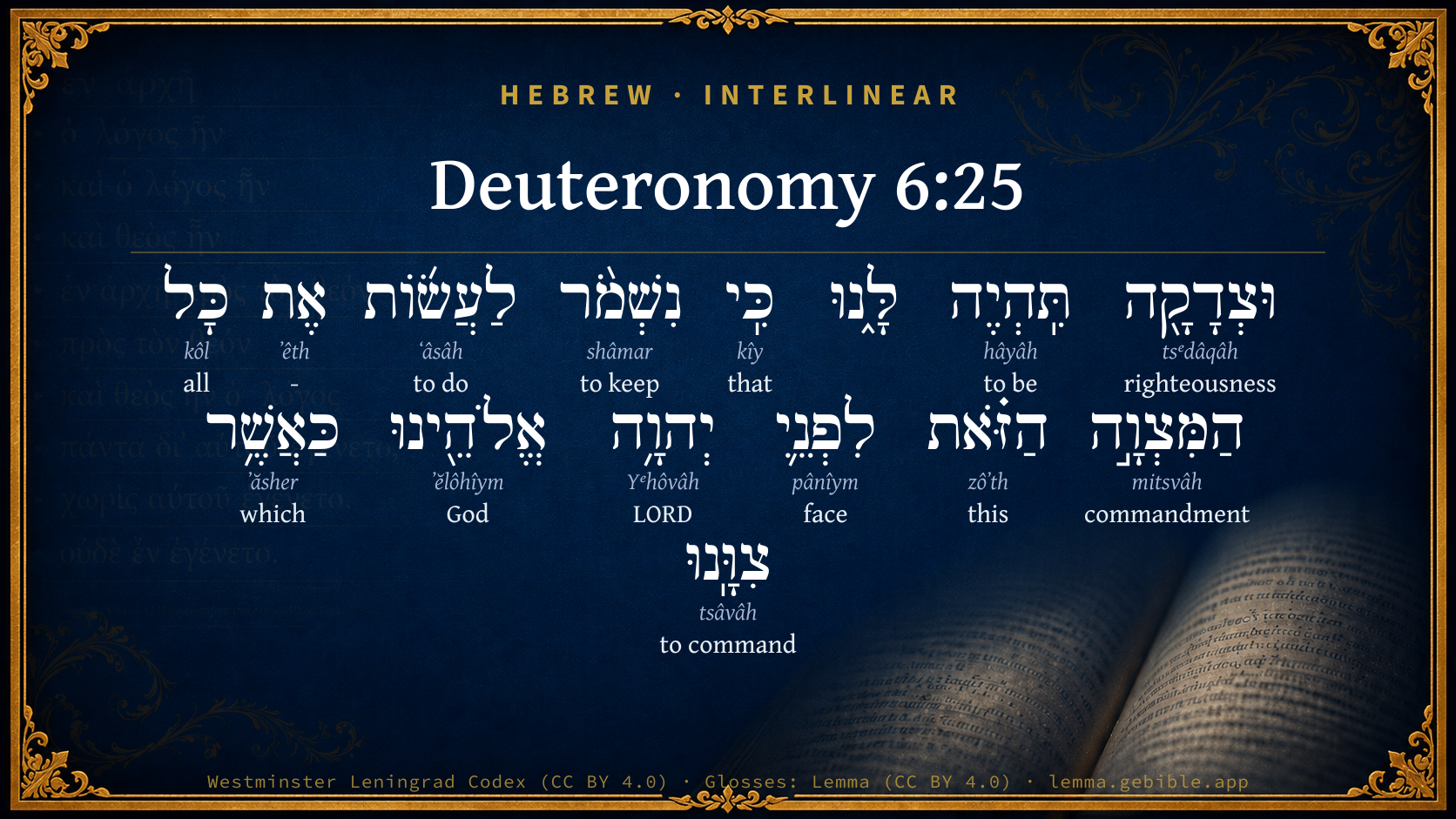
Hebrew (Westminster Leningrad Codex) Deuteronomy 6:25 appears in the Hebrew Old Testament. The text above is from the Westminster Leningrad Codex. Each word links to its Strong’s number, a concise gloss, and parsing drawn from the Open Scriptures Hebrew Bible morphology. Click any word for its full Brown-Driver-Briggs (BDB) entry.
Download image
Cite this verse

Deuteronomy 6:25 (World English Bible). Public Domain. Lemma interlinear Bible study tool, https://lemma.gebible.app/v/deuteronomy/6/25.

Show BibTeX & RIS
BibTeX
RIS
English Translation
It shall be righteousness to us, if we observe to do all this commandment before Yahweh our God, as he has commanded us.
World English Bible · Public Domain
Download a study sheet

One document with this verse’s original text, its word-by-word gloss line, the meaning frame, cross-references with their text, attributed commentary, and full source and license credits — printable, and it pastes into notes with its structure intact.

This verse Autodidact and up

Study sheet (.html) Plain text (.txt)

A passage Seminary Student

Up to 50 verses in one chapter. A passage sheet keeps up to 6 commentary sources and 12 cross-references per verse, in the order this page ranks them, and says so on the sheet whenever that leaves anything out. Ask for a single verse and you get the Autodidact verse sheet above.

Everything on this page stays free to read, with no account — the sheet is a download of what is already on screen, not access to it.

Want to remove ads? Support Godless Engineer
Compare translations 3

The same verse in 3 English versions, stacked beneath the original-language interlinear above. Click any original word for its lexicon entry.

Each is an independent rendering of the whole verse — the interlinear is not word-aligned to these translations.

Highlighted words mark where these versions differ — a whole-verse word diff, not a word-by-word alignment.

  • World English Bible Public Domain
    It shall be righteousness to us, if we observe to do all this commandment before Yahweh our God, as he has commanded us.
  • King James Version Public Domain
    And it shall be our righteousness, if we observe to do all these commandments before the LORD our God, as he hath commanded us.
  • unfoldingWord Literal Text CC BY-SA 4.0
    And it will be righteousness to us, if we keep doing all these commandments to the face of Yahweh our God, as he has commanded us.’

unfoldingWord Literal Text — © unfoldingWord, licensed CC BY-SA 4.0. Word-aligned USFM3 via Door43 (git.door43.org/unfoldingWord/en_ult).

Versions to compare (up to 4)

3 of 4 selected

Show all 18 translations

Every available English version of this verse, each an independent rendering of the whole verse.

  • World English Bible Public Domain
    It shall be righteousness to us, if we observe to do all this commandment before Yahweh our God, as he has commanded us.
  • Berean Standard Bible Public Domain
    And if we are careful to observe every one of these commandments before the LORD our God, as He has commanded us, then that will be our righteousness.”
  • Majority Standard Bible Public Domain
    And if we are careful to observe every one of these commandments before the LORD our God, as He has commanded us, then that will be our righteousness.”
  • King James Version Public Domain
    And it shall be our righteousness, if we observe to do all these commandments before the LORD our God, as he hath commanded us.
  • American Standard Version (1901) Public Domain
    And it shall be righteousness unto us, if we observe to do all this commandment before Jehovah our God, as he hath commanded us.
  • Revised Version (1885) Public Domain
    And it shall be righteousness unto us, if we observe to do all this commandment before the LORD our God, as he hath commanded us.
  • Geneva Bible (1599) Public Domain
    Moreouer, this shall be our righteousnes before the Lord our God, if we take heede to keepe all these commandements, as he hath commanded vs.
  • Douay-Rheims (1899) Public Domain
    And he will be merciful to us, if we keep and do all his precepts before the Lord our God, as he hath commanded us.
  • Young's Literal Translation Public Domain
    and righteousness it is for us, when we observe to do all this command before Jehovah our God, as He hath commanded us.
  • Literal Standard Version CC BY-SA 4.0
    and it is righteousness for us when we observe to do all this command before our God YHWH, as He has commanded us.”
  • Unlocked Literal Bible CC BY-SA 4.0
    If we keep all these commands before Yahweh our God, as he has commanded us, this will be our righteousness.'
  • unfoldingWord Literal Text CC BY-SA 4.0
    And it will be righteousness to us, if we keep doing all these commandments to the face of Yahweh our God, as he has commanded us.’
  • Darby Bible Public Domain
    And it shall be our righteousness if we take heed to do all these commandments before Jehovah our God, as he hath commanded us.
  • World Messianic Bible Public Domain
    It shall be righteousness to us, if we observe to do all these commandments before the LORD our God, as he has commanded us.”
  • Webster's Bible Public Domain
    And it shall be our righteousness, if we observe to do all these commandments before the LORD our God, as he hath commanded us.
  • Free Bible Version CC BY-SA 4.0
    And if we carefully observe each of these commandments as we live in the presence of the Lord, as he instructed us, then we will be right with him.”
  • Bible in Basic English Public Domain
    And it will be our righteousness if we take care to keep all this order before the Lord our God as he has given it to us.
  • JPS Tanakh (1917) Public Domain
    And it shall be righteousness unto us, if we observe to do all this commandment before the LORD our God, as He hath commanded us.'

Literal Standard Version (2020), Covenant Press — licensed CC BY-SA 4.0. Text via the HelloAO Bible API (eBible.org). Unlocked Literal Bible (unfoldingWord) — licensed CC BY-SA 4.0. Text via the HelloAO Bible API (eBible.org). unfoldingWord Literal Text — © unfoldingWord, licensed CC BY-SA 4.0. Word-aligned USFM3 via Door43 (git.door43.org/unfoldingWord/en_ult). Free Bible Version, Dr. Jonathan Gallagher — licensed CC BY-SA 4.0. Text via the HelloAO Bible API (eBible.org).

Word by word

More ways to search: Search by grammar → Find every occurrence → Compare this word →

Practice this passage: Drill this verse → Learn its vocabulary →

וּצְדָקָ֖ה
tsᵉdâqâh
H6666
“and · righteousness”
Conjunction + Noun, Common, Feminine, Singular, Absolute
Part of Speech
Conjunction + Noun
Type
Common
Gender
Feminine
Number
Singular
State
Absolute
Full BDB Definition

Origin: from H6663

TWOT: 1879b

justice, righteousness - righteousness (in government) - of judge, ruler, king - of law - of Davidic king Messiah - righteousness (of God's attribute) - righteousness (in a case or cause) - righteousness, truthfulness - righteousness (as ethically right) - righteousness (as vindicated), justification, salvation - of God - prosperity (of people) - righteous acts
  1. תִּֽהְיֶה hâyâh H1961 “to be” Verb, Qal, Imperfect, 3rd Person, Feminine, Singular
  2. כִּֽי kîy H3588 “that” Conjunction
  3. נִשְׁמֹ֨ר shâmar H8104 “to keep” Verb, Qal, Imperfect, 1st Person, Common, Plural
  4. לַעֲשׂ֜וֹת ʻâsâh H6213 “to do” Preposition + Verb, Qal, Infinitive Construct
  5. אֶת ʼêth H853 “-” Particle, Direct Object
  6. כָּל kôl H3605 “all of” Noun, Common, Masculine, Singular, Construct
  7. הַמִּצְוָ֣ה mitsvâh H4687 “the · commandment” Particle, Definite Article + Noun, Common, Feminine, Singular, Absolute
  8. הַזֹּ֗את zôʼth H2063 “the · this” Particle, Definite Article + Pronoun, Demonstrative, Feminine, Singular
  9. לִפְנֵ֛י pânîym H6440 “to/for · face(s) of” Preposition + Noun, Common, Both, Plural, Construct
  10. יְהוָ֥ה Yᵉhôvâh H3068 “LORD” Noun, Proper
  11. אֱלֹהֵ֖ינוּ ʼĕlôhîym H430 “God(s) · our” Noun, Common, Masculine, Plural, Construct + Suffix, Personal, 1st Person, Common, Plural
  12. כַּאֲשֶׁ֥ר ʼăsher H834 “like/as · which” Preposition + Particle, Relative
  13. צִוָּֽנוּ tsâvâh H6680 “to command · us” Verb, Piel, Perfect, 3rd Person, Masculine, Singular + Suffix, Personal, 1st Person, Common, Plural

About this verse

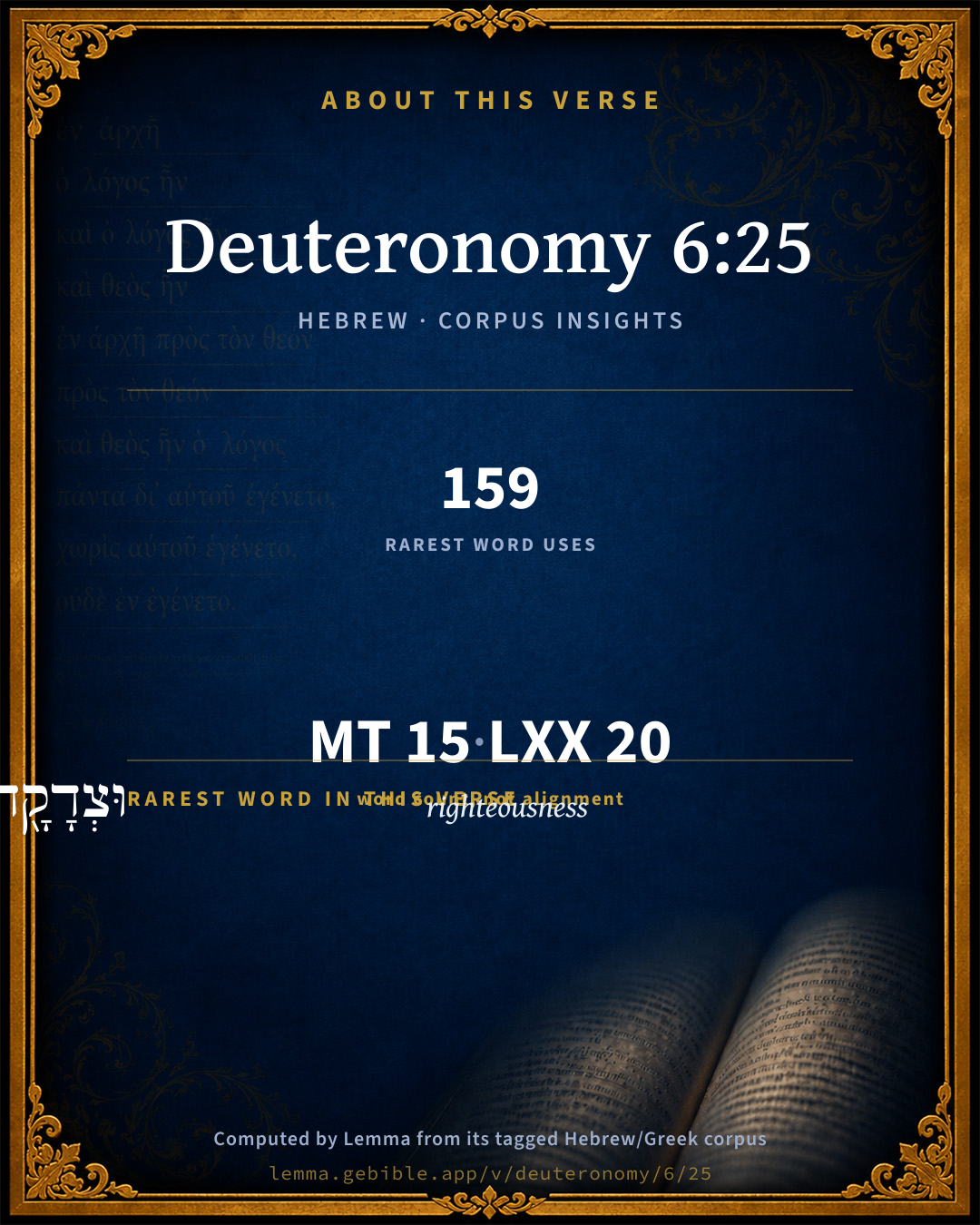
These counts appear in no published source. They are computed here, from the morphology-tagged text and Lemma’s own curated glosses. What Lemma adds →

15
words
14
distinct lemmas
Pentateuch
section

Grammatical profile

  • 4 verbs
  • 6 nouns
  • 1 pronoun
  • 1 preposition
  • 1 conjunction
  • 2 particles

Verb forms

  • תִּֽהְיֶה Qal · Imperfect
  • נִשְׁמֹ֨ר Qal · Imperfect
  • לַעֲשׂ֜וֹת Qal · Infinitive Construct
  • צִוָּֽנוּ Piel · Perfect

Hebrew & Septuagint length

In English translation the verse runs 23 words from the Hebrew and 26 from the Septuagint (LXX English) — closely comparable.

A rough comparison of the two English renderings, which tokenize alike — not a word-level alignment.

Word counts can differ between the Hebrew and the Greek without any difference in meaning — e.g. the Hebrew direct-object marker אֵת has no separate Greek word, and Greek often adds the article ὁ.

In the original languages it is 15 Hebrew tokens and 20 Greek tokens — but the two are counted differently (Hebrew bundles its prefixes and suffixes into one token; the Greek is in lemma form), so that isn’t a like-for-like length.

Cross-references

11

Topical passages linked to Deuteronomy 6:25 in the Treasury of Scripture Knowledge — connected by theme and wording, ordered by reader-vote popularity; previews shown in the World English Bible.

  • Deuteronomy 24:13 you shall surely restore to him the pledge when the sun goes down, that he may sleep in his garment, and bless you: and it shall be righteousness to you before Yahweh your God.
  • Romans 10:3 For being ignorant of God's righteousness, and seeking to establish their own righteousness, they didn't subject themselves to the righteousness of God.
  • Psalms 106:30–31 Then Phinehas stood up, and executed judgment, So the plague was stopped.
  • Psalms 119:6 Then I wouldn't be disappointed, When I consider all of your commandments.
  • Proverbs 12:28 In the way of righteousness is life; In its path there is no death.
  • Luke 10:28–29 He said to him, "You have answered correctly. Do this, and you will live."
  • Romans 10:5–6 For Moses writes about the righteousness of the law, "The one who does them will live by them."
  • James 2:10 For whoever shall keep the whole law, and yet stumble in one point, he has become guilty of all.
  • Leviticus 18:5 You shall therefore keep my statutes and my ordinances; which if a man does, he shall live in them: I am Yahweh.
  • Ezekiel 20:11 I gave them my statutes, and shown them my ordinances, which if a man do, he shall live in them.
  • Galatians 3:12 The law is not of faith, but, "The man who does them will live by them."

Cross-references courtesy of OpenBible.info (CC BY 4.0).

Hebrew and Greek witnesses Masoretic Hebrew ↔ Greek Septuagint

The same verse in the two great witnesses to the Old Testament, shown verse-for-verse.

These are two independent witnesses, not word-aligned to each other, and the Septuagint is shown in lemma (dictionary) form.

Hebrew Deuteronomy 6:25 Masoretic · Westminster Leningrad Codex

וּצְדָקָ֖ה תִּֽהְיֶה לָּ֑נוּ כִּֽי נִשְׁמֹ֨ר לַעֲשׂ֜וֹת אֶת כָּל הַמִּצְוָ֣ה הַזֹּ֗את לִפְנֵ֛י יְהוָ֥ה אֱלֹהֵ֖ינוּ כַּאֲשֶׁ֥ר צִוָּֽנוּ

It shall be righteousness to us, if we observe to do all this commandment before Yahweh our God, as he has commanded us.

World English Bible · Public Domain

Greek LXX Deuteronomy 6:25 Septuagint · lemma form

καί ἐλεημοσύνη εἰμί ἐγώ ἐάν φυλάσσω ποιέω πᾶς ὁ ἐντολή οὗτος ἐναντίον κύριος ὁ θεός ἐγώ καθά ἐντέλλομαι ἐγώ κύριος

And there shall be mercy to us, if we take heed to keep all these commands before the Lord our God, as he has commanded us.

LXX2012 (modern English Septuagint) · Public Domain

On this verse, Ellicott's Commentary for English Readers discusses the Septuagint’s reading. Read the note in Commentary ↓

Hebrew: Westminster Leningrad Codex (CC BY 4.0). Greek: Septuagint (public domain); English from LXX2012 (modern English Septuagint) (Public Domain). How the Septuagint differs from the Hebrew →

Targum (Aramaic paraphrase)

2

The Targum is the ancient Jewish Aramaic paraphrase of the Hebrew Scriptures — an interpretive translation, not the Hebrew text itself. Onkelos (literal) and Pseudo-Jonathan (expansive) render the Torah, and Jonathan the Prophets. Coverage is partial: where no permissively-licensed English translation exists for a verse, only the Aramaic is shown. This is verse-level text, not a word-by-word alignment to the Hebrew.

  1. Targum Onkelos Torah (Genesis–Deuteronomy)
    וְזָכוּתָא תְּהֵא לָנָא אֲרֵי נִטַר לְמֶעְבַּד יָת כָּל תַּפְקֶדְתָּא הָדָא קֳדָם יְיָ אֱלָהָנָא כְּמָא דִי פַקְדָנָא

    (no public-domain English translation for this verse)

    Targum Onkelos — Aramaic: “Onkelos Genesis” (public domain); “Onkelos Exodus” (public domain); “Onkelos Leviticus” (public domain); “Onkelos Numbers” (public domain); “Onkelos Deuteronomy” (public domain). English: “Sefaria Community Translation” (CC0 1.0 (public-domain dedication)); “J.W. Etheridge. The Targums of Onkelos and Jonathan Ben Uzziel on the Pentateuch. London: Longmans, Green, 1862” (public domain). Text via Sefaria.

  2. Targum Pseudo-Jonathan Torah (Genesis–Deuteronomy)
    וּזְכוּ יְהֵא נְטִיר לָנָא לְעַלְמָא דְאָתֵי אֲרוּם נִנְטוֹר לְמֶעֱבַד יַת כָּל תַּפְקֵידְתָּא הָדָא קֳדָם יְיָ אֱלָהָנָא הֵיכְמָא דְפַקֵדְנָא

    and (the reward of) righteousness will be reserved for us in the world to come, if we keep all these commandments to perform them before the Lord our God, as He hath commanded us.

    Targum Pseudo-Jonathan — Aramaic: “Targum Jonathan on Genesis” (public domain); “Targum Jonathan on Exodus” (public domain); “Targum Jonathan on Leviticus” (public domain); “Targum Jonathan on Numbers” (public domain); “Targum Jonathan on Deuteronomy” (public domain). English: “The Targum of Jonathan ben Uzziel, trans. J. W. Etheridge, London, 1862” (public domain). Text via Sefaria.

Commentary

Notes on Deuteronomy 6:25 from classic Christian and Jewish commentators (each source and its license shown beneath its notes). The classic Christian expositions comment on the surrounding passage and are grouped to its opening verse, so a note may address several verses; the Jewish commentaries on the Tanakh (Rashi and others) are per-verse, so they appear only where the commentator wrote on this verse.

Lemma curates 59 commentaries, every one of them public domain or Creative Commons licensed, each selected and text-cleaned for this edition rather than reprinted as found. About our sources →

Joseph Benson's Commentary

Deu 6:25. It shall be our righteousness — Hebrew, Righteousness shall be to us. We shall be owned, and pronounced by God to be righteous and holy persons, if we sincerely obey him; otherwise we shall be declared to be unrighteous and ungodly. Or, mercy shall be to us, or with us. For as the Hebrew word rendered righteousness is very often put for mercy, (as Psa 24:5; Psa 36:10; Psa 51:14; Pro 10:2; Pro 11:4; Dan 9:16,) so this sense seems best to agree both with the Scripture use of this phrase, (in which righteousness seldom or never, but grace or mercy frequently, is said to be to us, or with us,) and with the foregoing verse and argument. God, saith he, (Deu 6:24,) commanded these things for our good, that he might preserve us alive, as it is this day. And, adds he in this verse, this is not all; for as he hath done us good, so he will go on to do us more and more good, and God’s mercy shall be to us, or with us, in the remainder of our lives, and for ever, if we observe these commandments. “Our sincere obedience,” says Henry, (including in the term, repentance, faith, and love, with all other graces,) “shall be accepted through a Mediator, to denominate us, as Noah was, righteous before God, Gen 7:1; Luk 1:6; and 1Jn 3:7. The Chaldee reads it, There shall be a reward to us if we observe to do these commandments.”

Joseph Benson's Commentary on the Old and New Testaments (1811–1818) — public domain. Text from a community e-Sword module.

Tyndale Open Study Notes

Tyndale Open Resources

6:25 righteous when we obey: Obedience shows that one is already in a state of righteousness, a standing before God obtained by faith (see 24:13; Hab 2:4; Rom 1:17; 4:1-5; Gal 3:6-7; see also Gen 15:6; Eph 2:8-9). When other nations observed Israel’s commitment to the covenant, they could rightly conclude that Israel was righteous.

Tyndale Open Study Notes — © Tyndale Open Resources, licensed CC BY-SA 4.0. Text via the HelloAO Bible API.

Geneva Bible (1599)

Geneva Bible translators

But because none could fully obey the law, we must have our recourse to Christ to be justified by faith.

Geneva Bible (1599) marginal notes — public domain. Text via Bolls.life.

Adam Clarke's Commentary

Verse 25. It shall be our righteousness] The evidence that we are under the influence of the fear and love of God. Moses does not say that this righteousness could be wrought without the influence of God's mercy, nor does he say that they should purchase heaven by it: but, God required them to be conformed to his will in all things, that they might be holy in heart, and righteous in every part of their moral conduct.

1. ON a very important subject in this chapter, it may be necessary to make some farther observations.

A most injurious and destructive maxim has lately been advanced by a few individuals, which it is to be hoped is disowned by the class of Christians to which they belong, though the authors affect to be thought Christians, and rational ones, too; the sum of the maxim is this: "Children ought not to be taught religion for fear of having their minds biased to some particular creed, but they should be left to themselves till they are capable of making a choice, and choose to make one." This maxim is in flat opposition to the command of God, and those who teach it show how little they are affected by the religion they profess. If they felt it to be good for any thing, they would certainly wish their children to possess it; but they do not teach religion to their children, because they feel it to be of no use to themselves. Now the Christian religion properly applied saves the soul, and fills the heart with love to God and man; for the love of God is shed abroad in the heart of a genuine believer, by the Holy Ghost given to him. These persons have no such love, because they have not the religion that inspires it; and the spurious religion which admits of the maxim above mentioned, is not the religion of God, and consequently better untaught than taught. But what can be said to those parents who, possessing a better faith, equally neglect the instruction of their children in the things of God! They are highly criminal; and if their children perish through neglect, which is very probable, what a dreadful account must they give in the great day! PARENTS! hear what the Lord saith unto you: Ye shall diligently teach your children that there is one Lord, Jehovah, Elohim; the Father, the Son, and the Holy Ghost: and that they must love him with all their heart, with all their soul, and with all their might. And as children are heedless, apt to forget, liable to be carried away by sensible things, repeat and re-repeat the instruction, and add line upon line, precept upon precept, here a little and there a little, carefully studying time, place, and circumstances, that your labour be not in vain: show it in its amiableness, excite attention by exciting interest; show how good, how useful, how blessed, how ennobling, how glorious it is. Whet these things on their hearts till the keenest edge is raised on the strongest desire, till they can say, "Whom have I in heaven but thee? and there is none upon earth I desire besides thee!"

See Clarke on De 4:9, and "Ge 18:32", and See Clarke on Ge 19:38 at the end.

2. Without offence to any, I hope, a few words more may be said on the nature of an oath, in addition to the note, See Clarke on De 6:13. The matter is important, and perhaps not well understood by many.

The making an appeal to the Supreme Being, and calling him to witness and record, constitutes the spirit and essence of an oath. It is no matter in what form this appeal is made, whether by putting the hand under the thigh, as among the patriarchs; by the water of the Ganges, as among the Hindoos; on a surat or chapter of the Koran, as among the Mohammedans; on a Hebrew Pentateuch, as among the Jews; on the form of the cross, as among the Roman Catholics; kissing the New Testament, as among Protestants in general; or holding up the hand, and making affirmation, as among the people called Quakers; still the oath is the same, for the appeal is made to God. On this ground (and this is the true ground), the holding up of the hand in a court of justice, is as perfect, as substantial, and as formal an oath, as kissing the New Testament. Why then so many objections against taking an oath in a court of justice by any one particular form, when the same thing is done in spirit, essence, and substance, when God is called to witness and record, though the form be different? When God says, Thou shalt fear the Lord thy God, and shalt swear by his name, he says, in effect, Thou shalt have no god besides me; thou shalt consider me the fountain of truth, the rewarder of righteousness, and the punisher of perfidy and wickedness. Swear by my name - bind thyself to me; take me for witness to all thy actions; and act in all things as having me continually before thine eyes, and knowing that for every act and word thou shalt give account to me in the day of judgment. Our Lord's command, Swear not at all, can never relate to an oath in a civil cause, taken according to the definition above given: profane and common swearing, with all light, irreverent oaths and imprecations, and all such oaths as are not required by the civil magistrate, in cases where the Lord is supposed to be witness, are certainly intended in our blessed Lord's prohibition. See Clarke on De 4:26.

Adam Clarke's Commentary on the Bible (1810–1826) — public domain. Text from a community e-Sword/MySword module.

Ellicott's Commentary for English Readers

(25) And it shall be our righteousness.—In one Targum, “It shall be merit to us,” or more fully, in the other, “It shall be merit laid up for us against the world to come.” In the LXX., “It shall be alms to us.” This conjunction of ideas will help to explain why in Mat_6:1 “alms” and “righteousness” occur as alternative readings. We have “alms” in the Authorised Version, “righteousness” in the Revised Version. To this day the Jews call alms ts’dâkah, “righteousness.”

A Bible Commentary for English Readers, edited by Charles John Ellicott (1878–1897) — public domain. Text from a community e-Sword module.

The Cambridge Bible for Schools and Colleges

gen. ed. J. J. S. Perowne

25. it shall be righteousness unto us] The thought of the previous verse shows that righteousness here does not mean goodness, uprightness, but rather justification, vindication, the right to live, and by consequence their life itself. Cf. the post-exilic Isa_61:11, Isa_62:1-2, in which righteousness is parallel to renown, to salvation and to glory. (See the present writer’s Isaiah xl.–lxvi. 217 ff.) Contrast Deu_25:13.

before Jehovah our God] Cp. Deu_24:13, where this phrase (thy God) follows immediately on righteousness unto thee. That may, as some suggest, have been the order here, too, but the transposition is not necessary. ‘To fulfil the commandment before Jehovah means so to fulfil it that He sees it, and that is a speaking feature of legal piety (Neh_5:19; Neh_13:14; Neh_13:22; Neh_13:31)’ (Bertholet).

The Cambridge Bible for Schools and Colleges (gen. ed. J. J. S. Perowne; Cambridge University Press, 1878–1918) — public domain. Text from a community e-Sword module.

John Gill's Exposition

And it shall be our righteousness,.... Or a mercy, benefit, and blessing to us; or this shall be reckoned our righteousness, and that by which we shall be justified:

if we observe to do all these commandments before the Lord our God, as he hath commanded us; in order to have such a justifying righteousness, a man must keep all the commandments of God, not one excepted; and that perfectly, without the least breach of them in thought, word, or deed; and that before the Lord, in his sight, not as it may appear to a man himself, or to others, but as it appears to God, who sees the heart, and weighs all actions; and a man must keep them in the manner the Lord has commanded, even with all his heart, soul, and strength, as in Deu 6:5 and this is not possible for a sinful man to do; and therefore righteousness cannot be by the law. Only Christ could thus keep all the commandments of God, and his obedience is our righteousness; and he only is the end of the law for righteousness to everyone that believes, and to him we must seek for it.

Next: Deuteronomy Chapter 7

John Gill's Exposition of the Whole Bible (1746–1763) — public domain (CC PDM 1.0). Text via the HelloAO Bible API.

Haydock's Catholic Bible Commentary

Merciful. Hebrew, "he will justify us." Chaldean, "reward us." Justice often denotes the mercy which God shews to his people, and the punishment which he inflicts upon their enemies. (Calmet) (Matthew vi. 1.) --- Past, present, and future benefits concur to make the Hebrews observe the commandments. God had rescued them from slavery; (ver. 21,) he had already given them great possessions, and would grant them still more if they would be faithful; as on the other hand, all will be lost if they prove rebellious, ver. 15. (Haydock)

George Leo Haydock (1774–1849), Haydock's Catholic Family Bible and Commentary, 1859 edition — public domain. Excludes Psalms (Douay-Rheims chapter numbering differs from Protestant) and Deuterocanonical books (Catholic canon only).

Matthew Poole's English Annotations

Heb. righteousness shall be to us. and pronounced by God to be truly righteous and holy persons, if we sincerely obey him, otherwise we shall be declared to be unrighteous and ungodly persons, and all our profession of religion will appear to be in hypocrisy. Or, mercy shall be to us, or with us. For as the Hebrew word rendered righteousness is very oft put for mercy, as Psa 24:5; 36:10; 51:14; Pro 10:2; 11:4; Dan 9:16, &c.; so this sense seems best to agree both with the Scripture use of this phrase, in which righteousness, seldom or never, to my remembrance, but grace or mercy frequently, is said to be to us or with us, as 2Sa 15:20; Psa 89:24; Pro 14:22; Gal 6:16; 2Jo 1:3; and with the foregoing verse and argument, God, saith he, Deu 6:24, commanded these things for our good, that he might preserve us alive, as it is this day. And, saith he in this verse, this is not all; for as he hath done us good, so he will go on to do us more and more good, and God’s mercy shall be to us, or with us, in the remainder of our lives, and for ever,

if we observe, & c.

Matthew Poole's English Annotations on the Holy Bible (1683–1685) — public domain. Text from a community e-Sword/MySword module.

Whedon's Commentary on the Bible

Daniel D. Whedon

25. It shall be our righteousness — “Righteousness will be to us” is the literal rendering. If we keep the commands of God we shall be deemed righteous, is undoubtedly the meaning of the expression. “This righteousness before Jehovah is not indeed the gospel righteousness of faith; but there is no opposition between the two, as that which is here spoken of is not founded on the outward righteousness of works, but upon an earnest striving after the fulfilment of the law to love God with all the heart; and this love is impossible without living faith.” — Keil.

Daniel D. Whedon (gen. ed.), Commentary on the Old and New Testaments (1874–1909) — public domain. Text from a community e-Sword module.

The Pulpit Commentary

And it shall be our righteousness; literally, And righteousness shall be to us, i.e. we shall be held righteous by God if we observe to do all that he has enjoined. (comp. Rom_10:5 Rom_6:16; Php_3:6) Before the Lord, i.e. not only in his sight, but according to his judgment, so as to be approved of him. (cf. Psa_56:13 Psa_116:9)

Our righteousness.

As contrasted with Pauline sayings, the text is an illustration of the maxim, "On the outside of things look for differences, on the inside for likenesses" (Hare). The form is that of the Law, the spirit is that of Christ, whose gospel is the key to the Law"s utterances.

I A REQUIREMENT WHICH ONE ONLY, VIZ. CHRIST, HAS PERFECTLY FULFILLED. "This is the name whereby he shall be called, the Lord our Righteousness". (Jer_23:6) He "is the end of the Law for righteousness to every one that believeth". (Rom_10:4) How? In the strictly legal, as in the strict ideal sense, righteousness requires an absolutely perfect fulfillment of every one of God"s commandments. The Jewish covenant required no less. The Jews were to live in their righteousness, i.e. in perfect keeping of the whole Law. But in point of fact, no Jew ever rendered perfect obedience. In many things, like others, he offended, and the covenant footing was only maintained through daily pardon of daily offences. Christ is our Redeemer from the curse thus entailed by transgression. (Gal_3:13) As the Lord"s righteous Servant, and Fulfiller of the Law, he has implemented the condition of acceptance in such a way that his obedience carries with it results to others as well as to himself. (Rom_5:17-21) In him the believer is justified. He claims him as the Lord his Righteousness. Christ has for him at once fulfilled the Law"s precept, and abolished its penalty. Sinful in himself, in Christ his sins are covered, and justification is obtained. (Rom_3:22-27 Rom_8:1-4; 1Co_1:30; 2Co_5:21)

II A REQUIREMENT WHICH BELIEVERS IS CHRIST ARE ENABLED TO FULFILL, THOUGH IMPERFECTLY, YET ACCEPTABLY. The utmost that the Jew could render was that imperfect but sincere obedience which is still the mark of the true believer. The believer"s duty is to render a perfect obedience; his privilege is that, falling short of this, his sincere though faulty obedience will be graciously accepted for the sake of Christ. In harmony with his calling, it was to be the Jew"s aim to realize the righteousness which the Law set before him. But in his inability to do this the weakness of the Law revealed itself, and in contrast with this weakness (Rom_8:3) is the power of the gospel, enabling the believer to triumph, and to bring forth fruit unto holiness, the end of which is everlasting life. (Rom_6:22) This also is a "righteousness of faith," as springing from faith, and rendered possible through it. It is his righteousness, yet in a deeper sense not his, but Christ"s, for it is the work of Christ living in him. (Gal_2:20) It is not the ground of acceptance, but a result of it; not a title to heaven, but meetness for it. It is itself a gift of grace, part of Christ"s salvation. J.O. (Mat_5:6; Eph_5:9, Eph_5:10; Php_2:12, 13; 1Pe_2:24; 1Jn_3:7-10; with Ro 6 Ro 7 Ro 8)

The Pulpit Commentary (1880–1919), ed. H.D.M. Spence-Jones & Joseph S. Exell — public domain. Text from a community e-Sword module.

John Wesley's Explanatory Notes

It shall be our righteousness - Hebrew. Righteousness shall be to us. We shall be owned and pronounced by God to be righteous and holy persons, if we sincerely obey him, otherwise we shall be declared to be unrighteous and ungodly. Or, mercy shall be to us, or with us. For as the Hebrew word rendered righteousness is very often put for mercy, (as Psalm xxiv, 5; xxxvi, 10; li, 14 Prov. x, 2; xi, 4 Dan. ix, 16) so this sense seems best to agree both with the scripture use of this phrase, (in which righteousness, seldom or never, but grace or mercy frequently, is said to be to us or with us) and with the foregoing verse and argument God, saith he, chap. v, 24, commanded these things for our good, that he might preserve us alive, as it is this day. And, saith he in this verse, this is not all; for as he hath done us good, so he will go on to do us more and more good, and God's mercy shall be to us, or with us, in the remainder of our lives, and forever, if we observe these commandments.

John Wesley, Explanatory Notes Upon the Whole Bible (1754–1765) — public domain. Text via the GEBible commentary corpus.

Keil & Delitzsch

C. F. Keil & F. Delitzsch

"And righteousness will be to us, if we observe to do:" i.e., our righteousness will consist in the observance of the law; we shall be regarded and treated by God as righteous, if we are diligent in the observance of the law. "Before Jehovah" refers primarily, no doubt, to the expression, "to do all these commandments;" but, as we may see from Deu 24:13, this does not prevent the further reference to the "righteousness" also. This righteousness before Jehovah, it is true, is not really the gospel "righteousness of faith;" but there is no opposition between the two, as the righteousness mentioned here is not founded upon the outward (pharisaic) righteousness of works, but upon an earnest striving after the fulfilment of the law, to love God with all the heart; and this love is altogether impossible without living faith.

Keil & Delitzsch — Biblical Commentary on the Old Testament (1861–1891) — public domain (CC PDM 1.0). Text via the HelloAO Bible API. (Old Testament only.)

Lesson kit

Teaching starters — assembled from the data on this page, not authored interpretation. Every prompt links to the verse data it draws on. Edit before teaching.

Deuteronomy, in the Pentateuch, opens this verse with 15 words (14 distinct Hebrew lemmas). Its most distinctive word is tsᵉdâqâh (“righteousness”). A historical commentator’s framing appears above. Read the whole chapter for the surrounding context.

Discussion questions

  1. How does “righteousness” (tsᵉdâqâh) shape what this verse is saying?
  2. Deuteronomy 24:13 shares this passage’s theme. How do the two illuminate each other?
  3. The translations on this page render this verse differently — a whole-verse word diff, not a word-by-word alignment. What might account for the different wordings?
  4. The verb «תִּֽהְיֶה» is Qal Imperfect. How does its form color the action?
  5. Reading how Joseph Benson's Commentary and Tyndale Open Study Notes read this verse, where do the two commentators agree and where do they part?

Things to notice

Reading settings

Reading text

Shown beneath each verse's original-language words.

Old Testament
Old Testament edition

Read the OT as the Masoretic Hebrew (MT) or the Greek Septuagint (LXX).

English shown for the Greek Septuagint (in the Hebrew ↔ Greek comparison).

Comparing translations? Open the Compare panel on any verse page to stack up to four side by side.