
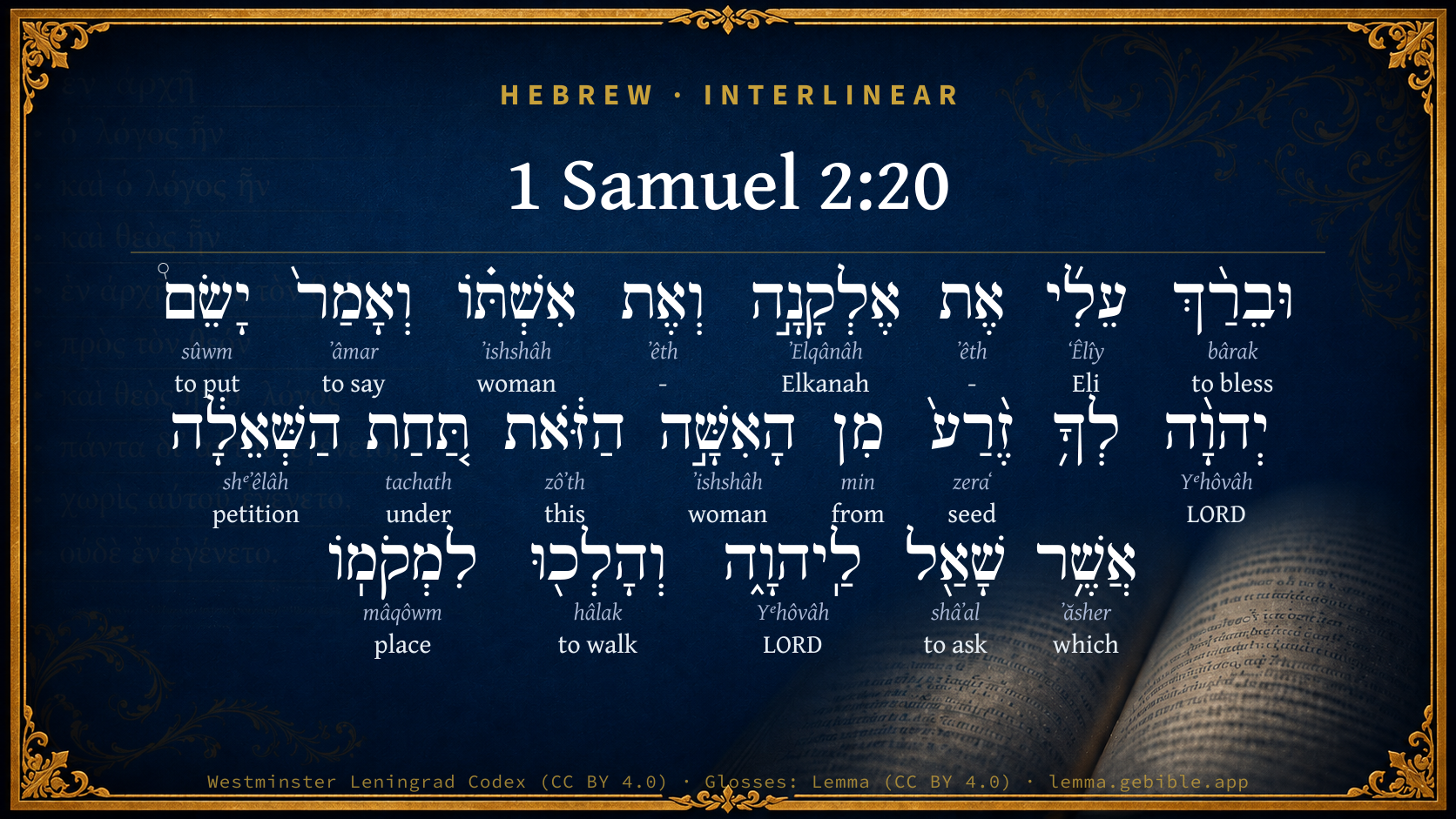
1 Samuel 2:20

Hebrew (Westminster Leningrad Codex) 1 Samuel 2:20 appears in the Hebrew Old Testament. The text above is from the Westminster Leningrad Codex. Each word links to its Strong’s number, a concise gloss, and parsing drawn from the Open Scriptures Hebrew Bible morphology. Click any word for its full Brown-Driver-Briggs (BDB) entry.
Download image
Cite this verse

1 Samuel 2:20 (World English Bible). Public Domain. Lemma interlinear Bible study tool, https://lemma.gebible.app/v/1-samuel/2/20.

Show BibTeX & RIS
BibTeX
RIS
English Translation
Eli blessed Elkanah and his wife, and said, Yahweh give you seed of this woman for the petition which was asked of Yahweh. They went to their own home.
World English Bible · Public Domain
Download a study sheet

One document with this verse’s original text, its word-by-word gloss line, the meaning frame, cross-references with their text, attributed commentary, and full source and license credits — printable, and it pastes into notes with its structure intact.

This verse Autodidact and up

Study sheet (.html) Plain text (.txt)

A passage Seminary Student

Up to 50 verses in one chapter. A passage sheet keeps up to 6 commentary sources and 12 cross-references per verse, in the order this page ranks them, and says so on the sheet whenever that leaves anything out. Ask for a single verse and you get the Autodidact verse sheet above.

Everything on this page stays free to read, with no account — the sheet is a download of what is already on screen, not access to it.

Want to remove ads? Support Godless Engineer
Compare translations 3

The same verse in 3 English versions, stacked beneath the original-language interlinear above. Click any original word for its lexicon entry.

Each is an independent rendering of the whole verse — the interlinear is not word-aligned to these translations.

Highlighted words mark where these versions differ — a whole-verse word diff, not a word-by-word alignment.

  • World English Bible Public Domain
    Eli blessed Elkanah and his wife, and said, Yahweh give you seed of this woman for the petition which was asked of Yahweh. They went to their own home.
  • King James Version Public Domain
    And Eli blessed Elkanah and his wife, and said, The LORD give thee seed of this woman for the loan which is lent to the LORD. And they went unto their own home.
  • unfoldingWord Literal Text CC BY-SA 4.0
    And Eli would bless Elkanah and his wife and would say, “May Yahweh give seed to you from this woman in place of the request that one requested of Yahweh.” And they would go to his place.

unfoldingWord Literal Text — © unfoldingWord, licensed CC BY-SA 4.0. Word-aligned USFM3 via Door43 (git.door43.org/unfoldingWord/en_ult).

Versions to compare (up to 4)

3 of 4 selected

Show all 18 translations

Every available English version of this verse, each an independent rendering of the whole verse.

  • World English Bible Public Domain
    Eli blessed Elkanah and his wife, and said, Yahweh give you seed of this woman for the petition which was asked of Yahweh. They went to their own home.
  • Berean Standard Bible Public Domain
    And Eli would bless Elkanah and his wife, saying, “May the LORD give you children by this woman in place of the one she dedicated to the LORD.” Then they would go home.
  • Majority Standard Bible Public Domain
    And Eli would bless Elkanah and his wife, saying, “May the LORD give you children by this woman in place of the one she dedicated to the LORD.” Then they would go home.
  • King James Version Public Domain
    And Eli blessed Elkanah and his wife, and said, The LORD give thee seed of this woman for the loan which is lent to the LORD. And they went unto their own home.
  • American Standard Version (1901) Public Domain
    And Eli blessed Elkanah and his wife, and said, Jehovah give thee seed of this woman for the petition which was asked of Jehovah. And they went unto their own home.
  • Revised Version (1885) Public Domain
    And Eli blessed Elkanah and his wife, and said, The LORD give thee seed of this woman for the loan which was lent to the LORD. And they went unto their own home.
  • Geneva Bible (1599) Public Domain
    And Eli blessed Elkanah and his wife, and said, The Lord giue thee seede of this woman, for the petition that she asked of the Lord: and they departed vnto their place.
  • Douay-Rheims (1899) Public Domain
    And Heli blessed Elcana and his wife: and he said to him: The Lord give thee seed of this woman, for the loan thou hast lent to the Lord. And they went to their own home.
  • Young's Literal Translation Public Domain
    And Eli blessed Elkanah, and his wife, and said, `Jehovah doth appoint for thee seed of this woman, for the petition which she asked for Jehovah;' and they have gone to their place.
  • Literal Standard Version CC BY-SA 4.0
    And Eli blessed Elkanah and his wife, and said, “YHWH appoints seed of this woman for you, for the petition which she asked for YHWH”; and they have gone to their place.
  • Unlocked Literal Bible CC BY-SA 4.0
    Eli would bless Elkanah and his wife and say, “May Yahweh give you more children by this woman because of the request she made of Yahweh.” Then they would return to their own home.
  • unfoldingWord Literal Text CC BY-SA 4.0
    And Eli would bless Elkanah and his wife and would say, “May Yahweh give seed to you from this woman in place of the request that one requested of Yahweh.” And they would go to his place.
  • Darby Bible Public Domain
    And Eli blessed Elkanah and his wife, and said, Jehovah give thee seed of this woman for the loan which is lent to Jehovah. And they went to their own home.
  • World Messianic Bible Public Domain
    Eli blessed Elkanah and his wife, and said, “May the LORD give you offspring from this woman for the petition which was asked of the LORD.” Then they went to their own home.
  • Webster's Bible Public Domain
    And Eli blessed Elkanah and his wife, and said, The LORD give thee issue of this woman for the loan which is lent to the LORD. And they went to their own home.
  • Free Bible Version CC BY-SA 4.0
    Eli would bless Elkanah and his wife, saying, “May the Lord give you children by this woman to replace the one she prayed for and dedicated to the Lord.” Then they would return home.
  • Bible in Basic English Public Domain
    And every year Eli gave Elkanah and his wife a blessing, saying, May the Lord give you offspring by this woman in exchange for the child you have given to the Lord. And they went back to their house.
  • JPS Tanakh (1917) Public Domain
    And Eli would bless Elkanah and his wife, and say: 'The LORD give thee seed of this woman for the loan which was lent to the LORD.' And they would go unto their own home.

Literal Standard Version (2020), Covenant Press — licensed CC BY-SA 4.0. Text via the HelloAO Bible API (eBible.org). Unlocked Literal Bible (unfoldingWord) — licensed CC BY-SA 4.0. Text via the HelloAO Bible API (eBible.org). unfoldingWord Literal Text — © unfoldingWord, licensed CC BY-SA 4.0. Word-aligned USFM3 via Door43 (git.door43.org/unfoldingWord/en_ult). Free Bible Version, Dr. Jonathan Gallagher — licensed CC BY-SA 4.0. Text via the HelloAO Bible API (eBible.org).

Word by word

More ways to search: Search by grammar → Find every occurrence → Compare this word →

Practice this passage: Drill this verse → Learn its vocabulary →

הַשְּׁאֵלָ֔ה
shᵉʼêlâh
H7596
“the · petition”
Particle, Definite Article + Noun, Common, Feminine, Singular, Absolute
Part of Speech
Particle + Noun
Type
Common
Gender
Feminine
Number
Singular
State
Absolute
Full BDB Definition

Origin: from H7592

TWOT: 2303a

request, thing asked for, demand - request, petition - thing asked for
  1. וּבֵרַ֨ךְ bârak H1288 “and · to bless” Conjunction + Verb, Piel, Sequential Perfect, 3rd Person, Masculine, Singular
  2. עֵלִ֜י ʻÊlîy H5941 “Eli” Noun, Proper
  3. אֶת ʼêth H853 “-” Particle, Direct Object
  4. אֶלְקָנָ֣ה ʼElqânâh H511 “Elkanah” Noun, Proper
  5. וְאֶת ʼêth H853 “and · -” Conjunction + Particle, Direct Object
  6. אִשְׁתּ֗וֹ ʼishshâh H802 “woman · his” Noun, Common, Feminine, Singular, Construct + Suffix, Personal, 3rd Person, Masculine, Singular
  7. וְאָמַר֙ ʼâmar H559 “and · to say” Conjunction + Verb, Qal, Sequential Perfect, 3rd Person, Masculine, Singular
  8. יָשֵׂם֩ sûwm H7760 “to put” Verb, Qal, Jussive, 3rd Person, Masculine, Singular
  9. יְהוָ֨ה Yᵉhôvâh H3068 “LORD” Noun, Proper
  10. זֶ֨רַע֙ zeraʻ H2233 “seed” Noun, Common, Masculine, Singular, Absolute
  11. מִן min H4480 “from” Preposition
  12. הָאִשָּׁ֣ה ʼishshâh H802 “the · woman” Particle, Definite Article + Noun, Common, Feminine, Singular, Absolute
  13. הַזֹּ֔את zôʼth H2063 “the · this” Particle, Definite Article + Pronoun, Demonstrative, Feminine, Singular
  14. תַּ֚חַת tachath H8478 “under” Preposition
  15. אֲשֶׁ֥ר ʼăsher H834 “which” Particle, Relative
  16. שָׁאַ֖ל shâʼal H7592 “to ask” Verb, Qal, Perfect, 3rd Person, Masculine, Singular
  17. לַֽיהוָ֑ה Yᵉhôvâh H3068 “to/for · LORD” Preposition + Noun, Proper
  18. וְהָלְכ֖וּ hâlak H1980 “and · to walk” Conjunction + Verb, Qal, Sequential Perfect, 3rd Person, Common, Plural
  19. לִמְקֹמֽוֹ mâqôwm H4725 “to/for · place · his” Preposition + Noun, Common, Masculine, Singular, Construct + Suffix, Personal, 3rd Person, Masculine, Singular

About this verse

These counts appear in no published source. They are computed here, from the morphology-tagged text and Lemma’s own curated glosses. What Lemma adds →

21
words
17
distinct lemmas
Historical
section

Notable vocabulary

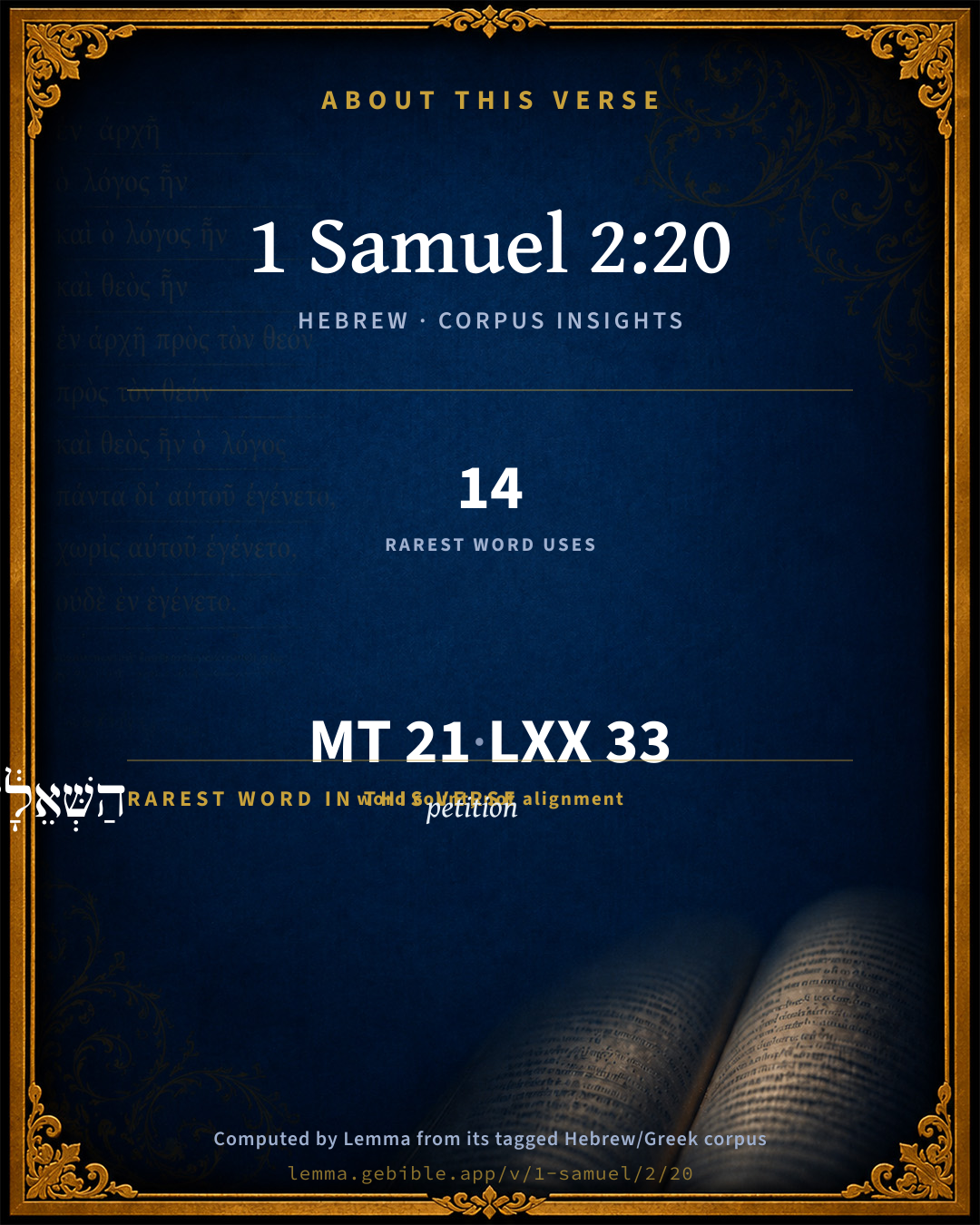
The rarest word here is הַשְּׁאֵלָ֔ה petition H7596 — appearing just 14 times in the whole Hebrew Bible.

Shared distinctive vocabulary

הַשְּׁאֵלָ֔ה petition H7596 occurs in 14 verses of the Hebrew Bible. Also found in:

Grammatical profile

  • 5 verbs
  • 9 nouns
  • 1 pronoun
  • 3 prepositions
  • 3 particles

Verb forms

  • וּבֵרַ֨ךְ Piel · Sequential Perfect
  • וְאָמַר֙ Qal · Sequential Perfect
  • יָשֵׂם֩ Qal · Jussive
  • שָׁאַ֖ל Qal · Perfect
  • וְהָלְכ֖וּ Qal · Sequential Perfect

Repetition

Words recur within this verse — often emphatic in Hebrew:

  • אִשְׁתּ֗וֹ woman H802 ×2
  • יְהוָ֨ה LORD H3068 ×2

Hebrew & Septuagint length

In English translation the verse runs 29 words from the Hebrew and 36 from the Septuagint (LXX English) — closely comparable.

A rough comparison of the two English renderings, which tokenize alike — not a word-level alignment.

Word counts can differ between the Hebrew and the Greek without any difference in meaning — e.g. the Hebrew direct-object marker אֵת has no separate Greek word, and Greek often adds the article ὁ.

In the original languages it is 21 Hebrew tokens and 33 Greek tokens — but the two are counted differently (Hebrew bundles its prefixes and suffixes into one token; the Greek is in lemma form), so that isn’t a like-for-like length.

Cross-references

8

Topical passages linked to 1 Samuel 2:20 in the Treasury of Scripture Knowledge — connected by theme and wording, ordered by reader-vote popularity; previews shown in the World English Bible.

  • 1 Samuel 1:27–28 For this child I prayed; and Yahweh has given me my petition which I asked of him:
  • Luke 2:34 and Simeon blessed them, and said to Mary, his mother, "Behold, this child is set for the falling and the rising of many in Israel, and for a sign which is spoken against.
  • Genesis 14:19 He blessed him, and said, "Blessed be Abram of God Most High, possessor of heaven and earth:
  • Genesis 27:27–29 He came near, and kissed him. He smelled the smell of his clothing, and blessed him, and said, "Behold, the smell of my son Is as the smell of a field which Yahweh has blessed.
  • Numbers 6:23–27 "Speak to Aaron and to his sons, saying, 'This is how you shall bless the children of Israel.' You shall tell them,
  • Ruth 2:12 Yahweh recompense your work, and a full reward be given you of Yahweh, the God of Israel, under whose wings you are come to take refuge.
  • Ruth 4:11 All the people who were in the gate, and the elders, said, We are witnesses. Yahweh make the woman who has come into your house like Rachel and like Leah, which two built the house of Israel: and do you worthily in Ephrathah, and be famous in Bethlehem:
  • 1 Samuel 1:11 She vowed a vow, and said, Yahweh of hosts, if you will indeed look on the affliction of your handmaid, and remember me, and not forget your handmaid, but will give to your handmaid a man-child, then I will give him to Yahweh all the days of his life, and there shall no razor come on his head.

Cross-references courtesy of OpenBible.info (CC BY 4.0).

Hebrew and Greek witnesses Masoretic Hebrew ↔ Greek Septuagint

The same verse in the two great witnesses to the Old Testament, shown verse-for-verse.

These are two independent witnesses, not word-aligned to each other, and the Septuagint is shown in lemma (dictionary) form.

Hebrew 1 Samuel 2:20 Masoretic · Westminster Leningrad Codex

וּבֵרַ֨ךְ עֵלִ֜י אֶת אֶלְקָנָ֣ה וְאֶת אִשְׁתּ֗וֹ וְאָמַר֙ יָשֵׂם֩ יְהוָ֨ה לְךָ֥ זֶ֨רַע֙ מִן הָאִשָּׁ֣ה הַזֹּ֔את תַּ֚חַת הַשְּׁאֵלָ֔ה אֲשֶׁ֥ר שָׁאַ֖ל לַֽיהוָ֑ה וְהָלְכ֖וּ לִמְקֹמֽוֹ

Eli blessed Elkanah and his wife, and said, Yahweh give you seed of this woman for the petition which was asked of Yahweh. They went to their own home.

World English Bible · Public Domain

Greek LXX 1 Samuel 2:20 Septuagint · lemma form

καί εὐλογέω ηλι ὁ ελκανα καί ὁ γυνή αὐτός λέγω ἀποτείνω σύ κύριος σπέρμα ἐκ ὁ γυνή οὗτος ἀντί ὁ χρέους ὅς χράομαι ὁ κύριος καί ἀποἔρχομαι ὁ ἄνθρωπος εἰς ὁ τόπος αὐτός

And Heli blessed Helcana and his wife, saying The Lord recompense to you seed of this woman, in return for the loan which you have lent to the Lord: and the man returned to his place.

LXX2012 (modern English Septuagint) · Public Domain

Hebrew: Westminster Leningrad Codex (CC BY 4.0). Greek: Septuagint (public domain); English from LXX2012 (modern English Septuagint) (Public Domain). How the Septuagint differs from the Hebrew →

Targum (Aramaic paraphrase)

1

The Targum is the ancient Jewish Aramaic paraphrase of the Hebrew Scriptures — an interpretive translation, not the Hebrew text itself. Onkelos (literal) and Pseudo-Jonathan (expansive) render the Torah, and Jonathan the Prophets. Coverage is partial: where no permissively-licensed English translation exists for a verse, only the Aramaic is shown. This is verse-level text, not a word-by-word alignment to the Hebrew.

  1. Targum Jonathan Prophets (Joshua–Malachi)
    וּבָרִיךְ עֵלִי יַת אֶלְקָנָה וְיַת אִתְּתֵיהּ וַאֲמַר יְקַיֵים יְיָ לָךְ בְּנִין כַּשְׁרִין מִן אִתְּתָא הָדָא חֲלַף שְׁאֶלְתָּא דְשָׁאֵל קֳדָם יְיָ וַאֲזַלוּ לְאַתְרֵיהוֹן:

    (no public-domain English translation for this verse)

    Targum Jonathan — Aramaic: “Mikraot Gedolot” (public domain). English: “Sefaria Community Translation” (CC0 1.0 (public-domain dedication)); “London "Chaldee Paraphrase," 1871” (public domain). Text via Sefaria.

Commentary

Notes on 1 Samuel 2:20 from classic Christian and Jewish commentators (each source and its license shown beneath its notes). The classic Christian expositions comment on the surrounding passage and are grouped to its opening verse, so a note may address several verses; the Jewish commentaries on the Tanakh (Rashi and others) are per-verse, so they appear only where the commentator wrote on this verse.

Lemma curates 59 commentaries, every one of them public domain or Creative Commons licensed, each selected and text-cleaned for this edition rather than reprinted as found. About our sources →

Trapp's Complete Commentary

John Trapp

1Sa 2:20 And Eli blessed Elkanah and his wife, and said, The LORD give thee seed of this woman for the loan which is lent to the LORD. And they went unto their own home.

Ver. 20. And Eli blessed Elkanah and his wife.] In the words of God, as being his high priest: and they took it so, and sped accordingly. {1Sa 2:21} Faith is effectual.

For the loan which is lent to the Lord.] This is a periphrasis for Samuel; who being begged of God, was no less the fruit of his parents’ supplications, than of their bodies. The words may be rendered, "For the petition which he asked of the Lord": and these, saith Junius, are not the words of Eli to Elkanah, but of the author concerning Elkanah.

John Trapp, A Commentary or Exposition upon All the Books of the Old and New Testament (1647–1656) — public domain. Text from a community e-Sword module.

Joseph Benson's Commentary

1Sa 2:20-21. Eli blessed Elkanah, &c. — This benediction given in his character of high-priest, and that by a divine suggestion, was followed by the desired effect, and verified what Hannah had uttered in her prophetical song. The Lord visited Hannah — None are losers by what they dedicate to the Lord, or employ in such a manner as is pleasing in his sight. The child Samuel grew — Not only in age and stature, but especially in wisdom and goodness. Before the Lord — Not only before men, who might easily be deceived, but in the presence and judgment of the all-seeing God. This will generally be the case with those children whose parents dedicate them early to the Lord, and endeavour to instil into their minds the true and genuine principles of piety and virtue.

Joseph Benson's Commentary on the Old and New Testaments (1811–1818) — public domain. Text from a community e-Sword module.

Tyndale Open Study Notes

Tyndale Open Resources

2:20 Eli would bless: Blessing was one of the functions of a priest (Num 6:23-27; Deut 10:8; 1 Chr 23:13). See study note on 1 Sam 1:17-18.

Tyndale Open Study Notes — © Tyndale Open Resources, licensed CC BY-SA 4.0. Text via the HelloAO Bible API.

Geneva Bible (1599)

Geneva Bible translators

Or, for the thing that she hath lent to the Lord: to wit, Samuel.

Geneva Bible (1599) marginal notes — public domain. Text via Bolls.life.

Jamieson, Fausset & Brown

Robert Jamieson, A. R. Fausset & David Brown

Eli blessed Elkanah and his wife--This blessing, like that which he had formerly pronounced, had a prophetic virtue; which, before long, appeared in the increase of Hannah's family (Sa1 2:21), and the growing qualifications of Samuel for the service of the sanctuary.

Jamieson, Fausset & Brown — Commentary Critical and Explanatory on the Whole Bible (1871) — public domain (CC PDM 1.0). Text via the HelloAO Bible API.

Adam Clarke's Commentary

Verse 20. Eli blessed Elkanah] The natural place of this verse seems to be before the 11th; after which the 21st should come in; after the 21st, perhaps the 26th should come in. 1Sa 2:11; 1Sa 2:21; 1Sa 2:26. The subjects in this chapter seem very much entangled and confused by the wrong position of the verses.

Adam Clarke's Commentary on the Bible (1810–1826) — public domain. Text from a community e-Sword/MySword module.

Ellicott's Commentary for English Readers

(20, 21) And Eli blessed Elkanah and his wife. . . . And the Lord visited Hannah.—The blessing of Eli, a blessing which soon bore its fruit in the house of the pious couple,—his training of Samuel, and unswerving kindness to the boy (see following chapter),—his sorrow at his priestly sons’ wickedness,—his passionate love for his country, all indicate that the influence of the weak but loving high priest was ever exerted to keep the faith of the people pure, and the life of Israel white before the Lord. There were evidently two parties at Shiloh, the head-quarters of the national religion: the reckless, unbelieving section, headed by Hophni and Phinehas; and the God-fearing, law-loving partisans of the old Divine law, under the influence of the weak, but religious, Eli. These latter kept the lamp of the loved faith burning—though but dimly—among the covenant people until the days when the strong hand of Samuel took the helm of government in Israel.

A Bible Commentary for English Readers, edited by Charles John Ellicott (1878–1897) — public domain. Text from a community e-Sword module.

The Cambridge Bible for Schools and Colleges

gen. ed. J. J. S. Perowne

20. for the loan which is lent] Better as in the margin, in return for the petition which she asked for Jehovah: i.e. in place of Samuel, for whom she prayed in order to dedicate him to God. Cp. 1Sa_1:11; 1Sa_1:27-28, and note on 1Sa_2:28.

unto their own home] Lit., “to his (Elkanah’s) place.” Cp. Gen_18:33.

The Cambridge Bible for Schools and Colleges (gen. ed. J. J. S. Perowne; Cambridge University Press, 1878–1918) — public domain. Text from a community e-Sword module.

John Gill's Exposition

And the Lord visited Hannah,.... In a way of mercy, approving and confirming the blessing of Eli; or rather granting the blessing he prayed for, by giving her power to conceive, bear, and bring forth children, as the following words explain it:

so that she conceived and bare three sons and two daughters; whereby the prophecy of Hannah was fulfilled, Sa1 2:5, and was no doubt matter of great joy to her, though of these children we nowhere else read, nor even of their names. Josephus (s) says, Elkanah had other sons by Hannah, and three daughters; which agrees not with the text:

and the child Samuel grew before the Lord: in age and stature, in grace and goodness, and improved much in the worship and service of God, both in the theory and practice of it; or became great with him, high in his esteem and favour, and was blessed with much of his presence, and with large gifts of his grace.

(s) Antiqu. l. 5. c. 10. sect. 3.

John Gill's Exposition of the Whole Bible (1746–1763) — public domain (CC PDM 1.0). Text via the HelloAO Bible API.

Haydock's Catholic Bible Commentary

Lent. This was in reply to what Anna had said, chap. i. 28. (Haydock) --- God always gives back with interest. (Menochius)

George Leo Haydock (1774–1849), Haydock's Catholic Family Bible and Commentary, 1859 edition — public domain. Excludes Psalms (Douay-Rheims chapter numbering differs from Protestant) and Deuterocanonical books (Catholic canon only).

Matthew Poole's English Annotations

As their superior, and God’s high priest, Eli blessed them in God’s name, and they received his blessing by faith, which made it effectual, 1Sa 2:21.

Seed, i.e. a child, or rather children, as the event showed.

For the loan which is lent to the Lord, or, for the petition, i.e. the thing desired, to wit, the child; which she, thy wife, asked of the Lord; or, for the Lord, as 1Sa 1:28, to whom accordingly she hath given them. And therefore as she asked him not so much for herself, for she seldom sees him, as for the Lord, to whose service she hath wholly devoted him; so now I pray that God would give you other children, for both your comfort and enjoyment.

Matthew Poole's English Annotations on the Holy Bible (1683–1685) — public domain. Text from a community e-Sword/MySword module.

Whedon's Commentary on the Bible

Daniel D. Whedon

20. The Lord give thee seed… for the loan — Literally: May Jehovah establish unto thee a seed from this woman in the place of the one asked for, (that is, Samuel,) which was asked for of Jehovah, (by both Elkanah and Hannah.) Compare the note on 1Sa_1:28. Eli here prays that other children may be granted to these pious parents to compensate them for the one now dedicated to the Lord, and 1Sa_2:21 shows that this prayer of the high priest was answered as speedily as the one recorded in 1Sa_1:17.

Daniel D. Whedon (gen. ed.), Commentary on the Old and New Testaments (1874–1909) — public domain. Text from a community e-Sword module.

The Pulpit Commentary

Vers. 20, 21. The Lord give thee seed, etc. The manner in which Eli blesses Elkanah shows that this surrender of a very young child to religious service was not looked upon as imposing a burden upon the sanctuary, but as the bestowal of a valued gift. Loan and lent by no means give the whole sense, which is in fact beyond the power of our language to express; for the Hebrew is remarkable for its manner of saying a great deal in a few words, by using them indefinitely. Besides the sense, then, of lending the child to God, the Hebrews also conveys the idea of Samuel having been obtained by prayer, but by prayer for Jehovah. Hannah had not asked simply for a son, but for a son whom she might dedicate to God. And now Eli prays that Jehovah will give her children to be her own (see on ch. 1:28).

Vers. 20, 21.

Solid character.

The facts are

1. Eli forms a favourable estimate of the conduct and character of Elkanah and Hannah.

2. God enriches them with several children.

3. Samuel advances in years and gains in repute.

4. The sons of Eli, becoming more dissolute, are rebuked by their father.Time had gradually brought out to the view of Eli the solid character of Elkanah and his wife. Their regular attendance on worship at the appointed seasons, and their reverent spirit, were in striking contrast with the degenerate habits with which Eli was too familiar. Their quiet, unassuming conduct harmonised with Hannah"s early professions of piety, and the child which they had presented to assist Eli in his ministrations had fully answered his expectations. Here, then, we have solid character:

I APPRECIATED BY MAN. The opportunities given through a succession of years had enabled Eli to form a favourable estimate of these obscure dwellers on Mount Ephraim. He was the more glad to give them his priestly benediction because of the rash words with which he once (1Sa_1:13, 1Sa_1:14) wounded a "sorrowful spirit." It is a blessed thing to enjoy the approval of the good. A good name is a precious treasure. There is a sweet reward for years of toil, and possibly under misapprehension and neglect, in being at last fairly appreciated for what one is and has done. Although there are proud ungodly men who will despise the godly poor, yet the conditions of character being appreciated by the better sections of society are within the reach of the most lowly. These conditions are

1. Constancy in the discharge of religious duties. Observance year by year of public worship and of all the ordinances of God is a good sign of a religious spirit. Eli was not wrong in supposing that there must be solid worth in a family that kept to the ways of the Lord when so many neglected religious duties. A man cannot claim a reputation by asking for it. The testimony of faithfulness in religious worship is admitted by all. Fluctuations in religious zeal always awaken distrust. Constancy is an element always honoured.

2. Manifestation of an unostentatious spirit. This must have impressed Eli very strongly. The quiet, unpretending spirit of the Levite and his wife gained on the venerable man year by year. And so always the quiet, even tenor of life tells an irresistible story. All sensible men shrink from the egotism and ostentation which sometimes assume the garb of religion. The proper thing for all is an earnest, lowly mind, more concerned with quietly doing what is right and pleasing to God than with making an impression on man. Those who think much of what men will say and think, and make corresponding demonstrations of zeal, are sure to fall into the snare of "eye service." Like the steady influence of light and dew, quiet goodness at home and in the Church and world is a real power. There are thousands of such lives in Christian homes.

3. Self-denial in God"s service. Though Hannah"s joy in giving her heart to God took off the edge of self-denial, yet Eli could not but be deeply impressed with the unusual self-sacrifice of both husband and wife. The true religious spirit of a man comes out in spontaneous offerings to the efficiency of the services of the sanctuary and the advancement of Christ"s kingdom. Character expressed in free, unconstrained surrender of money, or time, or sons for religious purposes cannot but be appreciated. It is in the power of all to perform some acts of self-denial for God, and apart from such acts, no professions will establish a reputation in the true Church of God. The intrinsic value of self-denial lies much in its freeness, its timeliness, its form. The surrender of a Samuel at such a time, in such a spirit, is an example to all ages. Are there no other Hannahs? Is all the "precious ointment" of the Christian Church exhausted?

II HONOURED BY GOD. God does not save by virtue of human merit, but through Christ; yet he honours fidelity by his special favour and greater blessing. Hannah had been honoured variously; e.g. in being heard, in having a son according to promise, in being permitted to consecrate him to the special service of God, in receiving grace to part with him from home if not from heart, and in being enabled to enjoy a blessed vision of One greater and more holy than Samuel. But the fidelity wherewith she and her husband had, during the period covered, served God in home and in public life, as also by the general tenor of their lives, was crowned with a great increase of domestic joy. The home of Hannah emptied for God became full The surrendered child was returned in fivefold form. The long, pining years of early life were followed by old age of blessed satisfaction. Thus do all ages show that "there is that scattereth and yet increaseth." "I sent you forth;" "lacked ye anything"?" There is a promise of a "hundredfold" for all that has been forsaken for Christ. In one way or another God will prove that he is not unrighteous to forget the work of faith and labour of love. "Them that honour me I will honour.

Practical lessons:

1. Let the lowly be patient in their endeavour to follow out the light they enjoy in worship and in service.

2. Many individuals and families can win for themselves the precioustreasure of human and Divine favour, even though the wealth and fame coveted in the world fall not to their lot.

3. The multiplication of quiet, unostentatious religious characters is an endearnestly to be sought, as adding in every sense to the welfare of the world.

4. The severity of our trials in the cause of Christ, if entered into rightly, issure to be crowned with blessing.

The Pulpit Commentary (1880–1919), ed. H.D.M. Spence-Jones & Joseph S. Exell — public domain. Text from a community e-Sword module.

unfoldingWord translationNotes

Door43 World Missions Community

because of the request she made of Yahweh

Hannah had asked Yahweh for a baby and promised him that she would give the baby to serve in the temple.

before Yahweh

This means where Yahweh could see him and Samuel could learn about Yahweh.

translationWords

bless

unfoldingWord translationNotes — © Distant Shores Media and the Door43 World Missions Community, licensed CC BY-SA 4.0. Source: git.door43.org/Door43/en_tn.

Rashi

Rabbi Shlomo Yitzchaki (Rashi)

Eili would then bless them. This is the present tense, i.e., he would bless him every year.

Because of the request that he had made. For himself a son. [Eili] would say to him, "May השם grant you seed, etc., i.e., may it be the Divine Will that all the children that you will have, will be from this righteous woman. This is an inverted sentence.

Rashi on the Tanakh — English translations: “The Judaica Press complete Tanach with Rashi, translated by A. J. Rosenberg” (CC BY 4.0); “Pentateuch with Rashi's commentary by M. Rosenbaum and A.M. Silbermann, 1929-1934” (public domain); “The Metsudah Tanach series, Lakewood, N.J” (CC BY 4.0); and “The Book of Joshua, Metsudah Publications, 1997” (CC BY 4.0). Text via Sefaria.

Lesson kit

Teaching starters — assembled from the data on this page, not authored interpretation. Every prompt links to the verse data it draws on. Edit before teaching.

1 Samuel, in the Historical, opens this verse with 21 words (17 distinct Hebrew lemmas). Its most distinctive word is shᵉʼêlâh (“petition”). A historical commentator’s framing appears above. Read the whole chapter for the surrounding context.

Discussion questions

  1. What does “petition” (shᵉʼêlâh) contribute to the verse as a whole?
  2. Judges 8:24 shares the word «petition» with this verse. How do the two illuminate each other?
  3. “woman” occurs 2× in this one verse. What is the effect of the repetition?
  4. The translations on this page render this verse differently — a whole-verse word diff, not a word-by-word alignment. What might account for the different wordings?
  5. The verb «וּבֵרַ֨ךְ» is Piel Sequential Perfect. How does its form color the action?
  6. Reading how Trapp's Complete Commentary and Joseph Benson's Commentary read this verse, where do the two commentators agree and where do they part?

Things to notice

Reading settings

Reading text

Shown beneath each verse's original-language words.

Old Testament
Old Testament edition

Read the OT as the Masoretic Hebrew (MT) or the Greek Septuagint (LXX).

English shown for the Greek Septuagint (in the Hebrew ↔ Greek comparison).

Comparing translations? Open the Compare panel on any verse page to stack up to four side by side.