
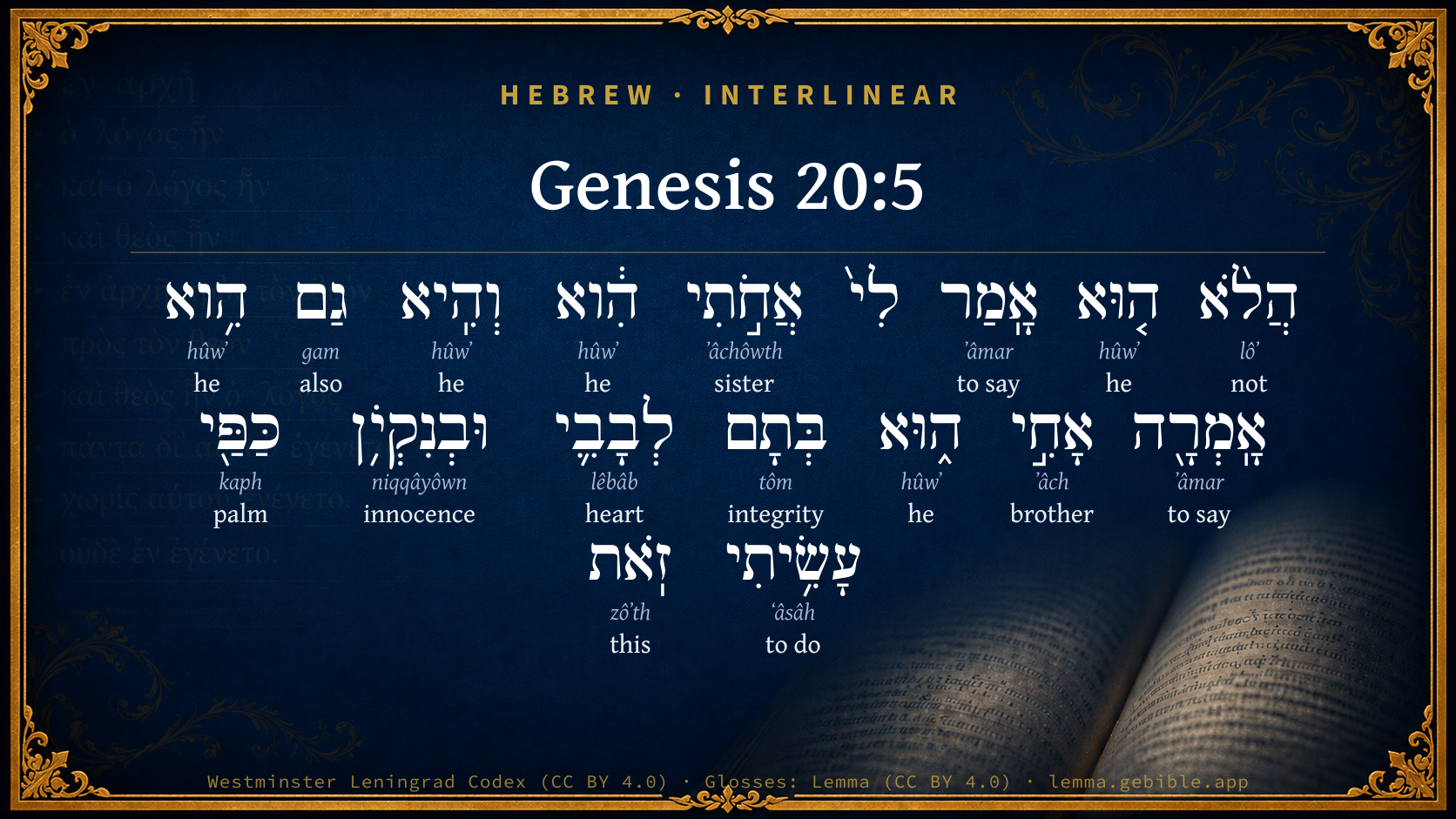
Genesis 20:5

Hebrew (Westminster Leningrad Codex) Genesis 20:5 appears in the Hebrew Old Testament. The text above is from the Westminster Leningrad Codex. Each word links to its Strong’s number, a concise gloss, and parsing drawn from the Open Scriptures Hebrew Bible morphology. Click any word for its full Brown-Driver-Briggs (BDB) entry.
Download image
Cite this verse

Genesis 20:5 (World English Bible). Public Domain. Lemma interlinear Bible study tool, https://lemma.gebible.app/v/genesis/20/5.

Show BibTeX & RIS
BibTeX
RIS
English Translation
Didn't he tell me, 'She is my sister?' She, even she herself said, 'He is my brother.' In the integrity of my heart and the innocence of my hands have I done this."
World English Bible · Public Domain
Highlights
  • 3 first appearances in the Hebrew Bible
Full analysis ↓
Download a study sheet

One document with this verse’s original text, its word-by-word gloss line, the meaning frame, cross-references with their text, attributed commentary, and full source and license credits — printable, and it pastes into notes with its structure intact.

This verse Autodidact and up

Study sheet (.html) Plain text (.txt)

A passage Seminary Student

Up to 50 verses in one chapter. A passage sheet keeps up to 6 commentary sources and 12 cross-references per verse, in the order this page ranks them, and says so on the sheet whenever that leaves anything out. Ask for a single verse and you get the Autodidact verse sheet above.

Everything on this page stays free to read, with no account — the sheet is a download of what is already on screen, not access to it.

Want to remove ads? Support Godless Engineer
Compare translations 3

The same verse in 3 English versions, stacked beneath the original-language interlinear above. Click any original word for its lexicon entry.

Each is an independent rendering of the whole verse — the interlinear is not word-aligned to these translations.

Highlighted words mark where these versions differ — a whole-verse word diff, not a word-by-word alignment.

  • World English Bible Public Domain
    Didn't he tell me, 'She is my sister?' She, even she herself said, 'He is my brother.' In the integrity of my heart and the innocence of my hands have I done this."
  • King James Version Public Domain
    Said he not unto me, She is my sister? and she, even she herself said, He is my brother: in the integrity of my heart and innocency of my hands have I done this.
  • unfoldingWord Literal Text CC BY-SA 4.0
    Did not he himself say to me, ‘She my sister’? And she herself also said, ‘He my brother.’ I did this in the integrity of my heart and in the innocence of my hands!”

unfoldingWord Literal Text — © unfoldingWord, licensed CC BY-SA 4.0. Word-aligned USFM3 via Door43 (git.door43.org/unfoldingWord/en_ult).

Versions to compare (up to 4)

3 of 4 selected

Show all 18 translations

Every available English version of this verse, each an independent rendering of the whole verse.

  • World English Bible Public Domain
    Didn't he tell me, 'She is my sister?' She, even she herself said, 'He is my brother.' In the integrity of my heart and the innocence of my hands have I done this."
  • Berean Standard Bible Public Domain
    Didn’t Abraham tell me, ‘She is my sister’? And she herself said, ‘He is my brother.’ I have done this in the integrity of my heart and the innocence of my hands.”
  • Majority Standard Bible Public Domain
    Didn’t Abraham tell me, ‘She is my sister’? And she herself said, ‘He is my brother.’ I have done this in the integrity of my heart and the innocence of my hands.”
  • King James Version Public Domain
    Said he not unto me, She is my sister? and she, even she herself said, He is my brother: in the integrity of my heart and innocency of my hands have I done this.
  • American Standard Version (1901) Public Domain
    Said he not himself unto me, She is my sister? And she, even she herself said, He is my brother. In the integrity of my heart and the innocency of my hands have I done this.
  • Revised Version (1885) Public Domain
    Said he not himself unto me, She is my sister? and she, even she herself said, He is my brother: in the integrity of my heart and the innocency of my hands have I done this.
  • Geneva Bible (1599) Public Domain
    Said not he vnto me, She is my sister? yea, and she her selfe said, He is my brother: with an vpright minde, and innocent handes haue I done this.
  • Douay-Rheims (1899) Public Domain
    Did not he say to me: She is my sister: and she say, He is my brother? in the simplicity of my heart, and cleanness of my hands have I done this.
  • Young's Literal Translation Public Domain
    hath not he himself said to me, She `is' my sister! and she, even she herself, said, He `is' my brother; in the integrity of my heart, and in the innocency of my hands, I have done this.'
  • Literal Standard Version CC BY-SA 4.0
    Has he not himself said to me, She [is] my sister! And she, even she herself, said, He [is] my brother; in the integrity of my heart, and in the innocence of my hands, I have done this.”
  • Unlocked Literal Bible CC BY-SA 4.0
    Did he not himself say to me, 'She is my sister?' Even she herself said, 'He is my brother.' I have done this in the integrity of my heart and the innocence of my hands.”
  • unfoldingWord Literal Text CC BY-SA 4.0
    Did not he himself say to me, ‘She my sister’? And she herself also said, ‘He my brother.’ I did this in the integrity of my heart and in the innocence of my hands!”
  • Darby Bible Public Domain
    Did he not say to me, She is my sister? and she, even she said, He is my brother. In the integrity of my heart and in the innocency of my hands have I done this.
  • World Messianic Bible Public Domain
    Didn’t he tell me, ‘She is my sister’? She, even she herself, said, ‘He is my brother.’ I have done this in the integrity of my heart and the innocence of my hands.”
  • Webster's Bible Public Domain
    Said he not to me, She is my sister? and she, even she herself said, He is my brother: in the integrity of my heart, and innocence of my hands have I done this.
  • Free Bible Version CC BY-SA 4.0
    Didn't Abraham tell me himself, ‘She's my sister,’ and didn't Sarah also say, ‘He's my brother’? I did this in all innocence—my conscience is clear!”
  • Bible in Basic English Public Domain
    Did he not say to me himself, She is my sister? and she herself said, He is my brother: with an upright heart and clean hands have I done this.
  • JPS Tanakh (1917) Public Domain
    Said he not himself unto me: She is my sister? and she, even she herself said: He is my brother. In the simplicity of my heart and the innocency of my hands have I done this.'

Literal Standard Version (2020), Covenant Press — licensed CC BY-SA 4.0. Text via the HelloAO Bible API (eBible.org). Unlocked Literal Bible (unfoldingWord) — licensed CC BY-SA 4.0. Text via the HelloAO Bible API (eBible.org). unfoldingWord Literal Text — © unfoldingWord, licensed CC BY-SA 4.0. Word-aligned USFM3 via Door43 (git.door43.org/unfoldingWord/en_ult). Free Bible Version, Dr. Jonathan Gallagher — licensed CC BY-SA 4.0. Text via the HelloAO Bible API (eBible.org).

Word by word

More ways to search: Search by grammar → Find every occurrence → Compare this word →

Practice this passage: Drill this verse → Learn its vocabulary →

וּבְנִקְיֹ֥ן
niqqâyôwn
H5356
“and · in/at · innocence of”
Conjunction + Preposition + Noun, Common, Masculine, Singular, Construct
Part of Speech
Conjunction + Preposition + Noun
Type
Common
Gender
Masculine
Number
Singular
State
Construct
Full BDB Definition

Origin: from H5352

TWOT: 1412c

innocency - freedom from guilt, innocency - freedom from punishment - cleanness of teeth (physical sense)
  1. הֲלֹ֨א lôʼ H3808 “not” Particle, Interrogative + Particle, Negative
  2. ה֤וּא hûwʼ H1931 “he” Pronoun, Personal, 3rd Person, Masculine, Singular
  3. אָֽמַר ʼâmar H559 “to say” Verb, Qal, Perfect, 3rd Person, Masculine, Singular
  4. אֲחֹ֣תִי ʼâchôwth H269 “sister · my” Noun, Common, Feminine, Singular, Construct + Suffix, Personal, 1st Person, Common, Singular
  5. הִ֔וא hûwʼ H1931 “he” Pronoun, Personal, 3rd Person, Feminine, Singular
  6. וְהִֽיא hûwʼ H1931 “and · he” Conjunction + Pronoun, Personal, 3rd Person, Feminine, Singular
  7. גַם gam H1571 “also” Adverb
  8. הִ֥וא hûwʼ H1931 “he” Pronoun, Personal, 3rd Person, Feminine, Singular
  9. אָֽמְרָ֖ה ʼâmar H559 “to say” Verb, Qal, Perfect, 3rd Person, Feminine, Singular
  10. אָחִ֣י ʼâch H251 “brother · my” Noun, Common, Masculine, Singular, Construct + Suffix, Personal, 1st Person, Common, Singular
  11. ה֑וּא hûwʼ H1931 “he” Pronoun, Personal, 3rd Person, Masculine, Singular
  12. בְּתָם tôm H8537 “in/at · integrity of” Preposition + Noun, Common, Masculine, Singular, Construct
  13. לְבָבִ֛י lêbâb H3824 “heart · my” Noun, Common, Masculine, Singular, Construct + Suffix, Personal, 1st Person, Common, Singular
  14. כַּפַּ֖י kaph H3709 “palms · my” Noun, Common, Feminine, Dual, Construct + Suffix, Personal, 1st Person, Common, Singular
  15. עָשִׂ֥יתִי ʻâsâh H6213 “to do” Verb, Qal, Perfect, 1st Person, Common, Singular
  16. זֹֽאת zôʼth H2063 “this” Pronoun, Demonstrative, Feminine, Singular

About this verse

These counts appear in no published source. They are computed here, from the morphology-tagged text and Lemma’s own curated glosses. What Lemma adds →

18
words
12
distinct lemmas
Pentateuch
section

Notable vocabulary

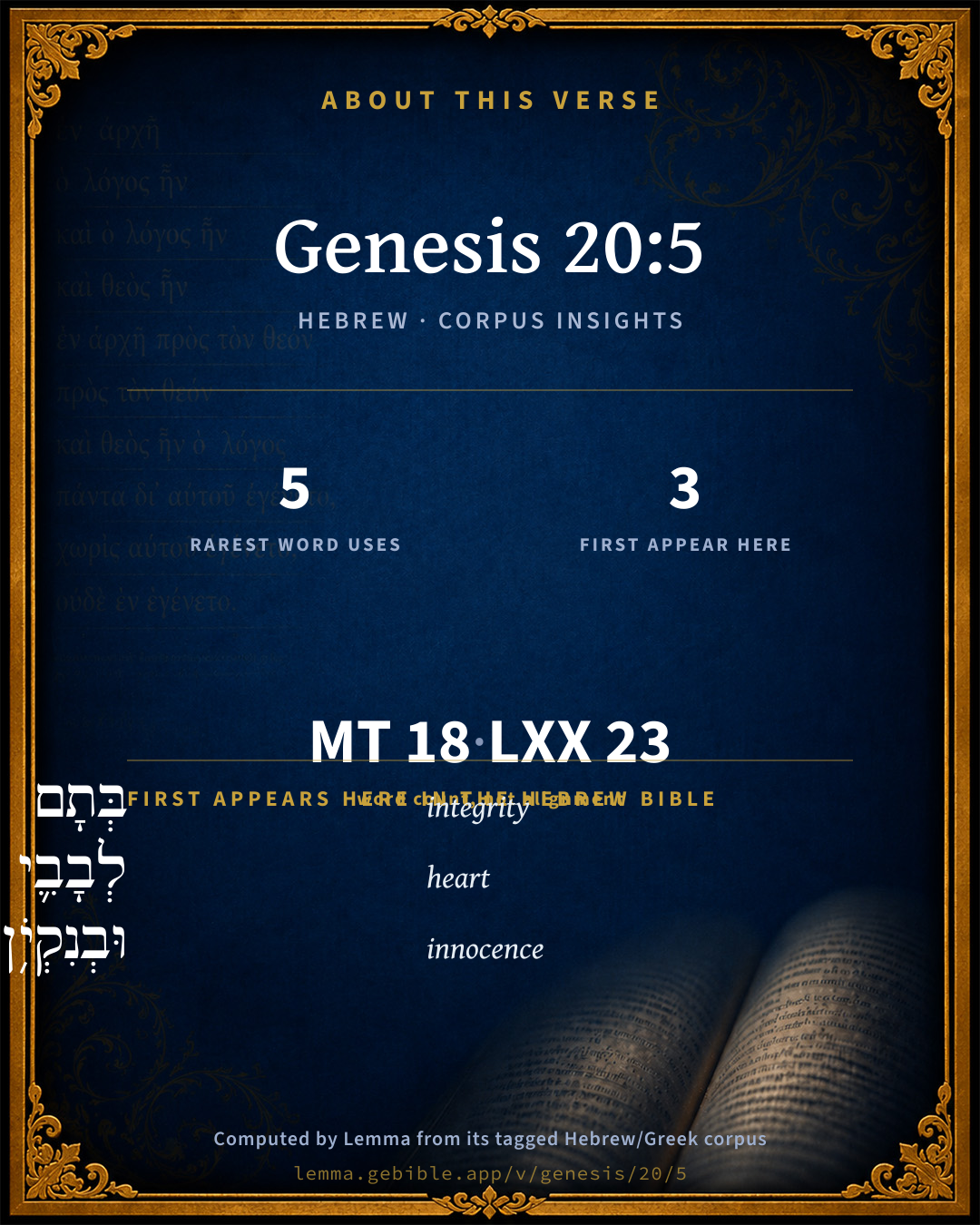
The rarest word here is וּבְנִקְיֹ֥ן innocence H5356 — appearing just 5 times in the whole Hebrew Bible.

First appearance in Scripture

These words make their first canonical appearance in the Hebrew Bible here:

  • בְּתָם integrity H8537
  • לְבָבִ֛י heart H3824
  • וּבְנִקְיֹ֥ן innocence H5356

Shared distinctive vocabulary

וּבְנִקְיֹ֥ן innocence H5356 occurs in 5 verses of the Hebrew Bible. Also found in:

Grammatical profile

  • 3 verbs
  • 6 nouns
  • 6 pronouns
  • 1 preposition
  • 1 adverb
  • 1 particle

Verb forms

  • אָֽמַר Qal · Perfect
  • אָֽמְרָ֖ה Qal · Perfect
  • עָשִׂ֥יתִי Qal · Perfect

Repetition

Words recur within this verse — often emphatic in Hebrew:

  • אָֽמַר to say H559 ×2
  • ה֤וּא he H1931 ×5

Hebrew & Septuagint length

In English translation the verse runs 33 words from the Hebrew and 34 from the Septuagint (LXX English) — closely comparable.

A rough comparison of the two English renderings, which tokenize alike — not a word-level alignment.

Word counts can differ between the Hebrew and the Greek without any difference in meaning — e.g. the Hebrew direct-object marker אֵת has no separate Greek word, and Greek often adds the article ὁ.

In the original languages it is 18 Hebrew tokens and 23 Greek tokens — but the two are counted differently (Hebrew bundles its prefixes and suffixes into one token; the Greek is in lemma form), so that isn’t a like-for-like length.

Cross-references

17

Topical passages linked to Genesis 20:5 in the Treasury of Scripture Knowledge — connected by theme and wording, ordered by reader-vote popularity; previews shown in the World English Bible.

  • 1 Kings 9:4 As for you, if you will walk before me, as David your father walked, in integrity of heart, and in uprightness, to do according to all that I have commanded you, and will keep my statutes and my ordinances;
  • Psalms 7:8 Yahweh administers judgment to the peoples. Judge me, Yahweh, according to my righteousness, And to my integrity that is in me.
  • Joshua 22:22 The Mighty One, God, Yahweh, the Mighty One, God, Yahweh, he knows; and Israel he shall know: if it be in rebellion, or if in trespass against Yahweh (don't save us this day),
  • 2 Kings 20:3 Remember now, Yahweh, I beg you, how I have walked before you in truth and with a perfect heart, and have done that which is good in your sight. Hezekiah wept sore.
  • 1 Chronicles 29:17 I know also, my God, that you try the heart, and have pleasure in uprightness. As for me, in the uprightness of my heart I have willingly offered all these things: and now have I seen with joy your people, that are present here, offer willingly to you.
  • Job 33:9 'I am clean, without disobedience. I am innocent, neither is there iniquity in me:
  • Psalms 24:4 He who has clean hands and a pure heart; Who has not lifted up his soul to falsehood, And has not sworn deceitfully.
  • Psalms 25:21 Let integrity and uprightness preserve me, For I wait for you.
  • Psalms 26:6 I will wash my hands in innocence, So I will go about your altar, Yahweh;
  • Psalms 73:13 Surely in vain I have cleansed my heart, And washed my hands in innocence,
  • Psalms 78:72 So he was their shepherd according to the integrity of his heart, And guided them by the skillfulness of his hands.
  • Proverbs 11:3 The integrity of the upright shall guide them, But the perverseness of the treacherous shall destroy them.
  • Proverbs 20:7 A righteous man walks in integrity. Blessed are his children after him.
  • Daniel 6:22 My God has sent his angel, and has shut the lions' mouths, and they have not hurt me; because as before him innocence was found in me; and also before you, O king, have I done no hurt.
  • 2 Corinthians 1:12 For our boasting is this: the testimony of our conscience, that in holiness and sincerity of God, not in fleshly wisdom but in the grace of God we behaved ourselves in the world, and more abundantly toward you.
  • 1 Thessalonians 2:10 You are witnesses with God, how holy, righteously, and blamelessly we behaved ourselves toward you who believe.
  • 1 Timothy 1:13 although I was before a blasphemer, a persecutor, and insolent. However, I obtained mercy, because I did it ignorantly in unbelief.

Cross-references courtesy of OpenBible.info (CC BY 4.0).

Hebrew and Greek witnesses Masoretic Hebrew ↔ Greek Septuagint

The same verse in the two great witnesses to the Old Testament, shown verse-for-verse.

These are two independent witnesses, not word-aligned to each other, and the Septuagint is shown in lemma (dictionary) form.

Hebrew Genesis 20:5 Masoretic · Westminster Leningrad Codex

הֲלֹ֨א ה֤וּא אָֽמַר לִי֙ אֲחֹ֣תִי הִ֔וא וְהִֽיא גַם הִ֥וא אָֽמְרָ֖ה אָחִ֣י ה֑וּא בְּתָם לְבָבִ֛י וּבְנִקְיֹ֥ן כַּפַּ֖י עָשִׂ֥יתִי זֹֽאת

Didn't he tell me, 'She is my sister?' She, even she herself said, 'He is my brother.' In the integrity of my heart and the innocence of my hands have I done this."

World English Bible · Public Domain

Greek LXX Genesis 20:5 Septuagint · lemma form

οὐ αὐτός ἐγώ εἶπον ἀδελφή ἐγώ εἰμί καί αὐτός ἐγώ εἶπον ἀδελφός ἐγώ εἰμί ἐν καθαρός καρδία καί ἐν δικαιοσύνη χείρ ποιέω οὗτος

Said he not to me, She is my sister, and said she not to me, He is my brother? with a pure heart and in the righteousness of my hands have I done this.

LXX2012 (modern English Septuagint) · Public Domain

Hebrew: Westminster Leningrad Codex (CC BY 4.0). Greek: Septuagint (public domain); English from LXX2012 (modern English Septuagint) (Public Domain). How the Septuagint differs from the Hebrew →

Targum (Aramaic paraphrase)

2

The Targum is the ancient Jewish Aramaic paraphrase of the Hebrew Scriptures — an interpretive translation, not the Hebrew text itself. Onkelos (literal) and Pseudo-Jonathan (expansive) render the Torah, and Jonathan the Prophets. Coverage is partial: where no permissively-licensed English translation exists for a verse, only the Aramaic is shown. This is verse-level text, not a word-by-word alignment to the Hebrew.

  1. Targum Onkelos Torah (Genesis–Deuteronomy)
    הֲלָא הוּא אֲמַר לִי אֲחָתִי הִיא וְהִיא אַף הִיא אֲמָרַת אָחִי הוּא בְּקַשִּׁיטוּת לִבִּי וּבְזַכָּאוּת יָדַי עֲבָדִית דָּא

    (no public-domain English translation for this verse)

    Targum Onkelos — Aramaic: “Onkelos Genesis” (public domain); “Onkelos Exodus” (public domain); “Onkelos Leviticus” (public domain); “Onkelos Numbers” (public domain); “Onkelos Deuteronomy” (public domain). English: “Sefaria Community Translation” (CC0 1.0 (public-domain dedication)); “J.W. Etheridge. The Targums of Onkelos and Jonathan Ben Uzziel on the Pentateuch. London: Longmans, Green, 1862” (public domain). Text via Sefaria.

  2. Targum Pseudo-Jonathan Torah (Genesis–Deuteronomy)
    הֲלָא הוּא אָמַר לִי דְאָחַת הִיא וְהִיא אוּף הִיא אָמְרַת אָחִי הוּא בְּקַשְׁטוּת לְבָבִי וּבְזַכְּאוּת יְדִי עֲבָדִית דָא

    Did he not tell me, She is my sister? and did not she also say, He is my brother? In the truthfulness of my heart and the innocency of my hands have I done this.

    Targum Pseudo-Jonathan — Aramaic: “Targum Jonathan on Genesis” (public domain); “Targum Jonathan on Exodus” (public domain); “Targum Jonathan on Leviticus” (public domain); “Targum Jonathan on Numbers” (public domain); “Targum Jonathan on Deuteronomy” (public domain). English: “The Targum of Jonathan ben Uzziel, trans. J. W. Etheridge, London, 1862” (public domain). Text via Sefaria.

Commentary

Notes on Genesis 20:5 from classic Christian and Jewish commentators (each source and its license shown beneath its notes). The classic Christian expositions comment on the surrounding passage and are grouped to its opening verse, so a note may address several verses; the Jewish commentaries on the Tanakh (Rashi and others) are per-verse, so they appear only where the commentator wrote on this verse.

Lemma curates 59 commentaries, every one of them public domain or Creative Commons licensed, each selected and text-cleaned for this edition rather than reprinted as found. About our sources →

Trapp's Complete Commentary

John Trapp

Gen 20:5 Said he not unto me, She [is] my sister? and she, even she herself said, He [is] my brother: in the integrity of my heart and innocency of my hands have I done this.

Ver. 5. Said he not unto me, She is my sister? &c.] Here Abraham and Sarah, though both famous, he for his faith, {Rom 4:19} and she for not being afraid with any amazement, {1Pe 3:6} yet here they show some trepidation. Sense, saith one, {a} fights sore against faith, when it is upon its own dunghill, I mean in a sensible danger. Nature’s retraction of itself from a visible fear, may cause the pulse of a Christian that beats truly and strongly in the main point (the state of the soul) to intermit and falter at such a time. {b}

In the integrity of my heart.] Great is the boldness of a clear conscience, be it but in some one particular, as here in Abimelech; a man that was magis extra vitia quam cum virtutibus (as Tacitus {c} saith of Galba) rather not evil than good; one whose nature was not changed, but chained up only. Civil men are but wolves chained up, tame devils, swine in a fair meadow; and yet these are the world’s honest men, and as high a price set upon them, as was once upon a cab of dove’s dung in the famine of Samaria. But these Abimelechs, these Catos, these civil judges, they want sincerity in the first table, and integrity in the second; for they stand not upon the inward corruptions, nor lesser breaches of the law. Abimelech, for all his confidence here, was to blame for his wandering, rash lust. And Cato, that mirror of morality, was a griping usurer, prostituted his wife, and slew himself. And yet Paterculus {d} will tell you, that he was, Homo virtuti simillimus, et per omnia virtute Diis quam hominibus propior ,& c.

{a} Mr Vines’s Fast Sermon:

{b} Elias fulminator ad Iezabalis minas trepidat .

{c} Tac., lib. i. cap. 12.

{d} Hist., lib. ii.

John Trapp, A Commentary or Exposition upon All the Books of the Old and New Testament (1647–1656) — public domain. Text from a community e-Sword module.

Geneva Bible (1599)

Geneva Bible translators

Not thinking to do any man harm.

As one falling by ignorance, and not doing evil of purpose.

Geneva Bible (1599) marginal notes — public domain. Text via Bolls.life.

Adam Clarke's Commentary

Verse 5. In the integrity of my heart, c.] Had Abimelech any other than honourable views in taking Sarah, he could not have justified himself thus to his Maker and that these views were of the most honourable kind, God himself, to whom the appeal was made, asserts in the most direct manner, Yea, I know that thou didst this in the integrity of thy heart.

Adam Clarke's Commentary on the Bible (1810–1826) — public domain. Text from a community e-Sword/MySword module.

Ellicott's Commentary for English Readers

(5) In the integrity of my heart . . . —Not only does Abimelech assert this, but Elohim (see Gen_20:6) admits the plea. And yet this Philistine king indulges in polygamy, and claims the right of taking the female relatives of any one passing through his territory to add them to his harem. But the words mean no more than that he was not consciously violating any of his own rules of morality, and thus illustrate the Gospel principle that men will be punished not by an absolute decree, but equitably, according to their knowledge (Luk_12:47-48). Abimelech was doing wrong, and was suffering punishment, but the punishment was remedial, and for his advancement in right-knowing and right-doing. It is thus by means of revelation that men have attained to a proper understanding of the moral law. Though often called “the law of Nature,” yet Nature does not give it, but only acknowledges it when given. The inner light is but a faint and inconstant glimmering, but Christ is the true light; for only by Him does the law of Nature become a clear-rule for human guidance (Joh_1:9; Rom_2:14-15; Mat_6:23).

A Bible Commentary for English Readers, edited by Charles John Ellicott (1878–1897) — public domain. Text from a community e-Sword module.

The Cambridge Bible for Schools and Colleges

gen. ed. J. J. S. Perowne

5. integrity] Heb. “perfectness.” Cf. Gen_6:9.

innocency of my hands] Cf. Psa_26:6.

The Cambridge Bible for Schools and Colleges (gen. ed. J. J. S. Perowne; Cambridge University Press, 1878–1918) — public domain. Text from a community e-Sword module.

John Gill's Exposition

Said he not unto me, she is my sister?.... By this it appears, that Abimelech had a personal conversation with Abraham, and inquired of him about Sarah, who she was, and what relation she was to him, who told him that she was his sister; and for the truth of this he appeals to the omniscient God, who knew that Abraham had told him this:

and she, even she herself said, he is my brother; when Sarah was asked what relation she stood in to Abraham, and he to her, she declared he was her brother; so that Abimelech had reason to conclude, from what both of them had said, that this was the truth of the matter, and especially from what Sarah said, who he thought might be depended on, and would speak out the whole truth on such an occasion:

in the integrity of my heart, and innocency of my hands, have I done this; hereby declaring, that his design was not to defile the woman, and to gratify his lust, but to take her to be his wife; and this he thought to be no evil, though he had a wife, Gen 20:17; polygamy not being reckoned a sin in those times; and that he had used no violence in taking her, they both seemingly agreeing to it.

John Gill's Exposition of the Whole Bible (1746–1763) — public domain (CC PDM 1.0). Text via the HelloAO Bible API.

Haydock's Catholic Bible Commentary

He say, &c. The pronouns in Hebrew are printed very incorrectly. --- He is my sister; and she, even he, said. (Kennicott)

George Leo Haydock (1774–1849), Haydock's Catholic Family Bible and Commentary, 1859 edition — public domain. Excludes Psalms (Douay-Rheims chapter numbering differs from Protestant) and Deuterocanonical books (Catholic canon only).

Matthew Poole's English Annotations

Without any adulterous design in my heart, or outward actions tending to it, being wholly ignorant of what thou now informest me.

Matthew Poole's English Annotations on the Holy Bible (1683–1685) — public domain. Text from a community e-Sword/MySword module.

The Pulpit Commentary

Said he not unto me, She is my sister? and she, even she herself said, He is my brother. From which it is clear that the Philistine monarch, equally with the Egyptian Pharaoh, shrank from the sin of adultery. In the integrity of my heart and innocency of my hands have I done this. Ie. he assumes the right of kings to take unmarried persons into their harems,

The Pulpit Commentary (1880–1919), ed. H.D.M. Spence-Jones & Joseph S. Exell — public domain. Text from a community e-Sword module.

Rashi

Rabbi Shlomo Yitzchaki (Rashi)

גם הוא ALSO SHE HERSELF — The word “also” presupposes that others also said the same: it serves to include her servants, cameldrivers and assdrivers — all these I asked and they told me, “He is her brother” (Genesis Rabbah 52:6).

בתם לבבי IN THE INTEGRITY OF MY HEART —I did not intend to sin.

ובנקיון כפי AND IN THE INNOCENCY OF MY HANDS —I am innocent of this sin because I have not touched her.

Rashi on the Tanakh — English translations: “The Judaica Press complete Tanach with Rashi, translated by A. J. Rosenberg” (CC BY 4.0); “Pentateuch with Rashi's commentary by M. Rosenbaum and A.M. Silbermann, 1929-1934” (public domain); “The Metsudah Tanach series, Lakewood, N.J” (CC BY 4.0); and “The Book of Joshua, Metsudah Publications, 1997” (CC BY 4.0). Text via Sefaria.

Radak

Rabbi David Kimhi (Radak)

הלא הוא אמר לי, when I asked him concerning Sarah’s marital status. I had not even relied on what my servants had been told, but I asked him personally, to be certain.

והיא גם היא, when I asked Sarah after I had taken her to my palace she also told me that “Avraham is my brother.” In view of this, what is my sin?

בתם לבבי, in perfect innocence, if I had had any reason to believe that she was a married lady, even my heart would not have desired her, i.e. I would not even have lusted after her.

ונקיון כפי, and my hands were clean! When I took her to my palace I did not demean her but I respected her dignity in every way.

Radak on the Tanakh — English translations: “Sefaria Community Translation” (CC0 1.0 (public-domain dedication)); “Eliyahu Munk, HaChut Hameshulash” (CC BY 4.0); “Rabbi Mike Feuer, Jerusalem Anthology” (CC BY 4.0); and “R. David Kimhi on the first book of Psalms, Translated by R.G. Finch, London, 1919” (public domain). Text via Sefaria.

Lesson kit

Teaching starters — assembled from the data on this page, not authored interpretation. Every prompt links to the verse data it draws on. Edit before teaching.

Genesis, in the Pentateuch, opens this verse with 18 words (12 distinct Hebrew lemmas). Its most distinctive word is niqqâyôwn (“innocence”). A historical commentator’s framing appears above. Read the whole chapter for the surrounding context.

Discussion questions

  1. How does “innocence” (niqqâyôwn) shape what this verse is saying?
  2. 3 words make their first appearance in Scripture here. What does this debut establish?
  3. How does Psalms 26:6, which shares the word «innocence», read alongside this verse?
  4. What does the repetition of “to say” (2× in this one verse) do in this verse?
  5. The translations on this page render this verse differently — a whole-verse word diff, not a word-by-word alignment. What might account for the different wordings?
  6. «אָֽמַר» is a Qal Perfect verb. How does that grammatical form shape the action described?
  7. Compare how Trapp's Complete Commentary and Geneva Bible (1599) read this verse. Where do they agree or differ?

Things to notice

Reading settings

Reading text

Shown beneath each verse's original-language words.

Old Testament
Old Testament edition

Read the OT as the Masoretic Hebrew (MT) or the Greek Septuagint (LXX).

English shown for the Greek Septuagint (in the Hebrew ↔ Greek comparison).

Comparing translations? Open the Compare panel on any verse page to stack up to four side by side.