
Deuteronomy 29:19

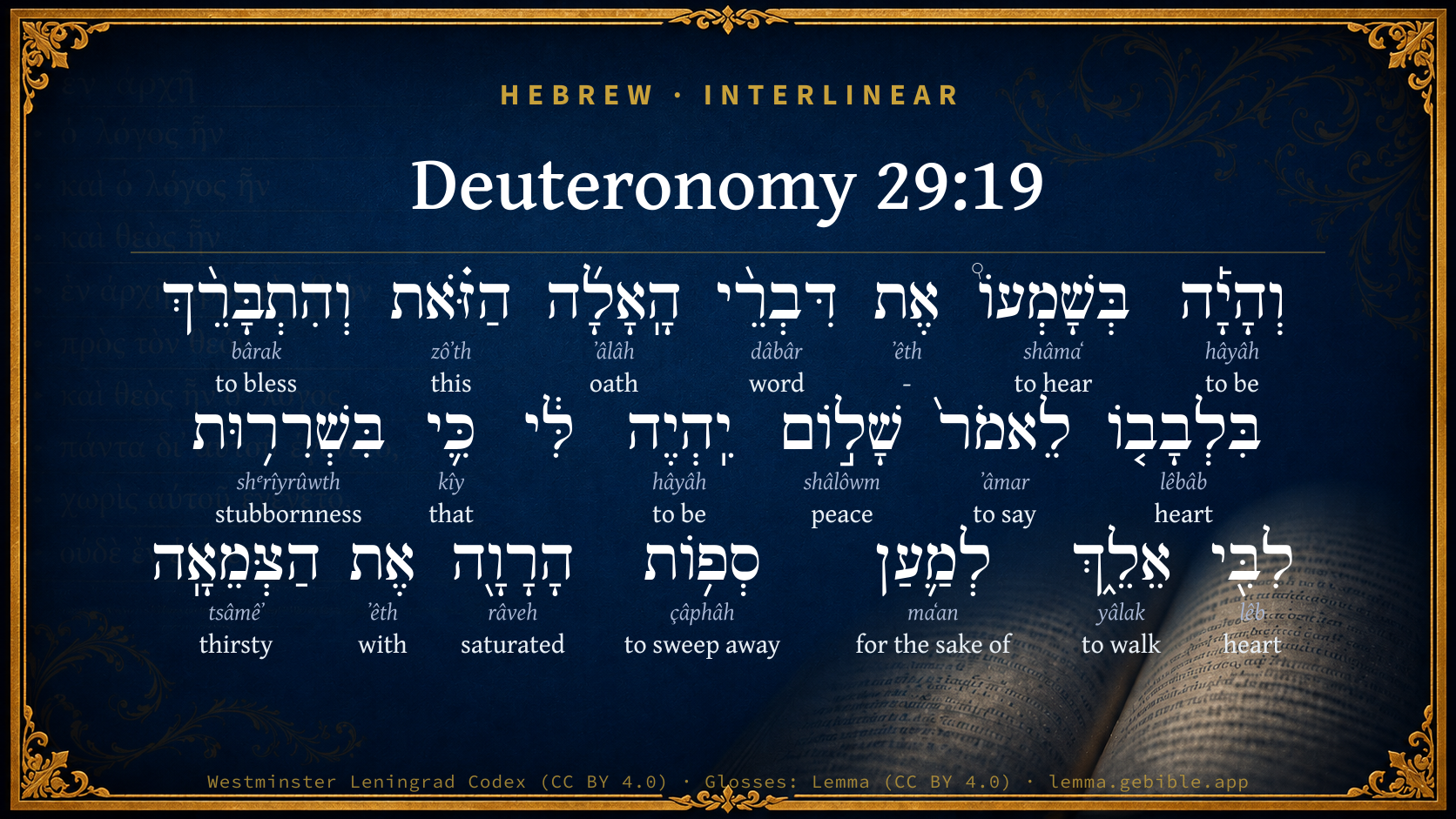
Hebrew (Westminster Leningrad Codex) Deuteronomy 29:19 appears in the Hebrew Old Testament. The text above is from the Westminster Leningrad Codex. Each word links to its Strong’s number, a concise gloss, and parsing drawn from the Open Scriptures Hebrew Bible morphology. Click any word for its full Brown-Driver-Briggs (BDB) entry.
Download image
Cite this verse

Deuteronomy 29:19 (World English Bible). Public Domain. Lemma interlinear Bible study tool, https://lemma.gebible.app/v/deuteronomy/29/19.

Show BibTeX & RIS
BibTeX
RIS
English Translation
and it happen, when he hears the words of this curse, that he bless himself in his heart, saying, I shall have peace, though I walk in the stubbornness of my heart, to destroy the moist with the dry.
World English Bible · Public Domain
Highlights
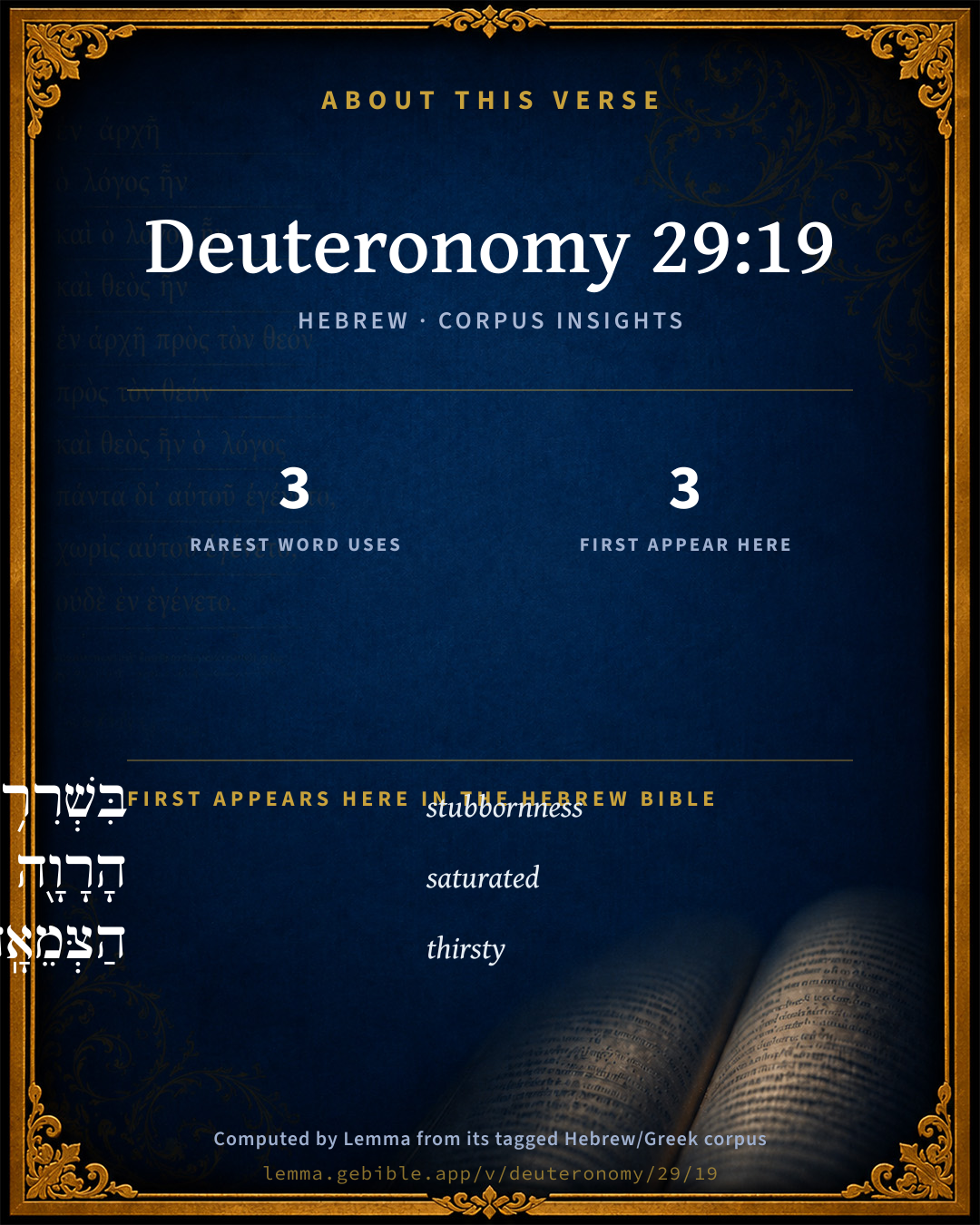
  • 3 first appearances in the Hebrew Bible
Full analysis ↓
Download a study sheet

One document with this verse’s original text, its word-by-word gloss line, the meaning frame, cross-references with their text, attributed commentary, and full source and license credits — printable, and it pastes into notes with its structure intact.

This verse Autodidact and up

Study sheet (.html) Plain text (.txt)

A passage Seminary Student

Up to 50 verses in one chapter. A passage sheet keeps up to 6 commentary sources and 12 cross-references per verse, in the order this page ranks them, and says so on the sheet whenever that leaves anything out. Ask for a single verse and you get the Autodidact verse sheet above.

Everything on this page stays free to read, with no account — the sheet is a download of what is already on screen, not access to it.

Want to remove ads? Support Godless Engineer
Compare translations 3

The same verse in 3 English versions, stacked beneath the original-language interlinear above. Click any original word for its lexicon entry.

Each is an independent rendering of the whole verse — the interlinear is not word-aligned to these translations.

Highlighted words mark where these versions differ — a whole-verse word diff, not a word-by-word alignment.

  • World English Bible Public Domain
    and it happen, when he hears the words of this curse, that he bless himself in his heart, saying, I shall have peace, though I walk in the stubbornness of my heart, to destroy the moist with the dry.
  • King James Version Public Domain
    And it come to pass, when he heareth the words of this curse, that he bless himself in his heart, saying, I shall have peace, though I walk in the imagination of mine heart, to add drunkenness to thirst:
  • unfoldingWord Literal Text CC BY-SA 4.0
    And it will be, when he hears the words of this curse, then he will bless himself in his heart, saying, ‘I will have peace, though I walk in the stubbornness of my heart,’ so that the wet the dry are swept away.

unfoldingWord Literal Text — © unfoldingWord, licensed CC BY-SA 4.0. Word-aligned USFM3 via Door43 (git.door43.org/unfoldingWord/en_ult).

Versions to compare (up to 4)

3 of 4 selected

Show all 18 translations

Every available English version of this verse, each an independent rendering of the whole verse.

  • World English Bible Public Domain
    and it happen, when he hears the words of this curse, that he bless himself in his heart, saying, I shall have peace, though I walk in the stubbornness of my heart, to destroy the moist with the dry.
  • Berean Standard Bible Public Domain
    because when such a person hears the words of this oath, he invokes a blessing on himself, saying, ‘I will have peace, even though I walk in the stubbornness of my own heart.’ This will bring disaster on the watered land as well as the dry.
  • Majority Standard Bible Public Domain
    because when such a person hears the words of this oath, he invokes a blessing on himself, saying, ‘I will have peace, even though I walk in the stubbornness of my own heart.’ This will bring disaster on the watered land as well as the dry.
  • King James Version Public Domain
    And it come to pass, when he heareth the words of this curse, that he bless himself in his heart, saying, I shall have peace, though I walk in the imagination of mine heart, to add drunkenness to thirst:
  • American Standard Version (1901) Public Domain
    and it come to pass, when he heareth the words of this curse, that he bless himself in his heart, saying, I shall have peace, though I walk in the stubbornness of my heart, to destroy the moist with the dry.
  • Revised Version (1885) Public Domain
    and it come to pass, when he heareth the words of this curse, that he bless himself in his heart, saying, I shall have peace, though I walk in the stubbornness of mine heart, to destroy the moist with the dry:
  • Geneva Bible (1599) Public Domain
    So that when he heareth the words of this curse, he blesse him selfe in his heart, saying, I shall haue peace, although I walke according to the stubburnes of mine owne heart, thus adding drunkennesse to thirst.
  • Douay-Rheims (1899) Public Domain
    And when he shall hear the words of this oath, he should bless himself in his heart saying: I shall have peace, and will walk on in the naughtiness of my heart: and the drunken may consume the thirsty,
  • Young's Literal Translation Public Domain
    `And it hath been, in his hearing the words of this oath, and he hath blessed himself in his heart, saying, I have peace, though in the stubbornness of my heart I go on, in order to end the fulness with the thirst.
  • Literal Standard Version CC BY-SA 4.0
    and it has been, in his hearing the words of this oath, that he has blessed himself in his heart, saying, I have peace, though I go on in the stubbornness of my heart—in order to sweep away the watered with the thirsty.
  • Unlocked Literal Bible CC BY-SA 4.0
    When that person hears the words of this curse, he will bless himself in his heart and say, 'I will have peace, though I walk in the stubbornness of my heart.' This would destroy the wet together with the dry.
  • unfoldingWord Literal Text CC BY-SA 4.0
    And it will be, when he hears the words of this curse, then he will bless himself in his heart, saying, ‘I will have peace, though I walk in the stubbornness of my heart,’ so that the wet the dry are swept away.
  • Darby Bible Public Domain
    and it come to pass, when he heareth the words of this curse, that he bless himself in his heart, saying, I shall have peace, though I walk in the stubbornness of my heart, to sweep away the drunken with the thirsty.
  • World Messianic Bible Public Domain
    and it happen, when he hears the words of this curse, that he bless himself in his heart, saying, “I shall have peace, though I walk in the stubbornness of my heart,” to destroy the moist with the dry.
  • Webster's Bible Public Domain
    And it should come to pass, when he heareth the words of this curse, that he should bless himself in his heart, saying, I shall have peace, though I walk in the imagination of my heart, to add drunkenness to thirst:
  • Free Bible Version CC BY-SA 4.0
    For when someone like that hears the words of this solemn promise, they think they'll still receive a blessing, telling themselves, “I'll be safe, even though I'll go on doing whatever I feel like.” Such an attitude would destroy good and bad alike.
  • Bible in Basic English Public Domain
    If such a man, hearing the words of this oath, takes comfort in the thought that he will have peace even if he goes on in the pride of his heart, taking whatever chance may give him:
  • JPS Tanakh (1917) Public Domain
    (29-18) and it come to pass, when he heareth the words of this curse, that he bless himself in his heart, saying: 'I shall have peace, though I walk in the stubbornness of my heart — that the watered be swept away with the dry';

Literal Standard Version (2020), Covenant Press — licensed CC BY-SA 4.0. Text via the HelloAO Bible API (eBible.org). Unlocked Literal Bible (unfoldingWord) — licensed CC BY-SA 4.0. Text via the HelloAO Bible API (eBible.org). unfoldingWord Literal Text — © unfoldingWord, licensed CC BY-SA 4.0. Word-aligned USFM3 via Door43 (git.door43.org/unfoldingWord/en_ult). Free Bible Version, Dr. Jonathan Gallagher — licensed CC BY-SA 4.0. Text via the HelloAO Bible API (eBible.org).

Word by word

More ways to search: Search by grammar → Find every occurrence → Compare this word →

Practice this passage: Drill this verse → Learn its vocabulary →

הָרָוָ֖ה
râveh
H7302
“the · saturated”
Particle, Definite Article + Adjective, Adjective, Feminine, Singular, Absolute
Part of Speech
Particle + Adjective
Type
Adjective
Gender
Feminine
Number
Singular
State
Absolute
Full BDB Definition

Origin: from H7301

TWOT: 2130b

watered, saturated
  1. וְהָיָ֡ה hâyâh H1961 “and · to be” Conjunction + Verb, Qal, Sequential Perfect, 3rd Person, Masculine, Singular
  2. בְּשָׁמְעוֹ֩ shâmaʻ H8085 “in/at · to hear · him” Preposition + Verb, Qal, Infinitive Construct + Suffix, Personal, 3rd Person, Masculine, Singular
  3. אֶת ʼêth H853 “-” Particle, Direct Object
  4. דִּבְרֵ֨י dâbâr H1697 “words of” Noun, Common, Masculine, Plural, Construct
  5. הָֽאָלָ֜ה ʼâlâh H423 “the · oath” Particle, Definite Article + Noun, Common, Feminine, Singular, Absolute
  6. הַזֹּ֗את zôʼth H2063 “the · this” Particle, Definite Article + Pronoun, Demonstrative, Feminine, Singular
  7. וְהִתְבָּרֵ֨ךְ bârak H1288 “and · to bless” Conjunction + Verb, Hithpael, Sequential Perfect, 3rd Person, Masculine, Singular
  8. בִּלְבָב֤וֹ lêbâb H3824 “in/at · heart · his” Preposition + Noun, Common, Masculine, Singular, Construct + Suffix, Personal, 3rd Person, Masculine, Singular
  9. לֵאמֹר֙ ʼâmar H559 “to say” Preposition + Verb, Qal, Infinitive Construct
  10. שָׁל֣וֹם shâlôwm H7965 “peace” Noun, Common, Masculine, Singular, Absolute
  11. יִֽהְיֶה hâyâh H1961 “to be” Verb, Qal, Imperfect, 3rd Person, Masculine, Singular
  12. כִּ֛י kîy H3588 “that” Conjunction
  13. בִּשְׁרִר֥וּת shᵉrîyrûwth H8307 “in/at · stubbornness of” Preposition + Noun, Common, Feminine, Singular, Construct
  14. לִבִּ֖י lêb H3820 “heart · my” Noun, Common, Masculine, Singular, Construct + Suffix, Personal, 1st Person, Common, Singular
  15. אֵלֵ֑ךְ yâlak H3212 “to walk” Verb, Qal, Imperfect, 1st Person, Common, Singular
  16. לְמַ֛עַן maʻan H4616 “for the sake of” Preposition
  17. סְפ֥וֹת çâphâh H5595 “to sweep away” Verb, Qal, Infinitive Construct
  18. אֶת ʼêth H854 “with” Preposition
  19. הַצְּמֵאָֽה tsâmêʼ H6771 “the · thirsty” Particle, Definite Article + Adjective, Adjective, Feminine, Singular, Absolute

About this verse

These counts appear in no published source. They are computed here, from the morphology-tagged text and Lemma’s own curated glosses. What Lemma adds →

21
words
19
distinct lemmas
Pentateuch
section

Notable vocabulary

The rarest word here is הָרָוָ֖ה saturated H7302 — appearing just 3 times in the whole Hebrew Bible.

First appearance in Scripture

These words make their first canonical appearance in the Hebrew Bible here:

  • בִּשְׁרִר֥וּת stubbornness H8307
  • הָרָוָ֖ה saturated H7302
  • הַצְּמֵאָֽה thirsty H6771

Shared distinctive vocabulary

הָרָוָ֖ה saturated H7302 occurs in 3 verses of the Hebrew Bible. Also found in:

Grammatical profile

  • 7 verbs
  • 6 nouns
  • 2 adjectives
  • 1 pronoun
  • 3 prepositions
  • 1 conjunction
  • 1 particle

Verb forms

  • וְהָיָ֡ה Qal · Sequential Perfect
  • בְּשָׁמְעוֹ֩ Qal · Infinitive Construct
  • וְהִתְבָּרֵ֨ךְ Hithpael · Sequential Perfect
  • לֵאמֹר֙ Qal · Infinitive Construct
  • יִֽהְיֶה Qal · Imperfect
  • אֵלֵ֑ךְ Qal · Imperfect
  • סְפ֥וֹת Qal · Infinitive Construct

Repetition

A word recurs within this verse — often emphatic in Hebrew:

  • וְהָיָ֡ה to be H1961 ×2

Hebrew & Septuagint length

In English translation the verse runs 39 words from the Hebrew and 44 from the Septuagint (LXX English) — closely comparable.

A rough comparison of the two English renderings, which tokenize alike — not a word-level alignment.

Word counts can differ between the Hebrew and the Greek without any difference in meaning — e.g. the Hebrew direct-object marker אֵת has no separate Greek word, and Greek often adds the article ὁ.

Cross-references

24

Topical passages linked to Deuteronomy 29:19 in the Treasury of Scripture Knowledge — connected by theme and wording, ordered by reader-vote popularity; previews shown in the World English Bible.

  • Jeremiah 7:24 But they didn't listen nor turn their ear, but walked in [their own] counsels [and] in the stubbornness of their evil heart, and went backward, and not forward.
  • Numbers 15:30 But the soul who does anything with a high hand, whether he is home-born or a foreigner, the same blasphemes Yahweh; and that soul shall be cut off from among his people.
  • Numbers 15:39 and it shall be to you for a fringe, that you may look on it, and remember all the commandments of Yahweh, and do them; and that you not follow after your own heart and your own eyes, after which you use to play the prostitute;
  • Deuteronomy 17:2 If there be found in the midst of you, within any of your gates which Yahweh your God gives you, man or woman, who does that which is evil in the sight of Yahweh your God, in transgressing his covenant,
  • Deuteronomy 29:12 that you may enter into the covenant of Yahweh your God, and into his oath, which Yahweh your God makes with you this day;
  • Psalms 49:18 Though while he lived he blessed his soul-- And men praise you when you do well for yourself--
  • Jeremiah 7:3–11 Thus says Yahweh of Hosts, the God of Israel, Amend your ways and your doings, and I will cause you to dwell in this place.
  • Jeremiah 44:16–17 As for the word that you have spoken to us in the name of Yahweh, we will not listen to you.
  • Romans 1:21 Because, knowing God, they didn't glorify him as God, neither gave thanks, but became vain in their reasoning, and their senseless heart was darkened.
  • 2 Corinthians 10:5 throwing down imaginations and every high thing that is exalted against the knowledge of God, and bringing every thought into captivity to the obedience of Christ;
  • Ephesians 4:17 This I say therefore, and testify in the Lord, that you no longer walk as the rest of the Gentiles also walk, in the futility of their mind,
  • Genesis 2:17 but of the tree of the knowledge of good and evil, you shall not eat of it: for in the day that you eat of it you will surely die."
  • Psalms 10:4–6 The wicked, in the pride of his face, Has no room in his thoughts for God.
  • Psalms 10:11 He says in his heart, "God has forgotten. He hides his face. He will never see it."
  • Psalms 94:6–7 They kill the widow and the alien, And murder the fatherless.
  • Proverbs 29:1 He who is often rebuked and stiffens his neck Will be destroyed suddenly, with no remedy.
  • Ecclesiastes 11:9 Rejoice, young man, in your youth, And let your heart cheer you in the days of your youth, And walk in the ways of your heart, And in the sight of your eyes; But know that for all these things God will bring you into judgment.
  • Jeremiah 3:17 At that time they shall call Jerusalem the throne of Yahweh; and all the nations shall be gathered to it, to the name of Yahweh, to Jerusalem: neither shall they walk any more after the stubbornness of their evil heart.
  • Jeremiah 5:12–13 They have denied Yahweh, and said, It is not he; neither shall evil come on us; neither shall we see sword nor famine:
  • Jeremiah 28:15–17 Then said the prophet Jeremiah to Hananiah the prophet, Hear now, Hananiah: Yahweh has not sent you; but you make this people to trust in a lie.
  • Jeremiah 44:27 Behold, I watch over them for evil, and not for good; and all the men of Judah who are in the land of Egypt shall be consumed by the sword and by the famine, until there be an end of them.
  • Ezekiel 13:16 [to wit], the prophets of Israel who prophesy concerning Jerusalem, and who see visions of peace for her, and there is no peace, says the Lord Yahweh.
  • Ezekiel 13:22 Because with lies you have grieved the heart of the righteous, whom I have not made sad; and strengthened the hands of the wicked, that he should not return from his wicked way, and be saved alive:
  • Ephesians 5:6 Let no one deceive you with empty words. For because of these things, the wrath of God comes on the children of disobedience.

Cross-references courtesy of OpenBible.info (CC BY 4.0).

Hebrew and Greek witnesses Masoretic Hebrew ↔ Greek Septuagint

The same verse in the two great witnesses to the Old Testament, shown verse-for-verse.

These are two independent witnesses, not word-aligned to each other, and the Septuagint is shown in lemma (dictionary) form.

Hebrew Deuteronomy 29:19 Masoretic · Westminster Leningrad Codex

וְהָיָ֡ה בְּשָׁמְעוֹ֩ אֶת דִּבְרֵ֨י הָֽאָלָ֜ה הַזֹּ֗את וְהִתְבָּרֵ֨ךְ בִּלְבָב֤וֹ לֵאמֹר֙ שָׁל֣וֹם יִֽהְיֶה לִּ֔י כִּ֛י בִּשְׁרִר֥וּת לִבִּ֖י אֵלֵ֑ךְ לְמַ֛עַן סְפ֥וֹת הָרָוָ֖ה אֶת הַצְּמֵאָֽה

and it happen, when he hears the words of this curse, that he bless himself in his heart, saying, I shall have peace, though I walk in the stubbornness of my heart, to destroy the moist with the dry.

World English Bible · Public Domain

Greek LXX Deuteronomy 29:19 Septuagint · lemma form

οὐ μή θέλω ὁ θεός εὐιλατεύω αὐτός ἀλλά ἤ τότε ἐκκαίω ὀργή κύριος καί ὁ ζῆλος αὐτός ἐν ὁ ἄνθρωπος ἐκεῖνος καί κολλάω ἐν αὐτός πᾶς ὁ ἀρά ὁ διαθήκη οὗτος ὁ γράφω ἐν ὁ βιβλίον ὁ νόμος οὗτος καί ἐκἀλείφω κύριος ὁ ὄνομα αὐτός ἐκ ὁ ὑπό ὁ οὐρανός

And it shall be if one shall hear the words of this curse, and shall flatter himself in his heart, saying, Let good happen to me, for I will walk in the error of my heart, lest the sinner destroy the guiltless with him:

LXX2012 (modern English Septuagint) · Public Domain

On this verse, Ellicott's Commentary for English Readers discusses the Septuagint’s reading. Read the note in Commentary ↓

Hebrew: Westminster Leningrad Codex (CC BY 4.0). Greek: Septuagint (public domain); English from LXX2012 (modern English Septuagint) (Public Domain). How the Septuagint differs from the Hebrew →

Targum (Aramaic paraphrase)

2

The Targum is the ancient Jewish Aramaic paraphrase of the Hebrew Scriptures — an interpretive translation, not the Hebrew text itself. Onkelos (literal) and Pseudo-Jonathan (expansive) render the Torah, and Jonathan the Prophets. Coverage is partial: where no permissively-licensed English translation exists for a verse, only the Aramaic is shown. This is verse-level text, not a word-by-word alignment to the Hebrew.

  1. Targum Onkelos Torah (Genesis–Deuteronomy)
    לָא יֵיבֵי יְיָ לְמִשְׁבַּק לֵהּ אֲרֵי בְּכֵן יִתְקֵף רָגְזָא דַיְיָ וְחֶמְתֵהּ בְּגַבְרָא הַהוּא וְיִדְבְּקוּן בֵּהּ כָּל לְוָטַּיָא דִכְתִיבִין בְּסִפְרָא הָדֵין וְיִמְחֵי יְיָ יָת שְׁמֵהּ מִתְּחוֹת שְׁמַיָא

    (no public-domain English translation for this verse)

    Targum Onkelos — Aramaic: “Onkelos Genesis” (public domain); “Onkelos Exodus” (public domain); “Onkelos Leviticus” (public domain); “Onkelos Numbers” (public domain); “Onkelos Deuteronomy” (public domain). English: “Sefaria Community Translation” (CC0 1.0 (public-domain dedication)); “J.W. Etheridge. The Targums of Onkelos and Jonathan Ben Uzziel on the Pentateuch. London: Longmans, Green, 1862” (public domain). Text via Sefaria.

  2. Targum Pseudo-Jonathan Torah (Genesis–Deuteronomy)
    לָא יְהֵי רַעֲוָא מִן קֳדָם יְיָ לְמִשְׁבַּק לֵיהּ אֲרוּם בְּכֵן יִתְקוֹף רוּגְזָא דַיְיָ וְחֵימְתֵיהּ בְּבַר נְשָׁא הַהוּא וְתָחֵיל בֵּיהּ כָּל פִּתְגָמֵי לְוָוטַיָא דִכְתִיבִין בְּסִפְרָא הָדֵין וְיִמְחֵי יְיָ יַת שׁוּם דוּכְרָנֵיהּ מִתְּחוֹת שְׁמַיָא

    It will not be pleasing to the Lord to forgive him; for the Lord’s anger and indignation will wax hot against that man, and all the words of the curses written in this book will rest upon him, and the Lord will blot out the memorial of his name from under the heavens.

    Targum Pseudo-Jonathan — Aramaic: “Targum Jonathan on Genesis” (public domain); “Targum Jonathan on Exodus” (public domain); “Targum Jonathan on Leviticus” (public domain); “Targum Jonathan on Numbers” (public domain); “Targum Jonathan on Deuteronomy” (public domain). English: “The Targum of Jonathan ben Uzziel, trans. J. W. Etheridge, London, 1862” (public domain). Text via Sefaria.

Commentary

Notes on Deuteronomy 29:19 from classic Christian and Jewish commentators (each source and its license shown beneath its notes). The classic Christian expositions comment on the surrounding passage and are grouped to its opening verse, so a note may address several verses; the Jewish commentaries on the Tanakh (Rashi and others) are per-verse, so they appear only where the commentator wrote on this verse.

Lemma curates 59 commentaries, every one of them public domain or Creative Commons licensed, each selected and text-cleaned for this edition rather than reprinted as found. About our sources →

Trapp's Complete Commentary

John Trapp

Deu 29:19 And it come to pass, when he heareth the words of this curse, that he bless himself in his heart, saying, I shall have peace, though I walk in the imagination of mine heart, to add drunkenness to thirst:

Ver. 19. When he heareth the words.] But feareth them no more than Behemoth doth the iron weapons, which are esteemed by him as straws. The presumptuous sinner, saith one, makes God a God of clouts, - one that, howsoever he speaks heavy words, will not do as he saith. Words are but wind, say they in Jeremiah. {Jer 5:13} "God forbid," say they in the Gospel. {Luk 20:16} These things are but spoken in terrorem, thinks the practical atheist; bugbear words, devised on purpose to frighten silly people, &c. Ahab, after he was threatened with utter rooting out, begat fifty sons, as it were to cross God, and to try it out with him. So Thrasonical Lamech brags, and goes on to outdare God himself; "If Cain be avenged," &c. {Gen 4:24} The old Italians were wont, in time of thunder, to shoot off their greatest ordinance, and to ring their greatest bells, to drown the noise of the heavens: like unto these are many frontless and flagitious persons. "But shall they escape by iniquity? In thine anger" - it is not more a prayer than a prophecy - "cast down the people, O God." {Psa 56:7}

To add drunkenness to thirst.] To "add rebellion to sin." {Job 34:37} "To drink iniquity like water." {Job 34:7} His sin and his repentance run in a circle, as drunkenness and thirst do. He sins and cries God mercy, and says he will sin no more, and yet does it again the next day, till his heart be so hardened by the deceitfulness of sin, that at length he loseth all passive power of "recovering himself out of the snare of the devil, by whom he is taken alive at his pleasure." {2Ti 2:26}

John Trapp, A Commentary or Exposition upon All the Books of the Old and New Testament (1647–1656) — public domain. Text from a community e-Sword module.

The Biblical Illustrator

Joseph S. Exell

Deu_29:19

To add drunkenness to thirst.

The sin of drunkenness

Among the vices which stamp upon human nature its fallen condition, there is not one which causes such misery, or which leads on to such reckless crime, as drunkenness.

1. It is a most selfish as well as degrading vice: it debases man, created in the image of God, lower than the brute creation. God denounces this sin most strongly in His Holy Word. Under the law of Moses, the son who would not obey the voice of his father, but gave himself up to gluttony and drunkenness, was put to death by stoning; and, in the Gospel, drunkenness is classed with murder, as one of the works of the flesh, of which it is said they which do such things shall not inherit the kingdom of God. Drunkenness is a vice which destroys soul and body. It weakens the intellect, making a man a madman in his rage, and an idiot in his sober moments. It ruins the health, producing the most painful diseases, and causing premature decay and death. It involves his family in poverty and misery. There is no peace in the drunkards home. Who can describe all the misery which follows in the train of drunkenness, all the crime to which it leads, all the sorrow which it causes to others? How fitly the words of the text describe it, when Moses warns the Israelites to beware lest there should be among them a root that beareth gall and wormwood; or, as the marginal reading is, a poisonful herb. Never did Satan plant a more fearful seed in the human heart than the love of strong drink. Drunkenness is, indeed, a root which beareth gall and wormwood; nothing sweet, or pleasant, or excellent, or beautiful can spring from it, or grow in the heart beside it. Like the deadly upas tree, it poisons all which rests under its shade, or comes near to it. The drunkard cannot be a high-principled, virtuous, or amiable man. In his sober moments the testimony of every drunkard must be, that the root of that fatal passion beareth gall and wormwood--that it is a poisonful herb.

2. The next particular--which the text points out--is the deceptive nature of the vice. Of all self-deceivers, the drunkard is the most deluded, the most blinded. And it come to pass, when he heareth the words of this curse, that he bless himself in his heart, saying, I shall have peace, though I walk in the imagination (or as the marginal rendering is), the stubbornness of mine heart, to add drunkenness to thirst. There is no man so difficult to convince of his folly and sinfulness as the drunkard, and no man so hard to turn away from his evil course. Satans most powerful weapon against our holy religion is drunkenness. A drunkard cannot be a true Christian, a child of God. He is more often an infidel, a blasphemer, and he is on the high road to every kind of sin and crime. Let us not stretch forth our hand to save the far-off heathen idolater, and remain indifferent and effortless about the drunkard dwelling close to us, and even one admitted into the fellowship of the same holy faith as ourselves. (S. Charlesworth.)

Degradation of drunkenness

Drunkenness is the shame of nature, the extinguisher of reason, the shipwreck of chastity, and the murder of conscience. Drunkenness is hurtful to the body; the cup kills more than the cannon; it causes dropsies, catarrhs, apoplexies; it fills the eye with fire, and the legs with water, and turns the body into an hospital. (T. Watson.)

The Biblical Illustrator, edited by Joseph S. Exell (c. 1880s–1900s) — public domain. Text from a community e-Sword module.

Joseph Benson's Commentary

Deu 29:19. The words of this curse — This oath and execration, wherein he swore he would keep covenant with God, and that with a curse pronounced against himself if he did not perform it. Bless himself — Flatter himself in his own eyes with vain hopes, as if God did not mind such things, and either could not, or would not punish them. Peace — Safety and prosperity. My own heart — Though I do not follow God’s command, but my own devices. To add drunkenness to thirst — The words may be rendered, to add thirst to drunkenness, and so the sense may be, that when he hath multiplied his sins, and made himself as it were drunk with them, yet he is not satisfied therewith, but still whets his appetite, and provokes his thirst after more, as drunkards often use means to make themselves thirst after more drink. This is well deserving of our most serious consideration. Moses here assures the Israelites that, how much soever they might flatter themselves with hopes of peace and safety on account of their privileges, none of these would avail them at all if they forsook the law of God, and apostatized from his worship and service. This people, however, notwithstanding this solemn warning, did, in after ages, confide in those outward privileges, and that at a time when they lived in the open violation of the divine commands. The temple, the temple of the Lord! was their cry and their confidence, as if the having that among them had been sufficient to save and render them prosperous and happy, even although they defiled it with their abominations. But they found, by sad experience, that the threatenings denounced by Moses against the violators of God’s law were fulfilled. Let us all take warning by this, and neither as a nation nor as individuals dare to promise ourselves security and peace while we walk in the imagination of our own hearts, and live in sin and forgetfulness of God.

Joseph Benson's Commentary on the Old and New Testaments (1811–1818) — public domain. Text from a community e-Sword module.

Tyndale Open Study Notes

Tyndale Open Resources

29:19 An attitude of nonchalance or smugness regarding God’s judgment would lead to utter ruin.

Tyndale Open Study Notes — © Tyndale Open Resources, licensed CC BY-SA 4.0. Text via the HelloAO Bible API.

Geneva Bible (1599)

Geneva Bible translators

Or, flatter.

For as he that is thirsty desireth to drink much, so he that followeth his appetites, seeketh by all means, and yet cannot be satisfied.

Geneva Bible (1599) marginal notes — public domain. Text via Bolls.life.

Adam Clarke's Commentary

Verse 19. To add drunkenness to thirst] A proverbial expression denoting the utmost indulgence in all sensual gratifications.

Adam Clarke's Commentary on the Bible (1810–1826) — public domain. Text from a community e-Sword/MySword module.

Ellicott's Commentary for English Readers

(19) The imagination.—Rather the “stubbornness” or “obstinacy.” The word is only found here and in Psa_81:12 outside the writings of Jeremiah, who uses it eight times.

To add drunkenness to thirst—i.e., the indulgence of the desire to the desire itself; to add sin to temptation. The LXX. have a strange paraphrase, “So that the sinner shall not involve the righteous with him in destruction.” The thought seems to be that, perhaps, one idolater would not make so much difference to Israel. He would never involve the whole nation in destruction. The drunkard could not be the ruin of the thirsty, so to speak, and, therefore, he might do as he pleased, and might, in fact, escape punishment, being protected by the general prosperity of Israel. The quotation in the Epistle to the Hebrews meets this mistaken view admirably: “Lest any root of bitterness springing up trouble you, and thereby many be defiled.” The Targums render “to add sins of infirmity to sins of presumption,” a rendering which partly explains that of the LXX.

A Bible Commentary for English Readers, edited by Charles John Ellicott (1878–1897) — public domain. Text from a community e-Sword module.

The Cambridge Bible for Schools and Colleges

gen. ed. J. J. S. Perowne

19. curse] Rather oath, for it is on the strength of Jehovah’s oath to be Israel’s God and so to protect them, that this Israelite flatters himself he is secure, no matter how he may behave. In the history of religion such a delusion has been lamentably frequent, and believers in extreme doctrines of election have presumed on these and recklessly indulged in evil.

bless himself in his heart] Flatter himself! Found only here.

stubbornness] Heb. sherirûth, firmness but always in a bad sense; only here, Jer_3:17; Jer_7:24; Jer_9:13; Jer_11:8; Jer_13:10; Jer_16:12; Jer_18:12; Jer_23:17, and in Psa_81:12 (13). This of course is not the man’s own, but the writer’s, view of him.

to destroy the moist with the dry] An unmeaning translation. The construction is elliptic and we should render: so as to sweep away the moist (herbage?) with the dried up; bring down a hurricane of destruction that would uproot the whole people, so fatal is the infectiousness, and so universal will be God’s punishment, of idolatry.

The Cambridge Bible for Schools and Colleges (gen. ed. J. J. S. Perowne; Cambridge University Press, 1878–1918) — public domain. Text from a community e-Sword module.

John Gill's Exposition

Then the Lord will not spare him,.... Have no mercy upon him, nor forgive him, being an hardhearted, impenitent, stubborn, and obstinate sinner, as well as guilty of the grossest and most provoking sin, as idolatry is:

but then the anger of the Lord, and his jealousy, shall smoke against that man; or, "the nose of the Lord shall smoke" (f); alluding to an angry, wrathful, furious man, whose brain being heated, and his passions inflamed, his breath steams through his nostrils like smoke; it denotes the vehement anger, the greatness of God's wrath and indignation against such a person, and his burning zeal or jealousy for his own honour and glory injured by the idolater:

and all the curses that are written in this book shall lie upon him: for as he that offends in one point is guilty of all, and especially in such a principal point as this, which concerns the being and worship of God; so he makes himself liable to all the curses of the law, which shall not only come upon him, but abide on him; and there is no person clear of them but by redemption through Christ, who, by being made a curse for his people, has redeemed them from the curse of the law:

and the Lord shall blot out his name from under heaven; he shall have no name in Israel, not in the church, and among the people of God, from whom he is to be excommunicated; shall have no name and place in the earth, being cut off from the land of the living; and shall have no name or fame after his death, his memory shall rot and perish; and he shall appear to have no name in the book of life; see Psa 69:28.

(f) "fumabit nasus Domini", Montanus.

John Gill's Exposition of the Whole Bible (1746–1763) — public domain (CC PDM 1.0). Text via the HelloAO Bible API.

Albert Barnes' Notes on the Bible

Compare on the thought Jer 23:17. The secret and presumptuous sinner is meant who flatters himself that all is well and will be well with him, since he follows his own devices and prospers. Compare Psa 73:11 ff.

To add drunkenness to thirst - The sense is probably: “Himself, drinking iniquity like water, Job 15:16, he corrupts and destroys others who are thirsting for it or prone to it.”

The sense of the whole passage from Deu 29:16 onward to Deu 29:20 may be exhibited thus: “Ye have seen the abominations of idolatry among the pagan. Do you therefore look diligently that there be no secret idolater among you; a root of bitterness to all about him. Let there be no one, I say, who when he hears the curses of the Law against this sin, flatters himself, saying within himself, ‘All will be well, for I walk unmolested in my own self-chosen path; ‘ and thus acting, not only takes his own fill of sin, but destroys likewise every tempted brother within his reach, for the Lord will not spare him,” etc.

Albert Barnes' Notes on the Bible (1834–1885) — public domain. Text from a community e-Sword/MySword module.

Haydock's Catholic Bible Commentary

The drunken, &c.: absumat ebria sitientem. It is a proverbial expression, which may either be understood as spoken by the sinner, blessing, that is, flattering himself in his sins with the imagination of peace, and so great an abundance as may satisfy, and as it were, consume all thirst and want, or it may be referred to the root of bitterness, spoken of before, which being drunken with sin may attract, and by that means consume such as thirst after the like evils. (Challoner) --- St. Jerome seems to have translated sephoth by assumat, as the manuscripts and interpreters read, before the correction of Sixtus V, who adopted the other signification of the Hebrew absumat. (Calmet) --- The sense however seems to be the same, as evil communications corrupt good manners, the wicked draw on those who before were dry, or thirsty, and superior to the allurements of pleasure, but not quite so sincere and constant as to shut out from their hearts the desire of tasting, what the man of the world so highly extols, and thus the just give way to the temptation, and become the companion of the libertine and of the idolater, and of course share in his destruction. The feasts of the idols were generally celebrated with the most dissolute mirth, which seemed more congenial to the depraved heart of man, than the sober feasts, which the Lord allowed his people. The drunken revellings in honour of Bacchus, who was worshipped in Arabia, &c., were a disgrace to human nature. Yet it is well known with what eagerness the deluded pagans joined in these religious sports. How prone to such excesses the Israelites also were, sacred history too plainly shews, so that they might well be described as thirsty, and willing to imitate those who were already drunk with dissolute pleasures; and this proverbial warning was not unnecessary to remind them what they had to expect from such conduct, at least if the people should become generally addicted to the service of idols. The most terrible chastisements mentioned below, (ver. 20, &c., and in the preceding chapters, and still greater, chap. xxviii. 61,) hung over their guilty heads. But the man who should give occasion to such a defection from the Lord, and , like Jeroboam, cause Israel to sin, must remember that he will have to suffer for the sins of all those whom he has perverted. Hence this cutting remark almost always accompanies the mention of Jeroboam’s name, He made Israel to sin. Such a one walked in the way, or imitated the sins of the house of Jeroboam, &c. A similar infamy and destruction attend arch-heretics and impostors. (Haydock) --- Chaldean translates, "Let him not say.....lest he should add sins of ignorance to sins of pride." (Calmet) --- Septuagint, "lest the innocent be involved in the destruction of the sinner." Cornelius a Lapide would leave out the negation, and translate, "that the innocent may be," &c. (Menochius) --- Bonfrere believes that the earth is to be understood; "and the earth drunken or deluged with rain, may take away its former dryness, yet so as to be rendered unfit for cultivation." The proverb affects those who wish for things which will prove destructive to them: so the man who expects to derive great pleasure and advantage from the practice of idolatry, will be miserably deceived, and will only bring on his own ruin; or, if his passions be gratified for a moment, he must, if he die in that state, endure eternal torments in destruction from the face of the Lord. Homer (Odyssey) says, "Crimes prosper not; the low outstrips the quick." Festina lente. Hasten slowly, is an old and useful admonition. Ebria, a drunken woman, is a very indifferent partner for one that is sober at a dance. (Haydock) --- The flesh being indulged, presently perverts the understanding. (Du Hamel)

George Leo Haydock (1774–1849), Haydock's Catholic Family Bible and Commentary, 1859 edition — public domain. Excludes Psalms (Douay-Rheims chapter numbering differs from Protestant) and Deuterocanonical books (Catholic canon only).

Matthew Poole's English Annotations

When he, i.e. that root or that man mentioned Deu 29:18.

Of this curse, i.e. of that oath mentioned Deu 29:12, wherein he swore that he would keep covenant with God, and that with a curse pronounced against himself if he did not perform it. Now if when he reads this again, or hears of it from others.

Bless himself in his heart, i.e. flatter himself in his own eyes, as Psa 36:2, with vain conceits and hopes, as if God did not mind such things, and either could not or would not punish them. Compare Psa 49:18; Jer 2:20; Zec 11:5.

Peace, i.e. safety and prosperity.

Though I walk in the imagination of mine heart; though in my practices and worship I do not follow God’s command, but my own devices, and whatsoever my fancy best liketh, minding nothing but the gratifying of mine own fancy and humour.

To add drunkenness to thirst; i.e. not only to satisfy his

thirst, i.e. his concupiscence and inclination to wickedness, but even to exceed it, as drunkards take ofttimes more than their appetite desires, and drink out of mere wantonness, or from a desire to be drunk; and as filthy persons commit lewdness with others more than their natural inclinations desire, or their strength can well bear, merely from a wicked mind, and from contempt of God, and because they will do so. The words may be rendered, to add thirst to drunkenness, the particle eth, which is a note of the accusative case, being joined with thirst, and not with drunkenness; and so the sense may be this, that when he hath multiplied his sins, and made himself as it were drunk with them, yet he is not satisfied therewith, but still whets his appetite, and provokes his thirst after more, as drunkards commonly will use means and temptations to make themselves thirst after more drink, that they may drink more abundantly. Or thus, to add the moist or moistening to the thirsty, i.e. instead of restraining and mortifying, as he ought to do, fully and greedily to satisfy his idolatrous or wicked inclinations, and resolved to give up himself to all the desires of his own heart. Compare Job 34:7; Pro 23:35; Isa 30:1; 56:12; Eph 4:19.

Matthew Poole's English Annotations on the Holy Bible (1683–1685) — public domain. Text from a community e-Sword/MySword module.

Whedon's Commentary on the Bible

Daniel D. Whedon

19. Though I walk in the imagination of mine heart — The word translated imagination is generally used in a bad sense. But it may be used, as in the corresponding Syriac, in a good sense.

To add drunkenness to thirst — The literal translation is, so that satiety increases thirst. The whole passage has almost baffled the ingenuity of commentators. We think the meaning is, I shall have peace even though I do not keep the laws of God, even though I do what is pleasing to myself and indulge my passions to satiety — even to a satiety that produces greater longing for indulgence.

Daniel D. Whedon (gen. ed.), Commentary on the Old and New Testaments (1874–1909) — public domain. Text from a community e-Sword module.

The Pulpit Commentary

That he bless himself in his heart; congratulate himselfsaying, I shall have peacei.e. , all shall be well with me though rather, forI walk in the imagination of mine heart; literally, in the firmness or hardness of my heart, (tWryriv, from rrv; to twist together, to be tough or firm); the word is always used in a bad sense in Hebrew, though not in Aramaic. (cf. Psa_81:13; Jer_3:17 Jer_7:24; Jer_9:13 Jer_9:14; Jer_11:8) To add drunkenness to thirst; a proverbial expression, of which very different explanations have been given. It is now generally admitted that the verb (twOps) cannot be taken here in the sense of "add," but has its proper sense of pouring out, pouring away, destroying. The word rendered "drunkenness" (twr from hwr to be sated with moisture, to be drenched) means rather "sated, drenched, well-watered;" and the word rendered "thirst" (hamex from amex; to thirst) is properly thirsty, and is used of dry land; (Isa_44:3) both are adjectives, and a substantive is to be supplied. Some supply vpn, soul or person; others, ra land. The former render, "The full soul with the thirsty" (Gesenius); or, "Them that are sated with them that are thirsty," i.e. as well those who have imbibed the poison as those who thirst for it (Knobel); or "That the sated soul may destroy the thirsty," i.e. that the impious one, restrained by no law and, as it were, drunk with crime, may corrupt others, also prone to evil, and bring on them destruction (Maurer). Those who supply "land," render "To destroy the well-watered land with the dry." This last seems the preferable rendering; but the general meaning is the same in either case, viz. that the effect of such hardness of heart would be to destroy one and all. "The Orientals are fond of such bipartite forms of expressing the whole (of. Gesenius, "Thes.," p. 1008)". (Knobel; cf. Deu_32:36)

The Pulpit Commentary (1880–1919), ed. H.D.M. Spence-Jones & Joseph S. Exell — public domain. Text from a community e-Sword module.

John Wesley's Explanatory Notes

Of this curse - Of that oath where-in he swore he would keep covenant with God, and that with a curse pronounced against himself if he did not perform it. Bless himself - Flatter himself in his own eyes, with vain hopes, as if God did not mind such things, and either could not, or would not punish them. Peace - Safety and prosperity. My own heart - Though I do not follow God's command, but my own devices. To add drunkenness to thirst - The words may be rendered, to add thirst to drunkenness, and so the sense may be, that when he hath multiplied his sins, and made himself as it were drunk with them, yet he is not satisfied therewith, but still whets his appetite, and provokes his thirst after more, as drunkards often use means to make themselves thirst after more drink.

John Wesley, Explanatory Notes Upon the Whole Bible (1754–1765) — public domain. Text via the GEBible commentary corpus.

Rashi

Rabbi Shlomo Yitzchaki (Rashi)

יעשן אף ה׳ THE ANGER OF THE LORD SHALL SMOKE [AGAINST THAT MAN] — Through anger the body becomes heated and smoke, as it were, issues from the nostrils. And thus does it state, (Psalms 18:9) “Smoke rose up in his nostril”. Although this idea is not really applicable to God, Scripture makes the human ear hear the matter (i.e. it tells it to him) in the manner that it is accustomed and able to understand according to the ordinary course of the world (i.e. when speaking of God it uses language that properly is applicable only to human beings because this the only language we have at our command).

וקנאתו — This is a term denoting wrath, emportment in old French; it means: retaining one’s hold on the 'garment of vengeance', and not forgoing one’s right to punish.

Rashi on the Tanakh — English translations: “The Judaica Press complete Tanach with Rashi, translated by A. J. Rosenberg” (CC BY 4.0); “Pentateuch with Rashi's commentary by M. Rosenbaum and A.M. Silbermann, 1929-1934” (public domain); “The Metsudah Tanach series, Lakewood, N.J” (CC BY 4.0); and “The Book of Joshua, Metsudah Publications, 1997” (CC BY 4.0). Text via Sefaria.

Ramban (Nachmanides)

Rabbi Moshe ben Nachman (Ramban / Nachmanides)

THE ANGER OF THE ETERNAL AND HIS JEALOUSY SHALL BE KINDLED AGAINST THAT MAN — this refers to the curse against the individual sinner, man or woman.

AND THE ETERNAL SHALL BLOT OUT HIS NAME — this is the curse against a whole family [if they all be sinners] for there is a common name to the head of their father’s house [and that name will be erased].

Ramban (Nachmanides) on the Tanakh — English translation: “Commentary on the Torah by Ramban (Nachmanides). Translated and annotated by Charles B. Chavel. New York, Shilo Pub. House, 1971-1976” (CC BY 4.0). Text via Sefaria.

Lesson kit

Teaching starters — assembled from the data on this page, not authored interpretation. Every prompt links to the verse data it draws on. Edit before teaching.

Deuteronomy, in the Pentateuch, opens this verse with 21 words (19 distinct Hebrew lemmas). Its most distinctive word is râveh (“saturated”). A historical commentator’s framing appears above. Read the whole chapter for the surrounding context.

Discussion questions

  1. How does “saturated” (râveh) shape what this verse is saying?
  2. 3 words here appear for the first time in Scripture. What is being introduced at this debut?
  3. Isaiah 58:11 shares the word «saturated» with this verse. How do the two illuminate each other?
  4. “to be” occurs 2× in this one verse. What is the effect of the repetition?
  5. The translations on this page render this verse differently — a whole-verse word diff, not a word-by-word alignment. What might account for the different wordings?
  6. The verb «וְהָיָ֡ה» is Qal Sequential Perfect. How does its form color the action?
  7. Reading how Trapp's Complete Commentary and The Biblical Illustrator read this verse, where do the two commentators agree and where do they part?

Things to notice

  • 3 words make their first canonical appearance in Scripture here.
  • These translations choose different wording for 19 words in this verse.
  • “to be” occurs 2× in this single verse.
  • 19 distinct Hebrew lemmas span 21 words in this verse.

Reading settings

Reading text

Shown beneath each verse's original-language words.

Old Testament
Old Testament edition

Read the OT as the Masoretic Hebrew (MT) or the Greek Septuagint (LXX).

English shown for the Greek Septuagint (in the Hebrew ↔ Greek comparison).

Comparing translations? Open the Compare panel on any verse page to stack up to four side by side.