Leviticus 15:32

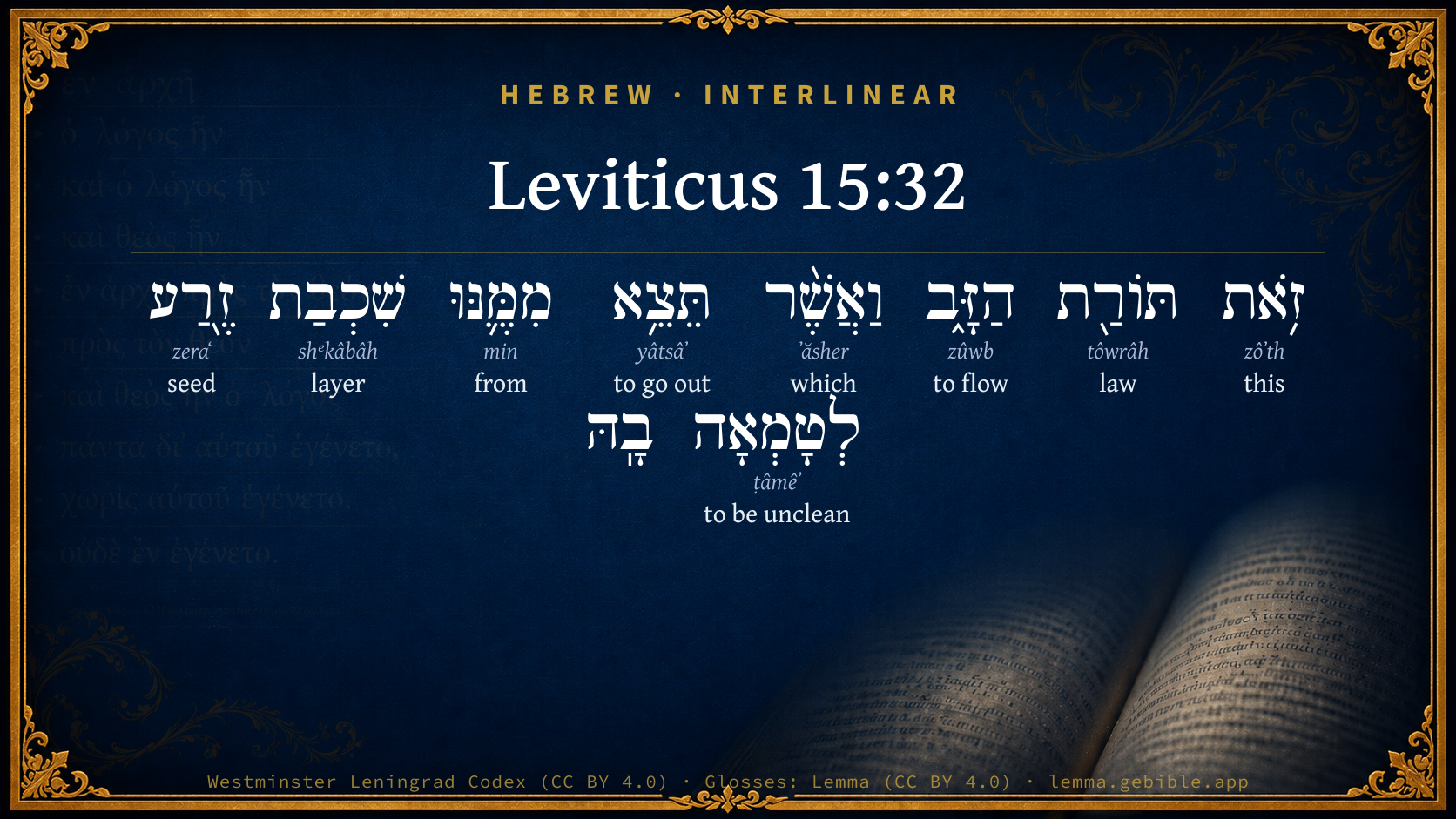
Hebrew (Westminster Leningrad Codex) Leviticus 15:32 appears in the Hebrew Old Testament. The text above is from the Westminster Leningrad Codex. Each word links to its Strong’s number, a concise gloss, and parsing drawn from the Open Scriptures Hebrew Bible morphology. Click any word for its full Brown-Driver-Briggs (BDB) entry.
Download image
Cite this verse

Leviticus 15:32 (World English Bible). Public Domain. Lemma interlinear Bible study tool, https://lemma.gebible.app/v/leviticus/15/32.

Show BibTeX & RIS
BibTeX
RIS
English Translation
This is the law of him who has a discharge, and of him who has an emission of semen, so that he is unclean thereby;
World English Bible · Public Domain
Download a study sheet

One document with this verse’s original text, its word-by-word gloss line, the meaning frame, cross-references with their text, attributed commentary, and full source and license credits — printable, and it pastes into notes with its structure intact.

This verse Autodidact and up

Study sheet (.html) Plain text (.txt)

A passage Seminary Student

Up to 50 verses in one chapter. A passage sheet keeps up to 6 commentary sources and 12 cross-references per verse, in the order this page ranks them, and says so on the sheet whenever that leaves anything out. Ask for a single verse and you get the Autodidact verse sheet above.

Everything on this page stays free to read, with no account — the sheet is a download of what is already on screen, not access to it.

Want to remove ads? Support Godless Engineer
Compare translations 3

The same verse in 3 English versions, stacked beneath the original-language interlinear above. Click any original word for its lexicon entry.

Each is an independent rendering of the whole verse — the interlinear is not word-aligned to these translations.

Highlighted words mark where these versions differ — a whole-verse word diff, not a word-by-word alignment.

  • World English Bible Public Domain
    This is the law of him who has a discharge, and of him who has an emission of semen, so that he is unclean thereby;
  • King James Version Public Domain
    This is the law of him that hath an issue, and of him whose seed goeth from him, and is defiled therewith;
  • unfoldingWord Literal Text CC BY-SA 4.0
    This the law of the flowing and of him from whom a layer of seed goes out to become unclean by it

unfoldingWord Literal Text — © unfoldingWord, licensed CC BY-SA 4.0. Word-aligned USFM3 via Door43 (git.door43.org/unfoldingWord/en_ult).

Versions to compare (up to 4)

3 of 4 selected

Show all 18 translations

Every available English version of this verse, each an independent rendering of the whole verse.

  • World English Bible Public Domain
    This is the law of him who has a discharge, and of him who has an emission of semen, so that he is unclean thereby;
  • Berean Standard Bible Public Domain
    This is the law of him who has a discharge, of the man who has an emission of semen whereby he is unclean,
  • Majority Standard Bible Public Domain
    This is the law of him who has a discharge, of the man who has an emission of semen whereby he is unclean,
  • King James Version Public Domain
    This is the law of him that hath an issue, and of him whose seed goeth from him, and is defiled therewith;
  • American Standard Version (1901) Public Domain
    This is the law of him that hath an issue, and of him whose seed of copulation goeth from him, so that he is unclean thereby;
  • Revised Version (1885) Public Domain
    This is the law of him that hath an issue, and of him whose seed of copulation goeth from him, so that he is unclean thereby;
  • Geneva Bible (1599) Public Domain
    This is the lawe of him that hath an issue, and of him from whome goeth an issue of seede whereby he is defiled:
  • Douay-Rheims (1899) Public Domain
    This is the law of him that hath the issue of seed, and that is defiled by copulation.
  • Young's Literal Translation Public Domain
    `This `is' the law of him who hath an issue, and of him whose seed of copulation goeth out from him, for uncleanness thereby,
  • Literal Standard Version CC BY-SA 4.0
    This [is] the law of him who has the discharging, and of him whose seed [from] intercourse goes out from him, to become unclean with it,
  • Unlocked Literal Bible CC BY-SA 4.0
    These are the regulations for anyone who has a flow of fluid, for any man whose semen goes out of him and makes him unclean,
  • unfoldingWord Literal Text CC BY-SA 4.0
    This the law of the flowing and of him from whom a layer of seed goes out to become unclean by it
  • Darby Bible Public Domain
    This is the law for him that hath a flux, and for the one whose seed of copulation goeth from him, and who is defiled therewith:
  • World Messianic Bible Public Domain
    This is the law of him who has a discharge, and of him who has an emission of semen, so that he is unclean by it;
  • Webster's Bible Public Domain
    This is the law of him that hath an issue, and of him whose seed goeth from him, and he is defiled therewith.
  • Free Bible Version CC BY-SA 4.0
    These are the regulations regarding a man who has a discharge, a man who has a release of semen that makes him unclean,
  • Bible in Basic English Public Domain
    This is the law for the man who has a flow from his body, or whose seed goes from him so that he is unclean;
  • JPS Tanakh (1917) Public Domain
    This is the law of him that hath an issue, and of him from whom the flow of seed goeth out, so that he is unclean thereby;

Literal Standard Version (2020), Covenant Press — licensed CC BY-SA 4.0. Text via the HelloAO Bible API (eBible.org). Unlocked Literal Bible (unfoldingWord) — licensed CC BY-SA 4.0. Text via the HelloAO Bible API (eBible.org). unfoldingWord Literal Text — © unfoldingWord, licensed CC BY-SA 4.0. Word-aligned USFM3 via Door43 (git.door43.org/unfoldingWord/en_ult). Free Bible Version, Dr. Jonathan Gallagher — licensed CC BY-SA 4.0. Text via the HelloAO Bible API (eBible.org).

Word by word

More ways to search: Search by grammar → Find every occurrence → Compare this word →

Practice this passage: Drill this verse → Learn its vocabulary →

About this verse

These counts appear in no published source. They are computed here, from the morphology-tagged text and Lemma’s own curated glosses. What Lemma adds →

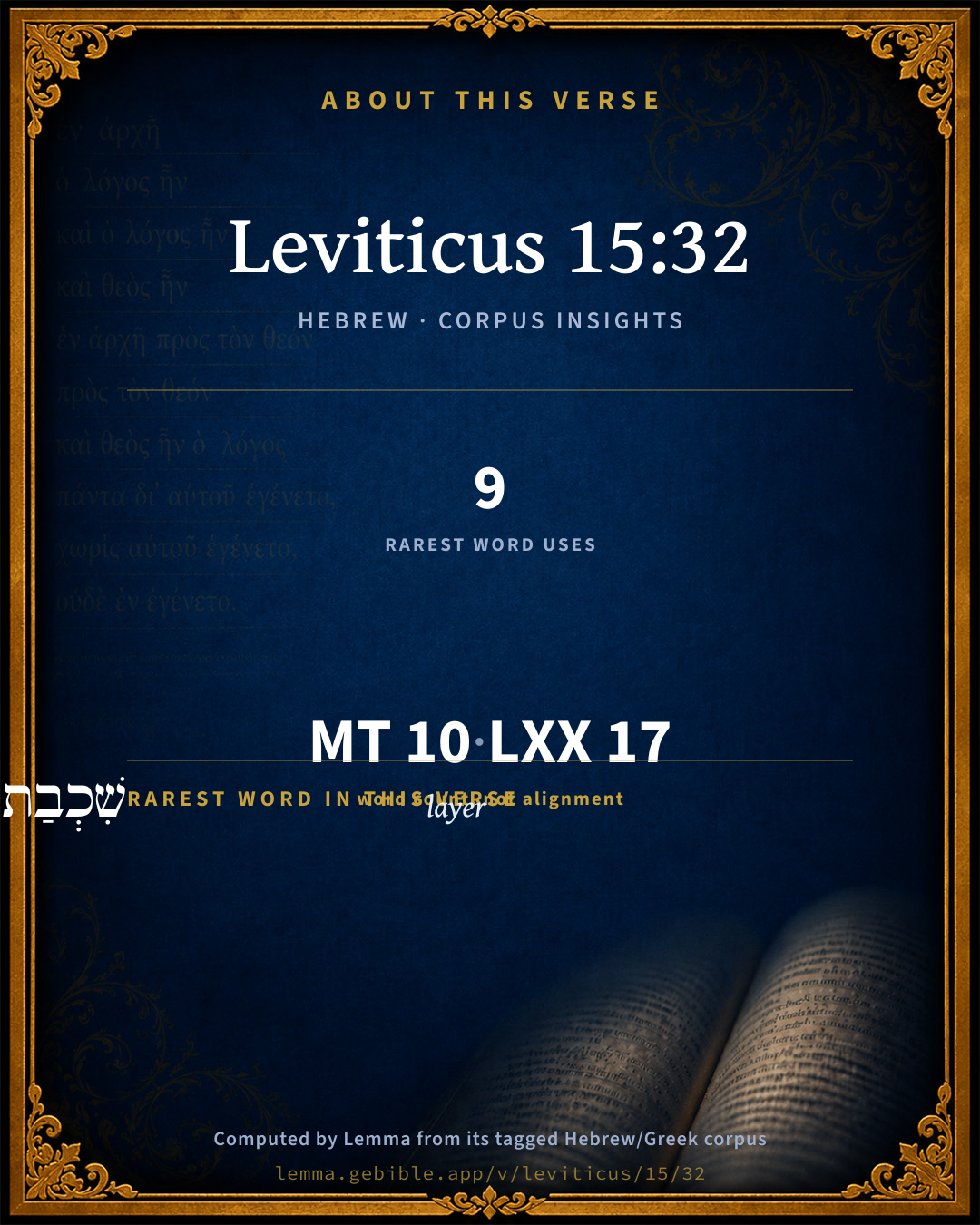
10
words
9
distinct lemmas
Pentateuch
section

Notable vocabulary

The rarest word here is שִׁכְבַת layer H7902 — appearing just 9 times in the whole Hebrew Bible.

Shared distinctive vocabulary

שִׁכְבַת layer H7902 occurs in 9 verses of the Hebrew Bible. Also found in:

Grammatical profile

  • 3 verbs
  • 3 nouns
  • 1 pronoun
  • 2 prepositions
  • 1 particle

Verb forms

  • הַזָּ֑ב Qal · Participle Active
  • תֵּצֵ֥א Qal · Imperfect
  • לְטָמְאָה Qal · Infinitive Construct

Hebrew & Septuagint length

In English translation the verse runs 25 words from the Hebrew and 26 from the Septuagint (LXX English) — closely comparable.

A rough comparison of the two English renderings, which tokenize alike — not a word-level alignment.

Word counts can differ between the Hebrew and the Greek without any difference in meaning — e.g. the Hebrew direct-object marker אֵת has no separate Greek word, and Greek often adds the article ὁ.

In the original languages it is 10 Hebrew tokens and 17 Greek tokens — but the two are counted differently (Hebrew bundles its prefixes and suffixes into one token; the Greek is in lemma form), so that isn’t a like-for-like length.

Cross-references

9

Topical passages linked to Leviticus 15:32 in the Treasury of Scripture Knowledge — connected by theme and wording, ordered by reader-vote popularity; previews shown in the World English Bible.

  • Leviticus 11:46 "'This is the law of the animal, and of the bird, and of every living creature that moves in the waters, and of every creature that creeps on the earth,
  • Leviticus 13:59 This is the law of the plague of mildew in a garment of wool or linen, either in the warp, or the woof, or in anything of skin, to pronounce it clean, or to pronounce it unclean.
  • Leviticus 14:2 "This shall be the law of the leper in the day of his cleansing. He shall be brought to the priest,
  • Leviticus 14:32 This is the law for him in whom is the plague of leprosy, who is not able to afford the sacrifice for his cleansing.
  • Leviticus 14:54–15:18 This is the law for any plague of leprosy, and for an itch,
  • Numbers 5:29 "This is the law of jealousy, when a wife, being under her husband, goes astray, and is defiled;
  • Numbers 6:13 "This is the law of the Nazirite: when the days of his separation are fulfilled, he shall be brought to the door of the Tent of Meeting,
  • Numbers 19:14 This is the law when a man dies in a tent: everyone who comes into the tent, and everyone who is in the tent, shall be unclean seven days.
  • Ezekiel 43:12 This is the law of the house: on the top of the mountain the whole limit of it round about shall be most holy. Behold, this is the law of the house.

Cross-references courtesy of OpenBible.info (CC BY 4.0).

Hebrew and Greek witnesses Masoretic Hebrew ↔ Greek Septuagint

The same verse in the two great witnesses to the Old Testament, shown verse-for-verse.

These are two independent witnesses, not word-aligned to each other, and the Septuagint is shown in lemma (dictionary) form.

Hebrew Leviticus 15:32 Masoretic · Westminster Leningrad Codex

זֹ֥את תּוֹרַ֖ת הַזָּ֑ב וַאֲשֶׁ֨ר תֵּצֵ֥א מִמֶּ֛נּוּ שִׁכְבַת זֶ֖רַע לְטָמְאָה בָֽהּ

This is the law of him who has a discharge, and of him who has an emission of semen, so that he is unclean thereby;

World English Bible · Public Domain

Greek LXX Leviticus 15:32 Septuagint · lemma form

οὗτος ὁ νόμος ὁ γονορρυής καί ἐάν τις ἐκἔρχομαι ἐκ αὐτός κοίτη σπέρμα ὥστε μιαίνω ἐν αὐτός

This is the law of the man who has an issue, and if one discharge seed of copulation, so that he should be polluted by it.

LXX2012 (modern English Septuagint) · Public Domain

Hebrew: Westminster Leningrad Codex (CC BY 4.0). Greek: Septuagint (public domain); English from LXX2012 (modern English Septuagint) (Public Domain). How the Septuagint differs from the Hebrew →

Targum (Aramaic paraphrase)

2

The Targum is the ancient Jewish Aramaic paraphrase of the Hebrew Scriptures — an interpretive translation, not the Hebrew text itself. Onkelos (literal) and Pseudo-Jonathan (expansive) render the Torah, and Jonathan the Prophets. Coverage is partial: where no permissively-licensed English translation exists for a verse, only the Aramaic is shown. This is verse-level text, not a word-by-word alignment to the Hebrew.

  1. Targum Onkelos Torah (Genesis–Deuteronomy)
    דָא אוֹרַיְתָא דְדוֹבָנָא וְדִי תִפּוֹק מִנֵהּ שִּׁכְבַת זַרְעָא לְאִסְתָּאָבָא בָהּ

    (no public-domain English translation for this verse)

    Targum Onkelos — Aramaic: “Onkelos Genesis” (public domain); “Onkelos Exodus” (public domain); “Onkelos Leviticus” (public domain); “Onkelos Numbers” (public domain); “Onkelos Deuteronomy” (public domain). English: “Sefaria Community Translation” (CC0 1.0 (public-domain dedication)); “J.W. Etheridge. The Targums of Onkelos and Jonathan Ben Uzziel on the Pentateuch. London: Longmans, Green, 1862” (public domain). Text via Sefaria.

  2. Targum Pseudo-Jonathan Torah (Genesis–Deuteronomy)
    דָא גְזֵירַת אַחֲוָיַית דוֹבָנָא וּמִן דְיִפּוֹק מִנֵיהּ שׁוּכְבַת זַרְעָא לְאִיסְתַּאֲבָא בָּהּ

    This is the decree of instruction for him who hath a defluxion, and for him whose seed goeth forth and defileth him;

    Targum Pseudo-Jonathan — Aramaic: “Targum Jonathan on Genesis” (public domain); “Targum Jonathan on Exodus” (public domain); “Targum Jonathan on Leviticus” (public domain); “Targum Jonathan on Numbers” (public domain); “Targum Jonathan on Deuteronomy” (public domain). English: “The Targum of Jonathan ben Uzziel, trans. J. W. Etheridge, London, 1862” (public domain). Text via Sefaria.

Commentary

Notes on Leviticus 15:32 from classic Christian and Jewish commentators (each source and its license shown beneath its notes). The classic Christian expositions comment on the surrounding passage and are grouped to its opening verse, so a note may address several verses; the Jewish commentaries on the Tanakh (Rashi and others) are per-verse, so they appear only where the commentator wrote on this verse.

Lemma curates 59 commentaries, every one of them public domain or Creative Commons licensed, each selected and text-cleaned for this edition rather than reprinted as found. About our sources →

Tyndale Open Study Notes

Tyndale Open Resources

15:32-33 A summary of the principles stated in 15:1-31. Bodily discharges—whether pus, semen, menstrual fluid, or blood—made an individual ceremonially unclean.

Tyndale Open Study Notes — © Tyndale Open Resources, licensed CC BY-SA 4.0. Text via the HelloAO Bible API.

Ellicott's Commentary for English Readers

(32, 33) This is the law.—These two verses give a summary of the contents of the chapter. In the recapitulation, however, as we have already seen, the order of the enactments is not strictly adhered to.

A Bible Commentary for English Readers, edited by Charles John Ellicott (1878–1897) — public domain. Text from a community e-Sword module.

The Cambridge Bible for Schools and Colleges

gen. ed. J. J. S. Perowne

32, 33. The concluding vv. include all the cases mentioned in this chapter. Cp. the conclusion to ch. 11.

The gradations in the methods of cleansing should be noted: (a) the uncleanness lasted till the end of the day, and ceased without any further ceremonial, ‘he shall be unclean until the even’; (b) washing the clothes and bathing in running water is added (Lev_15:13); (c) sacrifices must also be offered, for the leper, a woman in childbirth (ch. 12) and two cases in ch. 15 (Lev_15:15; Lev_15:30).

The Cambridge Bible for Schools and Colleges (gen. ed. J. J. S. Perowne; Cambridge University Press, 1878–1918) — public domain. Text from a community e-Sword module.

Keil & Delitzsch

C. F. Keil & F. Delitzsch

Concluding formula. The words, "him that lieth with her that is unclean," are more general than the expression, "lie with her," in Lev 15:24, and involve not only intercourse with an unclean woman, but lying by her side upon one and the same bed.

Keil & Delitzsch — Biblical Commentary on the Old Testament (1861–1891) — public domain (CC PDM 1.0). Text via the HelloAO Bible API. (Old Testament only.)

unfoldingWord translationNotes

Door43 World Missions Community

These are the regulations

"These are the things that must be done"

makes him unclean ... an unclean woman

People whom other people may not touch are spoken of as if they were physically unclean. (See: Metaphor)

who has a menstrual period

"who is menstruating" or "who is bleeding from her womb"

translationWords

seed

had relations with

unfoldingWord translationNotes — © Distant Shores Media and the Door43 World Missions Community, licensed CC BY-SA 4.0. Source: git.door43.org/Door43/en_tn.

Rashi

Rabbi Shlomo Yitzchaki (Rashi)

זאת תורת הזב THIS IS THE LAW OF HIM THAT HATH AN ISSUE, i.e. anyone who has but one appearance of flux. And what is his law?

ואשר תצא ממנו שכבת זרע, he is like him to whom a pollution happened: he is unclean with an uncleanness lasting only till the evening (Sifra, Metzora Parashat Zavim, Chapter 9 8; cf. v. 16).

Rashi on the Tanakh — English translations: “The Judaica Press complete Tanach with Rashi, translated by A. J. Rosenberg” (CC BY 4.0); “Pentateuch with Rashi's commentary by M. Rosenbaum and A.M. Silbermann, 1929-1934” (public domain); “The Metsudah Tanach series, Lakewood, N.J” (CC BY 4.0); and “The Book of Joshua, Metsudah Publications, 1997” (CC BY 4.0). Text via Sefaria.

Lesson kit

Teaching starters — assembled from the data on this page, not authored interpretation. Every prompt links to the verse data it draws on. Edit before teaching.

Leviticus, in the Pentateuch, opens this verse with 10 words (9 distinct Hebrew lemmas). Its most distinctive word is shᵉkâbâh (“layer”). A historical commentator’s framing appears above. Read the whole chapter for the surrounding context.

Discussion questions

  1. The word shᵉkâbâh carries the sense “layer.” How does it shape the verse?
  2. How does Exodus 16:13, which shares the word «layer», read alongside this verse?
  3. These translations render this verse differently. What is at stake in choosing one wording over another?
  4. «הַזָּ֑ב» is a Qal Participle Active verb. How does that grammatical form shape the action described?
  5. Compare how Tyndale Open Study Notes and Ellicott's Commentary for English Readers read this verse. Where do they agree or differ?

Things to notice

Reading settings

Reading text

Shown beneath each verse's original-language words.

Old Testament
Old Testament edition

Read the OT as the Masoretic Hebrew (MT) or the Greek Septuagint (LXX).

English shown for the Greek Septuagint (in the Hebrew ↔ Greek comparison).

Comparing translations? Open the Compare panel on any verse page to stack up to four side by side.