
Amos 7:3

Hebrew (Westminster Leningrad Codex) Amos 7:3 appears in the Hebrew Old Testament. The text above is from the Westminster Leningrad Codex. Each word links to its Strong’s number, a concise gloss, and parsing drawn from the Open Scriptures Hebrew Bible morphology. Click any word for its full Brown-Driver-Briggs (BDB) entry.
Download image
Cite this verse

Amos 7:3 (World English Bible). Public Domain. Lemma interlinear Bible study tool, https://lemma.gebible.app/v/amos/7/3.

Show BibTeX & RIS
BibTeX
RIS
English Translation
Yahweh relented concerning this. "It shall not be," says Yahweh.
World English Bible · Public Domain
Download a study sheet

One document with this verse’s original text, its word-by-word gloss line, the meaning frame, cross-references with their text, attributed commentary, and full source and license credits — printable, and it pastes into notes with its structure intact.

This verse Autodidact and up

Study sheet (.html) Plain text (.txt)

A passage Seminary Student

Up to 50 verses in one chapter. A passage sheet keeps up to 6 commentary sources and 12 cross-references per verse, in the order this page ranks them, and says so on the sheet whenever that leaves anything out. Ask for a single verse and you get the Autodidact verse sheet above.

Everything on this page stays free to read, with no account — the sheet is a download of what is already on screen, not access to it.

Want to remove ads? Support Godless Engineer
Compare translations 3

The same verse in 3 English versions, stacked beneath the original-language interlinear above. Click any original word for its lexicon entry.

Each is an independent rendering of the whole verse — the interlinear is not word-aligned to these translations.

Highlighted words mark where these versions differ — a whole-verse word diff, not a word-by-word alignment.

  • World English Bible Public Domain
    Yahweh relented concerning this. "It shall not be," says Yahweh.
  • King James Version Public Domain
    The LORD repented for this: It shall not be, saith the LORD.
  • unfoldingWord Literal Text CC BY-SA 4.0
    Yahweh relented concerning this. “It will not happen,” he said.

unfoldingWord Literal Text — © unfoldingWord, licensed CC BY-SA 4.0. Word-aligned USFM3 via Door43 (git.door43.org/unfoldingWord/en_ult).

Versions to compare (up to 4)

3 of 4 selected

Show all 18 translations

Every available English version of this verse, each an independent rendering of the whole verse.

  • World English Bible Public Domain
    Yahweh relented concerning this. "It shall not be," says Yahweh.
  • Berean Standard Bible Public Domain
    So the LORD relented from this plan. “It will not happen,” He said.
  • Majority Standard Bible Public Domain
    So the LORD relented from this plan. “It will not happen,” He said.
  • King James Version Public Domain
    The LORD repented for this: It shall not be, saith the LORD.
  • American Standard Version (1901) Public Domain
    Jehovah repented concerning this: It shall not be, saith Jehovah.
  • Revised Version (1885) Public Domain
    The LORD repented concerning this: It shall not be, saith the LORD.
  • Geneva Bible (1599) Public Domain
    So the Lord repented for this. It shall not be, saith the Lord.
  • Douay-Rheims (1899) Public Domain
    The Lord had pity upon this: It shall not be, said the Lord.
  • Young's Literal Translation Public Domain
    Jehovah hath repented of this, `It shall not be,' said Jehovah.
  • Literal Standard Version CC BY-SA 4.0
    YHWH has relented of this, “It will not be,” said YHWH.
  • Unlocked Literal Bible CC BY-SA 4.0
    Yahweh relented concerning this. “It will not happen,” he said.
  • unfoldingWord Literal Text CC BY-SA 4.0
    Yahweh relented concerning this. “It will not happen,” he said.
  • Darby Bible Public Domain
    Jehovah repented for this: It shall not be, said Jehovah.
  • World Messianic Bible Public Domain
    The LORD relented concerning this. “It shall not be,” says the LORD.
  • Webster's Bible Public Domain
    The LORD repented for this: It shall not be, saith the LORD.
  • Free Bible Version CC BY-SA 4.0
    So the Lord changed his mind. “It won't happen,” said the Lord.
  • Bible in Basic English Public Domain
    The Lord, changing his purpose about this, said, It will not be.
  • JPS Tanakh (1917) Public Domain
    The LORD repented concerning this; 'It shall not be', saith the LORD.

Literal Standard Version (2020), Covenant Press — licensed CC BY-SA 4.0. Text via the HelloAO Bible API (eBible.org). Unlocked Literal Bible (unfoldingWord) — licensed CC BY-SA 4.0. Text via the HelloAO Bible API (eBible.org). unfoldingWord Literal Text — © unfoldingWord, licensed CC BY-SA 4.0. Word-aligned USFM3 via Door43 (git.door43.org/unfoldingWord/en_ult). Free Bible Version, Dr. Jonathan Gallagher — licensed CC BY-SA 4.0. Text via the HelloAO Bible API (eBible.org).

Word by word

More ways to search: Search by grammar → Find every occurrence → Compare this word →

Practice this passage: Drill this verse → Learn its vocabulary →

נִחַ֥ם
nâcham
H5162
“to comfort”
Verb, Niphal, Perfect, 3rd Person, Masculine, Singular
Part of Speech
Verb
Stem
Niphal
Form
Perfect
Person
3rd Person
Gender
Masculine
Number
Singular
Full BDB Definition

Origin: a primitive root

TWOT: 1344

to be sorry, console oneself, repent, regret, comfort, be comforted - (Niphal) - to be sorry, be moved to pity, have compassion - to be sorry, rue, suffer grief, repent - to comfort oneself, be comforted - to comfort oneself, ease oneself - (Piel) to comfort, console - (Pual) to be comforted, be consoled - (Hithpael) - to be sorry, have compassion - to rue, repent of - to comfort oneself, be comforted - to ease oneself
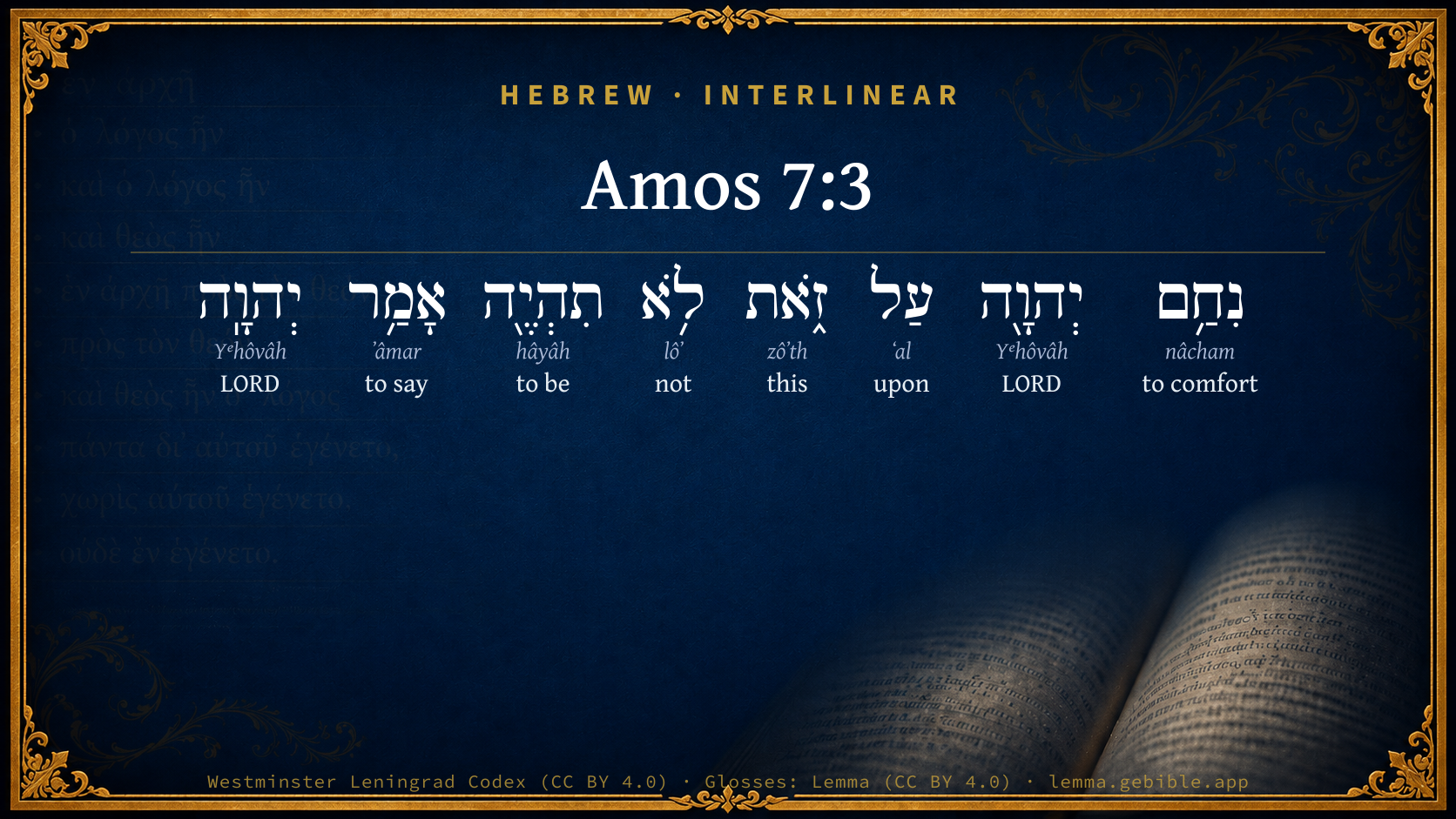
  1. יְהוָ֖ה Yᵉhôvâh H3068 “LORD” Noun, Proper
  2. עַל ʻal H5921 “upon” Preposition
  3. זֹ֑את zôʼth H2063 “this” Pronoun, Demonstrative, Feminine, Singular
  4. לֹ֥א lôʼ H3808 “not” Particle, Negative
  5. תִהְיֶ֖ה hâyâh H1961 “to be” Verb, Qal, Imperfect, 3rd Person, Feminine, Singular
  6. אָמַ֥ר ʼâmar H559 “to say” Verb, Qal, Perfect, 3rd Person, Masculine, Singular
  7. יְהוָֽה Yᵉhôvâh H3068 “LORD” Noun, Proper

About this verse

These counts appear in no published source. They are computed here, from the morphology-tagged text and Lemma’s own curated glosses. What Lemma adds →

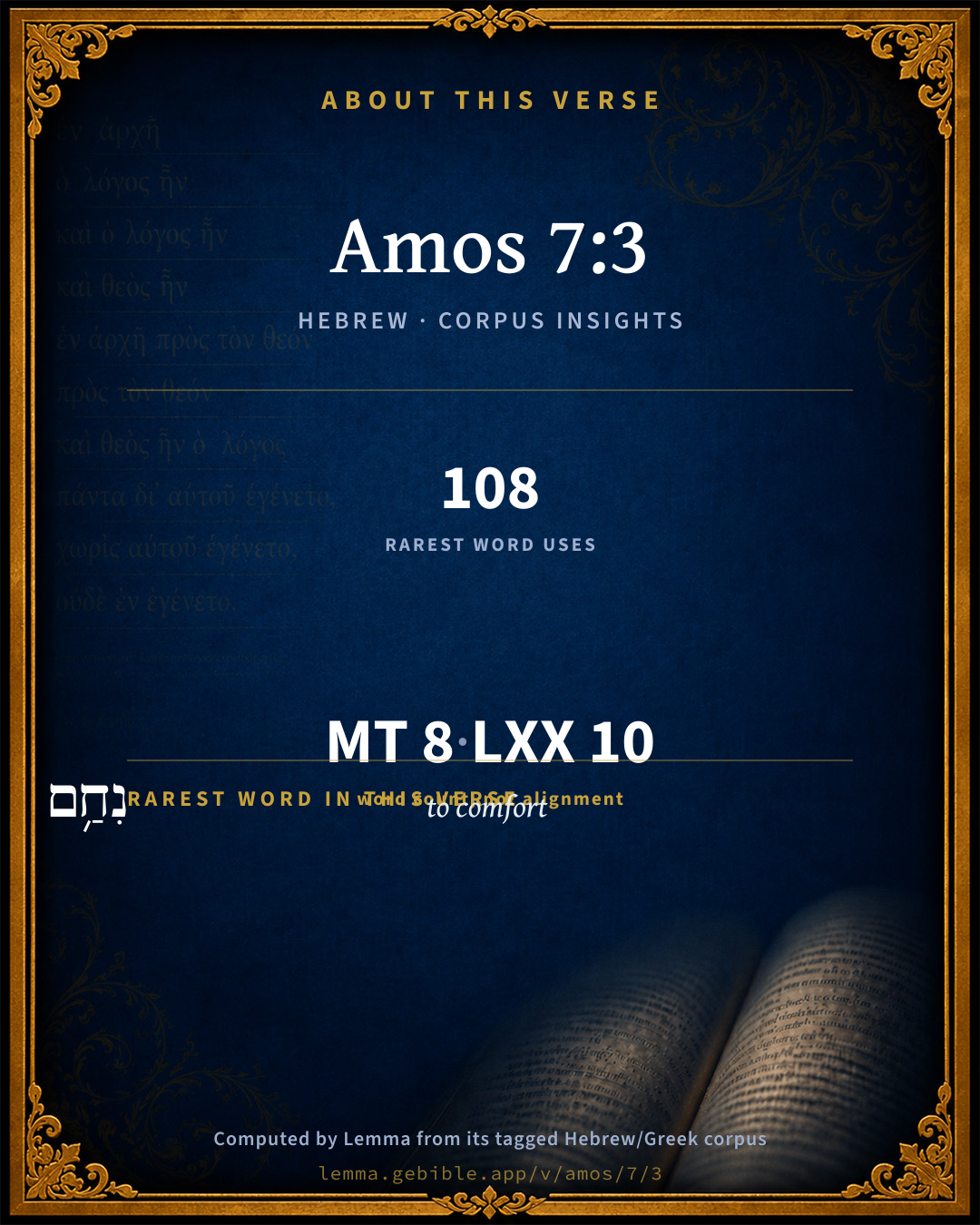
8
words
7
distinct lemmas
Prophets
section

Grammatical profile

  • 3 verbs
  • 2 nouns
  • 1 pronoun
  • 1 preposition
  • 1 particle

Verb forms

  • נִחַ֥ם Niphal · Perfect
  • תִהְיֶ֖ה Qal · Imperfect
  • אָמַ֥ר Qal · Perfect

Repetition

A word recurs within this verse — often emphatic in Hebrew:

  • יְהוָ֖ה LORD H3068 ×2

Hebrew & Septuagint length

In English translation the verse runs 10 words from the Hebrew and 13 from the Septuagint (LXX English) — closely comparable.

A rough comparison of the two English renderings, which tokenize alike — not a word-level alignment.

Word counts can differ between the Hebrew and the Greek without any difference in meaning — e.g. the Hebrew direct-object marker אֵת has no separate Greek word, and Greek often adds the article ὁ.

In the original languages it is 8 Hebrew tokens and 10 Greek tokens — but the two are counted differently (Hebrew bundles its prefixes and suffixes into one token; the Greek is in lemma form), so that isn’t a like-for-like length.

Cross-references

9

Topical passages linked to Amos 7:3 in the Treasury of Scripture Knowledge — connected by theme and wording, ordered by reader-vote popularity; previews shown in the World English Bible.

  • Deuteronomy 32:36 For Yahweh will judge his people, Repent himself for his servants; When he sees that [their] power is gone, There is none [remaining], shut up or left at large.
  • Jonah 3:10 God saw their works, that they turned from their evil way. God repented of the evil which he said he would do to them, and he didn't do it.
  • Hosea 11:8 "How can I give you up, Ephraim? How can I hand you over, Israel? How can I make you like Admah? How can I make you like Zeboiim? My heart is turned within me, My compassion is aroused.
  • Psalms 106:45 He remembered for them his covenant, And repented according to the multitude of his loving kindnesses.
  • Joel 2:14 Who knows? He may turn and relent, And leave a blessing behind him, Even a meal offering and a drink offering to Yahweh, your God.
  • Amos 7:6 Yahweh relented concerning this. "This also shall not be," says the Lord Yahweh.
  • Jeremiah 26:19 Did Hezekiah king of Judah and all Judah put him to death? Didn't he fear Yahweh, and entreat the favor of Yahweh, and Yahweh repented him of the evil which he had pronounced against them? Thus should we commit great evil against our own souls.
  • James 5:16 Confess your offenses to one another, and pray one for another, that you may be healed. The effective, earnest prayer of a righteous man is powerfully effective.
  • 1 Chronicles 21:15 God sent an angel to Jerusalem to destroy it: and as he was about to destroy, Yahweh saw, and he repented him of the evil, and said to the destroying angel, It is enough; now stay your hand. The angel of Yahweh was standing by the threshing floor of Ornan the Jebusite.

Cross-references courtesy of OpenBible.info (CC BY 4.0).

Hebrew and Greek witnesses Masoretic Hebrew ↔ Greek Septuagint

The same verse in the two great witnesses to the Old Testament, shown verse-for-verse.

These are two independent witnesses, not word-aligned to each other, and the Septuagint is shown in lemma (dictionary) form.

Hebrew Amos 7:3 Masoretic · Westminster Leningrad Codex

נִחַ֥ם יְהוָ֖ה עַל זֹ֑את לֹ֥א תִהְיֶ֖ה אָמַ֥ר יְהוָֽה

Yahweh relented concerning this. "It shall not be," says Yahweh.

World English Bible · Public Domain

Greek LXX Amos 7:3 Septuagint · lemma form

μετανοέω κύριος ἐπί οὗτος καί οὗτος οὐ εἰμί λέγω κύριος

Repent, O Lord, for this. And this shall not be, says the Lord.

LXX2012 (modern English Septuagint) · Public Domain

On this verse, Haydock's Catholic Bible Commentary discusses the Septuagint’s reading. Read the note in Commentary ↓

Hebrew: Westminster Leningrad Codex (CC BY 4.0). Greek: Septuagint (public domain); English from LXX2012 (modern English Septuagint) (Public Domain). How the Septuagint differs from the Hebrew →

Targum (Aramaic paraphrase)

1

The Targum is the ancient Jewish Aramaic paraphrase of the Hebrew Scriptures — an interpretive translation, not the Hebrew text itself. Onkelos (literal) and Pseudo-Jonathan (expansive) render the Torah, and Jonathan the Prophets. Coverage is partial: where no permissively-licensed English translation exists for a verse, only the Aramaic is shown. This is verse-level text, not a word-by-word alignment to the Hebrew.

  1. Targum Jonathan Prophets (Joshua–Malachi)
    אָתִיב יְיָ רוּגְזֵיהּ עַל דָא לָא תִתְקַיֵים אֲמַר יְיָ:

    (no public-domain English translation for this verse)

    Targum Jonathan — Aramaic: “Mikraot Gedolot” (public domain). English: “Sefaria Community Translation” (CC0 1.0 (public-domain dedication)); “London "Chaldee Paraphrase," 1871” (public domain). Text via Sefaria.

Commentary

Notes on Amos 7:3 from classic Christian and Jewish commentators (each source and its license shown beneath its notes). The classic Christian expositions comment on the surrounding passage and are grouped to its opening verse, so a note may address several verses; the Jewish commentaries on the Tanakh (Rashi and others) are per-verse, so they appear only where the commentator wrote on this verse.

Lemma curates 59 commentaries, every one of them public domain or Creative Commons licensed, each selected and text-cleaned for this edition rather than reprinted as found. About our sources →

Trapp's Complete Commentary

John Trapp

Amo 7:3 The LORD repented for this: It shall not be, saith the LORD.

Ver. 3. The Lord repented for this: It shall not be, saith the Lord] Here was mutatio rei, non Dei; facti, non consilii: a change, not of God’s will, but of his work; therefore (by way of explication) it followeth, "It shall not be, saith the Lord." To speak properly, there can be no repentance in God, 1Sa 15:20, but this is spoken after the manner of men; and it notably setteth forth the power of faithful prayer, able, after a sort, to alter God’s mind, and to transfuse a dead palsy into the hands of omnipotence, Exo 32:10, where God is fain to bespeak his own freedom; and Moses is represented as the great chancellor of heaven.

John Trapp, A Commentary or Exposition upon All the Books of the Old and New Testament (1647–1656) — public domain. Text from a community e-Sword module.

Tyndale Open Study Notes

Tyndale Open Resources

7:3-6 The Lord relented twice in response to Amos’s intercession.

Tyndale Open Study Notes — © Tyndale Open Resources, licensed CC BY-SA 4.0. Text via the HelloAO Bible API.

Geneva Bible (1599)

Geneva Bible translators

That is, stayed this plague at my prayer.

Geneva Bible (1599) marginal notes — public domain. Text via Bolls.life.

Jamieson, Fausset & Brown

Robert Jamieson, A. R. Fausset & David Brown

repented for this--that is, of this. The change was not in the mind of God (Num 2:19; Jam 1:17), but in the effect outwardly. God unchangeably does what is just; it is just that He should hear intercessory prayer (Jam 5:16-18), as it would have been just for Him to have let judgment take its course at once on the guilty nation, but for the prayer of one or two righteous men in it (compare Gen 18:23-33; Sa1 15:11; Jer 42:10). The repentance of the sinner, and God's regard to His own attributes of mercy and covenanted love, also cause God outwardly to deal with him as if he repented (Jon 3:10), whereas the change in outward dealing is in strictest harmony with God's own unchangeableness.

It shall not be--Israel's utter overthrow now. Pul was influenced by God to accept money and withdraw from Israel.

Jamieson, Fausset & Brown — Commentary Critical and Explanatory on the Whole Bible (1871) — public domain (CC PDM 1.0). Text via the HelloAO Bible API.

Adam Clarke's Commentary

Verse 3. The Lord repented] Changed his purpose of destroying them by the locusts. See Am 7:6.

Adam Clarke's Commentary on the Bible (1810–1826) — public domain. Text from a community e-Sword/MySword module.

Ellicott's Commentary for English Readers

(3) The Lord repented.—The judgment is withheld. On the anthropomorphism of Jehovah repenting, comp. Gen_6:5 and other passages.

A Bible Commentary for English Readers, edited by Charles John Ellicott (1878–1897) — public domain. Text from a community e-Sword module.

The Cambridge Bible for Schools and Colleges

gen. ed. J. J. S. Perowne

3. concerning this] viz. concerning the further undefined calamity, which He had purposed, and of which Amos had rightly interpreted the locusts as being the harbinger. “God is said to repent” (lit., as Arabic seems to shew, to sigh deeply, or groan) “upon (or over) evil, which He has either inflicted (Deu_32:36), or has said that He would inflict (Exo_32:12, Joe_2:13, Jon_3:10, Jer_18:8), and which, upon repentance or prayer, He suspends or checks” (Pusey).

The Cambridge Bible for Schools and Colleges (gen. ed. J. J. S. Perowne; Cambridge University Press, 1878–1918) — public domain. Text from a community e-Sword module.

John Gill's Exposition

The Lord repented for this,.... He heard the prayer of the prophet, and at his intercession averted, the threatened judgment; thus the effectual fervent prayer of a righteous man avails much, Jam 5:16; this is spoken after the manner of men; as men, when they repent of a thing, desist from it, so the Lord desisted from going on with this judgment; he did not change his mind, but changed the dispensations of his providence according to his mind and will:

it shall not be, saith the Lord; these grasshoppers or locusts, the Assyrian army, shall not at this time destroy the land of Israel: Pul king of Assyria took a sum of money of the king of Israel, and so turned back, and stayed not in the land, Kg2 15:19.

John Gill's Exposition of the Whole Bible (1746–1763) — public domain (CC PDM 1.0). Text via the HelloAO Bible API.

Albert Barnes' Notes on the Bible

The Lord repented for this - God is said to “repent, to have strong compassion upon” or “over” evil, which He has either inflicted Deu 32:36; 1Ch 21:15, or has said that He would inflict Exo 32:12; Joe 2:13; Jon 3:10; Jer 18:8, and which, upon repentance or prayer, He suspends or checks. Here, Amos does not intercede until after the judgment had been, in part, inflicted. He prayed, when in vision the locust “had made an end of eating the grass of the land,” and when “the fire had eaten up a part.” Nor, until Israel had suffered what these visions foretold, was he “small,” either in his own or in human sight, or in relation to his general condition. The “this” then, “of which God repented” and said, “it shall not be,” is that further undefined evil, which His first infliction threatened. Evil and decay do not die out, but destroy. Oppression does not weary itself out, but increases. Visitations of God are tokens of His displeasure, and, in the order of His justice, rest on the sinner. Pul and Tiglath-pileser, when they came with their armies on Israel, were instruments of God’s chastening. According to the ways of God’s justice, or of man’s ambition, the evil now begun, would have continued, but that God, at the prayer of the prophet, said, “Hitherto shalt thou come, and no further” Job 38:11.

Albert Barnes' Notes on the Bible (1834–1885) — public domain. Text from a community e-Sword/MySword module.

Haydock's Catholic Bible Commentary

The. Septuagint, "Repent, O Lord, on this head, and this shall," &c. --- Not be: the grass shall not be totally devoured. (Haydock) --- The king of the Assyrians invaded Juda in vain, 4 Kings xix. (Worthington)

George Leo Haydock (1774–1849), Haydock's Catholic Family Bible and Commentary, 1859 edition — public domain. Excludes Psalms (Douay-Rheims chapter numbering differs from Protestant) and Deuterocanonical books (Catholic canon only).

Matthew Poole's English Annotations

The Lord repented; this, spoke after the manner of man, is to be understood as becomes the immutability and omniscience of God; what a man when he repenteth doth, desisting front the thing, so God, desisting or suspending his own act, doth tell us he repenteth.

It shall not be: this explains the former; that sore famine like to be caused by these locusts came not, Amos prevailed by prayer, and the judgment was diverted.

Matthew Poole's English Annotations on the Holy Bible (1683–1685) — public domain. Text from a community e-Sword/MySword module.

The Pulpit Commentary

Repented for this; or, concerning this destruction. The punishment was conditioned by man"s behaviour or other considerations. Here the prophet"s intercession abates the full infliction of the penalty (compare analogous expressions, Deu_32:36 1Sa_15:11 2Sa_24:16 Jer_18:8 Jer_42:10 Jon_3:10, where see note). Amos may have had in memory the passage in Joe_2:13. The LXX here and in ver. 6 has Metanohson Kurie epi toutw kai touto ouk estai legei Kuriov , "Repent, O Lord, for this; and this shall not be, saith the Lord." Hence some early commentators gathered that the prophet"s intercession was rejected; but the words do not necessarily bear that sense (see St. Cyril Alex. and Theodoret, in loc.). It shall not be. This respite refers to the retreat of the Assyrians under Pul, the usurping monarch who assumed the name of Tiglath-Pileser II (2Ki_15:17, etc.) Some commentators consider the judgment to be literally plague of locusts; but this is not probable.

The repentance of Jehovah.

Whatever it was of which the Lord is here said to have repented, the meaning, the lesson, is the same. The plague of locusts, the incursion of the foe, was stayed, and it was stayed in consequence of the prophet"s intercession, and because of the pity and loving kindness of Jehovah.

I NO CHANGE IS ASSERTED IN THE CHARACTER, THE GOVERNMENT, THE WILL, OF THE ETERNAL. In this sense the Lord is not a man that he should repent. Whilst all men are subject not only to vicissitudes of circumstances, but to variations in disposition, and even in principles of action, God is a stranger to all such mutability. "I," says he, "am the Lord that changeth not." Well for us is it that this is so; that we have not to do with a mutable, a capricious deity. Because he is the Lord that changeth not, therefore the sons of Jacob are not consumed.

II BUT ALL THE THREATS OF THE DIVINE JUDGE ARE CONDITIONAL UPON HUMAN CONDUCT. The whole of revelation bears out this statement. What God commands he enforces with the promise of reward and with the threat of punishment. This is in accordance with his character and position as the Moral Governor of his universe. He does not, as an earthly tyrant might do, take pleasure in inflicting punishment upon any of his dependent creatures. On the contrary, he desireth not the death of a sinner. If the threatened respond to the appeal of Heaven, if they turn from their wickedness, they shall surely live, and not die. He repenteth him of the evil, and is favourable and forgiving towards the penitent.

III THE DIVINE REPENTANCE DEMANDS THE ADORATION AND THE PRAISE OF THOSE WHO OWE TO IT THEIR SALVATION. There is not one child of Adam who is not indebted to the repentance of Jehovah for the sparing of life, for long suffering, for the aversion of judgment. In fact, but for this, the original sentence against the sinner must have been fulfilled, and the race of mankind must have perished. Every successive interposition of Divine mercy has been the evidence of that relenting which exclaims, "How shall I give thee up?" And the advent and sacrifice of Immanuel, the mediatorial scheme, the redemption of mankind, the recovery of the lost, are all to be attributed to this same cause. The fountain of salvation must be discovered in the repentance of the Unchanging. It is a paradox; but it is a paradox honouring to God and life giving to man. T.

The Pulpit Commentary (1880–1919), ed. H.D.M. Spence-Jones & Joseph S. Exell — public domain. Text from a community e-Sword module.

John Wesley's Explanatory Notes

Repented - This is spoken after the manner of men.

John Wesley, Explanatory Notes Upon the Whole Bible (1754–1765) — public domain. Text via the GEBible commentary corpus.

Scofield Reference Notes

C. I. Scofield

repented

(See Scofield "Zec 8:14").

The Scofield Reference Bible (1917 edition), notes by C. I. Scofield — public domain. Text from a community e-Sword module.

Rashi

Rabbi Shlomo Yitzchaki (Rashi)

The Lord relented concerning this—He acquiesced to my prayer and was entreated of me.

Rashi on the Tanakh — English translations: “The Judaica Press complete Tanach with Rashi, translated by A. J. Rosenberg” (CC BY 4.0); “Pentateuch with Rashi's commentary by M. Rosenbaum and A.M. Silbermann, 1929-1934” (public domain); “The Metsudah Tanach series, Lakewood, N.J” (CC BY 4.0); and “The Book of Joshua, Metsudah Publications, 1997” (CC BY 4.0). Text via Sefaria.

Lesson kit

Teaching starters — assembled from the data on this page, not authored interpretation. Every prompt links to the verse data it draws on. Edit before teaching.

Amos, in the Prophets, opens this verse with 8 words (7 distinct Hebrew lemmas). Its most distinctive word is nâcham (“to comfort”). A historical commentator’s framing appears above. Read the whole chapter for the surrounding context.

Discussion questions

  1. What does “to comfort” (nâcham) contribute to the verse as a whole?
  2. Deuteronomy 32:36 shares this passage’s theme. How do the two illuminate each other?
  3. “LORD” occurs 2× in this one verse. What is the effect of the repetition?
  4. These translations render this verse differently; the difference is in the English rendering, not the original. What questions does that raise?
  5. The verb «נִחַ֥ם» is Niphal Perfect. How does its form color the action?
  6. Reading how Trapp's Complete Commentary and Tyndale Open Study Notes read this verse, where do the two commentators agree and where do they part?

Things to notice

Reading settings

Reading text

Shown beneath each verse's original-language words.

Old Testament
Old Testament edition

Read the OT as the Masoretic Hebrew (MT) or the Greek Septuagint (LXX).

English shown for the Greek Septuagint (in the Hebrew ↔ Greek comparison).

Comparing translations? Open the Compare panel on any verse page to stack up to four side by side.