Numbers 14:8

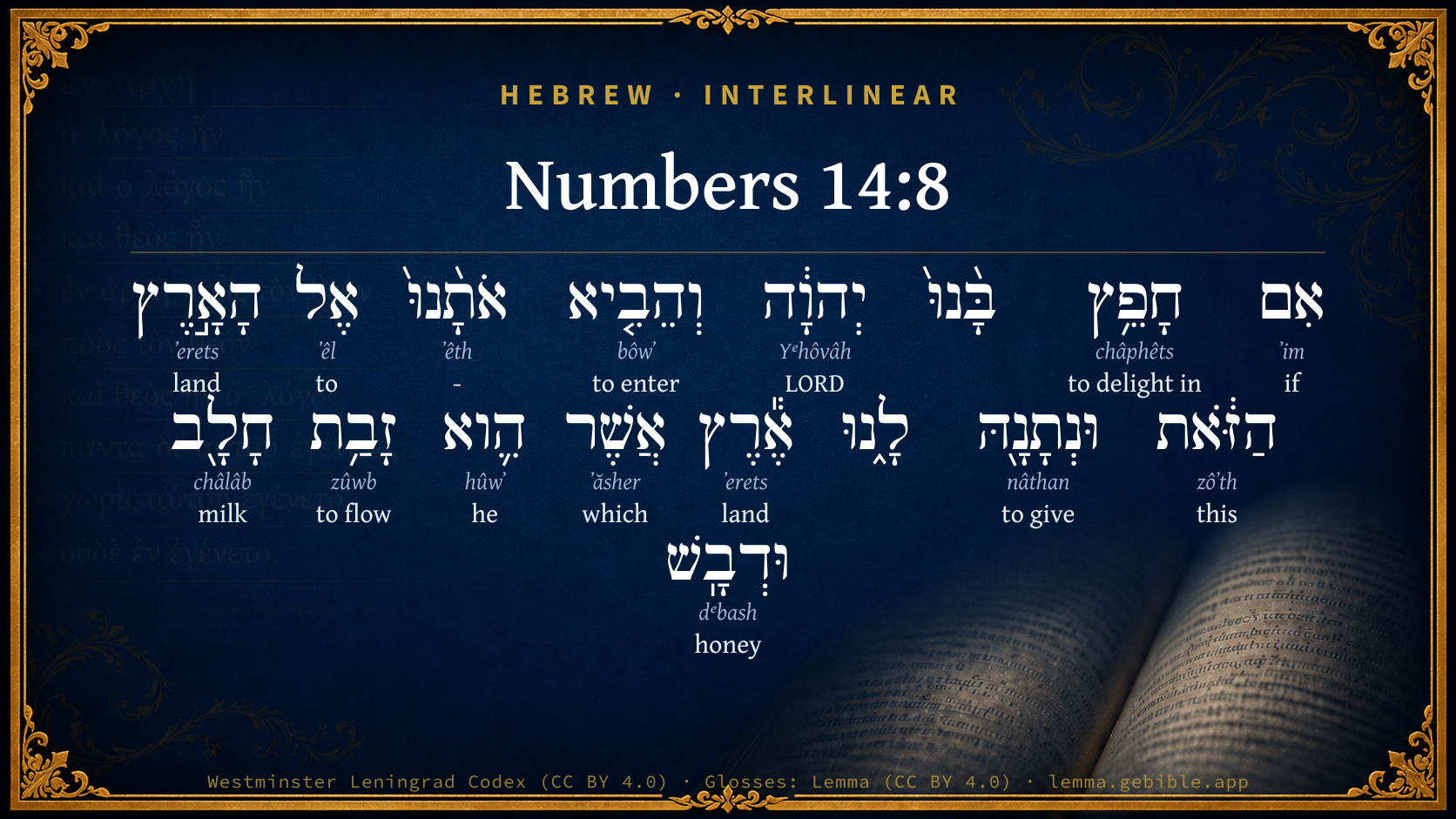
Hebrew (Westminster Leningrad Codex) Numbers 14:8 appears in the Hebrew Old Testament. The text above is from the Westminster Leningrad Codex. Each word links to its Strong’s number, a concise gloss, and parsing drawn from the Open Scriptures Hebrew Bible morphology. Click any word for its full Brown-Driver-Briggs (BDB) entry.
Download image
Cite this verse

Numbers 14:8 (World English Bible). Public Domain. Lemma interlinear Bible study tool, https://lemma.gebible.app/v/numbers/14/8.

Show BibTeX & RIS
BibTeX
RIS
English Translation
If Yahweh delight in us, then he will bring us into this land, and give it to us; a land which flows with milk and honey.
World English Bible · Public Domain
Download a study sheet

One document with this verse’s original text, its word-by-word gloss line, the meaning frame, cross-references with their text, attributed commentary, and full source and license credits — printable, and it pastes into notes with its structure intact.

This verse Autodidact and up

Study sheet (.html) Plain text (.txt)

A passage Seminary Student

Up to 50 verses in one chapter. A passage sheet keeps up to 6 commentary sources and 12 cross-references per verse, in the order this page ranks them, and says so on the sheet whenever that leaves anything out. Ask for a single verse and you get the Autodidact verse sheet above.

Everything on this page stays free to read, with no account — the sheet is a download of what is already on screen, not access to it.

Want to remove ads? Support Godless Engineer
Compare translations 3

The same verse in 3 English versions, stacked beneath the original-language interlinear above. Click any original word for its lexicon entry.

Each is an independent rendering of the whole verse — the interlinear is not word-aligned to these translations.

Highlighted words mark where these versions differ — a whole-verse word diff, not a word-by-word alignment.

  • World English Bible Public Domain
    If Yahweh delight in us, then he will bring us into this land, and give it to us; a land which flows with milk and honey.
  • King James Version Public Domain
    If the LORD delight in us, then he will bring us into this land, and give it us; a land which floweth with milk and honey.
  • unfoldingWord Literal Text CC BY-SA 4.0
    If Yahweh delights in us, then he will bring us to this land, and he will give it to us, a land that is flowing milk and honey.

unfoldingWord Literal Text — © unfoldingWord, licensed CC BY-SA 4.0. Word-aligned USFM3 via Door43 (git.door43.org/unfoldingWord/en_ult).

Versions to compare (up to 4)

3 of 4 selected

Show all 18 translations

Every available English version of this verse, each an independent rendering of the whole verse.

  • World English Bible Public Domain
    If Yahweh delight in us, then he will bring us into this land, and give it to us; a land which flows with milk and honey.
  • Berean Standard Bible Public Domain
    If the LORD delights in us, He will bring us into this land, a land flowing with milk and honey, and He will give it to us.
  • Majority Standard Bible Public Domain
    If the LORD delights in us, He will bring us into this land, a land flowing with milk and honey, and He will give it to us.
  • King James Version Public Domain
    If the LORD delight in us, then he will bring us into this land, and give it us; a land which floweth with milk and honey.
  • American Standard Version (1901) Public Domain
    If Jehovah delight in us, then he will bring us into this land, and give it unto us; a land which floweth with milk and honey.
  • Revised Version (1885) Public Domain
    If the LORD delight in us, then he will bring us into this land, and give it unto us; a land which floweth with milk and honey.
  • Geneva Bible (1599) Public Domain
    If the Lord loue vs, he will bring vs into this land, and giue it vs, which is a land that floweth with milke and honie.
  • Douay-Rheims (1899) Public Domain
    If the Lord be favourable, he will bring us into it, and give us a land flowing with milk and honey.
  • Young's Literal Translation Public Domain
    if Jehovah hath delighted in us, then He hath brought us in unto this land, and hath given it to us, a land which is flowing with milk and honey;
  • Literal Standard Version CC BY-SA 4.0
    if YHWH has delighted in us, then He has brought us into this land, and has given it to us, a land which is flowing with milk and honey;
  • Unlocked Literal Bible CC BY-SA 4.0
    If Yahweh is pleased with us, then he will take us into this land and give it to us. The land flows with milk and honey.
  • unfoldingWord Literal Text CC BY-SA 4.0
    If Yahweh delights in us, then he will bring us to this land, and he will give it to us, a land that is flowing milk and honey.
  • Darby Bible Public Domain
    If Jehovah delight in us, he will bring us into this land, and give it us, a land that flows with milk and honey;
  • World Messianic Bible Public Domain
    If the LORD delights in us, then he will bring us into this land, and give it to us: a land which flows with milk and honey.
  • Webster's Bible Public Domain
    If the LORD delighteth in us, then he will bring us into this land, and give it to us; a land which floweth with milk and honey.
  • Free Bible Version CC BY-SA 4.0
    If the Lord is happy with us, he will take us there and give it to us, a land that's so productive it's like flowing with milk and honey.
  • Bible in Basic English Public Domain
    And if the Lord has delight in us, he will take us into this land and give it to us, a land flowing with milk and honey.
  • JPS Tanakh (1917) Public Domain
    If the LORD delight in us, then He will bring us into this land, and give it unto us — a land which floweth with milk and honey.

Literal Standard Version (2020), Covenant Press — licensed CC BY-SA 4.0. Text via the HelloAO Bible API (eBible.org). Unlocked Literal Bible (unfoldingWord) — licensed CC BY-SA 4.0. Text via the HelloAO Bible API (eBible.org). unfoldingWord Literal Text — © unfoldingWord, licensed CC BY-SA 4.0. Word-aligned USFM3 via Door43 (git.door43.org/unfoldingWord/en_ult). Free Bible Version, Dr. Jonathan Gallagher — licensed CC BY-SA 4.0. Text via the HelloAO Bible API (eBible.org).

Word by word

More ways to search: Search by grammar → Find every occurrence → Compare this word →

Practice this passage: Drill this verse → Learn its vocabulary →

זָבַ֥ת
zûwb
H2100
“flowing”
Verb, Qal, Participle Active, Feminine, Singular, Construct
Part of Speech
Verb
Stem
Qal
Form
Participle Active
Gender
Feminine
Number
Singular
State
Construct
Full BDB Definition

Origin: a primitive root

TWOT: 534

to flow, gush, issue, discharge - (Qal) - to flow, gush - to die, pine away (figuratively) - to flow (of issue from woman), have an issue, flux - flowing (participle)
  1. אִם ʼim H518 “if” Conjunction
  2. חָפֵ֥ץ châphêts H2654 “to delight in” Verb, Qal, Perfect, 3rd Person, Masculine, Singular
  3. יְהוָ֔ה Yᵉhôvâh H3068 “LORD” Noun, Proper
  4. וְהֵבִ֤יא bôwʼ H935 “and · to enter” Conjunction + Verb, Hiphil, Sequential Perfect, 3rd Person, Masculine, Singular
  5. אֹתָ֨נוּ֙ ʼêth H853 “- · us” Particle, Direct Object + Suffix, Personal, 1st Person, Common, Plural
  6. אֶל ʼêl H413 “to” Preposition
  7. הָאָ֣רֶץ ʼerets H776 “the · land” Particle, Definite Article + Noun, Common, Both, Singular, Absolute
  8. הַזֹּ֔את zôʼth H2063 “the · this” Particle, Definite Article + Pronoun, Demonstrative, Feminine, Singular
  9. וּנְתָנָ֖הּ nâthan H5414 “and · to give · her” Conjunction + Verb, Qal, Sequential Perfect, 3rd Person, Masculine, Singular + Suffix, Personal, 3rd Person, Feminine, Singular
  10. אֶ֕רֶץ ʼerets H776 “land” Noun, Common, Both, Singular, Absolute
  11. אֲשֶׁר ʼăsher H834 “which” Particle, Relative
  12. הִ֛וא hûwʼ H1931 “he” Pronoun, Personal, 3rd Person, Feminine, Singular
  13. חָלָ֖ב châlâb H2461 “milk” Noun, Common, Masculine, Singular, Absolute
  14. וּדְבָֽשׁ dᵉbash H1706 “and · honey” Conjunction + Noun, Common, Masculine, Singular, Absolute

About this verse

These counts appear in no published source. They are computed here, from the morphology-tagged text and Lemma’s own curated glosses. What Lemma adds →

17
words
14
distinct lemmas
Pentateuch
section

Shared distinctive vocabulary

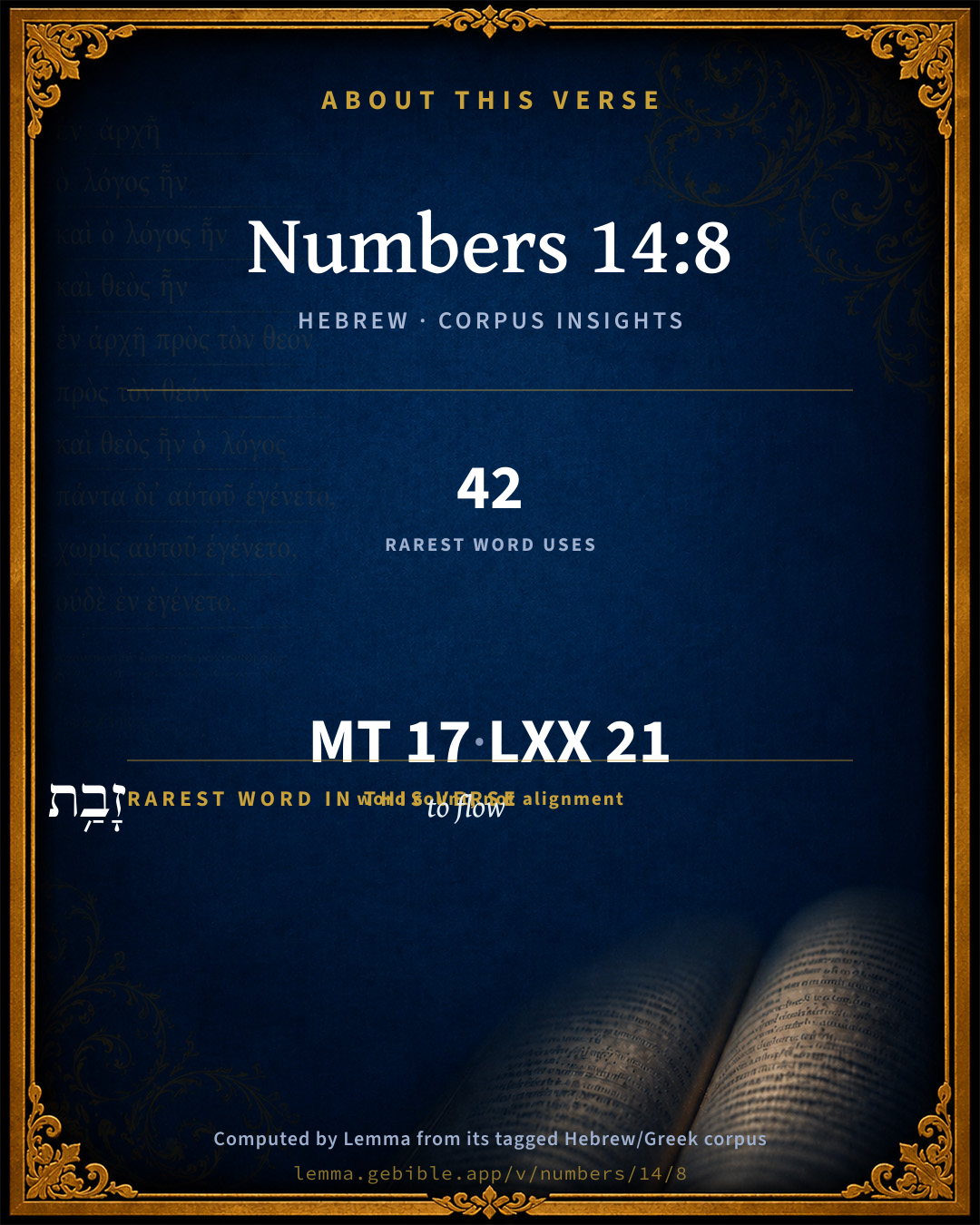
זָבַ֥ת to flow H2100 occurs in 41 verses of the Hebrew Bible. Also found in:

Grammatical profile

  • 4 verbs
  • 5 nouns
  • 2 pronouns
  • 3 prepositions
  • 1 conjunction
  • 2 particles

Verb forms

  • חָפֵ֥ץ Qal · Perfect
  • וְהֵבִ֤יא Hiphil · Sequential Perfect
  • וּנְתָנָ֖הּ Qal · Sequential Perfect
  • זָבַ֥ת Qal · Participle Active

Repetition

A word recurs within this verse — often emphatic in Hebrew:

  • הָאָ֣רֶץ land H776 ×2

Hebrew & Septuagint length

In English translation the verse runs 26 words from the Hebrew and 24 from the Septuagint (LXX English) — closely comparable.

A rough comparison of the two English renderings, which tokenize alike — not a word-level alignment.

Word counts can differ between the Hebrew and the Greek without any difference in meaning — e.g. the Hebrew direct-object marker אֵת has no separate Greek word, and Greek often adds the article ὁ.

In the original languages it is 17 Hebrew tokens and 21 Greek tokens — but the two are counted differently (Hebrew bundles its prefixes and suffixes into one token; the Greek is in lemma form), so that isn’t a like-for-like length.

Cross-references

12

Topical passages linked to Numbers 14:8 in the Treasury of Scripture Knowledge — connected by theme and wording, ordered by reader-vote popularity; previews shown in the World English Bible.

  • 2 Samuel 22:20 He brought me forth also into a large place; He delivered me, because he delighted in me.
  • Isaiah 62:4 You shall no more be termed Forsaken; neither shall your land any more be termed Desolate: but you shall be called Hephzibah, and your land Beulah; for Yahweh delights in you, and your land shall be married.
  • Numbers 13:27 They told him, and said, We came to the land where you sent us; and surely it flows with milk and honey; and this is the fruit of it.
  • Deuteronomy 10:15 Only Yahweh had a delight in your fathers to love them, and he chose their seed after them, even you above all peoples, as at this day.
  • Psalms 147:10–11 He doesn't delight in the strength of the horse. He takes no pleasure in the legs of a man.
  • Romans 8:31 What then shall we say about these things? If God is for us, who can be against us?
  • 1 Kings 10:9 Blessed be Yahweh your God, who delighted in you, to set you on the throne of Israel: because Yahweh loved Israel forever, therefore made he you king, to do justice and righteousness.
  • Psalms 22:8 "He trusts in Yahweh; Let him deliver him; Let him rescue him, since he delights in him."
  • Zephaniah 3:17 Yahweh, your God, is in the midst of you, a mighty one who will save. He will rejoice over you with joy. He will rest in his love. He will rejoice over you with singing.
  • Jeremiah 32:41 Yes, I will rejoice over them to do them good, and I will plant them in this land assuredly with my whole heart and with my whole soul.
  • Exodus 3:8 I have come down to deliver them out of the hand of the Egyptians, and to bring them up out of that land to a good and large land, to a land flowing with milk and honey; to the place of the Canaanite, the Hittite, the Amorite, the Perizzite, the Hivite, and the Jebusite.
  • 2 Samuel 15:25–26 The king said to Zadok, Carry back the ark of God into the city: if I shall find favor in the eyes of Yahweh, he will bring me again, and show me both it, and his habitation:

Cross-references courtesy of OpenBible.info (CC BY 4.0).

Hebrew and Greek witnesses Masoretic Hebrew ↔ Greek Septuagint

The same verse in the two great witnesses to the Old Testament, shown verse-for-verse.

These are two independent witnesses, not word-aligned to each other, and the Septuagint is shown in lemma (dictionary) form.

Hebrew Numbers 14:8 Masoretic · Westminster Leningrad Codex

אִם חָפֵ֥ץ בָּ֨נוּ֙ יְהוָ֔ה וְהֵבִ֤יא אֹתָ֨נוּ֙ אֶל הָאָ֣רֶץ הַזֹּ֔את וּנְתָנָ֖הּ לָ֑נוּ אֶ֕רֶץ אֲשֶׁר הִ֛וא זָבַ֥ת חָלָ֖ב וּדְבָֽשׁ

If Yahweh delight in us, then he will bring us into this land, and give it to us; a land which flows with milk and honey.

World English Bible · Public Domain

Greek LXX Numbers 14:8 Septuagint · lemma form

εἰ αἱρετίζω ἐγώ κύριος εἰςἄγω ἐγώ εἰς ὁ γῆ οὗτος καί δίδωμι αὐτός ἐγώ γῆ ὅστις εἰμί ῥέω γάλα καί μέλι

If the Lord choose us, he will bring us into this land, and give it us; a land which flows with milk and honey.

LXX2012 (modern English Septuagint) · Public Domain

Hebrew: Westminster Leningrad Codex (CC BY 4.0). Greek: Septuagint (public domain); English from LXX2012 (modern English Septuagint) (Public Domain). How the Septuagint differs from the Hebrew →

Targum (Aramaic paraphrase)

2

The Targum is the ancient Jewish Aramaic paraphrase of the Hebrew Scriptures — an interpretive translation, not the Hebrew text itself. Onkelos (literal) and Pseudo-Jonathan (expansive) render the Torah, and Jonathan the Prophets. Coverage is partial: where no permissively-licensed English translation exists for a verse, only the Aramaic is shown. This is verse-level text, not a word-by-word alignment to the Hebrew.

  1. Targum Onkelos Torah (Genesis–Deuteronomy)
    אִם רַעֲוָא בָנָא קֳדָם יְיָ וְיָעֵל יָתָנָא לְאַרְעָא הָדָא וְיִתְּנִנַהּ לָנָא אַרְעָא דִי הִיא עַבְדָא חֲלַב וּדְבָשׁ

    (no public-domain English translation for this verse)

    Targum Onkelos — Aramaic: “Onkelos Genesis” (public domain); “Onkelos Exodus” (public domain); “Onkelos Leviticus” (public domain); “Onkelos Numbers” (public domain); “Onkelos Deuteronomy” (public domain). English: “Sefaria Community Translation” (CC0 1.0 (public-domain dedication)); “J.W. Etheridge. The Targums of Onkelos and Jonathan Ben Uzziel on the Pentateuch. London: Longmans, Green, 1862” (public domain). Text via Sefaria.

  2. Targum Pseudo-Jonathan Torah (Genesis–Deuteronomy)
    אִין רַעֲוָא דַיְיָ אִית בָּנָא וְאָעֵיל יָתָנָא לְאַרְעָא הָדָא וְיִתְּנִינָהּ לָנָא אַרְעָא דְהִיא עַבְדָא חֲלַב וּדְבָשׁ

    If the Lord hath pleasure in us, He will bring us into this land, and give it us, a land producing milk and honey.

    Targum Pseudo-Jonathan — Aramaic: “Targum Jonathan on Genesis” (public domain); “Targum Jonathan on Exodus” (public domain); “Targum Jonathan on Leviticus” (public domain); “Targum Jonathan on Numbers” (public domain); “Targum Jonathan on Deuteronomy” (public domain). English: “The Targum of Jonathan ben Uzziel, trans. J. W. Etheridge, London, 1862” (public domain). Text via Sefaria.

Commentary

Notes on Numbers 14:8 from classic Christian and Jewish commentators (each source and its license shown beneath its notes). The classic Christian expositions comment on the surrounding passage and are grouped to its opening verse, so a note may address several verses; the Jewish commentaries on the Tanakh (Rashi and others) are per-verse, so they appear only where the commentator wrote on this verse.

Lemma curates 59 commentaries, every one of them public domain or Creative Commons licensed, each selected and text-cleaned for this edition rather than reprinted as found. About our sources →

Joseph Benson's Commentary

Num 14:8-9. If the Lord delight in us — If by our rebellion and ingratitude we do not provoke God to leave and forsake us. They are bread for us — We shall destroy them as easily as we eat our bread. Their defence — Their conduct and courage, and especially God, who was pleased to afford them his protection, till their iniquities were full, is utterly departed from them, and hath given them up as a prey to us. The Lord is with us — By his special grace and almighty power, to save us from them and all our enemies. Only rebel not against the Lord — Nothing can ruin sinners but their own rebellion. If God leave them, it is because they drive him from them, and they die, because they will die.

Joseph Benson's Commentary on the Old and New Testaments (1811–1818) — public domain. Text from a community e-Sword module.

Whedon's Commentary on the Bible

Daniel D. Whedon

8. If the Lord delight in us — Here Joshua and Caleb revealed the ground of their confidence — the ability of Jehovah to make good his promise, which they viewed not as absolute, but as conditioned upon the demeanour of the nation. The weakness of the report of the ten lies in its Godlessness. In estimating the possibility of the conquest Jehovah is counted out.

Milk and honey — This is a poetical description of a country rich in pasturage and flowers. For the abundance of honey in ancient Canaan see Jdg_14:8; 1Sa_14:25-26; of both wheat and honey, see Psa_81:16. Sceptics, in view of the comparative sterility of modern Palestine, allege that this must be a false view of Canaan, and they question the inspiration of the Scriptures containing this oft-repeated statement. But there are causes which make modern Palestine barren: 1.) The destruction of the timber in the long series of sieges and invasions which that unhappy land has suffered has greatly reduced the moisture of the atmosphere by cutting off evaporation through the leaves. Hence rains are less frequent, and the sources of artificial irrigation are diminished. 2.) The decay of the terraces necessary to retain the soil on the steep slopes of the round hills. This is owing to the misrule and lack of security to the fruits of industry which have for generations been the lot of the cultivators.

Daniel D. Whedon (gen. ed.), Commentary on the Old and New Testaments (1874–1909) — public domain. Text from a community e-Sword module.

Jamieson, Fausset & Brown

Robert Jamieson, A. R. Fausset & David Brown

a land flowing with milk and honey--a general expression, descriptive of a rich and fertile country. The two articles specified were among the principal products of the Holy Land.

Jamieson, Fausset & Brown — Commentary Critical and Explanatory on the Whole Bible (1871) — public domain (CC PDM 1.0). Text via the HelloAO Bible API.

John Gill's Exposition

If the Lord delight in us,.... Continue to delight in them as he had, and as appears by what he had done for, them in Egypt, at the Red sea, and in the wilderness; see Deu 10:15,

then he will bring us into this land, and give it us, as he has promised:

a land which floweth with milk and honey; as the Lord himself hath described it, and as the unbelieving spies themselves had owned it; Num 13:27.

John Gill's Exposition of the Whole Bible (1746–1763) — public domain (CC PDM 1.0). Text via the HelloAO Bible API.

Matthew Poole's English Annotations

If by our rebellion and ingratitude we do not provoke God to loathe and forsake us.

Matthew Poole's English Annotations on the Holy Bible (1683–1685) — public domain. Text from a community e-Sword/MySword module.

The Pulpit Commentary

If the Lord delight in us. An expression used by Moses himself. (Deu_10:15) It did indeed place the whole matter in the only right light; all the doubt that could possibly exist was the doubt implied in that "if."

The Pulpit Commentary (1880–1919), ed. H.D.M. Spence-Jones & Joseph S. Exell — public domain. Text from a community e-Sword module.

John Wesley's Explanatory Notes

Delight in us - If by our rebellion and ingratitude we do not provoke God to leave and forsake us.

John Wesley, Explanatory Notes Upon the Whole Bible (1754–1765) — public domain. Text via the GEBible commentary corpus.

Lesson kit

Teaching starters — assembled from the data on this page, not authored interpretation. Every prompt links to the verse data it draws on. Edit before teaching.

Numbers, in the Pentateuch, opens this verse with 17 words (14 distinct Hebrew lemmas). Its most distinctive word is zûwb (“to flow”). A historical commentator’s framing appears above. Read the whole chapter for the surrounding context.

Discussion questions

  1. How does “to flow” (zûwb) shape what this verse is saying?
  2. How does Exodus 3:8, which shares the word «to flow», read alongside this verse?
  3. What does the repetition of “land” (2× in this one verse) do in this verse?
  4. The translations on this page render this verse differently — a whole-verse word diff, not a word-by-word alignment. What might account for the different wordings?
  5. «חָפֵ֥ץ» is a Qal Perfect verb. How does that grammatical form shape the action described?
  6. Compare how Joseph Benson's Commentary and Whedon's Commentary on the Bible read this verse. Where do they agree or differ?

Things to notice

Reading settings

Reading text

Shown beneath each verse's original-language words.

Old Testament
Old Testament edition

Read the OT as the Masoretic Hebrew (MT) or the Greek Septuagint (LXX).

English shown for the Greek Septuagint (in the Hebrew ↔ Greek comparison).

Comparing translations? Open the Compare panel on any verse page to stack up to four side by side.