
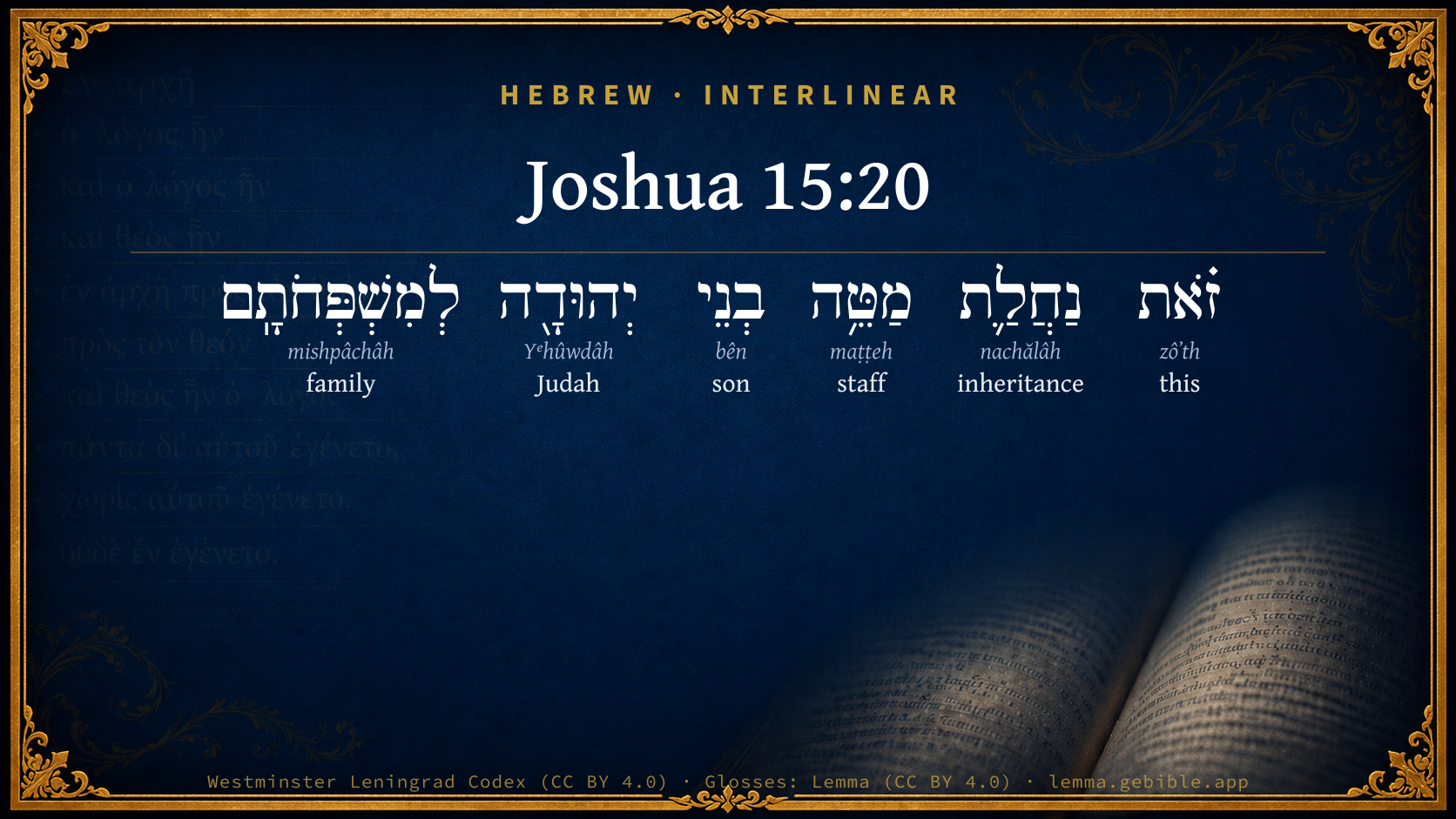
Joshua 15:20

Hebrew (Westminster Leningrad Codex) Joshua 15:20 appears in the Hebrew Old Testament. The text above is from the Westminster Leningrad Codex. Each word links to its Strong’s number, a concise gloss, and parsing drawn from the Open Scriptures Hebrew Bible morphology. Click any word for its full Brown-Driver-Briggs (BDB) entry.
Download image
Cite this verse

Joshua 15:20 (World English Bible). Public Domain. Lemma interlinear Bible study tool, https://lemma.gebible.app/v/joshua/15/20.

Show BibTeX & RIS
BibTeX
RIS
English Translation
This is the inheritance of the tribe of the children of Judah according to their families.
World English Bible · Public Domain
Download a study sheet

One document with this verse’s original text, its word-by-word gloss line, the meaning frame, cross-references with their text, attributed commentary, and full source and license credits — printable, and it pastes into notes with its structure intact.

This verse Autodidact and up

Study sheet (.html) Plain text (.txt)

A passage Seminary Student

Up to 50 verses in one chapter. A passage sheet keeps up to 6 commentary sources and 12 cross-references per verse, in the order this page ranks them, and says so on the sheet whenever that leaves anything out. Ask for a single verse and you get the Autodidact verse sheet above.

Everything on this page stays free to read, with no account — the sheet is a download of what is already on screen, not access to it.

Want to remove ads? Support Godless Engineer
Compare translations 3

The same verse in 3 English versions, stacked beneath the original-language interlinear above. Click any original word for its lexicon entry.

Each is an independent rendering of the whole verse — the interlinear is not word-aligned to these translations.

Highlighted words mark where these versions differ — a whole-verse word diff, not a word-by-word alignment.

  • World English Bible Public Domain
    This is the inheritance of the tribe of the children of Judah according to their families.
  • King James Version Public Domain
    This is the inheritance of the tribe of the children of Judah according to their families.
  • unfoldingWord Literal Text CC BY-SA 4.0
    This the inheritance of the tribe of the sons of Judah according to their clans:

unfoldingWord Literal Text — © unfoldingWord, licensed CC BY-SA 4.0. Word-aligned USFM3 via Door43 (git.door43.org/unfoldingWord/en_ult).

Versions to compare (up to 4)

3 of 4 selected

Show all 18 translations

Every available English version of this verse, each an independent rendering of the whole verse.

  • World English Bible Public Domain
    This is the inheritance of the tribe of the children of Judah according to their families.
  • Berean Standard Bible Public Domain
    This is the inheritance of the clans of the tribe of Judah.
  • Majority Standard Bible Public Domain
    This is the inheritance of the clans of the tribe of Judah.
  • King James Version Public Domain
    This is the inheritance of the tribe of the children of Judah according to their families.
  • American Standard Version (1901) Public Domain
    This is the inheritance of the tribe of the children of Judah according to their families.
  • Revised Version (1885) Public Domain
    This is the inheritance of the tribe of the children of Judah according to their families.
  • Geneva Bible (1599) Public Domain
    This shalbe the inheritance of the tribe of the children of Iudah according to their families.
  • Douay-Rheims (1899) Public Domain
    This is the possession of the tribe of the children of Juda by their kindreds.
  • Young's Literal Translation Public Domain
    This `is' the inheritance of the tribe of the sons of Judah, for their families.
  • Literal Standard Version CC BY-SA 4.0
    This [is] the inheritance of the tribe of the sons of Judah, for their families.
  • Unlocked Literal Bible CC BY-SA 4.0
    This was the inheritance of the tribe of Judah, clan by clan.
  • unfoldingWord Literal Text CC BY-SA 4.0
    This the inheritance of the tribe of the sons of Judah according to their clans:
  • Darby Bible Public Domain
    This is the inheritance of the tribe of the children of Judah according to their families.
  • World Messianic Bible Public Domain
    This is the inheritance of the tribe of the children of Judah according to their families.
  • Webster's Bible Public Domain
    This is the inheritance of the tribe of the children of Judah according to their families.
  • Free Bible Version CC BY-SA 4.0
    This was the land allotted to the tribe of Judah, by families.
  • Bible in Basic English Public Domain
    This is the heritage of the tribe of Judah, by their families.
  • JPS Tanakh (1917) Public Domain
    This is the inheritance of the tribe of the children of Judah according to their families.

Literal Standard Version (2020), Covenant Press — licensed CC BY-SA 4.0. Text via the HelloAO Bible API (eBible.org). Unlocked Literal Bible (unfoldingWord) — licensed CC BY-SA 4.0. Text via the HelloAO Bible API (eBible.org). unfoldingWord Literal Text — © unfoldingWord, licensed CC BY-SA 4.0. Word-aligned USFM3 via Door43 (git.door43.org/unfoldingWord/en_ult). Free Bible Version, Dr. Jonathan Gallagher — licensed CC BY-SA 4.0. Text via the HelloAO Bible API (eBible.org).

Word by word

More ways to search: Search by grammar → Find every occurrence → Compare this word →

Practice this passage: Drill this verse → Learn its vocabulary →

About this verse

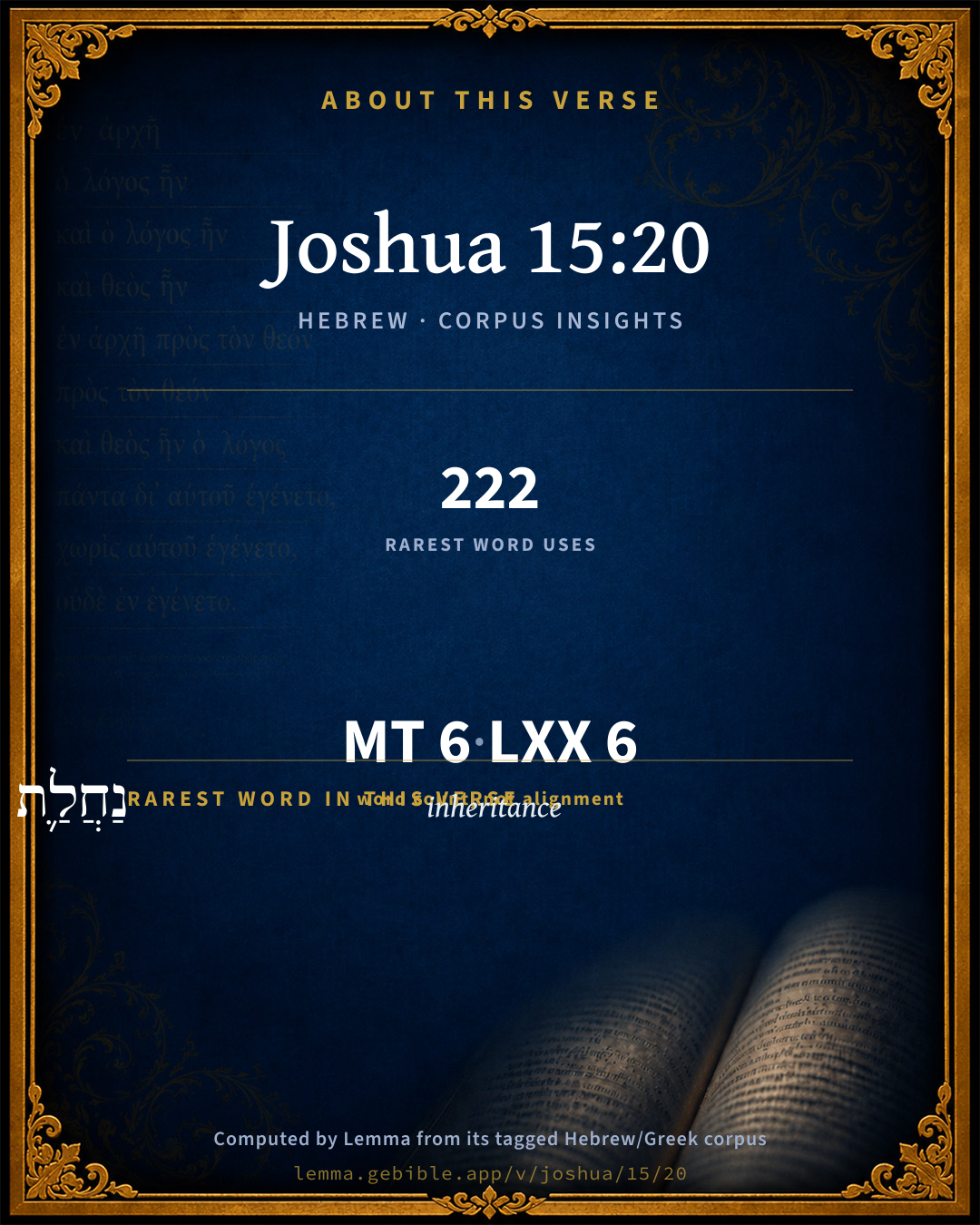
These counts appear in no published source. They are computed here, from the morphology-tagged text and Lemma’s own curated glosses. What Lemma adds →

6
words
6
distinct lemmas
Historical
section

Grammatical profile

  • 5 nouns
  • 1 pronoun

Hebrew & Septuagint length

In English translation the verse runs 16 words from the Hebrew and 12 from the Septuagint (LXX English) — closely comparable.

A rough comparison of the two English renderings, which tokenize alike — not a word-level alignment.

Word counts can differ between the Hebrew and the Greek without any difference in meaning — e.g. the Hebrew direct-object marker אֵת has no separate Greek word, and Greek often adds the article ὁ.

In the original languages it is 6 Hebrew tokens and 6 Greek tokens — but the two are counted differently (Hebrew bundles its prefixes and suffixes into one token; the Greek is in lemma form), so that isn’t a like-for-like length.

Cross-references

2

Topical passages linked to Joshua 15:20 in the Treasury of Scripture Knowledge — connected by theme and wording, ordered by reader-vote popularity; previews shown in the World English Bible.

  • Genesis 49:8–12 "Judah, your brothers will praise you: Your hand will be on the neck of your enemies; Your father's sons will bow down before you.
  • Deuteronomy 33:7 This is [the blessing] of Judah: and he said, Hear, Yahweh, the voice of Judah, Bring him in to his people. With his hands he contended for himself; You shall be a help against his adversaries.

Cross-references courtesy of OpenBible.info (CC BY 4.0).

Hebrew and Greek witnesses Masoretic Hebrew ↔ Greek Septuagint

The same verse in the two great witnesses to the Old Testament, shown verse-for-verse.

These are two independent witnesses, not word-aligned to each other, and the Septuagint is shown in lemma (dictionary) form.

Hebrew Joshua 15:20 Masoretic · Westminster Leningrad Codex

זֹ֗את נַחֲלַ֛ת מַטֵּ֥ה בְנֵי יְהוּדָ֖ה לְמִשְׁפְּחֹתָֽם

This is the inheritance of the tribe of the children of Judah according to their families.

World English Bible · Public Domain

Greek LXX Joshua 15:20 Septuagint · lemma form

οὗτος ὁ κληρονομία φυλή υἱός ιουδα

This is the inheritance of the tribe of the children of Juda.

LXX2012 (modern English Septuagint) · Public Domain

Hebrew: Westminster Leningrad Codex (CC BY 4.0). Greek: Septuagint (public domain); English from LXX2012 (modern English Septuagint) (Public Domain). How the Septuagint differs from the Hebrew →

Targum (Aramaic paraphrase)

1

The Targum is the ancient Jewish Aramaic paraphrase of the Hebrew Scriptures — an interpretive translation, not the Hebrew text itself. Onkelos (literal) and Pseudo-Jonathan (expansive) render the Torah, and Jonathan the Prophets. Coverage is partial: where no permissively-licensed English translation exists for a verse, only the Aramaic is shown. This is verse-level text, not a word-by-word alignment to the Hebrew.

  1. Targum Jonathan Prophets (Joshua–Malachi)
    דָא אַחְסָנַת שִׁבְטָא דִבְנֵי יְהוּדָה לְזַרְעֲיַתְהוֹן:

    (no public-domain English translation for this verse)

    Targum Jonathan — Aramaic: “Mikraot Gedolot” (public domain). English: “Sefaria Community Translation” (CC0 1.0 (public-domain dedication)); “London "Chaldee Paraphrase," 1871” (public domain). Text via Sefaria.

Commentary

Notes on Joshua 15:20 from classic Christian and Jewish commentators (each source and its license shown beneath its notes). The classic Christian expositions comment on the surrounding passage and are grouped to its opening verse, so a note may address several verses; the Jewish commentaries on the Tanakh (Rashi and others) are per-verse, so they appear only where the commentator wrote on this verse.

Lemma curates 59 commentaries, every one of them public domain or Creative Commons licensed, each selected and text-cleaned for this edition rather than reprinted as found. About our sources →

Keil & Delitzsch

C. F. Keil & F. Delitzsch

Jos 15:20 contains the closing formula to vv. 1-19, i.e., to the description of the territory of Judah by its boundaries (vid., Jos 18:20).

Keil & Delitzsch — Biblical Commentary on the Old Testament (1861–1891) — public domain (CC PDM 1.0). Text via the HelloAO Bible API. (Old Testament only.)

Tyndale Open Study Notes

Tyndale Open Resources

15:20-63 Not all of these locations can be identified with certainty. Many are unknown except for their occurrence in this and other lists. Some receive passing reference in other texts.

Tyndale Open Study Notes — © Tyndale Open Resources, licensed CC BY-SA 4.0. Text via the HelloAO Bible API.

Matthew Henry's Commentary

We have here a list of the several cities that fell within the lot of the tribe of Judah, which are mentioned by name, that they might know their own, and both keep it and keep to it, and might neither through cowardice nor sloth lose the possession of what was their own.

I. The cities are here named, and numbered in several classes, which they then could account for the reason of better than we can now. Here are, 1. Some that are said to be the uttermost cities towards the coast of Edom, Jos 15:21-32. Here are thirty-eight named, and yet said to be twenty-nine (Jos 15:32), because nine of these were afterwards transferred to the lot of Simeon, and are reckoned as belonging to that, as appears by comparing Jos 19:2, etc.; therefore those only are counted (though the rest are named) which remained to Judah. 2. Others that are said to be in the valley (Jos 15:33) are counted to be fourteen, yet fifteen are named; but it is probable that Gederah and Gederathaim were either two names or two parts of one and the same city. 3. Then sixteen are named without any head of distinction, Jos 15:37-41, and nine more, Jos 15:42-44. 4. Then the three Philistine-cities, Ekron, Ashdod, and Gaza, Jos 15:45-47. 5. Cities in the mountains, eleven in all (Jos 15:48-51), nine more (Jos 15:52-54), ten more (Jos 15:55-57), six more (Jos 15:58, Jos 15:59), then two (Jos 15:60), and six in the wilderness, a part of the country not so thick of inhabitants as some others were.

II. Now here, 1. We do not find Bethlehem, which was afterwards the city of David, and was ennobled by the birth of our Lord Jesus in it. But that city, which at the best was but little among the thousands of Judah (Mic 5:2), except that it was thus dignified, was now so little as not to be accounted one of the cities, but perhaps was one of the villages not named. Christ came to give honour to the places he was related to, not to receive honour from them. 2. Jerusalem is said to continue in the hands of the Jebusites (Jos 15:63), for the children of Judah could not drive them out, through their sluggishness, stupidity, and unbelief. Had they attempted it with vigour and resolution, we have reason to think God would not have been wanting to them to give them success; but they could not do it, because they would not. Jerusalem was afterwards to be the holy city, the royal city, the city of the great King, the brightest ornament of all the land of Israel. God has designed it should be so. It may therefore be justly looked upon as a punishment of their neglect to conquer other cities which God had given them that they were so long kept out of this. 3. Among the cities of Judah (in all 114) we meet with Libnah, which in Joram's days revolted, and probably set up for a free independent state (Kg2 8:22), and Lachish, where king Amaziah was slain (Kg1 14:19); it led the dance in idolatry (Mic 1:13); it was the beginning of sin to the daughter of Zion. Giloh, Ahithophel's town, is here mentioned, and Tekoa, of which the prophet Amos was, and near which Jehoshaphat obtained that glorious victory, Ch2 20:20, etc., and Maresha, where Asa was a conqueror. Many of the cities of this tribe occur in the history of David's troubles. Adullam, Ziph, Keilah, Maon, Engedi, Ziklag, here reckoned in this tribe, were places near which David had most of his haunts; for, though sometimes Saul drove him out from the inheritance of the Lord, yet he kept as close to it as he could. The wilderness of Judah he frequented much, and in it John Baptist preached, and there the kingdom of heaven commenced, Mat 3:1. The riches of this country no doubt answered Jacob's blessing of this tribe, that he should wash his garments in wine, Gen 49:11. And, in general, Judah, thou art he whom thy brethren shall praise, not envy.

Matthew Henry's Commentary on the Whole Bible (1708–1710) — public domain (CC PDM 1.0). Text via the HelloAO Bible API.

John Calvin's Commentaries

20. This is the inheritance, etc He had formerly, indeed, traced out the boundaries of the children of Judah; but it is now shown for a different reason how large and fertile the territory was which the Lord in his great liberality had bestowed upon them. One hundred and thirteen cities with their towns and villages are enumerated. The number attests not only the populousness, but also the fertility of the country. And there cannot be a doubt that by the divine blessing a new degree of fertility was imparted to it. The goodness of God was, however, manifested in the very nature of the land selected for his people, a land abounding in all kinds of advantages. If we attend to the number of souls in the tribe, we shall find that one half of the country would have been amply sufficient for their habitation. For when eight hundred were allocated in each of the cities, the remainder had the towns and the villages. It is no doubt true that a portion was afterwards withdrawn and given to the tribe of Simeon. For in this was accomplished the dispersion of which Jacob had prophesied,

“I will divide them in Jacob, and scatter them in Israel.” (Genesis 49:7)

They were accordingly admitted by the children of Judah as a kind of guests.

John Calvin's Commentaries (1540-1563) — public domain. Text from the Calvin Translation Society English edition (1840s-50s) via the Christian Classics Ethereal Library (ccel.org). Calvin's coverage is partial (roughly two-thirds of the Bible); uncommented books and verses are honest gaps, never fabricated. The 19th-century editor's footnotes and remarks are omitted so the notes are faithfully Calvin's own voice.

The Cambridge Bible for Schools and Colleges

gen. ed. J. J. S. Perowne

20–32. Cities of Judah in the South

20. This is the inheritance] “The speech of Achsah to her father was the best reason for the slight notice of this desert tract in later times, and is the best introduction to the real territory of Judah, on which we now enter. ‘Give me a blessing, for thou hast given me a south land; give me also springs of water.’ The wells of Beersheba were enough for the Patriarchs, the Amalekites, and the Kenites, but they were not enough for the daughter of Judah and the house of the mighty Caleb.” Stanley’s Sinai and Palestine, p. 161. The territory of Judah, in average length about 45 miles and in average breadth about 50, was from a very early period divided into four main regions—(i) the South; (ii) the Lowland; (iii) the Mountain; (iv) the Wilderness.

(α) The South was the undulating pasture country which intervened between the hills, the proper possession of the tribe, and the desert country which marks the lower part of Palestine.

(β) The Lowland, or, to give it its proper name, the Shephelah, was a broad strip of land lying between the central mountains and the Mediterranean Sea. From the edge of the sandy tract which fringes the immediate shore it stretched up to the bases of the hills of Judah—the garden and granary of the tribe—and formed the lower part of the maritime plain which extended along the whole seaboard of Palestine from “the river of Egypt” to Sidon.

(γ) The Mountain, or “the Hill Country,” though not the richest, was at once the largest and the most important of the four. “Beginning a few miles below Hebron, where it attains its highest level, it stretches eastward to the Dead Sea and westward to the Shephelah, and forms an elevated district or plateau, which, though thrown into considerable undulations, yet preserves a general level in both directions.”

(δ) The Wilderness, Midbah, which here, and here only, is synonymous with Arâbah, represents the sunken district adjoining the Dead Sea. See Mr. Grove’s article in Smith’s Bibl. Dict.

The Cambridge Bible for Schools and Colleges (gen. ed. J. J. S. Perowne; Cambridge University Press, 1878–1918) — public domain. Text from a community e-Sword module.

John Gill's Exposition

This is the inheritance of the tribe of the children of Judah, according to their families. The general description of which is given in the preceding part of the chapter, as the particular cities belonging to it are enumerated in the following part; the account of the gift of Hebron to Caleb, and the taking of Debir by Othniel, with the request of Achsah, and the grant of it, are inserted between them, and stand as it were in a parenthesis.

This is the inheritance of the tribe of the children of Judah, according to their families. The general description of which is given in the preceding part of the chapter, as the particular cities belonging to it are enumerated in the following part; the account of the gift of Hebron to Caleb, and the taking of Debir by Othniel, with the request of Achsah, and the grant of it, are inserted between them, and stand as it were in a parenthesis.

Joshua 15:21

jos 15:21

jos 15:21

jos 15:21And the uttermost cities of the tribe of the children of Judah,.... That is, those cities which were the outward part of the tribe of Judah, the southern border of it; for the midland cities are not in this part, of the description reckoned, which reaches from hence to the end of Jos 15:32,

toward the coast of Edom southward: it begins about the dead sea, and goes on in that part of the land of Canaan which bordered on Idumea, and so proceeds on westward towards Gaza, and the Mediterranean sea: the cities in this part of the tribe

were Kabzeel, called Jekabzeel, Neh 11:25; and was the native place of Benaiah, one of David's mighty men, Sa2 23:20,

and Eder and Jagur; of which we have no mention elsewhere.

John Gill's Exposition of the Whole Bible (1746–1763) — public domain (CC PDM 1.0). Text via the HelloAO Bible API.

The Pulpit Commentary

This is the inheritance. The territory of Judah is divided into four parts, in the summary which follows: the "south," the "valley," the "mountains," and the "wilderness." Tribe. Here hFm. (see note Jos_13:29)

The Pulpit Commentary (1880–1919), ed. H.D.M. Spence-Jones & Joseph S. Exell — public domain. Text from a community e-Sword module.

unfoldingWord translationNotes

Door43 World Missions Community

This was the inheritance of the tribe of Judah

The land that the tribe of Judah received is spoken of as if it were an inheritance that they received as a permanent possession. AT: "This was the land that the tribe of Judah received as an inheritance" (See: Metaphor)

translationWords

inherit

tribe

Judah

clan

unfoldingWord translationNotes — © Distant Shores Media and the Door43 World Missions Community, licensed CC BY-SA 4.0. Source: git.door43.org/Door43/en_tn.

Lesson kit

Teaching starters — assembled from the data on this page, not authored interpretation. Every prompt links to the verse data it draws on. Edit before teaching.

Joshua, in the Historical, opens this verse with 6 words (6 distinct Hebrew lemmas). Its most distinctive word is nachălâh (“inheritance”). A historical commentator’s framing appears above. Read the whole chapter for the surrounding context.

Discussion questions

  1. What does “inheritance” (nachălâh) contribute to the verse as a whole?
  2. Genesis 49:8–12 shares this passage’s theme. How do the two illuminate each other?
  3. These translations render this verse differently. What is at stake in choosing one wording over another?
  4. Reading how Keil & Delitzsch and Tyndale Open Study Notes read this verse, where do the two commentators agree and where do they part?

Things to notice

Reading settings

Reading text

Shown beneath each verse's original-language words.

Old Testament
Old Testament edition

Read the OT as the Masoretic Hebrew (MT) or the Greek Septuagint (LXX).

English shown for the Greek Septuagint (in the Hebrew ↔ Greek comparison).

Comparing translations? Open the Compare panel on any verse page to stack up to four side by side.