
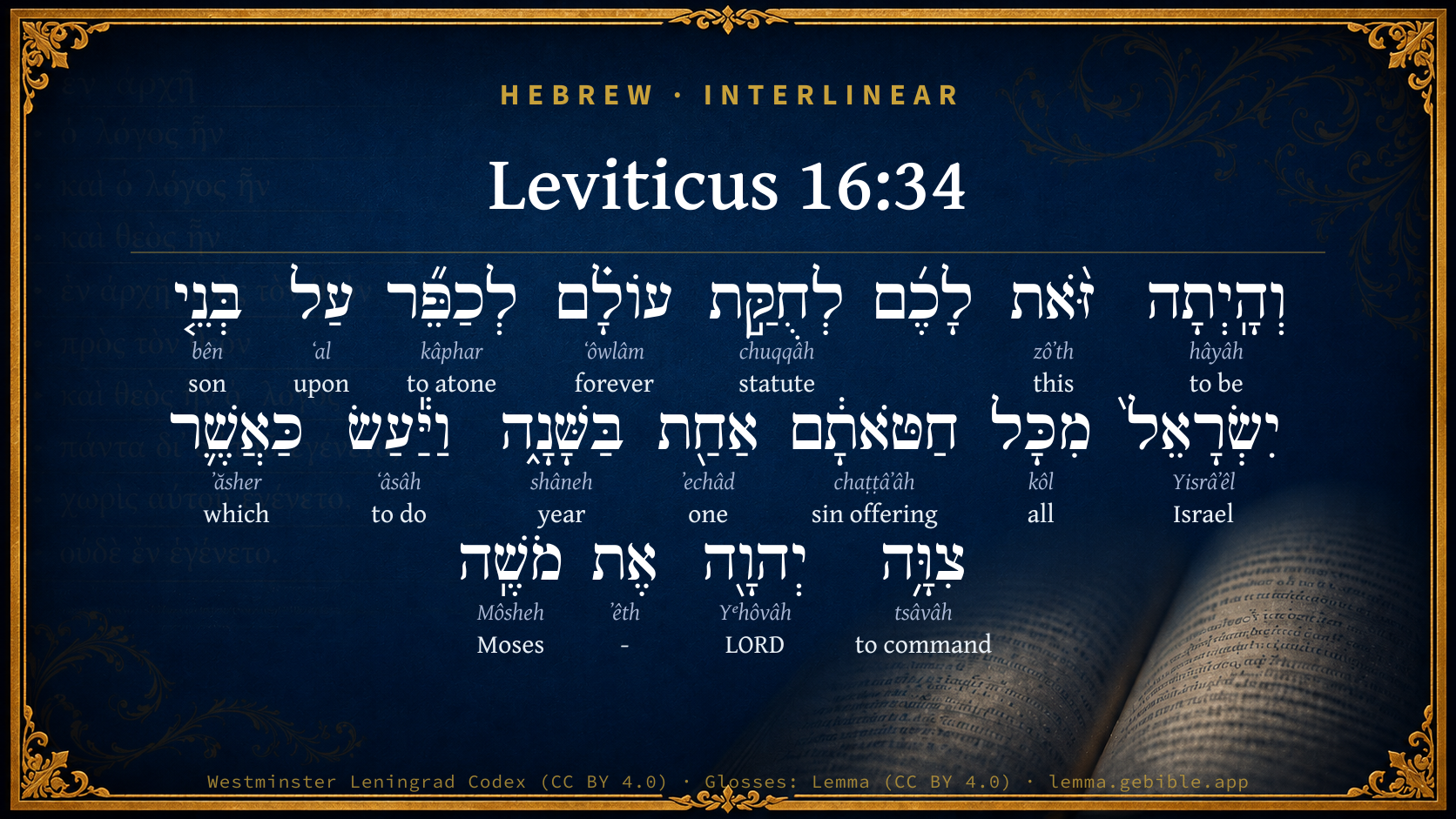
Leviticus 16:34

Hebrew (Westminster Leningrad Codex) Leviticus 16:34 appears in the Hebrew Old Testament. The text above is from the Westminster Leningrad Codex. Each word links to its Strong’s number, a concise gloss, and parsing drawn from the Open Scriptures Hebrew Bible morphology. Click any word for its full Brown-Driver-Briggs (BDB) entry.
Download image
Cite this verse

Leviticus 16:34 (World English Bible). Public Domain. Lemma interlinear Bible study tool, https://lemma.gebible.app/v/leviticus/16/34.

Show BibTeX & RIS
BibTeX
RIS
English Translation
"This shall be an everlasting statute for you, to make atonement for the children of Israel once in the year because of all their sins." It was done as Yahweh commanded Moses.
World English Bible · Public Domain
Download a study sheet

One document with this verse’s original text, its word-by-word gloss line, the meaning frame, cross-references with their text, attributed commentary, and full source and license credits — printable, and it pastes into notes with its structure intact.

This verse Autodidact and up

Study sheet (.html) Plain text (.txt)

A passage Seminary Student

Up to 50 verses in one chapter. A passage sheet keeps up to 6 commentary sources and 12 cross-references per verse, in the order this page ranks them, and says so on the sheet whenever that leaves anything out. Ask for a single verse and you get the Autodidact verse sheet above.

Everything on this page stays free to read, with no account — the sheet is a download of what is already on screen, not access to it.

Want to remove ads? Support Godless Engineer
Compare translations 3

The same verse in 3 English versions, stacked beneath the original-language interlinear above. Click any original word for its lexicon entry.

Each is an independent rendering of the whole verse — the interlinear is not word-aligned to these translations.

Highlighted words mark where these versions differ — a whole-verse word diff, not a word-by-word alignment.

  • World English Bible Public Domain
    "This shall be an everlasting statute for you, to make atonement for the children of Israel once in the year because of all their sins." It was done as Yahweh commanded Moses.
  • King James Version Public Domain
    And this shall be an everlasting statute unto you, to make an atonement for the children of Israel for all their sins once a year. And he did as the LORD commanded Moses.
  • unfoldingWord Literal Text CC BY-SA 4.0
    And this will be for you an enduring statute to make atonement for the sons of Israel from all their sins, once in the year.” And he did just as Yahweh commanded Moses.

unfoldingWord Literal Text — © unfoldingWord, licensed CC BY-SA 4.0. Word-aligned USFM3 via Door43 (git.door43.org/unfoldingWord/en_ult).

Versions to compare (up to 4)

3 of 4 selected

Show all 18 translations

Every available English version of this verse, each an independent rendering of the whole verse.

  • World English Bible Public Domain
    "This shall be an everlasting statute for you, to make atonement for the children of Israel once in the year because of all their sins." It was done as Yahweh commanded Moses.
  • Berean Standard Bible Public Domain
    This is to be a permanent statute for you, to make atonement once a year for the Israelites because of all their sins.” And all this was done as the LORD had commanded Moses.
  • Majority Standard Bible Public Domain
    This is to be a permanent statute for you, to make atonement once a year for the Israelites because of all their sins.” And all this was done as the LORD had commanded Moses.
  • King James Version Public Domain
    And this shall be an everlasting statute unto you, to make an atonement for the children of Israel for all their sins once a year. And he did as the LORD commanded Moses.
  • American Standard Version (1901) Public Domain
    And this shall be an everlasting statute unto you, to make atonement for the children of Israel because of all their sins once in the year. And he did as Jehovah commanded Moses.
  • Revised Version (1885) Public Domain
    And this shall be an everlasting statute unto you, to make atonement for the children of Israel because of all their sins once in the year. And he did as the LORD commanded Moses.
  • Geneva Bible (1599) Public Domain
    And this shalbe an euerlasting ordinance vnto you, to make an atonement for the children of Israel for all their sinnes once a yeere: and as the Lord commanded Moses, he did.
  • Douay-Rheims (1899) Public Domain
    And this shall be an ordinance for ever, that you pray for the children of Israel, and for all their sins once in a year. He did therefore as the Lord had commanded Moses.
  • Young's Literal Translation Public Domain
    `And this hath been to you for a statute age-during, to make atonement for the sons of Israel, because of all their sins, once in a year;' and he doth as Jehovah hath commanded Moses.
  • Literal Standard Version CC BY-SA 4.0
    And this has been for a continuous statute to you, to make atonement for the sons of Israel, because of all their sins, once in a year”; and he does as YHWH has commanded Moses.
  • Unlocked Literal Bible CC BY-SA 4.0
    This will always be a statute for you, to make atonement for the people of Israel because of all their sins, once in every year.” This was done as Yahweh commanded Moses.
  • unfoldingWord Literal Text CC BY-SA 4.0
    And this will be for you an enduring statute to make atonement for the sons of Israel from all their sins, once in the year.” And he did just as Yahweh commanded Moses.
  • Darby Bible Public Domain
    And this shall be an everlasting statute unto you, to make atonement for the children of Israel [to cleanse them] from all their sins once a year. And he did as Jehovah had commanded Moses.
  • World Messianic Bible Public Domain
    “This shall be an everlasting statute for you, to make atonement for the children of Israel once in the year because of all their sins.” It was done as the LORD commanded Moses.
  • Webster's Bible Public Domain
    And this shall be an everlasting statute to you, to make an atonement for the children of Israel for all their sins once a year. And he did as the LORD commanded Moses.
  • Free Bible Version CC BY-SA 4.0
    This regulation applies to you for all time: once a year the Israelites have all their sins made right.” Moses did everything as the Lord had ordered.
  • Bible in Basic English Public Domain
    And let this be an order for ever for you, so that the sin of the children of Israel may be taken away once every year. And he did as the Lord gave orders to Moses.
  • JPS Tanakh (1917) Public Domain
    And this shall be an everlasting statute unto you, to make atonement for the children of Israel because of all their sins once in the year.' And he did as the LORD commanded Moses.

Literal Standard Version (2020), Covenant Press — licensed CC BY-SA 4.0. Text via the HelloAO Bible API (eBible.org). Unlocked Literal Bible (unfoldingWord) — licensed CC BY-SA 4.0. Text via the HelloAO Bible API (eBible.org). unfoldingWord Literal Text — © unfoldingWord, licensed CC BY-SA 4.0. Word-aligned USFM3 via Door43 (git.door43.org/unfoldingWord/en_ult). Free Bible Version, Dr. Jonathan Gallagher — licensed CC BY-SA 4.0. Text via the HelloAO Bible API (eBible.org).

Word by word

More ways to search: Search by grammar → Find every occurrence → Compare this word →

Practice this passage: Drill this verse → Learn its vocabulary →

לְכַפֵּ֞ר
kâphar
H3722
“to atone”
Preposition + Verb, Piel, Infinitive Construct
Part of Speech
Preposition + Verb
Stem
Piel
Form
Infinitive Construct
Full BDB Definition

Origin: a primitive root

TWOT: 1023 , 1024 , 1025 , 1026

to cover, purge, make an atonement, make reconciliation, cover over with pitch - (Qal) to coat or cover with pitch - (Piel) - to cover over, pacify, propitiate - to cover over, atone for sin, make atonement for - to cover over, atone for sin and persons by legal rites - (Pual) - to be covered over - to make atonement for - (Hithpael) to be covered
  1. וְהָֽיְתָה hâyâh H1961 “and · to be” Conjunction + Verb, Qal, Sequential Perfect, 3rd Person, Feminine, Singular
  2. זֹּ֨את zôʼth H2063 “this” Pronoun, Demonstrative, Feminine, Singular
  3. לְחֻקַּ֣ת chuqqâh H2708 “to/for · statute of” Preposition + Noun, Common, Both, Singular, Construct
  4. עוֹלָ֗ם ʻôwlâm H5769 “forever” Noun, Common, Masculine, Singular, Absolute
  5. עַל ʻal H5921 “upon” Preposition
  6. בְּנֵ֤י bên H1121 “sons of” Noun, Common, Masculine, Plural, Construct
  7. יִשְׂרָאֵל֙ Yisrâʼêl H3478 “Israel” Noun, Proper
  8. מִכָּל kôl H3605 “from · all of” Preposition + Noun, Common, Masculine, Singular, Construct
  9. חַטֹּאתָ֔ם chaṭṭâʼâh H2403 “sin offerings · their” Noun, Common, Feminine, Plural, Construct + Suffix, Personal, 3rd Person, Masculine, Plural
  10. אַחַ֖ת ʼechâd H259 “one” Adjective, Cardinal number, Feminine, Singular, Absolute
  11. בַּשָּׁנָ֑ה shâneh H8141 “in/at the · year” Preposition, Determined + Noun, Common, Feminine, Singular, Absolute
  12. וַיַּ֕עַשׂ ʻâsâh H6213 “and · to do” Conjunction + Verb, Qal, Sequential Imperfect, 3rd Person, Masculine, Singular
  13. כַּאֲשֶׁ֛ר ʼăsher H834 “like/as · which” Preposition + Particle, Relative
  14. צִוָּ֥ה tsâvâh H6680 “to command” Verb, Piel, Perfect, 3rd Person, Masculine, Singular
  15. יְהוָ֖ה Yᵉhôvâh H3068 “LORD” Noun, Proper
  16. אֶת ʼêth H853 “-” Particle, Direct Object
  17. מֹשֶֽׁה Môsheh H4872 “Moses” Noun, Proper

About this verse

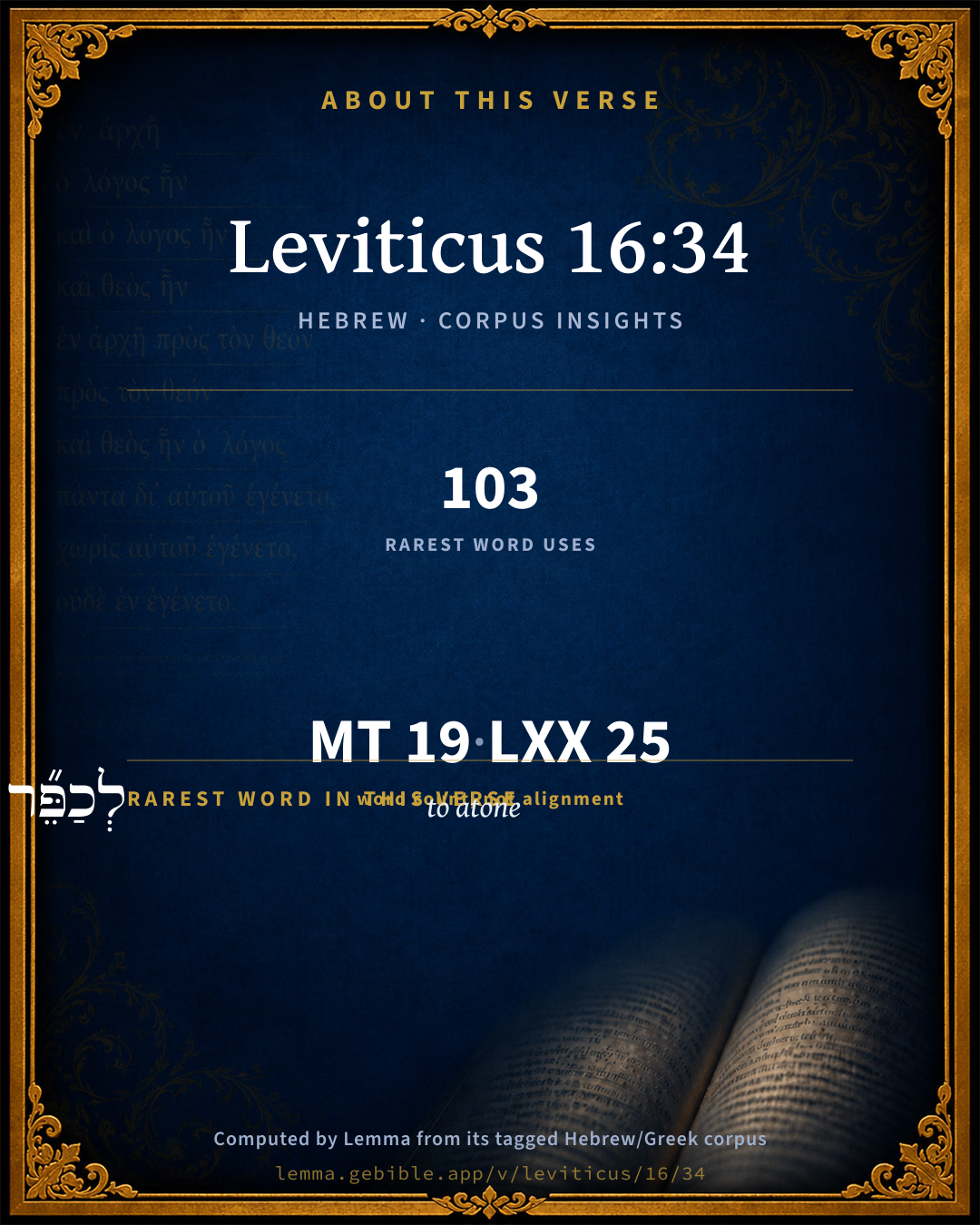
These counts appear in no published source. They are computed here, from the morphology-tagged text and Lemma’s own curated glosses. What Lemma adds →

19
words
18
distinct lemmas
Pentateuch
section

Grammatical profile

  • 4 verbs
  • 9 nouns
  • 1 adjective
  • 1 pronoun
  • 2 prepositions
  • 2 particles

Verb forms

  • וְהָֽיְתָה Qal · Sequential Perfect
  • לְכַפֵּ֞ר Piel · Infinitive Construct
  • וַיַּ֕עַשׂ Qal · Sequential Imperfect
  • צִוָּ֥ה Piel · Perfect

Hebrew & Septuagint length

In English translation the verse runs 32 words from the Hebrew and 34 from the Septuagint (LXX English) — closely comparable.

A rough comparison of the two English renderings, which tokenize alike — not a word-level alignment.

Word counts can differ between the Hebrew and the Greek without any difference in meaning — e.g. the Hebrew direct-object marker אֵת has no separate Greek word, and Greek often adds the article ὁ.

In the original languages it is 19 Hebrew tokens and 25 Greek tokens — but the two are counted differently (Hebrew bundles its prefixes and suffixes into one token; the Greek is in lemma form), so that isn’t a like-for-like length.

Cross-references

7

Topical passages linked to Leviticus 16:34 in the Treasury of Scripture Knowledge — connected by theme and wording, ordered by reader-vote popularity; previews shown in the World English Bible.

  • Hebrews 9:7 but into the second the high priest alone, once in the year, not without blood, which he offers for himself, and for the errors of the people.
  • Hebrews 9:25 nor yet that he should offer himself often, as the high priest enters into the holy place year by year with blood not his own,
  • Exodus 30:10 Aaron shall make atonement on its horns once in the year; with the blood of the sin offering of atonement once in the year he shall make atonement for it throughout your generations. It is most holy to Yahweh."
  • Hebrews 10:3 But in those sacrifices there is yearly reminder of sins.
  • Hebrews 10:14 For by one offering he has perfected forever those who are being sanctified.
  • Leviticus 23:31 You shall do no manner of work: it is a statute forever throughout your generations in all your dwellings.
  • Numbers 29:7 On the tenth day of this seventh month you shall have a holy convocation; and you shall afflict your souls: you shall do no manner of work;

Cross-references courtesy of OpenBible.info (CC BY 4.0).

Hebrew and Greek witnesses Masoretic Hebrew ↔ Greek Septuagint

The same verse in the two great witnesses to the Old Testament, shown verse-for-verse.

These are two independent witnesses, not word-aligned to each other, and the Septuagint is shown in lemma (dictionary) form.

Hebrew Leviticus 16:34 Masoretic · Westminster Leningrad Codex

וְהָֽיְתָה זֹּ֨את לָכֶ֜ם לְחֻקַּ֣ת עוֹלָ֗ם לְכַפֵּ֞ר עַל בְּנֵ֤י יִשְׂרָאֵל֙ מִכָּל חַטֹּאתָ֔ם אַחַ֖ת בַּשָּׁנָ֑ה וַיַּ֕עַשׂ כַּאֲשֶׁ֛ר צִוָּ֥ה יְהוָ֖ה אֶת מֹשֶֽׁה

"This shall be an everlasting statute for you, to make atonement for the children of Israel once in the year because of all their sins." It was done as Yahweh commanded Moses.

World English Bible · Public Domain

Greek LXX Leviticus 16:34 Septuagint · lemma form

καί εἰμί οὗτος σύ νόμιμος αἰώνιος ἐκἱλάσκομαι περί ὁ υἱός ἰσραήλ ἀπό πᾶς ὁ ἁμαρτία αὐτός ἅπαξ ὁ ἐνιαυτός ποιέω καθάπερ συντάσσω κύριος ὁ μωυσῆς

And this shall be to you a perpetual statute to make atonement for the children of Israel for all their sins: it shall be done once in the year, as the Lord commanded Moses.

LXX2012 (modern English Septuagint) · Public Domain

On this verse, Trapp's Complete Commentary discusses the Septuagint’s reading. Read the note in Commentary ↓

Hebrew: Westminster Leningrad Codex (CC BY 4.0). Greek: Septuagint (public domain); English from LXX2012 (modern English Septuagint) (Public Domain). How the Septuagint differs from the Hebrew →

Targum (Aramaic paraphrase)

2

The Targum is the ancient Jewish Aramaic paraphrase of the Hebrew Scriptures — an interpretive translation, not the Hebrew text itself. Onkelos (literal) and Pseudo-Jonathan (expansive) render the Torah, and Jonathan the Prophets. Coverage is partial: where no permissively-licensed English translation exists for a verse, only the Aramaic is shown. This is verse-level text, not a word-by-word alignment to the Hebrew.

  1. Targum Onkelos Torah (Genesis–Deuteronomy)
    וּתְהֵי דָא לְכוֹן לִקְיַם עָלָם לְכַפָּרָא עַל בְּנֵי יִשְׂרָאֵל מִכָּל חוֹבֵיהוֹן חֲדָא בְּשַׁתָּא וַעֲבַד כְּמָא דִי פַּקִיד יְיָ יָת מֹשֶׁה

    (no public-domain English translation for this verse)

    Targum Onkelos — Aramaic: “Onkelos Genesis” (public domain); “Onkelos Exodus” (public domain); “Onkelos Leviticus” (public domain); “Onkelos Numbers” (public domain); “Onkelos Deuteronomy” (public domain). English: “Sefaria Community Translation” (CC0 1.0 (public-domain dedication)); “J.W. Etheridge. The Targums of Onkelos and Jonathan Ben Uzziel on the Pentateuch. London: Longmans, Green, 1862” (public domain). Text via Sefaria.

  2. Targum Pseudo-Jonathan Torah (Genesis–Deuteronomy)
    וּתְהֵי דָא לְכוֹן לִקְיָים עֲלָם לְכַפָּרָא עַל בְּנֵי יִשְרָאֵל מִכָּל חוֹבֵיהוֹן חֲדָא זִמְנָא בְּשַׁתָּא וַעֲבַד אַהֲרן הֵיכְמָא דְפַקֵיד יְיָ יַת משֶׁה

    And this shall be to you for an everlasting statute, to expiate the children of Israel from all their sins, once in the year. And Aharon did as the Lord commanded Mosheh.

    Targum Pseudo-Jonathan — Aramaic: “Targum Jonathan on Genesis” (public domain); “Targum Jonathan on Exodus” (public domain); “Targum Jonathan on Leviticus” (public domain); “Targum Jonathan on Numbers” (public domain); “Targum Jonathan on Deuteronomy” (public domain). English: “The Targum of Jonathan ben Uzziel, trans. J. W. Etheridge, London, 1862” (public domain). Text via Sefaria.

Commentary

Notes on Leviticus 16:34 from classic Christian and Jewish commentators (each source and its license shown beneath its notes). The classic Christian expositions comment on the surrounding passage and are grouped to its opening verse, so a note may address several verses; the Jewish commentaries on the Tanakh (Rashi and others) are per-verse, so they appear only where the commentator wrote on this verse.

Lemma curates 59 commentaries, every one of them public domain or Creative Commons licensed, each selected and text-cleaned for this edition rather than reprinted as found. About our sources →

Ellicott's Commentary for English Readers

(34) And this shall be an everlasting statute.—Better, And this shall be a statute for ever, as the Authorised Version has it in Lev_16:29. Here, again, we have an instance of how the same phrase which occurs three times within four verses (see Lev_16:29; Lev_16:31; Lev_16:34) is rendered in the Authorised Version by two different phrases, thus giving the idea to the English reader that there is a difference in the original. The thrice-repeated phrase emphasises the abiding nature of this law, and indicates the solemnity of the day.

And he did as the Lord commanded Moses—That is, Aaron performed the service for the first time, according to the ordinances which the Lord communicated to Moses. A similar remark occurs at the first observance of the Passover. (See Exo_12:50.) The solemn admonition, therefore, addressed to the priesthood at the beginning of this chapter (see Lev_16:1-2), not to presume on their office, but to submit to the Divine regulations, was duly observed by the first high priest. It may, however, also be designed to indicate that Aaron did not assume the dignity of the pontificate to exalt himself, but in obedience to the command God gave to Moses.

A Bible Commentary for English Readers, edited by Charles John Ellicott (1878–1897) — public domain. Text from a community e-Sword module.

Trapp's Complete Commentary

John Trapp

Lev 16:34 And this shall be an everlasting statute unto you, to make an atonement for the children of Israel for all their sins once a year. And he did as the LORD commanded Moses.

Ver. 34. For all their sins once a year.] For whereas in their private sacrifices they durst not confess their capital sins for fear of death, due to them by the law, God graciously provided and instituted this yearly sacrifice of atonement for the sins of the whole people, without particular acknowledgment of any. There are of good note who think, {a} that this anniversary fast, called "the fast" by a specialty, {Act 27:9} was instituted in reference unto, and solemn remembrance of, the fall of Adam; which happened, say they, on the tenth day of the world, answering to the first of November. But how strangely are the Jews at this day besotted, if that be true of them that some {b} report, viz., that at this their feast of reconciliation, they use to bribe Satan, that he may not accuse them for their sins; and that this is one thing for which they do yearly afflict their souls, namely, the translation of the Bible out of Hebrew into Greek, by the Septuagint!

{a} Arch. Ussher, Annales Vet. Test., p. 2.

{b} Alex. Ross’s View of Religions.

John Trapp, A Commentary or Exposition upon All the Books of the Old and New Testament (1647–1656) — public domain. Text from a community e-Sword module.

Joseph Benson's Commentary

Lev 16:34. This shall be an everlasting statute — By which were typified the two great gospel privileges; remission of sins and access to God, both which we owe to the mediation of the Lord Jesus. He shall make an atonement — for all their sins — Meaning all such sins as could be expiated by the law, which were, τα αγνοηματα, the errors, or sins of ignorance of the people, as the apostle expresses it Heb 9:6, where he speaks of the atonement made on this day. “To this sort of offences alone,” as Dr. Doddridge justly observes on the verse just referred to, “and not to those presumptuously committed, the efficacy of the atonement extended.” And even to justification from these, as the Hebrew doctors justly observe, all these rites of expiation, however solemnly performed, availed nothing in the sight of God, without repentance, and sincere resolutions of new obedience. Now, the two great gospel duties of repentance and faith are hereby typified; by which we obtain an interest in the atonement made by the death of Christ, and come to be entitled to the benefit of it. By repentance we must afflict our souls — inwardly sorrowing for our sins, and living a life of self-denial and mortification. And we must make a penitent confession of sin, and that with an eye to Christ whom we have pierced. By faith we must put our hands on the head of the offering, relying on Christ as the Lord our righteousness; pleading his satisfaction, as that which was alone able to atone for our sins, and procure us a pardon, and with a hand of faith on his sacrifice, must assure ourselves that, if we confess and forsake our sins, God is faithful and just to forgive us our sins, and cleanse us from all unrighteousness. We may observe further here, that in the year of jubilee, the trumpet which proclaimed liberty was ordered to be sounded in the close of the day of atonement, Lev 25:9. For the remission of the debt we owe to God, our release from the bondage of sin, and our return to our inheritance above, are all owing to the mediation and intercession of Jesus Christ. By the atonement we obtain rest for our souls, and all the glorious liberties of the children of God.

Joseph Benson's Commentary on the Old and New Testaments (1811–1818) — public domain. Text from a community e-Sword module.

Whedon's Commentary on the Bible

Daniel D. Whedon

34. For all their sins — Though this day is appointed by God as the day for the forgiveness of sins, no such end can be reached except by true repentance and the firm determination not to sin any more. As is stated in Tr. Yoma, 85 b: “He who yieldeth to sin in the supposition that the day of atonement will bring him forgiveness, will find no forgiveness on this day. And only the sins committed by man against God can be atoned for on this day; as to the sins, however, between man and man, this day is powerless to remove them until the offender has appeased the offended.” Since there were many sins and “errors” (Greek, ignorances, Heb_9:7) for which there had been no specific expiation in the Levitical code, and many which had been neglected, there was need of one general expiation once each year. See Lev_16:9, note. “If the law were not spiritual, atonement would not be so absolutely necessary. That any one could keep the law, and thereby merit the favour of God, never entered the thought of the lawgiver. Its immediate purpose was only to excite a sense of the need of redemption. In this view, the law was only παιδαγωγος εις Χριστον,” (a child-leader unto Christ.) — Hengstenberg. For a reply to Baehr’s denial of the substitutional nature of the Mosaic sacrifices, see Numbers 15, concluding note. “To a God of infinite benevolence, justice, and holiness, nothing can compensate for sin save the removal of sinfulness from the heart of the sinner; nothing make room for forgiveness save the establishment of a principle of daily life actually operating and assuring that removal. Wherefore the willing self-sacrifice of the innocent for the guilty is admissible in God’s plan of salvation, not as an end satisfactory in itself, but as a means for effecting that real, practical removal of sin by the destruction of sinfulness, which will justify a just and holy God for pardoning and forgetting the sins of the past. To this principle nothing else in the whole Mosaic ritual so plainly points as does the feast of atonement. In the death of its victims it repeated the daily lesson of bloody sacrifices; while in its liberated offering it set forth the crowning truth, that even self-sacrifice can expiate sins committed only in so far as it removes — ’sends away for Azazel’ — the disposition to commit sins.” — Geo. W. Cable.

And he — that is, Aaron, to whom Moses was directed to communicate this command — did as the Lord commanded. This bit of history must have been added at least seven months after the dedication of the tabernacle, when Nadab and Abihu were slain and the precepts of this chapter were given. The first day of atonement was after the rebellion at Kadesh-Barnea. Compare Lev_9:23; Lev_10:1, with Exo_40:17, and Introduction to Numbers, (4.)

Daniel D. Whedon (gen. ed.), Commentary on the Old and New Testaments (1874–1909) — public domain. Text from a community e-Sword module.

The Pulpit Commentary

This shall be an everlasting statute unto you. It lasted as long as the earthly Jerusalem lasted, and until the heavenly Jerusalem was instituted, when it had a spiritual fulfillment once for all. Of old there was a high priest that cleansed the people with the blood of bulls and goats, but now that the true High Priest is come, the former priesthood is no more. It is a providential dispensation of God that the city and temple of Jerusalem have been destroyed; for if they were still standing, some who are weak in faith might be dazzled by the outward splendor of the literal types, and not drawn by faith to the spiritual antitypes. If there are any, therefore, who, in considering the Levitical ritual of the great Day of Atonement, and in looking at the two he-goats the one sacrificed, the other let go, charged with sins, into the wilderness do not recognize the one Christ who died for our sins and took away our sins, and do not see there the "everlasting statute" of which God here speaks by Moses, let him go up thrice a year to Jerusalem, and there search for the altar which has crumbled in the dust, and offer up his victims there without a priest. But no; thanks be to God, the earthly priesthood and temple are abolished, that we may raise our heart to the heavenly, and look up with faith and love and joy to him who offered himself once for all, and who ever liveth to make intercession for us" (Origen, "Hom." 10, as quoted by Wordsworth). And he did as the Lord commanded Moses; that is. Moses announced to Aaron the Law which was to be carried out about five months later.

The Pulpit Commentary (1880–1919), ed. H.D.M. Spence-Jones & Joseph S. Exell — public domain. Text from a community e-Sword module.

John Wesley's Explanatory Notes

This shall be an everlasting statute - By which were typified the two great gospel privileges; remission of sins, and access to God, both which we owe to the mediation of the Lord Jesus.

John Wesley, Explanatory Notes Upon the Whole Bible (1754–1765) — public domain. Text via the GEBible commentary corpus.

unfoldingWord translationNotes

Door43 World Missions Community

General Information:

Yahweh finishes telling Moses what the people must do on the Day of Atonement.

This was done as Yahweh commanded Moses

This can be translated in active form. AT: "And Moses did as Yahweh commanded" or "And Aaron did as Yahweh commanded Moses" (See: Active or Passive)

translationWords

statute

atonement

sin

command

Moses

unfoldingWord translationNotes — © Distant Shores Media and the Door43 World Missions Community, licensed CC BY-SA 4.0. Source: git.door43.org/Door43/en_tn.

Rashi

Rabbi Shlomo Yitzchaki (Rashi)

'ויעש כאשר צוה וגו AND HE DID AS [THE LORD] COMMANDED [MOSES] etc. — When the next Day of Atonement arrived he (Aaron) did everything as is here set forth in order. And Scripture only states this in order to declare the praise of Aaron — that he did not attire himself with them (the official garments) for his own aggrandisement, but as one who was executing the ordinance of his King (Sifra, Acharei Mot, Chapter 8 10).

Rashi on the Tanakh — English translations: “The Judaica Press complete Tanach with Rashi, translated by A. J. Rosenberg” (CC BY 4.0); “Pentateuch with Rashi's commentary by M. Rosenbaum and A.M. Silbermann, 1929-1934” (public domain); “The Metsudah Tanach series, Lakewood, N.J” (CC BY 4.0); and “The Book of Joshua, Metsudah Publications, 1997” (CC BY 4.0). Text via Sefaria.

Ramban (Nachmanides)

Rabbi Moshe ben Nachman (Ramban / Nachmanides)

AND HE DID AS THE ETERNAL COMMANDED MOSES. This means that Aaron fulfilled all that he was commanded, and he was careful all his life not to enter the Holy of Holies except on the Day of Atonement in order to bring his offerings, according to all that G-d commanded Moses.

Ramban (Nachmanides) on the Tanakh — English translation: “Commentary on the Torah by Ramban (Nachmanides). Translated and annotated by Charles B. Chavel. New York, Shilo Pub. House, 1971-1976” (CC BY 4.0). Text via Sefaria.

Lesson kit

Teaching starters — assembled from the data on this page, not authored interpretation. Every prompt links to the verse data it draws on. Edit before teaching.

Leviticus, in the Pentateuch, opens this verse with 19 words (18 distinct Hebrew lemmas). Its most distinctive word is kâphar (“to atone”). A historical commentator’s framing appears above. Read the whole chapter for the surrounding context.

Discussion questions

  1. What does “to atone” (kâphar) contribute to the verse as a whole?
  2. Hebrews 9:7 shares this passage’s theme. How do the two illuminate each other?
  3. These translations render this verse differently; the difference is in the English rendering, not the original. What questions does that raise?
  4. The verb «וְהָֽיְתָה» is Qal Sequential Perfect. How does its form color the action?
  5. Reading how Ellicott's Commentary for English Readers and Trapp's Complete Commentary read this verse, where do the two commentators agree and where do they part?

Things to notice

Reading settings

Reading text

Shown beneath each verse's original-language words.

Old Testament
Old Testament edition

Read the OT as the Masoretic Hebrew (MT) or the Greek Septuagint (LXX).

English shown for the Greek Septuagint (in the Hebrew ↔ Greek comparison).

Comparing translations? Open the Compare panel on any verse page to stack up to four side by side.