
Deuteronomy 11:22

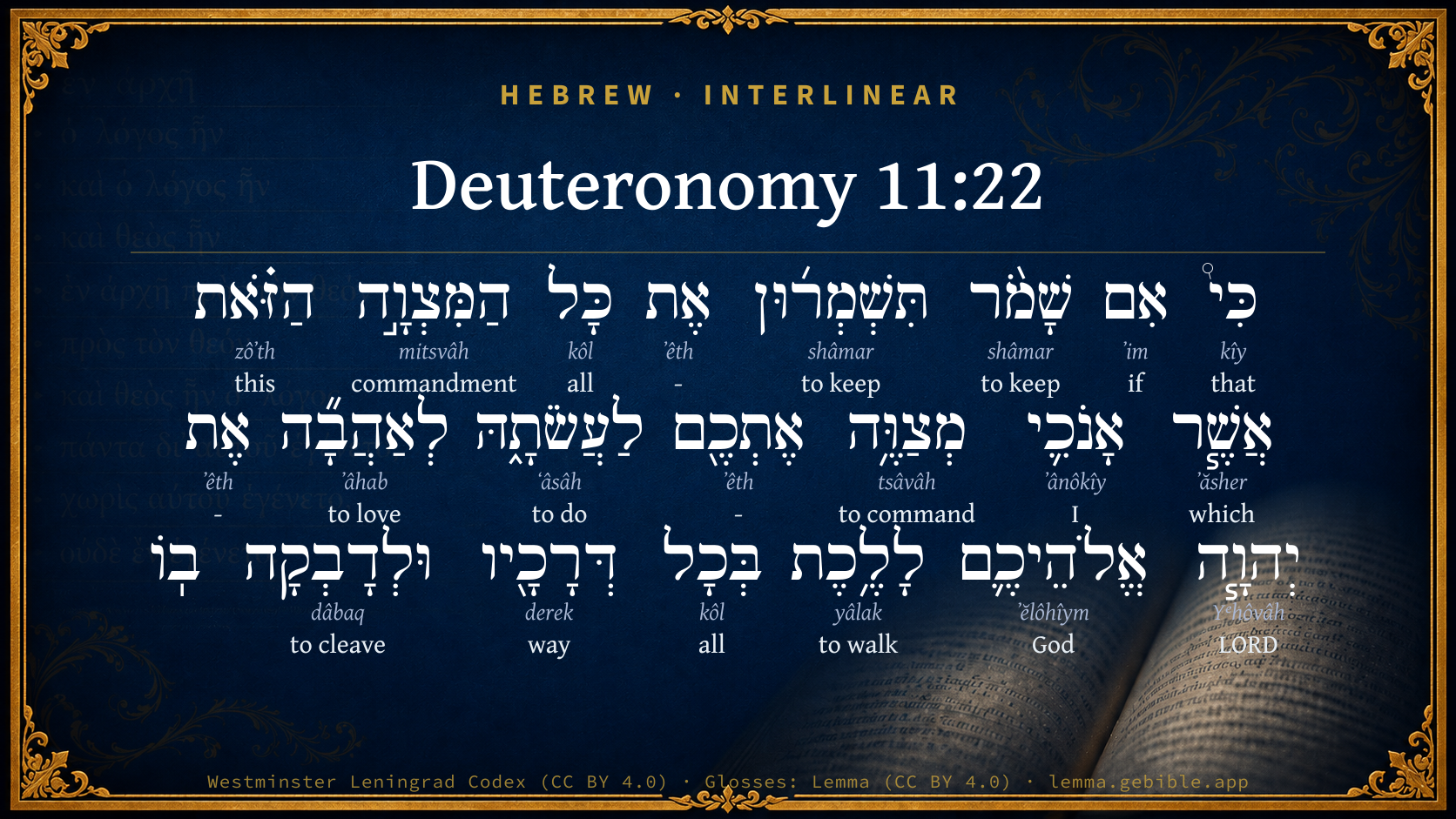
Hebrew (Westminster Leningrad Codex) Deuteronomy 11:22 appears in the Hebrew Old Testament. The text above is from the Westminster Leningrad Codex. Each word links to its Strong’s number, a concise gloss, and parsing drawn from the Open Scriptures Hebrew Bible morphology. Click any word for its full Brown-Driver-Briggs (BDB) entry.
Download image
Cite this verse

Deuteronomy 11:22 (World English Bible). Public Domain. Lemma interlinear Bible study tool, https://lemma.gebible.app/v/deuteronomy/11/22.

Show BibTeX & RIS
BibTeX
RIS
English Translation
For if you shall diligently keep all this commandment which I command you, to do it, to love Yahweh your God, to walk in all his ways, and to cleave to him;
World English Bible · Public Domain
Download a study sheet

One document with this verse’s original text, its word-by-word gloss line, the meaning frame, cross-references with their text, attributed commentary, and full source and license credits — printable, and it pastes into notes with its structure intact.

This verse Autodidact and up

Study sheet (.html) Plain text (.txt)

A passage Seminary Student

Up to 50 verses in one chapter. A passage sheet keeps up to 6 commentary sources and 12 cross-references per verse, in the order this page ranks them, and says so on the sheet whenever that leaves anything out. Ask for a single verse and you get the Autodidact verse sheet above.

Everything on this page stays free to read, with no account — the sheet is a download of what is already on screen, not access to it.

Want to remove ads? Support Godless Engineer
Compare translations 3

The same verse in 3 English versions, stacked beneath the original-language interlinear above. Click any original word for its lexicon entry.

Each is an independent rendering of the whole verse — the interlinear is not word-aligned to these translations.

Highlighted words mark where these versions differ — a whole-verse word diff, not a word-by-word alignment.

  • World English Bible Public Domain
    For if you shall diligently keep all this commandment which I command you, to do it, to love Yahweh your God, to walk in all his ways, and to cleave to him;
  • King James Version Public Domain
    For if ye shall diligently keep all these commandments which I command you, to do them, to love the LORD your God, to walk in all his ways, and to cleave unto him;
  • unfoldingWord Literal Text CC BY-SA 4.0
    For if keeping, you will keep all these commandments that I am commanding you to do them, to love Yahweh your God, to walk in all his ways, and to cling to him,

unfoldingWord Literal Text — © unfoldingWord, licensed CC BY-SA 4.0. Word-aligned USFM3 via Door43 (git.door43.org/unfoldingWord/en_ult).

Versions to compare (up to 4)

3 of 4 selected

Show all 18 translations

Every available English version of this verse, each an independent rendering of the whole verse.

  • World English Bible Public Domain
    For if you shall diligently keep all this commandment which I command you, to do it, to love Yahweh your God, to walk in all his ways, and to cleave to him;
  • Berean Standard Bible Public Domain
    For if you carefully keep all these commandments I am giving you to follow—to love the LORD your God, to walk in all His ways, and to hold fast to Him—
  • Majority Standard Bible Public Domain
    For if you carefully keep all these commandments I am giving you to follow—to love the LORD your God, to walk in all His ways, and to hold fast to Him—
  • King James Version Public Domain
    For if ye shall diligently keep all these commandments which I command you, to do them, to love the LORD your God, to walk in all his ways, and to cleave unto him;
  • American Standard Version (1901) Public Domain
    For if ye shall diligently keep all this commandment which I command you, to do it, to love Jehovah your God, to walk in all his ways, and to cleave unto him;
  • Revised Version (1885) Public Domain
    For if ye shall diligently keep all this commandment which I command you, to do it; to love the LORD your God, to walk in all his ways, and to cleave unto him;
  • Geneva Bible (1599) Public Domain
    For if ye keepe diligently all these commandements, which I command you to doe: that is, to loue the Lord your God, to walke in all his waies, and to cleaue vnto him,
  • Douay-Rheims (1899) Public Domain
    That thy days may be multiplied, and the days of thy children in the land which the Lord swore to thy fathers, that he would give them as long as the heaven hangeth over the earth.
  • Young's Literal Translation Public Domain
    `For, if ye diligently keep all this command which I am commanding you -- to do it, to love Jehovah your God, to walk in all His ways, and to cleave to Him,
  • Literal Standard Version CC BY-SA 4.0
    For if you diligently keep all this command which I am commanding you to do—to love your God YHWH, to walk in all His ways, and to cleave to Him—
  • Unlocked Literal Bible CC BY-SA 4.0
    For if you diligently keep all these commandments that I am commanding you, so as to do them, to love Yahweh your God, to walk in all his ways, and to cling to him,
  • unfoldingWord Literal Text CC BY-SA 4.0
    For if keeping, you will keep all these commandments that I am commanding you to do them, to love Yahweh your God, to walk in all his ways, and to cling to him,
  • Darby Bible Public Domain
    For if ye diligently keep all this commandment which I command you [this day] to do it, to love Jehovah your God, to walk in all his ways, and to cleave unto him,
  • World Messianic Bible Public Domain
    For if you shall diligently keep all these commandments which I command you—to do them, to love the LORD your God, to walk in all his ways, and to cling to him—
  • Webster's Bible Public Domain
    For if ye shall diligently keep all these commandments which I command you, to do them, to love the LORD your God, to walk in all his ways, and to cleave to him;
  • Free Bible Version CC BY-SA 4.0
    If you are careful to keep all these commandments I am giving you to follow, if you love the Lord your God and follow all his ways and hold onto him,
  • Bible in Basic English Public Domain
    For if you take care to keep all the orders which I give you, and to do them; loving the Lord your God and walking in all his ways and being true to him:
  • JPS Tanakh (1917) Public Domain
    For if ye shall diligently keep all this commandment which I command you, to do it, to love the LORD your God, to walk in all His ways, and to cleave unto Him,

Literal Standard Version (2020), Covenant Press — licensed CC BY-SA 4.0. Text via the HelloAO Bible API (eBible.org). Unlocked Literal Bible (unfoldingWord) — licensed CC BY-SA 4.0. Text via the HelloAO Bible API (eBible.org). unfoldingWord Literal Text — © unfoldingWord, licensed CC BY-SA 4.0. Word-aligned USFM3 via Door43 (git.door43.org/unfoldingWord/en_ult). Free Bible Version, Dr. Jonathan Gallagher — licensed CC BY-SA 4.0. Text via the HelloAO Bible API (eBible.org).

Word by word

More ways to search: Search by grammar → Find every occurrence → Compare this word →

Practice this passage: Drill this verse → Learn its vocabulary →

וּלְדָבְקָה
dâbaq
H1692
“and · to cleave”
Conjunction + Preposition + Verb, Qal, Infinitive Construct
Part of Speech
Conjunction + Preposition + Verb
Stem
Qal
Form
Infinitive Construct
Full BDB Definition

Origin: a primitive root

TWOT: 398

to cling, stick, stay close, cleave, keep close, stick to, stick with, follow closely, join to, overtake, catch - (Qal) - to cling, cleave to - to stay with - (Pual) to be joined together - (Hiphil) - to cause to cleave to - to pursue closely - to overtake - (Hophal) to be made to cleave
  1. כִּי֩ kîy H3588 “that” Conjunction
  2. אִם ʼim H518 “if” Conjunction
  3. שָׁמֹ֨ר shâmar H8104 “to keep” Verb, Qal, Infinitive Absolute
  4. תִּשְׁמְר֜וּן shâmar H8104 “to keep” Verb, Qal, Imperfect, 2nd Person, Masculine, Plural + Suffix, n
  5. אֶת ʼêth H853 “-” Particle, Direct Object
  6. כָּל kôl H3605 “all of” Noun, Common, Masculine, Singular, Construct
  7. הַמִּצְוָ֣ה mitsvâh H4687 “the · commandment” Particle, Definite Article + Noun, Common, Feminine, Singular, Absolute
  8. הַזֹּ֗את zôʼth H2063 “the · this” Particle, Definite Article + Pronoun, Demonstrative, Feminine, Singular
  9. אֲשֶׁ֧ר ʼăsher H834 “which” Particle, Relative
  10. אָנֹכִ֛י ʼânôkîy H595 “I” Pronoun, Personal, 1st Person, Common, Singular
  11. מְצַוֶּ֥ה tsâvâh H6680 “commanding” Verb, Piel, Participle Active, Masculine, Singular, Absolute
  12. אֶתְכֶ֖ם ʼêth H853 “- · you” Particle, Direct Object + Suffix, Personal, 2nd Person, Masculine, Plural
  13. לַעֲשֹׂתָ֑הּ ʻâsâh H6213 “to do · her” Preposition + Verb, Qal, Infinitive Construct + Suffix, Personal, 3rd Person, Feminine, Singular
  14. לְאַהֲבָ֞ה ʼâhab H157 “to love” Preposition + Verb, Qal, Infinitive Construct
  15. אֶת ʼêth H853 “-” Particle, Direct Object
  16. יְהוָ֧ה Yᵉhôvâh H3068 “LORD” Noun, Proper
  17. אֱלֹהֵיכֶ֛ם ʼĕlôhîym H430 “God(s) · your” Noun, Common, Masculine, Plural, Construct + Suffix, Personal, 2nd Person, Masculine, Plural
  18. לָלֶ֥כֶת yâlak H3212 “to walk” Preposition + Verb, Qal, Infinitive Construct
  19. בְּכָל kôl H3605 “in/at · all of” Preposition + Noun, Common, Masculine, Singular, Construct
  20. דְּרָכָ֖יו derek H1870 “ways · his” Noun, Common, Both, Plural, Construct + Suffix, Personal, 3rd Person, Masculine, Singular

About this verse

These counts appear in no published source. They are computed here, from the morphology-tagged text and Lemma’s own curated glosses. What Lemma adds →

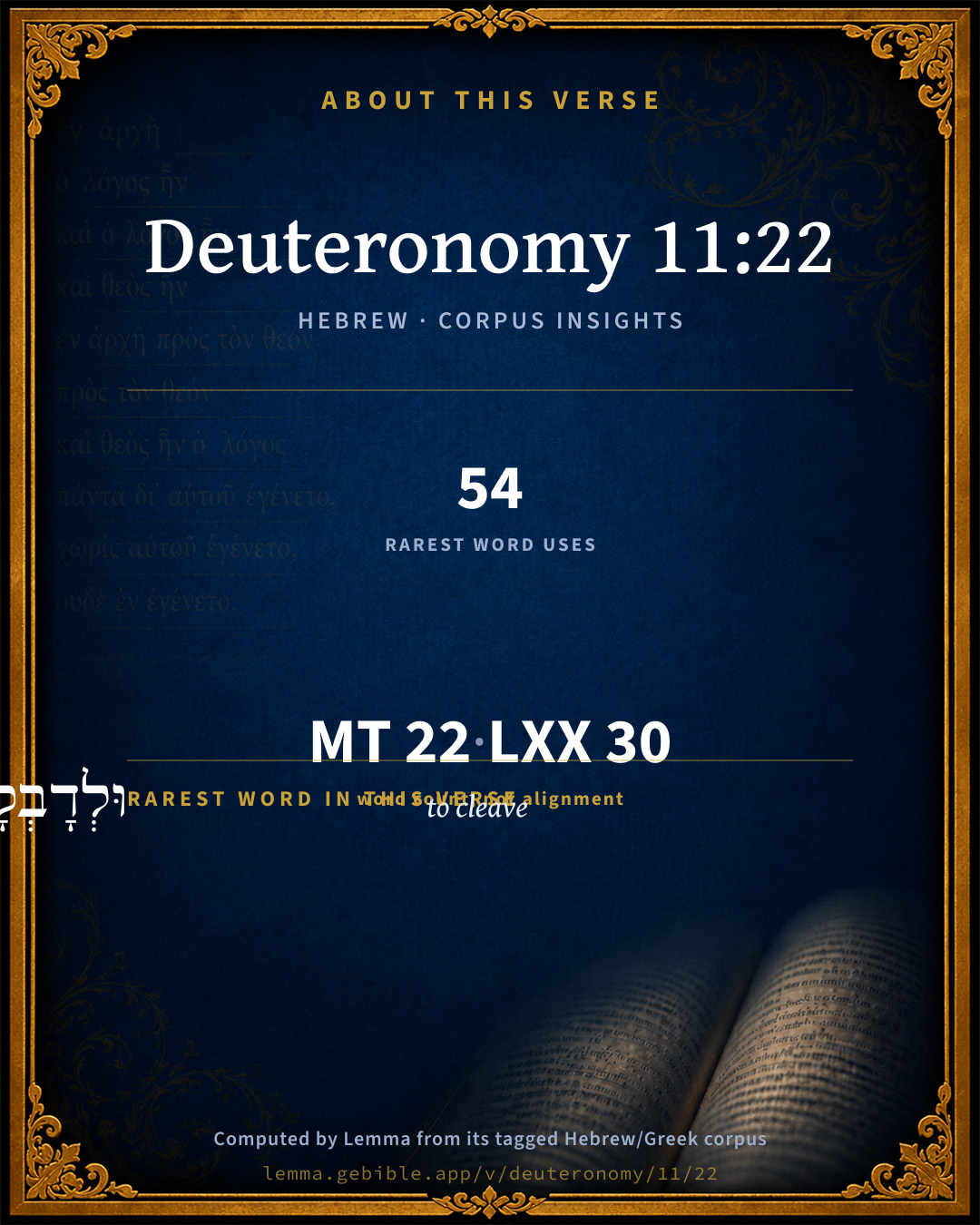
22
words
17
distinct lemmas
Pentateuch
section

Shared distinctive vocabulary

וּלְדָבְקָה to cleave H1692 occurs in 52 verses of the Hebrew Bible. Also found in:

Grammatical profile

  • 7 verbs
  • 6 nouns
  • 2 pronouns
  • 1 preposition
  • 2 conjunctions
  • 4 particles

Verb forms

  • שָׁמֹ֨ר Qal · Infinitive Absolute
  • תִּשְׁמְר֜וּן Qal · Imperfect
  • מְצַוֶּ֥ה Piel · Participle Active
  • לַעֲשֹׂתָ֑הּ Qal · Infinitive Construct
  • לְאַהֲבָ֞ה Qal · Infinitive Construct
  • לָלֶ֥כֶת Qal · Infinitive Construct
  • וּלְדָבְקָה Qal · Infinitive Construct

Repetition

Words recur within this verse — often emphatic in Hebrew:

  • שָׁמֹ֨ר to keep H8104 ×2
  • כָּל all H3605 ×2

Hebrew & Septuagint length

In English translation the verse runs 32 words from the Hebrew and 43 from the Septuagint (LXX English) — closely comparable.

A rough comparison of the two English renderings, which tokenize alike — not a word-level alignment.

Word counts can differ between the Hebrew and the Greek without any difference in meaning — e.g. the Hebrew direct-object marker אֵת has no separate Greek word, and Greek often adds the article ὁ.

In the original languages it is 22 Hebrew tokens and 30 Greek tokens — but the two are counted differently (Hebrew bundles its prefixes and suffixes into one token; the Greek is in lemma form), so that isn’t a like-for-like length.

Cross-references

10

Topical passages linked to Deuteronomy 11:22 in the Treasury of Scripture Knowledge — connected by theme and wording, ordered by reader-vote popularity; previews shown in the World English Bible.

  • Deuteronomy 6:17 You shall diligently keep the commandments of Yahweh your God, and his testimonies, and his statutes, which he has commanded you.
  • Deuteronomy 11:13 It shall happen, if you shall listen diligently to my commandments which I command you this day, to love Yahweh your God, and to serve him with all your heart and with all your soul,
  • Deuteronomy 10:20 You shall fear Yahweh your God; him shall you serve; and to him shall you cleave, and by his name shall you swear.
  • Genesis 2:24 Therefore a man will leave his father and his mother, and will join with his wife, and they will be one flesh.
  • Deuteronomy 30:20 to love Yahweh your God, to obey his voice, and to cleave to him; for he is your life, and the length of your days; that you may dwell in the land which Yahweh swore to your fathers, to Abraham, to Isaac, and to Jacob, to give them.
  • Acts 11:23 who, when he had come, and had seen the grace of God, was glad. He exhorted them all, that with purpose of heart they should remain near to the Lord.
  • 2 Corinthians 11:2–3 For I am jealous over you with a godly jealousy. For I married you to one husband, that I might present you as a pure virgin to Christ.
  • 2 Timothy 4:8 From now on, there is stored up for me the crown of righteousness, which the Lord, the righteous judge, will give to me on that day; and not to me only, but also to all those who have loved his appearing.
  • 1 John 5:2–3 By this we know that we love the children of God, when we love God and keep his commandments.
  • Matthew 22:37 Jesus said to him, "'You shall love the Lord your God with all your heart, and with all your soul, and with all your mind.'

Cross-references courtesy of OpenBible.info (CC BY 4.0).

Hebrew and Greek witnesses Masoretic Hebrew ↔ Greek Septuagint

The same verse in the two great witnesses to the Old Testament, shown verse-for-verse.

These are two independent witnesses, not word-aligned to each other, and the Septuagint is shown in lemma (dictionary) form.

Hebrew Deuteronomy 11:22 Masoretic · Westminster Leningrad Codex

כִּי֩ אִם שָׁמֹ֨ר תִּשְׁמְר֜וּן אֶת כָּל הַמִּצְוָ֣ה הַזֹּ֗את אֲשֶׁ֧ר אָנֹכִ֛י מְצַוֶּ֥ה אֶתְכֶ֖ם לַעֲשֹׂתָ֑הּ לְאַהֲבָ֞ה אֶת יְהוָ֧ה אֱלֹהֵיכֶ֛ם לָלֶ֥כֶת בְּכָל דְּרָכָ֖יו וּלְדָבְקָה בֽוֹ

For if you shall diligently keep all this commandment which I command you, to do it, to love Yahweh your God, to walk in all his ways, and to cleave to him;

World English Bible · Public Domain

Greek LXX Deuteronomy 11:22 Septuagint · lemma form

καί εἰμί ἐάν ἀκοή ἀκούω πᾶς ὁ ἐντολή οὗτος ὅσος ἐγώ ἐντέλλομαι σύ σήμερον ποιέω ἀγαπάω κύριος ὁ θεός ἐγώ καί πορεύομαι ἐν πᾶς ὁ ὁδός αὐτός καί προςκολλάω αὐτός

And it shall come to pass that if you⌃ will indeed listen to all these commands, which I charge you to observe this day, to love the Lord our God, and to walk in all his ways, and to cleave close to him;

LXX2012 (modern English Septuagint) · Public Domain

Hebrew: Westminster Leningrad Codex (CC BY 4.0). Greek: Septuagint (public domain); English from LXX2012 (modern English Septuagint) (Public Domain). How the Septuagint differs from the Hebrew →

Targum (Aramaic paraphrase)

2

The Targum is the ancient Jewish Aramaic paraphrase of the Hebrew Scriptures — an interpretive translation, not the Hebrew text itself. Onkelos (literal) and Pseudo-Jonathan (expansive) render the Torah, and Jonathan the Prophets. Coverage is partial: where no permissively-licensed English translation exists for a verse, only the Aramaic is shown. This is verse-level text, not a word-by-word alignment to the Hebrew.

  1. Targum Onkelos Torah (Genesis–Deuteronomy)
    אֲרֵי אִם מִטַר תִּטְרוּן יָת כָּל תַּפְקֶדְתָּא הָדָא דִי אֲנָא מְפַקֵד יָתְכוֹן לְמֶעְבְּדַהּ לְמִרְחַם יָת יְיָ אֱלָהֲכוֹן לִמְהַךְ בְּכָל אָרְחָן דְתַקְנָן קֳדָמוֹהִי וּלְאִתְקְרָבָא לְדַחַלְתֵּהּ

    (no public-domain English translation for this verse)

    Targum Onkelos — Aramaic: “Onkelos Genesis” (public domain); “Onkelos Exodus” (public domain); “Onkelos Leviticus” (public domain); “Onkelos Numbers” (public domain); “Onkelos Deuteronomy” (public domain). English: “Sefaria Community Translation” (CC0 1.0 (public-domain dedication)); “J.W. Etheridge. The Targums of Onkelos and Jonathan Ben Uzziel on the Pentateuch. London: Longmans, Green, 1862” (public domain). Text via Sefaria.

  2. Targum Pseudo-Jonathan Torah (Genesis–Deuteronomy)
    אֲרוּם אִין מִנְטוֹר תִּנְטְרוּן יַת כָּל תַּפְקֵידְתָּא הֲדָא דַאֲנָא מְפַקֵּיד יַתְכוֹן לְמַעַבְדָהּ לְמִרְחַם יַת יְיָ אֱלָהָכוֹן לִמְהַךְ בְּכָל אָרְחָן דְּתַקְנָן קֳדָמוֹי וּמְטוּל לְאִתְקְרָבָא לִדְחַלְתֵּיהּ

    For if you diligently keep every commandment that I command you to do it, to love the Lord your God, and walk in all the ways that are right before Him, and cleave unto His fear,

    Targum Pseudo-Jonathan — Aramaic: “Targum Jonathan on Genesis” (public domain); “Targum Jonathan on Exodus” (public domain); “Targum Jonathan on Leviticus” (public domain); “Targum Jonathan on Numbers” (public domain); “Targum Jonathan on Deuteronomy” (public domain). English: “The Targum of Jonathan ben Uzziel, trans. J. W. Etheridge, London, 1862” (public domain). Text via Sefaria.

Commentary

Notes on Deuteronomy 11:22 from classic Christian and Jewish commentators (each source and its license shown beneath its notes). The classic Christian expositions comment on the surrounding passage and are grouped to its opening verse, so a note may address several verses; the Jewish commentaries on the Tanakh (Rashi and others) are per-verse, so they appear only where the commentator wrote on this verse.

Lemma curates 59 commentaries, every one of them public domain or Creative Commons licensed, each selected and text-cleaned for this edition rather than reprinted as found. About our sources →

Ellicott's Commentary for English Readers

(22) To walk in all his ways.—“He is compassionate, and thou shalt be compassionate. He showeth mercies, and thou shalt show mercies.” Again Rashi’s comment is worthy of the New Testament. What follows shows the need of a mediator.

To cleave unto him.—Is it possible to speak so? Is He not “a consuming fire “? (and how can we cleave unto Him?) “But cleave unto wise men and their disciples (the students of the Law), and I tell thee it will be as though thou didst cleave unto Him.” In New Testament language this would read, “Be ye followers of me, as I am of Christ;” and “He that receiveth Me, receiveth Him that sent Me.”

A Bible Commentary for English Readers, edited by Charles John Ellicott (1878–1897) — public domain. Text from a community e-Sword module.

John Gill's Exposition

There shall be no man able to stand before you,.... Meaning not a single man, such an one as Og, or any of the sons of Anak, the giants; because it could never be thought, imagined, or feared, that one man only should be able to stand against 600,000 fighting men, but any people or nation, though greater and mightier than they:

for the Lord your God shall lay the fear of you, and the dread of you, upon all the land that ye shall tread upon: that is, upon all the land of Canaan, and the inhabitants of it; who should hear what wonderful things had been done for them in Egypt, and at the Red sea, and in the wilderness; and what they had done to Sihon and Og, and to their countries, and which accordingly was fulfilled, Jos 2:9.

as he hath said unto you; had promised them, Deu 2:25 and which was prophesied of in the prophetic song at the Red sea; see Exo 15:14.

John Gill's Exposition of the Whole Bible (1746–1763) — public domain (CC PDM 1.0). Text via the HelloAO Bible API.

Haydock's Catholic Bible Commentary

CHAPTER XI.

George Leo Haydock (1774–1849), Haydock's Catholic Family Bible and Commentary, 1859 edition — public domain. Excludes Psalms (Douay-Rheims chapter numbering differs from Protestant) and Deuterocanonical books (Catholic canon only).

The Pulpit Commentary

Vers. 22-25. If they were sedulous to keep God"s commandments, and faithfully adhered to him, loving him and walking in all his ways, he would drive out before them the nations of the Canaanites, and cause them to possess the territory of nations greater and mightier than themselves. Every place on which the soles of their feet should tread should be theirs, i.e. they had but to enter the land to become possessors of it. This is more exactly defined as restricted to the land the boundaries of which are given from the Arabian desert on the south to Lebanon on the north, and from the river Euphrates on the east to the Mediterranean on the west. (Deu_1:7) From the wilderness and Lebanon; read, even unto Lebanon; wOnb h is for wOnb LhAd (cf. in the end of the verse). The uttermost sea; rather, the hinder sea, (Num_34:6) the sea that lay behind one looking to the east. (ver. 26; cf. Deu_7:24 Deu_2:25 Exo_23:27)

Vers. 22-25. The moral power of national righteousness.

There was a definite territory assigned by God to Israel. They were promised it, but the prohibition against going beyond what God had allotted them, was as remarkable and strong as the assurance of their possessing such allotment. The bounds here specified are stated afresh in Jos_1:3, Jos_1:4. In the days of Solomon these boundaries were actually theirs. But, as is welt known, they were a people untrained for war; in regard to military skill and warlike appliances, other nations were vastly more than a match for them, leaving out of the question Israel"s paucity in numbers. But (and it is not the least striking feature in the Mosaic legislation) they were to have power of another kind, even that which was moral, a power arising from their righteousness, and also dependent upon it. And in this passage:

1. Moses afresh reminds the people of their duty to keep the commandments of the Lord their God.

2. He points out that their loyalty to God and assurance of his protection would give them irresistible strength.

3. The knowledge of this higher order of moral life, and of the promised guard of their covenant God, would so influence the other nations that they would be inspired with dread. (see Jos_2:9, Jos_2:10, Jos_2:11)

4. This dread of Israel which the nations round about would feel would clear their way, would ensure their conquest, and would be a security for them in retaining their possessions. From all this we get one of the most important lessons suggested which can possibly be taught on national affairs, viz. That the kind of power over other nations, which a people may well desire the most, is that which comes from the influence of its own righteousness.

I NATIONAL POWER IS UNIVERSALLY COVETED. Nor, provided sundry conditions are fulfilled which will be presently named, is this wrong. No nation ought to consent to be a cipher among nations. Just as really as a man may well wish to be something amongst his fellows, so should a people wish to be something in the regard of neighboring states.

II IT IS MOST IMPORTANT THAT THE POWER OF A NATION OVER OTHERS SHOULD BE THAT OF THE HIGHEST KIND. One nation may be chiefly great in its commercial enterprise, another in its culture of art, a third in the renown of its orators or poets, a fourth in its philosophic wisdom, a fifth in its military or naval fame; but there is a power, unlike all these, after which Israel was hidden to aspire.

III THAT IS THE POWER MOST TO BE DESIRED WHICH WOULD MAKE IT WORTH WHILE TO PERPETUATE THE NATION POSSESSING IT, FOR THE SAKE OF THE WORLD"S GOOD. Moses, under Divine direction, is continually recognizing this, by putting Israel"s continuance in the land as conditioned on their loyalty to Jehovah and his laws.

IV THE ONLY POWER WHICH IS ABSOLUTELY NECESSARY TO THE WORLD"S GOOD IS THAT OF RIGHTEOUSNESS. This unites a people. This gives clear heads, strong frames, valiant hearts. A nation whose heart is soundly righteous will not fight unless it must; but if it must, it will fight grandly and for a righteous aim.

V THIS POWER OF RIGHTEOUSNESS WILL HAVE A MANIFOLD EFFECT WITH REGARD TO OTHER NATIONS.

1. As a rule, it will ensure their good-will.

2. Appealing as it does to man"s sense of justice, it will help to ward off attacks from without.

3. Where it fails to do this, and where an attack has to be resisted, if in the hour of their need they cry unto God, they will find that he shields them in the day of battle. (see 2Ch_20:1-29)

VI THIS POWER MAY EVEN BE DEVELOPED AND STRENGTHENED BY REPEATED AND ARDUOUS CONFLICT. (See 2Ch_20:29) When a people are with one heart loyal to God, and do with one voice cry unto him, they will find out that Jehovah hears, and that God speeds the right. And may we not appeal fearlessly to every one of our readers, and say, Is not this power of righteousness preeminently that which the world wants? This being so, we may bring this series of remarks to a close by observing VII THAT THE GREAT GOD OF NATIONS WILL SET HIS SEAL OF APPROVAL ON PEOPLES THAT SO CLEAVE TO THE RIGHT, BY GIVING AGAIN AND AGAIN THE VICTORY TO THAT WHICH, HUMANLY SPEAKING, IS THE WEAKER SIDE. Scripture cases of this abound: Israel and Pharaoh; Gideon and the Midianites; Hezekiah and Sennacherib; Jehoshaphat and the Ammonites; and (in another sense) Elijah and the priests and prophets of Baal. The Word of God is continually showing us that power is not always where it seems to be, but very often where it seems not to be: Joseph, Daniel, Peter, etc. From all these considerations, there may be drawn out an earnest appeal to men, even if they aim at naught higher than to be the true lovers and guardians of their country and nation, to seek for the sake of their own dear land, to love and to practice righteousness. Nor let it be supposed that this statement is at all affected by the fact that we are "not under the Law but under grace." Grace reigns through righteousness, and only through righteousness. Infinite grace has offered a Sacrifice which has done away with the need of continuing the sacrifices of the ceremonial law. But grace never has and never will abate one jot or tittle of the demands for righteousness which mark the moral law. Never! And if we are rescued from condemnation, if we are made sons of God, it is not that we may be absolved from the obligation to righteousness; but that "the righteousness of the Law may be fulfilled in us" from the spontaneity of personal choice, without the need of any command to enforce or pressure to constrain. And inasmuch as only in a perfectly righteous people can there be an absolute guarantee of permanence, it follows that only the people in the commonwealth of Israel will constitute "the eternal city." For there" the people shall be all righteous," and then "they shall inherit the land forever." Righteousness and permanence are thus linked together in the prophetic outlook of Isaiah, as really as in the legislation of Moses. (see Isa_61:2) In this newand nobler world, righteousness will come into being, not as a response to a Divine command, but as the product of a Divine creation. And then around it there shall be an eternal guard. No enemy from without shall dare to attack; no foe from within shall weaken. "Salvation will God appoint for walls and bulwarks.

Vers. 22-26. Vastness of promise.

An inspiring statement of what God would do for the obedient nation. Shining through it we see the promise to the Church. God promises

I VICTORY OVER ALL ENEMIES. (Ver. 23.) The strongest spiritual foes will go down if we cleave to God. Though greater and mightier than we, they shall be overthrown.

II ENLARGEMENT OF BOUNDS. (Ver. 23.) They would grow numerous, fill the land, and spread beyond it. A wider prospect is held out to the Church. Her possession is the earth. If faithful, she has the means within herself to spread abroad her conquests, and occupy from sea to sea.

III MORAL SUPREMACY. (Ver. 25.) Israel"s power would be acknowledged her influence felt. Men would dread her hostility. The felt presence of God in a man, or in a Church, has a power to inspire fear. Its awing effect is felt often where it is not acknowledged. J.O.

Vers. 22-25. He who best serves is most fit to rule.

Golden links of life unite our pious love with universal conquest. "All things become ours, if we are Christ"s.

I LOYAL OBEDIENCE GENERATES LOVE. It is quite true that love is the mother of obedience; it is also true that obedience fosters and intensifies love. The earth receives heat from the sun, but it gives out heat likewise. The sentiment of love in the breast will dwindle and die unless it have practical exercise. Diligent and thoughtful service will bring us nearer God, make God more precious to us, and bind us to him in tenderer bonds. There is an interlacement of affection. Our desires send deep their roots in God, and an indissoluble alliance is the result.

II UNION WITH GOD SECURES HIS PRACTICAL AID. We are required" to cleave to him." The effect is that he will cleave to us, and prove a real Ally, an almighty Helper. He will drive out all our foes for us, however great and mighty they be. Our foes become his foes. He identifies himself with our cause; or, what is the same thing, we identify ourselves with his.

III DIVINE ASSISTANCE MAKES US ALL-CONQUERING. "No man shall be able to stand before us." Good men will be drawn to us in sacred friendship; bad men will be held fast in the mysterious spell of awe. We shall be known as the friends and allies of God; and, in proportion as we are like him, men will feel for us the dread they feel for God.

IV SUCH VALIANT STRENGTH WILL INTRODUCE US TO UNIVERSAL INHERITANCE. "Every place whereon the soles of our feet shall tread shall be ours." In such covenant alliance with God, we shall walk through his universe as his heirs." Every element of material substance, every event in time, every circumstance and experience, shall conduce to our profit. The world shall be laid under tribute to our best life. We shall extract advantage and joy from adversity itself. D.

The Pulpit Commentary (1880–1919), ed. H.D.M. Spence-Jones & Joseph S. Exell — public domain. Text from a community e-Sword module.

unfoldingWord translationNotes

Door43 World Missions Community

General Information:

Moses continues speaking to the people of Israel.

For if you diligently keep all these commandments that I am commanding you, so as to do them

"For if you are careful to do everything that I have commanded you"

walk in all his ways

How Yahweh wants a person to live and behave is spoken of as if they are Yahweh's ways or roads. A person obeying Yahweh is spoken of as if he were walking on Yahweh's ways or roads. (See: Metaphor)

to cling to him

To have a good relationship with Yahweh and to completely rely on him is spoken of as if the person were clinging to Yahweh. AT: "to rely on him" or "to have a good relationship with him" Look at how similar words are translated in Deuteronomy 10:20. (See: Metaphor)

all these nations from before you, and you will dispossess nations

Here "nations" represent the people groups already living in Canaan. AT: "all of these people groups from before you, and you will take the land from people groups" (See: Metonymy)

larger and mightier than yourselves

Although Israel's army is smaller and weaker than the people groups living in Canaan, Yahweh will enable the people of Israel to defeat them.

translationWords

command

love

Yahweh

God

walk

cast out

nation

might

unfoldingWord translationNotes — © Distant Shores Media and the Door43 World Missions Community, licensed CC BY-SA 4.0. Source: git.door43.org/Door43/en_tn.

Rashi

Rabbi Shlomo Yitzchaki (Rashi)

שמר תשמרון [IF] YE SHALL DILIGENTLY OBSERVE [ALL THESE COMMANDMENTS] — The repetition of the verb implies an admonition to be very much on one’s guard: to be careful in respect to one’s study of the Torah that it should not be forgotten (cf. Sifrei Devarim 48:2).

ללכת בכל דרכיו TO WALK IN ALL HIS WAYS — He is merciful, be thou merciful; He bestows lovingkindness, bestow thou lovingkindness (Sifrei Devarim 49:1).

ולדבקה בו AND TO CLEAVE TO HIM — Is it possible to say this? Is He not “a consuming fire” (Deuteronomy 4:24)? But it means: cleave to the scholars and sages, and I will account it unto you as though you cleave to Him (Sifrei Devarim 49:2).

Rashi on the Tanakh — English translations: “The Judaica Press complete Tanach with Rashi, translated by A. J. Rosenberg” (CC BY 4.0); “Pentateuch with Rashi's commentary by M. Rosenbaum and A.M. Silbermann, 1929-1934” (public domain); “The Metsudah Tanach series, Lakewood, N.J” (CC BY 4.0); and “The Book of Joshua, Metsudah Publications, 1997” (CC BY 4.0). Text via Sefaria.

Ramban (Nachmanides)

Rabbi Moshe ben Nachman (Ramban / Nachmanides)

AND TO CLEAVE UNTO HIM. Rabbi Abraham ibn Ezra commented: “[You are to walk in His ways so that you will merit to cleave unto Him] ultimately, this being a great secret.” But the secret is not by reason of this reference [here in the verse before us]. Perhaps he is stating: “to love the Eternal, to walk in all His ways until you become worthy to cleave unto Him in the end” [as Ibn Ezra wrote]. But in the Book of Joshua it is stated, Neither make mention of the name of their gods, nor cause to swear by them, neither serve them, nor worship them; but cleave unto the Eternal your G-d, as ye have done unto this day [thus indicating that “cleaving to G-d” was not an ultimate goal, but something they had been experiencing all along]. If so, the verse [before us] is one of the admonitions against idolatry, meaning that one’s thought should not part from G-d [and transfer] to other gods, that one should not think that there is any substance to idolatry but instead it is all nought and worthless. Thus this verse is similar to what he said, and Him shall ye serve, and unto Him shall ye cleave, the intent being to warn that one is not to worship G-d [in combination] with anything besides Him, but to worship [only] G-d alone, with one’s heart and deeds.It is possible that the term “cleaving” includes the obligation that you remember G-d and His love always, that your thought should never be separated from Him when thou walkest by the way, and when thou liest down, and when thou risest up to such a degree that [a person] during his conversation with people by mouth and tongue, his [entire] heart will not be with them, but instead be directed towards G-d. With men of such excellence it is possible that even in their lifetime, their souls shall be bound in the bundle of life, since their very being is a “residence” for the Divine Glory, as the author of the Book of the Kuzari alludes. I have already mentioned this matter in the section on forbidden relations. And when Joshua said as ye have done unto this day he meant, that when they were in the wilderness and the cloud of the Eternal was over them, and the manna would descend from heaven, and the quail would come up and the well was always before them, and all their requirements were provided by Heaven in miraculous ways — then their thoughts and deeds were [perforce] always with G-d. Therefore Joshua warned them that even now in the Land, when these wonderful deeds would be removed from them, their thoughts should always be with them [i.e., the wonders that G-d had done for them], to cleave unto the glorious and fearful Name and their attention should not be withdrawn from Him.

Ramban (Nachmanides) on the Tanakh — English translation: “Commentary on the Torah by Ramban (Nachmanides). Translated and annotated by Charles B. Chavel. New York, Shilo Pub. House, 1971-1976” (CC BY 4.0). Text via Sefaria.

Sforno

Rabbi Ovadia Sforno

For if you truly guard. If you are involved in Torah in order to recognize the kindness of Hashem, this will lead to love.

To walk in all His ways. Accustom yourself in those ways with which He runs the world — righteousness and justice.

And cling to Him. That all of your actions will be with the intention of doing His will, as the verse states, “In all your ways, know Him” (Mishlei 3:6).

Sforno on the Tanakh — English translation: “Yalkut, Sifsei Chachomim Chumash, Metsudah Publications, 2009” (CC BY 4.0). Text via Sefaria.

Lesson kit

Teaching starters — assembled from the data on this page, not authored interpretation. Every prompt links to the verse data it draws on. Edit before teaching.

Deuteronomy, in the Pentateuch, opens this verse with 22 words (17 distinct Hebrew lemmas). Its most distinctive word is dâbaq (“to cleave”). A historical commentator’s framing appears above. Read the whole chapter for the surrounding context.

Discussion questions

  1. How does “to cleave” (dâbaq) shape what this verse is saying?
  2. How does Genesis 2:24, which shares the word «to cleave», read alongside this verse?
  3. What does the repetition of “to keep” (2× in this one verse) do in this verse?
  4. These translations render this verse differently. What is at stake in choosing one wording over another?
  5. «שָׁמֹ֨ר» is a Qal Infinitive Absolute verb. How does that grammatical form shape the action described?
  6. Compare how Ellicott's Commentary for English Readers and John Gill's Exposition read this verse. Where do they agree or differ?

Things to notice

Reading settings

Reading text

Shown beneath each verse's original-language words.

Old Testament
Old Testament edition

Read the OT as the Masoretic Hebrew (MT) or the Greek Septuagint (LXX).

English shown for the Greek Septuagint (in the Hebrew ↔ Greek comparison).

Comparing translations? Open the Compare panel on any verse page to stack up to four side by side.