
Deuteronomy 31:9

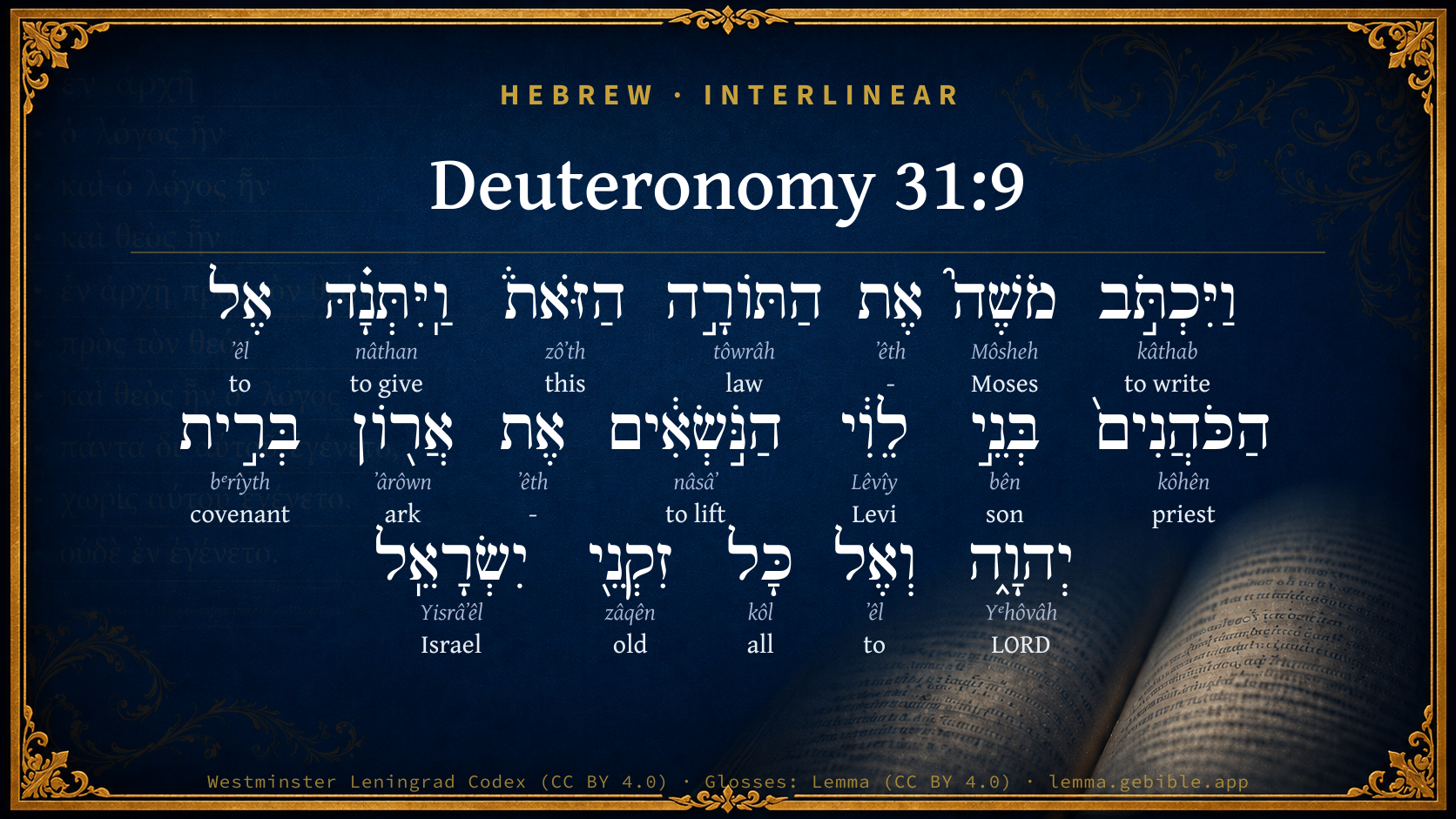
Hebrew (Westminster Leningrad Codex) Deuteronomy 31:9 appears in the Hebrew Old Testament. The text above is from the Westminster Leningrad Codex. Each word links to its Strong’s number, a concise gloss, and parsing drawn from the Open Scriptures Hebrew Bible morphology. Click any word for its full Brown-Driver-Briggs (BDB) entry.
Download image
Cite this verse

Deuteronomy 31:9 (World English Bible). Public Domain. Lemma interlinear Bible study tool, https://lemma.gebible.app/v/deuteronomy/31/9.

Show BibTeX & RIS
BibTeX
RIS
English Translation
Moses wrote this law, and delivered it to the priests the sons of Levi, who bore the ark of the covenant of Yahweh, and to all the elders of Israel.
World English Bible · Public Domain
Download a study sheet

One document with this verse’s original text, its word-by-word gloss line, the meaning frame, cross-references with their text, attributed commentary, and full source and license credits — printable, and it pastes into notes with its structure intact.

This verse Autodidact and up

Study sheet (.html) Plain text (.txt)

A passage Seminary Student

Up to 50 verses in one chapter. A passage sheet keeps up to 6 commentary sources and 12 cross-references per verse, in the order this page ranks them, and says so on the sheet whenever that leaves anything out. Ask for a single verse and you get the Autodidact verse sheet above.

Everything on this page stays free to read, with no account — the sheet is a download of what is already on screen, not access to it.

Want to remove ads? Support Godless Engineer
Compare translations 3

The same verse in 3 English versions, stacked beneath the original-language interlinear above. Click any original word for its lexicon entry.

Each is an independent rendering of the whole verse — the interlinear is not word-aligned to these translations.

Highlighted words mark where these versions differ — a whole-verse word diff, not a word-by-word alignment.

  • World English Bible Public Domain
    Moses wrote this law, and delivered it to the priests the sons of Levi, who bore the ark of the covenant of Yahweh, and to all the elders of Israel.
  • King James Version Public Domain
    And Moses wrote this law, and delivered it unto the priests the sons of Levi, which bare the ark of the covenant of the LORD, and unto all the elders of Israel.
  • unfoldingWord Literal Text CC BY-SA 4.0
    And Moses wrote this law and gave it to the priests, the sons of Levi, who carry the box of the covenant of Yahweh, and to all the elders of Israel.

unfoldingWord Literal Text — © unfoldingWord, licensed CC BY-SA 4.0. Word-aligned USFM3 via Door43 (git.door43.org/unfoldingWord/en_ult).

Versions to compare (up to 4)

3 of 4 selected

Show all 18 translations

Every available English version of this verse, each an independent rendering of the whole verse.

  • World English Bible Public Domain
    Moses wrote this law, and delivered it to the priests the sons of Levi, who bore the ark of the covenant of Yahweh, and to all the elders of Israel.
  • Berean Standard Bible Public Domain
    So Moses wrote down this law and gave it to the priests, the sons of Levi, who carried the ark of the covenant of the LORD, and to all the elders of Israel.
  • Majority Standard Bible Public Domain
    So Moses wrote down this law and gave it to the priests, the sons of Levi, who carried the ark of the covenant of the LORD, and to all the elders of Israel.
  • King James Version Public Domain
    And Moses wrote this law, and delivered it unto the priests the sons of Levi, which bare the ark of the covenant of the LORD, and unto all the elders of Israel.
  • American Standard Version (1901) Public Domain
    And Moses wrote this law, and delivered it unto the priests the sons of Levi, that bare the ark of the covenant of Jehovah, and unto all the elders of Israel.
  • Revised Version (1885) Public Domain
    And Moses wrote this law, and delivered it unto the priests the sons of Levi, which bare the ark of the covenant of the LORD, and unto all the elders of Israel.
  • Geneva Bible (1599) Public Domain
    And Moses wrote this Lawe, and deliuered it vnto the Priestes the sonnes of Leui (which bare the Arke of the couenant of the Lord) and vnto all the Elders of Israel,
  • Douay-Rheims (1899) Public Domain
    And Moses wrote this law, and delivered it to the priests the sons of Levi, who carried the ark of the covenant of the Lord, and to all the ancients of Israel.
  • Young's Literal Translation Public Domain
    And Moses writeth this law, and giveth it unto the priests (sons of Levi, those bearing the ark of the covenant of Jehovah), and unto all the elders of Israel,
  • Literal Standard Version CC BY-SA 4.0
    And Moses writes this law and gives it to the priests (sons of Levi, those carrying the Ark of the Covenant of YHWH), and to all [the] elderly of Israel,
  • Unlocked Literal Bible CC BY-SA 4.0
    Moses wrote this law and gave it out to the priests, the sons of Levi, who carried the ark of the covenant of Yahweh; he also gave copies of it to all the elders of Israel.
  • unfoldingWord Literal Text CC BY-SA 4.0
    And Moses wrote this law and gave it to the priests, the sons of Levi, who carry the box of the covenant of Yahweh, and to all the elders of Israel.
  • Darby Bible Public Domain
    And Moses wrote this law, and delivered it to the priests, the sons of Levi, who bore the ark of the covenant of Jehovah, and to all the elders of Israel.
  • World Messianic Bible Public Domain
    Moses wrote this law and delivered it to the priests the sons of Levi, who bore the ark of the LORD’s covenant, and to all the elders of Israel.
  • Webster's Bible Public Domain
    And Moses wrote this law, and delivered it to the priests the sons of Levi, who bore the ark of the covenant of the LORD, and to all the elders of Israel.
  • Free Bible Version CC BY-SA 4.0
    Moses wrote this law down and gave it to the priests, the sons of Levi, who carried the Ark of the covenant of the Lord, and to all the Israelite elders.
  • Bible in Basic English Public Domain
    Then Moses put all this law in writing, and gave it to the priests, the sons of Levi, who take up the ark of the Lord's agreement, and to all the responsible men of Israel.
  • JPS Tanakh (1917) Public Domain
    And Moses wrote this law, and delivered it unto the priests the sons of Levi, that bore the ark of the covenant of the LORD, and unto all the elders of Israel.

Literal Standard Version (2020), Covenant Press — licensed CC BY-SA 4.0. Text via the HelloAO Bible API (eBible.org). Unlocked Literal Bible (unfoldingWord) — licensed CC BY-SA 4.0. Text via the HelloAO Bible API (eBible.org). unfoldingWord Literal Text — © unfoldingWord, licensed CC BY-SA 4.0. Word-aligned USFM3 via Door43 (git.door43.org/unfoldingWord/en_ult). Free Bible Version, Dr. Jonathan Gallagher — licensed CC BY-SA 4.0. Text via the HelloAO Bible API (eBible.org).

Word by word

More ways to search: Search by grammar → Find every occurrence → Compare this word →

Practice this passage: Drill this verse → Learn its vocabulary →

לֵוִ֔י
Lêvîy
H3878
“Levi”
Noun, Proper
Part of Speech
Noun
Type
Proper
Full BDB Definition

Origin: from H3867

TWOT: 1093

Levi = "joined to" - the 3rd son of Jacob by Leah and progenitor of tribe of Levites
  1. וַיִּכְתֹּ֣ב kâthab H3789 “and · to write” Conjunction + Verb, Qal, Sequential Imperfect, 3rd Person, Masculine, Singular
  2. מֹשֶׁה֮ Môsheh H4872 “Moses” Noun, Proper
  3. אֶת ʼêth H853 “-” Particle, Direct Object
  4. הַתּוֹרָ֣ה tôwrâh H8451 “the · law” Particle, Definite Article + Noun, Common, Feminine, Singular, Absolute
  5. הַזֹּאת֒ zôʼth H2063 “the · this” Particle, Definite Article + Pronoun, Demonstrative, Feminine, Singular
  6. וַֽיִּתְּנָ֗הּ nâthan H5414 “and · to give · her” Conjunction + Verb, Qal, Sequential Imperfect, 3rd Person, Masculine, Singular + Suffix, Personal, 3rd Person, Feminine, Singular
  7. אֶל ʼêl H413 “to” Preposition
  8. הַכֹּהֲנִים֙ kôhên H3548 “the · priests” Particle, Definite Article + Noun, Common, Masculine, Plural, Absolute
  9. בְּנֵ֣י bên H1121 “sons of” Noun, Common, Masculine, Plural, Construct
  10. הַנֹּ֣שְׂאִ֔ים nâsâʼ H5375 “the · lifting” Particle, Definite Article + Verb, Qal, Participle Active, Masculine, Plural, Absolute
  11. אֶת ʼêth H853 “-” Particle, Direct Object
  12. אֲר֖וֹן ʼârôwn H727 “ark of” Noun, Common, Both, Singular, Construct
  13. בְּרִ֣ית bᵉrîyth H1285 “covenant of” Noun, Common, Feminine, Singular, Construct
  14. יְהוָ֑ה Yᵉhôvâh H3068 “LORD” Noun, Proper
  15. וְאֶל ʼêl H413 “and · to” Conjunction + Preposition
  16. כָּל kôl H3605 “all of” Noun, Common, Masculine, Singular, Construct
  17. זִקְנֵ֖י zâqên H2205 “old of” Adjective, Adjective, Masculine, Plural, Construct
  18. יִשְׂרָאֵֽל Yisrâʼêl H3478 “Israel” Noun, Proper

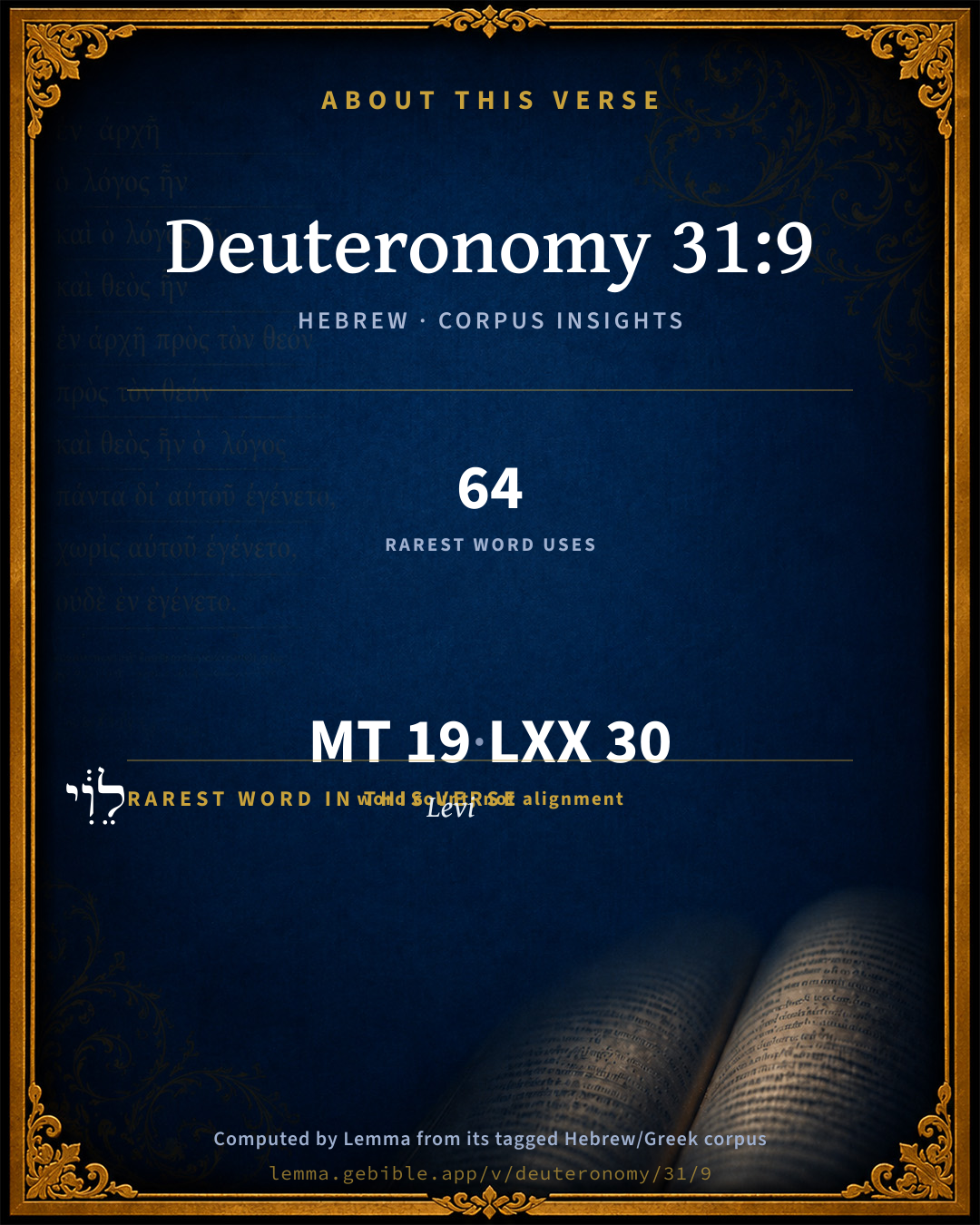
About this verse

These counts appear in no published source. They are computed here, from the morphology-tagged text and Lemma’s own curated glosses. What Lemma adds →

19
words
17
distinct lemmas
Pentateuch
section

Grammatical profile

  • 3 verbs
  • 10 nouns
  • 1 adjective
  • 1 pronoun
  • 2 prepositions
  • 2 particles

Verb forms

  • וַיִּכְתֹּ֣ב Qal · Sequential Imperfect
  • וַֽיִּתְּנָ֗הּ Qal · Sequential Imperfect
  • הַנֹּ֣שְׂאִ֔ים Qal · Participle Active

Repetition

A word recurs within this verse — often emphatic in Hebrew:

  • אֶל to H413 ×2

Hebrew & Septuagint length

In English translation the verse runs 30 words from the Hebrew and 40 from the Septuagint (LXX English) — closely comparable.

A rough comparison of the two English renderings, which tokenize alike — not a word-level alignment.

Word counts can differ between the Hebrew and the Greek without any difference in meaning — e.g. the Hebrew direct-object marker אֵת has no separate Greek word, and Greek often adds the article ὁ.

In the original languages it is 19 Hebrew tokens and 30 Greek tokens — but the two are counted differently (Hebrew bundles its prefixes and suffixes into one token; the Greek is in lemma form), so that isn’t a like-for-like length.

Cross-references

21

Topical passages linked to Deuteronomy 31:9 in the Treasury of Scripture Knowledge — connected by theme and wording, ordered by reader-vote popularity; previews shown in the World English Bible.

  • Numbers 4:15 "When Aaron and his sons have finished covering the sanctuary, and all the furniture of the sanctuary, as the camp moves forward; after that, the sons of Kohath shall come to carry it: but they shall not touch the sanctuary, lest they die. These things are the burden of the sons of Kohath in the Tent of Meeting.
  • Joshua 3:3 and they commanded the people, saying, When you see the ark of the covenant of Yahweh your God, and the priests the Levites bearing it, then you shall remove from your place, and go after it.
  • Numbers 33:2 Moses wrote their goings out according to their journeys by the commandment of Yahweh: and these are their journeys according to their goings out.
  • Deuteronomy 17:18 It shall be, when he sits on the throne of his kingdom, that he shall write him a copy of this law in a book, out of [that which is] before the priests the Levites:
  • Deuteronomy 31:22–26 So Moses wrote this song the same day, and taught it the children of Israel.
  • Deuteronomy 31:28 Assemble to me all the elders of your tribes, and your officers, that I may speak these words in their ears, and call heaven and earth to witness against them.
  • Joshua 3:14–17 It happened, when the people removed from their tents, to pass over the Jordan, the priests who bore the ark of the covenant being before the people;
  • Joshua 6:12 Joshua rose early in the morning, and the priests took up the ark of Yahweh.
  • 1 Kings 8:3 All the elders of Israel came, and the priests took up the ark.
  • 1 Chronicles 15:2 Then David said, None ought to carry the ark of God but the Levites: for them has Yahweh chosen to carry the ark of God, and to minister to him forever.
  • 1 Chronicles 15:12–15 and said to them, You are the heads of the fathers' [houses] of the Levites: sanctify yourselves, both you and your brothers, that you may bring up the ark of Yahweh, the God of Israel, to [the place] that I have prepared for it.
  • Daniel 9:13 As it is written in the law of Moses, all this evil is come on us: yet have we not entreated the favor of Yahweh our God, that we should turn from our iniquities, and have discernment in your truth.
  • Hosea 4:6 My people are destroyed for lack of knowledge. Because you have rejected knowledge, I will also reject you, That you may be no priest to me. Because you have your God's law, I will also forget your children.
  • Malachi 2:7 For the priest's lips should keep knowledge, and they should seek the law at his mouth; for he is the messenger of Yahweh of Hosts.
  • Malachi 4:4 "Remember the law of Moses my servant, which I commanded to him in Horeb for all Israel, even statutes and ordinances.
  • Mark 10:4–5 They said, "Moses allowed a certificate of divorce to be written, and to divorce her."
  • Mark 12:19 "Teacher, Moses wrote to us, 'If a man's brother dies, and leaves a wife behind him, and leaves no children, that his brother should take his wife, and raise up offspring for his brother.'
  • Luke 20:28 They asked him, "Teacher, Moses wrote to us that if a man's brother dies having a wife, and he is childless, his brother should take the wife, and raise up children for his brother.
  • John 1:17 For the law was given through Moses. Grace and truth came through Jesus Christ.
  • John 1:45 Philip found Nathanael, and said to him, "We have found him, of whom Moses in the law, and the prophets, wrote: Jesus of Nazareth, the son of Joseph."
  • John 5:46 For if you believed Moses, you would believe me; for he wrote about me.

Cross-references courtesy of OpenBible.info (CC BY 4.0).

Hebrew and Greek witnesses Masoretic Hebrew ↔ Greek Septuagint

The same verse in the two great witnesses to the Old Testament, shown verse-for-verse.

These are two independent witnesses, not word-aligned to each other, and the Septuagint is shown in lemma (dictionary) form.

Hebrew Deuteronomy 31:9 Masoretic · Westminster Leningrad Codex

וַיִּכְתֹּ֣ב מֹשֶׁה֮ אֶת הַתּוֹרָ֣ה הַזֹּאת֒ וַֽיִּתְּנָ֗הּ אֶל הַכֹּהֲנִים֙ בְּנֵ֣י לֵוִ֔י הַנֹּ֣שְׂאִ֔ים אֶת אֲר֖וֹן בְּרִ֣ית יְהוָ֑ה וְאֶל כָּל זִקְנֵ֖י יִשְׂרָאֵֽל

Moses wrote this law, and delivered it to the priests the sons of Levi, who bore the ark of the covenant of Yahweh, and to all the elders of Israel.

World English Bible · Public Domain

Greek LXX Deuteronomy 31:9 Septuagint · lemma form

καί γράφω μωυσῆς ὁ ῥῆμα ὁ νόμος οὗτος εἰς βιβλίον καί δίδωμι ὁ ἱερεύς ὁ υἱός λευί ὁ αἴρω ὁ κιβωτός ὁ διαθήκη κύριος καί ὁ πρεσβύτερος ὁ υἱός ἰσραήλ

And Moses wrote the words of this law in a book, and gave it to the priests the sons of Levi who bear the ark of the covenant of the Lord, and to the elders of the sons of Israel.

LXX2012 (modern English Septuagint) · Public Domain

On this verse, The Cambridge Bible for Schools and Colleges discusses the Septuagint’s reading. Read the note in Commentary ↓

Hebrew: Westminster Leningrad Codex (CC BY 4.0). Greek: Septuagint (public domain); English from LXX2012 (modern English Septuagint) (Public Domain). How the Septuagint differs from the Hebrew →

Targum (Aramaic paraphrase)

2

The Targum is the ancient Jewish Aramaic paraphrase of the Hebrew Scriptures — an interpretive translation, not the Hebrew text itself. Onkelos (literal) and Pseudo-Jonathan (expansive) render the Torah, and Jonathan the Prophets. Coverage is partial: where no permissively-licensed English translation exists for a verse, only the Aramaic is shown. This is verse-level text, not a word-by-word alignment to the Hebrew.

  1. Targum Onkelos Torah (Genesis–Deuteronomy)
    וּכְתַב מֹשֶׁה יָת אוֹרַיְתָא הָדָא וִיהָבַהּ לְכָהֲנַיָא בְּנֵי לְוֵי דְנָטְלִין יָת אֲרוֹן קְיָמָא דַיְיָ וּלְכָל סָבֵי יִשְׂרָאֵל

    (no public-domain English translation for this verse)

    Targum Onkelos — Aramaic: “Onkelos Genesis” (public domain); “Onkelos Exodus” (public domain); “Onkelos Leviticus” (public domain); “Onkelos Numbers” (public domain); “Onkelos Deuteronomy” (public domain). English: “Sefaria Community Translation” (CC0 1.0 (public-domain dedication)); “J.W. Etheridge. The Targums of Onkelos and Jonathan Ben Uzziel on the Pentateuch. London: Longmans, Green, 1862” (public domain). Text via Sefaria.

  2. Targum Pseudo-Jonathan Torah (Genesis–Deuteronomy)
    וּכְתַב משֶׁה יַת אוֹרַיְיתָא הָדָא וּמְסָרָהּ לְכַהֲנַיָא בְּנֵי לֵוִי דְנַטְלִין יַת אֲרוֹן קְיָימָא דַיְיָ וּלְכָל חַכִּימֵי יִשְרָאֵל

    And Mosheh wrote this law, and delivered it to the priests the sons of Levi, who bare the ark of the Lord’s covenant, and to all the sages of Israel.

    Targum Pseudo-Jonathan — Aramaic: “Targum Jonathan on Genesis” (public domain); “Targum Jonathan on Exodus” (public domain); “Targum Jonathan on Leviticus” (public domain); “Targum Jonathan on Numbers” (public domain); “Targum Jonathan on Deuteronomy” (public domain). English: “The Targum of Jonathan ben Uzziel, trans. J. W. Etheridge, London, 1862” (public domain). Text via Sefaria.

Commentary

Notes on Deuteronomy 31:9 from classic Christian and Jewish commentators (each source and its license shown beneath its notes). The classic Christian expositions comment on the surrounding passage and are grouped to its opening verse, so a note may address several verses; the Jewish commentaries on the Tanakh (Rashi and others) are per-verse, so they appear only where the commentator wrote on this verse.

Lemma curates 59 commentaries, every one of them public domain or Creative Commons licensed, each selected and text-cleaned for this edition rather than reprinted as found. About our sources →

Matthew Henry's Commentary

The law was given by Moses; so it is said, Joh 1:17. He was not only entrusted to deliver it to that generation, but to transmit it to the generations to come; and here it appears that he was faithful to that trust.

I. Moses wrote this law, Deu 31:9. The learned bishop Patrick understands this of all the five books of Moses, which are often called the law; he supposes that though Moses had written most of the Pentateuch before, yet he did not finish it till now; now he put his last hand to that sacred volume. Many think that the law here (especially since it is called this law, this grand abridgment of the law) is to be understood of this book of Deuteronomy; all those discourses to the people which have taken up this whole book, he, being in them divinely inspired, wrote them as the word of God. He wrote this law, 1. That those who had heard it might often review it themselves, and call it to mind. 2. That it might be the more safely handed down to posterity. Note, The church has received abundance of advantage from the writing, as well as from the preaching, of divine things; faith comes not only by hearing, but by reading. The same care that was taken of the law, thanks be to God, is taken of the gospel too; soon after it was preached it was written, that it might reach to those on whom the ends of the world shall come.

II. Having written it, he committed it to the care and custody of the priests and elders. He delivered one authentic copy to the priests, to be laid up by the ark (v. 26), there to remain as a standard by which all other copies must be tried. And it is supposed that he gave another copy to the elders of each tribe, to be transcribed by all of that tribe that were so disposed. Some observe that the elders, as well as the priests, were entrusted with the law, to intimate that magistrates by the power, as well as ministers by their doctrine, are to maintain religion, and to take care that the law be not broken nor lost.

III. He appointed the public reading of this law in a general assembly of all Israel every seventh year. The pious Jews (it is very probable) read the laws daily in their families, and Moses of old time was read in the synagogue every sabbath day, Act 15:21. But once in seven years, that the law might be the more magnified and made honourable, it must be read in a general assembly. Though we read the word in private, we must not think it needless to hear it read in public. Now here he give direction,

1. When this solemn reading of the law must be, that the time might add to the solemnity; it must be done, (1.) In the year of release. In that year the land rested, so that they could the better spare time to attend this service. Servants who were then discharged, and poor debtors who were then acquitted from their debts, must know that, having the benefit of the law, it was justly expected they should yield obedience to it, and therefore give up themselves to be God's servants, because he had loosed their bonds. The year of release was typical of gospel grace, which therefore is called the acceptable year of the Lord; for our remission and liberty by Christ engage us to keep his commandments, Luk 1:74, Luk 1:75. (2.) At the feast of tabernacles in that year. In that feast they were particularly required to rejoice before God, Lev 23:40. Therefore then they must read the law, both to qualify their mirth and keep it in due bounds, and to sanctify their mirth, that they might make the law of God the matter of their rejoicing, and might read it with pleasure and not as a task.

2. To whom it must be read: To all Israel (Deu 31:11), men, women, and children, and the strangers, Deu 31:12. The women and children were not obliged to go up to the other feasts, but to this only in which the law was read. Note, It is the will of God that all people should acquaint themselves with his word. It is a rule to all, and therefore should be read to all. It is supposed that, since all Israel could not possibly meet in one place, nor could one man's voice reach them all, as many as the courts of the Lord's house would hold met there, and the rest at the same time in their synagogues. The Jewish doctors say that the hearers were bound to prepare their hearts, and to hear with fear and reverence, and with joy and trembling, as in the day when the law was given on Mount Sinai; and, though there were great and wise men who knew the whole law very well, yet they were bound to hear with great attention; for he that reads is the messenger of the congregation to cause the words of God to be heard. I wish those that hear the gospel read and preached would consider this.

3. By whom it must be read: Thou shalt read it (Deu 31:11), "Thou, O Israel," by a proper person appointed for that purpose; or, "Thou, O Joshua," their chief ruler; accordingly we find that he did read the law himself, Jos 8:34, Jos 8:35. So did Josiah, Ch2 34:30, and Ezra, Neh 8:3. And the Jews say that the king himself (when they had one) was the person that read in the courts of the temple, that a pulpit was set up for that purpose in the midst of the court, in which the king stood, that the book of the law was delivered to him by the high priest, that he stood up to receive it, uttered a prayer (as every one did that was to read the law in public) before he read; and then, if he pleased, he might sit down and read. But if he read standing it was thought the more commendable, as (they say) king Agrippa did. Here let me offer it as a conjecture that Solomon is called the preacher, in his Ecclesiastes, because he delivered the substance of that book in a discourse to the people, after his public reading of the law in the feast of tabernacles, according to this appointment here.

4. For what end it must be thus solemnly read. (1.) That the present generation might hereby keep up their acquaintance with the law of God, Deu 31:12. They must hear, that they may learn, and fear God, and observe to do their duty. See here what we are to aim at in hearing the word; we must hear, that we may learn and grow in knowledge; and every time we read the scriptures we shall find that there is still more and more to be learned out of them. We must learn, that we may fear God, that is, that we may be duly affected with divine things; and must fear God, that we may observe and do the words of his law; for in vain do we pretend to fear him if we do not obey him. (2.) That the rising generation might betimes be leavened with religion (Deu 31:13); not only that those who know something may thus know more, but that the children who have not known any thing may betimes know this, how much it is their interest as well as duty to fear God.

Matthew Henry's Commentary on the Whole Bible (1708–1710) — public domain (CC PDM 1.0). Text via the HelloAO Bible API.

Jamieson, Fausset & Brown

Robert Jamieson, A. R. Fausset & David Brown

HE DELIVERS THE LAW TO THE PRIESTS, TO READ IT EVERY SEVENTH YEAR TO THE PEOPLE. (Deu 31:9-13)

And Moses wrote this law, and delivered it unto the priests--The law thus committed to writing was either the whole book of Deuteronomy, or the important part of it contained between the twenty-seventh and thirtieth chapters. It was usual in cases of public or private contract for two copies of the engagement to be made--one to be deposited in the national archives or some secure place for reference, should occasion require. The other was to remain in the hands of the contracting parties (Jer 32:12-14). The same course was followed on this renewal of the covenant between God and Israel. Two written copies of the law were prepared, the one of which was delivered to the public representatives of Israel; namely, the priests and the elders.

the priests, . . . who bare the ark of the covenant--In all ordinary journeys, it was the common duty of the Levites to carry the ark and its furniture (Num 4:15); but, on solemn or extraordinary occasions, that office was discharged by the priests (Jos 3:3-8; Jos 6:6; Ch1 15:11-12).

all the elders of Israel--They were assistants to the priests and overseers to take care of the preservation, rehearsal, and observance of the law.

Jamieson, Fausset & Brown — Commentary Critical and Explanatory on the Whole Bible (1871) — public domain (CC PDM 1.0). Text via the HelloAO Bible API.

Ellicott's Commentary for English Readers

Deu_31:9-13. MOSES RESIGNS HIS CHARGE AS LAWGIVER TO THE PRIESTS.

(9-11) And Moses wrote this law, and delivered it unto the priests . . . And . . . commanded them, saying . . . thou shalt read.—This must be distinguished from the deliverance of the “book” to the Levites in Deu_31:25-26. The deliverance here must be understood as a charge and a trust conveyed to the priests, making them responsible for the “reading of the law,” and for the instruction of the people. This is the special duty of the priests. They are said to “bear” the ark of the covenant here; not because they always carried it (they did sometimes, as in Joshua 3), but because they were responsible for it, just as they were also responsible for the exposition of the law (Deu_17:9). This is another example of the distinction between priests and Levites in the book of Deuteronomy.

(10, 11) At the end of every seven years, in the . . . year of release, in the feast of tabernacles . . . thou shalt read this law.—The fulfilment of this command, as far as the reading of the law is concerned, is described in Jos_8:34-35; and again “at the feast of tabernacles” in Nehemiah 8. That the law read on these occasions was especially the book of Deuteronomy appears from the Talmudical treatise Sotah (p. 41), where the reading of it by the king is described as beginning with Deu_1:1 : “These are the words.” It is in this connection that the story is told of Agrippa that he wept when he came to Deu_17:15, “Thou mayest not set a stranger over thee.” But they said, “Fear not, Agrippa, thou art our brother,” and he then finished the reading. It was read from a platform erected in the forecourt of the temple. From this passage it is clear that the “reading” was understood to refer specially to the book of Deuteronomy.

(13) That their children . . . may hear.—It is obvious from this that the existence of many copies of the law was not contemplated by the writer. Comp. Deu_6:6-7 : “These words shall be in thine heart, and thou shalt teach them.”

A Bible Commentary for English Readers, edited by Charles John Ellicott (1878–1897) — public domain. Text from a community e-Sword module.

The Cambridge Bible for Schools and Colleges

gen. ed. J. J. S. Perowne

9. Moses wrote this law] Besides Deu_31:24 the only statement to this effect in Deut.

this law] Heb. Tôrah, see on Deu_1:5. In Deut. the Code (possibly with hortatory additions, but we cannot tell the exact extent of it here intended, see Deu_27:3) is called Tôrah only in Deu_1:5, Deu_4:8 (parallel to statutes and judgements), Deu_4:44 (a title); twice in the law of the King Deu_17:18 f., and nowhere else in chs. 5–26, but in chs. 27–31 no fewer than 14 times, 5 of which are within Deu_31:9-26, and in Jos_1:8. This unequal distribution is very striking.

the priests the sons of Levi] See on Deu_10:8, Deu_18:1. Steuern. takes the sons of Levi as secondary, because omitted by LXX, but it is only LXX B which omits the phrase; LXX A and other Codd. have it.

which bare the ark, etc.] See on Deu_10:8.

the elders] See on Deu_19:12. Marti omits the whole clause, the priests … covenant of the Lord, as a later substitute for the original Joshua; but if this theory be correct the rest, and unto all the elders of Israel, must also be secondary, since the imperatives in 11 f. are sing.

9–13. The Law written and delivered to the Levites, etc.

Moses wrote this Law and gave it to the priests and elders, charging them to read it every seventh year at the Feast of Booths to all Israel, women, little ones and gerim included, that they and their children might evermore fear God and do its words upon the land.—The language is almost purely deuteronomic, and the passage may be original to D (Dillm. Dri., etc.) or from the edition of D, introduced by 1–3 (‘not impossible,’ Berth. Marti). Steuern. takes parts of it as original to his Sg. author, the rest due to later expansion, but his analysis is precarious; Cullen (147, 159) as part of the epilogue to the Torah. The order of the passage, between two others relating the commission to Joshua, is inexplicable, unless we suppose that in place of the priests, the sons of Levi … and the elders, to whom Deu_31:9 describes that Moses entrusted the written law, the name of Joshua himself originally stood. And for this there is some evidence in the sing. thou shalt read and assemble of Deu_31:11 f. But the text is not certain.

The Cambridge Bible for Schools and Colleges (gen. ed. J. J. S. Perowne; Cambridge University Press, 1878–1918) — public domain. Text from a community e-Sword module.

Trapp's Complete Commentary

John Trapp

Deu 31:9 And Moses wrote this law, and delivered it unto the priests the sons of Levi, which bare the ark of the covenant of the LORD, and unto all the elders of Israel.

Ver. 9. Unto the priests.] God’s library-keepers, his depositaries.

Unto all the elders of Israel.] As to the keepers of both tables.

John Trapp, A Commentary or Exposition upon All the Books of the Old and New Testament (1647–1656) — public domain. Text from a community e-Sword module.

Joseph Benson's Commentary

Deu 31:9. Moses wrote this law — Largely so called, comprehending not only the contents of this book of Deuteronomy, but the whole law or doctrine delivered unto him, contained in these five books. Or rather it is probable the whole Pentateuch is here intended, which is the meaning of the word law in many parts of Scripture. And delivered it unto the priests — Who were in duty bound to be peculiarly conversant with it, to keep it carefully and religiously, and to bring it forth upon occasion, and instruct the people out of it. And unto all the elders — The magistrates, whose office it was to see that these laws of God were duly observed. The Jews allege that Moses, having delivered one copy unto the priests, gave one likewise to each tribe, which he committed to the care of the elders of it.

Joseph Benson's Commentary on the Old and New Testaments (1811–1818) — public domain. Text from a community e-Sword module.

The Pulpit Commentary

Vers. 9-13. Moses turns next to the priests and the elders, and to them he commits the Law which he had written, with the injunction to read it to the people at the end of every seven years during the festival of the year of release, viz. at the Feast of Tabernacles, (cf. Lev_23:34) when they appeared before the Lord. At the end of every seven years. (cf. Deu_15:1) The Law was committed to the priests and elders, not merely to preserve it in safe keeping, but that they might see to its being observed by the people; else why commit it to the elders whose it was to administer rule in the nation, as well as to the priests who alone had access to the ark of the covenant where the Law was deposited? Moses "entrusted the reading to the priesthood and the college of elders, as the spiritual and secular rulers of the congregation; and hence the singular, Thou shalt read this Law to all Israel" (Keil). By the Law here is meant the Pentateuch; but it does not necessarily follow that the whole of the Pentateuch was to be thus read. As the reading was to be only once in seven years, it may be concluded that it was not so much for the information of the people that this was done, as for the purpose of publicly declaring, and by a solemn ceremony impressing on their minds the condition on which they held their position and privileges as the chosen people of the Lord; and for this the reading of select portions of the Torah would be sufficient. The Feast of Tabernacles was appointed as the season for the reading, doubtless because there was a connection between the end for which the Law was read and the spirit and meaning of that festival as a festival of rejoicing because of their deliverance from the uncertainty and unsettledness of their state in the wilderness, and their establishment in a well-ordered state where they could in peace and quietness enjoy the blessings which the bounty of God bestowed. When all Israel is come to appear before the Lord. (cf. Deu_16:16) Thou shalt read this law. (cf. Jos_8:34 2Ki_23:2; Neh_8:1, etc.)

Vers. 9-13. Importance of knowing the Word of God.

In resigning his commission into other hands, Moses had a double duty to discharge. There had been, in fact, a twofold responsibility resting on him more or less till the close of his life, which after his death would be divided. He was not only the leader of the people, but also the receiver, transcriber, and guardian of the Law. As the nation became consolidated, this double work would certainly become too heavy for one man to discharge. Hence he commissions one man to be the leader of an army, and another set of men to be the conservators of the truth. Joshua is leader. The priests are to be the keepers and teachers of the Law. It is one remarkable feature of the constitution of the Hebrew commonwealth, that such stress is laid upon popular education. This was again and again made matter of Divine precept. And about this there were two main regulations: one, that it was to begin at home; another, that it was to have as its one golden thread running through all, that the fear of the Lord was the beginning of wisdom. Over and above, however, the home teaching from childhood, there was to be at stated times a public reading and enforcement of the Law. At this public reading, the people were to be gathered together. "Young men and maidens, old men and children;" the stranger that was within their gates was not to be forgotten. All, all were to hear the Word of God, that they might learn, fear, love, and obey.

It is to secure this most desirable end that Moses, having written the Law, delivers it to the priests, the sons of Levi, and gives them the charge of which the paragraph before us is the sum. Our theme is The value of the Word of God as an educating power in home and nation. The points to be noted in the words of Moses here given, are these:

1. That both young and old were to have ever before them the truth that their life was for God, was to be permeated by Divine influence, and regulated by the Divine will.

2. That the will of God, so revealed as to be the true and sufficient regulator of life, was to be found in the Book of the Law.

3. That all classes of the people, home-born and alien, freemen and slaves, were to be taught what was the Divine will concerning them.

4. That the object of the teaching was that they might grow up with an intelligent apprehension of the deep meaning of life.

5. That intelligence was intended and expected to blossom into piety. Men were to "fear" the Lord their God, and to "observe to do all the words of this Law.

Our purpose in this Homily is to inquire, How far does all this hold good at the present day? When Moses wrote the Law, it served, as it did for ages after, as the people"s literature. It would take a like place with the people that our histories of England do now, and would, moreover, serve them as the story-book for children, and the statute-book for all. And there was a time when to large masses of our people the Bible constituted the chief literary treasure of the home. And ere the people could read, the exposition and enforcement of its truths from the pulpit formed the staple of their education. But things are changed now. The increase of literary material in every direction is amazing. The vastly wider field of natural knowledge takes so much time and energy for its exploration, that the Bible is in danger of being "crowded out." And what may be called in an intelligible sense the literary rivals of the Bible are "legion." We propose to suggest a few lines of thought which the Christian preacher may work out, with the view of showing that an intelligent acquaintance with the Word of God is, if possible, more important now than ever it was. Many reasons may be urged for this.

I LET US CONSIDER THE VARIOUS ASPECTS IN WHICH THE BIBLE MAY BE REGARDED. We need scarcely observe (save for the sake of completeness of setting) that our Bible is much larger than Israel"s was, and that therefore by so much as this is the case there is much more to be affirmed of it now than could be of the old Book of the Law.

1. In the Bible we have a trustworthy history of Judaism and Christianity, in their origin and meaning. Of the first we have an outline during the main periods of its constitutional history; of the second, during the first generation after its planting. And so important are these features of history, that apart from them the history of the world cannot be understood.

2. We have the noblest ethical standard in the world. The moral law cannot, even in conception, be surpassed.

3. We have a revelation of a great redeeming plan steadily unfolded from Genesis to Revelation.

4. We have a disclosure of God in the Person of the Lord Jesus Christ.

5. We have the manifestation of power from heaven to begin a new creation of grace.

6. We have a body of doctrine for the life that now is.

7. We have glorious glimpses of the life which is to come. In all these respects the Book is unique. It has no compeer in any literature in the world!

II AS THE CONTENTS OF THE BIBLE ARE UNIQUE, SO ALSO IS ITS OBJECT DEFINITE. (See Ps 1 Ps 119; Joh 21, et al.) That object is the regulation of life on earth, and the preparation of it for heaven. And the Book seeks to secure this by enforcement of duty, revelations of truth, disclosures of love, and offers of power.

III NO AMOUNT OF NATURAL LEARNING CAN EVER COMPENSATE FOR DEFICIENCY OF KNOWLEDGE OR FAILURE IN PRACTICE CONCERNING MAN"S DUTY TO HIMSELF, HIS FAMILY, HIS NEIGHBOR, AND HIS GOD. If he fails here, he fails everywhere. The more splendidly a vessel is fitted up, the more costly the wreck if she dashes on the rocks. To teach natural knowledge and leave out religion, is to furnish the vessel but to fail to make any provision for steering it aright.

IV NATURAL KNOWLEDGE IN THE HANDS OF OTHER THAN VIRTUOUS MEN MAY BECOME AN INSTRUMENT OF ENORMOUS MISCHIEF. The attempt to blow up the Winter Palace at St. Petersburg is an illustration of what science and skill may do in bad hands. The disclosures after the destruction of the Tay Bridge showed us how science, art, and skill may do their best, and yet the greatest efforts of great men may be blown away in an hour by a single blast, through the weak points which unconscientious work had left, in the hope of being undetected.

V THE GREATER THE STRENGTH THAT IS PUT FORTH IN ACQUIRING KNOWLEDGE, THE GREATER THE ENERGY DEMANDED IN ORDER TO USE SUCH KNOWLEDGE WELL. The larger the vessel, the more power is required to propel her. So the wider the culture, the stronger does moral principle need to be in order that natural knowledge may be not a veil to conceal, but a book to reveal the Divine.

VI HENCE THE CONCLUSION FOLLOWS: SO far from the accumulating mass of natural knowledge making the Word of God less necessary as a guide to living well and dying well, the fact is, that the necessity of Bible study is greater than ever! No book can take its place. No study can supersede that of the ways of God to man. Some of the wisest men of the age (so far as science goes) confess themselves hopelessly in the dark with regard to man"s origin, nature, and destiny. Ah! in the Book of God, and in that alone, can man learn that which shall make him wise unto salvation. Here alone can we learn the mystery of God"s will which was hidden from ages and generations, but now is made manifest. Here alone can he be taught that godliness which hath "promise of the life that now is, and of that which is to come.

Vers. 9, 24-26. The authorship of the book.

A clear testimony to the Mosaic authorship of the Book of Deuteronomy. The book, as Moses gave it to the priests, has plainly been re-edited, with the additions of Moses" song, Moses" blessing, and the account of his death; but only the wantonness of criticism can see "a different hand or hands" in Deuteronomy 12-26, from that employed upon the earlier chapters, or discern probability in the assumption that Deu 4:44-26:19 once constituted a separate book. The unity in style and treatment is so conspicuous throughout same vein of thought, the same tone and tenor of feeling, the same peculiarities of conception and expression that unity of authorship follows as a thing of course. The denial of it is incomprehensible. It is less certain whether the "Book of the Law" (ver. 26) comprehends Deuteronomy only, or the bulk of the other books of the Pentateuch as well. That Deuteronomy is represented as existing in a written form is plain from Deu_28:58, 61 29:20, 21, 27; and Hoses had probably the written discourses in his band when he delivered them. But Deuteronomy, as a written book, rests so entirely on the history as we have it in the previous books; is so steeped in allusions to it; implies so full and accurate a knowledge of it, from the days of the patriarchs downwards; that the presumption in favor of that history also existing in a written form, in authentic records, which subsequent generations could consult, is so strong as almost to amount to certainty. It is incredible that Moses should have taken pains to write out these long discourses discourses based on the history, and inculcating so earnestly the keeping of its facts and lessons in remembrance and yet have taken no pains to secure an authentic record of the history itself; that he should not have compiled or composed, out of the abundant materials at his command, a connected narrative of God"s dealings with the nation, down to the point at which he addressed it; incorporating with that narrative the body of his legislation. Confining our attention to Deuteronomy, there can be no fair question but that it gives itself out as from the pen of Moses. This claim is disputed, and the book referred to about the time of Josiah on grounds of style, of discrepancies with the Levitical laws, and of laws and allusions implying the later date. On the contrary, we hold that the critical hypothesis can be shown to raise greater difficulties than it lays, and that the difficulties in the way of accepting the book as a composition of Moses have been greatly exaggerated. We glance at a few of these difficulties.

I STYLE. Professor W.R. Smith ("Old Testament," p. 433) notes as a crucial instance the laws about the cities of refuge in Numbers 35., and Deuteronomy 19. These laws are supposed to have been penned by the same hand within a few months of each other; yet, it is alleged, the vocabulary, structure of sentences, and cast of expression widely differ.

But allowance must surely be made for the difference between a careful original statement of a law, and a later general rehearsal of its substance in the rounded style of free, popular discourse. And what are the specific differences? Deuteronomy, we are told, does not use the term "refuge," but "the cities are always described by a periphrasis." But the Deuteronomist simply says, "Thou shalt separate three cities for thee in the midst of thy; (Deu_19:2) "thou shalt separate three cities for thee"; (Deu_19:7) thou shalt add three cities more for thee"; (Deu_19:9) and there is no periphrasis. The phrase, "that every slayer may flee thither", (Deu_19:3) "the slayer which shall flee thither", (Deu_19:4) is derived from Num_35:11, Num_35:15. But Deuteronomy and Numbers use different words for "accidentally."Admitted, but the words used are synonymous, and are only used in each case twice altogether in Num_35:11, Num_35:15, and in Deu_4:42 Deu_19:4. "The judges in the one are " the congregation," in the other " the elders of his city. But Deuteronomy says nothing about "judges," and "the elders" who are once referred to in Deu_19:12, plainly act in the name of the congregation. "The verb for "hate" is different." Rather, "the verb for "hate does not occur at all in Numbers 35., but the noun derived from it does, (Num_35:20) and is translated "hatred," while in vers. 21, 22, a different term, translated "enmity," is employed, which expresses nearly the same sense. Had these words appeared, one in Numbers and the other in Deuteronomy, instead of standing in consecutive verses of one chapter, they would doubtless have been quoted as further evidence of diversity of authorship. So one book, uses the expression "to kill any person," while the other has "to kill his neighbor a difference surely not incompatible with identity of authorship. "The detailed description of the difference between murder and accidental homicide is entirely diverse in language and detail." But in Deuteronomy there is no "detailed description" of the kind referred to. There is in Numbers; (Num_35:16-24) but Deuteronomy confines itself to one simple illustration from concrete life, admirably adapted, it will be admitted, to the speaker"s popular purpose. (Deu_19:5) The statement in Deuteronomy, it is evident, presupposes the earlier law, and is incomplete without it, occupying only a dozen verses, as compared with over twenty in Numbers, while even of the dozen, three are occupied with a new provision for the number of the cities being ultimately raised to. (Deu_19:8-10)

II DISCREPANCIES IN LAWS. Considering the number of the laws, the alleged discrepancies are singularly few. On the "tithes," see Deu_26:12; on the "firstlings," Deu_15:20; "the priests" due," in Deu_18:3, seems, like the "fleece" of Deu_18:4, to be in addition to the provision in Num_18:11-18; the law of carrion (Deu_14:21) is slightly modified in view of the altered circumstances of settlement in Canaan; (cf. Lev_17:15) and so with other instances. The chief modifications arise from the new legislation in regard to the central sanctuary, with the permission to kill and eat flesh at home. (Deu_12:20-24) On this depends the new tithe-laws (provision for the sanctuary feasts), the additions to the priests" portions, and various minor changes.

III PECULIARITIES IMPLYING A LATER DATE. We need not delay on stray phrases, such as "unto this day", (Deu_3:14) or "as Israel did unto the land of his possession". (Deu_2:12) The instances usually cited are not of great force, and are easily explicable as glosses. More important cases are:

1. The central altar. On this, see under Deuteronomy 12. It suffices to meet most objections to observe that, on the face of it, the Law bears that it was not intended to be put strictly in force till certain important conditions had been fulfilled conditions which, owing to the disobedience of the people, who during the time of the judges so often put back the clock of their own history, were not fulfilled tilt as late as the days of David and Solomon. For thus it reads (ver. 10), "When ye go over Jordan, and dwell in the land which the Lord your God giveth you to inherit, and when he giveth you rest from all your enemies round about, so that ye dwell in safety; then there shall be a place," etc.. (cf. 1Ki_3:2 1Ki_5:4)

2. Priests and Levites. The distinction between priests and Levites, which counts for so much in Leviticus and Numbers, is not, it is alleged, recognized in Deuteronomy. The phrase in use is not "priests and Levites" (which, however, as little as the other, occurs in the earlier books), but the priests the Levites". (Deu_17:9, 18 18:1 24:8 27:9) They are not distinctively "the sons of Aaron," but "sons of Levi". (Deu_21:5 Deu_31:9) "All Levites are possible priests." But the objection is deprived of its force when we discover, what any one can verify, that these same expressions were freely used, and used interchangeably with others, at a time when it is not doubted that the Levitical system was in full operation. This is the case in the Books of Chronicles, written, it is asserted, in the interest of that system, yet using this phrase, "the priests the Levites," without hesitation or sense of ambiguity. (2Ch_5:5 2Ch_23:18 2Ch_30:27) "The priests the Levites" mean simply the Levitical priests; and when the tribe of Levi as a whole is meant, it is either expressly designated as such, (Deu_10:8) or the designation is appended to the other phrase as a wider denomination. (Deu_18:1) Nor is the idiom a strange one. At first, the priests," the sons of Aaron," stood out from the people with sharp distinctness, as alone invested with sacred office. The case was greatly altered after the separation of the tribe of Levi; when the designation "sons of Aaron" seems speedily to have been dropped for another identifying the priests more directly with their tribe. "Sons of Aaron" is not found in the latter part of Numbers. Priests and Levites had more in common with each other than either class had with the body of the people; and besides, the priests were Levites. So that to the popular eye, the tribe of Levi stood apart, forming, as a whole, one sacred body, engaged in ministering in holy things to God. Sacerdotal functions are attributed to the tribe, but not necessarily to all members of it. (Deu_10:8 Deu_18:7) (On the ministering of the Levites, comp. 1Ch_15:2; 2Ch_29:11 2Ch_31:2) The counter-theory, that this distinction had no existence under the kings, and first originated in the time of the exile, is without a jot of evidence in the Books of Kings, and only escapes foundering on the statements in Chronicles, Ezra, and Nehemiah, by robbing these books of their historical character.

3. The position of the Levites. Instead of being furnished with cities and pasturages, and enjoying an independent income from the tithes, they are represented as homeless and dependent, wandering from place to place, and glad to be invited, with the stranger, the widow, and the fatherless, to share in charitable feasts. (See on this, Deu_12:19) But if a time is sought for the composition of the book when this was the actual position of the Levites, no time is so suitable as that of Moses himself, before the tithe-laws had come into regular operation when, in truth, there was little or nothing to tithe and when the Levites would be largely dependent on the hospitality of individuals. The language would have a point and force to Moses" contemporaries, which it would have greatly lost had the circumstances of the Levites, at the time of his address, been more prosperous. They were dependent then, and might from very obvious causes come to be dependent again. Their state would not be greatly bettered in the unsettled times of the conquest. Nothing could be more appropriate in itself, better adapted to create kindly sympathies between Levites and people, or more likely to avert neglect of the tribe by withholding of their just dues, than the perpetuation of these primitive hospitalities. No doubt the Levites suffered severely in the days of the judges and under bad kings, but we are not to forget the power and splendor to which the order attained under David and Solomon, and the revivals it enjoyed under Hezekiah and Josiah. There is no evidence that their condition was so deplorably destitute in the later days of the kingdom as the critics represent.

4. The law of the king. (De 17) The law, it is thought, is sketched in terms borrowed from the court of Solomon. The objection derives much of its plausibility from not observing that the description of Solomon"s court in the Book of Kings (1Ki_10:26-29 1Ki_11:1-4) is, on the other hand, given in terms distinctly borrowed from this law. The familiarity of the writer of the Books of Kings with Deuteronomy is undoubted, and he plainly draws up his account of Solomon"s luxury and splendor in such language as will impress the mind by its contrast to the law. We, on the contrary, reading the law, are apt to think of Solomon"s reign as if it were the original, and the law the copy. Solomon did what Moses knew too well kings would be prone to do, and there was every reason for the warning that was given. The objections taken to the book cannot, therefore, be allowed to set aside its own decisive testimony to its authorship. If we adopt the hypothesis of the critics, we are involved in graver difficulties than those from which we flee. We must suppose a state of things as existing under the kings, in respect of the Levitical orders, which we have no reason to believe ever did exist, which there is great difficulty in believing to have existed, and which historical documents in the most express language tell us did not exist. We must suppose Josiah and his people deceived about the book, for they unquestionably took it for a veritable book of Moses, grieving that its words had been neglected by their fathers. (2Ki 22:23; 2Ch 34) We must explain away a multitude of the plainest allusion to the book, not simply in Joshua, but in the prophets, particularly in Hosea, whose pages are rich in such references. (Deu_7:13 Deu_8:7-20 Deu_11:14-16, with Hos_2:8 Hos_12:8 Hos_13:6 De 12 with Hos_8:11; Deu_18:18 with Hos_12:13; Deu_17:12 with Hos_4:4; Deu_28:68 with Hos_8:13 Hos_9:3; Deu_29:23 Hos_11:8; Deu_30:1-10 with Ho 14; Deu_25:13-16 with Hos_12:7, etc.) We must suppose such a passage as Solomon"s prayer at the dedication of the temple, (1Ki 8) which is saturated with Deuteronomic language, to have been a free and unhistorical composition; though, if this be allowed for Deuteronomy, it need not trouble us with Solomon. Even then we are not out of difficulties, for the book itself is in many respects internally unsuitable to the times to which it is assigned; compare e.g. the mild tone of the book towards Edom the kindly and brotherly relations which are enjoined with the hostile tone to which we are accustomed in the prophets, where Edom is a sort of later Amalek, a standing type of implacable enmity to the people of God. If Deuteronomy is not by Moses, it bears false witness of itself, was misconceived by the writers of the later books of Scripture, imposed upon the Jews from the days of its first appearance, and has had its claims endorsed by Christ and his apostles in a way which makes them partners in the general delusion. J.O.

Vers. 9, 24-27. The written Word.

The Law here put in writing and solemnly deposited in the side of the ark, is the foundation of our present Bible. All Scripture is built up upon it. On this consignment of the first installment of the Word, we remark

I THE WRITTEN WORD EMBODIES AND IS THE VEHICLE OF AN AUTHORITATIVE REVELATION. The Law was first given, thereafter recorded. Revelation precedes the record of it. But this line must not be drawn too finely. The record is inspired, (1Ti_3:16) and is to us the revelation of the will of God. It is, as well as contains, the Word of God. The line must not be drawn too finely:

1. Between revelation and its history. The threads of revelation cannot be picked out from the texture of its history, and exhibited apart. They constitute one whole; the record embraces both.

2. Between revelation and inspired prophetical discourses with psalms, poems, wisdom literature, etc., which unfold the principles of revelation, apply and enforce them, turn them into subjects of praise, or deal with them reflectively. For discourses, psalms, didactic literature, etc., add to revelation as well as unfold its meaning.

3. Between revelation and the written Word. For that, as above remarked, is the revelation to us. It is clothed with its own authority as inspired an authority the nature and degree of which is a study by itself and it is clothed with the authoritativeness (objective) inherent in the revelations of which records are preserved.

II THE WRITTEN WORD IS NECESSARY FOR THE PERPETUATION OF REVEALED TRUTH. It embodies truth in a form which secures its transmission to posterity without material distortion or corruption. Tradition, however carefully guarded, would have been a most unsafe medium for the conveyance of important revelations. A body of facts and laws such as we have in the Pentateuch, or discourses like these of Moses, could not have been entrusted to it without certainty of mutilation. The Law, accordingly, was put in writing. A written revelation is one great proof of the wisdom and care of Goal. Variations in manuscripts rarely affect the substance of the message.

III THE WRITTEN WORD IS A WITNESS FOR GOD AGAINST THE APOSTASY OF THOSE TO WHOM THE WORD IS GIVEN. (Ver. 26.)

1. If it does not prevent corruption of doctrine, it testifies against it. It was by appeal to the Scriptures that Josiah wrought his reformation in Judah. (2Ki 23) It was by appeal to the Scriptures that the Reformers aroused Europe against the Church of Rome.

2. If it cannot prevent apostasy in deed, it remains as a witness against the apostates. It holds up the Law from which they have departed. It convicts them of rebellion. It denounces against them the penalties of transgression. While it invites them to repentance, and promise, if they return, healing of their backslidings. J.O.

Vers. 9-13. The literary executors of Moses.

It must have been a solemn act on the part of Moses, after having nominated Joshua as his successor in the leadership of Israel, to summon the priests and the elders, that they might be the custodians of his manuscripts, and deal with them as he desired. It was to the ministers of religion, and to the rulers elected by the people and ordained of God, that he gave this important charge. Of course they could not, as nowadays, publish in multiplied copies the carefully written Law. But they were directed to have a great congregation every seven years, at the time of the Feast of Tabernacles, for the public reading of the Law. Hence in this sabbatic time, when no rain need be feared, but brightness and peace reigned by night and day in the land of promise, they were to make public, through reading, this important Law. This interesting arrangement suggests such lessons as these

I THERE IS NOTHING SO PRECIOUS AS GOD"S WORD. No wonder that special officers got special charge of it, when the first installment was given and completed. It was a sacred deposit such as no other nation possessed. The Jew had surely a great advantage, inasmuch as there were committed to him "the oracles of God". (Rom_3:2)

II THE WIDEST POSSIBLE PUBLICATION SHOULD BE SECURED FOR IT. No better arrangement in times before printing can be imagined than this one of a great congregation with perfect publicity thereat. What an audience every seventh year! And amid the solemnity of the year of release, the sabbatic year, when time lay plentifully on their hands, they could not better spend a portion of the year than in meeting together to learn God"s Law. It was a splendid, periodic publicity.

And is it not typical of that wider publicity which the printing press is now giving to the Divine Word? Assuredly it is a striking fact that the circulation of the most successful human publication dwindles into insignificance compared with the circulation of the Word of God. Men are trying to make it as widely known as possible.

III SPECIAL SEASONS FOR THE STUDY OF GOD"S LAW ARE EMINENTLY DESIRABLE. Had this direction of Moses been faithfully followed, there would have been a revival of religion every seventh year. A new start would thus have been given to the study of God"s will, and greater devotedness of spirit have been created throughout the many thousands of Israel.

Similarly, congregations and Churches should have grand assemblies for the express purpose of the public study of God"s Law, not merely on the Lord"s day each week, but at special and stated seasons. The "camp meetings" of America may have objectionable elements attaching to them; but it would be a good day for all the Churches, if some grand reunions could be devised, when the highest aim of mankind would be carried out in the study of God"s Law.

IV THE CHILDREN AS WELL AS ADULTS SHOULD BE MADE SHARERS IN THE SPECIAL STUDY AND BLESSING. The purpose of the arrangement was not only to publish truths as widely as possible among the adult portion of the population, but to interest also the children in the doctrines and discipline of the Church. Hence the meeting was to be an aggregation of families. It was to be "a gathering of the clans;" young as well as old were to hear the wonderful works of God and his gracious commandments.

The special religious service, then, which the Churches should aim at, will be of the widest character. It should contemplate the presence of the young as well as the old, and be adapted to the revival of the Lord"s work in all sections of the Church. There is power in the aggregation of individuals for religious purposes. The children must be kept in view in every effort to extend the kingdom. The family must be lifted, if possible, all of a piece, as a unit of God"s own making, and in the elevation of families will come the elevation of nations.

There is something peculiarly bright and happy in the picture. The sky is cloudless and the people are living in booths "without carefulness." They have met together for the purpose of celebrating a feast, but there is to be a special study of the Law for the benefit of young as well as old. Old heads and young are bowed before the Majesty of heaven, anxious to know his will and how to do it. In such circumstances surely religion must be promoted. May we have grace to imitate such an excellent example! R.M.E.

Vers. 9-13, 24-29. The honor appertaining to God"s Law.

As our Lord, in the near prospect of death, employed his thoughts in comforting and instructing others, so Moses, instead of centering his thought upon himself, is only more eager to provide for the people"s future obedience. Inasmuch as his days on earth were now very few, he yearned to crowd into them as much counsel and kindly warning as it was possible. To be of service to Israel this absorbed the passions and desires of his soul.

I GOD"S REDEMPTIVE LAW IS EMBODIED IN A WRITTEN FORM, To Moses it had been revealed that it would not suffice to instruct the people orally in the lines of religious duty. So pregnant with importance is the Law of God, that it must be reduced to writing, and carefully preserved. God"s law concerning our bodily life how to use food, how to heal disease, how to prolong our days all this is revealed in other modes: this Law is written by the finger of God on the very structure of man. In such matters, God"s will is to be discovered by investigation and by experiment. But the law of the soul"s life is disclosed to us in a different way. How sin can be pardoned; how reconciliation between a guilty man and his Maker can be secured; how inward purity can be gained, and immortality reached; all this is disclosed by God through his prophets, and reduced to a written form. If a perverse disposition prevails in a man, he may refuse to read the record, and so "count himself unworthy of everlasting life.

II GOD"S REDEMPTIVE LAW IS COMMITTED TO TRUSTY STEWARDS. The Law of God written by Moses, touching purification and obedience, was placed in the custody of the priests (ver. 9), and secured in the ark of the covenant. This was both a realized fact and a symbolic figure. That ark is an emblem of Christ"s Church, and the sons of Levi were the early representatives of genuine believers. The Christian family has become a royal priesthood; and one of their delightful duties is to conserve God"s Law so as to hand it on to coming generations. By the loving care of loyal disciples, the oracles of God have been preserved intact. The vigorous life of the Church today is displayed in revising the exact text, translating it into other tongues, and unfolding it to the understanding of the people. We are "stewards of the mysteries of God.

III GOD"S REDEMPTIVE LAW IS TO BE PERIODICALLY EXPOUNDED. Moses required this to be done once in every seven years. By this method, the recollections of those who had heard it aforetime would be revived, it would be impressed on memory with fresh force, and many would rise to a higher understanding and appreciation of its meaning. The recurring period is symbolic. Once every seven days the privilege now returns. Nor have we to journey to some metropolis to hear the sacred record. Printing has multiplied the copies of God"s Law on every side; and it would be spiritual obtuseness if we did not recognize this modern invention as a new agency in God"s hands for enlightening the human race. The Law was ordained to be "read in the year of release, and at the Feast of Tabernacles." This was the anniversary of the Sinaitic revelation; this festival was signalized for its unusual joyousness. And this fresh revelation of God"s truth, in each septennial period, would add new zest to gladness. Good men would say, "Thy words were found, and I did eat them, and they were to me as the joy and rejoicing of my heart.

IV GOD"S REDEMPTIVE LAW IS TO BE BROUGHT WITHIN THE UNDERSTANDING OF ALL. The wisdom and the loving-kindness of God are displayed in his care for children. As he has abundantly provided for their bodily and mental wants in their long dependence upon parents, so too he provides for the enlightenment of their consciences by the ministry of his Word. Right impressions are very early made. It is the highest wisdom to entwine the tender affections of children around God and truth and heaven. Before they know anything" else, God commands us to see to it that "they hear, and learn to fear the Lord our God." To neglect the religious training of the young is heinous sin. This is to deprive the host of God"s elect of young recruits. "instead of the fathers, must come up the children." God"s will is abundantly revealed, to the end that we may do it. D.

The Pulpit Commentary (1880–1919), ed. H.D.M. Spence-Jones & Joseph S. Exell — public domain. Text from a community e-Sword module.

Tyndale Open Study Notes

Tyndale Open Resources

31:9-13 So that future generations in Israel could be reminded of their covenant obligations, the covenant text was to be read publicly. Doing so was a practical necessity in an era when personal copies of documents were not generally available.

31:9 Ark of the Lord’s Covenant: This gold-plated wooden chest contained the two stone tablets bearing the text of the Ten Commandments. It was also the Lord’s throne, as he sat there invisibly among his people (see study note on 10:1).

Tyndale Open Study Notes — © Tyndale Open Resources, licensed CC BY-SA 4.0. Text via the HelloAO Bible API.

Adam Clarke's Commentary

Verse 9. Moses wrote this law] Not the whole Pentateuch, but either the discourses and precepts mentioned in the preceding chapters, or the book of Deuteronomy, which is most likely.

Some of the rabbins have pretended that Moses wrote thirteen copies of the whole Pentateuch; that he gave one to each of the twelve tribes, and the thirteenth was laid up by the ark. This opinion deserves little credit. Some think that he wrote two copies, one of which he gave to the priests and Levites for general use, according to what is said in this verse, the other to be laid up beside the ark as a standard copy for reference, and to be a witness against the people should they break it or become idolatrous. This second copy is supposed to be intended De 31:26. As the law was properly a covenant or contract between God and the people, it is natural to suppose there were two copies of it, that each of the contracting parties might have one: therefore one was laid up beside the ark, this was the Lord's copy; another was given to the priests and Levites, this was the people's copy.

Adam Clarke's Commentary on the Bible (1810–1826) — public domain. Text from a community e-Sword/MySword module.

John Gill's Exposition

And Moses commanded them,.... The priests and the elders, to whom the law was delivered:

saying; as follows:

at the end of every seven years; every seventh year was a year of rest to the land, and of remission of debts to poor debtors: at the close of this year or going out of it, according to the Misnah (t), even on the eighth year coming in, the following was to be done, namely, the reading of the law; and so Jarchi interprets it of the first year of release, the eighth, that is, the first year after the year of release; but Aben Ezra better interprets it of the beginning of the seventh year; for as he elsewhere observes on Deu 15:1; the word signifies the extremity of the year, and there are two extremities of it, the beginning and the end, and the first extremity is meant; which is more likely than that the reading of the law should be put off to the end of the year, and which seems to be confirmed by what follows:

in the solemnity of the year of release, in the feast of tabernacles, or "in the appointed time" (u); of the year of release, of the release of debtors from their debts, Deu 15:1; when the time or season appointed and fixed was come: moreover, what is here directed to being to be done at the feast of tabernacles, shows it to be at the beginning of the year, since that feast was in the month Tisri, which was originally the beginning of the year, before the coming of the children of Israel out of Egypt, and still continued so for many things, and particularly for the years of release (w); and this was a very proper time for the reading of the law, when all the increase of the earth and fruits thereof were gathered in; and so their hearts filled, or at least should be, with gladness and gratitude; and when there was no tillage of the land, being the seventh year, and so were at leisure for such service; and when all poor debtors were released from their debts, and so were freed from all cares and troubles, and could better attend unto it.

(t) Sotah, c. 7. sect. 8. (u) "in tempore statuto", Pagninus, Montanus: stato tempor. Junius & Tremellius, Piscator. (w) Misn. Roshhashanah, c. 1. sect. 1.

John Gill's Exposition of the Whole Bible (1746–1763) — public domain (CC PDM 1.0). Text via the HelloAO Bible API.

Haydock's Catholic Bible Commentary

This law of Deuteronomy. (Menochius) --- Some think that he had written so far before he came to the assembly, as well as the Canticle; because God commanded him the same to ascend the mount, chap. xxxii. 48. (Calmet) --- But Moses did not speak the discourses recorded in this book, at one time. After he had, therefore, dismissed the people with his blessing, and with an assurance that God would be their newly appointed leader, he committed to writing what he had delivered by God’s order, at different times, and gave a copy of the Pentateuch to the priests, who were to keep it carefully on the side of the ark, and explain it to the people, particularly every seventh year. The Jews understand this law to mean the whole Pentateuch. It may denote also, more particularly (Haydock) Deuteronomy, as far as this place, or the 27th, and three subsequent chapters of it. He gave two copies; one to be deposited beside the ark, and the other (ver. 26,) to be kept by the priests. In all contracts of consequence, this method is observed, one copy being laid carefully by, and the other left in the hands of those who may be concerned, Jeremias xxxii. 12. The Rabbins say that 13 copies were taken; one for each of the 12 tribes and one to be placed on the side of the ark. But of this new assertion we must not expect to hear any proof. --- Priests, whose duty it is to instruct the people, Matthew ii. 7. (Calmet) --- Ancients, or magistrates, who must put the law in execution, and guide their decisions by it. (Haydock) --- The mention of the ark in this place is to insinuate that the book was to be deposited on one side of it, ver. 26. The priests might carry the ark, if they thought proper, (Menochius) as they did sometimes on the more solemn occasions; (Josue iii., and vi., and 1 Kings iv. 4,) though the duty belonged to the Levites, Numbers iii., and iv. The pagans placed their sacred books in their temples, under the care of the priests, who were obliged to transcribe them. (Calmet)

George Leo Haydock (1774–1849), Haydock's Catholic Family Bible and Commentary, 1859 edition — public domain. Excludes Psalms (Douay-Rheims chapter numbering differs from Protestant) and Deuterocanonical books (Catholic canon only).

Matthew Poole's English Annotations

This law, largely so called, the whole law or doctrine delivered unto Moses contained in these five books.

Delivered it unto the priests, that they might keep it carefully and religiously, and bring it forth upon occasion, and read it, and instruct the people out of it.

Which bare the ark, to wit, sometimes in great solemnities, as Jos 3:13,17; 6:12; 1Ki 8:3; though the Levites also might bear it, as appears from Num 3; Num 4; Num 10; 1Ch 15:2.

The elders of Israel were assistants to the priests, and overseers to take care that the law should be kept, and read, and observed.

Matthew Poole's English Annotations on the Holy Bible (1683–1685) — public domain. Text from a community e-Sword/MySword module.

Whedon's Commentary on the Bible

Daniel D. Whedon

9. And Moses wrote this law — This law need not mean the whole of the book of Deuteronomy, but only the most important part. At this time it was formally handed over to the priests for safe keeping.

Which bare the ark of the covenant — It was the province of the Kohathites to carry the ark and its furniture. See Num_4:15. It would seem that on special occasions the priests performed the office of bearing the ark, as in the passage through Jordan (Jos_3:3; Jos_4:9) and around Jericho, (Jos_6:6,) and in the solemn proclamation of the law at Ebal and Gerizim, and in the dedication of the temple. 1Ki_8:3.

And unto all the elders — The priests represented the ecclesiastical polity and the elders the civil polity of Israel. In these two bodies the whole nation was represented.

Daniel D. Whedon (gen. ed.), Commentary on the Old and New Testaments (1874–1909) — public domain. Text from a community e-Sword module.

John Wesley's Explanatory Notes

This law - Largely so called, the whole law or doctrine delivered unto Moses contained in these five books. To the priests - That they might keep it carefully and religiously, and bring it forth upon occasion, and read it, and instruct the people out of it. The elders - Who were assistants to the priests, to take care that the law should be kept, and read, and observed.

John Wesley, Explanatory Notes Upon the Whole Bible (1754–1765) — public domain. Text via the GEBible commentary corpus.

unfoldingWord translationNotes

Door43 World Missions Community

gave it out to the priests, the sons of Levi

"gave it out to the Levites, who are the priests"

seven years

"7 years" (See: Numbers)

fixed for the cancellation of debts

"for canceling debts"

Festival of Shelters

Other names for this festival are "Feast of Tabernacles," "Festival of Booths," and "Feast of the Ingathering." During harvest, farmers would set up temporary shelters in the field. This festival took place after the last harvest of the year. See how you translated this in Deuteronomy 16:13.

Yahweh your God ... you will read

Moses speaks to the Israelites as if they were one man, so the words "you" and "your" here are singular. (See: Forms of You)

in their hearing

"so that they can hear it"

translationWords

law

priest

Levi

ark of the covenant

elder

command

year

festival

God

sanctuary

unfoldingWord translationNotes — © Distant Shores Media and the Door43 World Missions Community, licensed CC BY-SA 4.0. Source: git.door43.org/Door43/en_tn.

Rashi

Rabbi Shlomo Yitzchaki (Rashi)

ויכתב משה... ויתנה AND MOSES WROTE [THIS LAW] AND GAVE IT [UNTO THE PRIESTS, THE SONS OF LEVI] — When it was completely finished he gave it to the sons of his tribe.

Rashi on the Tanakh — English translations: “The Judaica Press complete Tanach with Rashi, translated by A. J. Rosenberg” (CC BY 4.0); “Pentateuch with Rashi's commentary by M. Rosenbaum and A.M. Silbermann, 1929-1934” (public domain); “The Metsudah Tanach series, Lakewood, N.J” (CC BY 4.0); and “The Book of Joshua, Metsudah Publications, 1997” (CC BY 4.0). Text via Sefaria.

Ramban (Nachmanides)

Rabbi Moshe ben Nachman (Ramban / Nachmanides)

AND MOSES WROTE THIS LAW — from the beginning of Bereshith to in the sight of all Israel., 34:12. Even though it is written here, thou shalt read this law before all Israel, and according to the opinion of our Rabbis, in Verse 9, refer to the entire Torah, while in Verse 11 the same expression refers to the Book of Deuteronomy? Ramban proceeds to answer this question. it refers to this Book of Deuteronomy, in Verse 9, refer to the entire Torah, while in Verse 11 the same expression refers to the Book of Deuteronomy? Ramban proceeds to answer this question. at this point, he reverted and explained, And it came to pass, when Moses had made an end of writing the words of this Law in a book, until they were finished. This includes the entire Torah. [Hence the expression this Law in the verse before us means the entire Torah, while in the following Verse 11, concerning the reading in the Assembly, the same expression refers only to the Book of Deuteronomy.]

Ramban (Nachmanides) on the Tanakh — English translation: “Commentary on the Torah by Ramban (Nachmanides). Translated and annotated by Charles B. Chavel. New York, Shilo Pub. House, 1971-1976” (CC BY 4.0). Text via Sefaria.

Lesson kit

Teaching starters — assembled from the data on this page, not authored interpretation. Every prompt links to the verse data it draws on. Edit before teaching.

Deuteronomy, in the Pentateuch, opens this verse with 19 words (17 distinct Hebrew lemmas). Its most distinctive word is Lêvîy (“Levi”). A historical commentator’s framing appears above. Read the whole chapter for the surrounding context.

Discussion questions

  1. What does “Levi” (Lêvîy) contribute to the verse as a whole?
  2. Numbers 4:15 shares this passage’s theme. How do the two illuminate each other?
  3. “to” occurs 2× in this one verse. What is the effect of the repetition?
  4. The translations on this page render this verse differently — a whole-verse word diff, not a word-by-word alignment. What might account for the different wordings?
  5. The verb «וַיִּכְתֹּ֣ב» is Qal Sequential Imperfect. How does its form color the action?
  6. Reading how Matthew Henry's Commentary and Jamieson, Fausset & Brown read this verse, where do the two commentators agree and where do they part?

Things to notice

Reading settings

Reading text

Shown beneath each verse's original-language words.

Old Testament
Old Testament edition

Read the OT as the Masoretic Hebrew (MT) or the Greek Septuagint (LXX).

English shown for the Greek Septuagint (in the Hebrew ↔ Greek comparison).

Comparing translations? Open the Compare panel on any verse page to stack up to four side by side.