Genesis 12:18

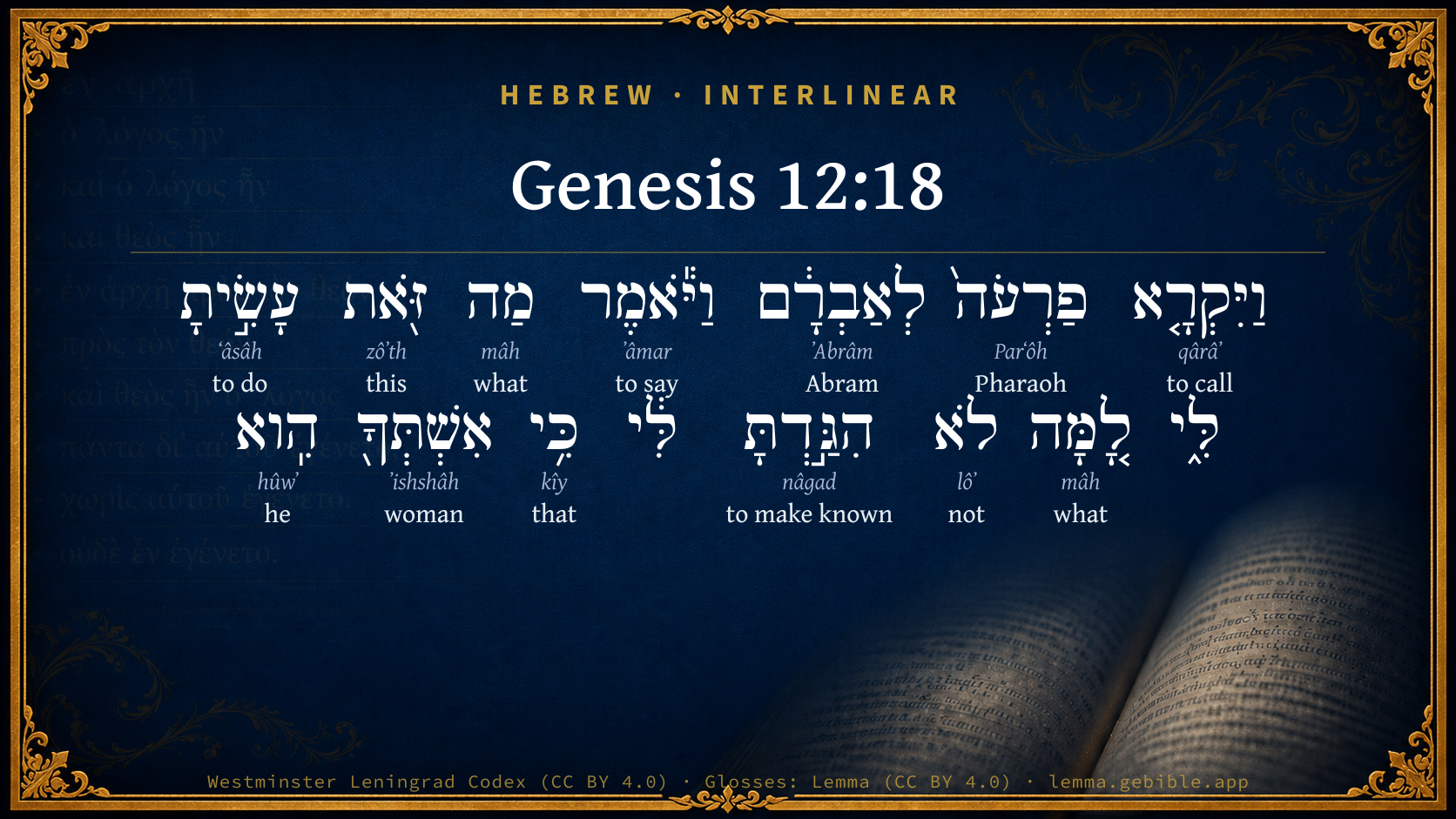
Hebrew (Westminster Leningrad Codex) Genesis 12:18 appears in the Hebrew Old Testament. The text above is from the Westminster Leningrad Codex. Each word links to its Strong’s number, a concise gloss, and parsing drawn from the Open Scriptures Hebrew Bible morphology. Click any word for its full Brown-Driver-Briggs (BDB) entry.
Download image
Cite this verse

Genesis 12:18 (World English Bible). Public Domain. Lemma interlinear Bible study tool, https://lemma.gebible.app/v/genesis/12/18.

Show BibTeX & RIS
BibTeX
RIS
English Translation
Pharaoh called Abram, and said, "What is this that you have done to me? Why didn't you tell me that she was your wife?
World English Bible · Public Domain
Download a study sheet

One document with this verse’s original text, its word-by-word gloss line, the meaning frame, cross-references with their text, attributed commentary, and full source and license credits — printable, and it pastes into notes with its structure intact.

This verse Autodidact and up

Study sheet (.html) Plain text (.txt)

A passage Seminary Student

Up to 50 verses in one chapter. A passage sheet keeps up to 6 commentary sources and 12 cross-references per verse, in the order this page ranks them, and says so on the sheet whenever that leaves anything out. Ask for a single verse and you get the Autodidact verse sheet above.

Everything on this page stays free to read, with no account — the sheet is a download of what is already on screen, not access to it.

Want to remove ads? Support Godless Engineer
Compare translations 3

The same verse in 3 English versions, stacked beneath the original-language interlinear above. Click any original word for its lexicon entry.

Each is an independent rendering of the whole verse — the interlinear is not word-aligned to these translations.

Highlighted words mark where these versions differ — a whole-verse word diff, not a word-by-word alignment.

  • World English Bible Public Domain
    Pharaoh called Abram, and said, "What is this that you have done to me? Why didn't you tell me that she was your wife?
  • King James Version Public Domain
    And Pharaoh called Abram and said, What is this that thou hast done unto me? why didst thou not tell me that she was thy wife?
  • unfoldingWord Literal Text CC BY-SA 4.0
    So Pharaoh called for Abram and said, “What this you have done to me? Why did you not tell me that she your wife?

unfoldingWord Literal Text — © unfoldingWord, licensed CC BY-SA 4.0. Word-aligned USFM3 via Door43 (git.door43.org/unfoldingWord/en_ult).

Versions to compare (up to 4)

3 of 4 selected

Show all 18 translations

Every available English version of this verse, each an independent rendering of the whole verse.

  • World English Bible Public Domain
    Pharaoh called Abram, and said, "What is this that you have done to me? Why didn't you tell me that she was your wife?
  • Berean Standard Bible Public Domain
    So Pharaoh summoned Abram and asked, “What have you done to me? Why didn’t you tell me she was your wife?
  • Majority Standard Bible Public Domain
    So Pharaoh summoned Abram and asked, “What have you done to me? Why didn’t you tell me she was your wife?
  • King James Version Public Domain
    And Pharaoh called Abram and said, What is this that thou hast done unto me? why didst thou not tell me that she was thy wife?
  • American Standard Version (1901) Public Domain
    And Pharaoh called Abram, and said, What is this that thou hast done unto me? why didst thou not tell me that she was thy wife?
  • Revised Version (1885) Public Domain
    And Pharaoh called Abram, and said, What is this that thou hast done unto me? why didst thou not tell me that she was thy wife?
  • Geneva Bible (1599) Public Domain
    Then Pharaoh called Abram, and saide, Why hast thou done this vnto me? Wherefore diddest thou not tell me, that she was thy wife?
  • Douay-Rheims (1899) Public Domain
    And Pharao called Abram, and said to him: What is this that thou hast done to me? Why didst thou not tell me that she was thy wife.
  • Young's Literal Translation Public Domain
    And Pharaoh calleth for Abram, and saith, `What `is' this thou hast done to me? why hast thou not declared to me that she `is' thy wife?
  • Literal Standard Version CC BY-SA 4.0
    And Pharaoh calls for Abram and says, “What [is] this you have done to me? Why have you not declared to me that she [is] your wife?
  • Unlocked Literal Bible CC BY-SA 4.0
    Pharaoh summoned Abram, and said, “What is this that you have done to me? Why did you not tell me that she was your wife?
  • unfoldingWord Literal Text CC BY-SA 4.0
    So Pharaoh called for Abram and said, “What this you have done to me? Why did you not tell me that she your wife?
  • Darby Bible Public Domain
    And Pharaoh called Abram, and said, What is this thou hast done to me? Why didst thou not tell me that she was thy wife?
  • World Messianic Bible Public Domain
    Pharaoh called Abram and said, “What is this that you have done to me? Why didn’t you tell me that she was your wife?
  • Webster's Bible Public Domain
    And Pharaoh called Abram, and said, What is this that thou hast done to me? why didst thou not tell me that she is thy wife?
  • Free Bible Version CC BY-SA 4.0
    So Pharaoh ordered Abram brought to him and said, “What have you done to me? Why didn't you tell me that she was your wife?
  • Bible in Basic English Public Domain
    Then Pharaoh sent for Abram, and said, What have you done to me? why did you not say that she was your wife?
  • JPS Tanakh (1917) Public Domain
    And Pharaoh called Abram, and said: 'What is this that thou hast done unto me? why didst thou not tell me that she was thy wife?

Literal Standard Version (2020), Covenant Press — licensed CC BY-SA 4.0. Text via the HelloAO Bible API (eBible.org). Unlocked Literal Bible (unfoldingWord) — licensed CC BY-SA 4.0. Text via the HelloAO Bible API (eBible.org). unfoldingWord Literal Text — © unfoldingWord, licensed CC BY-SA 4.0. Word-aligned USFM3 via Door43 (git.door43.org/unfoldingWord/en_ult). Free Bible Version, Dr. Jonathan Gallagher — licensed CC BY-SA 4.0. Text via the HelloAO Bible API (eBible.org).

Word by word

More ways to search: Search by grammar → Find every occurrence → Compare this word →

Practice this passage: Drill this verse → Learn its vocabulary →

לְאַבְרָ֔ם
ʼAbrâm
H87
“to/for · Abram”
Preposition + Noun, Proper
Part of Speech
Preposition + Noun
Type
Proper
Full BDB Definition

Origin: contracted from H48

TWOT: None

Abram = "exalted father" - original name of Abraham
  1. וַיִּקְרָ֤א qârâʼ H7121 “and · to call” Conjunction + Verb, Qal, Sequential Imperfect, 3rd Person, Masculine, Singular
  2. פַרְעֹה֙ Parʻôh H6547 “Pharaoh” Noun, Proper
  3. וַיֹּ֕אמֶר ʼâmar H559 “and · to say” Conjunction + Verb, Qal, Sequential Imperfect, 3rd Person, Masculine, Singular
  4. מַה mâh H4100 “what” Particle, Interrogative
  5. זֹּ֖את zôʼth H2063 “this” Pronoun, Demonstrative, Feminine, Singular
  6. עָשִׂ֣יתָ ʻâsâh H6213 “to do” Verb, Qal, Perfect, 2nd Person, Masculine, Singular
  7. לָ֚מָּה mâh H4100 “to/for · what” Preposition + Particle, Interrogative
  8. לֹא lôʼ H3808 “not” Particle, Negative
  9. הִגַּ֣דְתָּ nâgad H5046 “to make known” Verb, Hiphil, Perfect, 2nd Person, Masculine, Singular
  10. כִּ֥י kîy H3588 “that” Conjunction
  11. אִשְׁתְּךָ֖ ʼishshâh H802 “woman · your” Noun, Common, Feminine, Singular, Construct + Suffix, Personal, 2nd Person, Masculine, Singular
  12. הִֽוא hûwʼ H1931 “he” Pronoun, Personal, 3rd Person, Feminine, Singular

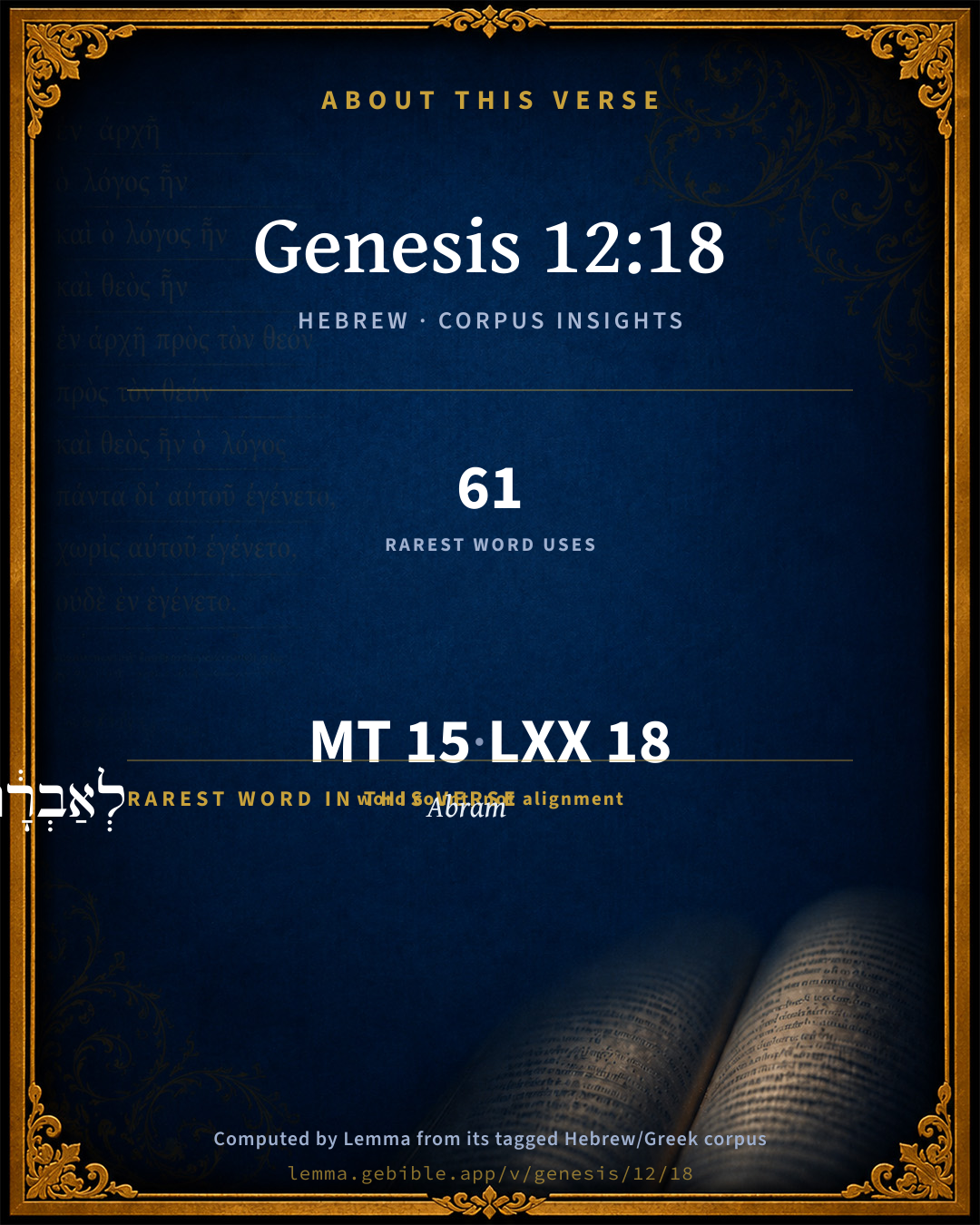
About this verse

These counts appear in no published source. They are computed here, from the morphology-tagged text and Lemma’s own curated glosses. What Lemma adds →

15
words
12
distinct lemmas
Pentateuch
section

Grammatical profile

  • 4 verbs
  • 3 nouns
  • 2 pronouns
  • 2 prepositions
  • 1 conjunction
  • 3 particles

Verb forms

  • וַיִּקְרָ֤א Qal · Sequential Imperfect
  • וַיֹּ֕אמֶר Qal · Sequential Imperfect
  • עָשִׂ֣יתָ Qal · Perfect
  • הִגַּ֣דְתָּ Hiphil · Perfect

Repetition

A word recurs within this verse — often emphatic in Hebrew:

Hebrew & Septuagint length

In English translation the verse runs 24 words from the Hebrew and 25 from the Septuagint (LXX English) — closely comparable.

A rough comparison of the two English renderings, which tokenize alike — not a word-level alignment.

Word counts can differ between the Hebrew and the Greek without any difference in meaning — e.g. the Hebrew direct-object marker אֵת has no separate Greek word, and Greek often adds the article ὁ.

In the original languages it is 15 Hebrew tokens and 18 Greek tokens — but the two are counted differently (Hebrew bundles its prefixes and suffixes into one token; the Greek is in lemma form), so that isn’t a like-for-like length.

Cross-references

10

Topical passages linked to Genesis 12:18 in the Treasury of Scripture Knowledge — connected by theme and wording, ordered by reader-vote popularity; previews shown in the World English Bible.

  • Genesis 20:9–10 Then Abimelech called Abraham, and said to him, "What have you done to us? How have I sinned against you, that you have brought on me and on my kingdom a great sin? You have done deeds to me that ought not to be done!"
  • Genesis 26:9–11 Abimelech called Isaac, and said, "Behold, surely she is your wife. Why did you say, 'She is my sister?'" Isaac said to him, "Because I said, 'Lest I die because of her.'"
  • 1 Samuel 14:43 Then Saul said to Jonathan, Tell me what you have done. Jonathan told him, and said, I did certainly taste a little honey with the end of the rod that was in my hand; and, behold, I must die.
  • Proverbs 21:1 The king's heart is in Yahweh's hand like the watercourses. He turns it wherever he desires.
  • Genesis 3:13 Yahweh God said to the woman, "What is this you have done?" The woman said, "The serpent deceived me, and I ate."
  • Genesis 4:10 Yahweh said, "What have you done? The voice of your brother's blood cries to me from the ground.
  • Genesis 31:26 Laban said to Jacob, "What have you done, that you have deceived me, and carried away my daughters like captives of the sword?
  • Genesis 44:15 Joseph said to them, "What deed is this that you have done? Don't you know that such a man as I can indeed divine?"
  • Exodus 32:21 Moses said to Aaron, "What did these people do to you, that you have brought a great sin on them?"
  • Joshua 7:19 Joshua said to Achan, My son, please give glory to Yahweh, the God of Israel, and make confession to him; and tell me now what you have done; don't hide it from me.

Cross-references courtesy of OpenBible.info (CC BY 4.0).

Hebrew and Greek witnesses Masoretic Hebrew ↔ Greek Septuagint

The same verse in the two great witnesses to the Old Testament, shown verse-for-verse.

These are two independent witnesses, not word-aligned to each other, and the Septuagint is shown in lemma (dictionary) form.

Hebrew Genesis 12:18 Masoretic · Westminster Leningrad Codex

וַיִּקְרָ֤א פַרְעֹה֙ לְאַבְרָ֔ם וַיֹּ֕אמֶר מַה זֹּ֖את עָשִׂ֣יתָ לִּ֑י לָ֚מָּה לֹא הִגַּ֣דְתָּ לִּ֔י כִּ֥י אִשְׁתְּךָ֖ הִֽוא

Pharaoh called Abram, and said, "What is this that you have done to me? Why didn't you tell me that she was your wife?

World English Bible · Public Domain

Greek LXX Genesis 12:18 Septuagint · lemma form

καλέω δέ φαραώ ὁ αβραμ εἶπον τίς οὗτος ποιέω ἐγώ ὅτι οὐ ἀποἀγγέλλω ἐγώ ὅτι γυνή σύ εἰμί

And Pharao having called Abram, said, What is this you have done to me, that you did not tell me that she was your wife?

LXX2012 (modern English Septuagint) · Public Domain

Hebrew: Westminster Leningrad Codex (CC BY 4.0). Greek: Septuagint (public domain); English from LXX2012 (modern English Septuagint) (Public Domain). How the Septuagint differs from the Hebrew →

Targum (Aramaic paraphrase)

2

The Targum is the ancient Jewish Aramaic paraphrase of the Hebrew Scriptures — an interpretive translation, not the Hebrew text itself. Onkelos (literal) and Pseudo-Jonathan (expansive) render the Torah, and Jonathan the Prophets. Coverage is partial: where no permissively-licensed English translation exists for a verse, only the Aramaic is shown. This is verse-level text, not a word-by-word alignment to the Hebrew.

  1. Targum Onkelos Torah (Genesis–Deuteronomy)
    וּקְרָא פַרְעֹה לְאַבְרָם וַאֲמַר מָה דָּא עֲבַדְתְּ לִי לְמָא לָא חַוֵּיתָא לִי אֲרֵי אִתְּתָךְ הִיא

    And Pharaoh called Abram and said, What is this that thou hast done to me? Why didst thou not show me that she is thy wife?

    Targum Onkelos — Aramaic: “Onkelos Genesis” (public domain); “Onkelos Exodus” (public domain); “Onkelos Leviticus” (public domain); “Onkelos Numbers” (public domain); “Onkelos Deuteronomy” (public domain). English: “Sefaria Community Translation” (CC0 1.0 (public-domain dedication)); “J.W. Etheridge. The Targums of Onkelos and Jonathan Ben Uzziel on the Pentateuch. London: Longmans, Green, 1862” (public domain). Text via Sefaria.

  2. Targum Pseudo-Jonathan Torah (Genesis–Deuteronomy)
    וּקְרָא פַּרְעה לְאַבְרָם וַאֲמַר מַה דָא עָבַדְתָּא לִי לְמָא לָא חַוֵיתָא לִי אֲרוּם אִנְתְּתָךְ הִיא

    And Pharoh called Abram, and said, What is this that thou hast done to me? Why didst thou not show me that she is thy wife?

    Targum Pseudo-Jonathan — Aramaic: “Targum Jonathan on Genesis” (public domain); “Targum Jonathan on Exodus” (public domain); “Targum Jonathan on Leviticus” (public domain); “Targum Jonathan on Numbers” (public domain); “Targum Jonathan on Deuteronomy” (public domain). English: “The Targum of Jonathan ben Uzziel, trans. J. W. Etheridge, London, 1862” (public domain). Text via Sefaria.

Commentary

Notes on Genesis 12:18 from classic Christian and Jewish commentators (each source and its license shown beneath its notes). The classic Christian expositions comment on the surrounding passage and are grouped to its opening verse, so a note may address several verses; the Jewish commentaries on the Tanakh (Rashi and others) are per-verse, so they appear only where the commentator wrote on this verse.

Lemma curates 59 commentaries, every one of them public domain or Creative Commons licensed, each selected and text-cleaned for this edition rather than reprinted as found. About our sources →

Trapp's Complete Commentary

John Trapp

Gen 12:18 And Pharaoh called Abram, and said, What [is] this [that] thou hast done unto me? why didst thou not tell me that she [was] thy wife?

Ver. 18. What is this that thou hast done unto me?] God had reproved Pharaoh, according to that; "He suffered no man to do them wrong, but reproved kings for their sakes"; {Psa 105:14} and now Pharaoh reproves Abram. It is a sad thing that saints should do that for which they should justly fall under the reproof of the wicked: we should rather dazzle their eyes, and draw from their consciences, at least, a testimony of our innocency, as David did from Saul’s, when he said, "Thou art more righteous than I, my son David". {1Sa 24:17} "Whose ox have I taken?" saith Samuel. {1Sa 12:3} "And which of you can condemn me of sin?" saith Christ. {Joh 8:46} Now, the life of a Christian should be a commentary upon Christ’s life. {1Pe 2:21} "Ye are a holy nation, a peculiar people, that ye should preach forth [εξαγγειλητε] his virtues," {1Pe 2:9} and not hang his picture - his image and graces - in a dark hole, but in a conspicuous place. Bucer so lived that neither could his friends sufficiently praise him, nor his foes justly blame him for any miscarriage. And Bradford was had in so great reverence and admiration for his holiness, that a multitude which never knew him but by fame greatly lamented his death; yea, and a number also of Papists themselves wished heartily his life. {a} But to have Egyptians jeer us, and that for sin, is threatened as a grievous misery. {Hos 7:16}

{a} Act. and Mon.

John Trapp, A Commentary or Exposition upon All the Books of the Old and New Testament (1647–1656) — public domain. Text from a community e-Sword module.

Joseph Benson's Commentary

Gen 12:18. What is this that thou hast done — What an ill thing: how unbecoming a wise and good man! Why didst thou not tell me that she was thy wife? — Intimating, that if he had known that he would not have taken her. It is a fault, too common among good people, to entertain suspicions of others beyond what there is cause for. We have often found more of virtue, honour, and conscience in some people, than we thought there was; and it ought to be a pleasure to us to be thus disappointed, as Abram was here, who found Pharaoh to be a better man than he expected.

Joseph Benson's Commentary on the Old and New Testaments (1811–1818) — public domain. Text from a community e-Sword module.

Jamieson, Fausset & Brown

Robert Jamieson, A. R. Fausset & David Brown

Here is a most humiliating rebuke, and Abram deserved it. Had not God interfered, he might have been tempted to stay in Egypt and forget the promise (Psa 105:13, Psa 105:15). Often still does God rebuke His people and remind them through enemies that this world is not their rest.

Next: Genesis Chapter 13

Jamieson, Fausset & Brown — Commentary Critical and Explanatory on the Whole Bible (1871) — public domain (CC PDM 1.0). Text via the HelloAO Bible API.

John Calvin's Commentaries

18. And Pharaoh called Abram. Pharaoh justly expostulates with Abram, who was chiefly in fault. No answer on the part of Abram is here recorded; and perhaps he assented to the just and true reprehension. It is, however, possible that the exculpation was omitted by Moses; whose design was to give an example of the Divine providence in preserving Abram, and vindicating his marriage relation. But, although Abram knew that he was suffering the due punishment of his folly, or of his unreasonable caution; He, nevertheless, relapsed, as we shall see in its proper place, a second time into the same fault.

John Calvin's Commentaries (1540-1563) — public domain. Text from the Calvin Translation Society English edition (1840s-50s) via the Christian Classics Ethereal Library (ccel.org). Calvin's coverage is partial (roughly two-thirds of the Bible); uncommented books and verses are honest gaps, never fabricated. The 19th-century editor's footnotes and remarks are omitted so the notes are faithfully Calvin's own voice.

The Cambridge Bible for Schools and Colleges

gen. ed. J. J. S. Perowne

18. Pharaoh called Abram] How Pharaoh discovered the truth is not recorded in our condensed version. All other explanations of the epidemic failing, possibly the wise men and magicians connected it with the presence of a foreigner in the palace serving Jehovah, and with the indignation of the offended local deities.

The Cambridge Bible for Schools and Colleges (gen. ed. J. J. S. Perowne; Cambridge University Press, 1878–1918) — public domain. Text from a community e-Sword module.

John Gill's Exposition

And Pharaoh called Abram, and said,.... Understanding how it was, that Sarai was his wife, which he came at the knowledge of, either by consulting his priests and diviners, as some say, on account of the plagues inflicted; or rather suspecting they were on the account of Sarai, from the nature of them, sent for her, and questioned her about this affair, who confessed the whole matter to him; unless it can be thought that he was warned of God in a dream, as Abimelech was on a like occasion; however he sent for Abram on what intelligence he had, and justly, though gently, reproved him:

what is this that thou hast done unto me? to impose upon me, and deceive me after this manner, by giving out that Sarai was thy sister, when she is thy wife; by which means I have been led to prepare to take her for my wife, and have brought plagues upon myself and family? and thus he resented it as an injury done him, as he well might:

why didst thou not tell me that she was thy wife? when he first took her into his house, and no doubt Abram was present then, and very often afterwards was in company with Pharaoh, and conversed with him, having respect for him for the sake of Sarai, he took to be his sister, and yet would never tell him she was his wife.

John Gill's Exposition of the Whole Bible (1746–1763) — public domain (CC PDM 1.0). Text via the HelloAO Bible API.

Matthew Poole's English Annotations

How great an injury hast thou done to me in concealing this from me, that she was thy wife!

Ques. How knew Pharaoh this?

Answ.

1. He guessed it from the quality of his plague, which also awakened his conscience.

2. Upon a serious inquiry into the cause of this plague, he understood it either by Divine instinct, as Gen 20:3, or by Sarai's confession, whom doubtless he severely examined about it. And she, being awakened by this warning, durst no longer conceal herself, and thought she might securely make herself known.

Matthew Poole's English Annotations on the Holy Bible (1683–1685) — public domain. Text from a community e-Sword/MySword module.

Whedon's Commentary on the Bible

Daniel D. Whedon

18. What is this — The heathen despot reproves the sin of the God-fearing Abram! What a humiliation!

Daniel D. Whedon (gen. ed.), Commentary on the Old and New Testaments (1874–1909) — public domain. Text from a community e-Sword module.

The Pulpit Commentary

Vers. 18, 19. And Pharaoh called Abram and said, What is this that thou hast done unto me t why didst thou not tell me she was thy wife? In which case we are bound to believe the monarch that he would not have taken her. Why saidst thou, She is my sister? so I might have taken her to me to wife (which as yet he had not done; an indirect proof both of the monarch"s honorable purpose towards Sarai and of Sarai"s unsullied purity): now therefore behold thy wife, take her, and go thy way. According to Josephus ("Bell. Jud:" 5:9:4) Sarah was only one night in Pharaoh"s house; but this is obviously incorrect.

The Pulpit Commentary (1880–1919), ed. H.D.M. Spence-Jones & Joseph S. Exell — public domain. Text from a community e-Sword module.

John Wesley's Explanatory Notes

What is this that thou hast done? - What an ill thing; how unbecoming a wife and good man! Why didst thou not tell me that she was thy wife? - Intimating, that if he had known that, he would not have taken her. It is a fault, too common among good people, to entertain suspicions of others beyond what there is cause for. We have often found more of virtue, honour, and conscience in some people, than we thought there was; and it ought to be a pleasure to us to be thus disappointed, as Abram was here, who found Pharaoh to be a better man than he expected.

John Wesley, Explanatory Notes Upon the Whole Bible (1754–1765) — public domain. Text via the GEBible commentary corpus.

Ramban (Nachmanides)

Rabbi Moshe ben Nachman (Ramban / Nachmanides)

AND PHARAOH CALLED ABRAM. It is possible that when the plagues suddenly came upon him and his house at the very time Sarah was taken to his house, he thought to himself, What is this that G-d hath done unto us? And so he asked her, and she told him that she is Abraham’s wife. For this reason he called Abraham and accused him. Or it may be, as our Rabbis say, that Pharaoh was smitten with a certain skin disease which is aggravated by intimacy with a woman. Therefore he suspected that perhaps she is Abraham’s wife, and so he said to him with uncertainty, What is this that thou hast done unto me?, in order to draw the truth from him. Were she his sister, he would say, “Indeed, she is my sister.” And Pharaoh further said to him, Now therefore behold thy wife, take her, and go thy way. He said this in order to see what he would say, and now he would answer his reproof. But Abraham remained silent and did not answer him a word out of his great fear. Then Pharaoh understood that she is his wife as he had suspected, and then Pharaoh commanded his men to send him away.

Ramban (Nachmanides) on the Tanakh — English translation: “Commentary on the Torah by Ramban (Nachmanides). Translated and annotated by Charles B. Chavel. New York, Shilo Pub. House, 1971-1976” (CC BY 4.0). Text via Sefaria.

Lesson kit

Teaching starters — assembled from the data on this page, not authored interpretation. Every prompt links to the verse data it draws on. Edit before teaching.

Genesis, in the Pentateuch, opens this verse with 15 words (12 distinct Hebrew lemmas). Its most distinctive word is ʼAbrâm (“Abram”). A historical commentator’s framing appears above. Read the whole chapter for the surrounding context.

Discussion questions

  1. What does “Abram” (ʼAbrâm) contribute to the verse as a whole?
  2. Genesis 20:9–10 shares this passage’s theme. How do the two illuminate each other?
  3. “what” occurs 2× in this one verse. What is the effect of the repetition?
  4. These translations render this verse differently. What is at stake in choosing one wording over another?
  5. The verb «וַיִּקְרָ֤א» is Qal Sequential Imperfect. How does its form color the action?
  6. Reading how Trapp's Complete Commentary and Joseph Benson's Commentary read this verse, where do the two commentators agree and where do they part?

Things to notice

Reading settings

Reading text

Shown beneath each verse's original-language words.

Old Testament
Old Testament edition

Read the OT as the Masoretic Hebrew (MT) or the Greek Septuagint (LXX).

English shown for the Greek Septuagint (in the Hebrew ↔ Greek comparison).

Comparing translations? Open the Compare panel on any verse page to stack up to four side by side.