
Deuteronomy 32:27

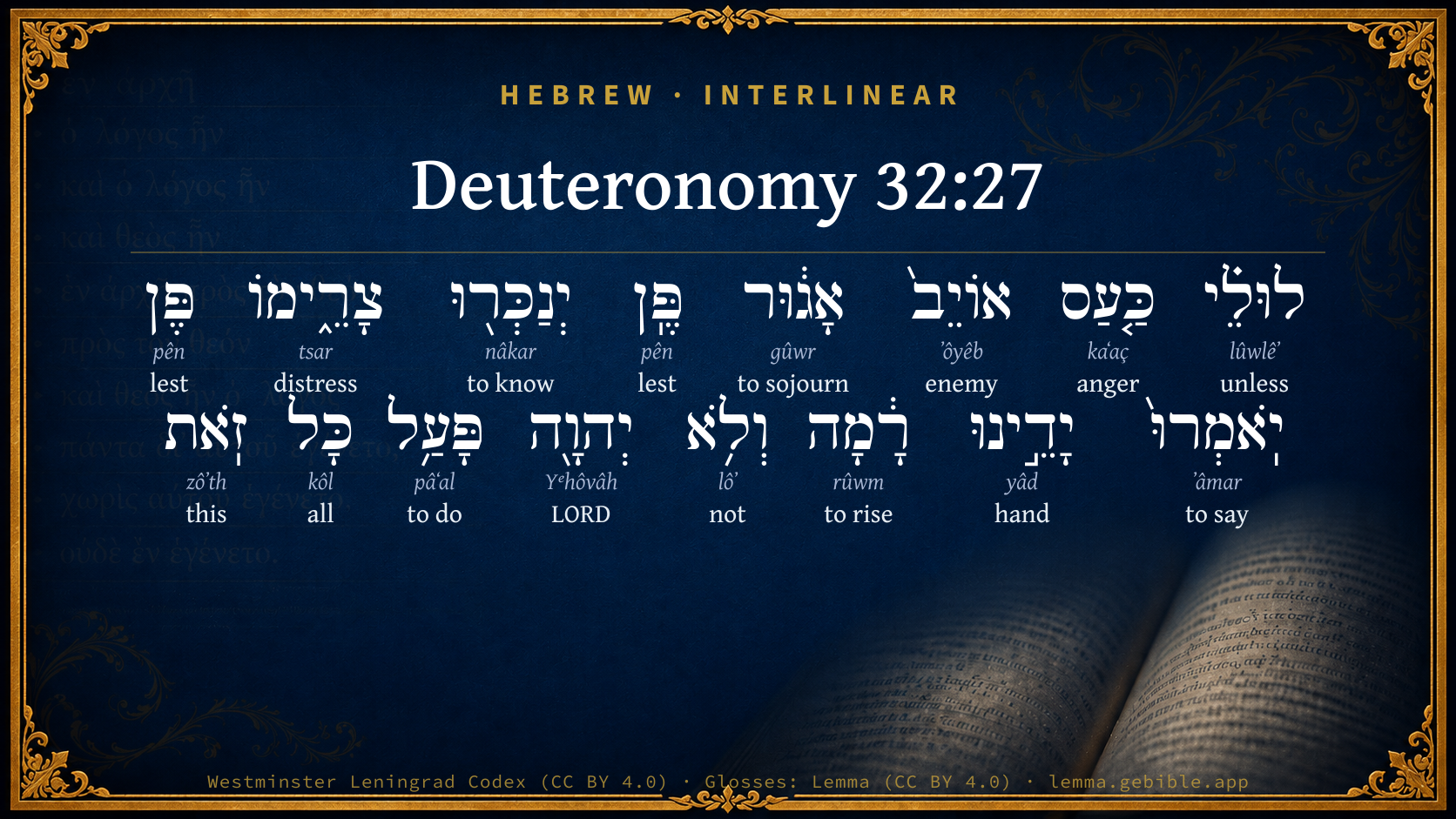
Hebrew (Westminster Leningrad Codex) Deuteronomy 32:27 appears in the Hebrew Old Testament. The text above is from the Westminster Leningrad Codex. Each word links to its Strong’s number, a concise gloss, and parsing drawn from the Open Scriptures Hebrew Bible morphology. Click any word for its full Brown-Driver-Briggs (BDB) entry.
Download image
Cite this verse

Deuteronomy 32:27 (World English Bible). Public Domain. Lemma interlinear Bible study tool, https://lemma.gebible.app/v/deuteronomy/32/27.

Show BibTeX & RIS
BibTeX
RIS
English Translation
Were it not that I feared the provocation of the enemy, Lest their adversaries should judge wrongly, Lest they should say, Our hand is exalted, Yahweh has not done all this.
World English Bible · Public Domain
Download a study sheet

One document with this verse’s original text, its word-by-word gloss line, the meaning frame, cross-references with their text, attributed commentary, and full source and license credits — printable, and it pastes into notes with its structure intact.

This verse Autodidact and up

Study sheet (.html) Plain text (.txt)

A passage Seminary Student

Up to 50 verses in one chapter. A passage sheet keeps up to 6 commentary sources and 12 cross-references per verse, in the order this page ranks them, and says so on the sheet whenever that leaves anything out. Ask for a single verse and you get the Autodidact verse sheet above.

Everything on this page stays free to read, with no account — the sheet is a download of what is already on screen, not access to it.

Want to remove ads? Support Godless Engineer
Compare translations 3

The same verse in 3 English versions, stacked beneath the original-language interlinear above. Click any original word for its lexicon entry.

Each is an independent rendering of the whole verse — the interlinear is not word-aligned to these translations.

Highlighted words mark where these versions differ — a whole-verse word diff, not a word-by-word alignment.

  • World English Bible Public Domain
    Were it not that I feared the provocation of the enemy, Lest their adversaries should judge wrongly, Lest they should say, Our hand is exalted, Yahweh has not done all this.
  • King James Version Public Domain
    Were it not that I feared the wrath of the enemy, lest their adversaries should behave themselves strangely, and lest they should say, Our hand is high, and the LORD hath not done all this.
  • unfoldingWord Literal Text CC BY-SA 4.0
    if the provocation of the enemy I did not fear, lest their adversaries misjudge, lest they say, “Our hand exalted, and Yahweh did not carry out all this.”’ ts\*

unfoldingWord Literal Text — © unfoldingWord, licensed CC BY-SA 4.0. Word-aligned USFM3 via Door43 (git.door43.org/unfoldingWord/en_ult).

Versions to compare (up to 4)

3 of 4 selected

Show all 18 translations

Every available English version of this verse, each an independent rendering of the whole verse.

  • World English Bible Public Domain
    Were it not that I feared the provocation of the enemy, Lest their adversaries should judge wrongly, Lest they should say, Our hand is exalted, Yahweh has not done all this.
  • Berean Standard Bible Public Domain
    if I had not dreaded the taunt of the enemy, lest their adversaries misunderstand and say: ‘Our own hand has prevailed; it was not the LORD who did all this.’”
  • Majority Standard Bible Public Domain
    if I had not dreaded the taunt of the enemy, lest their adversaries misunderstand and say: ‘Our own hand has prevailed; it was not the LORD who did all this.’”
  • King James Version Public Domain
    Were it not that I feared the wrath of the enemy, lest their adversaries should behave themselves strangely, and lest they should say, Our hand is high, and the LORD hath not done all this.
  • American Standard Version (1901) Public Domain
    Were it not that I feared the provocation of the enemy, Lest their adversaries should judge amiss, Lest they should say, Our hand is exalted, And Jehovah hath not done all this.
  • Revised Version (1885) Public Domain
    Were it not that I feared the provocation of the enemy, Lest their adversaries should misdeem, Lest they should say, Our hand is exalted, And the LORD hath not done all this.
  • Geneva Bible (1599) Public Domain
    Saue that I feared the furie of the enemie, least their aduersaries should waxe proude, and least they should say, Our hie hande and not the Lord hath done all this:
  • Douay-Rheims (1899) Public Domain
    But for the wrath of the enemies I have deferred it: lest perhaps their enemies might be proud, and should say: Our mighty hand, and not the Lord, hath done all these things.
  • Young's Literal Translation Public Domain
    If not -- the anger of an enemy I fear, Lest their adversaries know -- Lest they say, Our hand is high, And Jehovah hath not wrought all this.
  • Literal Standard Version CC BY-SA 4.0
    If I do not fear the anger of an enemy, || Lest their adversaries know—Lest they say, Our hand is high, || And YHWH has not worked all this.
  • Unlocked Literal Bible CC BY-SA 4.0
    Were it not that I feared the provocation of the enemy, and that their enemies would judge mistakenly, and that they would say, 'Our hand is exalted,' I would have done all this.
  • unfoldingWord Literal Text CC BY-SA 4.0
    if the provocation of the enemy I did not fear, lest their adversaries misjudge, lest they say, “Our hand exalted, and Yahweh did not carry out all this.”’ ts\*
  • Darby Bible Public Domain
    If I did not fear provocation from the enemy, Lest their adversaries should misunderstand it, Lest they should say, Our hand is high, and Jehovah has not done all this.
  • World Messianic Bible Public Domain
    were it not that I feared the provocation of the enemy, lest their adversaries should judge wrongly, lest they should say, ‘Our hand is exalted; the LORD has not done all this.’”
  • Webster's Bible Public Domain
    Were it not that I feared the wrath of the enemy, lest their adversaries should behave themselves strangely, and lest they should say, Our hand is high, and the LORD hath not done all this.
  • Free Bible Version CC BY-SA 4.0
    but I didn't want to hear their conquerors jeering, their enemies misunderstanding what had happened and saying, ‘We won all by ourselves, the Lord didn't have anything to do with it.’
  • Bible in Basic English Public Domain
    But for the fear that their haters, uplifted in their pride, might say, Our hand is strong, the Lord has not done all this.
  • JPS Tanakh (1917) Public Domain
    Were it not that I dreaded the enemy's provocation, lest their adversaries should misdeem, lest they should say: Our hand is exalted, and not the LORD hath wrought all this.'

Literal Standard Version (2020), Covenant Press — licensed CC BY-SA 4.0. Text via the HelloAO Bible API (eBible.org). Unlocked Literal Bible (unfoldingWord) — licensed CC BY-SA 4.0. Text via the HelloAO Bible API (eBible.org). unfoldingWord Literal Text — © unfoldingWord, licensed CC BY-SA 4.0. Word-aligned USFM3 via Door43 (git.door43.org/unfoldingWord/en_ult). Free Bible Version, Dr. Jonathan Gallagher — licensed CC BY-SA 4.0. Text via the HelloAO Bible API (eBible.org).

Word by word

More ways to search: Search by grammar → Find every occurrence → Compare this word →

Practice this passage: Drill this verse → Learn its vocabulary →

לוּלֵ֗י
lûwlêʼ
H3884
“unless”
Conjunction
Part of Speech
Conjunction
Full BDB Definition

Origin: from H3863 and H3808

TWOT: 1085a

unless, if not, except
  1. כַּ֤עַס kaʻaç H3708 “anger of” Noun, Common, Masculine, Singular, Construct
  2. אוֹיֵב֙ ʼôyêb H341 “enemy” Verb, Qal, Participle Active, Masculine, Singular, Absolute
  3. אָג֔וּר gûwr H1481 “to sojourn” Verb, Qal, Imperfect, 1st Person, Common, Singular
  4. פֶּֽן pên H6435 “lest” Conjunction
  5. יְנַכְּר֖וּ nâkar H5234 “to know” Verb, Piel, Imperfect, 3rd Person, Masculine, Plural
  6. צָרֵ֑ימוֹ tsar H6862 “distresses · their” Noun, Common, Masculine, Plural, Construct + Suffix, Personal, 3rd Person, Masculine, Plural
  7. פֶּן pên H6435 “lest” Conjunction
  8. יֹֽאמְרוּ֙ ʼâmar H559 “to say” Verb, Qal, Imperfect, 3rd Person, Masculine, Plural
  9. יָדֵ֣ינוּ yâd H3027 “hands · our” Noun, Common, Both, Dual, Construct + Suffix, Personal, 1st Person, Common, Plural
  10. רָ֔מָה rûwm H7311 “to rise” Verb, Qal, Perfect, 3rd Person, Feminine, Singular
  11. וְלֹ֥א lôʼ H3808 “and · not” Conjunction + Particle, Negative
  12. יְהוָ֖ה Yᵉhôvâh H3068 “LORD” Noun, Proper
  13. פָּעַ֥ל pâʻal H6466 “to do” Verb, Qal, Perfect, 3rd Person, Masculine, Singular
  14. כָּל kôl H3605 “all of” Noun, Common, Masculine, Singular, Construct
  15. זֹֽאת zôʼth H2063 “this” Pronoun, Demonstrative, Feminine, Singular

About this verse

These counts appear in no published source. They are computed here, from the morphology-tagged text and Lemma’s own curated glosses. What Lemma adds →

16
words
15
distinct lemmas
Pentateuch
section

Notable vocabulary

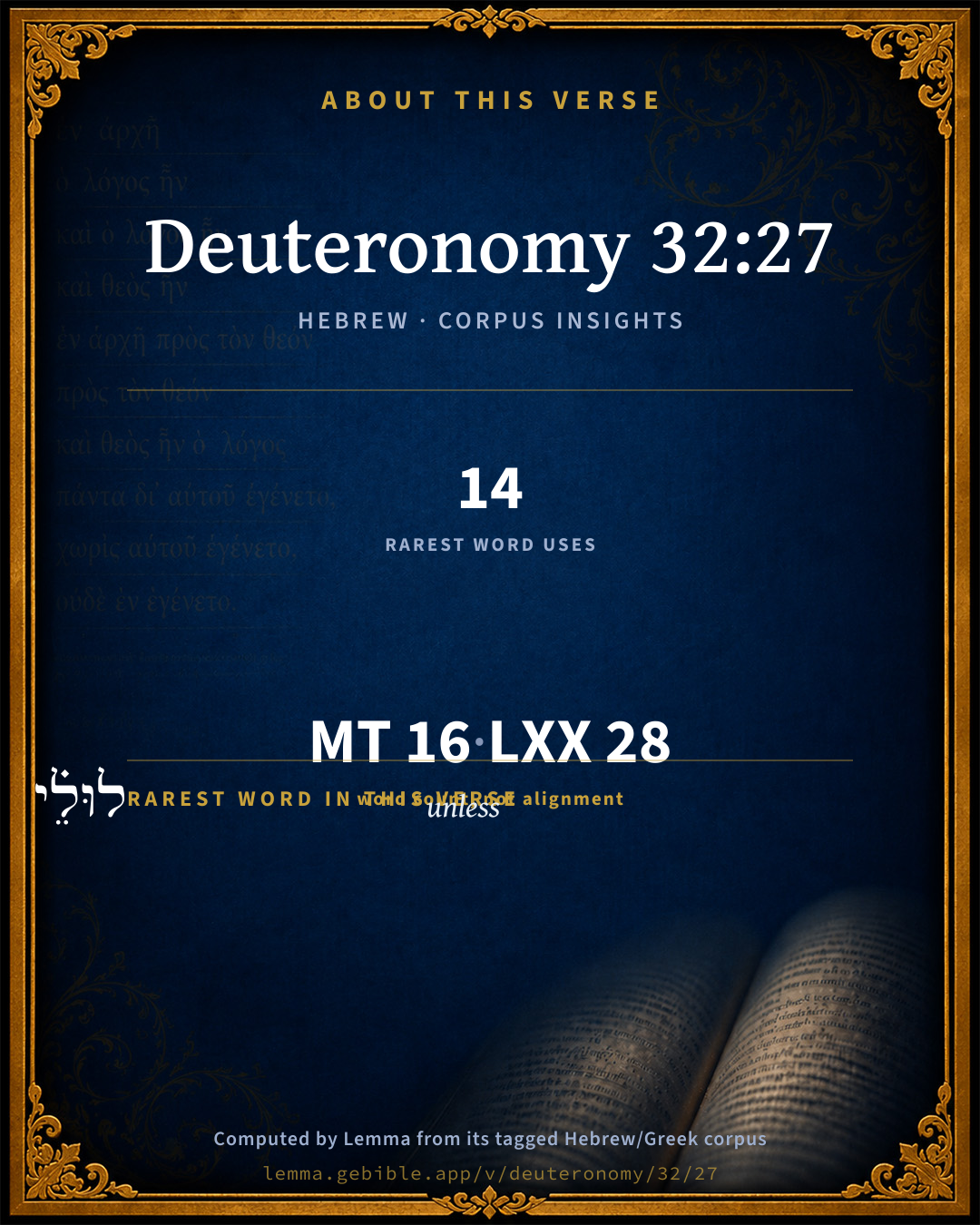
The rarest word here is לוּלֵ֗י unless H3884 — appearing just 14 times in the whole Hebrew Bible.

Shared distinctive vocabulary

לוּלֵ֗י unless H3884 occurs in 14 verses of the Hebrew Bible. Also found in:

Grammatical profile

  • 6 verbs
  • 5 nouns
  • 1 pronoun
  • 3 conjunctions
  • 1 particle

Verb forms

  • אוֹיֵב֙ Qal · Participle Active
  • אָג֔וּר Qal · Imperfect
  • יְנַכְּר֖וּ Piel · Imperfect
  • יֹֽאמְרוּ֙ Qal · Imperfect
  • רָ֔מָה Qal · Perfect
  • פָּעַ֥ל Qal · Perfect

Repetition

A word recurs within this verse — often emphatic in Hebrew:

  • פֶּֽן lest H6435 ×2

Hebrew & Septuagint length

In English translation the verse runs 31 words from the Hebrew and 38 from the Septuagint (LXX English) — closely comparable.

A rough comparison of the two English renderings, which tokenize alike — not a word-level alignment.

Word counts can differ between the Hebrew and the Greek without any difference in meaning — e.g. the Hebrew direct-object marker אֵת has no separate Greek word, and Greek often adds the article ὁ.

In the original languages it is 16 Hebrew tokens and 28 Greek tokens — but the two are counted differently (Hebrew bundles its prefixes and suffixes into one token; the Greek is in lemma form), so that isn’t a like-for-like length.

Cross-references

18

Topical passages linked to Deuteronomy 32:27 in the Treasury of Scripture Knowledge — connected by theme and wording, ordered by reader-vote popularity; previews shown in the World English Bible.

  • Numbers 14:15–16 Now if you shall kill this people as one man, then the nations which have heard the fame of you will speak, saying,
  • Exodus 32:12 Why should the Egyptians speak, saying, 'He brought them forth for evil, to kill them in the mountains, and to consume them from the surface of the earth?' Turn from your fierce wrath, and repent of this evil against your people.
  • Joshua 7:9 For the Canaanites and all the inhabitants of the land will hear of it, and will compass us round, and cut off our name from the earth: and what will you do for your great name?
  • 1 Samuel 12:22 For Yahweh will not forsake his people for his great name's sake, because it has pleased Yahweh to make you a people to himself.
  • Psalms 140:8 Yahweh, don't grant the desires of the wicked. Don't let their evil plans succeed, or they will become proud. Selah.
  • Zechariah 1:14–15 So the angel who talked with me said to me, "Proclaim, saying, 'Thus says Yahweh of Hosts: "I am jealous for Jerusalem and for Zion with a great jealousy.
  • Psalms 115:1–2 Not to us, Yahweh, not to us, But to your name give glory, For your loving kindness, and for your truth's sake.
  • Isaiah 10:8–15 For he says, Aren't my princes all of them kings?
  • Isaiah 37:10 Thus shall you speak to Hezekiah king of Judah, saying, Don't let your God in whom you trust deceive you, saying, Jerusalem shall not be given into the hand of the king of Assyria.
  • Isaiah 37:12–23 Have the gods of the nations delivered them, which my fathers have destroyed, Gozan, and Haran, and Rezeph, and the children of Eden who were in Telassar?
  • Isaiah 37:28–29 But I know your sitting down, and your going out, and your coming in, and your raging against me.
  • Isaiah 37:35 For I will defend this city to save it, for my own sake, and for my servant David's sake.
  • Isaiah 47:7 You said, I shall be mistress forever; so that you did not lay these things to your heart, neither did remember the latter end of it.
  • Jeremiah 19:4 Because they have forsaken me, and have estranged this place, and have burned incense in it to other gods, that they didn't know, they and their fathers and the kings of Judah; and have filled this place with the blood of innocents,
  • Lamentations 1:9 Her filthiness was in her skirts; she didn't remember her latter end; Therefore is she come down wonderfully; she has no comforter: See, Yahweh, my affliction; for the enemy has magnified himself.
  • Ezekiel 20:13–14 But the house of Israel rebelled against me in the wilderness: they didn't walk in my statutes, and they rejected my ordinances, which if a man keep, he shall live in them; and my Sabbaths they greatly profaned. Then I said I would pour out my wrath on them in the wilderness, to consume them.
  • Ezekiel 20:20–22 and make my Sabbaths holy; and they shall be a sign between me and you, that you may know that I am Yahweh your God.
  • Daniel 4:30–37 The king spoke and said, Is not this great Babylon, which I have built for the royal dwelling-place, by the might of my power and for the glory of my majesty?

Cross-references courtesy of OpenBible.info (CC BY 4.0).

Hebrew and Greek witnesses Masoretic Hebrew ↔ Greek Septuagint

The same verse in the two great witnesses to the Old Testament, shown verse-for-verse.

These are two independent witnesses, not word-aligned to each other, and the Septuagint is shown in lemma (dictionary) form.

Hebrew Deuteronomy 32:27 Masoretic · Westminster Leningrad Codex

לוּלֵ֗י כַּ֤עַס אוֹיֵב֙ אָג֔וּר פֶּֽן יְנַכְּר֖וּ צָרֵ֑ימוֹ פֶּן יֹֽאמְרוּ֙ יָדֵ֣ינוּ רָ֔מָה וְלֹ֥א יְהוָ֖ה פָּעַ֥ל כָּל זֹֽאת

Were it not that I feared the provocation of the enemy, Lest their adversaries should judge wrongly, Lest they should say, Our hand is exalted, Yahweh has not done all this.

World English Bible · Public Domain

Greek LXX Deuteronomy 32:27 Septuagint · lemma form

εἰ μή διά ὀργή ἐχθρός ἵνα μή μακροχρονίζω καί ἵνα μή συν ἐπιτίθημι ὁ ὑπεναντίος μή εἶπον ὁ χείρ ἐγώ ὁ ὑψηλός καί οὐ κύριος ποιέω οὗτος πᾶς

Were it not for the wrath of the enemy, lest they should live long, lest their enemies should combine against them; lest they should say, Our own high arm, and not the Lord, has done all these things.

LXX2012 (modern English Septuagint) · Public Domain

Hebrew: Westminster Leningrad Codex (CC BY 4.0). Greek: Septuagint (public domain); English from LXX2012 (modern English Septuagint) (Public Domain). How the Septuagint differs from the Hebrew →

Targum (Aramaic paraphrase)

2

The Targum is the ancient Jewish Aramaic paraphrase of the Hebrew Scriptures — an interpretive translation, not the Hebrew text itself. Onkelos (literal) and Pseudo-Jonathan (expansive) render the Torah, and Jonathan the Prophets. Coverage is partial: where no permissively-licensed English translation exists for a verse, only the Aramaic is shown. This is verse-level text, not a word-by-word alignment to the Hebrew.

  1. Targum Onkelos Torah (Genesis–Deuteronomy)
    אִלוּלָפוֹן רָגְזָא דְסָנְאָה כְּנִישׁ דִילְמָא יִתְרַבְרַב בְּעֵל דְבָבָא דִילְמָא יֵימְרוּן יְדָנָא תְקִיפַת לָנָא וְלָא מִן קֳדָם יְיָ הֲוַת כָּל דָא

    (no public-domain English translation for this verse)

    Targum Onkelos — Aramaic: “Onkelos Genesis” (public domain); “Onkelos Exodus” (public domain); “Onkelos Leviticus” (public domain); “Onkelos Numbers” (public domain); “Onkelos Deuteronomy” (public domain). English: “Sefaria Community Translation” (CC0 1.0 (public-domain dedication)); “J.W. Etheridge. The Targums of Onkelos and Jonathan Ben Uzziel on the Pentateuch. London: Longmans, Green, 1862” (public domain). Text via Sefaria.

  2. Targum Pseudo-Jonathan Torah (Genesis–Deuteronomy)
    אִלוּלָפוֹן רוּגְזָא דְסַנָאָה דְחִיל דִלְמָא יִתְרַבְרְבוּן לְקִיבְלֵי מְעִיקֵיהוֹן דִלְמָא יֵימְרוּן יְדֵינָן מִתְפַּרְעוּן לָן מִבַּעֲלֵי דְבָבֵינָן וְלָא מִן קֳדָם יְיָ אִתְגַזָרַת כָּל דָא

    but for the wrath of the enemy, and that their oppressors would glorify themselves against Me, and say, Our hand hath taken vengeance upon our adversaries, and all this hath not been decreed by the Lord;

    Targum Pseudo-Jonathan — Aramaic: “Targum Jonathan on Genesis” (public domain); “Targum Jonathan on Exodus” (public domain); “Targum Jonathan on Leviticus” (public domain); “Targum Jonathan on Numbers” (public domain); “Targum Jonathan on Deuteronomy” (public domain). English: “The Targum of Jonathan ben Uzziel, trans. J. W. Etheridge, London, 1862” (public domain). Text via Sefaria.

Commentary

Notes on Deuteronomy 32:27 from classic Christian and Jewish commentators (each source and its license shown beneath its notes). The classic Christian expositions comment on the surrounding passage and are grouped to its opening verse, so a note may address several verses; the Jewish commentaries on the Tanakh (Rashi and others) are per-verse, so they appear only where the commentator wrote on this verse.

Lemma curates 59 commentaries, every one of them public domain or Creative Commons licensed, each selected and text-cleaned for this edition rather than reprinted as found. About our sources →

John Gill's Exposition

For they are a nation void of counsel,.... This is said not of the Jews, whose character is given, Deu 32:6; and instances of their ingratitude, folly, and want of counsel and understanding, have been already mentioned, and punishment for the same inflicted on them, according to this prophetic song; so that the prophecy respecting them is issued, and another people are taken notice of, even their enemies, of whom the Jewish writers in general interpret these words, and what follows; and was true of the Gentiles, both of the Pagan sort of them, who took too much to themselves, and ascribed the destruction of the Jews, and their conquest of them, to themselves, and their idols; and of false Christians among them, when the Roman empire became Christian, such as expressed themselves in the language of the latter part Deu 32:27, "our hand is high", &c. which plainly showed them to be a people devoid of the true knowledge of the Scriptures, they should have made the men of their counsel, and have consulted; and of the Gospel of Christ, which is the counsel of God, as the Arians, Pelagians, &c. must be, or they would never imbibe and advance tenets so diametrically opposite thereunto:

neither is there any understanding is them; of divine and spiritual things, of the Scriptures, and the doctrines of them; of the person of Christ, and his divine perfections, or they would never deny his deity; of the righteousness of God, of that which is required in the law, and revealed in the Gospel, or they would never set up a righteousness of their own for justification; and of themselves, their unrighteousness, impurity, and impotence to that which is good; or they would never so strongly assert the purity of human nature, and the power of man's freewill: God foreseeing all the folly, and want of counsel and understanding in the Gentile world, under different characters, preserved a remnant of the Jews as a standing admonition to them.

John Gill's Exposition of the Whole Bible (1746–1763) — public domain (CC PDM 1.0). Text via the HelloAO Bible API.

Trapp's Complete Commentary

John Trapp

Deu 32:27 Were it not that I feared the wrath of the enemy, lest their adversaries should behave themselves strangely, [and] lest they should say, Our hand [is] high, and the LORD hath not done all this.

Ver. 27. Were it not that I feared.] See Deu 32:20.

Lest their adversaries.] This is that, likely, that moves the Lord hitherto to spare England. God hath dealt with us, not according to his ordinary rule, but according to his prerogative. England, if it may be so spoke with reverence, is a paradox to the Bible. Pererius, the Jesuit, commenting upon Gen 15:16, If any marvel, saith he, why England continueth to flourish, notwithstanding the cruel persecution - just execution, he should have said - of Catholics there; I answer, Because their sin is not yet full: Sed veniet tandem iniquitatiscom plementum, &c. We hope better, though we deserve the worst that can be. But somewhat God will do for his own great name; and lest the enemy exalt himself, {Psa 140:8} and say, "Our hand is high, the Lord hath not done this."

John Trapp, A Commentary or Exposition upon All the Books of the Old and New Testament (1647–1656) — public domain. Text from a community e-Sword module.

Joseph Benson's Commentary

Deu 32:27-28. Were it not that I feared the wrath of the enemy — Their rage against me, as it is expressed Isa 37:28-29; their furious reproaches against my name, as if I were cruel to my people, or unable to deliver them. This is spoken after the manner of men; and the meaning is, that it would have been righteous in God to cut them entirely off and wipe out their very memory from the earth; but such a sudden and final destruction of a people in whose behalf God had done so much, for establishing his true worship among them, and for conveying it from them to the rest of the world, would have occasioned those heathen to insult God himself, by ascribing their destruction to their own valour, or to the power of their idols, and not to his righteous judgment. Therefore, to prevent this wrong construction of such desolating judgments, it became the divine wisdom to defer the execution of them. We find Moses more than once representing before God the blasphemous reflections which the heathen would make, in case of the total destruction of the Israelitish nation, as an argument to avert the effects of the divine displeasure. Void of counsel — Their enemies are ignorant and foolish, and therefore would readily form such a false and foolish judgment upon things.

Joseph Benson's Commentary on the Old and New Testaments (1811–1818) — public domain. Text from a community e-Sword module.

Tyndale Open Study Notes

Tyndale Open Resources

32:27 I feared: God is never terrified or intimidated. This fear is concern that Israel’s enemies would attribute their success to their own efforts rather than to God’s sovereign judgment of his people (see Exod 32:11-14).

Tyndale Open Study Notes — © Tyndale Open Resources, licensed CC BY-SA 4.0. Text via the HelloAO Bible API.

Geneva Bible (1599)

Geneva Bible translators

Rejoicing to see the godly afflicted, and attributing that to themselves, which is wrought by God’s hand.

Geneva Bible (1599) marginal notes — public domain. Text via Bolls.life.

Adam Clarke's Commentary

Verse 27. Were it not that I feared the wrath of the enemy] Houbigant and others contend that wrath here refers not to the enemy, but to God; and that the passage should be thus translated: "Indignation for the adversary deters me, lest their enemies should be alienated, and say, The strength of our hands, and not of the Lord's, hath done this." Had not God punished them in such a way as proved that his hand and not the hand of man had done it, the heathens would have boasted of their prowess, and Jehovah would have been blasphemed, as not being able to protect his worshippers, or to punish their infidelities. Titus, when he took Jerusalem, was so struck with the strength of the place, that he acknowledged that if God had not delivered it into his hands, the Roman armies never could have taken it.

Adam Clarke's Commentary on the Bible (1810–1826) — public domain. Text from a community e-Sword/MySword module.

Ellicott's Commentary for English Readers

(27) Behave themselves strangely.—Possibly, misunderstand it, or take note of it (as a strange thing).

A Bible Commentary for English Readers, edited by Charles John Ellicott (1878–1897) — public domain. Text from a community e-Sword module.

The Cambridge Bible for Schools and Colleges

gen. ed. J. J. S. Perowne

27. provocation] Cp. Deu_32:19, but here the vexation caused to Himself by the foes’ misconstruction. The anthropomorphism is very strong. Sam. reads my foe. On the Heb. for feared see Deu_1:17, Deu_18:22.

The Cambridge Bible for Schools and Colleges (gen. ed. J. J. S. Perowne; Cambridge University Press, 1878–1918) — public domain. Text from a community e-Sword module.

Haydock's Catholic Bible Commentary

Wrath. The enemies of the Israelites wished nothing more than their destruction. If therefore God had gratified this desire, by punishing his people as they deserved, the enemy would have presently insinuated that He had not been able to drive them out, or that (Haydock) he was fickle, &c. --- Mighty. (excelsa;) "lifted up." This expression shews the pride and insolence of those who make use of it, as if they despised God and all his laws. Procopius mentions this wicked inscription, to be still seen at Rome, "I lift up my hands to (or against) God, who destroyed me, though innocent, in the 20th year of my age." Pos. Procius, (Calmet) who seems to have been a woman, quæ vixi, &c. (Haydock)

George Leo Haydock (1774–1849), Haydock's Catholic Family Bible and Commentary, 1859 edition — public domain. Excludes Psalms (Douay-Rheims chapter numbering differs from Protestant) and Deuterocanonical books (Catholic canon only).

Matthew Poole's English Annotations

The wrath of the enemy, i.e. their rage against me, as it is expressed Isa 37:28,29; their insolent and furious reproaches against my name, as if I were unnatural and cruel to my people, or unable to deliver them. Compare Exo 32:12; Num 14:13; Deu 9:28; Jos 7:9. The fear hereof is ascribed to God after the manner of men.

Strangely, i.e. insolently and arrogantly, above what they used to do. Or,

make themselves strangers, i.e. either really not acknowledge, or pretend they did not know, that which I had publicly declared, and they either did or easily might have known, to wit, that this judgment was inflicted upon them by my hand for their sins.

Matthew Poole's English Annotations on the Holy Bible (1683–1685) — public domain. Text from a community e-Sword/MySword module.

Whedon's Commentary on the Bible

Daniel D. Whedon

27. Were it not that I feared — The idea of the verse is, that Israel’s enemies might ascribe the nation’s destruction to their own power, whereas it would be the work of God. Comp. Exo_32:12.

Daniel D. Whedon (gen. ed.), Commentary on the Old and New Testaments (1874–1909) — public domain. Text from a community e-Sword module.

John Wesley's Explanatory Notes

The wrath - Their rage against me, as it is expressed, Isaiah xxxvii, 28, 29, their furious reproaches against my name, as if I were cruel to my people or unable to deliver them. The fear hereof is ascribed to God after the manner of men. Strangely - Insolenty and arrogantly above what they used to do.

John Wesley, Explanatory Notes Upon the Whole Bible (1754–1765) — public domain. Text via the GEBible commentary corpus.

unfoldingWord translationNotes

Door43 World Missions Community

General Information:

Moses speaks a poetic song to the people of Israel. He continues to quote Yahweh's words. (See: Parallelism)

Were it not that I feared the provocation of the enemy

"I was afraid of the provocation of the enemy"

the provocation of the enemy

This abstract noun can be translated as a verb. AT: "that the enemy would provoke me" or "that the enemy would cause me to be angry" (See: Abstract Nouns)

the enemy

Yahweh speaks of his enemies as if they are one man. AT: "my enemy" or "my enemies" (See: Pronouns)

judge mistakenly

"misunderstand"

Our hand is exalted

Here "hand" represents the strength or power of a person. To be exalted is an idiom for defeating an enemy. AT: "We have defeated them because we are more powerful" (See: Metonymy and Idiom)

translationWords

fear

adversary

judge

hand

exalt

unfoldingWord translationNotes — © Distant Shores Media and the Door43 World Missions Community, licensed CC BY-SA 4.0. Source: git.door43.org/Door43/en_tn.

Rashi

Rabbi Shlomo Yitzchaki (Rashi)

לולי כעס אויב אגור WERE IT NOT THAT THE WRATH OF THE ENEMY WAS אגור — i.e. were it not that the wrath of the enemy were heaped up (אגור) against them to destroy them, and if he does overpower them and destroy them, he will attribute the greatness to himself and to his god, and he will not attribute it to Me. That is the meaning of what is stated immediately afterwords: פן ינכרו צרימו — i.e. lest they treat the matter as arising from a stranger (ינכרו) by attributing their power to a stranger (נכרי) to whom the greatness, however, does not actually belong, פן יאמרו ידינו רמה וגו׳ LEST THEY SHOULD SAY, OUR HAND IS EXALTED etc.

Rashi on the Tanakh — English translations: “The Judaica Press complete Tanach with Rashi, translated by A. J. Rosenberg” (CC BY 4.0); “Pentateuch with Rashi's commentary by M. Rosenbaum and A.M. Silbermann, 1929-1934” (public domain); “The Metsudah Tanach series, Lakewood, N.J” (CC BY 4.0); and “The Book of Joshua, Metsudah Publications, 1997” (CC BY 4.0). Text via Sefaria.

Lesson kit

Teaching starters — assembled from the data on this page, not authored interpretation. Every prompt links to the verse data it draws on. Edit before teaching.

Deuteronomy, in the Pentateuch, opens this verse with 16 words (15 distinct Hebrew lemmas). Its most distinctive word is lûwlêʼ (“unless”). A historical commentator’s framing appears above. Read the whole chapter for the surrounding context.

Discussion questions

  1. The word lûwlêʼ carries the sense “unless.” How does it shape the verse?
  2. How does Genesis 31:42, which shares the word «unless», read alongside this verse?
  3. What does the repetition of “lest” (2× in this one verse) do in this verse?
  4. These translations render this verse differently; the difference is in the English rendering, not the original. What questions does that raise?
  5. «אוֹיֵב֙» is a Qal Participle Active verb. How does that grammatical form shape the action described?
  6. Compare how John Gill's Exposition and Trapp's Complete Commentary read this verse. Where do they agree or differ?

Things to notice

Reading settings

Reading text

Shown beneath each verse's original-language words.

Old Testament
Old Testament edition

Read the OT as the Masoretic Hebrew (MT) or the Greek Septuagint (LXX).

English shown for the Greek Septuagint (in the Hebrew ↔ Greek comparison).

Comparing translations? Open the Compare panel on any verse page to stack up to four side by side.