
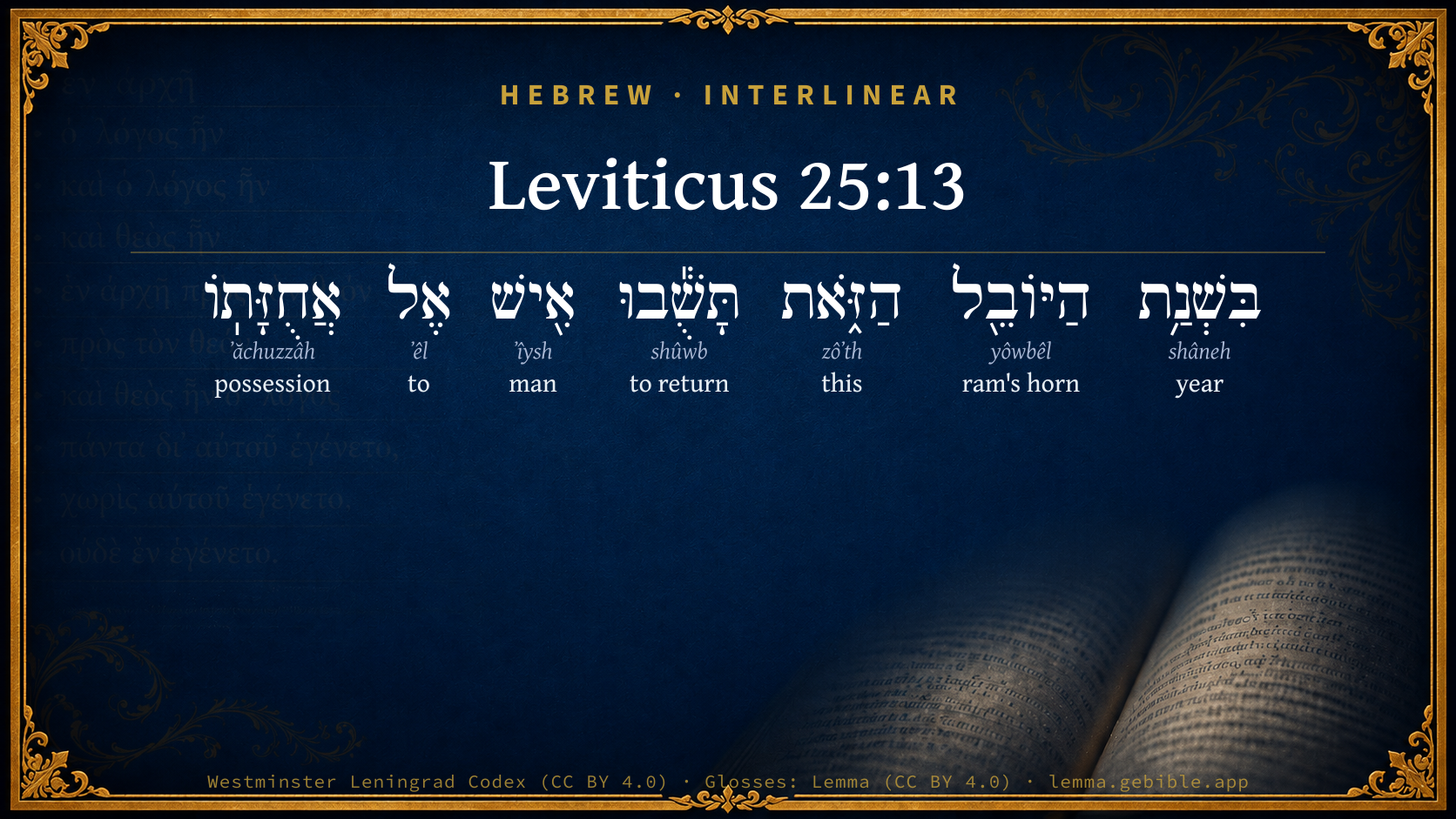
Leviticus 25:13

Hebrew (Westminster Leningrad Codex) Leviticus 25:13 appears in the Hebrew Old Testament. The text above is from the Westminster Leningrad Codex. Each word links to its Strong’s number, a concise gloss, and parsing drawn from the Open Scriptures Hebrew Bible morphology. Click any word for its full Brown-Driver-Briggs (BDB) entry.
Download image
Cite this verse

Leviticus 25:13 (World English Bible). Public Domain. Lemma interlinear Bible study tool, https://lemma.gebible.app/v/leviticus/25/13.

Show BibTeX & RIS
BibTeX
RIS
English Translation
"'In this Year of Jubilee each of you shall return to his property.
World English Bible · Public Domain
Download a study sheet

One document with this verse’s original text, its word-by-word gloss line, the meaning frame, cross-references with their text, attributed commentary, and full source and license credits — printable, and it pastes into notes with its structure intact.

This verse Autodidact and up

Study sheet (.html) Plain text (.txt)

A passage Seminary Student

Up to 50 verses in one chapter. A passage sheet keeps up to 6 commentary sources and 12 cross-references per verse, in the order this page ranks them, and says so on the sheet whenever that leaves anything out. Ask for a single verse and you get the Autodidact verse sheet above.

Everything on this page stays free to read, with no account — the sheet is a download of what is already on screen, not access to it.

Want to remove ads? Support Godless Engineer
Compare translations 3

The same verse in 3 English versions, stacked beneath the original-language interlinear above. Click any original word for its lexicon entry.

Each is an independent rendering of the whole verse — the interlinear is not word-aligned to these translations.

Highlighted words mark where these versions differ — a whole-verse word diff, not a word-by-word alignment.

  • World English Bible Public Domain
    "'In this Year of Jubilee each of you shall return to his property.
  • King James Version Public Domain
    In the year of this jubilee ye shall return every man unto his possession.
  • unfoldingWord Literal Text CC BY-SA 4.0
    In this Year of Jubilee you shall return, each to his possession.

unfoldingWord Literal Text — © unfoldingWord, licensed CC BY-SA 4.0. Word-aligned USFM3 via Door43 (git.door43.org/unfoldingWord/en_ult).

Versions to compare (up to 4)

3 of 4 selected

Show all 18 translations

Every available English version of this verse, each an independent rendering of the whole verse.

  • World English Bible Public Domain
    "'In this Year of Jubilee each of you shall return to his property.
  • Berean Standard Bible Public Domain
    In this Year of Jubilee, each of you shall return to his own property.
  • Majority Standard Bible Public Domain
    In this Year of Jubilee, each of you shall return to his own property.
  • King James Version Public Domain
    In the year of this jubilee ye shall return every man unto his possession.
  • American Standard Version (1901) Public Domain
    In this year of jubilee ye shall return every man unto his possession.
  • Revised Version (1885) Public Domain
    In this year of jubile ye shall return every man unto his possession.
  • Geneva Bible (1599) Public Domain
    In the yeere of this Iubile, ye shall returne euery man vnto his possession.
  • Douay-Rheims (1899) Public Domain
    In the year of the jubilee all shall return to their possessions.
  • Young's Literal Translation Public Domain
    in the year of this jubilee ye turn back each unto his possession.
  • Literal Standard Version CC BY-SA 4.0
    you return each to his possession in this Year of the Jubilee.
  • Unlocked Literal Bible CC BY-SA 4.0
    You must return everyone to his own property in this year of Jubilee.
  • unfoldingWord Literal Text CC BY-SA 4.0
    In this Year of Jubilee you shall return, each to his possession.
  • Darby Bible Public Domain
    In this year of the jubilee ye shall return every man unto his possession.
  • World Messianic Bible Public Domain
    “‘In this Year of Jubilee each of you shall return to his property.
  • Webster's Bible Public Domain
    In the year of this jubilee ye shall return every man to his possession.
  • Free Bible Version CC BY-SA 4.0
    In this Jubilee Year, every one of you shall return to your own property.
  • Bible in Basic English Public Domain
    In this year of Jubilee, let every man go back to his heritage.
  • JPS Tanakh (1917) Public Domain
    In this year of jubilee ye shall return every man unto his possession.

Literal Standard Version (2020), Covenant Press — licensed CC BY-SA 4.0. Text via the HelloAO Bible API (eBible.org). Unlocked Literal Bible (unfoldingWord) — licensed CC BY-SA 4.0. Text via the HelloAO Bible API (eBible.org). unfoldingWord Literal Text — © unfoldingWord, licensed CC BY-SA 4.0. Word-aligned USFM3 via Door43 (git.door43.org/unfoldingWord/en_ult). Free Bible Version, Dr. Jonathan Gallagher — licensed CC BY-SA 4.0. Text via the HelloAO Bible API (eBible.org).

Word by word

More ways to search: Search by grammar → Find every occurrence → Compare this word →

Practice this passage: Drill this verse → Learn its vocabulary →

About this verse

These counts appear in no published source. They are computed here, from the morphology-tagged text and Lemma’s own curated glosses. What Lemma adds →

7
words
7
distinct lemmas
Pentateuch
section

Shared distinctive vocabulary

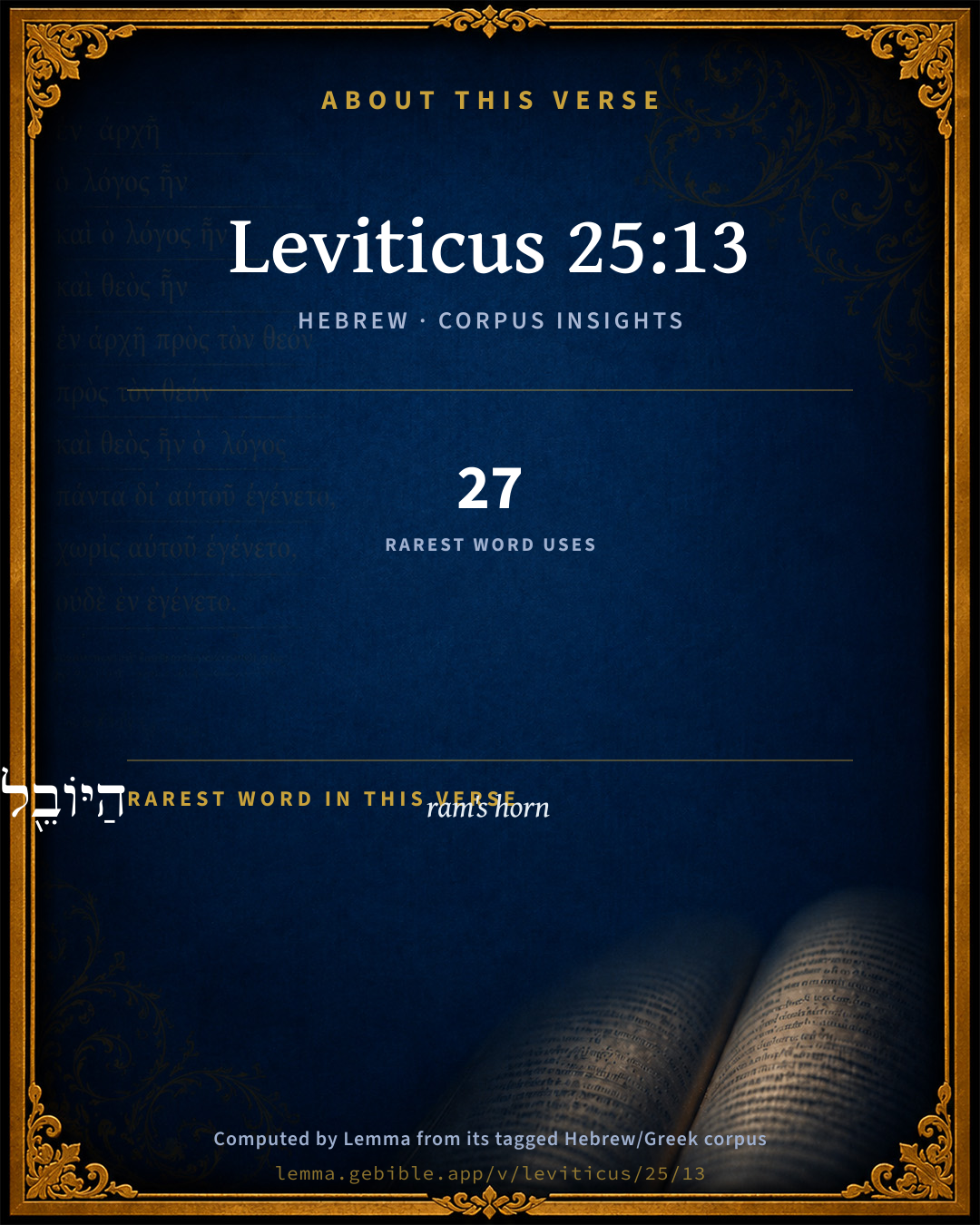
הַיּוֹבֵ֖ל ram's horn H3104 occurs in 25 verses of the Hebrew Bible. Also found in:

Grammatical profile

  • 1 verb
  • 4 nouns
  • 1 pronoun
  • 1 preposition

Verb forms

  • תָּשֻׁ֕בוּ Qal · Imperfect

Hebrew & Septuagint length

In English translation the verse runs 13 words from the Hebrew and 18 from the Septuagint (LXX English) — closely comparable.

A rough comparison of the two English renderings, which tokenize alike — not a word-level alignment.

Word counts can differ between the Hebrew and the Greek without any difference in meaning — e.g. the Hebrew direct-object marker אֵת has no separate Greek word, and Greek often adds the article ὁ.

Cross-references

3

Topical passages linked to Leviticus 25:13 in the Treasury of Scripture Knowledge — connected by theme and wording, ordered by reader-vote popularity; previews shown in the World English Bible.

  • Leviticus 25:10 You shall make the fiftieth year holy, and proclaim liberty throughout the land to all its inhabitants. It shall be a jubilee to you; and each of you shall return to his own property, and each of you shall return to his family.
  • Leviticus 27:17–24 If he dedicates his field from the Year of Jubilee, according to your valuation it shall stand.
  • Numbers 36:4 When the jubilee of the children of Israel shall be, then will their inheritance be added to the inheritance of the tribe whereunto they shall belong: so will their inheritance be taken away from the inheritance of the tribe of our fathers.

Cross-references courtesy of OpenBible.info (CC BY 4.0).

Hebrew and Greek witnesses Masoretic Hebrew ↔ Greek Septuagint

The same verse in the two great witnesses to the Old Testament, shown verse-for-verse.

These are two independent witnesses, not word-aligned to each other, and the Septuagint is shown in lemma (dictionary) form.

Hebrew Leviticus 25:13 Masoretic · Westminster Leningrad Codex

בִּשְׁנַ֥ת הַיּוֹבֵ֖ל הַזֹּ֑את תָּשֻׁ֕בוּ אִ֖ישׁ אֶל אֲחֻזָּתֽוֹ

"'In this Year of Jubilee each of you shall return to his property.

World English Bible · Public Domain

Greek LXX Leviticus 25:13 Septuagint · lemma form

ἐν ὁ ἔτος ὁ ἄφεσις σημασία αὐτός ἐπι ἀναἔρχομαι ἕκαστος εἰς ὁ κτῆσις αὐτός

In the year of the release even the jubilee of it, shall each one return to his possession.

LXX2012 (modern English Septuagint) · Public Domain

Hebrew: Westminster Leningrad Codex (CC BY 4.0). Greek: Septuagint (public domain); English from LXX2012 (modern English Septuagint) (Public Domain). How the Septuagint differs from the Hebrew →

Targum (Aramaic paraphrase)

2

The Targum is the ancient Jewish Aramaic paraphrase of the Hebrew Scriptures — an interpretive translation, not the Hebrew text itself. Onkelos (literal) and Pseudo-Jonathan (expansive) render the Torah, and Jonathan the Prophets. Coverage is partial: where no permissively-licensed English translation exists for a verse, only the Aramaic is shown. This is verse-level text, not a word-by-word alignment to the Hebrew.

  1. Targum Onkelos Torah (Genesis–Deuteronomy)
    בְּשַׁתָּא דְיוֹבֵלָא הָדָא תְּתוּבוּן גְבַר לְאַחֲסַנְתֵּהּ

    (no public-domain English translation for this verse)

    Targum Onkelos — Aramaic: “Onkelos Genesis” (public domain); “Onkelos Exodus” (public domain); “Onkelos Leviticus” (public domain); “Onkelos Numbers” (public domain); “Onkelos Deuteronomy” (public domain). English: “Sefaria Community Translation” (CC0 1.0 (public-domain dedication)); “J.W. Etheridge. The Targums of Onkelos and Jonathan Ben Uzziel on the Pentateuch. London: Longmans, Green, 1862” (public domain). Text via Sefaria.

  2. Targum Pseudo-Jonathan Torah (Genesis–Deuteronomy)
    בְּשַׁתָּא דְיוּבְלָא הֲדָא תְּתוּבוּן גְבַר לְאַחְסַנְתֵּיהּ

    In this year of Jubela you shall return every man unto his inheritance.

    Targum Pseudo-Jonathan — Aramaic: “Targum Jonathan on Genesis” (public domain); “Targum Jonathan on Exodus” (public domain); “Targum Jonathan on Leviticus” (public domain); “Targum Jonathan on Numbers” (public domain); “Targum Jonathan on Deuteronomy” (public domain). English: “The Targum of Jonathan ben Uzziel, trans. J. W. Etheridge, London, 1862” (public domain). Text via Sefaria.

Commentary

Notes on Leviticus 25:13 from classic Christian and Jewish commentators (each source and its license shown beneath its notes). The classic Christian expositions comment on the surrounding passage and are grouped to its opening verse, so a note may address several verses; the Jewish commentaries on the Tanakh (Rashi and others) are per-verse, so they appear only where the commentator wrote on this verse.

Lemma curates 59 commentaries, every one of them public domain or Creative Commons licensed, each selected and text-cleaned for this edition rather than reprinted as found. About our sources →

Trapp's Complete Commentary

John Trapp

Lev 25:13 In the year of this jubile ye shall return every man unto his possession.

Ver. 13. Ye shall return every man unto his possession.] So shall all saints to the paradise of God, at the sound of the last trumpet.

John Trapp, A Commentary or Exposition upon All the Books of the Old and New Testament (1647–1656) — public domain. Text from a community e-Sword module.

The Expositor's Bible

THE JUBILEE AND THE LAND

Lev_25:13-28

"In this year of jubilee ye shall return every man unto his possession. And if thou sell aught unto thy neighbour, or buy of thy neighbours hand, ye shall not wrong one another: according to the number of years after the jubilee thou shalt buy of thy neighbour, and according unto the number of years of the crops he shall sell unto thee. According to the multitude of the years thou shalt increase the price thereof, and according to the fewness of the years thou shalt diminish the price of it; for the number of the crops doth he sell unto thee. And ye shall not wrong one another; but thou shalt fear thy God: for I am the Lord your God. Wherefore ye shall do My statutes, and keep My judgments and do them; and ye shall dwell in the land in safety. And the land shall yield her fruit, and ye shall eat your fill, and dwell therein in safety. And if ye shall say, What shall we eat the seventh year? behold, we shall not sow, nor gather in our increase: then I will command My blessing upon you in the sixth year, and it shall bring forth fruit for the three years. And ye shall sow the eighth year, and eat of the fruits, the old store; until the ninth year, until her fruits come in, ye shall eat the old store. And the land shall not be sold in perpetuity; for the land is Mine: for ye are strangers and sojourners with Me. And in all the land of your possession ye shall grant a redemption for the land. If thy brother be waxen poor, and sell some of his possession, then shall his kinsman that is next unto him come, and shall redeem that which his brother hath sold. And if a man have no one to redeem it, and he be waxen rich and find sufficient to redeem it then let him count the years of the sale thereof, and restore the overplus unto the man to whom he sold it; and he shall return unto his possession. But if he be not able to get it back for himself, then that which he hath sold shall remain in the hand of him that hath bought it until the year of jubilee: and in the jubilee it shall go out, and he shall return unto his possession."

The remainder of the chapter (Lev_25:13-55) deals with the practical application of this law of the jubilee to various cases. In Lev_25:13-28 we have the application of the law to the case of property in land; in Lev_25:29-34, to sales of dwelling houses; and the remaining verses (Lev_25:35-55) deal with the application of this law to the institution of slavery.

As regards the first matter, the transfers of right in land, these in all cases were to be governed by the fundamental principle enounced in Lev_25:23 : "The land shall not be sold in perpetuity; for the land is Mine: for ye are strangers and sojourners with Me."

Thus in the theocracy there was no such thing as either private or communal ownership in land. Just as in some lands today the only owner of the land is the king, so it was in Israel; but in this case the King was Jehovah. From this it follows evidently, that properly speaking, according to this law, there could be no such thing in Israel as a sale or purchase of land. All that any man could buy or sell was the right to its products, and that, again, only for a limited time; for every fiftieth year the land was to revert to the family to whom its use had been originally assigned. Hence the regulations (Lev_25:14-19) regarding such transfers of the right to the use of the land. They are all governed by the simple and equitable principle that the price paid for the usufruct of the land was to be exactly proportioned to the number of years which were to elapse between the date of the sale and the reversion of the land, which would take place in the jubilee. Thus, the price for such transfer of right in the first year of the jubilee period would be at its maximum, because the sale covered the right to the produce of the land for forty-nine years; while, on the other hand, in the case of a transfer made in the forty-eighth year, the price would have fallen to a very small amount, as only the product of one years cultivation remained to be sold, and after the ensuing sabbatic year the land would revert in the jubilee to the original holder. The command to keep in mind this principle, and not wrong one another, is enforced (Lev_25:17-19) by the injunction to do this because of the fear of God; and by the promise that if Israel will obey this law, they shall dwell in safety, and have abundance.

In Lev_25:24-28, after the declaration of the fundamental law that the land belongs only to the Lord, and that they are to regard themselves as simply His tenants, "sojourners with Him," a second application of the law is made. First, it is ordered that in every case, and without reference to the year of jubilee, every landholder who through stress of poverty may be obliged to sell the usufruct of his land shall retain the right to redeem it. Three cases are assumed. First (Lev_25:25), it is ordered that if the poor man have lost his land, and have a kinsman who is able to redeem it, he shall do so. Secondly (Lev_25:26), if he have no such kinsman, but himself become able to redeem it, it shall be his privilege to do so. In both cases alike, "the overplus," i.e., the value of the land for the years still remaining till the jubilee, for which the purchaser had paid, is to be restored to him, and then the land reverts at once, without waiting for the jubilee, to the original proprietor. The third case (Lev_25:28) is that of the poor man who has no kinsman to buy back his landholding, and never becomes able to do so himself. In such a case, the purchaser was to hold it until the jubilee year, when the land reverted without compensation to the family of the poor man who had transferred it. That this was strictly equitable is self-evident, when we remember that, according to the law previously laid down, the purchaser had only paid for the value of the product of the land until the jubilee year; and when he had received its produce for that time, naturally and in strict equity his right in the land terminated.

William Robertson Nicoll, ed., The Expositor's Bible (London: Hodder & Stoughton, 1887–1910) — public domain. 65 of 66 books (1 Corinthians is not separately keyed, as that volume carries no machine-parseable verse references); section-level commentary keyed to the opening verse. Introductory and overview sections not keyed to a specific passage are excluded.

Jamieson, Fausset & Brown

Robert Jamieson, A. R. Fausset & David Brown

ye shall return every man unto his possession, &c.--Inheritances, from whatever cause, and how frequently soever they had been alienated, came back into the hands of the original proprietors. This law of entail, by which the right heir could never be excluded, was a provision of great wisdom for preserving families and tribes perfectly distinct, and their genealogies faithfully recorded, in order that all might have evidence to establish their right to the ancestral property. Hence the tribe and family of Christ were readily discovered at his birth.

Jamieson, Fausset & Brown — Commentary Critical and Explanatory on the Whole Bible (1871) — public domain (CC PDM 1.0). Text via the HelloAO Bible API.

Ellicott's Commentary for English Readers

(13) Ye shall return every man unto his possession.—In the year of jubile every man is to be restored to his landed property, whether he had disposed of it by sale or by gift.

A Bible Commentary for English Readers, edited by Charles John Ellicott (1878–1897) — public domain. Text from a community e-Sword module.

The Cambridge Bible for Schools and Colleges

gen. ed. J. J. S. Perowne

13. See introd. note.

The Cambridge Bible for Schools and Colleges (gen. ed. J. J. S. Perowne; Cambridge University Press, 1878–1918) — public domain. Text from a community e-Sword module.

John Gill's Exposition

In the year of this jubilee,.... In the beginning of it, as Aben Ezra, though not on the first day of Tisri, but the tenth day, the day of atonement, when the trumpet was blown:

ye shall return every man unto his possession; which is repeated from Lev 25:10; the reason of which, the Jews say, is to include gifts, and which, according to them, are like sales, and returned in the year of "jubilee"; that is, if a man gave his estate in possession to another, he returned to it, in the year of jubilee, equally as if he had sold it; and therefore they observe the same phrase is twice used by Moses, to include gifts (y): but perhaps the truer reason is, because this was a special business done at this time, and of great importance; the word "return" being so often used, may serve to confirm the sense of the word "jubilee", given previously; see Gill on Lev 25:9.

(y) Misn. Becorot, c. 8. sect. 10. & Bartenora in ib.

John Gill's Exposition of the Whole Bible (1746–1763) — public domain (CC PDM 1.0). Text via the HelloAO Bible API.

The Pulpit Commentary

Vers. 13-17. The Israelites were only tenants of God. They might regard themselves as owners for fifty years, but at the end of every fifty years the land was to come back to him to whom the Lord had assigned it, or to his representative. It might be bought and sold on that understanding, the value of the purchase being four. d by reckoning the price of the harvests up to the next jubilee day; but in this period only "the years of the fruits" were to be counted, that is, the sabbatical years, in which there would be no harvests, were to be deducted. Ye shall not therefore oppress (or overreach) one another by demanding more for the hind than would be its just value under the limitation of the jubilee law.

The Pulpit Commentary (1880–1919), ed. H.D.M. Spence-Jones & Joseph S. Exell — public domain. Text from a community e-Sword module.

unfoldingWord translationNotes

Door43 World Missions Community

this year of Jubilee

"this year of restoration" or "this year to return land and free slaves"

translationWords

neighbor

unfoldingWord translationNotes — © Distant Shores Media and the Door43 World Missions Community, licensed CC BY-SA 4.0. Source: git.door43.org/Door43/en_tn.

Rashi

Rabbi Shlomo Yitzchaki (Rashi)

תשבו איש אל אחזתו YE SHALL RETURN EVERY MAN UNTO HIS POSSESSION — But has it not already been stated: (v. 10) “and ye shall return every man unto his possession”? But this is repeated in order to include in this law also the case of one who sold his field and his son came forward and redeemed it, — that it also is to be returned to the father in the Jubilee (Sifra, Behar, Chapter 3 6).

Rashi on the Tanakh — English translations: “The Judaica Press complete Tanach with Rashi, translated by A. J. Rosenberg” (CC BY 4.0); “Pentateuch with Rashi's commentary by M. Rosenbaum and A.M. Silbermann, 1929-1934” (public domain); “The Metsudah Tanach series, Lakewood, N.J” (CC BY 4.0); and “The Book of Joshua, Metsudah Publications, 1997” (CC BY 4.0). Text via Sefaria.

Sforno

Rabbi Ovadia Sforno

Each man shall return to his ancestral land. It is permitted for the owners that return to the ancestral land to take control over it as their estate, and to build houses, dovecotes, or pens for their flocks, and other things, except for working the soil and watching over the fruits.

Sforno on the Tanakh — English translation: “Yalkut, Sifsei Chachomim Chumash, Metsudah Publications, 2009” (CC BY 4.0). Text via Sefaria.

Lesson kit

Teaching starters — assembled from the data on this page, not authored interpretation. Every prompt links to the verse data it draws on. Edit before teaching.

Leviticus, in the Pentateuch, opens this verse with 7 words (7 distinct Hebrew lemmas). Its most distinctive word is yôwbêl (“ram's horn”). A historical commentator’s framing appears above. Read the whole chapter for the surrounding context.

Discussion questions

  1. The word yôwbêl carries the sense “ram's horn.” How does it shape the verse?
  2. How does Exodus 19:13, which shares the word «ram's horn», read alongside this verse?
  3. These translations render this verse differently; the difference is in the English rendering, not the original. What questions does that raise?
  4. «תָּשֻׁ֕בוּ» is a Qal Imperfect verb. How does that grammatical form shape the action described?
  5. Compare how Trapp's Complete Commentary and The Expositor's Bible read this verse. Where do they agree or differ?

Things to notice

Reading settings

Reading text

Shown beneath each verse's original-language words.

Old Testament
Old Testament edition

Read the OT as the Masoretic Hebrew (MT) or the Greek Septuagint (LXX).

English shown for the Greek Septuagint (in the Hebrew ↔ Greek comparison).

Comparing translations? Open the Compare panel on any verse page to stack up to four side by side.