Genesis 17:10

Hebrew (Westminster Leningrad Codex) Genesis 17:10 appears in the Hebrew Old Testament. The text above is from the Westminster Leningrad Codex. Each word links to its Strong’s number, a concise gloss, and parsing drawn from the Open Scriptures Hebrew Bible morphology. Click any word for its full Brown-Driver-Briggs (BDB) entry.
Download image
Cite this verse

Genesis 17:10 (World English Bible). Public Domain. Lemma interlinear Bible study tool, https://lemma.gebible.app/v/genesis/17/10.

Show BibTeX & RIS
BibTeX
RIS
English Translation
This is my covenant, which you shall keep, between me and you and your seed after you. Every male among you shall be circumcised.
World English Bible · Public Domain
Highlights
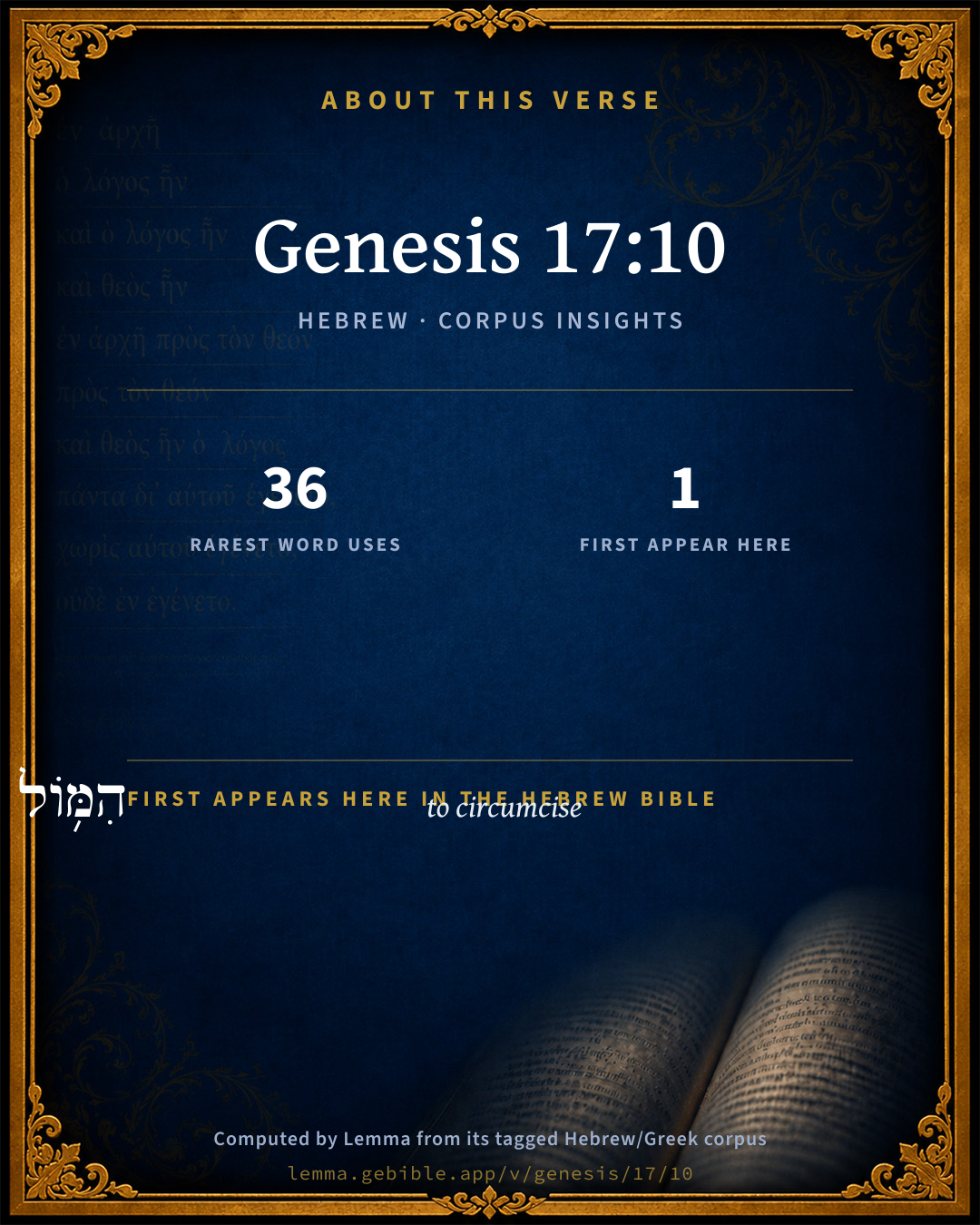
  • 1 first appearance in the Hebrew Bible
Full analysis ↓
Download a study sheet

One document with this verse’s original text, its word-by-word gloss line, the meaning frame, cross-references with their text, attributed commentary, and full source and license credits — printable, and it pastes into notes with its structure intact.

This verse Autodidact and up

Study sheet (.html) Plain text (.txt)

A passage Seminary Student

Up to 50 verses in one chapter. A passage sheet keeps up to 6 commentary sources and 12 cross-references per verse, in the order this page ranks them, and says so on the sheet whenever that leaves anything out. Ask for a single verse and you get the Autodidact verse sheet above.

Everything on this page stays free to read, with no account — the sheet is a download of what is already on screen, not access to it.

Want to remove ads? Support Godless Engineer
Compare translations 3

The same verse in 3 English versions, stacked beneath the original-language interlinear above. Click any original word for its lexicon entry.

Each is an independent rendering of the whole verse — the interlinear is not word-aligned to these translations.

Highlighted words mark where these versions differ — a whole-verse word diff, not a word-by-word alignment.

  • World English Bible Public Domain
    This is my covenant, which you shall keep, between me and you and your seed after you. Every male among you shall be circumcised.
  • King James Version Public Domain
    This is my covenant, which ye shall keep, between me and you and thy seed after thee; Every man child among you shall be circumcised.
  • unfoldingWord Literal Text CC BY-SA 4.0
    This my covenant which you must keep, between me and you and your offspring after you: Every male among you must be circumcised.

unfoldingWord Literal Text — © unfoldingWord, licensed CC BY-SA 4.0. Word-aligned USFM3 via Door43 (git.door43.org/unfoldingWord/en_ult).

Versions to compare (up to 4)

3 of 4 selected

Show all 18 translations

Every available English version of this verse, each an independent rendering of the whole verse.

  • World English Bible Public Domain
    This is my covenant, which you shall keep, between me and you and your seed after you. Every male among you shall be circumcised.
  • Berean Standard Bible Public Domain
    This is My covenant with you and your descendants after you, which you are to keep: Every male among you must be circumcised.
  • Majority Standard Bible Public Domain
    This is My covenant with you and your descendants after you, which you are to keep: Every male among you must be circumcised.
  • King James Version Public Domain
    This is my covenant, which ye shall keep, between me and you and thy seed after thee; Every man child among you shall be circumcised.
  • American Standard Version (1901) Public Domain
    This is my covenant, which ye shall keep, between me and you and thy seed after thee: every male among you shall be circumcised.
  • Revised Version (1885) Public Domain
    This is my covenant, which ye shall keep, between me and you and thy seed after thee; every male among you shall be circumcised.
  • Geneva Bible (1599) Public Domain
    This is my couenant which ye shall keepe betweene me and you, and thy seede after thee, Let euery man childe among you be circumcised:
  • Douay-Rheims (1899) Public Domain
    This is my covenant which you shall observe, between me and you, and thy seed after thee: All the male kind of you shall be circumcised:
  • Young's Literal Translation Public Domain
    this `is' My covenant which ye keep between Me and you, and thy seed after thee: Every male of you `is' to be circumcised;
  • Literal Standard Version CC BY-SA 4.0
    this [is] My covenant which you keep between Me and you, and your seed after you: every male of you [is] to be circumcised;
  • Unlocked Literal Bible CC BY-SA 4.0
    This is my covenant, which you must keep, between me and you and your descendants after you: Every male among you must be circumcised.
  • unfoldingWord Literal Text CC BY-SA 4.0
    This my covenant which you must keep, between me and you and your offspring after you: Every male among you must be circumcised.
  • Darby Bible Public Domain
    This is my covenant which ye shall keep, between me and you and thy seed after thee -- that every male among you be circumcised.
  • World Messianic Bible Public Domain
    This is my covenant, which you shall keep, between me and you and your offspring after you. Every male among you shall be circumcised.
  • Webster's Bible Public Domain
    This is my covenant, which ye shall keep between me and you, and thy seed after thee; Every male-child among you shall be circumcised.
  • Free Bible Version CC BY-SA 4.0
    This is my agreement with you and your descendants who come after you, the agreement you are to keep: every male among you shall be circumcised.
  • Bible in Basic English Public Domain
    And this is the agreement which you are to keep with me, you and your seed after you: every male among you is to undergo circumcision.
  • JPS Tanakh (1917) Public Domain
    This is My covenant, which ye shall keep, between Me and you and thy seed after thee: every male among you shall be circumcised.

Literal Standard Version (2020), Covenant Press — licensed CC BY-SA 4.0. Text via the HelloAO Bible API (eBible.org). Unlocked Literal Bible (unfoldingWord) — licensed CC BY-SA 4.0. Text via the HelloAO Bible API (eBible.org). unfoldingWord Literal Text — © unfoldingWord, licensed CC BY-SA 4.0. Word-aligned USFM3 via Door43 (git.door43.org/unfoldingWord/en_ult). Free Bible Version, Dr. Jonathan Gallagher — licensed CC BY-SA 4.0. Text via the HelloAO Bible API (eBible.org).

Word by word

More ways to search: Search by grammar → Find every occurrence → Compare this word →

Practice this passage: Drill this verse → Learn its vocabulary →

הִמּ֥וֹל
mûwl
H4135
“to circumcise”
Verb, Niphal, Infinitive Absolute
Part of Speech
Verb
Stem
Niphal
Form
Infinitive Absolute
Full BDB Definition

Origin: a primitive root

TWOT: 1161

to circumcise, let oneself be circumcised, cut, be cut off - (Qal) to circumcise - (Niphal) to be circumcised, circumcise oneself - (Hiphil) to cause to be circumcised - of destruction (figuratively) - (Hithpolel) to be cut off - (Polel) cut down
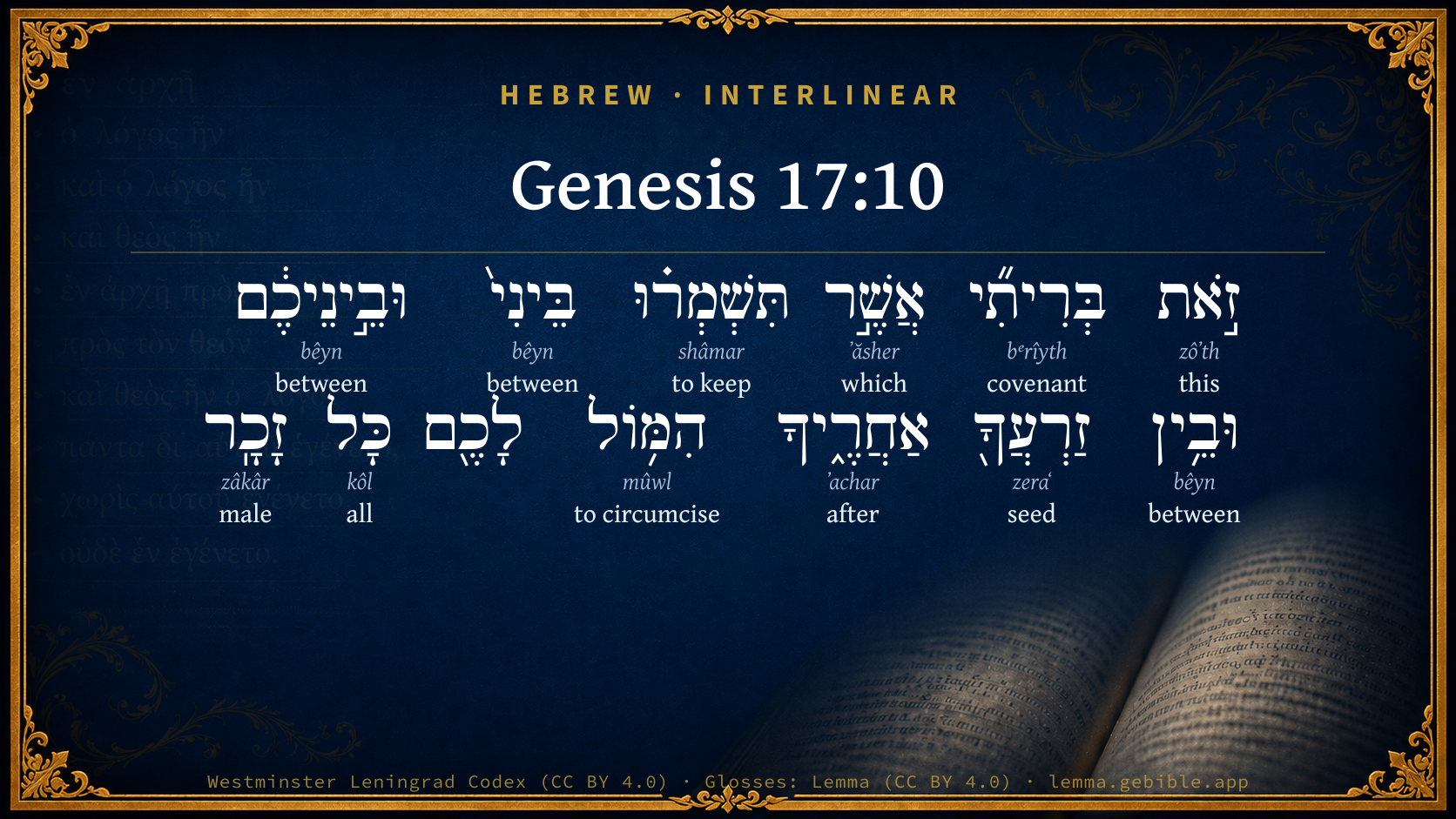
  1. זֹ֣את zôʼth H2063 “this” Pronoun, Demonstrative, Feminine, Singular
  2. בְּרִיתִ֞י bᵉrîyth H1285 “covenant · my” Noun, Common, Feminine, Singular, Construct + Suffix, Personal, 1st Person, Common, Singular
  3. אֲשֶׁ֣ר ʼăsher H834 “which” Particle, Relative
  4. תִּשְׁמְר֗וּ shâmar H8104 “to keep” Verb, Qal, Imperfect, 2nd Person, Masculine, Plural
  5. בֵּינִי֙ bêyn H996 “between · me” Preposition + Suffix, Personal, 1st Person, Common, Singular
  6. וּבֵ֣ינֵיכֶ֔ם bêyn H996 “and · between · you” Conjunction + Preposition + Suffix, Personal, 2nd Person, Masculine, Plural
  7. וּבֵ֥ין bêyn H996 “and · between” Conjunction + Preposition
  8. זַרְעֲךָ֖ zeraʻ H2233 “seed · your” Noun, Common, Masculine, Singular, Construct + Suffix, Personal, 2nd Person, Masculine, Singular
  9. אַחֲרֶ֑יךָ ʼachar H310 “after · you” Preposition + Suffix, Personal, 2nd Person, Masculine, Singular
  10. כָּל kôl H3605 “all of” Noun, Common, Masculine, Singular, Construct
  11. זָכָֽר zâkâr H2145 “male” Adjective, Adjective, Masculine, Singular, Absolute

About this verse

These counts appear in no published source. They are computed here, from the morphology-tagged text and Lemma’s own curated glosses. What Lemma adds →

13
words
10
distinct lemmas
Pentateuch
section

First appearance in Scripture

This word makes its first canonical appearance in the Hebrew Bible here:

  • הִמּ֥וֹל to circumcise H4135

Shared distinctive vocabulary

הִמּ֥וֹל to circumcise H4135 occurs in 32 verses of the Hebrew Bible. Also found in:

Grammatical profile

  • 2 verbs
  • 3 nouns
  • 1 adjective
  • 1 pronoun
  • 5 prepositions
  • 1 particle

Verb forms

  • תִּשְׁמְר֗וּ Qal · Imperfect
  • הִמּ֥וֹל Niphal · Infinitive Absolute

Repetition

A word recurs within this verse — often emphatic in Hebrew:

  • בֵּינִי֙ between H996 ×3

Hebrew & Septuagint length

In English translation the verse runs 24 words from the Hebrew and 30 from the Septuagint (LXX English) — closely comparable.

A rough comparison of the two English renderings, which tokenize alike — not a word-level alignment.

Word counts can differ between the Hebrew and the Greek without any difference in meaning — e.g. the Hebrew direct-object marker אֵת has no separate Greek word, and Greek often adds the article ὁ.

Cross-references

24

Topical passages linked to Genesis 17:10 in the Treasury of Scripture Knowledge — connected by theme and wording, ordered by reader-vote popularity; previews shown in the World English Bible.

  • Acts 7:8 He gave him the covenant of circumcision. So Abraham became the father of Isaac, and circumcised him the eighth day. Isaac became the father of Jacob, and Jacob became the father of the twelve patriarchs.
  • Colossians 2:11–12 in whom you were also circumcised with a circumcision not made with hands, in the putting off of the body of the sins of the flesh, in the circumcision of Christ;
  • Romans 4:9–11 Is this blessing then pronounced on the circumcised, or on the uncircumcised also? For we say that faith was accounted to Abraham for righteousness.
  • Galatians 5:3–6 Yes, I testify again to every man who receives circumcision, that he is a debtor to do the whole law.
  • Genesis 17:11 You shall be circumcised in the flesh of your foreskin. It will be a token of a covenant between me and you.
  • Joshua 5:2 At that time Yahweh said to Joshua, Make you flint knives, and circumcise again the children of Israel the second time.
  • Romans 3:30 since indeed there is one God who will justify the circumcised by faith, and the uncircumcised through faith.
  • 1 Corinthians 7:18–19 Was anyone called having been circumcised? Let him not become uncircumcised. Has anyone been called in uncircumcision? Let him not be circumcised.
  • Philippians 3:3 For we are the circumcision, who worship God in the Spirit, and rejoice in Christ Jesus, and have no confidence in the flesh;
  • Deuteronomy 30:6 Yahweh your God will circumcise your heart, and the heart of your seed, to love Yahweh your God with all your heart, and with all your soul, that you may live.
  • Romans 3:25 whom God set forth to be an atoning sacrifice, through faith in his blood, for a demonstration of his righteousness through the passing over of prior sins, in God's forbearance;
  • Galatians 6:12 As many as desire to look good in the flesh, they compel you to be circumcised; only that they may not be persecuted for the cross of Christ.
  • Ephesians 2:11 Therefore remember that once you, the Gentiles in the flesh, who are called "uncircumcision" by that which is called "circumcision," (in the flesh, made by hands);
  • Genesis 34:15 Only on this condition will we consent to you. If you will be as we are, that every male of you be circumcised;
  • Exodus 4:25 Then Zipporah took a flint, and cut off the foreskin of her son, and cast it at his feet; and she said, "Surely you are a bridegroom of blood to me."
  • Exodus 12:48 When a stranger shall live as a foreigner with you, and will keep the Passover to Yahweh, let all his males be circumcised, and then let him come near and keep it; and he shall be as one who is born in the land: but no uncircumcised person shall eat of it.
  • Deuteronomy 10:16 Circumcise therefore the foreskin of your heart, and be no more stiff-necked.
  • Joshua 5:4 This is the cause why Joshua did circumcise: all the people who came forth out of Egypt, who were males, even all the men of war, died in the wilderness by the way, after they came forth out of Egypt.
  • Jeremiah 4:4 Circumcise yourselves to Yahweh, and take away the foreskins of your heart, you men of Judah and inhabitants of Jerusalem; lest my wrath go forth like fire, and burn so that none can quench it, because of the evil of your doings.
  • Jeremiah 9:25–26 Behold, the days come, says Yahweh, that I will punish all those who are circumcised in [their] uncircumcision:
  • John 7:22 Moses has given you circumcision (not that it is of Moses, but of the fathers), and on the Sabbath you circumcise a boy.
  • Romans 2:28–3:1 For he is not a Jew who is one outwardly, neither is that circumcision which is outward in the flesh;
  • Romans 3:28 We maintain therefore that a man is justified by faith apart from the works of the law.
  • Galatians 3:28 There is neither Jew nor Greek, there is neither slave nor free man, there is neither male nor female; for you are all one in Christ Jesus.

Cross-references courtesy of OpenBible.info (CC BY 4.0).

Hebrew and Greek witnesses Masoretic Hebrew ↔ Greek Septuagint

The same verse in the two great witnesses to the Old Testament, shown verse-for-verse.

These are two independent witnesses, not word-aligned to each other, and the Septuagint is shown in lemma (dictionary) form.

Hebrew Genesis 17:10 Masoretic · Westminster Leningrad Codex

זֹ֣את בְּרִיתִ֞י אֲשֶׁ֣ר תִּשְׁמְר֗וּ בֵּינִי֙ וּבֵ֣ינֵיכֶ֔ם וּבֵ֥ין זַרְעֲךָ֖ אַחֲרֶ֑יךָ הִמּ֥וֹל לָכֶ֖ם כָּל זָכָֽר

This is my covenant, which you shall keep, between me and you and your seed after you. Every male among you shall be circumcised.

World English Bible · Public Domain

Greek LXX Genesis 17:10 Septuagint · lemma form

καί οὗτος ὁ διαθήκη ὅς διατηρέω ἀνά μέσος ἐγώ καί σύ καί ἀνά μέσος ὁ σπέρμα σύ μετά σύ εἰς ὁ γενεά αὐτός περιτέμνω σύ πᾶς ἀρσενικός

And this is the covenant which you shall fully keep between me and you, and between your seed after you for their generations; every male of you shall be circumcised.

LXX2012 (modern English Septuagint) · Public Domain

Hebrew: Westminster Leningrad Codex (CC BY 4.0). Greek: Septuagint (public domain); English from LXX2012 (modern English Septuagint) (Public Domain). How the Septuagint differs from the Hebrew →

Targum (Aramaic paraphrase)

2

The Targum is the ancient Jewish Aramaic paraphrase of the Hebrew Scriptures — an interpretive translation, not the Hebrew text itself. Onkelos (literal) and Pseudo-Jonathan (expansive) render the Torah, and Jonathan the Prophets. Coverage is partial: where no permissively-licensed English translation exists for a verse, only the Aramaic is shown. This is verse-level text, not a word-by-word alignment to the Hebrew.

  1. Targum Onkelos Torah (Genesis–Deuteronomy)
    דָא קְיָמִי דִי תִטְרוּן בֵּין מֵימְרִי וּבֵינֵיכוֹן וּבֵין בְּנָיךְ בַּתְרָךְ מִגְזַר לְכוֹן כָּל דְכוּרָא

    (no public-domain English translation for this verse)

    Targum Onkelos — Aramaic: “Onkelos Genesis” (public domain); “Onkelos Exodus” (public domain); “Onkelos Leviticus” (public domain); “Onkelos Numbers” (public domain); “Onkelos Deuteronomy” (public domain). English: “Sefaria Community Translation” (CC0 1.0 (public-domain dedication)); “J.W. Etheridge. The Targums of Onkelos and Jonathan Ben Uzziel on the Pentateuch. London: Longmans, Green, 1862” (public domain). Text via Sefaria.

  2. Targum Pseudo-Jonathan Torah (Genesis–Deuteronomy)
    דָא קְיָימִי דְתִטְרוּן בֵּין מֵימְרִי וּבֵינֵיכוֹן וּבֵין בְּנָךְ בַּתְרָךְ מִגְזַר לְכוֹן כָּל דְכוּרָא אִין לֵית לֵיהּ אַבָּא לְמִגְזְרֵיהּ

    This is My covenant, that you shall observe between My Word and you, and your sons after you:--Every male of you being circumcised, though he have not a father to circumcise him.

    Targum Pseudo-Jonathan — Aramaic: “Targum Jonathan on Genesis” (public domain); “Targum Jonathan on Exodus” (public domain); “Targum Jonathan on Leviticus” (public domain); “Targum Jonathan on Numbers” (public domain); “Targum Jonathan on Deuteronomy” (public domain). English: “The Targum of Jonathan ben Uzziel, trans. J. W. Etheridge, London, 1862” (public domain). Text via Sefaria.

Commentary

Notes on Genesis 17:10 from classic Christian and Jewish commentators (each source and its license shown beneath its notes). The classic Christian expositions comment on the surrounding passage and are grouped to its opening verse, so a note may address several verses; the Jewish commentaries on the Tanakh (Rashi and others) are per-verse, so they appear only where the commentator wrote on this verse.

Lemma curates 59 commentaries, every one of them public domain or Creative Commons licensed, each selected and text-cleaned for this edition rather than reprinted as found. About our sources →

Trapp's Complete Commentary

John Trapp

Gen 17:10 This [is] my covenant, which ye shall keep, between me and you and thy seed after thee; Every man child among you shall be circumcised.

Ver. 10. Every man-child among you.] Infants were circumcised to signify that we had better be flayed, and have our skin quite stripped off, than to have it as a skin-bottle hanging in the smoke of filthy desires, and blown full of unclean motions with the breath of Satan. That wretched renegade that betrayed Rhodes was well served. For his promised wife and portion were presented: but the Turk told him that he would not have a Christian to be his son-in-law, but he must be a Mussulman, that is, a believing Turk, within and without. And therefore he caused his baptized skin, as he called it, to be flayed off, and him to be cast in a bed, strewed with salt, that he might get a new skin, and so he should be his son-in-law. But the wicked wretch ended his life with shame and torment. {a}

{a} Spec. Bel. Sac., p. 157.

John Trapp, A Commentary or Exposition upon All the Books of the Old and New Testament (1647–1656) — public domain. Text from a community e-Sword module.

Joseph Benson's Commentary

Gen 17:10. The token of the covenant is circumcision, for the sake of which, the covenant is itself called the covenant of circumcision, Act 7:8. It is here said to be the covenant which Abraham and his seed must keep, as a copy or counterpart. It is called a sign and seal, (Rom 4:11,) for it was, 1st, A confirmation to Abraham and his seed of those promises which were God’s part of the covenant, assuring them that, in due time, Canaan should be theirs: and the continuance of this ordinance, after Canaan was theirs, intimates that that promise looked further, to another Canaan. 2d, An obligation upon Abraham and his seed to that duty which was their part of the covenant, not only to the duty of accepting the covenant, and putting away the corruption of the flesh, which were primarily signified by circumcision, but in general to the observation of all God’s commands. They who will have God to be to them a God, must consent to be to him a people.

Joseph Benson's Commentary on the Old and New Testaments (1811–1818) — public domain. Text from a community e-Sword module.

Geneva Bible (1599)

Geneva Bible translators

Circumcision is called the covenant, because it signifieth the covenant, and hath the promise of grace joined unto it: which phrase is common to all Sacraments.

Geneva Bible (1599) marginal notes — public domain. Text via Bolls.life.

Jamieson, Fausset & Brown

Robert Jamieson, A. R. Fausset & David Brown

Every man child among you shall be circumcised--This was the sign in the Old Testament Church as baptism is in the New, and hence the covenant is called "covenant of circumcision" (Act 7:8; Rom 4:11). The terms of the covenant were these: on the one hand Abraham and his seed were to observe the right of circumcision; and on the other, God promised, in the event of such observance, to give them Canaan for a perpetual possession, to be a God to him and his posterity, and that in him and his seed all nations should be blessed.

Jamieson, Fausset & Brown — Commentary Critical and Explanatory on the Whole Bible (1871) — public domain (CC PDM 1.0). Text via the HelloAO Bible API.

Adam Clarke's Commentary

Verse 10. Every man - child - shall be circumcised.] Those who wish to invalidate the evidence of the Divine origin of the Mosaic law, roundly assert that the Israelites received the rite of circumcision from the Egyptians. Their apostle in this business is Herodotus, who, lib. ii., p. 116, Edit. Steph. 1592, says: "The Colchians, Egyptians, and Ethiopians, are the only nations in the world who have used circumcision απ αρχης, from the remotest period; and the Phoenicians and Syrians who inhabit Palestine acknowledge they received this from the Egyptians." Herodotus cannot mean Jews by Phoenicians and Syrians; if he does he is incorrect, for no Jew ever did or ever could acknowledge this, with the history of Abraham in his hand. If Herodotus had written before the days of Abraham, or at least before the sojourning of the children of Israel in Egypt, and informed us that circumcision had been practised among them απ αρχης, from the beginning, there would then exist a possibility that the Israelites while sojourning among them had learned and adopted this rite. But when we know that Herodotus flourished only 484 years before the Christian era, and that Jacob and his family sojourned in Egypt more than 1800 years before Christ, and that all the descendants of Abraham most conscientiously observed circumcision, and do so to this day, then the presumption is that the Egyptians received it from the Israelites, but that it was impossible the latter could have received it from the former, as they had practised it so long before their ancestors had sojourned in Egypt.

Adam Clarke's Commentary on the Bible (1810–1826) — public domain. Text from a community e-Sword/MySword module.

John Calvin's Commentaries

10. Every man-child among you shall be circumcised Although God promised alike to males and females, what he afterwards sanctioned by circumcision, he nevertheless consecrated, in one sex, the whole people to himself. For whereas, by this symbol, the promise which was given, indiscriminately, to males and females, is confirmed, and it is certain that females as well as males had need of confirmation, it is hence evident, that the symbol was ordained for the sake of both sexes. Nor is it of any force in opposition to this reasoning to say that each individual is commanded to communicate in the sacraments, if he would derive any benefit from them, on the ground that no profit is received by those who neglect their use. For the covenant of God was graven on the bodies of the males, with this condition annexed, that the females also should as their associates be partakers of the same sign.

John Calvin's Commentaries (1540-1563) — public domain. Text from the Calvin Translation Society English edition (1840s-50s) via the Christian Classics Ethereal Library (ccel.org). Calvin's coverage is partial (roughly two-thirds of the Bible); uncommented books and verses are honest gaps, never fabricated. The 19th-century editor's footnotes and remarks are omitted so the notes are faithfully Calvin's own voice.

Ellicott's Commentary for English Readers

(10) Shall be circumcised.—It is stated by Herodotus (Book ii. 104) that the Egyptians were circumcised, and that the Syrians in Palestine confessed that they learned this practice from the Egyptians. Origen, however, seems to limit circumcision to the priesthood (Epist. ad Rom., § ii. 13); and the statement of Herodotus is not only very loose, but his date is too far posterior to the time of Abram for us to be able to place implicit confidence in it. If we turn to the evidence of Egyptian monuments and of the mummies, we find proof of the rite having become general in Egypt only in quite recent times. The discussion is, however, merely of archaeological importance; for circumcision was just as appropriate a sign of the covenant if borrowed from institutions already existing as if then used for the first time. It is, moreover, an acknowledged fact that the Bible is always true to the local colouring. Chaldæan influence is predominant in those early portions of Genesis which we owe to Abram, a citizen of Ur of the Chaldees; his life and surroundings subsequently are those of an Arab sheik; while Egyptian influence is strongly marked in the latter part of Genesis, and in the history of the Exodus from that country. In this fact we have a sufficient answer to the theories which would bring down the composition of the Pentateuch to a late period: for the author would certainly have written in accordance with the facts and ideas of his own times. If, however, Abram had seen circumcision in Egypt, when the famine drove him thither, and had learned the significance of the rite, and that the idea of it was connected with moral purity, there was in this even a reason why God should choose it as the outward sign of the sacrament which He was now bestowing upon the patriarch.

The fitness of circumcision to be a sign of entering into a covenant, and especially into one to which children were to be admitted, consisted in its being a representation of a new birth by the putting off of the old man, and the dedication of the new man unto holiness. The flesh was cast away that the spirit might grow strong; and the change of name in Abram and Sarai was typical of this change of condition. They had been born again, and so must again be named. And though women could not indeed be admitted directly into the covenant, yet they shared in its privileges by virtue of their consanguinity to the men, who were as sponsors for them; and thus Sarai changes her name equally with her husband.

A Bible Commentary for English Readers, edited by Charles John Ellicott (1878–1897) — public domain. Text from a community e-Sword module.

The Cambridge Bible for Schools and Colleges

gen. ed. J. J. S. Perowne

10. shall be circumcised] The rite of circumcision, which is here given as the symbol of the covenant with Abraham and his seed, was no new institution. In Abraham’s time it was already a well-known practice. It is adopted as the sign of the covenant, and consecrated to be the abiding pledge and witness of the relationship between the God who revealed Himself to Abraham and the people of which Abraham was the founder.

Circumcision is found to have been practised among the peoples of Africa at a very early time. In Egypt records of the practice are said to go back to an age many centuries previous to the time of Abraham. From Egypt it is said to have been transmitted into Phoenicia and Syria (see Herodotus, ii. 114). From the present account it is clear that the Israelites believed the institution to have had its origin in the patriarchal era. We learn from Jer_9:25-26 that it was practised by Edomites, Ammonites, and Moabites, as well as by Egyptians and Israelites.

The custom is prevalent in very different parts of the world. For instance, it is found in S. Africa and in Madagascar.

It very possibly has some connexion with the cuttings and tattooings by which the savage avowed his relationship to the Deity of his tribe, and hoped to secure his favour by wearing his sign. Hence it took rank with the distinctive badges of a tribe or people.

Recent investigation has not tended to support the theory that circumcision has any connexion with primitive child sacrifice; nor, again, that it took its origin from hygienic motives. Apparently, it represents the dedication of the manhood of the people to God. In the history of Israel, it has survived as the symbol of the people belonging to Jehovah through His special election. Its significance in Israel is something quite distinct from that in other circumcised peoples. This corporeal sacrament remained to the Israelite, when every other tie of religion or race had been severed.

For its renewal (a) in the time of Moses, (b) in the time of Joshua, see Exo_4:25; Jos_5:2. In both of these passages the use of a stone, or flint, instrument possibly represents the survival of the rite from an age of remotest antiquity, before the introduction of metal.

For circumcision as an honourable badge, the absence of which would be regarded as a reproach in Egypt, see Jos_5:7-9. The alleged omission of the Philistines to practise this rite (Jdg_14:3; 1Sa_31:4; 2Sa_1:20) may possibly be due to their foreign origin.

The Cambridge Bible for Schools and Colleges (gen. ed. J. J. S. Perowne; Cambridge University Press, 1878–1918) — public domain. Text from a community e-Sword module.

John Gill's Exposition

This is my covenant,.... The token of it, for the promise itself was given before, which is more properly the covenant; circumcision is so called in an improper sense, being only the sign of it:

which ye shall keep between me and you, and thy seed after thee; which was to be observed by Abraham, and the males in his house then with him, as Ishmael, and those that were born in his house, or bought with his money, and by his posterity in succeeding ages, and it is what follows:

every man child among you shall be circumcised; this was the first institution of circumcision, and it was an institution of God, and not of man. Indeed Herodotus says (m), that"the Colchi, Egyptians, and Ethiopians only of all men circumcised from the beginning; and the Phoenicians and Syrians, which are in Palestine, learnt it of the Egyptians, as they themselves confess.''So Diodorus Siculus (n) speaks of circumcision as an Egyptian rite, and says there are some who make the nation of the Colchi, and of the Jews, to come from the Egyptians: hence he observes, that with these nations there is an ancient tradition to circumcise their newborn infants, which rite was derived from the Egyptians: but as the original of the Jewish nation is mistaken, so likewise the original this rite. And they may as well be thought to be mistaken in the one as in the other. Those in Palestine that were circumcised were the Jews only, as Josephus (o) observes; but they did not learn this rite from the Egyptians, nor do they ever confess it, but on the contrary suggest, that the Egyptians learnt it from them in the times of Joseph; for their principal lexicographer says (p), the Egyptians were circumcised in the times of Joseph, and when Joseph died they drew over the foreskin of the flesh. The Colchi indeed, who were a colony of the Egyptians, might learn it from them; and so the Ethiopians, who were their neighbours likewise, and agreed with them in many things. Artapanus (q), an Heathen writer, says, indeed, that the Ethiopians, though enemies, had such a regard for Moses, that they learned from him the rite of circumcision; and not only they, but all the priests, that is, in Egypt; and indeed the Egyptian priests only, and not the people, were circumcised. It is not very difficult to account for it, how other nations besides the Jews should receive circumcision, which was first enjoined Abraham and his seed; the Ishmaelites had it from Ishmael the son of Abraham; from them the old Arabs; from the Arabs, the Saracens; and from the Saracens, the Turks to this day: other Arabian nations, as the Midianites, and others, had it from the sons of Abraham by Keturah; and perhaps the Egyptians and Ethiopians from them, if the former had it not from the Israelites; and the Edomites had it from Edom or Esau, the son of Isaac, the son of Abraham; so that all originally had it from Abraham, and he by a divine command. It is not so much to be wondered at, that Herodotus and Diodorus Siculus, men either imposed upon by the Egyptian priests, as the former, or wrote in favour of that nation, as the latter, and wholly ignorant of divine revelation, should assert what they have done; but that Christian writers, who have the advantage of divine revelation, and have read the history of the Bible, such as Marsham, Spencer, and Le Clerc, should incline to the same sentiment, is amazing; and especially when our blessed Lord has expressly said in Joh 7:22, that circumcision is "of the fathers", Abraham, Isaac, and Jacob, first given to them, and practised by them. Even Theodotus (s), an Heathen writer, agrees with this sacred testimony of Moses, when speaking of the circumcision of Shechem, in the times of Jacob, he traces this rite to its original, and observes, that when Abraham was brought out of his own country, he was ordered "from heaven" to circumcise every man in his house. It may indeed seem strange how it should obtain in the islands of the West Indies, as in Jucatana, Sancta Crux, and others, where the Spaniards found in the beginning of the sixteenth century those isles inhabited by idolaters, who were circumcised (t).

(m) Euterpe sive, l. 2. c. 104. (n) Bibliothec. l. 4. p. 24. & l. 3. p. 165. (o) Contr Apion. l. 1. c. 22. (p) Raal Aruch in Rad. fol. 91. 1. (q) Apud Euseb. Evangel Praepar. l. 9. c. 27. p. 433. (s) Apud Euseb. ut supra, (Evangel Praepar. l. 9.) c. 22. p. 428. (t) Vid. P. Martyr. Decad. 3. lib. 10. & de Insul. Ind. Occident.

John Gill's Exposition of the Whole Bible (1746–1763) — public domain (CC PDM 1.0). Text via the HelloAO Bible API.

Matthew Poole's English Annotations

Circumcision is here called the covenant by a usual metonomy, because it is the condition, sign, and seal of the covenant, the pledge of God’s promise and man’s duty. And upon the same grounds the cup, i.e. the wine, is called the new testament in Christ’s blood, Luk 22:20; or, which is all one, Christ’s blood in the new testament, Mat 26:28.

It is evident that women as well as men were comprehended in this covenant, from Gen 34:14; Exo 12:3,4; Joe 2:15,16. Yet circumcision is given only to the males, partly, because it could not, at least not conveniently, be administered to females; partly, because man is the principal cause of the propagation of children, and consequently of the propagation of that original corruption which cleaves to them; partly, to signify that all persons begotten by man should be polluted by sin, though not all conceived by a woman, as Christ was; and partly, because man is the head of the woman, and of the family, upon whom all their concerns are devolved, and from whom the distinction of families and people comes.

Matthew Poole's English Annotations on the Holy Bible (1683–1685) — public domain. Text from a community e-Sword/MySword module.

Whedon's Commentary on the Bible

Daniel D. Whedon

10. This is my covenant, which ye shall keep — That is, this is the sign or seal of the covenant which it will be your place to observe. Hence Stephen said: “He gave him the covenant of circumcision.” Act_7:8.

Every man child among you shall be circumcised — Here was a positive commandment, as direct and uncompromising as the absolute prohibition of the fruit of the tree of knowledge. Gen_2:17.

Obedience must now supplement faith. “Circumcision was confined to the male sex. This was neither owing to the physical nor to the ethical state of woman, but to the dependent position which she occupied in antiquity. Circumcision implies as much the humiliation as the exaltation of man, expressing as it did both his natural incapacity for being a member of the covenant, and his special divine calling in that direction. The absence of circumcision does not convey that these lessons and privileges applied not to woman also, but that she was dependent, and that her position in the natural and covenant life was not without the husband, but in and with him, not in her capacity as woman, but as wife and mother.” — Kurtz.

Daniel D. Whedon (gen. ed.), Commentary on the Old and New Testaments (1874–1909) — public domain. Text from a community e-Sword module.

The Pulpit Commentary

This is my covenant (i.e. the sign of it, as in Gen_9:12) which ye shall keep (i.e. observe to. do), between me and you and thy seed after thee; Every man child among you shall be circumcised. Literally, circumcise among. (or of) you every male, the inf. abs. lwOMhi, when it stands abruptly at the commencement of a sentence, having the force of a command (cf. Ewalds "Hebrew Syntax, Gesenius, "Grammar,"

The Pulpit Commentary (1880–1919), ed. H.D.M. Spence-Jones & Joseph S. Exell — public domain. Text from a community e-Sword module.

John Wesley's Explanatory Notes

The token of the covenant, is circumcision, for the sake of which the covenant is itself called the covenant of circumcision, Acts vii, 8. It is here said to be the covenant which Abraham and his seed must keep, as a copy or counterpart, it is called a sign and seal, Rom. iv, 11, for it was.

1. A confirmation to Abraham and his seed of those promises which were God's part of the covenant, assuring them that, in due time, Canaan should be theirs: and the continuance of this ordinance, after Canaan was theirs, intimates, that that promise looked farther, to another Canaan.

2. An obligation upon Abraham and his seed to that duty which was their part of the covenant, not only to the duty of accepting the covenants and putting away the corruption of the flesh, which were primarily signified by circumcision, but in general to the observation of all God's commands. They who will have God to be to them a God, must consent to be to him a people. Now,

1. Circumcision was a bloody ordinance, for all things by the law were purged with blood, Heb. ix, 22. See Exod. xxiv, 8. But the blood of Christ being shed, all bloody ordinances are now abolished. Circumcision therefore gives way to baptism.

2. It was peculiar to the males, though the women also were included in the covenant.

3. Christ having not yet offered himself for us, God would have man to enter into covenant, by the offering of some part of his own body, and no part could be better spared.

4. The ordinance was to be administered to children when they were eight days old, that they might gather some strength to be able to undergo the pain of it.

5. The children of the strangers were to be circumcised, which looked favourable upon the Gentiles, who should, in due time be brought into the family of Abraham, by faith. Here is, (1.) The promise made to Abraham of a son by Sarai, that son in whom the promise made to him should be fulfilled, that he should be the father of many nations, for she also shall be a mother of nations, and kings of people shall be of her, ver. 16. Note,

1. God reveals the purposes of his goodwill to his people by degrees. God had told Abraham long before, that he should have a son, but never 'till now that he should have a son by Sarai.

2. The blessing of the Lord makes fruitful, and adds no sorrow with it; no such sorrow as was in Hagar's case. I will bless her, with the blessing of fruitfulness, and then thou shalt have a son of her.

3. Civil government and order is a great blessing to the church. It is promised not only that people, but kings of people should be of her; not a headless rout, but a well modelled, well governed society.

John Wesley, Explanatory Notes Upon the Whole Bible (1754–1765) — public domain. Text via the GEBible commentary corpus.

Rashi

Rabbi Shlomo Yitzchaki (Rashi)

'ביני וביניכם וגו BETWEEN ME AND YOU — “you” is plural and refers to all those belonging to Abraham who were then alive.

ובין זרעך אחריך AND THY SEED AFTER THEE — those who are yet to be born.

המול is an infinitive equal to לְהִמּוֹל just as you may say עַשׂוֹת in place of לעשות (i.e. the infinitive may be with or without ל prefixed).

Rashi on the Tanakh — English translations: “The Judaica Press complete Tanach with Rashi, translated by A. J. Rosenberg” (CC BY 4.0); “Pentateuch with Rashi's commentary by M. Rosenbaum and A.M. Silbermann, 1929-1934” (public domain); “The Metsudah Tanach series, Lakewood, N.J” (CC BY 4.0); and “The Book of Joshua, Metsudah Publications, 1997” (CC BY 4.0). Text via Sefaria.

Radak

Rabbi David Kimhi (Radak)

זאת בריתי, just as I keep and observe my end as spelled out in verse 7, so you must keep and observe it. The Torah employs the plural mode when speaking of Avraham and his descendants, i.e. תשמרו, as it had done in verse 9 when spelling the word אחריך, "after you,: with the letter י indicating such a plural. This covenant was to be between G'd (sing.) and the Jewish people (ph.)

ביני וביניכם, a reference to Avraham, Yitzchok, and Yaakov, seeing that Avraham was still alive for 15 years of Yaakov's life.

ובין זרעך אחריך, a reference to Yaakov's descendants.

המול לכם כל זכר, every male of you shall be circumcised. By saying לכם, he included that both he and his descendants were meant. After Avraham had heard the words כל זכר, he understood that this circumcision was to be performed on the male member, the reproductive organ. It was to be the area of the body where the difference between the sexes was most notable. Our sages in Kidushin 29 say that the word לכם, meant that if a baby had no father, the commandment to have the circumcision performed devolves on the court in the respective city in which the child lives.

המול, an infinitive in the passive conjugation נפעל, meaning that the subject about whom the Torah speaks, the Jewish nation, is "to have each male circumcised." The root of the verb is נמל, it is parallel to such roots as שקל, הנדף, עשן, (compare Psalms 68,3). According to my opinion the word הנדף in that erse is a noun, as I have explained in my book שער הדקדוק. In accordance with that theory the word המול is also a noun with an additional letter ה, such as we find it when fully spelled out as הנמול, "the circumcised one," parallel to הנדף, "the dispersed one." Alternatively, the root of the verb is מול as in Amos 4,12 הכון, from the root כון.

Radak on the Tanakh — English translations: “Sefaria Community Translation” (CC0 1.0 (public-domain dedication)); “Eliyahu Munk, HaChut Hameshulash” (CC BY 4.0); “Rabbi Mike Feuer, Jerusalem Anthology” (CC BY 4.0); and “R. David Kimhi on the first book of Psalms, Translated by R.G. Finch, London, 1919” (public domain). Text via Sefaria.

Lesson kit

Teaching starters — assembled from the data on this page, not authored interpretation. Every prompt links to the verse data it draws on. Edit before teaching.

Genesis, in the Pentateuch, opens this verse with 13 words (10 distinct Hebrew lemmas). Its most distinctive word is mûwl (“to circumcise”). A historical commentator’s framing appears above. Read the whole chapter for the surrounding context.

Discussion questions

  1. What does “to circumcise” (mûwl) contribute to the verse as a whole?
  2. This is the first place “to circumcise” appears in Scripture (first appears here). What does its debut here establish?
  3. How does Genesis 17:12, which shares the word «to circumcise», read alongside this verse?
  4. What does the repetition of “between” (3× in this one verse) do in this verse?
  5. The translations on this page render this verse differently — a whole-verse word diff, not a word-by-word alignment. What might account for the different wordings?
  6. «תִּשְׁמְר֗וּ» is a Qal Imperfect verb. How does that grammatical form shape the action described?
  7. Compare how Trapp's Complete Commentary and Joseph Benson's Commentary read this verse. Where do they agree or differ?

Things to notice

  • 1 word makes its first canonical appearance in Scripture here.
  • These translations choose different wording for 7 words in this verse.
  • “between” occurs 3× in this single verse.
  • 10 distinct Hebrew lemmas span 13 words in this verse.

Reading settings

Reading text

Shown beneath each verse's original-language words.

Old Testament
Old Testament edition

Read the OT as the Masoretic Hebrew (MT) or the Greek Septuagint (LXX).

English shown for the Greek Septuagint (in the Hebrew ↔ Greek comparison).

Comparing translations? Open the Compare panel on any verse page to stack up to four side by side.