
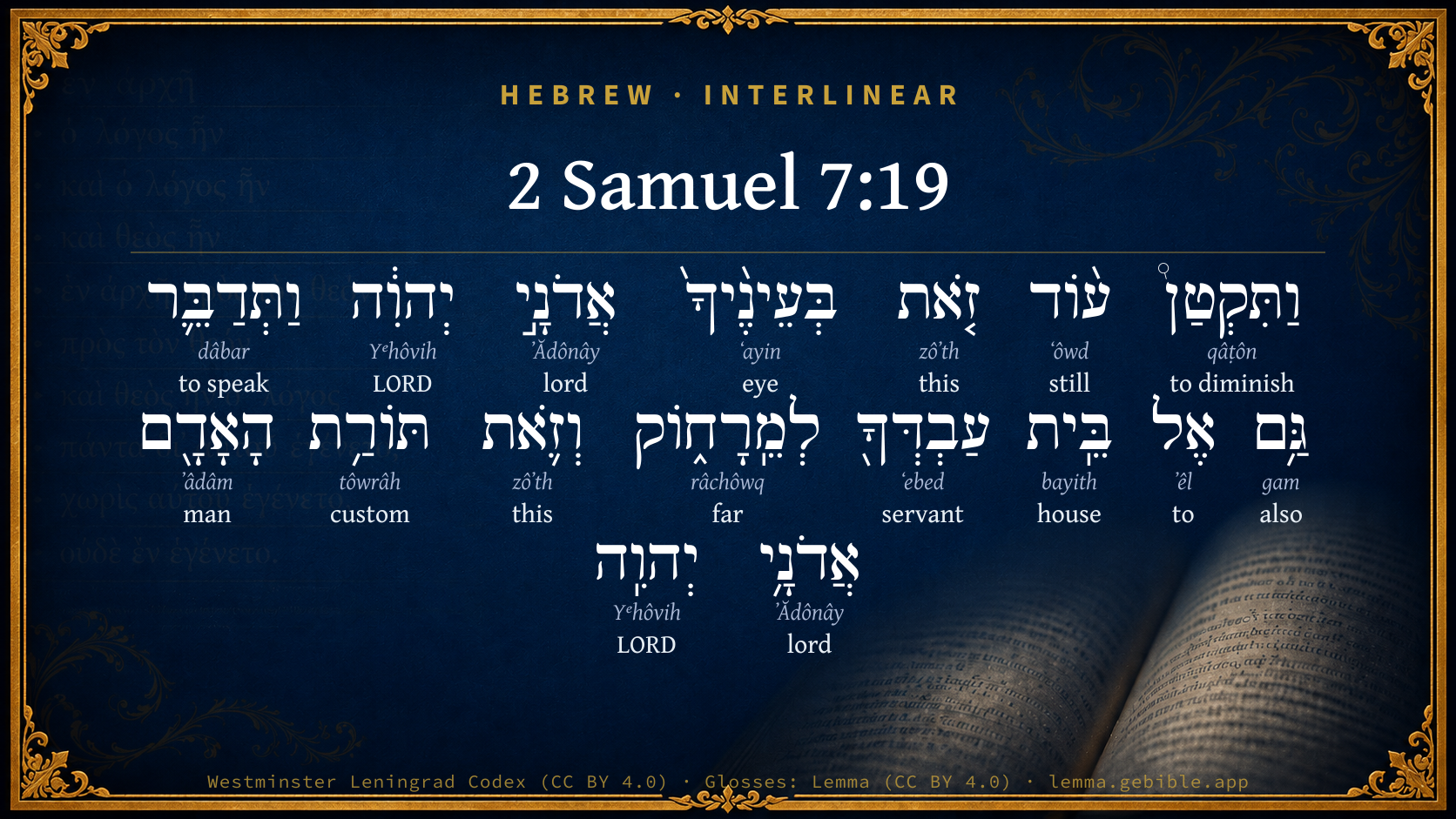
2 Samuel 7:19

Hebrew (Westminster Leningrad Codex) 2 Samuel 7:19 appears in the Hebrew Old Testament. The text above is from the Westminster Leningrad Codex. Each word links to its Strong’s number, a concise gloss, and parsing drawn from the Open Scriptures Hebrew Bible morphology. Click any word for its full Brown-Driver-Briggs (BDB) entry.
Download image
Cite this verse

2 Samuel 7:19 (World English Bible). Public Domain. Lemma interlinear Bible study tool, https://lemma.gebible.app/v/2-samuel/7/19.

Show BibTeX & RIS
BibTeX
RIS
English Translation
This was yet a small thing in your eyes, Lord Yahweh; but you have spoken also of your servant's house for a great while to come; and this [too] after the manner of men, Lord Yahweh!
World English Bible · Public Domain
Highlights
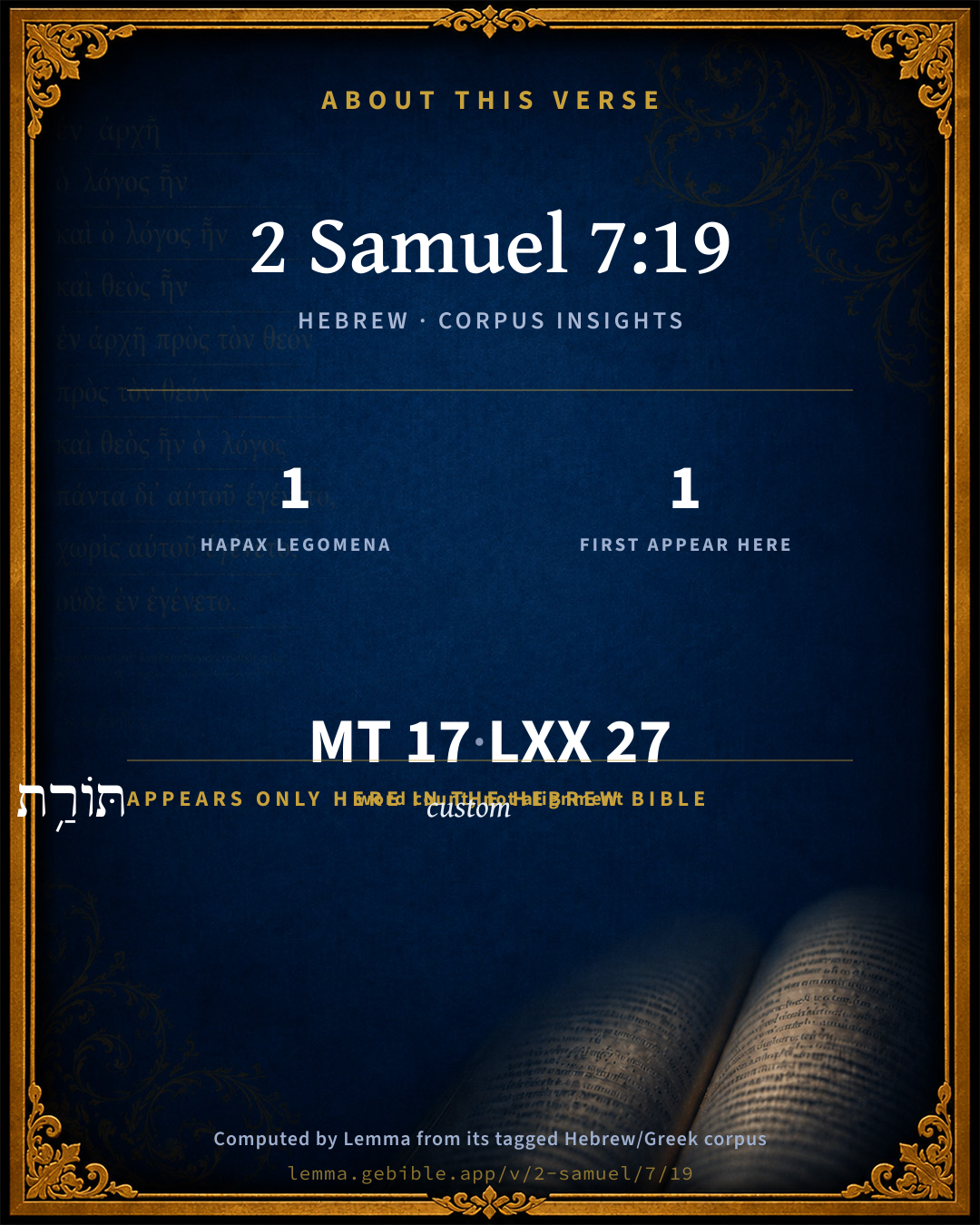
  • 1 hapax legomenon — only here in the Hebrew Bible
  • 1 first appearance in the Hebrew Bible
Full analysis ↓
Download a study sheet

One document with this verse’s original text, its word-by-word gloss line, the meaning frame, cross-references with their text, attributed commentary, and full source and license credits — printable, and it pastes into notes with its structure intact.

This verse Autodidact and up

Study sheet (.html) Plain text (.txt)

A passage Seminary Student

Up to 50 verses in one chapter. A passage sheet keeps up to 6 commentary sources and 12 cross-references per verse, in the order this page ranks them, and says so on the sheet whenever that leaves anything out. Ask for a single verse and you get the Autodidact verse sheet above.

Everything on this page stays free to read, with no account — the sheet is a download of what is already on screen, not access to it.

Want to remove ads? Support Godless Engineer
Compare translations 3

The same verse in 3 English versions, stacked beneath the original-language interlinear above. Click any original word for its lexicon entry.

Each is an independent rendering of the whole verse — the interlinear is not word-aligned to these translations.

Highlighted words mark where these versions differ — a whole-verse word diff, not a word-by-word alignment.

  • World English Bible Public Domain
    This was yet a small thing in your eyes, Lord Yahweh; but you have spoken also of your servant's house for a great while to come; and this [too] after the manner of men, Lord Yahweh!
  • King James Version Public Domain
    And this was yet a small thing in thy sight, O Lord GOD; but thou hast spoken also of thy servant's house for a great while to come. And is this the manner of man, O Lord GOD?
  • unfoldingWord Literal Text CC BY-SA 4.0
    And this was yet small in your eyes, my Lord Yahweh, for you have spoken even about the house of your servant to afar. And this the law of man, my Lord Yahweh!

unfoldingWord Literal Text — © unfoldingWord, licensed CC BY-SA 4.0. Word-aligned USFM3 via Door43 (git.door43.org/unfoldingWord/en_ult).

Versions to compare (up to 4)

3 of 4 selected

Show all 18 translations

Every available English version of this verse, each an independent rendering of the whole verse.

  • World English Bible Public Domain
    This was yet a small thing in your eyes, Lord Yahweh; but you have spoken also of your servant's house for a great while to come; and this [too] after the manner of men, Lord Yahweh!
  • Berean Standard Bible Public Domain
    And as if this was a small thing in Your eyes, O Lord GOD, You have also spoken about the future of the house of Your servant. Is this Your custom with man, O Lord GOD?
  • Majority Standard Bible Public Domain
    And as if this was a small thing in Your eyes, O Lord GOD, You have also spoken about the future of the house of Your servant. Is this Your custom with man, O Lord GOD?
  • King James Version Public Domain
    And this was yet a small thing in thy sight, O Lord GOD; but thou hast spoken also of thy servant's house for a great while to come. And is this the manner of man, O Lord GOD?
  • American Standard Version (1901) Public Domain
    And this was yet a small thing in thine eyes, O Lord Jehovah; but thou hast spoken also of thy servant's house for a great while to come; and this `too' after the manner of men, O Lord Jehovah!
  • Revised Version (1885) Public Domain
    And this was yet a small thing in thine eyes, O Lord GOD; but thou hast spoken also of thy servant’s house for a great while to come; and this too after the manner of men, O Lord GOD!
  • Geneva Bible (1599) Public Domain
    And this was yet a small thing in thy sight, O Lord God, therefore thou hast spoken also of thy seruants house for a great while: but doth this appertaine to man, O Lord God?
  • Douay-Rheims (1899) Public Domain
    But yet this hath seemed little in thy sight, O Lord God, unless thou didst also speak of the house of thy servant for a long time to come: for this is the law of Adam, O Lord God.
  • Young's Literal Translation Public Domain
    And yet this `is' little in Thine eyes, Lord Jehovah, and Thou dost speak also concerning the house of Thy servant afar off; and this `is' the law of the Man, Lord Jehovah.
  • Literal Standard Version CC BY-SA 4.0
    And yet this [is] little in Your eyes, Lord YHWH, and You also speak concerning the house of Your servant far off; and this [is] the law of the man, Lord YHWH.
  • Unlocked Literal Bible CC BY-SA 4.0
    Now this was a small thing in your sight, Lord Yahweh. You have even spoken about your servant's family for a great while to come, and have shown me future generations, Lord Yahweh!
  • unfoldingWord Literal Text CC BY-SA 4.0
    And this was yet small in your eyes, my Lord Yahweh, for you have spoken even about the house of your servant to afar. And this the law of man, my Lord Yahweh!
  • Darby Bible Public Domain
    And yet this hath been a small thing in thy sight, Lord Jehovah; but thou hast spoken also of thy servant's house for a great while to come. And is this the manner of man, Lord Jehovah?
  • World Messianic Bible Public Domain
    This was yet a small thing in your eyes, Lord GOD, but you have spoken also of your servant’s house for a great while to come; and this among men, Lord GOD!
  • Webster's Bible Public Domain
    And this was yet a small thing in thy sight, O Lord GOD; but thou hast spoken also of thy servant's house for a great while to come. And is this the manner of man, O Lord GOD?
  • Free Bible Version CC BY-SA 4.0
    God, you talk as if this was a small thing in your eyes, and you also have spoken about the future of my house, my family dynasty. Is this your usual way of dealing with human beings, Lord God?
  • Bible in Basic English Public Domain
    And this was only a small thing to you, O Lord God; but your words have even been about the far-off future of your servant's family, O Lord God!
  • JPS Tanakh (1917) Public Domain
    And this was yet a small thing in Thine eyes, O Lord GOD; but Thou hast spoken also of Thy servant's house for a great while to come; and this too after the manner of great men, O Lord GOD.

Literal Standard Version (2020), Covenant Press — licensed CC BY-SA 4.0. Text via the HelloAO Bible API (eBible.org). Unlocked Literal Bible (unfoldingWord) — licensed CC BY-SA 4.0. Text via the HelloAO Bible API (eBible.org). unfoldingWord Literal Text — © unfoldingWord, licensed CC BY-SA 4.0. Word-aligned USFM3 via Door43 (git.door43.org/unfoldingWord/en_ult). Free Bible Version, Dr. Jonathan Gallagher — licensed CC BY-SA 4.0. Text via the HelloAO Bible API (eBible.org).

Word by word

More ways to search: Search by grammar → Find every occurrence → Compare this word →

Practice this passage: Drill this verse → Learn its vocabulary →

תּוֹרַ֥ת
tôwrâh
H8452
“custom of”
Noun, Common, Feminine, Singular, Construct
Part of Speech
Noun
Type
Common
Gender
Feminine
Number
Singular
State
Construct
Full BDB Definition

Origin: probably from H8448

TWOT: 910d

custom, manner, mode, law (of man)
  1. וַתִּקְטַן֩ qâṭôn H6994 “and · to diminish” Conjunction + Verb, Qal, Sequential Imperfect, 3rd Person, Feminine, Singular
  2. ע֨וֹד ʻôwd H5750 “still” Adverb
  3. זֹ֤את zôʼth H2063 “this” Pronoun, Demonstrative, Feminine, Singular
  4. בְּעֵינֶ֨יךָ֙ ʻayin H5869 “in/at · eyes · your” Preposition + Noun, Common, Both, Dual, Construct + Suffix, Personal, 2nd Person, Masculine, Singular
  5. אֲדֹנָ֣י ʼĂdônây H136 “Lord · my” Noun, Common, Masculine, Plural, Construct + Suffix, Personal, 1st Person, Common, Singular
  6. יְהוִ֔ה Yᵉhôvih H3069 “LORD” Noun, Proper
  7. וַתְּדַבֵּ֛ר dâbar H1696 “and · to speak” Conjunction + Verb, Piel, Sequential Imperfect, 2nd Person, Masculine, Singular
  8. גַּ֥ם gam H1571 “also” Particle, Accusative
  9. אֶל ʼêl H413 “to” Preposition
  10. בֵּֽית bayith H1004 “house of” Noun, Common, Masculine, Singular, Construct
  11. עַבְדְּךָ֖ ʻebed H5650 “servant · your” Noun, Common, Masculine, Singular, Construct + Suffix, Personal, 2nd Person, Masculine, Singular
  12. לְמֵֽרָח֑וֹק râchôwq H7350 “to/for · from · far” Preposition + Preposition + Adjective, Adjective, Masculine, Singular, Absolute
  13. וְזֹ֛את zôʼth H2063 “and · this” Conjunction + Pronoun, Demonstrative, Feminine, Singular
  14. הָאָדָ֖ם ʼâdâm H120 “the · man” Particle, Definite Article + Noun, Common, Masculine, Singular, Absolute
  15. אֲדֹנָ֥י ʼĂdônây H136 “Lord · my” Noun, Common, Masculine, Plural, Construct + Suffix, Personal, 1st Person, Common, Singular
  16. יְהוִֽה Yᵉhôvih H3069 “LORD” Noun, Proper

About this verse

These counts appear in no published source. They are computed here, from the morphology-tagged text and Lemma’s own curated glosses. What Lemma adds →

17
words
14
distinct lemmas
Historical
section

Notable vocabulary

1 hapax legomenon — a word that appears only here in the entire Hebrew Bible:

  • תּוֹרַ֥ת custom H8452

First appearance in Scripture

This word makes its first canonical appearance in the Hebrew Bible here:

  • תּוֹרַ֥ת custom H8452

Shared distinctive vocabulary

וַתִּקְטַן֩ to diminish H6994 occurs in 4 verses of the Hebrew Bible. Also found in:

Grammatical profile

  • 2 verbs
  • 9 nouns
  • 1 adjective
  • 2 pronouns
  • 1 preposition
  • 1 adverb
  • 1 particle

Verb forms

  • וַתִּקְטַן֩ Qal · Sequential Imperfect
  • וַתְּדַבֵּ֛ר Piel · Sequential Imperfect

Repetition

Words recur within this verse — often emphatic in Hebrew:

  • אֲדֹנָ֣י lord H136 ×2
  • יְהוִ֔ה LORD H3069 ×2
  • זֹ֤את this H2063 ×2

Hebrew & Septuagint length

In English translation the verse runs 36 words from the Hebrew and 38 from the Septuagint (LXX English) — closely comparable.

A rough comparison of the two English renderings, which tokenize alike — not a word-level alignment.

Word counts can differ between the Hebrew and the Greek without any difference in meaning — e.g. the Hebrew direct-object marker אֵת has no separate Greek word, and Greek often adds the article ὁ.

In the original languages it is 17 Hebrew tokens and 27 Greek tokens — but the two are counted differently (Hebrew bundles its prefixes and suffixes into one token; the Greek is in lemma form), so that isn’t a like-for-like length.

Cross-references

9

Topical passages linked to 2 Samuel 7:19 in the Treasury of Scripture Knowledge — connected by theme and wording, ordered by reader-vote popularity; previews shown in the World English Bible.

  • Isaiah 55:8–9 For my thoughts are not your thoughts, neither are your ways my ways, says Yahweh.
  • 1 Chronicles 17:17 This was a small thing in your eyes, God; but you have spoken of your servant's house for a great while to come, and have regarded me according to the estate of a man of high degree, Yahweh God.
  • 2 Samuel 7:11–16 and [as] from the day that I commanded judges to be over my people Israel; and I will cause you to rest from all your enemies. Moreover Yahweh tells you that Yahweh will make you a house.
  • Psalms 36:7 How precious is your loving kindness, God! The children of men take refuge under the shadow of your wings.
  • Numbers 16:9 [seems it but] a small thing to you, that the God of Israel has separated you from the congregation of Israel, to bring you near to himself, to do the service of the tent of Yahweh, and to stand before the congregation to minister to them;
  • Numbers 16:13 is it a small thing that you have brought us up out of a land flowing with milk and honey, to kill us in the wilderness, but you must needs make yourself also a prince over us?
  • 2 Samuel 12:8 I gave you your master's house, and your master's wives into your bosom, and gave you the house of Israel and of Judah; and if that would have been too little, I would have added to you many more such things.
  • Ephesians 2:7 that in the ages to come he might show the exceeding riches of his grace in kindness toward us in Christ Jesus;
  • Ephesians 3:19–20 and to know Christ's love which surpasses knowledge, that you may be filled with all the fullness of God.

Cross-references courtesy of OpenBible.info (CC BY 4.0).

Hebrew and Greek witnesses Masoretic Hebrew ↔ Greek Septuagint

The same verse in the two great witnesses to the Old Testament, shown verse-for-verse.

These are two independent witnesses, not word-aligned to each other, and the Septuagint is shown in lemma (dictionary) form.

Hebrew 2 Samuel 7:19 Masoretic · Westminster Leningrad Codex

וַתִּקְטַן֩ ע֨וֹד זֹ֤את בְּעֵינֶ֨יךָ֙ אֲדֹנָ֣י יְהוִ֔ה וַתְּדַבֵּ֛ר גַּ֥ם אֶל בֵּֽית עַבְדְּךָ֖ לְמֵֽרָח֑וֹק וְזֹ֛את תּוֹרַ֥ת הָאָדָ֖ם אֲדֹנָ֥י יְהוִֽה

This was yet a small thing in your eyes, Lord Yahweh; but you have spoken also of your servant's house for a great while to come; and this [too] after the manner of men, Lord Yahweh!

World English Bible · Public Domain

Greek LXX 2 Samuel 7:19 Septuagint · lemma form

καί κατασμικρύνω μικρός ἐνώπιόν σύ κύριος ἐγώ κύριος καί λαλέω ὑπέρ ὁ οἶκος ὁ δοῦλος σύ εἰς μακρός οὗτος δέ ὁ νόμος ὁ ἄνθρωπος κύριος ἐγώ κύριος

Whereas I was very little before you, O Lord, my Lord, yet you spoke concerning the house of your servant for a long time to to come. And is this the law of man, O Lord, my Lord?

LXX2012 (modern English Septuagint) · Public Domain

Hebrew: Westminster Leningrad Codex (CC BY 4.0). Greek: Septuagint (public domain); English from LXX2012 (modern English Septuagint) (Public Domain). How the Septuagint differs from the Hebrew →

Targum (Aramaic paraphrase)

1

The Targum is the ancient Jewish Aramaic paraphrase of the Hebrew Scriptures — an interpretive translation, not the Hebrew text itself. Onkelos (literal) and Pseudo-Jonathan (expansive) render the Torah, and Jonathan the Prophets. Coverage is partial: where no permissively-licensed English translation exists for a verse, only the Aramaic is shown. This is verse-level text, not a word-by-word alignment to the Hebrew.

  1. Targum Jonathan Prophets (Joshua–Malachi)
    וּזְעֵירַת עוֹד דָא קֳדָמָךְ יְיָ אֱלֹהִים וּמַלֵלְתָּא אַף עַל בֵּית עַבְדָךְ לְעַלְמָא דְאָתֵי וְדָא חַזְיָא לִבְנֵי אֱנָשָׁא יְיָ אֱלֹהִים:

    (no public-domain English translation for this verse)

    Targum Jonathan — Aramaic: “Mikraot Gedolot” (public domain). English: “Sefaria Community Translation” (CC0 1.0 (public-domain dedication)); “London "Chaldee Paraphrase," 1871” (public domain). Text via Sefaria.

Commentary

Notes on 2 Samuel 7:19 from classic Christian and Jewish commentators (each source and its license shown beneath its notes). The classic Christian expositions comment on the surrounding passage and are grouped to its opening verse, so a note may address several verses; the Jewish commentaries on the Tanakh (Rashi and others) are per-verse, so they appear only where the commentator wrote on this verse.

Lemma curates 59 commentaries, every one of them public domain or Creative Commons licensed, each selected and text-cleaned for this edition rather than reprinted as found. About our sources →

Trapp's Complete Commentary

John Trapp

2Sa 7:19 And this was yet a small thing in thy sight, O Lord GOD; but thou hast spoken also of thy servant’s house for a great while to come. And [is] this the manner of man, O Lord GOD?

Ver. 19. And this was yet a small thing in thy sight.] We should make the most of God’s mercies unto us in our thankful acknowledgments, instancing the particulars.

For a great while to come.] In longinquum, for as far as Christ’s time, and to all perpetuity.

And is this the manner of man, O Lord God?] q.d., I think not. Men do not use to deal so liberally with their servants; they think it kindness enough to give them a pension, or some copyhold, {A kind of tenure in England of ancient origin: tenure of lands being parcel of a manor} to maintain them while they live; but take no care for their children after them, or how it shall fare with them in later ages.

John Trapp, A Commentary or Exposition upon All the Books of the Old and New Testament (1647–1656) — public domain. Text from a community e-Sword module.

Joseph Benson's Commentary

2Sa 7:19. This — Which thou hast already done for me, that thou hast brought me hitherto to this pitch of honour, and peace, and prosperity in which, through thy favour, I now stand. Was small — Though it was more than I deserved, or could expect, yet thou didst not think it enough for thee to give to me. A great while — For many future ages, and indeed to all eternity. Is this, &c. — Do men use to deal so kindly with their inferiors as thou hast done with me? No; this is the prerogative of divine grace.

Joseph Benson's Commentary on the Old and New Testaments (1811–1818) — public domain. Text from a community e-Sword module.

Tyndale Open Study Notes

Tyndale Open Resources

7:19 God’s plan to give David a lasting dynasty stretched well beyond his lifetime. The promise is fulfilled forever in the eternal reign of Christ (Rev 11:15).

Tyndale Open Study Notes — © Tyndale Open Resources, licensed CC BY-SA 4.0. Text via the HelloAO Bible API.

Geneva Bible (1599)

Geneva Bible translators

Hebrew, is this the law of man?

Cometh not this rather of thy free mercy, than of any worthiness that can be in man?

Geneva Bible (1599) marginal notes — public domain. Text via Bolls.life.

Jamieson, Fausset & Brown

Robert Jamieson, A. R. Fausset & David Brown

is this the manner of man, O Lord God?--that is, is it customary for men to show such condescension to persons so humble as I am? (See Ch1 17:17.)

Jamieson, Fausset & Brown — Commentary Critical and Explanatory on the Whole Bible (1871) — public domain (CC PDM 1.0). Text via the HelloAO Bible API.

Adam Clarke's Commentary

Verse 19. And is this the manner of man] Literally: And this, O Lord God, is the law of Adam. Does he refer to the promise made to Adam, The seed of the woman shall bruise the head of the serpent? From my line shall the Messiah spring, and be the spiritual and triumphant King, for ever and ever. See the additions at the end. 2Sa 7:25.

Adam Clarke's Commentary on the Bible (1810–1826) — public domain. Text from a community e-Sword/MySword module.

Ellicott's Commentary for English Readers

(19) Is this the manner of man?—This clause is very obscure in the original, and little help in determining its meaning can be had from the ancient versions. The word translated “manner” is a very common one, and never has this sense elsewhere; its well established meaning is law. Neither is there any reason to suppose that a question is intended. Translate, “And this is a law for man!” David expresses his surprise that so great a promise, even a decree of an eternal kingdom, should be given to such as himself and his posterity. The same thought is far less strikingly expressed in the parallel passage (1Ch_17:18), “Thou hast regarded me according to the estate of a man of high degree.”

A Bible Commentary for English Readers, edited by Charles John Ellicott (1878–1897) — public domain. Text from a community e-Sword module.

The Cambridge Bible for Schools and Colleges

gen. ed. J. J. S. Perowne

19. And is this the manner of man] It is best to understand these difficult words as David’s expression of humble astonishment at the greatness of the honour destined for him and his house. Render, And this is a law for men! i.e. this decree that my kingdom shall be established for ever, is to be valid for weak human beings, such as myself and my posterity! Another explanation very commonly adopted is, And this is the manner of man, viz. to speak so familiarly and condescendingly as thou hast done to me; but the Heb. word is used nowhere else in the sense of manner, and the whole context requires a reference to the substance rather than to the manner of the communication.

The reading in 1 Chron. is quite different: “thou hast regarded me according to the estate of a man of high degree.” One or other of the texts is perhaps corrupt.

The Cambridge Bible for Schools and Colleges (gen. ed. J. J. S. Perowne; Cambridge University Press, 1878–1918) — public domain. Text from a community e-Sword module.

John Gill's Exposition

And this was yet a small thing in thy sight, O Lord God,.... This of raising him to the throne, and settling him on it, was but a small thing in comparison of what he promised to do for him and his:

but thou hast spoken also of thy servant's house for a great while to come; since he had not only spoken of a son that should succeed him in the kingdom, but that he would make him an house, and establish his kingdom; yea, that the throne of his kingdom should be established for ever, that a race of kings should spring from him, and especially the King Messiah, of whose kingdom there would be no end; and so the Targum,"thou hast spoken of the house of thy servant unto the world to come,''a phrase often used by the Jews for the times of the Messiah; see Heb 2:5; and so Abarbinel thinks this clause has respect to Messiah the son of David:

and is this the manner of man, O Lord God? to bestow their favours on their inferiors, persons of no worth and merit, and is a profuse manner? it is not; and yet to one so much below thee, and so undeserving, hast thou most largely and liberally given such great and unmerited mercies: or is it the manner, or customary to deal thus with men mean and abject, though it may with great personages that make a great figure in the world? it is not: and yet I am regarded by thee as if I was one of the greatest monarchs on earth: this sense agrees with the parallel text in Ch1 17:17; "and hast regarded me according to the estate of a man of high degree"; or, "this is the law", or "doctrine of the man who is the Lord God" (c). This doctrine contained in the promise now made respects the seed of the woman, the promised Shiloh, the illustrious man, Jehovah's fellow, the incarnate God, the Messiah, who is Jehovah our righteousness, the true God and eternal life.

(c) So Luther and Osiander; or "this is the delineation of the man who is the Lord", &c. So Hiller. Onomastic. Sacr. p. 447.

John Gill's Exposition of the Whole Bible (1746–1763) — public domain (CC PDM 1.0). Text via the HelloAO Bible API.

Albert Barnes' Notes on the Bible

Is this the manner of man - Compare 1Ch 17:17. Our passage may be thus understood: But this is the law (or prerogative) of a great man to found dynasties which are to last into the far future. David expresses his astonishment that he, of such humble birth, and one so little in his own eyes, should not only be raised to the throne, but be assured of the perpetuity of the succession in his descendants, as if he were a man of high degree.

Albert Barnes' Notes on the Bible (1834–1885) — public domain. Text from a community e-Sword/MySword module.

Haydock's Catholic Bible Commentary

God. Thus man wishes to be treated. This maxim prevails universally. People seek for their own and their children’s happiness; a favour which thou hast graciously promised unto me. (Calmet) --- Thus immortality, and all happiness, were proposed unto the first man. (Menochius) --- Some use an interrogation; "Is this the law of Adam?" (Calmet) --- Protestants, "manner of man." Can this felicity attend a man in his fallen state? Does the greatest friend treat his companion with so much condescension and regard? (Haydock) --- In 1 Paralipomenon xvii. 17, it is thus expressed, and hast made me remarkable above all men, O Lord God. Osiander translates, "Behold the law of man, of the Lord God." I now discern the mysterious union of the godhead with our humanity, in the person of the Son. (Calmet) --- Luther attributes this version, Hæc est ratio hominis, qui Daomius Deus est, to Zisgler; and hence proves the incarnation. Amama and Tarnovius shew the weakness of the proof, though the article of faith be otherwise indubitable. (Haydock) --- David is full of admiration that God should treat a weak mortal in such a manner. (Du Hamel)

George Leo Haydock (1774–1849), Haydock's Catholic Family Bible and Commentary, 1859 edition — public domain. Excludes Psalms (Douay-Rheims chapter numbering differs from Protestant) and Deuterocanonical books (Catholic canon only).

Matthew Poole's English Annotations

This, to wit, which thou hast already done for me, as he now said, that thou hast brought me hitherto, i.e. to that pitch of honour, and peace, and prosperity, in which through thy favour I now stand. This was yet a small thing in thy sight; though it was more than I deserved, or could expect, yet thou didst not think it enough for thee to give me.

For a great while to come; for many future ages and indeed to all eternity.

Is this the manner of man, O Lord God? do men use to deal so freely and kindly with their inferiors, as thou hast, done with me? No: this is the prerogative of Divine grace, to give such promises and largesses as this. So these are words of admiration; which very well suit with the foregoing and following words. Or, Is this the manner, or law, or custom, of mean or obscure men, &c, as the Hebrew adam is confessed and sometimes to signify as Psa 49:2; 62:9; Isa 2:9; i.e. Is this the manner of men’s dealing with mean and obscure persons, such as I am? So the Hebrew haadam is the genitive case of the object, which is frequent in the Hebrew and other languages. And this seems more probable, because it exactly agrees with the parallel place, 1Ch 17:17, where the words are, thou hast regarded me according to the estate of a man of high degree, i.e. thou hast dealt with me as if I had been not a poor mean shepherd, but the son of some great monarch, to whom such honours best agree.

Matthew Poole's English Annotations on the Holy Bible (1683–1685) — public domain. Text from a community e-Sword/MySword module.

Whedon's Commentary on the Bible

Daniel D. Whedon

19. For a great while to come — Reference to the for ever of 2Sa_7:13; 2Sa_7:16.

Is this the manner of man — Rather, This is the law of man. This gracious condescension of God in bestowing these promised blessings upon his servant David and his house is a sublime illustration of that law of love which should ever govern man — that law which says, “Thou shalt love thy neighbour as thyself.” Lev_19:18. As God dealt with David in his infinite grace, let man do unto his neighbour according to the ability which he may have. “When God the Lord,” says Hengstenberg, “in his treatment of poor mortals, follows the rule which he has laid down for the conduct of men one towards another — when he shows himself kind and affectionate — this must fill with adoring amazement those who know themselves and God.”

Daniel D. Whedon (gen. ed.), Commentary on the Old and New Testaments (1874–1909) — public domain. Text from a community e-Sword module.

The Pulpit Commentary

And is this the manner of man, O Lord God? Hebrew, and this is the law of man, O Lord Jehovah. In the parallel passage (1Ch_17:17) the Hebrew has, "And thou hast regarded me according to the law of a man of high degree." The rendering of the Authorized Version here, which, by making the clause interrogative, implies a negative, gives absolutely no sense; but some commentators render, "And this is the manner of men, O Lord Jehovah," understanding thereby that God was acting towards David in a human manner, that is, as an earthly friend and benefactor would do. But though the Revised Version favours this rendering, the Hebrew word torah never has this meaning, and, unless, the attempt be made to amend the text, for which the versions give no help, we must take torah in its usual sense, and understand that this continuance of David"s house into the distant future has now become a human law, that is, a divinely constituted ordinance, which must now take its place among the laws which govern human affairs. The words are undoubtedly difficult, and we feel that David was speaking in an ejaculatory manner, in sentences but half expressed, breaking forth from him bit by bit, under the pressure of deep excitement within. We notice too that, while there is no direct reference to the Messiah in David"s words, yet that the Psalms indicate that he did connect the duration of his house with the Messiah"s advent; and this ejaculation may have sprung forth, if not from a fully formed conviction, yet from the feeling that the permanence of his house was for the purpose of a higher kingdom than that of Jerusalem; and so the promise was a "law of man" and the promulgation of a decree which affected the whole human race. This may be the meaning of the Vulgate, which renders "a law of Adam," that is, one embracing within its scope all Adam"s race,

The Pulpit Commentary (1880–1919), ed. H.D.M. Spence-Jones & Joseph S. Exell — public domain. Text from a community e-Sword module.

John Wesley's Explanatory Notes

This - Which thou hast already done for me, that thou hast brought me hitherto, to that pitch of honour, and peace, and prosperity, in which through thy favour I now stand. Was small - Though it was more than I deserved, or could expect, yet thou didst not think it enough for thee to give to me. A great while - For many future ages, and indeed to all eternity. Is this, &c. - Do men use to deal so kindly with their inferiors, as thou hast done with me? No: this is the prerogative of divine grace.

John Wesley, Explanatory Notes Upon the Whole Bible (1754–1765) — public domain. Text via the GEBible commentary corpus.

Rashi

Rabbi Shlomo Yitzchaki (Rashi)

Also, about the house of your servant. To have my son reign after me.

Is this anouncent [fitting] for [mere] man? A wonderment. Is it fitting to announce such to [mere] flesh and blood Another explanation: You have done for me as you did for Odom Horishon that you had shown him the future generations that were to come from him.

Rashi on the Tanakh — English translations: “The Judaica Press complete Tanach with Rashi, translated by A. J. Rosenberg” (CC BY 4.0); “Pentateuch with Rashi's commentary by M. Rosenbaum and A.M. Silbermann, 1929-1934” (public domain); “The Metsudah Tanach series, Lakewood, N.J” (CC BY 4.0); and “The Book of Joshua, Metsudah Publications, 1997” (CC BY 4.0). Text via Sefaria.

Lesson kit

Teaching starters — assembled from the data on this page, not authored interpretation. Every prompt links to the verse data it draws on. Edit before teaching.

2 Samuel, in the Historical, opens this verse with 17 words (14 distinct Hebrew lemmas). Its most distinctive word is tôwrâh (“custom”). A historical commentator’s framing appears above. Read the whole chapter for the surrounding context.

Discussion questions

  1. How does “custom” (tôwrâh) shape what this verse is saying?
  2. This verse holds 1 word here found nowhere else in the Hebrew Bible. What might the rare word draw attention to?
  3. The word “custom” first appears here in Scripture. What is being introduced at this debut?
  4. Genesis 32:10 shares the word «to diminish» with this verse. How do the two illuminate each other?
  5. “lord” occurs 2× in this one verse. What is the effect of the repetition?
  6. These translations render this verse differently; the difference is in the English rendering, not the original. What questions does that raise?
  7. The verb «וַתִּקְטַן֩» is Qal Sequential Imperfect. How does its form color the action?
  8. Reading how Trapp's Complete Commentary and Joseph Benson's Commentary read this verse, where do the two commentators agree and where do they part?

Things to notice

  • 1 word in this verse appears nowhere else in the Hebrew Bible.
  • 1 word makes its first canonical appearance in Scripture here.
  • This verse counts 17 Hebrew ↔ 27 Greek words.
  • These translations choose different wording for 23 words in this verse.
  • “lord” occurs 2× in this single verse.

Reading settings

Reading text

Shown beneath each verse's original-language words.

Old Testament
Old Testament edition

Read the OT as the Masoretic Hebrew (MT) or the Greek Septuagint (LXX).

English shown for the Greek Septuagint (in the Hebrew ↔ Greek comparison).

Comparing translations? Open the Compare panel on any verse page to stack up to four side by side.