
Genesis 29:25

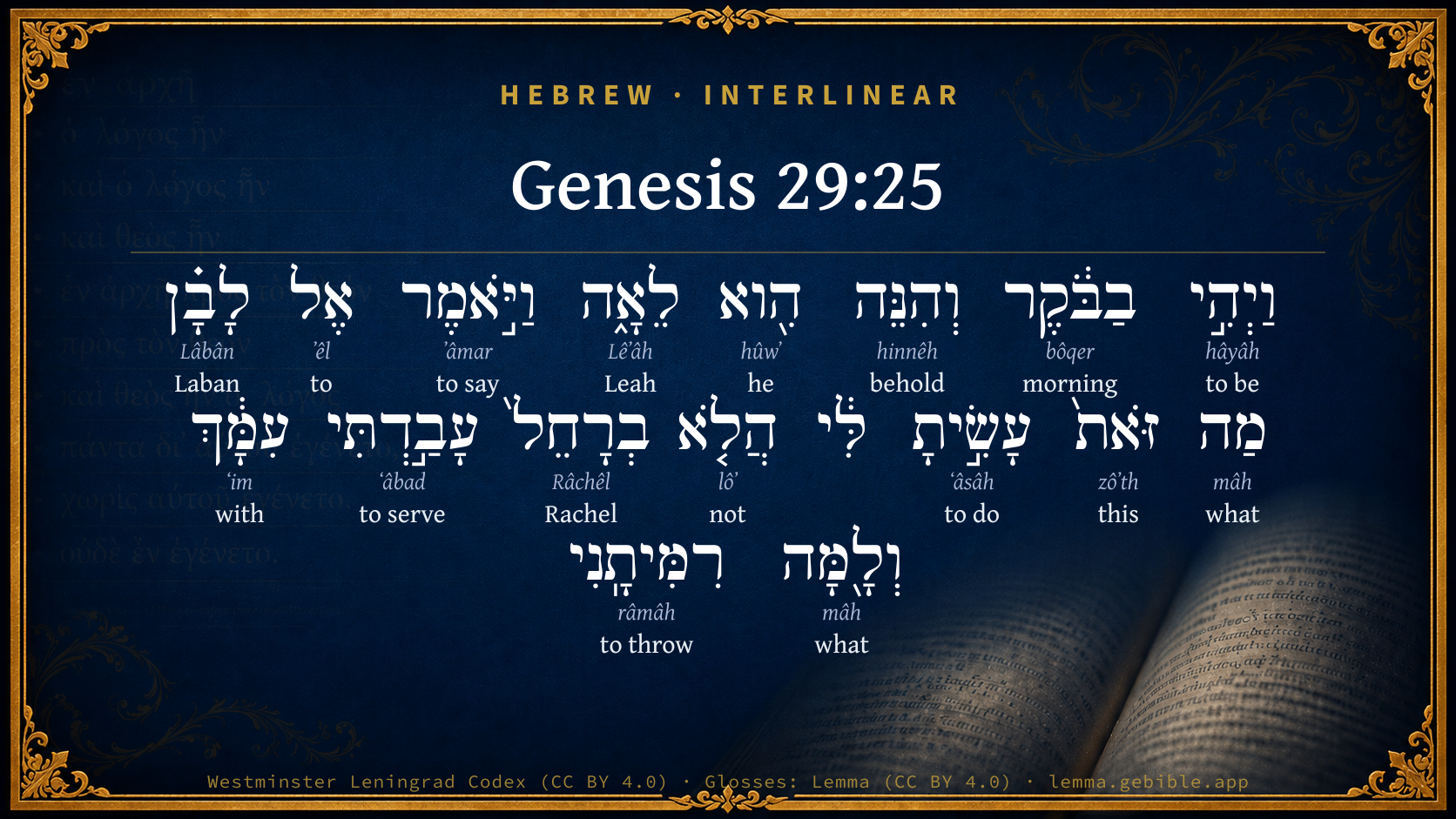
Hebrew (Westminster Leningrad Codex) Genesis 29:25 appears in the Hebrew Old Testament. The text above is from the Westminster Leningrad Codex. Each word links to its Strong’s number, a concise gloss, and parsing drawn from the Open Scriptures Hebrew Bible morphology. Click any word for its full Brown-Driver-Briggs (BDB) entry.
Download image
Cite this verse

Genesis 29:25 (World English Bible). Public Domain. Lemma interlinear Bible study tool, https://lemma.gebible.app/v/genesis/29/25.

Show BibTeX & RIS
BibTeX
RIS
English Translation
It happened in the morning that, behold, it was Leah. He said to Laban, "What is this you have done to me? Didn't I serve with you for Rachel? Why then have you deceived me?"
World English Bible · Public Domain
Highlights
  • 1 first appearance in the Hebrew Bible
Full analysis ↓
Download a study sheet

One document with this verse’s original text, its word-by-word gloss line, the meaning frame, cross-references with their text, attributed commentary, and full source and license credits — printable, and it pastes into notes with its structure intact.

This verse Autodidact and up

Study sheet (.html) Plain text (.txt)

A passage Seminary Student

Up to 50 verses in one chapter. A passage sheet keeps up to 6 commentary sources and 12 cross-references per verse, in the order this page ranks them, and says so on the sheet whenever that leaves anything out. Ask for a single verse and you get the Autodidact verse sheet above.

Everything on this page stays free to read, with no account — the sheet is a download of what is already on screen, not access to it.

Want to remove ads? Support Godless Engineer
Compare translations 3

The same verse in 3 English versions, stacked beneath the original-language interlinear above. Click any original word for its lexicon entry.

Each is an independent rendering of the whole verse — the interlinear is not word-aligned to these translations.

Highlighted words mark where these versions differ — a whole-verse word diff, not a word-by-word alignment.

  • World English Bible Public Domain
    It happened in the morning that, behold, it was Leah. He said to Laban, "What is this you have done to me? Didn't I serve with you for Rachel? Why then have you deceived me?"
  • King James Version Public Domain
    And it came to pass, that in the morning, behold, it was Leah: and he said to Laban, What is this thou hast done unto me? did not I serve with thee for Rachel? wherefore then hast thou beguiled me?
  • unfoldingWord Literal Text CC BY-SA 4.0
    Then it happened in the morning, that behold, she Leah! So he said to Laban, “What this you have done to me? Was not for Rachel that I served with you? So why have you deceived me?”

unfoldingWord Literal Text — © unfoldingWord, licensed CC BY-SA 4.0. Word-aligned USFM3 via Door43 (git.door43.org/unfoldingWord/en_ult).

Versions to compare (up to 4)

3 of 4 selected

Show all 18 translations

Every available English version of this verse, each an independent rendering of the whole verse.

  • World English Bible Public Domain
    It happened in the morning that, behold, it was Leah. He said to Laban, "What is this you have done to me? Didn't I serve with you for Rachel? Why then have you deceived me?"
  • Berean Standard Bible Public Domain
    When morning came, there was Leah! “What have you done to me?” Jacob said to Laban. “Wasn’t it for Rachel that I served you? Why have you deceived me?”
  • Majority Standard Bible Public Domain
    When morning came, there was Leah! “What have you done to me?” Jacob said to Laban. “Wasn’t it for Rachel that I served you? Why have you deceived me?”
  • King James Version Public Domain
    And it came to pass, that in the morning, behold, it was Leah: and he said to Laban, What is this thou hast done unto me? did not I serve with thee for Rachel? wherefore then hast thou beguiled me?
  • American Standard Version (1901) Public Domain
    And it came to pass in the morning that, behold, it was Leah. And he said to Laban, What is this thou hast done unto me? Did not I serve with thee for Rachel? Wherefore then hast thou beguiled me?
  • Revised Version (1885) Public Domain
    And it came to pass in the morning that, behold, it was Leah: and he said to Laban, What is this thou hast done unto me? did not I serve with thee for Rachel? wherefore then hast thou beguiled me?
  • Geneva Bible (1599) Public Domain
    But when the morning was come, behold, it was Leah. Then sayde he to Laban, Wherefore hast thou done thus to mee? did not I serue thee for Rahel? wherfore then hast thou beguiled me?
  • Douay-Rheims (1899) Public Domain
    And he said to his father in law: What is it that thou didst mean to do? did not I serve thee for Rachel? why hast thou deceived me?
  • Young's Literal Translation Public Domain
    And it cometh to pass in the morning, that lo, it `is' Leah; and he saith unto Laban, `What `is' this thou hast done to me? for Rachel have I not served with thee? and why hast thou deceived me?'
  • Literal Standard Version CC BY-SA 4.0
    And it comes to pass in the morning, that behold, it [is] Leah; and he says to Laban, “What [is] this you have done to me? Have I not served with you for Rachel? And why have you deceived me?”
  • Unlocked Literal Bible CC BY-SA 4.0
    In the morning, behold, it was Leah! Jacob said to Laban, “What is this you have done to me? Did I not serve you for Rachel? Why then have you tricked me?”
  • unfoldingWord Literal Text CC BY-SA 4.0
    Then it happened in the morning, that behold, she Leah! So he said to Laban, “What this you have done to me? Was not for Rachel that I served with you? So why have you deceived me?”
  • Darby Bible Public Domain
    And it came to pass in the morning, that behold, it was Leah. And he said to Laban, What is this thou hast done to me? Have I not served thee for Rachel? Why then hast thou deceived me?
  • World Messianic Bible Public Domain
    In the morning, behold, it was Leah! He said to Laban, “What is this you have done to me? Didn’t I serve with you for Rachel? Why then have you deceived me?”
  • Webster's Bible Public Domain
    And it came to pass, that in the morning, behold, it was Leah: and he said to Laban, What is this thou hast done to me? did I not serve with thee for Rachel? why then hast thou deceived me?
  • Free Bible Version CC BY-SA 4.0
    When morning came, he saw it was Leah! He went to Laban and asked angrily, “What have you done to me? It was for Rachel that I worked for you! Why have you deceived me?”
  • Bible in Basic English Public Domain
    And in the morning Jacob saw that it was Leah: and he said to Laban, What have you done to me? was I not working for you so that I might have Rachel? why have you been false to me?
  • JPS Tanakh (1917) Public Domain
    And it came to pass in the morning that, behold, it was Leah; and he said to Laban: 'What is this thou hast done unto me? did not I serve with thee for Rachel? wherefore then hast thou beguiled me?'

Literal Standard Version (2020), Covenant Press — licensed CC BY-SA 4.0. Text via the HelloAO Bible API (eBible.org). Unlocked Literal Bible (unfoldingWord) — licensed CC BY-SA 4.0. Text via the HelloAO Bible API (eBible.org). unfoldingWord Literal Text — © unfoldingWord, licensed CC BY-SA 4.0. Word-aligned USFM3 via Door43 (git.door43.org/unfoldingWord/en_ult). Free Bible Version, Dr. Jonathan Gallagher — licensed CC BY-SA 4.0. Text via the HelloAO Bible API (eBible.org).

Word by word

More ways to search: Search by grammar → Find every occurrence → Compare this word →

Practice this passage: Drill this verse → Learn its vocabulary →

רִמִּיתָֽנִי
râmâh
H7411
“to throw · me”
Verb, Piel, Perfect, 2nd Person, Masculine, Singular + Suffix, Personal, 1st Person, Common, Singular
Part of Speech
Verb
Stem
Piel
Form
Perfect
Person
2nd Person
Gender
Masculine
Number
Singular
Full BDB Definition

Origin: a primitive root

TWOT: 2168 , 2169

to cast, shoot, hurl - (Qal) - to throw - bow-shooters, bowmen (participle) - (Piel) to throw down - to beguile, deceive, mislead, deal treacherously - (Piel) - to beguile, deceive, mislead, trick - to deal treacherously with, betray
  1. וַיְהִ֣י hâyâh H1961 “and · to be” Conjunction + Verb, Qal, Sequential Imperfect, 3rd Person, Masculine, Singular
  2. בַבֹּ֔קֶר bôqer H1242 “in/at the · morning” Preposition, Determined + Noun, Common, Masculine, Singular, Absolute
  3. וְהִנֵּה hinnêh H2009 “and · behold” Conjunction + Particle, Demonstrative
  4. הִ֖וא hûwʼ H1931 “he” Pronoun, Personal, 3rd Person, Feminine, Singular
  5. לֵאָ֑ה Lêʼâh H3812 “Leah” Noun, Proper
  6. וַיֹּ֣אמֶר ʼâmar H559 “and · to say” Conjunction + Verb, Qal, Sequential Imperfect, 3rd Person, Masculine, Singular
  7. אֶל ʼêl H413 “to” Preposition
  8. לָבָ֗ן Lâbân H3837 “Laban” Noun, Proper
  9. מַה mâh H4100 “what” Particle, Interrogative
  10. זֹּאת֙ zôʼth H2063 “this” Pronoun, Demonstrative, Feminine, Singular
  11. עָשִׂ֣יתָ ʻâsâh H6213 “to do” Verb, Qal, Perfect, 2nd Person, Masculine, Singular
  12. הֲלֹ֤א lôʼ H3808 “not” Particle, Interrogative + Particle, Negative
  13. בְרָחֵל֙ Râchêl H7354 “in/at · Rachel” Preposition + Noun, Proper
  14. עָבַ֣דְתִּי ʻâbad H5647 “to serve” Verb, Qal, Perfect, 1st Person, Common, Singular
  15. עִמָּ֔ךְ ʻim H5973 “with · you” Preposition + Suffix, Personal, 2nd Person, Feminine, Singular
  16. וְלָ֖מָּה mâh H4100 “and · to/for · what” Conjunction + Preposition + Particle, Interrogative

About this verse

These counts appear in no published source. They are computed here, from the morphology-tagged text and Lemma’s own curated glosses. What Lemma adds →

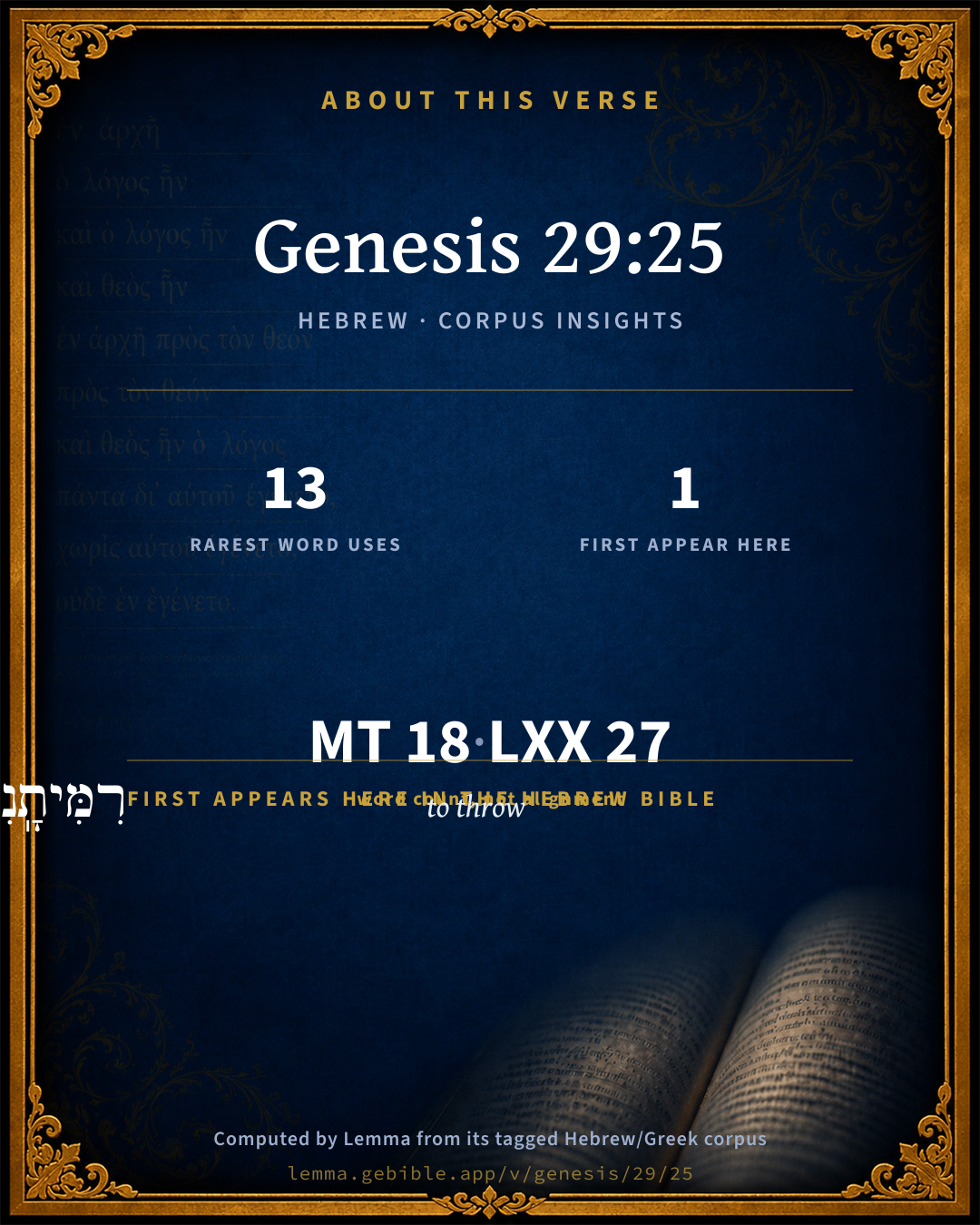
18
words
16
distinct lemmas
Pentateuch
section

Notable vocabulary

The rarest word here is רִמִּיתָֽנִי to throw H7411 — appearing just 13 times in the whole Hebrew Bible.

First appearance in Scripture

This word makes its first canonical appearance in the Hebrew Bible here:

  • רִמִּיתָֽנִי to throw H7411

Shared distinctive vocabulary

רִמִּיתָֽנִי to throw H7411 occurs in 13 verses of the Hebrew Bible. Also found in:

Grammatical profile

  • 5 verbs
  • 4 nouns
  • 2 pronouns
  • 3 prepositions
  • 4 particles

Verb forms

  • וַיְהִ֣י Qal · Sequential Imperfect
  • וַיֹּ֣אמֶר Qal · Sequential Imperfect
  • עָשִׂ֣יתָ Qal · Perfect
  • עָבַ֣דְתִּי Qal · Perfect
  • רִמִּיתָֽנִי Piel · Perfect

Repetition

A word recurs within this verse — often emphatic in Hebrew:

Hebrew & Septuagint length

In English translation the verse runs 35 words from the Hebrew and 36 from the Septuagint (LXX English) — closely comparable.

A rough comparison of the two English renderings, which tokenize alike — not a word-level alignment.

Word counts can differ between the Hebrew and the Greek without any difference in meaning — e.g. the Hebrew direct-object marker אֵת has no separate Greek word, and Greek often adds the article ὁ.

In the original languages it is 18 Hebrew tokens and 27 Greek tokens — but the two are counted differently (Hebrew bundles its prefixes and suffixes into one token; the Greek is in lemma form), so that isn’t a like-for-like length.

Cross-references

9

Topical passages linked to Genesis 29:25 in the Treasury of Scripture Knowledge — connected by theme and wording, ordered by reader-vote popularity; previews shown in the World English Bible.

  • Matthew 7:2 For with whatever judgment you judge, you will be judged; and with whatever measure you measure, it will be measured to you.
  • Proverbs 11:31 Behold, the righteous shall be repaid in the earth; How much more the wicked and the sinner!
  • Genesis 12:18 Pharaoh called Abram, and said, "What is this that you have done to me? Why didn't you tell me that she was your wife?
  • Genesis 27:35–36 He said, "Your brother came with deceit, and has taken away your blessing."
  • Judges 1:7 Adoni-bezek said, "Seventy kings, having their thumbs and their great toes cut off, gathered [their food] under my table: as I have done, so God has requited me." They brought him to Jerusalem, and he died there.
  • 1 Corinthians 3:13 each man's work will be revealed. For the Day will declare it, because it is revealed in fire; and the fire itself will test what sort of work each man's work is.
  • Revelation 3:19 As many as I love, I reprove and chasten. Be zealous therefore, and repent.
  • Matthew 7:12 Therefore whatever you desire for men to do to you, you shall also do to them; for this is the law and the prophets.
  • John 21:17 He said to him the third time, "Simon, son of Jonah, do you have affection for me?" Peter was grieved because he asked him the third time, "Do you have affection for me?" He said to him, "Lord, you know everything. You know that I have affection for you." Jesus said to him, "Feed my sheep.

Cross-references courtesy of OpenBible.info (CC BY 4.0).

Hebrew and Greek witnesses Masoretic Hebrew ↔ Greek Septuagint

The same verse in the two great witnesses to the Old Testament, shown verse-for-verse.

These are two independent witnesses, not word-aligned to each other, and the Septuagint is shown in lemma (dictionary) form.

Hebrew Genesis 29:25 Masoretic · Westminster Leningrad Codex

וַיְהִ֣י בַבֹּ֔קֶר וְהִנֵּה הִ֖וא לֵאָ֑ה וַיֹּ֣אמֶר אֶל לָבָ֗ן מַה זֹּאת֙ עָשִׂ֣יתָ לִּ֔י הֲלֹ֤א בְרָחֵל֙ עָבַ֣דְתִּי עִמָּ֔ךְ וְלָ֖מָּה רִמִּיתָֽנִי

It happened in the morning that, behold, it was Leah. He said to Laban, "What is this you have done to me? Didn't I serve with you for Rachel? Why then have you deceived me?"

World English Bible · Public Domain

Greek LXX Genesis 29:25 Septuagint · lemma form

γίγνομαι δέ πρωΐ καί ἰδού εἰμί λεια εἶπον δέ ἰακώβ ὁ λαβαν τίς οὗτος ποιέω ἐγώ οὐ περί ραχηλ δουλεύω παρά σύ καί ἵνα τίς παραλογίζομαι ἐγώ

And it was morning, and behold it was Lea; and Jacob said to Laban, What is this that you have done to me? did I not serve you for Rachel? and therefore have you deceived me?

LXX2012 (modern English Septuagint) · Public Domain

Hebrew: Westminster Leningrad Codex (CC BY 4.0). Greek: Septuagint (public domain); English from LXX2012 (modern English Septuagint) (Public Domain). How the Septuagint differs from the Hebrew →

Targum (Aramaic paraphrase)

2

The Targum is the ancient Jewish Aramaic paraphrase of the Hebrew Scriptures — an interpretive translation, not the Hebrew text itself. Onkelos (literal) and Pseudo-Jonathan (expansive) render the Torah, and Jonathan the Prophets. Coverage is partial: where no permissively-licensed English translation exists for a verse, only the Aramaic is shown. This is verse-level text, not a word-by-word alignment to the Hebrew.

  1. Targum Onkelos Torah (Genesis–Deuteronomy)
    וַהֲוָה בְצַפְרָא וְהָא הִיא לֵאָה וַאֲמַר לְלָבָן מָה דָּא עֲבַדְתָּ לִּי הֲלָא בְרָחֵל פְּלָחִית עִמָּךְ וּלְמָא שַׁקַּרְתָּ בִּי

    (no public-domain English translation for this verse)

    Targum Onkelos — Aramaic: “Onkelos Genesis” (public domain); “Onkelos Exodus” (public domain); “Onkelos Leviticus” (public domain); “Onkelos Numbers” (public domain); “Onkelos Deuteronomy” (public domain). English: “Sefaria Community Translation” (CC0 1.0 (public-domain dedication)); “J.W. Etheridge. The Targums of Onkelos and Jonathan Ben Uzziel on the Pentateuch. London: Longmans, Green, 1862” (public domain). Text via Sefaria.

  2. Targum Pseudo-Jonathan Torah (Genesis–Deuteronomy)
    וַהֲוָה לְעִידוּנֵי צַפְרָא וְאִסְתַּכֵּל בָּהּ וְהָא הִיא לֵאָה דְכוּלָה לֵילְיָא הֲוָה חָשִׁיב דְרָחֵל הִיא מִן בִּגְלַל דְמָסְרַת לָהּ רָחֵל כָּל מִלַיָא דְמָסַר לָהּ יַעֲקב וְכַד חָמָא כֵּן אָמַר לְלָבָן מַה דָא עָבַדְתְּ לִי הֲלָא בְּגִין רָחֵל פְּלָחִית עִמָךְ וּלְמָא שָׁקַרְתְּ בִּי

    And it was the time of the morning and he saw her, and behold, she was Leah, whom all the night he had thought to be Rahel; because Rahel had delivered to her all the things with which Jakob had presented her. But when he saw this, he said to Laban, what is this that thou hast done to me? Was it not for Rahel that I served with thee? Why hast thou deceived me?

    Targum Pseudo-Jonathan — Aramaic: “Targum Jonathan on Genesis” (public domain); “Targum Jonathan on Exodus” (public domain); “Targum Jonathan on Leviticus” (public domain); “Targum Jonathan on Numbers” (public domain); “Targum Jonathan on Deuteronomy” (public domain). English: “The Targum of Jonathan ben Uzziel, trans. J. W. Etheridge, London, 1862” (public domain). Text via Sefaria.

Commentary

Notes on Genesis 29:25 from classic Christian and Jewish commentators (each source and its license shown beneath its notes). The classic Christian expositions comment on the surrounding passage and are grouped to its opening verse, so a note may address several verses; the Jewish commentaries on the Tanakh (Rashi and others) are per-verse, so they appear only where the commentator wrote on this verse.

Lemma curates 59 commentaries, every one of them public domain or Creative Commons licensed, each selected and text-cleaned for this edition rather than reprinted as found. About our sources →

Trapp's Complete Commentary

John Trapp

Gen 29:25 And it came to pass, that in the morning, behold, it [was] Leah: and he said to Laban, What [is] this thou hast done unto me? did not I serve with thee for Rachel? wherefore then hast thou beguiled me?

Ver. 25. In the morning, behold, it was Leah.] A foul disappointment: but so the world ever serves us. The Hebrews have taken up this passage for a proverb, when a man’s hopes are deceived in a wife, or anything else, wherein he looked for content and comfort.

John Trapp, A Commentary or Exposition upon All the Books of the Old and New Testament (1647–1656) — public domain. Text from a community e-Sword module.

John Calvin's Commentaries

25. And he said to Laban. Jacob rightly expostulates respecting the fraud practiced upon him. And the answer of Laban, though it is not without a pretext, yet forms no excuse for the fraud. It was not the custom to give the younger daughters in marriage before the elder: and injustice would have been done to the firstborn by disturbing this accustomed order. But he ought not, on that account, craftily to have betrothed Rachel to Jacob, and then to have substituted Leah in her place. He should rather have cautioned Jacob himself, in time, to turn his thoughts to Leah, or else to refrain from marriage with either of them. But we may learn from this, that wicked and deceitful men, when once they have turned aside from truth, make no end of transgressing: meanwhile, they always put forward some pretext for the purpose of freeing themselves from blame. He had before acted unjustly toward his nephew in demanding seven years’ labor for his daughter; he had also unjustly set his daughter to sale, without dowry, for the sake of gain; but the most unworthy deed of all was perfidiously to deprive his nephew of his betrothed wife, to pervert the sacred laws of marriage, and to leave nothing safe or sound. Yet we see him pretending that he has an honorable defense for his conduct, because it was not the custom of the country to prefer the younger to the elder.

John Calvin's Commentaries (1540-1563) — public domain. Text from the Calvin Translation Society English edition (1840s-50s) via the Christian Classics Ethereal Library (ccel.org). Calvin's coverage is partial (roughly two-thirds of the Bible); uncommented books and verses are honest gaps, never fabricated. The 19th-century editor's footnotes and remarks are omitted so the notes are faithfully Calvin's own voice.

The Cambridge Bible for Schools and Colleges

gen. ed. J. J. S. Perowne

25. beguiled] i.e. “deceived,” as Jos_9:22; but a different word in the Hebrew from that in Gen_3:13. Laban had succeeded in astutely bestowing his less attractive daughter in marriage.

The Cambridge Bible for Schools and Colleges (gen. ed. J. J. S. Perowne; Cambridge University Press, 1878–1918) — public domain. Text from a community e-Sword module.

John Gill's Exposition

And it came to pass, that, in the morning, behold, it was Leah,.... The morning light discovered her, and her veil being off, her tender eyes showed who she was: it is much her voice had not betrayed her; but perhaps there might be a likeness of voice in her and her sister; or she might keep silence, and so not be discovered in that way; but to excuse her from sin is not easy, even the sin of adultery and incest. Manythings may be said indeed in her favour, as obedience to her father, and, being the eldest daughter, might be desirous of having an husband first, and especially of having the promised seed, which God promised to Abraham, and was to be in the line of Jacob: and it may be, as Schmidt observes, that Laban had persuaded her to believe, that the matrimonial contract he had made with Jacob was on her account, and that she was truly his spouse; and the same he might say to Rachel, which made her easy, or otherwise it is difficult to account for it that she should acquiesce in it; for it can hardly be thought to be done without her knowledge, when it was for the solemnity of her marriage that the men of the city were called together, and a feast made for them; for that she should deliver up to her sister the things or signs that Jacob had given her to carry on the fraud, as the Jewish writers (r) say, is beyond belief:

and he said to Laban; when he arose in the morning, and at first meeting with him:

what is this that thou hast done unto me? what a wicked thing is it? as it was, to put another woman to bed to him that was not his wife, and in the room of his lawful wife; or why hast thou done this to me? what reason was there for it? what have I done, that could induce thee to do me such an injury? for Jacob knew what he had done, of that he does not inquire, but of the reason of it, and expostulates with him about the crime, as it was a sin against God, and an injury to him:

did I not serve thee, for Rachel? even seven years, according to agreement? was not this the covenant I made with thee, that she should be my wife at the end of them?

wherefore then hast thou beguiled me? by giving Leah instead of her: though Laban is not to be justified in this action, yet here appears in Providence a righteous retaliation of Jacob; he beguiled his own father, pretending he was his brother Esau; and now his father-in-law beguiles him, giving him blear eyed Leah instead of beautiful Rachel.

(r) Targum Jon. & Jarchi in loc.

John Gill's Exposition of the Whole Bible (1746–1763) — public domain (CC PDM 1.0). Text via the HelloAO Bible API.

Matthew Poole's English Annotations

Though Laban could not solidly answer the question, yet Jacob could do it, and had just cause to reflect upon his own former action of beguiling his father; for which God had now punished him in the same kind.

Matthew Poole's English Annotations on the Holy Bible (1683–1685) — public domain. Text from a community e-Sword/MySword module.

Whedon's Commentary on the Bible

Daniel D. Whedon

25. Thou beguiled me — Jacob now feels the weight and bitterness of deception. But it is a retribution for his own supplanting and defrauding of Esau.

Daniel D. Whedon (gen. ed.), Commentary on the Old and New Testaments (1874–1909) — public domain. Text from a community e-Sword module.

The Pulpit Commentary

And it came to pass, that in the morning, Behold, it was Leah. If Jacob"s deception, even with the veiled bride, may still be difficult to understand, it is easy to perceive in Leah"s substitution for Rachel a clear instance of Divine retribution for the imposition he had practiced on his father. So the Lord oftentimes rewards evil-doers according to their wickedness (cf. 2Sa_12:10-12) And he said to Laban (who, Calvin conjectures, had given Jacob a splendid entertainment the night before to make him say nothing about the fraud), What is this thou hast done unto me? did not I serve with thee for Rachel? wherefore then hast thou beguiled me? It says much for Jacob that he did not seek to repudiate the marriage. Perhaps he saw the hand of God in what had happened, and probably considered that though he had chosen Rachel, God had selected Leah as his wife. If so, it must be set to Jacob"s credit that at the call of God, thus providentially addressed to him, he was prepared to sacrifice his best affections to the claims of religion and duty. It is not Jacob, but Laban, who proposes that he should also marry Rachel.

The Pulpit Commentary (1880–1919), ed. H.D.M. Spence-Jones & Joseph S. Exell — public domain. Text from a community e-Sword module.

John Wesley's Explanatory Notes

Behold it was Leah - Jacob had cheated his own father when he pretended to be Esau, and now his father-in-law cheated him. Herein, how unrighteous soever Laban was, the Lord was righteous.

John Wesley, Explanatory Notes Upon the Whole Bible (1754–1765) — public domain. Text via the GEBible commentary corpus.

Keil & Delitzsch

C. F. Keil & F. Delitzsch

But when Jacob complained to Laban the next morning of his deception, he pleaded the custom of the country: כּן יעשׂה לא, "it is not accustomed to be so in our place, to give the younger before the first-born." A perfectly worthless excuse; for if this had really been the custom in Haran as in ancient India and elsewhere, he ought to have told Jacob of it before. But to satisfy Jacob, he promised him that in a week he would give him the younger also, if he would serve him seven years longer for her.

Keil & Delitzsch — Biblical Commentary on the Old Testament (1861–1891) — public domain (CC PDM 1.0). Text via the HelloAO Bible API. (Old Testament only.)

Rashi

Rabbi Shlomo Yitzchaki (Rashi)

ויהי בבקר והנה הוא לאה AND IT CAME TO PASS, THAT IN THE MORNING, BEHOLD, IT WAS LEAH —But at night it was not Leah (i. e. he failed to recognise that it was Leah) because Jacob had given Rachel certain secret signs by which they could at all times recognise one another, and when Rachel saw that they were about to bring Leah to him for the marriage ceremony, she thought, “My sister may now be put to shame”, and she therefore readily transmitted these signs to her (Megillah 13b).

Rashi on the Tanakh — English translations: “The Judaica Press complete Tanach with Rashi, translated by A. J. Rosenberg” (CC BY 4.0); “Pentateuch with Rashi's commentary by M. Rosenbaum and A.M. Silbermann, 1929-1934” (public domain); “The Metsudah Tanach series, Lakewood, N.J” (CC BY 4.0); and “The Book of Joshua, Metsudah Publications, 1997” (CC BY 4.0). Text via Sefaria.

Radak

Rabbi David Kimhi (Radak)

ויהי בבוקר והנה היא לאה, for he had not recognised her until morning as we explained. The aggadic explanation mentioned by Rashi that Rachel had given her sister Leah the codeword which she and Yaakov had agreed should serve to preclude such a swap is well known.

Radak on the Tanakh — English translations: “Sefaria Community Translation” (CC0 1.0 (public-domain dedication)); “Eliyahu Munk, HaChut Hameshulash” (CC BY 4.0); “Rabbi Mike Feuer, Jerusalem Anthology” (CC BY 4.0); and “R. David Kimhi on the first book of Psalms, Translated by R.G. Finch, London, 1919” (public domain). Text via Sefaria.

Lesson kit

Teaching starters — assembled from the data on this page, not authored interpretation. Every prompt links to the verse data it draws on. Edit before teaching.

Genesis, in the Pentateuch, opens this verse with 18 words (16 distinct Hebrew lemmas). Its most distinctive word is râmâh (“to throw”). A historical commentator’s framing appears above. Read the whole chapter for the surrounding context.

Discussion questions

  1. How does “to throw” (râmâh) shape what this verse is saying?
  2. The word “to throw” first appears here in Scripture. What is being introduced at this debut?
  3. Exodus 15:1 shares the word «to throw» with this verse. How do the two illuminate each other?
  4. “what” occurs 2× in this one verse. What is the effect of the repetition?
  5. These translations render this verse differently. What is at stake in choosing one wording over another?
  6. The verb «וַיְהִ֣י» is Qal Sequential Imperfect. How does its form color the action?
  7. Reading how Trapp's Complete Commentary and John Calvin's Commentaries read this verse, where do the two commentators agree and where do they part?

Things to notice

Reading settings

Reading text

Shown beneath each verse's original-language words.

Old Testament
Old Testament edition

Read the OT as the Masoretic Hebrew (MT) or the Greek Septuagint (LXX).

English shown for the Greek Septuagint (in the Hebrew ↔ Greek comparison).

Comparing translations? Open the Compare panel on any verse page to stack up to four side by side.