
Numbers 16:6

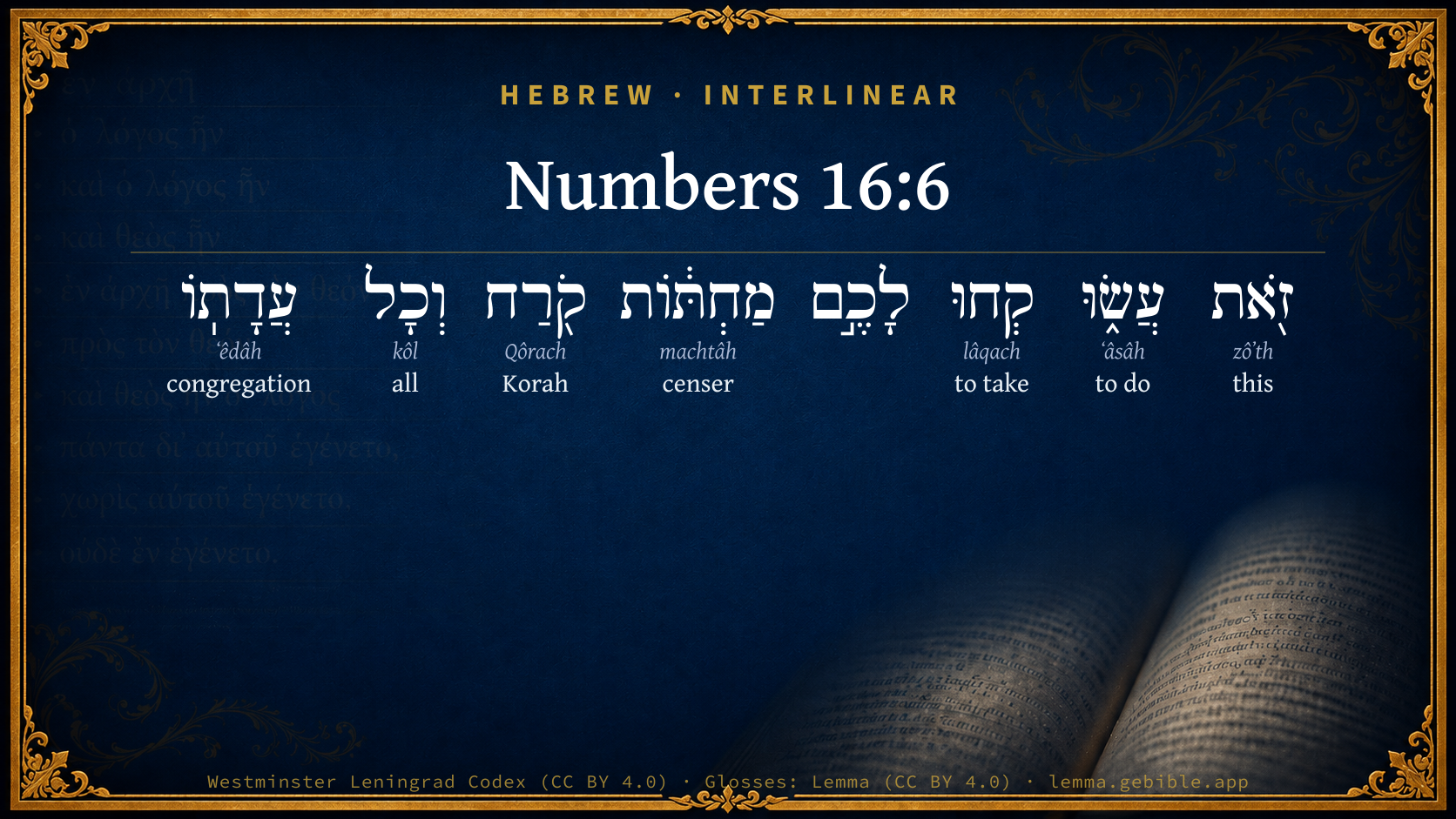
Hebrew (Westminster Leningrad Codex) Numbers 16:6 appears in the Hebrew Old Testament. The text above is from the Westminster Leningrad Codex. Each word links to its Strong’s number, a concise gloss, and parsing drawn from the Open Scriptures Hebrew Bible morphology. Click any word for its full Brown-Driver-Briggs (BDB) entry.
Download image
Cite this verse

Numbers 16:6 (World English Bible). Public Domain. Lemma interlinear Bible study tool, https://lemma.gebible.app/v/numbers/16/6.

Show BibTeX & RIS
BibTeX
RIS
English Translation
This do: take you censers, Korah, and all his company;
World English Bible · Public Domain
Download a study sheet

One document with this verse’s original text, its word-by-word gloss line, the meaning frame, cross-references with their text, attributed commentary, and full source and license credits — printable, and it pastes into notes with its structure intact.

This verse Autodidact and up

Study sheet (.html) Plain text (.txt)

A passage Seminary Student

Up to 50 verses in one chapter. A passage sheet keeps up to 6 commentary sources and 12 cross-references per verse, in the order this page ranks them, and says so on the sheet whenever that leaves anything out. Ask for a single verse and you get the Autodidact verse sheet above.

Everything on this page stays free to read, with no account — the sheet is a download of what is already on screen, not access to it.

Want to remove ads? Support Godless Engineer
Compare translations 3

The same verse in 3 English versions, stacked beneath the original-language interlinear above. Click any original word for its lexicon entry.

Each is an independent rendering of the whole verse — the interlinear is not word-aligned to these translations.

Highlighted words mark where these versions differ — a whole-verse word diff, not a word-by-word alignment.

  • World English Bible Public Domain
    This do: take you censers, Korah, and all his company;
  • King James Version Public Domain
    This do; Take you censers, Korah, and all his company;
  • unfoldingWord Literal Text CC BY-SA 4.0
    Do this: take for you censers, Korah and all his congregation,

unfoldingWord Literal Text — © unfoldingWord, licensed CC BY-SA 4.0. Word-aligned USFM3 via Door43 (git.door43.org/unfoldingWord/en_ult).

Versions to compare (up to 4)

3 of 4 selected

Show all 18 translations

Every available English version of this verse, each an independent rendering of the whole verse.

  • World English Bible Public Domain
    This do: take you censers, Korah, and all his company;
  • Berean Standard Bible Public Domain
    You, Korah, and all your followers are to do as follows: Take censers,
  • Majority Standard Bible Public Domain
    You, Korah, and all your followers are to do as follows: Take censers,
  • King James Version Public Domain
    This do; Take you censers, Korah, and all his company;
  • American Standard Version (1901) Public Domain
    This do: take you censers, Korah, and all his company;
  • Revised Version (1885) Public Domain
    This do; take you censers, Korah, and all his company;
  • Geneva Bible (1599) Public Domain
    This doe therefore, Take you censers, both Korah, and all his companie,
  • Douay-Rheims (1899) Public Domain
    Do this therefore: Take every man of you your censers, thou Core, and all thy company.
  • Young's Literal Translation Public Domain
    This do: take to yourselves censers, Korah, and all his company,
  • Literal Standard Version CC BY-SA 4.0
    Do this: take censers for yourselves—Korah and all his company—
  • Unlocked Literal Bible CC BY-SA 4.0
    Do this, Korah and all your group. Take censers
  • unfoldingWord Literal Text CC BY-SA 4.0
    Do this: take for you censers, Korah and all his congregation,
  • Darby Bible Public Domain
    This do: take you censers, Korah, and all his band,
  • World Messianic Bible Public Domain
    Do this: have Korah and all his company take censers,
  • Webster's Bible Public Domain
    This do; Take you censers, Korah, and all his company;
  • Free Bible Version CC BY-SA 4.0
    This is what you, Korah, and everyone with you are going to do. Take some incense burners,
  • Bible in Basic English Public Domain
    So do this: let Korah and all his band take vessels for burning perfumes;
  • JPS Tanakh (1917) Public Domain
    This do: take you censors, Korah, and all his company;

Literal Standard Version (2020), Covenant Press — licensed CC BY-SA 4.0. Text via the HelloAO Bible API (eBible.org). Unlocked Literal Bible (unfoldingWord) — licensed CC BY-SA 4.0. Text via the HelloAO Bible API (eBible.org). unfoldingWord Literal Text — © unfoldingWord, licensed CC BY-SA 4.0. Word-aligned USFM3 via Door43 (git.door43.org/unfoldingWord/en_ult). Free Bible Version, Dr. Jonathan Gallagher — licensed CC BY-SA 4.0. Text via the HelloAO Bible API (eBible.org).

Word by word

More ways to search: Search by grammar → Find every occurrence → Compare this word →

Practice this passage: Drill this verse → Learn its vocabulary →

About this verse

These counts appear in no published source. They are computed here, from the morphology-tagged text and Lemma’s own curated glosses. What Lemma adds →

8
words
7
distinct lemmas
Pentateuch
section

Notable vocabulary

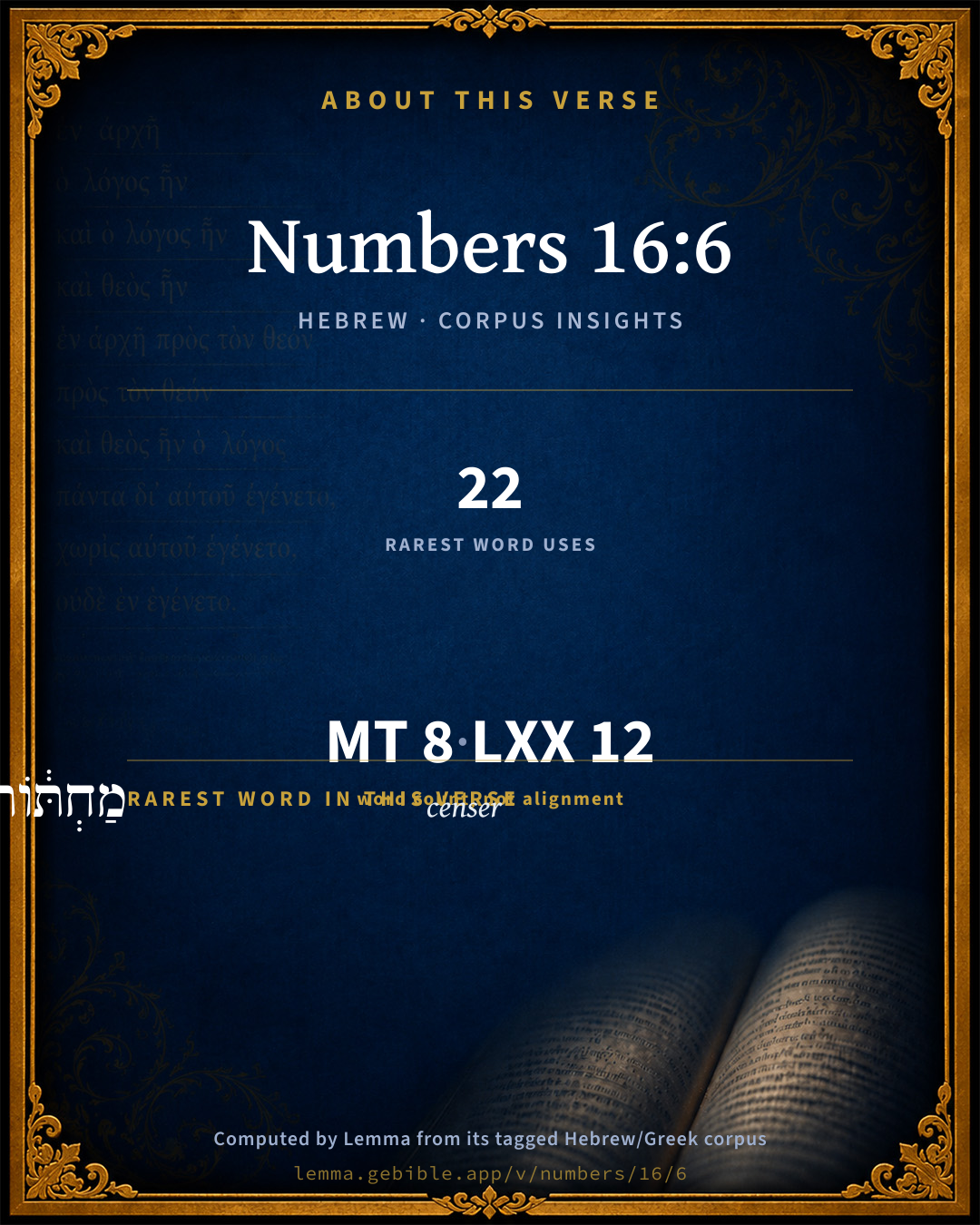
The rarest word here is מַחְתּ֔וֹת censer H4289 — appearing just 22 times in the whole Hebrew Bible.

Shared distinctive vocabulary

מַחְתּ֔וֹת censer H4289 occurs in 19 verses of the Hebrew Bible. Also found in:

Grammatical profile

  • 2 verbs
  • 4 nouns
  • 1 pronoun
  • 1 preposition

Verb forms

  • עֲשׂ֑וּ Qal · Imperative
  • קְחוּ Qal · Imperative

Hebrew & Septuagint length

In English translation the verse runs 10 words from the Hebrew and 12 from the Septuagint (LXX English) — closely comparable.

A rough comparison of the two English renderings, which tokenize alike — not a word-level alignment.

Word counts can differ between the Hebrew and the Greek without any difference in meaning — e.g. the Hebrew direct-object marker אֵת has no separate Greek word, and Greek often adds the article ὁ.

In the original languages it is 8 Hebrew tokens and 12 Greek tokens — but the two are counted differently (Hebrew bundles its prefixes and suffixes into one token; the Greek is in lemma form), so that isn’t a like-for-like length.

Cross-references

5

Topical passages linked to Numbers 16:6 in the Treasury of Scripture Knowledge — connected by theme and wording, ordered by reader-vote popularity; previews shown in the World English Bible.

  • Leviticus 10:1 Nadab and Abihu, the sons of Aaron, each took his censer, and put fire in it, and laid incense on it, and offered strange fire before Yahweh, which he had not commanded them.
  • Leviticus 16:12–13 He shall take a censer full of coals of fire from off the altar before Yahweh, and two handfuls of sweet incense beaten small, and bring it within the veil:
  • Numbers 16:35–40 Fire came forth from Yahweh, and devoured the two hundred fifty men who offered the incense.
  • Numbers 16:46–48 Moses said to Aaron, Take your censer, and put fire therein from off the altar, and lay incense thereon, and carry it quickly to the congregation, and make atonement for them: for there is wrath gone out from Yahweh; the plague is begun.
  • 1 Kings 18:21–23 Elijah came near to all the people, and said, "How long will you waver between the two sides? If Yahweh is God, follow him; but if Baal, then follow him." The people answered him not a word.

Cross-references courtesy of OpenBible.info (CC BY 4.0).

Hebrew and Greek witnesses Masoretic Hebrew ↔ Greek Septuagint

The same verse in the two great witnesses to the Old Testament, shown verse-for-verse.

These are two independent witnesses, not word-aligned to each other, and the Septuagint is shown in lemma (dictionary) form.

Hebrew Numbers 16:6 Masoretic · Westminster Leningrad Codex

זֹ֖את עֲשׂ֑וּ קְחוּ לָכֶ֣ם מַחְתּ֔וֹת קֹ֖רַח וְכָל עֲדָתֽוֹ

This do: take you censers, Korah, and all his company;

World English Bible · Public Domain

Greek LXX Numbers 16:6 Septuagint · lemma form

οὗτος ποιέω λαμβάνω σύ αὐτός πυρεῖον κορε καί πᾶς ὁ συναγωγή αὐτός

This do you⌃: take to yourselves censers, Core and all his company;

LXX2012 (modern English Septuagint) · Public Domain

On this verse, The Pulpit Commentary discusses the Septuagint’s reading. Read the note in Commentary ↓

Hebrew: Westminster Leningrad Codex (CC BY 4.0). Greek: Septuagint (public domain); English from LXX2012 (modern English Septuagint) (Public Domain). How the Septuagint differs from the Hebrew →

Targum (Aramaic paraphrase)

2

The Targum is the ancient Jewish Aramaic paraphrase of the Hebrew Scriptures — an interpretive translation, not the Hebrew text itself. Onkelos (literal) and Pseudo-Jonathan (expansive) render the Torah, and Jonathan the Prophets. Coverage is partial: where no permissively-licensed English translation exists for a verse, only the Aramaic is shown. This is verse-level text, not a word-by-word alignment to the Hebrew.

  1. Targum Onkelos Torah (Genesis–Deuteronomy)
    דָא עַבִידוּ סָבוּ לְכוֹן מַחְתְּיָן קֹרַח וְכָל כְּנִשְׁתֵּהּ

    (no public-domain English translation for this verse)

    Targum Onkelos — Aramaic: “Onkelos Genesis” (public domain); “Onkelos Exodus” (public domain); “Onkelos Leviticus” (public domain); “Onkelos Numbers” (public domain); “Onkelos Deuteronomy” (public domain). English: “Sefaria Community Translation” (CC0 1.0 (public-domain dedication)); “J.W. Etheridge. The Targums of Onkelos and Jonathan Ben Uzziel on the Pentateuch. London: Longmans, Green, 1862” (public domain). Text via Sefaria.

  2. Targum Pseudo-Jonathan Torah (Genesis–Deuteronomy)
    דָא עִיבִידוּ סָבוּ לְכוֹן מַחְתְּיַין קרַח וְכָל כְּנִישַׁת סַעֲדוֹי

    Do this: Let Korach and all the company of his helpers take censers,

    Targum Pseudo-Jonathan — Aramaic: “Targum Jonathan on Genesis” (public domain); “Targum Jonathan on Exodus” (public domain); “Targum Jonathan on Leviticus” (public domain); “Targum Jonathan on Numbers” (public domain); “Targum Jonathan on Deuteronomy” (public domain). English: “The Targum of Jonathan ben Uzziel, trans. J. W. Etheridge, London, 1862” (public domain). Text via Sefaria.

Commentary

Notes on Numbers 16:6 from classic Christian and Jewish commentators (each source and its license shown beneath its notes). The classic Christian expositions comment on the surrounding passage and are grouped to its opening verse, so a note may address several verses; the Jewish commentaries on the Tanakh (Rashi and others) are per-verse, so they appear only where the commentator wrote on this verse.

Lemma curates 59 commentaries, every one of them public domain or Creative Commons licensed, each selected and text-cleaned for this edition rather than reprinted as found. About our sources →

Tyndale Open Study Notes

Tyndale Open Resources

16:6 prepare your incense burners: Korah and his company were to act like priests by burning incense (as in Lev 16:11-13); God would decide who was legitimate.

Tyndale Open Study Notes — © Tyndale Open Resources, licensed CC BY-SA 4.0. Text via the HelloAO Bible API.

Jamieson, Fausset & Brown

Robert Jamieson, A. R. Fausset & David Brown

Take your censers, Korah, and all his company, &c.--that is, since you aspire to the priesthood, then go, perform the highest function of the office--that of offering incense; and if you are accepted well. How magnanimous the conduct of Moses, who was now as willing that God's people should be priests, as formerly that they should be prophets (Num 11:29). But he warned them that they were making a perilous experiment.

Jamieson, Fausset & Brown — Commentary Critical and Explanatory on the Whole Bible (1871) — public domain (CC PDM 1.0). Text via the HelloAO Bible API.

Ellicott's Commentary for English Readers

(6) Take you censers.—The offering of incense was the peculiar prerogative and the holiest function of the priesthood. The destruction of Nadab and Abihu ought to have served as a warning to Korah and his company not to provoke a similar exhibition of the Divine displeasure.

A Bible Commentary for English Readers, edited by Charles John Ellicott (1878–1897) — public domain. Text from a community e-Sword module.

The Cambridge Bible for Schools and Colleges

gen. ed. J. J. S. Perowne

6. censers] fire-pans. So R.V. in Exo_27:3. An instrument for carrying burning coals. These fire-pans were not the sacred utensils of the Tabernacle, which would never be taken out of the Tabernacle precincts, but the private property of the 250 men; see on Num_16:37.

6, 7. Korah and his followers are challenged to test their claim to equality with the Levites (represented by Moses and Aaron) by undergoing a species of ordeal, viz. to perform a sacred priestly function and see what will happen.

The Cambridge Bible for Schools and Colleges (gen. ed. J. J. S. Perowne; Cambridge University Press, 1878–1918) — public domain. Text from a community e-Sword module.

John Gill's Exposition

This do, take you censers,.... Vessels to put incense in to offer, which was the business of the priests:

Korah, and all his company; the two hundred fifty princes that were with him, for so many we read took censers, and offered incense, Num 16:18.

John Gill's Exposition of the Whole Bible (1746–1763) — public domain (CC PDM 1.0). Text via the HelloAO Bible API.

Haydock's Catholic Bible Commentary

Censers. It was not lawful for the Levites to offer incense: but they had prepared for themselves the ensigns of the priestly power, and Moses permits them to try their success. (Haydock) --- They might have brought the censers, or broad plates, bowls, or vials, (Apocalypse v. 8,) out of Egypt, where every family offers incense to their domestic gods and sacred animals. In Sicily and Greece they were also very common, as well as at Babylon; where married people always purified themselves with the smoke of incense. (Herodotus, i. 197.)

George Leo Haydock (1774–1849), Haydock's Catholic Family Bible and Commentary, 1859 edition — public domain. Excludes Psalms (Douay-Rheims chapter numbering differs from Protestant) and Deuterocanonical books (Catholic canon only).

Matthew Poole's English Annotations

Since ye will be priests, take your censers, and act as priests, at your peril.

Matthew Poole's English Annotations on the Holy Bible (1683–1685) — public domain. Text from a community e-Sword/MySword module.

Whedon's Commentary on the Bible

Daniel D. Whedon

6. Take you censers — The burning of incense was one of the holier functions of the priesthood, because it brought the priest near to the immediate presence of God, the vail only separating between Him and the incense-offerer. Some years before this the revolters had a loud warning against rashness in offering incense, in the case of Nadab and Abihu. Lev_10:1-3, notes.

Daniel D. Whedon (gen. ed.), Commentary on the Old and New Testaments (1874–1909) — public domain. Text from a community e-Sword module.

The Pulpit Commentary

Take you censers. twOTjm. Septuagint, pureia . Translated "fire-pails" in Exo_27:3. From the number required, they must have been either household utensils used for carrying fire, or else they must have been made in some simple fashion for the occasion. The offering of incense was proposed by Moses as a test because it was a typically priestly function, to which the gravest importance was attached, (Lev_10:1 Lev_16:12, Lev_16:13) and because it was so very simply executed.

The Pulpit Commentary (1880–1919), ed. H.D.M. Spence-Jones & Joseph S. Exell — public domain. Text from a community e-Sword module.

Keil & Delitzsch

C. F. Keil & F. Delitzsch

To leave the decision of this to the Lord, Korah and his company, who laid claim to this prerogative, were to take censers, and bring lighted incense before Jehovah. He whom the Lord should choose was to be the sanctified one. This was to satisfy them. With the expression רב־לכם in Num 16:7, Moses gives the rebels back their own words in Num 16:3. The divine decision was connected with the offering of incense, because this was the holiest function of the priestly service, which brought the priest into the immediate presence of God, and in connection with which Jehovah had already shown to the whole congregation how He sanctified Himself, by a penal judgment on those who took this office upon themselves without a divine call (Lev 10:1-3). Num 16:8. He then set before them the wickedness of their enterprise, to lead them to search themselves, and avert the judgment which threatened them. In doing this, he made a distinction between Korah the Levite, and Dathan and Abiram the Reubenites, according to the difference in the motives which prompted their rebellion, and the claims which they asserted. He first of all (Num 16:8-11) reminded Korah the Levite of the way in which God had distinguished his tribe, by separating the Levites from the rest of the congregation, to attend to the service of the sanctuary (Num 3:5., Num 8:6.), and asked him, "Is this too little for you? The God of Israel (this epithet is used emphatically for Jehovah) has brought thee near to Himself, and all thy brethren the sons of Levi with thee, and ye strive after the priesthood also. Therefore...thou and thy company, who have leagued themselves against Jehovah:...and Aaron, what is he, that he murmur against him?" These last words, as an expression of wrath, are elliptical, or rather an aposiopesis, and are to be filled up in the following manner: "Therefore,...as Jehovah has distinguished you in this manner,...what do ye want? Ye rebel against Jehovah! why do ye murmur against Aaron? He has not seized upon the priesthood of his own accord, but Jehovah has called him to it, and he is only a feeble servant of God" (cf. Exo 16:7). Moses then (Num 16:12-14) sent for Dathan and Abiram, who, as is tacitly assumed, had gone back to their tents during the warning given to Korah. But they replied, "We shall not come up." עלה, to go up, is used either with reference to the tabernacle, as being in a spiritual sense the culminating point of the entire camp, or with reference to appearance before Moses, the head and ruler of the nation. "Is it too little that thou hast brought us out of a land flowing with milk and honey (they apply this expression in bitter irony to Egypt), to kill us in the wilderness (deliver us up to death), that thou wilt be always playing the lord over us?" The idea of continuance, which is implied in the inf. abs., השׂתּרר, from שׂרר, to exalt one's self as ruler (Ges. 131, 36), is here still further intensified by גּם. "Moreover, thou hast not brought us into a land flowing with milk and honey, or given us fields and vineyards for an inheritance (i.e., thou hast not kept thy promise, Exo 4:30 compared with Num 3:7.). Wilt thou put out the eyes of these people?" i.e., wilt thou blind them as to thy doings and designs?

Keil & Delitzsch — Biblical Commentary on the Old Testament (1861–1891) — public domain (CC PDM 1.0). Text via the HelloAO Bible API. (Old Testament only.)

unfoldingWord translationNotes

Door43 World Missions Community

Connecting Statement:

Moses continues speaking to Korah and the men who were with Korah.

censers

containers in which to burn incense

before Yahweh

This is an idiom. AT: "in Yahweh's presence" (See: Idiom)

that man will be set apart to Yahweh

This can be stated in active form. AT: "Yahweh will set apart that man for himself" (See: Active or Passive)

You have gone too far

This represents doing more than one should. AT: "You have done more than you should" or "You assume to have more authority than you should" (See: Idiom)

translationWords

fire

incense

set apart

unfoldingWord translationNotes — © Distant Shores Media and the Door43 World Missions Community, licensed CC BY-SA 4.0. Source: git.door43.org/Door43/en_tn.

Rashi

Rabbi Shlomo Yitzchaki (Rashi)

זאת עשו קחו לכם מחתות THIS DO: TAKE YOU CENSERS — What reason had he to speak to them thus? He said to them: according to the custom of the heathens there are numerous forms of divine worship, and consequently numerous priests, for they cannot assemble for worship in one temple; we, however, have One God, one Ark, one Law, one Altar, all constituting one form of worship and therefore we need but one High Priest; — and you, 250 men, all demand the High Priesthood?! I would like this myself, but events will prove that this is impossible. Here you have a rite which is dear to God more than any other — it is the offering of incense, which is even dearer to Him than all the sacrifices, but a deadly poison is contained in it, for through it Nadab and Abihu were burnt!” (cf. Leviticus 10:2). It was on this account that he warned them by saying, And it shall come to pass that the man whom the Lord will choose is the holy one — he is already in his state of holiness (not “he will become holy”; he thus warned them that there was not the slightest likelihood that they would be chosen). This must be the meaning of הוא הקדוש, not "he will become holy”, for do we not know that he whom He would choose would become holy? But this, in effect, is what Moses said to them: “I am telling you this in order that you may not imperil your lives, for only he whom He will choose will come out of this alive, but all of you will perish” (Midrash Tanchuma, Korach 5).

מחתות CENSERS — vessels into which coals are raked and which have a handle (cf. Rashi on Exodus 27:3).

Rashi on the Tanakh — English translations: “The Judaica Press complete Tanach with Rashi, translated by A. J. Rosenberg” (CC BY 4.0); “Pentateuch with Rashi's commentary by M. Rosenbaum and A.M. Silbermann, 1929-1934” (public domain); “The Metsudah Tanach series, Lakewood, N.J” (CC BY 4.0); and “The Book of Joshua, Metsudah Publications, 1997” (CC BY 4.0). Text via Sefaria.

Lesson kit

Teaching starters — assembled from the data on this page, not authored interpretation. Every prompt links to the verse data it draws on. Edit before teaching.

Numbers, in the Pentateuch, opens this verse with 8 words (7 distinct Hebrew lemmas). Its most distinctive word is machtâh (“censer”). A historical commentator’s framing appears above. Read the whole chapter for the surrounding context.

Discussion questions

  1. How does “censer” (machtâh) shape what this verse is saying?
  2. How does Exodus 25:38, which shares the word «censer», read alongside this verse?
  3. These translations render this verse differently; the difference is in the English rendering, not the original. What questions does that raise?
  4. «עֲשׂ֑וּ» is a Qal Imperative verb. How does that grammatical form shape the action described?
  5. Compare how Tyndale Open Study Notes and Jamieson, Fausset & Brown read this verse. Where do they agree or differ?

Things to notice

Reading settings

Reading text

Shown beneath each verse's original-language words.

Old Testament
Old Testament edition

Read the OT as the Masoretic Hebrew (MT) or the Greek Septuagint (LXX).

English shown for the Greek Septuagint (in the Hebrew ↔ Greek comparison).

Comparing translations? Open the Compare panel on any verse page to stack up to four side by side.