Genesis 21:10

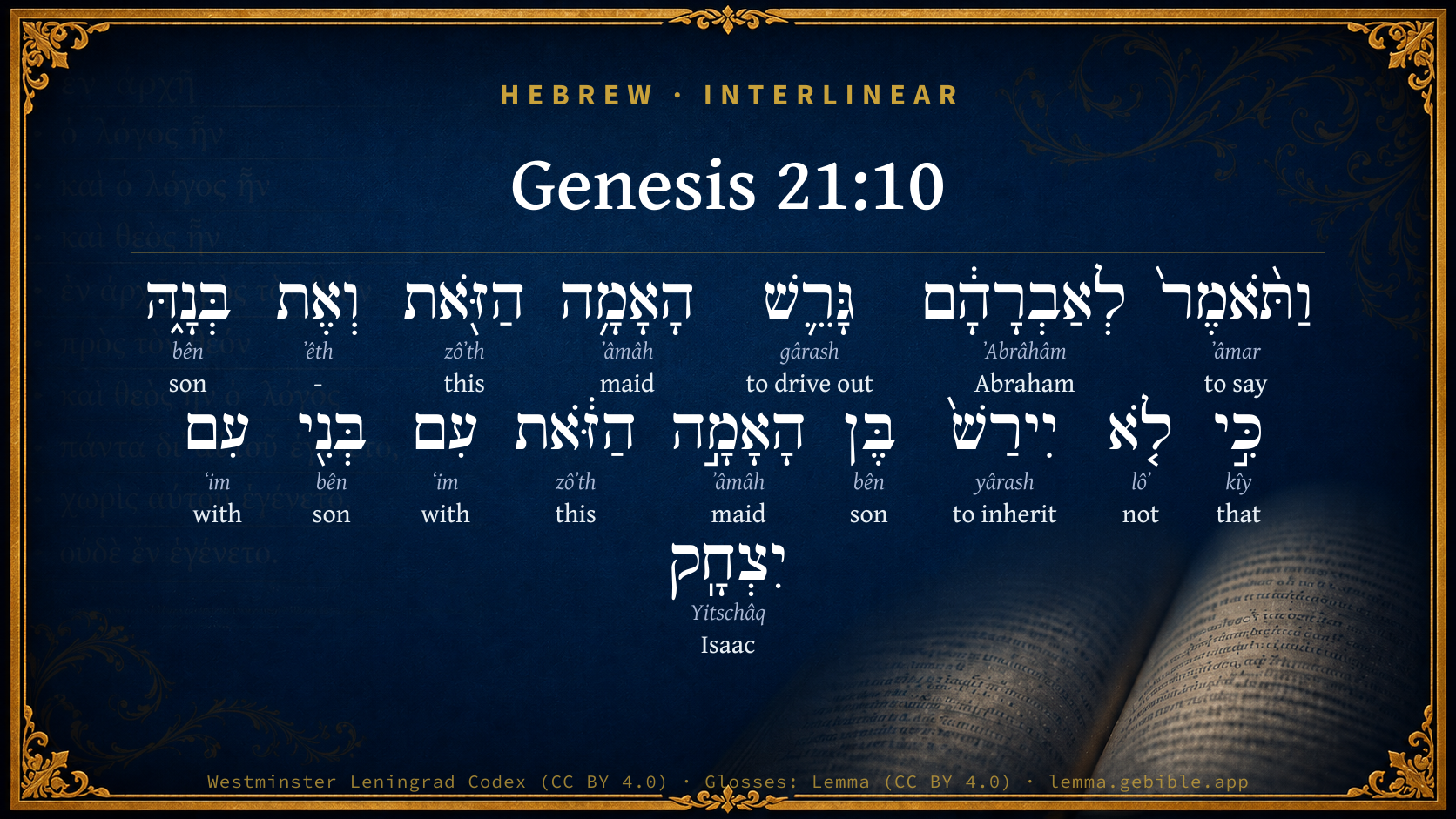
Hebrew (Westminster Leningrad Codex) Genesis 21:10 appears in the Hebrew Old Testament. The text above is from the Westminster Leningrad Codex. Each word links to its Strong’s number, a concise gloss, and parsing drawn from the Open Scriptures Hebrew Bible morphology. Click any word for its full Brown-Driver-Briggs (BDB) entry.
Download image
Cite this verse

Genesis 21:10 (World English Bible). Public Domain. Lemma interlinear Bible study tool, https://lemma.gebible.app/v/genesis/21/10.

Show BibTeX & RIS
BibTeX
RIS
English Translation
Therefore she said to Abraham, "Cast out this handmaid and her son! For the son of this handmaid will not be heir with my son, even with Isaac."
World English Bible · Public Domain
Download a study sheet

One document with this verse’s original text, its word-by-word gloss line, the meaning frame, cross-references with their text, attributed commentary, and full source and license credits — printable, and it pastes into notes with its structure intact.

This verse Autodidact and up

Study sheet (.html) Plain text (.txt)

A passage Seminary Student

Up to 50 verses in one chapter. A passage sheet keeps up to 6 commentary sources and 12 cross-references per verse, in the order this page ranks them, and says so on the sheet whenever that leaves anything out. Ask for a single verse and you get the Autodidact verse sheet above.

Everything on this page stays free to read, with no account — the sheet is a download of what is already on screen, not access to it.

Want to remove ads? Support Godless Engineer
Compare translations 3

The same verse in 3 English versions, stacked beneath the original-language interlinear above. Click any original word for its lexicon entry.

Each is an independent rendering of the whole verse — the interlinear is not word-aligned to these translations.

Highlighted words mark where these versions differ — a whole-verse word diff, not a word-by-word alignment.

  • World English Bible Public Domain
    Therefore she said to Abraham, "Cast out this handmaid and her son! For the son of this handmaid will not be heir with my son, even with Isaac."
  • King James Version Public Domain
    Wherefore she said unto Abraham, Cast out this bondwoman and her son: for the son of this bondwoman shall not be heir with my son, even with Isaac.
  • unfoldingWord Literal Text CC BY-SA 4.0
    So she said to Abraham, “Drive away that slave woman and her son, because the son of that slave woman will not inherit with my son, with Isaac!”

unfoldingWord Literal Text — © unfoldingWord, licensed CC BY-SA 4.0. Word-aligned USFM3 via Door43 (git.door43.org/unfoldingWord/en_ult).

Versions to compare (up to 4)

3 of 4 selected

Show all 18 translations

Every available English version of this verse, each an independent rendering of the whole verse.

  • World English Bible Public Domain
    Therefore she said to Abraham, "Cast out this handmaid and her son! For the son of this handmaid will not be heir with my son, even with Isaac."
  • Berean Standard Bible Public Domain
    and she said to Abraham, “Expel the slave woman and her son, for the slave woman’s son will never share in the inheritance with my son Isaac!”
  • Majority Standard Bible Public Domain
    and she said to Abraham, “Expel the slave woman and her son, for the slave woman’s son will never share in the inheritance with my son Isaac!”
  • King James Version Public Domain
    Wherefore she said unto Abraham, Cast out this bondwoman and her son: for the son of this bondwoman shall not be heir with my son, even with Isaac.
  • American Standard Version (1901) Public Domain
    Wherefore she said unto Abraham, Cast out this handmaid and her son. For the son of this handmaid shall not be heir with my son, even with Isaac.
  • Revised Version (1885) Public Domain
    Wherefore she said unto Abraham, Cast out this bondwoman and her son: for the son of this bondwoman shall not be heir with my son, even with Isaac.
  • Geneva Bible (1599) Public Domain
    Wherefore she saide vnto Abraham, Cast out this bond woman and her sonne: for ye sonne of this bonde woman shall not be heire with my sonne Izhak.
  • Douay-Rheims (1899) Public Domain
    Cast out this bondwoman, and her son: for the son of the bondwoman shall not be heir with my son Isaac.
  • Young's Literal Translation Public Domain
    and she saith to Abraham, `Cast out this handmaid and her son; for the son of this handmaid hath no possession with my son -- with Isaac.'
  • Literal Standard Version CC BY-SA 4.0
    and she says to Abraham, “Cast out this handmaid and her son; for the son of this handmaid has no possession with my son—with Isaac.”
  • Unlocked Literal Bible CC BY-SA 4.0
    So she said to Abraham, “Drive out this slave woman and her son, for the son of this slave woman will not be heir with my son, with Isaac.”
  • unfoldingWord Literal Text CC BY-SA 4.0
    So she said to Abraham, “Drive away that slave woman and her son, because the son of that slave woman will not inherit with my son, with Isaac!”
  • Darby Bible Public Domain
    And she said to Abraham, Cast out this handmaid and her son; for the son of this handmaid shall not inherit with my son -- with Isaac.
  • World Messianic Bible Public Domain
    Therefore she said to Abraham, “Cast out this servant and her son! For the son of this servant will not be heir with my son, Isaac.”
  • Webster's Bible Public Domain
    Wherefore, she said to Abraham, Cast out this bond-woman, and her son: for the son of this bond-woman shall not be heir with my son, even with Isaac.
  • Free Bible Version CC BY-SA 4.0
    So she went to Abraham and told him, “You have to get rid of this slave woman and this son of hers! A slave woman's son is not going to be one of your heirs and inherit together with my son Isaac!”
  • Bible in Basic English Public Domain
    So she said to Abraham, Send away that woman and her son: for the son of that woman is not to have a part in the heritage with my son Isaac.
  • JPS Tanakh (1917) Public Domain
    Wherefore she said unto Abraham: 'Cast out this bondwoman and her son; for the son of this bondwoman shall not be heir with my son, even with Isaac.'

Literal Standard Version (2020), Covenant Press — licensed CC BY-SA 4.0. Text via the HelloAO Bible API (eBible.org). Unlocked Literal Bible (unfoldingWord) — licensed CC BY-SA 4.0. Text via the HelloAO Bible API (eBible.org). unfoldingWord Literal Text — © unfoldingWord, licensed CC BY-SA 4.0. Word-aligned USFM3 via Door43 (git.door43.org/unfoldingWord/en_ult). Free Bible Version, Dr. Jonathan Gallagher — licensed CC BY-SA 4.0. Text via the HelloAO Bible API (eBible.org).

Word by word

More ways to search: Search by grammar → Find every occurrence → Compare this word →

Practice this passage: Drill this verse → Learn its vocabulary →

גָּרֵ֛שׁ
gârash
H1644
“drive out”
Verb, Piel, Imperative, 2nd Person, Masculine, Singular
Part of Speech
Verb
Stem
Piel
Form
Imperative
Person
2nd Person
Gender
Masculine
Number
Singular
Full BDB Definition

Origin: a primitive root

TWOT: 388

to drive out, expel, cast out, drive away, divorce, put away, thrust away, trouble, cast up - (Qal) to thrust out, cast out - (Niphal) to be driven away, be tossed - (Piel) to drive out, drive away - (Pual) to be thrust out
  1. וַתֹּ֨אמֶר֙ ʼâmar H559 “and · to say” Conjunction + Verb, Qal, Sequential Imperfect, 3rd Person, Feminine, Singular
  2. לְאַבְרָהָ֔ם ʼAbrâhâm H85 “to/for · Abraham” Preposition + Noun, Proper
  3. הָאָמָ֥ה ʼâmâh H519 “the · maid” Particle, Definite Article + Noun, Common, Feminine, Singular, Absolute
  4. הַזֹּ֖את zôʼth H2063 “the · this” Particle, Definite Article + Pronoun, Demonstrative, Feminine, Singular
  5. וְאֶת ʼêth H853 “and · -” Conjunction + Particle, Direct Object
  6. בְּנָ֑הּ bên H1121 “son · her” Noun, Common, Masculine, Singular, Construct + Suffix, Personal, 3rd Person, Feminine, Singular
  7. כִּ֣י kîy H3588 “that” Conjunction
  8. לֹ֤א lôʼ H3808 “not” Particle, Negative
  9. יִירַשׁ֙ yârash H3423 “to inherit” Verb, Qal, Imperfect, 3rd Person, Masculine, Singular
  10. בֶּן bên H1121 “son of” Noun, Common, Masculine, Singular, Construct
  11. הָאָמָ֣ה ʼâmâh H519 “the · maid” Particle, Definite Article + Noun, Common, Feminine, Singular, Absolute
  12. הַזֹּ֔את zôʼth H2063 “the · this” Particle, Definite Article + Pronoun, Demonstrative, Feminine, Singular
  13. עִם ʻim H5973 “with” Preposition
  14. בְּנִ֖י bên H1121 “son · my” Noun, Common, Masculine, Singular, Construct + Suffix, Personal, 1st Person, Common, Singular
  15. עִם ʻim H5973 “with” Preposition
  16. יִצְחָֽק Yitschâq H3327 “Isaac” Noun, Proper

About this verse

These counts appear in no published source. They are computed here, from the morphology-tagged text and Lemma’s own curated glosses. What Lemma adds →

17
words
12
distinct lemmas
Pentateuch
section

Shared distinctive vocabulary

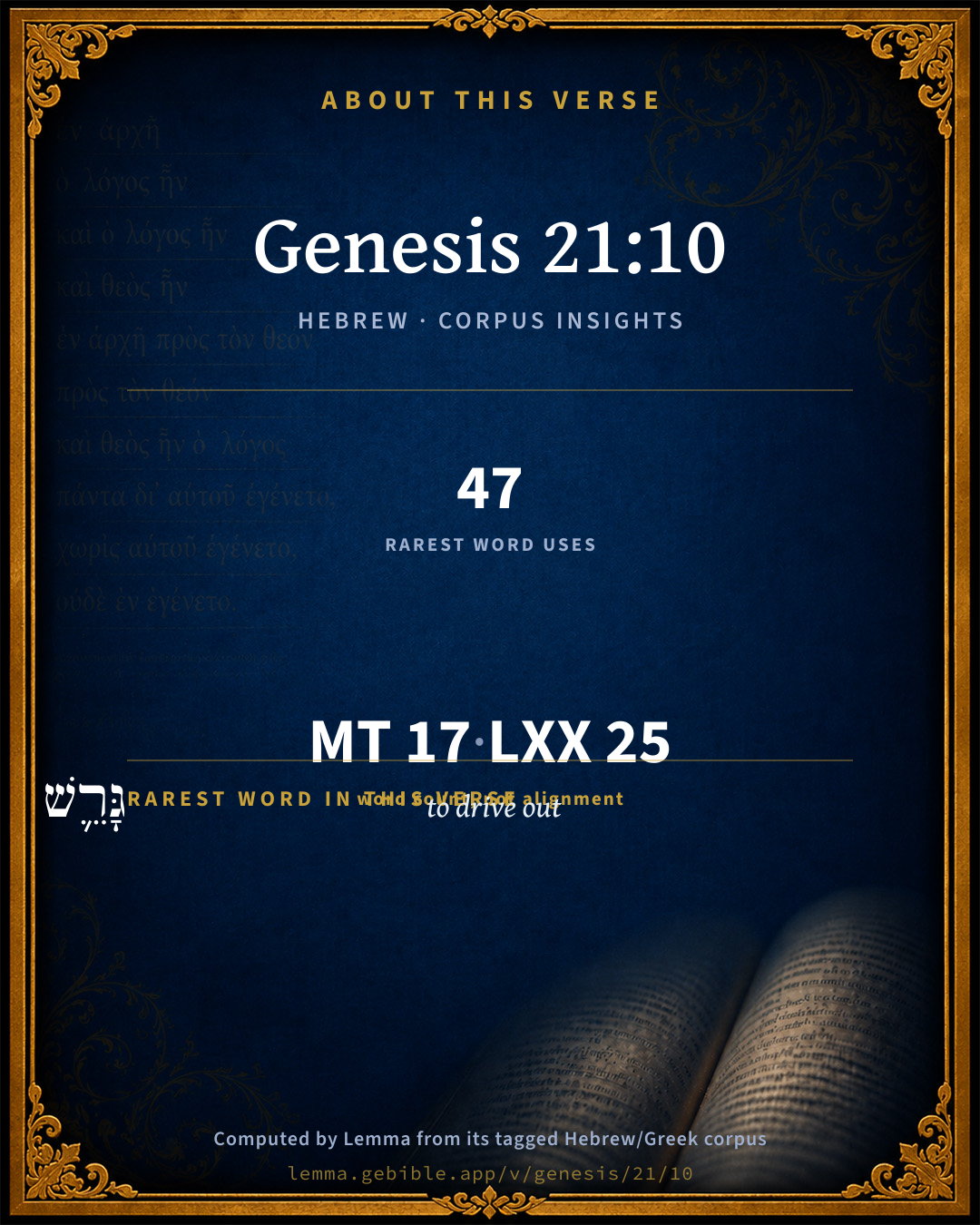
גָּרֵ֛שׁ to drive out H1644 occurs in 45 verses of the Hebrew Bible. Also found in:

Grammatical profile

  • 3 verbs
  • 7 nouns
  • 2 pronouns
  • 2 prepositions
  • 1 conjunction
  • 2 particles

Verb forms

  • וַתֹּ֨אמֶר֙ Qal · Sequential Imperfect
  • גָּרֵ֛שׁ Piel · Imperative
  • יִירַשׁ֙ Qal · Imperfect

Repetition

Words recur within this verse — often emphatic in Hebrew:

  • בְּנָ֑הּ son H1121 ×3
  • הָאָמָ֥ה maid H519 ×2
  • הַזֹּ֖את this H2063 ×2
  • עִם with H5973 ×2

Hebrew & Septuagint length

In English translation the verse runs 28 words from the Hebrew and 25 from the Septuagint (LXX English) — closely comparable.

A rough comparison of the two English renderings, which tokenize alike — not a word-level alignment.

Word counts can differ between the Hebrew and the Greek without any difference in meaning — e.g. the Hebrew direct-object marker אֵת has no separate Greek word, and Greek often adds the article ὁ.

In the original languages it is 17 Hebrew tokens and 25 Greek tokens — but the two are counted differently (Hebrew bundles its prefixes and suffixes into one token; the Greek is in lemma form), so that isn’t a like-for-like length.

Cross-references

15

Topical passages linked to Genesis 21:10 in the Treasury of Scripture Knowledge — connected by theme and wording, ordered by reader-vote popularity; previews shown in the World English Bible.

  • John 8:35 A bondservant doesn't live in the house forever. A son remains forever.
  • Galatians 4:22–31 For it is written that Abraham had two sons, one by the handmaid, and one by the free woman.
  • 1 John 2:19 They went out from us, but they didn't belong to us; for if they had belonged to us, they would have continued with us. But they left, that they might be revealed that none of them belong to us.
  • Genesis 36:6–7 Esau took his wives, his sons, his daughters, and all the members of his household, with his cattle, all his animals, and all his possessions, which he had gathered in the land of Canaan, and went into a land away from his brother Jacob.
  • 1 Peter 1:4 to an incorruptible and undefiled inheritance that doesn't fade away, reserved in heaven for you,
  • Genesis 25:19 This is the history of the generations of Isaac, Abraham's son. Abraham became the father of Isaac.
  • Matthew 8:11–12 I tell you that many will come from the east and the west, and will sit down with Abraham, Isaac, and Jacob in the Kingdom of Heaven,
  • Matthew 22:13 Then the king said to the servants, 'Bind him hand and foot, take him away, and throw him into the outer darkness; there is where the weeping and grinding of teeth will be.'
  • Galatians 3:18 For if the inheritance is of the law, it is no more of promise; but God has granted it to Abraham by promise.
  • Galatians 4:7 So you are no longer a bondservant, but a son; and if a son, then an heir of God through Christ.
  • Genesis 17:19 God said, "No, but Sarah, your wife, will bear you a son. You shall call his name Isaac. I will establish my covenant with him for an everlasting covenant for his seed after him.
  • Genesis 17:21 But my covenant I establish with Isaac, whom Sarah will bear to you at this set time in the next year."
  • Genesis 20:11 Abraham said, "Because I thought, 'Surely the fear of God is not in this place. They will kill me for my wife's sake.'
  • Genesis 22:10 Abraham stretched forth his hand, and took the knife to kill his son.
  • Genesis 25:6 but to the sons of the concubines who Abraham had, Abraham gave gifts. He sent them away from Isaac his son, while he yet lived, eastward, to the east country.

Cross-references courtesy of OpenBible.info (CC BY 4.0).

Hebrew and Greek witnesses Masoretic Hebrew ↔ Greek Septuagint

The same verse in the two great witnesses to the Old Testament, shown verse-for-verse.

These are two independent witnesses, not word-aligned to each other, and the Septuagint is shown in lemma (dictionary) form.

Hebrew Genesis 21:10 Masoretic · Westminster Leningrad Codex

וַתֹּ֨אמֶר֙ לְאַבְרָהָ֔ם גָּרֵ֛שׁ הָאָמָ֥ה הַזֹּ֖את וְאֶת בְּנָ֑הּ כִּ֣י לֹ֤א יִירַשׁ֙ בֶּן הָאָמָ֣ה הַזֹּ֔את עִם בְּנִ֖י עִם יִצְחָֽק

Therefore she said to Abraham, "Cast out this handmaid and her son! For the son of this handmaid will not be heir with my son, even with Isaac."

World English Bible · Public Domain

Greek LXX Genesis 21:10 Septuagint · lemma form

καί εἶπον ὁ αβρααμ ἐκβάλλω ὁ παιδίσκη οὗτος καί ὁ υἱός αὐτός οὐ γάρ κληρονομέω ὁ υἱός ὁ παιδίσκη οὗτος μετά ὁ υἱός ἐγώ ισαακ

then she said to Abraam, Cast out this bondwoman and her son, for the son of this bondwoman shall not inherit with my son Isaac.

LXX2012 (modern English Septuagint) · Public Domain

Hebrew: Westminster Leningrad Codex (CC BY 4.0). Greek: Septuagint (public domain); English from LXX2012 (modern English Septuagint) (Public Domain). How the Septuagint differs from the Hebrew →

Targum (Aramaic paraphrase)

2

The Targum is the ancient Jewish Aramaic paraphrase of the Hebrew Scriptures — an interpretive translation, not the Hebrew text itself. Onkelos (literal) and Pseudo-Jonathan (expansive) render the Torah, and Jonathan the Prophets. Coverage is partial: where no permissively-licensed English translation exists for a verse, only the Aramaic is shown. This is verse-level text, not a word-by-word alignment to the Hebrew.

  1. Targum Onkelos Torah (Genesis–Deuteronomy)
    וַאֲמֶרֶת לְאַבְרָהָם תָּרֵךְ אַמְתָא הָדָא וְיָת בְּרַהּ אֲרֵי לָא יֵרַת בַּר אַמְתָא הָדָא עִם בְּרִי עִם יִצְחָק

    (no public-domain English translation for this verse)

    Targum Onkelos — Aramaic: “Onkelos Genesis” (public domain); “Onkelos Exodus” (public domain); “Onkelos Leviticus” (public domain); “Onkelos Numbers” (public domain); “Onkelos Deuteronomy” (public domain). English: “Sefaria Community Translation” (CC0 1.0 (public-domain dedication)); “J.W. Etheridge. The Targums of Onkelos and Jonathan Ben Uzziel on the Pentateuch. London: Longmans, Green, 1862” (public domain). Text via Sefaria.

  2. Targum Pseudo-Jonathan Torah (Genesis–Deuteronomy)
    וַאֲמָרַת לְאַבְרָהָם טְרוֹד יַת אַמְתָא הָדָא וְיַת בְּרָהּ אֲרוּם לֵית אֶוְושַׁר לְמֵירוּת בַּר אַמְתָא הָדָא עִם בְּרִי וְיִגַח קְרָבָא עִם יִצְחָק

    And she said to Abraham, Cast out this handmaid and her son: for it is not possible for the son of this handmaid to inherit with my son; and he to make war with Izhak.

    Targum Pseudo-Jonathan — Aramaic: “Targum Jonathan on Genesis” (public domain); “Targum Jonathan on Exodus” (public domain); “Targum Jonathan on Leviticus” (public domain); “Targum Jonathan on Numbers” (public domain); “Targum Jonathan on Deuteronomy” (public domain). English: “The Targum of Jonathan ben Uzziel, trans. J. W. Etheridge, London, 1862” (public domain). Text via Sefaria.

Commentary

Notes on Genesis 21:10 from classic Christian and Jewish commentators (each source and its license shown beneath its notes). The classic Christian expositions comment on the surrounding passage and are grouped to its opening verse, so a note may address several verses; the Jewish commentaries on the Tanakh (Rashi and others) are per-verse, so they appear only where the commentator wrote on this verse.

Lemma curates 59 commentaries, every one of them public domain or Creative Commons licensed, each selected and text-cleaned for this edition rather than reprinted as found. About our sources →

The Cambridge Bible for Schools and Colleges

gen. ed. J. J. S. Perowne

10. “Hebrew custom provided for the recognition of the children of the maid-servant (Gen_30:3), and Ishmael according to the Elohist (Gen_21:10) was coheir with Isaac” (Stanley Cook, p. 140).

The Cambridge Bible for Schools and Colleges (gen. ed. J. J. S. Perowne; Cambridge University Press, 1878–1918) — public domain. Text from a community e-Sword module.

Trapp's Complete Commentary

John Trapp

Gen 21:10 Wherefore she said unto Abraham, Cast out this bondwoman and her son: for the son of this bondwoman shall not be heir with my son, [even] with Isaac.

Ver. 10. Cast out this bondwoman.] Who had been, likely, either an author or abettor of her son’s sin, in ambitiously seeking the inheritance. Out they must, therefore, together: as all hypocrites one day must be cast out of God’s kingdom. Heaven is an "undefiled inheritance": no dirty dog ever trampled on that golden pavement. There is no passing e coeno in coelum . Heaven would be no heaven to the unregenerate. Beetles love dunghills better than ointments; and swine love mud better than a garden.

“ Quid Paris? ut salvus regnet vivatque beatus,

Cogi posse negat .”

“What of Paris? To reign in saftey and live in happiness,

- nothing, he says, can force him.”

- Horat., epist. 2, lines 9, 10.

John Trapp, A Commentary or Exposition upon All the Books of the Old and New Testament (1647–1656) — public domain. Text from a community e-Sword module.

Joseph Benson's Commentary

Gen 21:10. Cast out the bond-woman — This was a type of the rejection of the unbelieving Jews, who, though they were the seed of Abraham, yet, because they submitted not to the gospel covenant, were unchurched and disfranchised. And that which above any thing provoked God to cast them off, was, their mocking and persecuting the gospel church, God’s Isaac, in its infancy.

Joseph Benson's Commentary on the Old and New Testaments (1811–1818) — public domain. Text from a community e-Sword module.

Tyndale Open Study Notes

Tyndale Open Resources

21:10 Earlier, Sarah mistreated Hagar and pressured her to flee (16:6); when Hagar’s son mistreated Isaac, Sarah demanded that that slave woman and her son leave.

Tyndale Open Study Notes — © Tyndale Open Resources, licensed CC BY-SA 4.0. Text via the HelloAO Bible API.

Jamieson, Fausset & Brown

Robert Jamieson, A. R. Fausset & David Brown

Wherefore she said unto Abraham, Cast out this bondwoman--Nothing but the expulsion of both could now preserve harmony in the household. Abraham's perplexity was relieved by an announcement of the divine will, which in everything, however painful to flesh and blood, all who fear God and are walking in His ways will, like him, promptly obey. This story, as the apostle tells us, in "an allegory" [Gal 4:24], and the "persecution" by the son of the Egyptian was the commencement of the four hundred years' affliction of Abraham's seed by the Egyptians.

Jamieson, Fausset & Brown — Commentary Critical and Explanatory on the Whole Bible (1871) — public domain (CC PDM 1.0). Text via the HelloAO Bible API.

Adam Clarke's Commentary

Verse 10. Cast out this bondwoman and her son] Both Sarah and Abraham have been accused of cruelty in this transaction, because every word reads harsh to us. Cast out; גרש garash signifies not only to thrust out, drive away, and expel, but also to divorce; (see Le 21:7); and it is in this latter sense the word should be understood here. The child of Abraham by Hagar might be considered as having a right at least to a part of the inheritance; and as it was sufficiently known to Sarah that God had designed that the succession should be established in the line of Isaac, she wished Abraham to divorce Hagar, or to perform some sort of legal act by which Ishmael might be excluded from all claim on the inheritance.

Adam Clarke's Commentary on the Bible (1810–1826) — public domain. Text from a community e-Sword/MySword module.

John Calvin's Commentaries

10. Cast out this bondwoman. Not only is Sarah exasperated against the transgressor, but she seems to act more imperiously towards her husband than was becoming in a modest wife. Peter shows, that when, on a previous occasion, she called Abraham lord, she did not do so feignedly; since he proposes her, as an example of voluntary subjection, to pious and chaste matrons. (1 Peter 3:6.) But now, she not only usurps the government of the house, by calling her husband to order, but commands him whom she ought to reverence, to be obedient to her will. Here, although I do not deny that Sarah, being moved by womanly feelings, exceeded the bounds of moderation, I yet do not doubt, both that her tongue and mind were governed by a secret impulse of the Spirit, and that this whole affair was directed by the providence of God. Without controversy, she was the minister of great and tremendous judgment. And Paul adduces this expression, not as a futile reproach, which an enraged woman had poured forth, but as a celestial oracle. But although she sustains a higher character than that of a private woman, yet she does not take from her husband his power; but makes him the lawful director of the ejection.

John Calvin's Commentaries (1540-1563) — public domain. Text from the Calvin Translation Society English edition (1840s-50s) via the Christian Classics Ethereal Library (ccel.org). Calvin's coverage is partial (roughly two-thirds of the Bible); uncommented books and verses are honest gaps, never fabricated. The 19th-century editor's footnotes and remarks are omitted so the notes are faithfully Calvin's own voice.

Ellicott's Commentary for English Readers

(10) Bondwoman.—Heb., ammâh. This word is rightly translated handmaid in Gal_4:22, &c., Revised Version. It is rendered maid in Gen_30:3, and in the plural, maidservants, in Gen_20:17, where, as we have seen, it means Abimelech’s inferior wives. So also in 1Sa_25:41, Abigail professes her willingness to descend from the position of an ammâh to that of a maidservant in David’s honour. The rendering “bondwoman “unduly depresses Hagar’s condition, and with it that of the Jewish Church in the allegory contained in Gal_4:22-31.

A Bible Commentary for English Readers, edited by Charles John Ellicott (1878–1897) — public domain. Text from a community e-Sword module.

John Gill's Exposition

And the thing was very grievous in Abraham's sight,.... The motion that Sarah made to turn out of his house Hagar and Ishmael was not agreeable to him, but the reverse; it seemed an ill thing to him; it was greatly displeasing to him, and he was unwilling to come into it:

because of his son; his son Ishmael; not grieved and uneasy for what he had done; not for committing idolatry, as the Targum of Jonathan suggests, or for mocking at Isaac; but for what was proposed to be done to him, the ejection of him from his house, because of the great love he had for him, and the great concern he had for his education, and that he might enjoy the blessing promised him, he, was loath to have him cast out of his family: no concern is expressed for Hagar, though both by what God said to Abraham, and by the provision he made for her, he had a regard unto her; but his chief concern was for his son, who perhaps had a greater share in his natural affections than as yet Isaac had; nor did express so much reluctance when he was bid to him up, as he did at this time, that being at the command of God, this at the instance of his wife, and which he supposed only proceeded from passion and resentment: the Hebrew writers say (x), that of all the evils that came upon Abraham this was the hardest and most grievous in his sight.

(x) Pirke Eliezer, c. 30.

John Gill's Exposition of the Whole Bible (1746–1763) — public domain (CC PDM 1.0). Text via the HelloAO Bible API.

Matthew Poole's English Annotations

1892 She was enraged by this fact, and perceived it was but a beginning and earnest of greater evil designed by him against her beloved Isaac; being also guided by the wise counsel and providence of God, as appears from Gen 21:12. Though the fact was done by Ishmael, yet Sarah plainly saw that this and other like carriages were from his mother’s instigation and encouragement, who being of an imperious and petulant disposition, as appears from Gen 16:4,9, in all probability comforted herself, and animated her son, by that right he had to his father’s inheritance as he was his first-born, as may be gathered both from the custom of women in such cases, and from the last words of this verse. Besides, if the mother had been continued, she would easily have prevailed with Abraham to fetch the child back again.

Matthew Poole's English Annotations on the Holy Bible (1683–1685) — public domain. Text from a community e-Sword/MySword module.

Whedon's Commentary on the Bible

Daniel D. Whedon

10. Cast out — Her old spirit of persecution, now embittered by what she saw in Ishmael, came back with imperious force. Comp. Gen_16:4-6. “Seeing in Ishmael nothing but the contemptible son of an Egyptian bond-maid — forgetting that he was that offspring of her husband whom she had herself desired — and heedless of the blessings which God had pronounced upon him — she demanded his expulsion, together with that of his detested mother.” — Kalisch.

Daniel D. Whedon (gen. ed.), Commentary on the Old and New Testaments (1874–1909) — public domain. Text from a community e-Sword module.

The Pulpit Commentary

Wherefore she said though with an admixture of sinful feelings, non dubito arcane Spiritus instinctu gubernatam fuisse ejus linguam et mentem (Calvin); vide Gal_4:30unto Abraham, Cast out by some kind of legal act as divorce: (cf. Lev_21:7, 14 22:13; Isa_57:20) which should insure the disinheriting ofIshmael (Bush); though probably this is to import later Mosaic legislation rote the records of primitive tunesthis bondwoman a term ill befitting Sarah, who had given Hagar to her husband as a wife (Gen_16:3) and her son (who was Abraham"s offspring, though not the promised seed; a consideration which should have mitigated Sarah"s anger): for the son of this bondwoman (a repetition evincing the bitter ness of her contempt and the intensity of her choler) shall not be heir with my son, even with Isaac. Notwithstanding the assurance (Gen_17:21) that the covenant was made with Isaac, Sarah was apprehensive lest Ishmael should contrive to disinherit him; an act of unbelief into which she was manifestly betrayed by her maternal fears and womanly jealousy.

The Pulpit Commentary (1880–1919), ed. H.D.M. Spence-Jones & Joseph S. Exell — public domain. Text from a community e-Sword module.

John Wesley's Explanatory Notes

Cast out the bond-woman - This was a type of the rejection of the unbelieving Jews, who, though they were the seed of Abraham, yet, because they submitted not to the gospel-covenant, were unchurched and disfranchised. And that, which above any thing provoked God to cast them off, was, their mocking and persecuting the gospel-church, God's Isaac, in his infancy.

John Wesley, Explanatory Notes Upon the Whole Bible (1754–1765) — public domain. Text via the GEBible commentary corpus.

unfoldingWord translationNotes

Door43 World Missions Community

she said to Abraham

"Sarah said to Abraham"

Drive out

"send away" or "get rid of"

this slave woman and her son

This refers to Hagar and Ishmael. Sarah probably did not refer to them by name because she was angry with them.

with my son, with Isaac

"with my son Isaac"

This thing was very grievous to Abraham

"Abraham was very unhappy about what Sarah said"

because of his son

"because it was about his son." It is implied that this means his son, Ishmael. (See: Assumed Knowledge and Implicit Information)

translationWords

Abraham

cast out

servant

heir

Isaac

unfoldingWord translationNotes — © Distant Shores Media and the Door43 World Missions Community, licensed CC BY-SA 4.0. Source: git.door43.org/Door43/en_tn.

Rashi

Rabbi Shlomo Yitzchaki (Rashi)

עם בני עם יצחק WITH MY SON, WITH ISAAC —For since this is my son, even though he were not as good as Isaac really is, or if he were as good a man as Isaac really is, even though he were not my son, this one (Ishmael) is not deserving of inheriting with him: how much less is he deserving of inheriting with my son, with Isaac — with one who possesses both these qualities (of being my son and of being the good man Isaac) (Genesis Rabbah 53:11).

Rashi on the Tanakh — English translations: “The Judaica Press complete Tanach with Rashi, translated by A. J. Rosenberg” (CC BY 4.0); “Pentateuch with Rashi's commentary by M. Rosenbaum and A.M. Silbermann, 1929-1934” (public domain); “The Metsudah Tanach series, Lakewood, N.J” (CC BY 4.0); and “The Book of Joshua, Metsudah Publications, 1997” (CC BY 4.0). Text via Sefaria.

Radak

Rabbi David Kimhi (Radak)

ותאמר...גרש האמה, it was inconceivable to expel the son without his mother as she would not remain after he had gone.

כי לא יירש, “he imagines that he will share equally in the inheritance because he is your son. This is the reason why he is so overbearing, making fun of my son.”

עם יצחק, the words suggest that Sarah had told Avraham “didn’t G’d tell you that He would perpetuate His covenant with Yitzchok who Sarah will bear for you? (17,21)?”

Radak on the Tanakh — English translations: “Sefaria Community Translation” (CC0 1.0 (public-domain dedication)); “Eliyahu Munk, HaChut Hameshulash” (CC BY 4.0); “Rabbi Mike Feuer, Jerusalem Anthology” (CC BY 4.0); and “R. David Kimhi on the first book of Psalms, Translated by R.G. Finch, London, 1919” (public domain). Text via Sefaria.

Lesson kit

Teaching starters — assembled from the data on this page, not authored interpretation. Every prompt links to the verse data it draws on. Edit before teaching.

Genesis, in the Pentateuch, opens this verse with 17 words (12 distinct Hebrew lemmas). Its most distinctive word is gârash (“to drive out”). A historical commentator’s framing appears above. Read the whole chapter for the surrounding context.

Discussion questions

  1. The word gârash carries the sense “to drive out.” How does it shape the verse?
  2. Genesis 3:24 shares the word «to drive out» with this verse. How do the two illuminate each other?
  3. “son” occurs 3× in this one verse. What is the effect of the repetition?
  4. These translations render this verse differently. What is at stake in choosing one wording over another?
  5. The verb «וַתֹּ֨אמֶר֙» is Qal Sequential Imperfect. How does its form color the action?
  6. Reading how The Cambridge Bible for Schools and Colleges and Trapp's Complete Commentary read this verse, where do the two commentators agree and where do they part?

Things to notice

Reading settings

Reading text

Shown beneath each verse's original-language words.

Old Testament
Old Testament edition

Read the OT as the Masoretic Hebrew (MT) or the Greek Septuagint (LXX).

English shown for the Greek Septuagint (in the Hebrew ↔ Greek comparison).

Comparing translations? Open the Compare panel on any verse page to stack up to four side by side.