
Isaiah 54:17

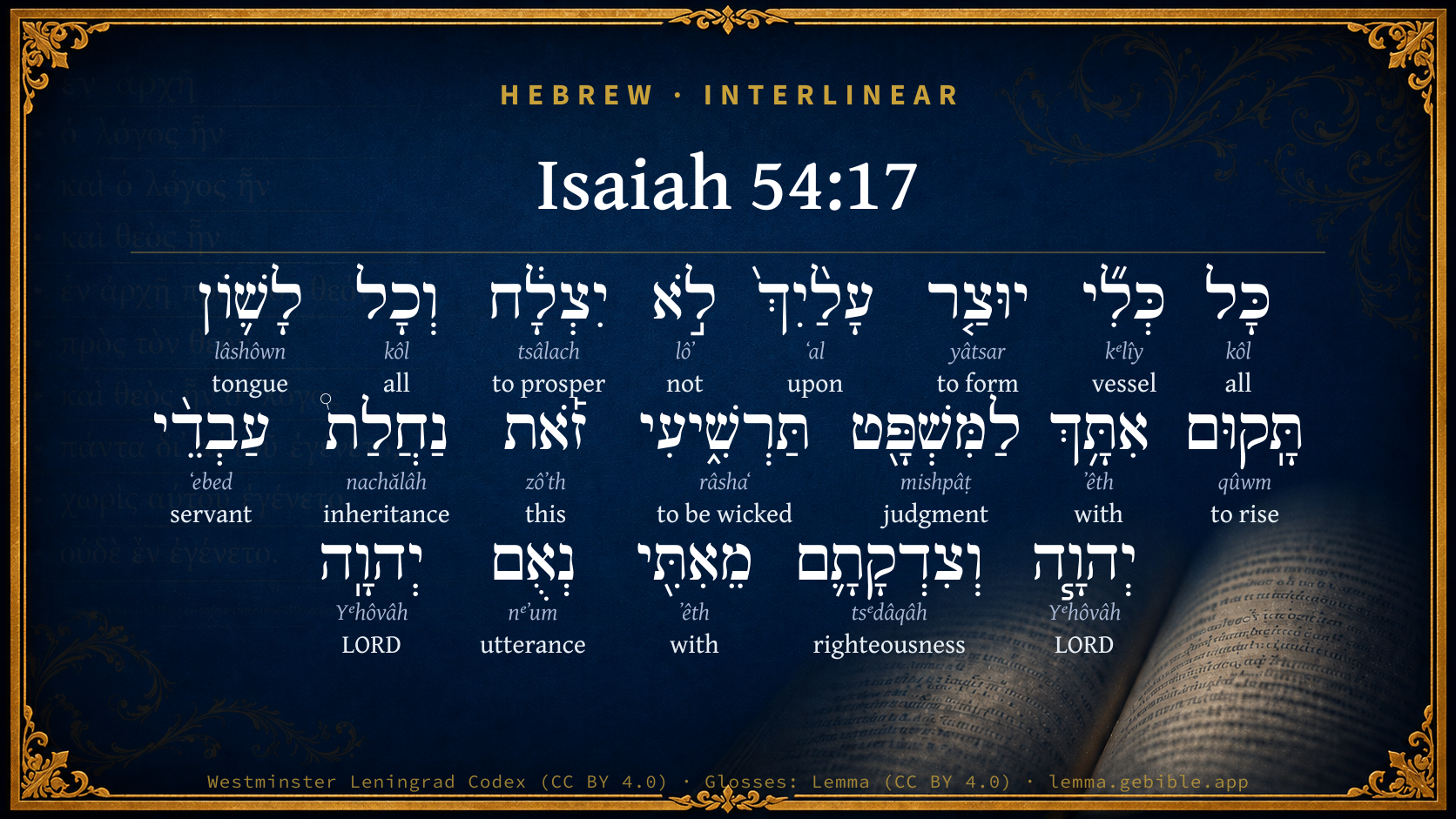
Hebrew (Westminster Leningrad Codex) Isaiah 54:17 appears in the Hebrew Old Testament. The text above is from the Westminster Leningrad Codex. Each word links to its Strong’s number, a concise gloss, and parsing drawn from the Open Scriptures Hebrew Bible morphology. Click any word for its full Brown-Driver-Briggs (BDB) entry.
Download image
Cite this verse

Isaiah 54:17 (World English Bible). Public Domain. Lemma interlinear Bible study tool, https://lemma.gebible.app/v/isaiah/54/17.

Show BibTeX & RIS
BibTeX
RIS
English Translation
No weapon that is formed against you shall prosper; and every tongue that shall rise against you in judgment you shall condemn. This is the heritage of the servants of Yahweh, and their righteousness which is of me, says Yahweh.
World English Bible · Public Domain
Download a study sheet

One document with this verse’s original text, its word-by-word gloss line, the meaning frame, cross-references with their text, attributed commentary, and full source and license credits — printable, and it pastes into notes with its structure intact.

This verse Autodidact and up

Study sheet (.html) Plain text (.txt)

A passage Seminary Student

Up to 50 verses in one chapter. A passage sheet keeps up to 6 commentary sources and 12 cross-references per verse, in the order this page ranks them, and says so on the sheet whenever that leaves anything out. Ask for a single verse and you get the Autodidact verse sheet above.

Everything on this page stays free to read, with no account — the sheet is a download of what is already on screen, not access to it.

Want to remove ads? Support Godless Engineer
Compare translations 3

The same verse in 3 English versions, stacked beneath the original-language interlinear above. Click any original word for its lexicon entry.

Each is an independent rendering of the whole verse — the interlinear is not word-aligned to these translations.

Highlighted words mark where these versions differ — a whole-verse word diff, not a word-by-word alignment.

  • World English Bible Public Domain
    No weapon that is formed against you shall prosper; and every tongue that shall rise against you in judgment you shall condemn. This is the heritage of the servants of Yahweh, and their righteousness which is of me, says Yahweh.
  • King James Version Public Domain
    No weapon that is formed against thee shall prosper; and every tongue that shall rise against thee in judgment thou shalt condemn. This is the heritage of the servants of the LORD, and their righteousness is of me, saith the LORD.
  • unfoldingWord Literal Text CC BY-SA 4.0
    Every weapon formed against you will not prosper, and every tongue rising against you in judgment, you will condemn. This the inheritance of the servants of Yahweh and their righteousness from me”—the declaration of Yahweh.

unfoldingWord Literal Text — © unfoldingWord, licensed CC BY-SA 4.0. Word-aligned USFM3 via Door43 (git.door43.org/unfoldingWord/en_ult).

Versions to compare (up to 4)

3 of 4 selected

Show all 18 translations

Every available English version of this verse, each an independent rendering of the whole verse.

  • World English Bible Public Domain
    No weapon that is formed against you shall prosper; and every tongue that shall rise against you in judgment you shall condemn. This is the heritage of the servants of Yahweh, and their righteousness which is of me, says Yahweh.
  • Berean Standard Bible Public Domain
    No weapon formed against you shall prosper, and you will refute every tongue that accuses you. This is the heritage of the servants of the LORD, and their vindication is from Me,” declares the LORD.
  • Majority Standard Bible Public Domain
    No weapon formed against you shall prosper, and you will refute every tongue that accuses you. This is the heritage of the servants of the LORD, and their vindication is from Me,” declares the LORD.
  • King James Version Public Domain
    No weapon that is formed against thee shall prosper; and every tongue that shall rise against thee in judgment thou shalt condemn. This is the heritage of the servants of the LORD, and their righteousness is of me, saith the LORD.
  • American Standard Version (1901) Public Domain
    No weapon that is formed against thee shall prosper; and every tongue that shall rise against thee in judgment thou shalt condemn. This is the heritage of the servants of Jehovah, and their righteousness which is of me, saith Jehovah.
  • Revised Version (1885) Public Domain
    No weapon that is formed against thee shall prosper; and every tongue that shall rise against thee in judgment thou shalt condemn. This is the heritage of the servants of the LORD, and their righteousness which is of me, saith the LORD.
  • Geneva Bible (1599) Public Domain
    But all the weapons that are made against thee, shall not prosper: and euery tongue that shall rise against thee in iudgement, thou shalt condemne. This is the heritage of the Lords seruants, and their righteousnesse is of me, sayth the Lord.
  • Douay-Rheims (1899) Public Domain
    No weapon that is formed against thee shall prosper: and every tongue that resisteth thee in judgment, thou shalt condemn. This is the inheritance of the servants of the Lord, and their justice with me, saith the Lord.
  • Young's Literal Translation Public Domain
    No weapon formed against thee prospereth, And every tongue rising against thee, In judgment thou condemnest. This `is' the inheritance of the servants of Jehovah, And their righteousness from me, an affirmation of Jehovah!
  • Literal Standard Version CC BY-SA 4.0
    No weapon formed against you prospers, || And every tongue rising against you, || You condemn in judgment. This [is] the inheritance of the servants of YHWH, || And their righteousness from Me,” a declaration of YHWH!
  • Unlocked Literal Bible CC BY-SA 4.0
    No weapon that is formed against you will succeed; and you will condemn everyone who accuses you. This is the heritage of the servants of Yahweh, and their vindication from me—this is Yahweh's declaration.”
  • unfoldingWord Literal Text CC BY-SA 4.0
    Every weapon formed against you will not prosper, and every tongue rising against you in judgment, you will condemn. This the inheritance of the servants of Yahweh and their righteousness from me”—the declaration of Yahweh.
  • Darby Bible Public Domain
    No weapon that is prepared against thee shall prosper; and every tongue that riseth against thee in judgment, thou shalt condemn. This is the inheritance of the servants of Jehovah; and their righteousness is of me, saith Jehovah.
  • World Messianic Bible Public Domain
    No weapon that is formed against you will prevail; and you will condemn every tongue that rises against you in judgment. This is the heritage of the LORD’s servants, and their righteousness is of me,” says the LORD.
  • Webster's Bible Public Domain
    No weapon that is formed against thee shall prosper; and every tongue that shall rise against thee in judgment thou shalt condemn. This is the heritage of the servants of the LORD, and their righteousness is from me, saith the LORD.
  • Free Bible Version CC BY-SA 4.0
    None of the weapons forged against you will succeed, and you will condemn anyone who accuses you. This is how the servants of the Lord are blessed, and I am the one who vindicates them, declares the Lord.
  • Bible in Basic English Public Domain
    No instrument of war which is formed against you will be of any use; and every tongue which says evil against you will be judged false. This is the heritage of the servants of the Lord, and their righteousness comes from me, says the Lord.
  • JPS Tanakh (1917) Public Domain
    No weapon that is formed against thee shall prosper; and every tongue that shall rise against thee in judgment thou shalt condemn. This is the heritage of the servants of the LORD, and their due reward from Me, saith the LORD.

Literal Standard Version (2020), Covenant Press — licensed CC BY-SA 4.0. Text via the HelloAO Bible API (eBible.org). Unlocked Literal Bible (unfoldingWord) — licensed CC BY-SA 4.0. Text via the HelloAO Bible API (eBible.org). unfoldingWord Literal Text — © unfoldingWord, licensed CC BY-SA 4.0. Word-aligned USFM3 via Door43 (git.door43.org/unfoldingWord/en_ult). Free Bible Version, Dr. Jonathan Gallagher — licensed CC BY-SA 4.0. Text via the HelloAO Bible API (eBible.org).

Word by word

More ways to search: Search by grammar → Find every occurrence → Compare this word →

Practice this passage: Drill this verse → Learn its vocabulary →

תַּרְשִׁ֑יעִי
râshaʻ
H7561
“to be wicked”
Verb, Hiphil, Imperfect, 2nd Person, Feminine, Singular
Part of Speech
Verb
Stem
Hiphil
Form
Imperfect
Person
2nd Person
Gender
Feminine
Number
Singular
Full BDB Definition

Origin: a primitive root

TWOT: 2222

to be wicked, act wickedly - (Qal) - to be wicked, act wickedly - to be guilty, be condemned - (Hiphil) - to condemn as guilty (in civil relations) - to condemn as guilty (in ethical or religious relations) - to act wickedly (in ethics and religion)
  1. כָּל kôl H3605 “all of” Noun, Common, Masculine, Singular, Construct
  2. כְּלִ֞י kᵉlîy H3627 “vessel” Noun, Common, Masculine, Singular, Absolute
  3. יוּצַ֤ר yâtsar H3335 “to form” Verb, Hophal, Imperfect, 3rd Person, Masculine, Singular
  4. עָלַ֨יִךְ֙ ʻal H5921 “upon · you” Preposition + Suffix, Personal, 2nd Person, Feminine, Singular
  5. לֹ֣א lôʼ H3808 “not” Particle, Negative
  6. יִצְלָ֔ח tsâlach H6743 “to prosper” Verb, Qal, Imperfect, 3rd Person, Masculine, Singular
  7. וְכָל kôl H3605 “and · all of” Conjunction + Noun, Common, Masculine, Singular, Construct
  8. לָשׁ֛וֹן lâshôwn H3956 “tongue” Noun, Common, Both, Singular, Absolute
  9. תָּֽקוּם qûwm H6965 “to rise” Verb, Qal, Imperfect, 3rd Person, Feminine, Singular
  10. אִתָּ֥ךְ ʼêth H854 “with · you” Preposition + Suffix, Personal, 2nd Person, Feminine, Singular
  11. לַמִּשְׁפָּ֖ט mishpâṭ H4941 “to/for the · judgment” Preposition, Determined + Noun, Common, Masculine, Singular, Absolute
  12. זֹ֡את zôʼth H2063 “this” Pronoun, Demonstrative, Feminine, Singular
  13. נַחֲלַת֩ nachălâh H5159 “inheritance of” Noun, Common, Feminine, Singular, Construct
  14. עַבְדֵ֨י ʻebed H5650 “servants of” Noun, Common, Masculine, Plural, Construct
  15. יְהוָ֧ה Yᵉhôvâh H3068 “LORD” Noun, Proper
  16. וְצִדְקָתָ֛ם tsᵉdâqâh H6666 “and · righteousness · their” Conjunction + Noun, Common, Feminine, Singular, Construct + Suffix, Personal, 3rd Person, Masculine, Plural
  17. מֵאִתִּ֖י ʼêth H854 “from · with · me” Preposition + Preposition + Suffix, Personal, 1st Person, Common, Singular
  18. נְאֻם nᵉʼum H5002 “utterance of” Noun, Common, Masculine, Singular, Construct
  19. יְהוָֽה Yᵉhôvâh H3068 “LORD” Noun, Proper

About this verse

These counts appear in no published source. They are computed here, from the morphology-tagged text and Lemma’s own curated glosses. What Lemma adds →

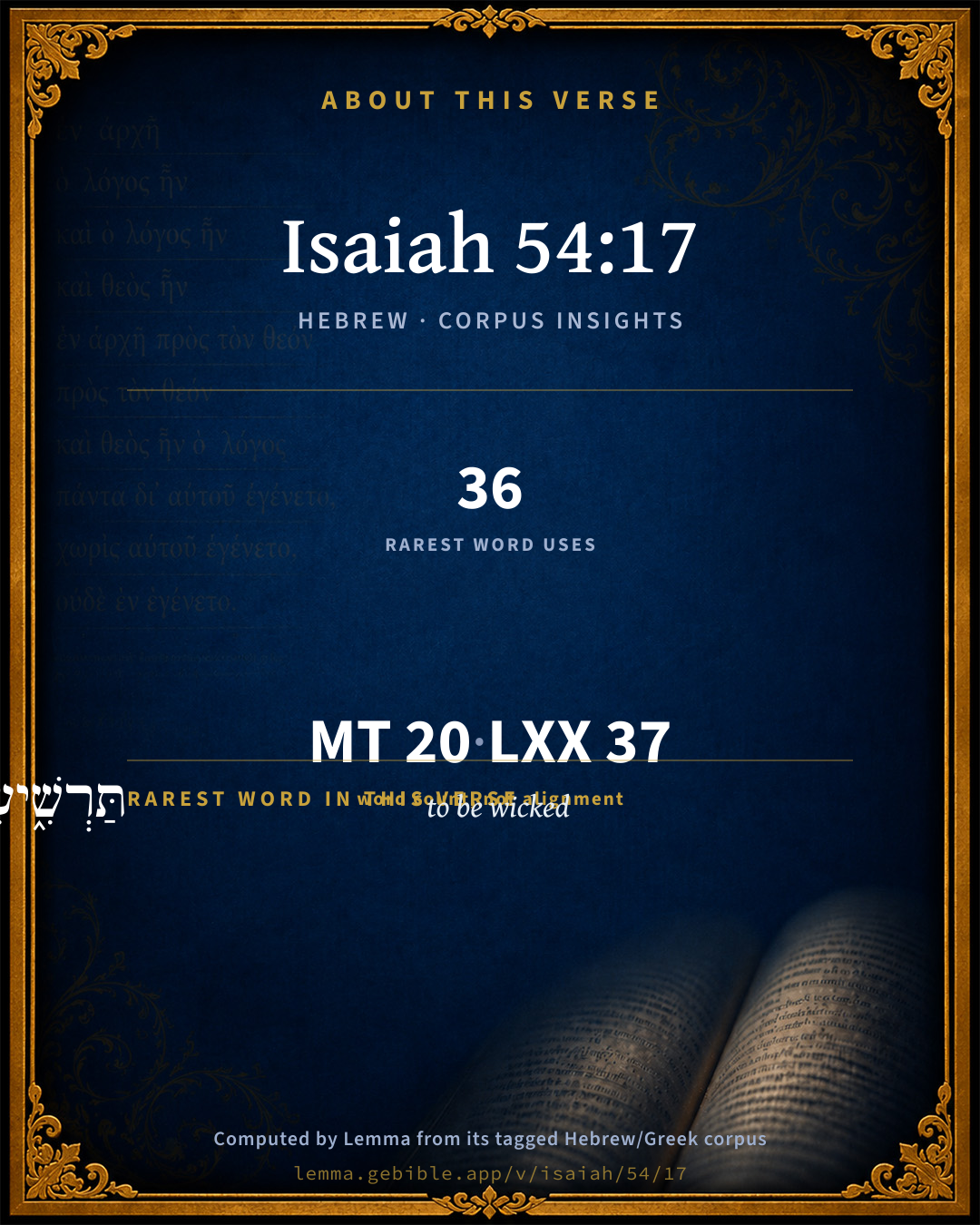
20
words
17
distinct lemmas
Prophets
section

Shared distinctive vocabulary

תַּרְשִׁ֑יעִי to be wicked H7561 occurs in 35 verses of the Hebrew Bible. Also found in:

Grammatical profile

  • 4 verbs
  • 11 nouns
  • 1 pronoun
  • 3 prepositions
  • 1 particle

Verb forms

  • יוּצַ֤ר Hophal · Imperfect
  • יִצְלָ֔ח Qal · Imperfect
  • תָּֽקוּם Qal · Imperfect
  • תַּרְשִׁ֑יעִי Hiphil · Imperfect

Repetition

Words recur within this verse — often emphatic in Hebrew:

  • כָּל all H3605 ×2
  • יְהוָ֧ה LORD H3068 ×2
  • אִתָּ֥ךְ with H854 ×2

Hebrew & Septuagint length

In English translation the verse runs 40 words from the Hebrew and 54 from the Septuagint (LXX English) — closely comparable.

A rough comparison of the two English renderings, which tokenize alike — not a word-level alignment.

Word counts can differ between the Hebrew and the Greek without any difference in meaning — e.g. the Hebrew direct-object marker אֵת has no separate Greek word, and Greek often adds the article ὁ.

In the original languages it is 20 Hebrew tokens and 37 Greek tokens — but the two are counted differently (Hebrew bundles its prefixes and suffixes into one token; the Greek is in lemma form), so that isn’t a like-for-like length.

Cross-references

32

Topical passages linked to Isaiah 54:17 in the Treasury of Scripture Knowledge — connected by theme and wording, ordered by reader-vote popularity; previews shown in the World English Bible.

  • Romans 8:28–39 We know that all things work together for good for those who love God, to those who are called according to his purpose.
  • Isaiah 54:15 Behold, they may gather together, but not by me: whoever shall gather together against you shall fall because of you.
  • John 10:28–30 I give eternal life to them. They will never perish, and no one will snatch them out of my hand.
  • Isaiah 50:8 He is near who justifies me; who will bring charges against me? Let us stand up together: who is my adversary? Let him come near to me.
  • Romans 8:1 There is therefore now no condemnation to those who are in Christ Jesus, who don't walk according to the flesh, but according to the Spirit.
  • Psalms 32:6 For this, let everyone who is godly pray to you in a time when you may be found. Surely when the great waters overflow, they shall not reach to him.
  • Psalms 2:1–6 Why do the nations rage, And the peoples plot a vain thing?
  • Matthew 16:18 I also tell you that you are Peter, and on this rock I will build my assembly, and the gates of Hades will not prevail against it.
  • Revelation 12:10 I heard a loud voice in heaven, saying, "Now is come the salvation, the power, and the Kingdom of our God, and the authority of his Christ; for the accuser of our brothers has been thrown down, who accuses them before our God day and night.
  • Daniel 6:20 When he came near to the den to Daniel, he cried with a lamentable voice; the king spoke and said to Daniel, Daniel, servant of the living God, is your God, whom you serve continually, able to deliver you from the lions?
  • Isaiah 29:8 It shall be as when a hungry man dreams, and, behold, he eats; but he awakes, and his soul is empty: or as when a thirsty man dreams, and, behold, he drinks; but he awakes, and, behold, he is faint, and his soul has appetite: so shall the multitude of all the nations be, that fight against Mount Zion.
  • Romans 10:4 For Christ is the fulfillment of the law for righteousness to everyone who believes.
  • 2 Corinthians 5:21 For him who knew no sin he made to be sin on our behalf; so that in him we might become the righteousness of God.
  • Psalms 61:5 For you, God, have heard my vows. You have given me the heritage of those who fear your name.
  • Isaiah 58:14 then shall you delight yourself in Yahweh; and I will make you to ride on the high places of the earth; and I will feed you with the heritage of Jacob your father: for the mouth of Yahweh has spoken it.
  • Isaiah 61:10 I will greatly rejoice in Yahweh, my soul shall be joyful in my God; for he has clothed me with the garments of salvation, he has covered me with the robe of righteousness, as a bridegroom decks himself with a garland, and as a bride adorns herself with her jewels.
  • Philippians 3:9 and be found in him, not having a righteousness of my own, that which is of the law, but that which is through faith in Christ, the righteousness which is from God by faith;
  • Jeremiah 23:6 In his days Judah shall be saved, and Israel shall dwell safely; and this is his name by which he shall be called: Yahweh our righteousness.
  • Psalms 71:19 Your righteousness also, God, reaches to the heavens; You have done great things. God, who is like you?
  • Daniel 3:26 Then Nebuchadnezzar came near to the mouth of the burning fiery furnace: he spoke and said, Shadrach, Meshach, and Abednego, you servants of the Most High God, come forth, and come here. Then Shadrach, Meshach, and Abednego came forth out of the midst of the fire.
  • Zechariah 3:1–4 He showed me Joshua the high priest standing before the angel of Yahweh, and Satan standing at his right hand to be his adversary.
  • Romans 6:22–23 But now, being made free from sin, and having become servants of God, you have your fruit of sanctification, and the result of eternal life.
  • 1 Corinthians 1:30 But of him, you are in Christ Jesus, who was made to us wisdom from God, and righteousness and sanctification, and redemption:
  • Job 42:7 It was so, that after Yahweh had spoken these words to Job, Yahweh said to Eliphaz the Temanite, "My wrath is kindled against you, and against your two friends; for you have not spoken of me the thing that is right, as my servant Job has.
  • Psalms 71:16 I will come with the mighty acts of the Lord Yahweh. I will make mention of your righteousness, even of yours alone.
  • Isaiah 45:24–25 Only in Yahweh, it is said of me, is righteousness and strength; even to him shall men come; and all those who were incensed against him shall be disappointed.
  • 2 Peter 1:1 Simon Peter, a servant and apostle of Jesus Christ, to those who have obtained a like precious faith with us in the righteousness of our God and Savior, Jesus Christ:
  • Romans 3:22 even the righteousness of God through faith in Jesus Christ to all and on all those who believe. For there is no distinction,
  • Ezekiel 38:9–10 You shall ascend, you shall come like a storm, you shall be like a cloud to cover the land, you, and all your hordes, and many peoples with you.
  • Job 22:5–30 Isn't your wickedness great? Neither is there any end to your iniquities.
  • Job 2:5 But put forth your hand now, and touch his bone and his flesh, and he will renounce you to your face."
  • Job 1:11 But put forth your hand now, and touch all that he has, and he will renounce you to your face."

Cross-references courtesy of OpenBible.info (CC BY 4.0).

Hebrew and Greek witnesses Masoretic Hebrew ↔ Greek Septuagint

The same verse in the two great witnesses to the Old Testament, shown verse-for-verse.

These are two independent witnesses, not word-aligned to each other, and the Septuagint is shown in lemma (dictionary) form.

Hebrew Isaiah 54:17 Masoretic · Westminster Leningrad Codex

כָּל כְּלִ֞י יוּצַ֤ר עָלַ֨יִךְ֙ לֹ֣א יִצְלָ֔ח וְכָל לָשׁ֛וֹן תָּֽקוּם אִתָּ֥ךְ לַמִּשְׁפָּ֖ט תַּרְשִׁ֑יעִי זֹ֡את נַחֲלַת֩ עַבְדֵ֨י יְהוָ֧ה וְצִדְקָתָ֛ם מֵאִתִּ֖י נְאֻם יְהוָֽה

No weapon that is formed against you shall prosper; and every tongue that shall rise against you in judgment you shall condemn. This is the heritage of the servants of Yahweh, and their righteousness which is of me, says Yahweh.

World English Bible · Public Domain

Greek LXX Isaiah 54:17 Septuagint · lemma form

πᾶς σκεῦος φθαρτός ἐπί σύ οὐ εὐοδόω καί πᾶς φωνή ἀναἵστημι ἐπί σύ εἰς κρίσις πᾶς αὐτός ἡττάω ὁ δέ ἔνοχος σύ εἰμί ἐν αὐτός εἰμί κληρονομία ὁ θεραπεύω κύριος καί σύ εἰμί ἐγώ δίκαιος λέγω κύριος

I will not suffer any weapon formed against you to prosper; and every voice that shall rise up against you for judgment, you shall vanquish them all; and your adversaries shall be condemned thereby. There is an inheritance to them that serve the Lord, and you⌃ shall be righteous before me, says the Lord.

LXX2012 (modern English Septuagint) · Public Domain

Hebrew: Westminster Leningrad Codex (CC BY 4.0). Greek: Septuagint (public domain); English from LXX2012 (modern English Septuagint) (Public Domain). How the Septuagint differs from the Hebrew →

Targum (Aramaic paraphrase)

1

The Targum is the ancient Jewish Aramaic paraphrase of the Hebrew Scriptures — an interpretive translation, not the Hebrew text itself. Onkelos (literal) and Pseudo-Jonathan (expansive) render the Torah, and Jonathan the Prophets. Coverage is partial: where no permissively-licensed English translation exists for a verse, only the Aramaic is shown. This is verse-level text, not a word-by-word alignment to the Hebrew.

  1. Targum Jonathan Prophets (Joshua–Malachi)
    כָּל זַיִן דְיִתַּקַן עֲלַךְ יְרוּשְׁלֵם לָא יַצְלַח וְכָל לִישָׁן דִיקוּם עִמָךְ לְדִינָא תְּחַיְבִינֵהּ דָא אַחְסָנַת עֲבָדַיָא דַייָ וְזַכְוָתֵיהוֹן מִן קֳדָמַי אֲמַר יְיָ:

    No weapon that is formed against thee, O Jerusalem, shall prosper; and every tongue that shall rise against thee in judgment thou shalt condemn. This is the heritage of the servants of the Lord, and their righteousness is from me, saith the Lord.

    Targum Jonathan — Aramaic: “Mikraot Gedolot” (public domain). English: “Sefaria Community Translation” (CC0 1.0 (public-domain dedication)); “London "Chaldee Paraphrase," 1871” (public domain). Text via Sefaria.

Commentary

Notes on Isaiah 54:17 from classic Christian and Jewish commentators (each source and its license shown beneath its notes). The classic Christian expositions comment on the surrounding passage and are grouped to its opening verse, so a note may address several verses; the Jewish commentaries on the Tanakh (Rashi and others) are per-verse, so they appear only where the commentator wrote on this verse.

Lemma curates 59 commentaries, every one of them public domain or Creative Commons licensed, each selected and text-cleaned for this edition rather than reprinted as found. About our sources →

Trapp's Complete Commentary

John Trapp

Isa 54:17 No weapon that is formed against thee shall prosper; and every tongue [that] shall rise against thee in judgment thou shalt condemn. This [is] the heritage of the servants of the LORD, and their righteousness [is] of me, saith the LORD.

Ver. 17. No weapon that is formed against thee shall prosper.] But shall be, as the poets feign of Ajax’s sword, which so long as he used against men, his enemies, served for help and defence; but after he began to abuse it to the harm of harmless beasts, it turned into his own bowels.

And every tongue thou shalt condemn.] As the eclipsed moon, by keeping her motion, wades out of the shadow, and recovers her splendour, so shalt thou when slandered. See Psa 37:6. {See Trapp on "Psa 37:6"}

This is the heritage.] Given them freely, and for perpetuity.

And their righteousness.] The clearing up of their wronged innocence.

John Trapp, A Commentary or Exposition upon All the Books of the Old and New Testament (1647–1656) — public domain. Text from a community e-Sword module.

The Biblical Illustrator

Joseph S. Exell

Isa_54:17

No weapon that is formed against thee shall prosper

Worthless weapons

I.

GLANCE AT THE WEAPONS WHICH HAVE BEEN USED AGAINST THE CHURCH COLLECTIVELY.

1. The first weapon that we notice is an old one--Infidelity. Nothing can be more palpable than this--humanity refuses to be infidel.

2. Behold another of these hostile implements is the weapon of persecution. A weak weapon, nevertheless.

II. AS REGARDS THE CHURCH INDIVIDUALLY NO WEAPON THAT IS FORMED AGAINST IT SHALL PROSPER.

1. The weapon of slander shall not prosper.

2. The weapon of doubt.

3. The weapon of death. (T. R. Stevenson.)

The godly mans heritage

I. THE ARMOURY OF SATAN. The enemy of souls is likened by our Lord to a strong man armed; He commands principalities and powers; skilled in hostilities, He has different modes of attack; He employs a great variety of weapons.

1. Persecution. And yet, when we estimate the results of persecution, we have to confess it has not prospered. It has been mightily restrained, and its remains have been turned to the praise of God. It has purified the Church, and given new impetus to the truth. Sometimes it has united the despised forces of Zion, so that their strength has been greatly increased.

2. Temptation. With this weapon the archer sorely wounded our first parents, and he has ever since too successfully hurled it against their progeny. But it does not prosper; it strips us of self-confidence, eradicates pride, drives us for safety to the Hiding Place, and presses upon us the constant necessity for that shield of faith which quenches all the fiery darts of the wicked. You cannot afford to despise temptations; but you need not despair under them while you call in the aid engaged to you.

3. False teaching. Clothed as an angel of light, the tempter first instilled error into the mind of Eve, before he could produce disobedience. It is no light affliction to have the minds view of Divine truth perverted. Various, however, as are the shades of false teaching, they do not prosper--they flourish for a time like grass upon the housetops, but they fill no mans bosom with harvest sheaves. The Word of God outlives them all. Each of those weapons was directed with fullest force against the Son of God.

II. THE WORLDLY MANS MALICE. Every tongue that shall rise against thee in judgment thou shalt condemn. The slightest whisper of suspicion is greedily sought after, if it cast but a shadow on the character of any saint, and it, is repeated till it grows to calumnious dimensions, and eateth as doth a canker. The worst manifestation of this malignant plague is that which makes its appearance within the Church: when those who should be the guardians become the assailants of a brothers character, and prejudice and suspicion displace confidence and charity. In the ease of the true Christian, integrity of life will disappoint all the aspersions of the wicked.

III. THE GODLY MANS VINDICATION. This is the heritage of the servants of the Lord, and their righteousness is of Me, saith the Lord. What an inheritance it is! It comprises all the blessings contained in Gods Word; and the fulfilment of all His gracious, promises. (W. G. Lewis.)

The Christians heritage

I. THE CHRISTIANS EXPERIENCE.

1. Weapons are formed against him. No Christian need expect aught else. As Israels experience in the wilderness, so the Christians in the world.

2. Tongues rise against him. From the days of Cain it has been so, and will be so to the end. So they treated the Lord, and so they will treat His disciples.

II. THY CHRISTIANS SECURITY.

1. No weapon shall prosper. The Christians enemies may be mighty, malignant, crafty, constant; but more mighty, more wise, more watchful, more indefatigable and loving is his protector.

2. Every tongue he shall condemn.

(1) He shall do it himself by well-doing (1Pe_2:15).

(2) God shall do it for him.

(3) It shall be done sufficiently on earth (Psa_37:6).

(4) Perfectly in eternity (Job_19:25).

See also Zec_3:1-10. Let Christians see to it that they so live that men speaking evil of them shall do it falsely, and God shall fully vindicate them. Who has this security? and in answer see--

III. THE CHRISTIANS CHARACTER. The servants of the Lord. This security is described as--

IV. THY CHRISTIANS HERITAGE; and this description may teach us--

1. That while the Christian is a servant, he is also a son and heir.

2. That his security is a thing not of merit, but of inheritance. It is a legacy secured to him by the death of Christ. It is the Fathers good pleasure to give them the kingdom.

3. We may be sure that a heritage from God is a certain possession. He is without variableness or shadow of turning.

V. THE CHRISTIANS TITLE. Perhaps this last clause had been better translated uniformly with previous one: And this is their righteousness (justification) from Me. But taking it as we have It, we may interpret it as teaching us

1. That the Christians justification is of God. It is the righteousness which is of God by faith.

2. That the Christians sanctification is of God. It is He who worketh in him to will and to do of Gods good pleasure.

3. That boasting is excluded. What hast thou that thou hast not received?

4. That security is perfect; for if God justify, who can condemn Rom_8:34)? and if God sanctify, He will perfect that which concerneth us. This clause thus explains as well as ratifies the promise, and, farther, it tells us how we may secure this promise for ourselves. Righteousness we have not by nature, righteousness we cannot attain of ourselves--but righteousness we may receive from God. (D. Jamison, B. A.)

Their righteousness is of Me, saith the Lord

Justification through imputed righteousness

In these words, which are spoken of all true believers, more particularly, we may observe--

I. THE FOUNDATION OF THEIR ACCEPTANCE WITH GOD, AND OF ALL THE GLORIOUS PRIVILEGES THAT THEY ENJOY OR ARE ENTITLED TO. It is a righteousness; such a righteousness as answers all the demands of the Divine law, a righteousness with which God is well pleased.

II. HOW BELIEVERS BECOME POSSESSED OF THIS RIGHTEOUSNESS, They have it not of themselves. It is not a righteousness wrought out by them or inherent in them, but a righteousness which they have of God. God, in the person of the Father, devised and provided it; God, in the person of the Son, wrought it out for them. It is also through the gracious operation of the Holy Spirit, enabling them to believe the report of the Gospel, and receive Christ exhibited and freely offered to them in it, that they come to be actually possessed of this righteousness.

III. THE INTEREST THAT BELIEVERS HAVE IN THAT RIGHTEOUSNESS WHICH IS THE GROUND OF THEIR JUSTIFICATION. It is called their righteousness. Though it is not theirs originally or subjectively, it is theirs really. It is theirs by the free gift of God.

IV. THE CERTAINTY OF THE GREAT AND IMPORTANT TRUTH ASSERTED IN THE TEXT, namely, that the righteousness of believers, or that righteousness by which they are justified, and on which their title to everlasting life and all the blessings of salvation is wholly founded, is a righteousness which they have not of themselves, but of God, or by His free gift and gracious imputation. This is what Jehovah Himself declares and attests in the plainest manner: Their righteousness is of Me, saith the Lord. (D. Wilson.)

The excellent properties and qualities of that righteousness by which believers are justified

It is--

1. A perfect righteousness.

2. A Divine righteousness.

3. A justice-satisfying righteousness.

4. A law-magnifying righteousness.

5. A God-glorifying righteousness.

6. A righteousness that is freely given to the unworthy and the guilty.

7. An everlasting righteousness. (D. Wilson.)

The Biblical Illustrator, edited by Joseph S. Exell (c. 1880s–1900s) — public domain. Text from a community e-Sword module.

The Preacher's Complete Homiletical Commentary

Joseph S. Exell (gen. ed.)

THE CHRISTIAN’S HERITAGE

Isa_54:17. No weapon that is formed against thee shall prosper, &c.

I. THE CHRISTIAN’S EXPERIENCE.

1. Weapons are formed against him. No Christian need expect aught else. As Israel’s experience in the wilderness, so the Christian’s in the world. The devil will try to hinder his progress, &c The world, too, in various ways—by its cares, snares, &c. The law in his members also will war against the law of his mind. He must fight his way, “fight the good fight of faith,” fight under the banner “Jehovah-Nissi,” fight, “putting on the whole armour of God.”

2. Tongues rise against him. From the days of Cain it has been so, and will be so to the end. Christians need not think it strange if they are mocked, maligned, misrepresented, all manner of evil said against them. So they treated the Lord, and so they will treat His disciples (Joh_15:9). But while this shall be, more or less, the experience of every Christian, learn, over against it—

II. THE CHRISTIAN’S SECURITY.

1. No weapon shall prosper. His enemies may be mighty, &c. but more mighty, wise, watchful, indefatigable and loving is his protector. He is perfectly safe. This does not mean, however, that he is not to use expedients—to watch and pray, to resist and strive.

2. Every tongue he shall condemn. (I.) He shall do it himself by welldoing (1Pe_2:15).

(2.) God shall do it for him.

(3.) It shall be done sufficiently on earth (Psa_37:6).

(4.) Perfectly in eternity (Job_19:25).

3. Let Christians see to it that they so live that men speaking evil of them shall do it “falsely,” and God shall fully vindicate them.

But now the question comes, Who has this security? and in answer see—

III. THE CHRISTIAN’S CHARACTER. “The servants of the Lord.” Only real Christians, to whom this security is given, i.e., those whose faith is a real root within and bears corresponding fruit without. Many arrogate such promises as this who have no right to them. They only who keep the precepts reap the promises. We must be servants if we would be safe. It is he who serves that the Lord preserves; none other (Mat_7:21).

This secunty is further described as—

IV. THE CHRISTIAN’S HERITAGE. This description may teach us—

1. That while he is a servant, he is also a son—son and heir. Each believer may say with John (1Jn_3:1-2).

2. That his security is a thing not of merit, but of inheritance. It is a legacy secured to him by the death of Christ (Luk_12:32).

3. We may be sure that a heritage from God is a certain possession (Jas_1:17).

V. THE CHRISTIAN’S TITLE.

1. The Christian’s justification is of God (Php_3:9).

2. His sanctification is of God (Php_2:13).

3. Boasting is excluded. “What hast thou that thou hast not received?”

4. His security is perfect. If God justify, who can condemn? (Rom_8:34.) And if God sanctify, He will perfect that which concerneth us. This clause thus explains as well as ratifies the promise, and, further, it tells us how we may secure this promise for ourselves. Righteousness we have not by nature; we cannot attain it of ourselves; but we may receive it from God. Let us seek it by faith in Christ, and He will be “the Lord our righteousness,” and then this glorious heritage is ours. What a different one from that of the wicked (Job_20:1-29).—David Jamison, B.A.: The Homiletic Quarterly, vol. iv. p. 538.

WORTHLESS WEAPONS

Isa_54:17. No weapon that is formed against thee shall prosper

Old castles contain many relics of the past, and on the walls hang many weapons of ancient date. To such a place the Church may be likened. A divine and secure citadel, it contains not a few victorious trophies—signs of its enemies’ defeat.

I. Some of the weapons that have been used against the Church collectively.

1. The first that we notice is very old. It was employed against Noah, Job, David, all who have been called to do great things for God. What is its name? Infidelity. But it has not prospered. Humanity refuses to be infidel. Sinners abound, not sceptics. Atheism, like physical deformity, is the exception, not the rule. The soul must have something to live upon. Again and again the foes of Christianity have become its converts in their very attempts to destroy it: Athenagoras, Gilbert West, Lord Lyttelton.

2. Behold another of these hostile implements. Its edge is keen; it gleams with cruel hate; there are crimson stains on it. Its name? Persecution. It has inflicted frightful, gaping wounds; it has taken many an innocent life; history is full of records of its merciless deeds. But it is a weak weapon, nevertheless. It has purified the Church oftentimes, by driving away the hypocrites and leaving the true believers; it has increased the Church by scattering abroad its preachers, who in new fields have made fresh converts; but it has not destroyed the Church. It has not prospered.

II. But the promise is true of the individual believer as well as of the Church. How hopeful, how happy, ought every believer to be! The soul of the good man is invulnerable.

1. The weapon of SLANDER shall not prosper. At one time or another all God’s servants are attacked by it. But in the end none of them is any the worse for it. God will take care of the reputations of His people. Are you slandered? Do as David did (Psa_119:6). So you may smile at your calumniators. The hour of your vindication is at hand (Psa_37:5-6).

2. The weapon of DOUBT shall not prosper. Like other men, the believer is assailed by doubts; but they do but cause him, as they did John the Baptist (Mat_11:2-3), to apply to Christ for their solution; and by Him he is settled and grounded in the truth, to which he clings the more firmly because he remembers how nearly he lost it.

3. The weapon of DEATH shall not prosper. He who trusts in God’s mercy through the substitution of Jesus Christ need not be alarmed at this weapon. You probably recollect handsome, brave Sir Walter Raleigh’s remark when he put his finger on the edge of the horrible axe which was speedily to end his life: “It is a sharp medicine, but it is a cure for all ills.”—T. R. Stevenson: Christian World Pulpit, vol. iii. pp. 244.

The meaning of this is that the Church of God cannot be destroyed.

I. GOD’S CHURCH HAS ALWAYS ENCOUNTERED OPPOSITION.

It has been persecuted. Its Divine origin has been and is disputed. There have always been enemies that have sought its destruction, &c.

That the Head of the Church should expose His truth to attack at all, is strange at first sight. But,

1. Opposition tests the sincerity of discipleship.

2. Keeps alive the evidence for the truth, which otherwise might drop out of recollection.

II. GOD’S CHURCH HAS SURVIVED OPPOSITION.

Thus this word has been hitherto fulfilled. [1686]

[1686] The language here is derived probably from courts of justice, and the idea is, that truth and victory, in every strife of words, would be on the side of the Church. To those who have watched the progress of discussions thus far on the subject of the true religion, it is needless to say that this has been triumphantly fulfilled. Argument, sophism, ridicule, have all been tried to overthrow the truth of the Christian religion. Appeals have been made to astronomy, geology, antiquities, history, and indeed to almost every department of science, and with the same want of success. Poetry has lent the charm of its numbers; the grave historian has interwoven with the thread of his narrative covert attacks and sly insinuations against the Bible; the earth has been explored to prove that “He who made the world and revealed its age to Moses was mistaken in its age;” and the records of Oriental nations, tracing their history up cycles of ages beyond the Scripture account of the creation of the world, have been appealed to; but thus far, in all these contests, ultimate victory has declared in favour of the Bible. And no matter from what quarter the attack has come, and no matter how much learning and talent have been evinced by the adversaries of the Bible; God has raised up some Watson, or Lardner, or Chalmers, or Buckland, or Cuvier, or Wiseman, to meet these charges, and to turn the scales in favour of the cause of truth.—Albert Barnes, D.D., Commentary, in loco.

1. Through persecution it has been preserved.

2. Notwithstanding enfeebling influences it has been preserved. It has often been exposed to bad air. For malism and superstition. Yet it has more adherents to-day than ever, and is growing.

3. Notwithstanding the attitude of scepticism and unbelief. Changes its front at different periods. Sometimes the literary history of the Bible is attacked; sometimes the reality of its facts; sometimes its miracles; some times its supposed incompatibility with scientific doctrines. Hitherto, however, it has always stood its ground, and emerges from every conflict stronger than before.

All this proves—

1. That the Gospel, which is the life of the Church, is commended by the strongest evidence.

2. That the Gospel is perpetuated by supernatural influences. Gibbon elaborated five secondary causes of the rapid and extensive propagation of the Gospel in the first centuries. They are true as far as they go. But he slurs over in a sentence a cause still greater, namely, the power of the Holy Spirit. This is a continuous miracle. Conversion is always the work of God. Every fresh convert is a fresh evidence of the truth.

3. That God’s Church and cause shall be maintained until its mission is accomplished. Notwithstanding all difficulty, all opposition, all new forms of unbelief, it shall fulfil this prophecy in the future as it has in the past.—J. Rawlinson.

The Preacher's Complete Homiletical Commentary (gen. ed. Joseph S. Exell; Funk & Wagnalls, c. 1892) — public domain (pre-1929). A full-Bible homiletical/sermon-outline anthology covering 65 of 66 books (2 John is absent from the source module). Text from a community e-Sword module.

Tyndale Open Study Notes

Tyndale Open Resources

54:17 no weapon . . . will succeed . . . accuse you . . . vindication: God will protect his people in war and in the courtroom. • These benefits are enjoyed by the servants of the Lord: Only the true children of God—people who come out of Israel and the nations—will enjoy the promised blessings of the age to come that God establishes.

Tyndale Open Study Notes — © Tyndale Open Resources, licensed CC BY-SA 4.0. Text via the HelloAO Bible API.

Jamieson, Fausset & Brown

Robert Jamieson, A. R. Fausset & David Brown

tongue . . . condemn--image from a court of justice. Those who desire to "condemn" thee thou shalt "condemn" (Exo 11:7; Jos 10:21; Psa 64:8; Rom 8:1, Rom 8:33).

righteousness . . . of me-- (Isa 45:24; Isa 46:13). Rather, "(this is) their justification from Me." Their enemies would "condemn" them, but I justify and vindicate them, and so they condemn their enemies.

Next: Isaiah Chapter 55

Jamieson, Fausset & Brown — Commentary Critical and Explanatory on the Whole Bible (1871) — public domain (CC PDM 1.0). Text via the HelloAO Bible API.

Ellicott's Commentary for English Readers

(17) Every tongue that shall rise . . .—The thought implied is that war comes as the punishment of guilt, and that it is preceded by the “cry” of accusation. Many such cries had risen up against the old Jerusalem (Isa_5:7). There should be none such heard against the new.

This is the heritage.—The solemn asseveration indicates the close of a distinct section.

A Bible Commentary for English Readers, edited by Charles John Ellicott (1878–1897) — public domain. Text from a community e-Sword module.

The Cambridge Bible for Schools and Colleges

gen. ed. J. J. S. Perowne

17. Israel therefore has no cause to fear any material weapon, and even the Satanic weapon of false accusations, which assail her righteous standing before God, she shall be able to foil.

every tongue … thou shalt condemn] i.e. shew to be in the wrong (cf. ch. Isa_50:8 f.).

This is the heritage &c.] A concluding summary. “This,” viz., all the blessings just enumerated, peace, righteousness, security, triumph over opposition.

of the servants of the Lord] The title “servants of Jehovah” (in the plural) has not hitherto been used in the prophecy (with the doubtful exception of ch. Isa_44:26, where it denotes the prophets). It is possible that its occurrence here forms a link of connexion between this chapter and the last. The ideal represented by the Servant of Jehovah is now reproduced in each individual member of the new Israel; they are all of the spiritual seed which was promised to him, and the salvation they enjoy is the fruit of the travail of his soul (Isa_53:10-11). It is noteworthy, at all events, that while from this point the Israelites are spoken of as servants of Jehovah, the ideal Servant is never again mentioned.

and their righteousness is of me] Rather, and (this is) their righteousness from me. The righteousness, or justification, bestowed on them by Jehovah (cf. Psa_24:5) is manifested in such blessedness as has just been spoken of.

The Cambridge Bible for Schools and Colleges (gen. ed. J. J. S. Perowne; Cambridge University Press, 1878–1918) — public domain. Text from a community e-Sword module.

John Gill's Exposition

No weapon that is formed against thee shall prosper,.... All weapons of war, as the Targum, which are made with a design to hurt and destroy the people of God, shall be rendered useless; not one of them shall prosper to the advantage of their enemies, or so as to answer their design; nor to the hurt and prejudice, ruin and destruction, of the saints:

and every tongue that shall rise against thee in judgment; that shall raise any calumny upon thee, or bring any charge against thee, or enter into a lawsuit with thee, litigate a point with thee in any court of judicature, or claim, in right and law, a power, authority, and dominion over thee, as the pope of Rome does over the consciences of men:

thou shalt condemn; disprove and roll off the calumny, refute the charge and accusation, put to silence the clamours and pretences of wicked men, carry the cause against them, and shake off the yoke of bondage they would bring them under; and, instead of being condemned by them, condemn them. By "weapon" may be meant all the attempts made by force to ruin the interest and church of Christ in the world, such as the bloody persecutions of the Roman emperors, who, though they made sad havoc of the professors of Christianity, and designed hereby to have rooted it out of the world, and thought they should have accomplished it, yet could not do it; so far from it, that the Christians yet more and more increased, insomuch that it became a common saying, that the blood of the martyrs was the seed of the church; also the wars of the Papists with the Albigenses and Waldenses, and all the cruel methods they have taken by fire and faggot, and the bloody inquisition, to hinder the growth of what they call heresy; yet all have been in vain, a reformation has taken place, and many nations have embraced the truth, and shook off the yoke of Popery; together with all their efforts since to crush the Protestant interest; and though the kings of the earth will be stirred up, and gather together to the battle of the Lord God Almighty, they will not succeed, but be overcome and slain, and the beast and false prophet at the head of them will be taken and cast alive into the lake of fire: and by the "tongue" may be designed the edicts of the Pagan emperors, forbidding the exercise of the Christian religion, and threatening the preachers and professors of it with imprisonment, confiscation of goods, and death itself; and the anathemas, bulls, and interdicts of the popes of Rome, as well as the reproaches, scandals, and calumnies uttered by the emissaries of that church against all that depart from it; together with the errors and heresies of false teachers of all sorts in all ages of the world, which, though levelled against the faith and doctrine of the church of Christ, have not been able to subvert it, nor ever will:

this is the heritage of the servants of the Lord; this, with all that is said in this chapter, is the part, portion, and privilege, that such shall enjoy who serve the Lord Christ, and not antichrist; they shall be treated rather as sons than as servants, and have an inheritance assigned them; not only protection from all enemies, and absolution from all charges, but they shall receive the reward of the inheritance in heaven, that which is incorruptible and undefiled, and reserved there, since they serve the Lord Christ:

and their righteousness is of me, saith the Lord; the vindication of their righteousness, of their cause, and of their character; or the reward of their righteous works in a way of grace; even all that righteousness and true holiness that is in them, and that righteousness which is imputed to them, and by which they are justified, are from the Lord; by which they are secured from all the charges of law and justice, and, from all the accusations of men and devils, and which will answer for them in a time to come, and acquit them at the bar of God before men and angels; see Rom 8:33.

Next: Isaiah Chapter 55

John Gill's Exposition of the Whole Bible (1746–1763) — public domain (CC PDM 1.0). Text via the HelloAO Bible API.

Albert Barnes' Notes on the Bible

No weapon that is formed - No instrument of war, no sword, or spear; no instrument of persecution or torture that is made by the smith, Isa 54:16.

Shall prosper - On the meaning of this word, see the notes at Isa 52:13. The sense here is, that it shall not have final and ultimate prosperity. It might be permitted for a time to appear to prosper - as persecutors and oppressors have done; but there would not be final and complete success.

And every tongue - No one shall be able to injure you by words and accusations. If a controversy shall arise; if others reproach you and accuse you of imposture and deceit, you will be able ultimately to convince them of error, and, by manifestation of the truth, to condemn them. The language here is derived probably from courts of justice (see the notes at Isa 41:1); and the idea is, that truth and victory, in every strife of words, would be on the side of the church. To those who have watched the progress of discussions thus far on the subject of the true religion, it is needless to say that this has been triumphantly fulfilled. Argument, sophism, ridicule, have all been tried to overthrow the truth of the Christian religion. Appeals have been made to astronomy, geology, antiquities, history, and indeed to almost every department of science, and with the same want of success. Poetry has lent the charm of its numbers; the grave historian has interwoven with the thread of his narrative covert attacks and sly insinuations against the Bible; the earth has been explored to prove that’ He who made the world and revealed its age to Moses was mistaken in its age;’ and the records of Oriental nations, tracing their history up cycles of ages beyond the Scripture account of the creation of the world, have been appealed to, but thus far in all these contests ultimate victory has declared in favor of the Bible. And no matter from what quarter the attack has come, and no matter how much learning and talent have been evinced by the adversaries of the Bible, God has raised up some Watson, or Lardner, or Chalmers, or Buckland, or Cuvier, or Wiseman, to meet these charges, and to turn the scales in favor of the cause of truth. They who are desirous of examining the effects of the controversy of Christianity with science, and the results, can find them detailed with great learning and talent in Dr. Wiseman’s Lectures on the connection between Science and Revealed Religion, Andover, 1837.

This is the heritage - The inheritance which awaits those who serve God is truth and victory. It is not gold and the triumph of battle. It is not the laurel won in fields of blood. But it is, the protection of God in all times of trouble; his friendship in all periods of adversity; complete victory in all contests with error and false systems of religion; and preservation when foes rise up in any form and endeavor to destroy the church, and to blot out its existence and its name.

And their righteousness is of me - Or rather, ‘this is the righteousness, or the justification which they obtain of me; this is that which I impart to them as their justification.’ The idea is not that their righteousness is of him, but that this justification or vindication from him is a part of their inheritance and their portion.

Albert Barnes' Notes on the Bible (1834–1885) — public domain. Text from a community e-Sword/MySword module.

Matthew Poole's English Annotations

No weapon that is formed against thee shall prosper; and as they cannot do any thing against thee without my leave, so I assure thee I will not suffer them to do it; and if any smith shall make any weapons to be employed against thee, he shall not succeed in it.

And every tongue that shall rise against thee in judgment thou shalt condemn; and I will deliver thee not only from the fury of the war, but also from the strife of tongues, from all the threatenings, and boasts, and reproaches of thine enemies, and from all the claims and pretences which they have of any right and power over thee. So thine enemies shall neither prevail against thee by violence, nor by pretences of justice.

This is the heritage; this blessed condition described in this chapter is the portion allotted to them by me.

Their righteousness; either,

1. The reward or fruit of their righteousness, as righteousness is used, Psa 112:3,9. Or,

2. Their right or the righteous administration of all their concerns, whereby they are preserved from all manner of oppressions, as righteousness was used, Isa 54:14. Is of me; I give it, and I will continue it to them; and who then can take it away from them?

Matthew Poole's English Annotations on the Holy Bible (1683–1685) — public domain. Text from a community e-Sword/MySword module.

Whedon's Commentary on the Bible

Daniel D. Whedon

17. No weapon… against thee shall prosper — An address of encouragement to Zion. No tongue entering into contest with thee shall prevail. Opposition, physical, ethical, spiritual, shall be discomfited Such is the heritage of God’s people — namely, his infallible promise, and his power to maintain and completely fulfil it.

Daniel D. Whedon (gen. ed.), Commentary on the Old and New Testaments (1874–1909) — public domain. Text from a community e-Sword module.

The Pulpit Commentary

No weapon... every tongue. Whether weapons are used against Israel, or whether she is attacked, as in Sennacherib"s time, by "the tongue that speaketh proud things", (Isa_36:4-20 Isa_37:10-13) the result will he the same. She will triumph over her enemies, and condemn them or put them to shame. Her security is her righteousness, which she derives from Jehovah. (comp. Isa_45:24, Isa_45:25)

Man"s righteousness is of God.

Whatever there is in man of goodness, virtue, sound or right feeling, high aspiration, spiritual strength, comes to him from the Almighty, from whence descends "every good gift and every perfect gift". (Jam_1:17) Original righteousness was from God. (Gen_1:27, Gen_1:31) When man fell, and "corrupted his way," recovery was impossible, unless God both devised a method by which it should be possible, and also superintended the working of his own method, and at each step made it effectual. The righteousness of the servants of God is a double righteousness, imputed and infused; but both come equally from the perfectly "righteous Servant", (Isa_53:11) who alone "justifies many.

I IMPUTED RIGHTEOUSNESS IS OF GOD. Imputed righteousness is the righteousness of God; for it is the righteousness of Christ, who is God. Christ is made to us" wisdom, and righteousness, and sanctification, and redemption". (1Co_1:30) The righteousness which is properly his, and which is a perfect righteousness, is, through our mystic union with him, imputed to us, as if it were ours, and so becomes ours, and justifies us. It is also "of God," since it is imputed to us by God. God the Father condescends to look upon us as so bound up in his Son that he passes on to us the merits of his Son, and, as it were, makes them ours.

II INFUSED RIGHTEOUSNESS IS OF GOD. Infused righteousness is the work of the Holy Spirit, who "sanctifies us, and all the elect people of God." It admits of infinite degrees, and in this life is always imperfect. The true Christian is always making progress in it, adding grace to grace, going on from strength to strength, perfecting holiness in the tear of God. But every step is made by God"s help. Without him man can do nothing. Every virtue that we have is also a grace a grace from the Divine point of view, a virtue from the human; with struggle and effort acquired by man, yet given to him by God. Imputed righteousness is that which justifies us; infused righteousness is that which sanctifies us. The one is a gift to us; the other is a gift in us. But both alike are the gift of God. (see Rom_3:21-26 Rom_5:15-19 1Co_4:7 1Co_15:10 Gal_5:22, 23 Eph_5:9, etc.)

The heritage of faithful service.

From the beginning to the end of the Scriptures the service of God is represented as the only wise course for men to take. All paths of disobedience are spoken of as ways of folly as well as of sin. It is godliness that has the promise of all things, here and hereafter. The heritage of the holy is very variously defined, the most remarkable definition being that given by our Lord in reply to Peter. (vide Mar_10:28-31) In the text we have it presented to us as a continual victory. No weapon formed against the righteous shall prosper, and every accusation shall be silenced. God will justify them. The faithful service of Christ is marked by victory over

I SUCCESS IN OUTWARD LIFE. Few weapons are so powerful as this in the hand of the enemy. Many are they who, in their folly, have allowed their prosperity to destroy them. (Pro_1:32) The sense of power, the enjoyment of popularity, the command of comforts, the continuance of success in the chosen vocation, these things prove too much for many souls. Under their influence men swerve from the straight line of simplicity of life, humility of spirit, purity of heart, integrity of character.

II ADVERSE CIRCUMSTANCES. These are often found to be victorious over men, triumphing over their faith in God, their gratitude, and their submission; leading down to sullenness and moroseness of spirit; in some cases conducting to unbelief and impiety.

III PRIVATION OF PRIVILEGE. When it is a man"s fortune to be separated from the community and to lead a life of comparative loneliness, he is cast much on his own resources. He misses the encouragement and inspiration which come from social worship and collective piety. Without the aid and influence of these, he is in danger of fainting and falling in his Christian course.

IV EXPOSURE TO CORRUPT COMPANIONSHIP. This is often a matter of necessity and not of choice. The best may have to submit to it, and the peril of spiritual injury from it is very great.

V THE FORCE OF A SURROUNDING SCEPTICISM. A force which either vigorously assaults the main fortress of the faith or sedulously and stealthily undermines the wails a great and growing peril.

It is promised to the servants of the Lord that they shall triumph over these various enemies. "No weapon that is formed," etc. But while

(1) God"s promise may well cheer his servants, helping them to pursue their troubled path, and to do their difficult or dangerous work with alacrity and hope; it is well that

(2) his conditions should be remembered. There is no absolute, unconditional guarantee; the careless, the disobedient, the negligent servant will be, nay, he is, defeated by the enemy; he yields and falls. But let a man be a faithful servant, studious of Christ"s will and daily seeking his Holy Spirit"s aid, and he will find that his Divine Lord will "always cause him to triumph;" he will know "the exceeding greatness of his power" to uphold and to perfect. Meantime, to those who are observers,

(3) God"s sustaining grace will prove the sign and seal of his Divine favour. "This is their righteousness justification of me. C.

The Pulpit Commentary (1880–1919), ed. H.D.M. Spence-Jones & Joseph S. Exell — public domain. Text from a community e-Sword module.

John Wesley's Explanatory Notes

Condemn - And I will deliver thee not only from the fury of war, but also from the strife of tongues. This - This blessed condition, is the portion allotted them by me. Righteousness - The reward of their righteousness. Of me - I give it, and I will continue it to them.

John Wesley, Explanatory Notes Upon the Whole Bible (1754–1765) — public domain. Text via the GEBible commentary corpus.

J. A. Alexander on Isaiah

Joseph Addison Alexander

“Every weapon (that) shall be formed against thee shall to prosper, and every tongue (that) shall rise with thee in judgment thou shalt condemns. This is the heritage of the servants of Jehovah, and their righteousness from me, saith Jehovah.” The common version of the first clause expresses the same thought in the English idiom, ‘no weapon that is formed against thee shall prosper’, a form of speech which does not exist in Hebrew, and can only be supplied by combining negative and universal terms. The expression, though ambiguous, is determined by the context. It cannot mean that only some of the weapons formed should take effect, which might be the meaning of the phrase in English, because in the affirmative clause which follows, and which must be co-extensive in its meaning, there is no such ambiguity, it being said expressly that every tongue shall be condemned. Another difference of idiom here exemplified has reference to the ellipsis of the relative pronoun, which in English is familiarly omitted when the object of the verb, but never when its subject. ‘Every weapon they form’ would be perfectly intelligible; but ‘every weapon is formed’ (for which is formed) would convey a wrong idea. ‘Shall not prosper’, (i.e., shall not take effect or accomplish its design). ‘To rise or stand in judgment,’ literally for or with respect to judgment, is to appear before a judgment-seat, to invoke the decision of a judge. ‘With thee’ may either denote simply simultaneous action, that of standing up together, or it may have the stronger sense ‘against thee’, as it seems to have above in v. 15, and as it has in our expressions to fight with or to go to law with, ‘The tongue’ is here personified, or used to represent the party litigant whose only weapon is his speech. For the judicial or forensic usage of the verb, see above, on Isa 50:9. Some suppose these two clauses to reduce all opposition and hostility to that of word and that of deed; but there may also be allusion to the obvious distinction between warfare in its military and its civil forms, or between what is properly called war and litigation. In all these varied forms of strife it is predicted that the church shall be victorious. (Compare Rom 8:37 and 2Co 2:14). And this security is represented as her heritage or lawful possession and as her right, (i.e., what is due to her from God, as the judge of the whole earth, Who must do right).

Joseph Addison Alexander, The Prophecies of Isaiah (1846–1847; New York: Scribner, 1870–1878) — public domain. Text from a community e-Sword module.

unfoldingWord translationNotes

Door43 World Missions Community

General Information:

Yahweh continues speaking to the people of Jerusalem.

No weapon that is formed against you will succeed

Enemies not succeeding against Yahweh's people is spoken of as if their weapons would not succeed against Yahweh's people. This can be stated in active form. AT: "Enemies may form weapons to attack you but they will not defeat you" (See: Metonymy and Active or Passive)

This is the heritage of the servants of Yahweh

The reward that Yahweh will give to those who serve him is spoken of as if the reward were something they would inherit. (See: Metaphor)

this is Yahweh's declaration

Yahweh speaks of himself by name to express the certainty of what he is declaring. Translate as in Isaiah 30:1. AT: "this is what Yahweh has declared" or "this is what I, Yahweh, have declared" (See: First, Second, or Third Person)

translationWords

condemn

accuse

inherit

servant

Yahweh

declare

unfoldingWord translationNotes — © Distant Shores Media and the Door43 World Missions Community, licensed CC BY-SA 4.0. Source: git.door43.org/Door43/en_tn.

Rashi

Rabbi Shlomo Yitzchaki (Rashi)

Any weapon whetted against you Any weapon that they will whet and sharpen for you, i.e., to battle with you.

whetted Heb. יוּצַר, an expression similar to (Jos. 5:2) “sharp knives (חַרְבוֹתצֻרִים),” also (Ps. 89:44) “You have also turned the edge of his sword (צוּר חַרְבּוֹ).”

Rashi on the Tanakh — English translations: “The Judaica Press complete Tanach with Rashi, translated by A. J. Rosenberg” (CC BY 4.0); “Pentateuch with Rashi's commentary by M. Rosenbaum and A.M. Silbermann, 1929-1934” (public domain); “The Metsudah Tanach series, Lakewood, N.J” (CC BY 4.0); and “The Book of Joshua, Metsudah Publications, 1997” (CC BY 4.0). Text via Sefaria.

Ibn Ezra

Rabbi Abraham ibn Ezra

יוצר עליך That is formed against thee. Shall not prosper, to become what it is destined to be; but it will be broken. יוצר Is formed. It is Hophal, similar in form to יוסר is taken away, (Lev. 4:35).

And every tongue, etc. This is the explanation of any weapon, etc.

Thou shalt condemn. All nations will accept the religion of Israel, who will prove to them the falsity of the faiths they have hitherto followed.

The heritage which they will receive from the Lord, that is, the Law or the Holy Land.

Ibn Ezra on the Tanakh — English translations: “Sefaria Community Translation” (CC0 1.0 (public-domain dedication)); “Yalkut, Sifsei Chachomim Chumash, Metsudah Publications, 2009” (CC BY 4.0); and “Commentary of Ibn Ezra on Isaiah - trans. by M. Friedlander, 1873” (public domain). Text via Sefaria.

Lesson kit

Teaching starters — assembled from the data on this page, not authored interpretation. Every prompt links to the verse data it draws on. Edit before teaching.

Isaiah, in the Prophets, opens this verse with 20 words (17 distinct Hebrew lemmas). Its most distinctive word is râshaʻ (“to be wicked”). A historical commentator’s framing appears above. Read the whole chapter for the surrounding context.

Discussion questions

  1. How does “to be wicked” (râshaʻ) shape what this verse is saying?
  2. Exodus 22:9 shares the word «to be wicked» with this verse. How do the two illuminate each other?
  3. “all” occurs 2× in this one verse. What is the effect of the repetition?
  4. These translations render this verse differently; the difference is in the English rendering, not the original. What questions does that raise?
  5. The verb «יוּצַ֤ר» is Hophal Imperfect. How does its form color the action?
  6. Reading how Trapp's Complete Commentary and The Biblical Illustrator read this verse, where do the two commentators agree and where do they part?

Things to notice

Reading settings

Reading text

Shown beneath each verse's original-language words.

Old Testament
Old Testament edition

Read the OT as the Masoretic Hebrew (MT) or the Greek Septuagint (LXX).

English shown for the Greek Septuagint (in the Hebrew ↔ Greek comparison).

Comparing translations? Open the Compare panel on any verse page to stack up to four side by side.