
Exodus 25:3

Hebrew (Westminster Leningrad Codex) Exodus 25:3 appears in the Hebrew Old Testament. The text above is from the Westminster Leningrad Codex. Each word links to its Strong’s number, a concise gloss, and parsing drawn from the Open Scriptures Hebrew Bible morphology. Click any word for its full Brown-Driver-Briggs (BDB) entry.
Download image
Cite this verse

Exodus 25:3 (World English Bible). Public Domain. Lemma interlinear Bible study tool, https://lemma.gebible.app/v/exodus/25/3.

Show BibTeX & RIS
BibTeX
RIS
English Translation
This is the offering which you shall take from them: gold, silver, brass,
World English Bible · Public Domain
Download a study sheet

One document with this verse’s original text, its word-by-word gloss line, the meaning frame, cross-references with their text, attributed commentary, and full source and license credits — printable, and it pastes into notes with its structure intact.

This verse Autodidact and up

Study sheet (.html) Plain text (.txt)

A passage Seminary Student

Up to 50 verses in one chapter. A passage sheet keeps up to 6 commentary sources and 12 cross-references per verse, in the order this page ranks them, and says so on the sheet whenever that leaves anything out. Ask for a single verse and you get the Autodidact verse sheet above.

Everything on this page stays free to read, with no account — the sheet is a download of what is already on screen, not access to it.

Want to remove ads? Support Godless Engineer
Compare translations 3

The same verse in 3 English versions, stacked beneath the original-language interlinear above. Click any original word for its lexicon entry.

Each is an independent rendering of the whole verse — the interlinear is not word-aligned to these translations.

Highlighted words mark where these versions differ — a whole-verse word diff, not a word-by-word alignment.

  • World English Bible Public Domain
    This is the offering which you shall take from them: gold, silver, brass,
  • King James Version Public Domain
    And this is the offering which ye shall take of them; gold, and silver, and brass,
  • unfoldingWord Literal Text CC BY-SA 4.0
    And these are the contributions that you shall receive from them: gold and silver and bronze

unfoldingWord Literal Text — © unfoldingWord, licensed CC BY-SA 4.0. Word-aligned USFM3 via Door43 (git.door43.org/unfoldingWord/en_ult).

Versions to compare (up to 4)

3 of 4 selected

Show all 18 translations

Every available English version of this verse, each an independent rendering of the whole verse.

  • World English Bible Public Domain
    This is the offering which you shall take from them: gold, silver, brass,
  • Berean Standard Bible Public Domain
    This is the offering you are to accept from them: gold, silver, and bronze;
  • Majority Standard Bible Public Domain
    This is the offering you are to accept from them: gold, silver, and bronze;
  • King James Version Public Domain
    And this is the offering which ye shall take of them; gold, and silver, and brass,
  • American Standard Version (1901) Public Domain
    And this is the offering which ye shall take of them: gold, and silver, and brass,
  • Revised Version (1885) Public Domain
    And this is the offering which ye shall take of them; gold, and silver, and brass;
  • Geneva Bible (1599) Public Domain
    And this is the offring which ye shall take of them, golde, and siluer, and brasse,
  • Douay-Rheims (1899) Public Domain
    And these are the things you must take: gold, and silver, and brass,
  • Young's Literal Translation Public Domain
    `And this `is' the heave-offering which ye take from them; gold, and silver, and brass,
  • Literal Standard Version CC BY-SA 4.0
    And this [is] the raised-offering which you take from them: gold, and silver, and bronze,
  • Unlocked Literal Bible CC BY-SA 4.0
    These are the offerings that you must receive from them: gold, silver, and bronze;
  • unfoldingWord Literal Text CC BY-SA 4.0
    And these are the contributions that you shall receive from them: gold and silver and bronze
  • Darby Bible Public Domain
    And this is the heave-offering that ye shall take of them: gold, and silver, and copper,
  • World Messianic Bible Public Domain
    This is the offering which you shall take from them: gold, silver, bronze,
  • Webster's Bible Public Domain
    And this is the offering which ye shall take of them; gold, and silver and brass,
  • Free Bible Version CC BY-SA 4.0
    These are the items you are to accept from them as contributions: gold, silver, and bronze;
  • Bible in Basic English Public Domain
    And this is the offering you are to take from them: gold and silver and brass;
  • JPS Tanakh (1917) Public Domain
    And this is the offering which ye shall take of them: gold, and silver, and brass;

Literal Standard Version (2020), Covenant Press — licensed CC BY-SA 4.0. Text via the HelloAO Bible API (eBible.org). Unlocked Literal Bible (unfoldingWord) — licensed CC BY-SA 4.0. Text via the HelloAO Bible API (eBible.org). unfoldingWord Literal Text — © unfoldingWord, licensed CC BY-SA 4.0. Word-aligned USFM3 via Door43 (git.door43.org/unfoldingWord/en_ult). Free Bible Version, Dr. Jonathan Gallagher — licensed CC BY-SA 4.0. Text via the HelloAO Bible API (eBible.org).

Word by word

More ways to search: Search by grammar → Find every occurrence → Compare this word →

Practice this passage: Drill this verse → Learn its vocabulary →

הַתְּרוּמָ֔ה
tᵉrûwmâh
H8641
“the · offering”
Particle, Definite Article + Noun, Common, Feminine, Singular, Absolute
Part of Speech
Particle + Noun
Type
Common
Gender
Feminine
Number
Singular
State
Absolute
Full BDB Definition

Origin: from H7311

TWOT: 2133i

contribution, offering - a heave offering - any offering - an offering to God - an offering (of grain, money, etc) - contribution
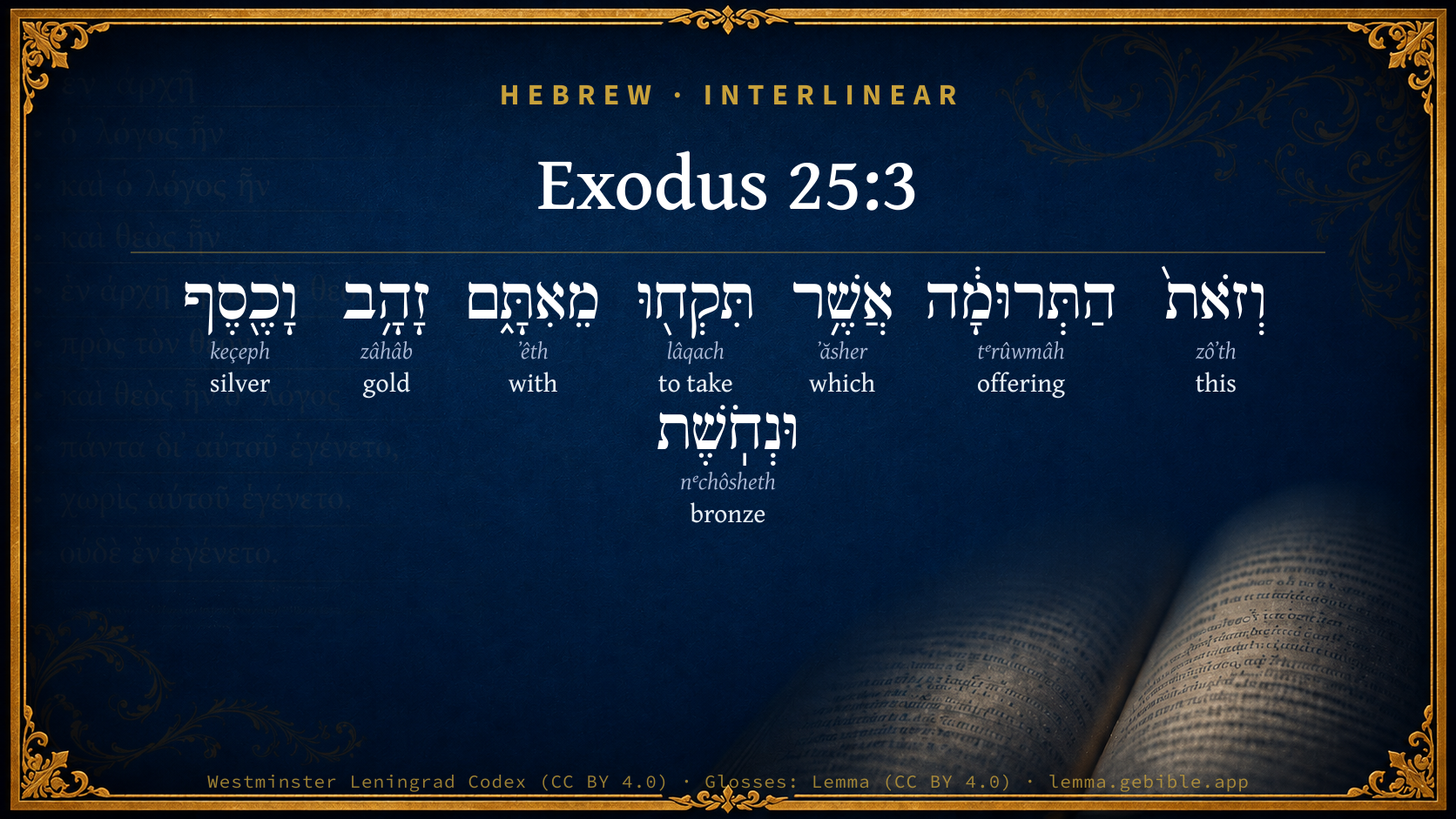
  1. וְזֹאת֙ zôʼth H2063 “and · this” Conjunction + Pronoun, Demonstrative, Feminine, Singular
  2. אֲשֶׁ֥ר ʼăsher H834 “which” Particle, Relative
  3. תִּקְח֖וּ lâqach H3947 “to take” Verb, Qal, Imperfect, 2nd Person, Masculine, Plural
  4. מֵאִתָּ֑ם ʼêth H854 “from · with · them” Preposition + Preposition + Suffix, Personal, 3rd Person, Masculine, Plural
  5. זָהָ֥ב zâhâb H2091 “gold” Noun, Common, Masculine, Singular, Absolute
  6. וָכֶ֖סֶף keçeph H3701 “and · silver” Conjunction + Noun, Common, Masculine, Singular, Absolute
  7. וּנְחֹֽשֶׁת nᵉchôsheth H5178 “and · bronze” Conjunction + Noun, Common, Feminine, Singular, Absolute

About this verse

These counts appear in no published source. They are computed here, from the morphology-tagged text and Lemma’s own curated glosses. What Lemma adds →

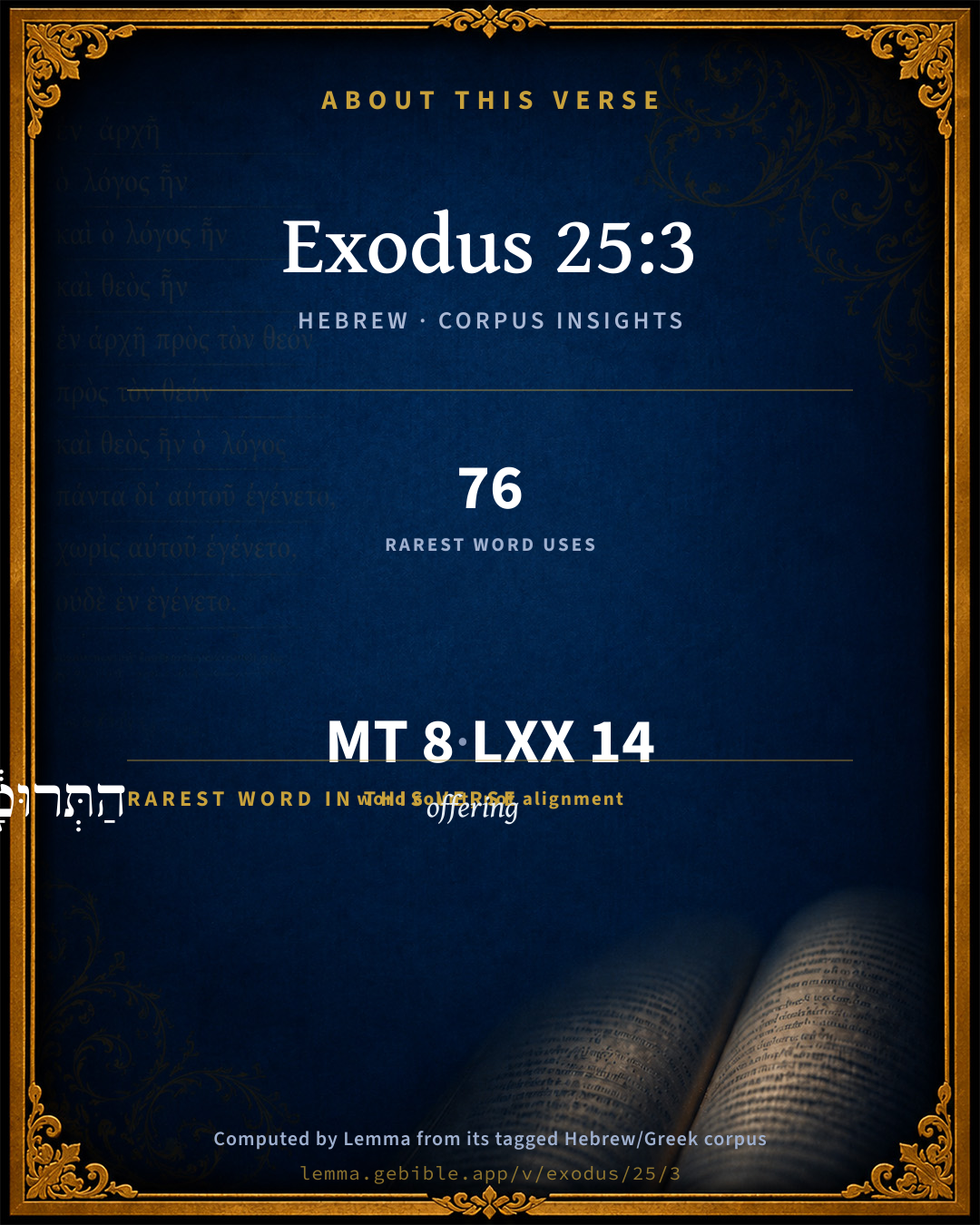
8
words
8
distinct lemmas
Pentateuch
section

Grammatical profile

  • 1 verb
  • 4 nouns
  • 1 pronoun
  • 1 preposition
  • 1 particle

Verb forms

  • תִּקְח֖וּ Qal · Imperfect

Hebrew & Septuagint length

In English translation the verse runs 13 words from the Hebrew and 16 from the Septuagint (LXX English) — closely comparable.

A rough comparison of the two English renderings, which tokenize alike — not a word-level alignment.

Word counts can differ between the Hebrew and the Greek without any difference in meaning — e.g. the Hebrew direct-object marker אֵת has no separate Greek word, and Greek often adds the article ὁ.

In the original languages it is 8 Hebrew tokens and 14 Greek tokens — but the two are counted differently (Hebrew bundles its prefixes and suffixes into one token; the Greek is in lemma form), so that isn’t a like-for-like length.

Cross-references

2

Topical passages linked to Exodus 25:3 in the Treasury of Scripture Knowledge — connected by theme and wording, ordered by reader-vote popularity; previews shown in the World English Bible.

  • Deuteronomy 8:9 a land in which you shall eat bread without scarceness, you shall not lack anything in it; a land whose stones are iron, and out of whose hills you may dig copper.
  • Job 28:2 Iron is taken out of the earth, And copper is smelted out of the ore.

Cross-references courtesy of OpenBible.info (CC BY 4.0).

Hebrew and Greek witnesses Masoretic Hebrew ↔ Greek Septuagint

The same verse in the two great witnesses to the Old Testament, shown verse-for-verse.

These are two independent witnesses, not word-aligned to each other, and the Septuagint is shown in lemma (dictionary) form.

Hebrew Exodus 25:3 Masoretic · Westminster Leningrad Codex

וְזֹאת֙ הַתְּרוּמָ֔ה אֲשֶׁ֥ר תִּקְח֖וּ מֵאִתָּ֑ם זָהָ֥ב וָכֶ֖סֶף וּנְחֹֽשֶׁת

This is the offering which you shall take from them: gold, silver, brass,

World English Bible · Public Domain

Greek LXX Exodus 25:3 Septuagint · lemma form

καί οὗτος εἰμί ὁ ἀπαρχή ὅς λαμβάνω παρά αὐτός χρυσίον καί ἀργύριον καί χαλκός

And this is the offering which you⌃ shall take of them; gold and silver and brass,

LXX2012 (modern English Septuagint) · Public Domain

Hebrew: Westminster Leningrad Codex (CC BY 4.0). Greek: Septuagint (public domain); English from LXX2012 (modern English Septuagint) (Public Domain). How the Septuagint differs from the Hebrew →

Targum (Aramaic paraphrase)

2

The Targum is the ancient Jewish Aramaic paraphrase of the Hebrew Scriptures — an interpretive translation, not the Hebrew text itself. Onkelos (literal) and Pseudo-Jonathan (expansive) render the Torah, and Jonathan the Prophets. Coverage is partial: where no permissively-licensed English translation exists for a verse, only the Aramaic is shown. This is verse-level text, not a word-by-word alignment to the Hebrew.

  1. Targum Onkelos Torah (Genesis–Deuteronomy)
    וְדָא אַפְרָשׁוּתָא דִתִסְבוּן מִנְהוֹן דַהֲבָא וְכַסְפָּא וּנְחָשָׁא:

    (no public-domain English translation for this verse)

    Targum Onkelos — Aramaic: “Onkelos Genesis” (public domain); “Onkelos Exodus” (public domain); “Onkelos Leviticus” (public domain); “Onkelos Numbers” (public domain); “Onkelos Deuteronomy” (public domain). English: “Sefaria Community Translation” (CC0 1.0 (public-domain dedication)); “J.W. Etheridge. The Targums of Onkelos and Jonathan Ben Uzziel on the Pentateuch. London: Longmans, Green, 1862” (public domain). Text via Sefaria.

  2. Targum Pseudo-Jonathan Torah (Genesis–Deuteronomy)
    וְדָא אַפְרָשׁוּתָא דְתִסְבוּן מִנְהוֹן דַּהֲבָא וְכַסְפָּא וּנְחָשָׁא

    And this is the separation which you shall take of them: gold, and silver, and brass;

    Targum Pseudo-Jonathan — Aramaic: “Targum Jonathan on Genesis” (public domain); “Targum Jonathan on Exodus” (public domain); “Targum Jonathan on Leviticus” (public domain); “Targum Jonathan on Numbers” (public domain); “Targum Jonathan on Deuteronomy” (public domain). English: “The Targum of Jonathan ben Uzziel, trans. J. W. Etheridge, London, 1862” (public domain). Text via Sefaria.

Commentary

Notes on Exodus 25:3 from classic Christian and Jewish commentators (each source and its license shown beneath its notes). The classic Christian expositions comment on the surrounding passage and are grouped to its opening verse, so a note may address several verses; the Jewish commentaries on the Tanakh (Rashi and others) are per-verse, so they appear only where the commentator wrote on this verse.

Lemma curates 59 commentaries, every one of them public domain or Creative Commons licensed, each selected and text-cleaned for this edition rather than reprinted as found. About our sources →

Trapp's Complete Commentary

John Trapp

Exo 25:3 And this [is] the offering which ye shall take of them; gold, and silver, and brass,

Ver. 3. Gold, and silver, and brass.] No mention of iron. Compare 1Ki 6:7; 1Ki 8:51.

John Trapp, A Commentary or Exposition upon All the Books of the Old and New Testament (1647–1656) — public domain. Text from a community e-Sword module.

Geneva Bible (1599)

Geneva Bible translators

For the building and use of the Tabernacle.

Geneva Bible (1599) marginal notes — public domain. Text via Bolls.life.

Jamieson, Fausset & Brown

Robert Jamieson, A. R. Fausset & David Brown

this is the offering which ye shall take of them--the articles of which the offerings should consist.

brass--rather copper, brass being a composite metal.

Jamieson, Fausset & Brown — Commentary Critical and Explanatory on the Whole Bible (1871) — public domain (CC PDM 1.0). Text via the HelloAO Bible API.

Adam Clarke's Commentary

Verse 3. This is the offering] There were three kinds of metals:

1. GOLD, זהב zahab, which may properly signify wrought gold; what was bright and resplendent, as the word implies. In Job 28:15-17, Job 28:19, gold is mentioned five times, and four of the words are different in the original.

(1) סגור SEGOR, from סגר sagar, to shut up; gold in the mine, or shut up in its ore.

(2) כתם KETHEM, from כתם catham, to sign, seal, or stamp; gold made current by being coined; standard or sterling gold, exhibiting the stamp expressive of its value.

(3) זהב ZAHAB, wrought gold, pure, highly polished gold; probably what was used for overlaying or gilding.

(4) פז PAZ, denoting solidity, compactness, and strength; probably gold formed into different kinds of plate, as it is joined in Ex 25:17 of the above chapter with כלי keley, vessels. The zahab, or pure gold, is here mentioned, because it was in a state that rendered it capable of being variously manufactured for the service of the sanctuary.

2. SILVER, כסף keseph, from casaph, to be pale, wan, or white; so called from its well-known colour.

3. BRASS, נחשת nechosheth, copper; unless we suppose that the factitious metal commonly called brass is intended: this is formed by a combination of the oxide or ore of zinc, called lapis calaminaris, with copper. Brass seems to have been very anciently in use, as we find it mentioned Ge 4:22; and the preparation of copper, to transform it into this factitious metal, seems to be very pointedly referred to Job 28:2: Iron is taken out of the earth, and brass is molten out of the stone; אבן יצוק נחושה eben yatsuk nechushah, translated by the Vulgate, Lapis, solutus calore, in aes vertitur, "The stone, liquefied by heat, is turned into brass." Is it going too far to say that the stone here may refer to the lapis calaminaris, which was used to turn the copper into brass? Because brass was capable of so fine a polish as to become exceedingly bright, and keep its lustre a considerable time, hence it was used for all weapons of war and defensive armour among ancient nations; and copper seems to have been in no repute, but for its use in making brass.

Adam Clarke's Commentary on the Bible (1810–1826) — public domain. Text from a community e-Sword/MySword module.

Ellicott's Commentary for English Readers

(3) Gold, and silver, and brass.—The Israelites had brought out of Egypt (1) their ancestral wealth—the possessions of Abraham and the accumulations of Joseph, and (2) the rich gifts received from the Egyptians at the moment of their departure. They had added to their wealth by the plunder of the Amalekites. Thus they possessed a considerable store of the precious metals; and there is no difficulty in supposing that they furnished the gold needed for the tabernacle without seriously impoverishing themselves. The silver, which was of small amount comparatively, appears ultimately to have been furnished in another way (Exo_30:12-16; Exo_38:25-28) The brass, or rather bronze, for brass seems to have been unknown at this time, was small in amount (Exo_38:29), and of no great value. It would have constituted no serious drain on the resources of the people.

A Bible Commentary for English Readers, edited by Charles John Ellicott (1878–1897) — public domain. Text from a community e-Sword module.

The Cambridge Bible for Schools and Colleges

gen. ed. J. J. S. Perowne

3. The metals. Gold, silver, and copper are specified, the gold being prescribed, in accordance with a significant gradation, for those vessels and parts of the sanctuary which were nearest to Jehovah, the silver and the copper for those which were further off and less important. Of gold there was a superior kind, called pure (lit. clean) gold, i.e. gold more carefully freed from silver or alloy than ordinary gold. ‘Pure gold’ is thus prescribed for the gilding of the ark, and for the mercy-seat (vv. 11, 17); for the gilding of the table of Presence-bread, and for its vessels (vv. 24, 29); for the candlestick and its utensils (vv. 31, 36 ff.); for the gilding of the altar of incense (Exo_30:3); and for the chains for the sacred pouch, and the plate on the mitre, in the high priest’s dress (Exo_28:14; Exo_28:22; Exo_28:36). Ordinary gold is prescribed for the rim and rings, and for the gilding of the staves, of the Ark, table of Presence-bread, and incense altar (Exo_25:11-13; Exodus 24, 25, 26, 28; Exo_30:3-5); for the cherubim on the mercy-seat (Exo_25:18); for the clasps of the curtains (Exo_26:6); for the gilding of the frames and of the bars outside, and of the pillars for the veil and for the screen (Exo_26:29; Exo_26:32; Exo_26:37); for the rings outside the frames for the bars (Exo_26:29); for the hooks attaching the veil and the screen to their pillars (Exo_26:32; Exo_26:37); and for the gold thread, rosettes, rings for the sacred pouch, and bells, in the high priest’s dress (Exo_28:6; Exo_28:8; Exo_28:15; Exodus 11, 13, 20; Exodus 23, 26, 27; Exodus 33). Silver is prescribed for the sockets of the frames, and of the pillars for the veil (Exo_26:19; Exo_26:25; Exo_26:32); and for the hooks and fillets of the pillars of the court (Exo_27:10-11; Exo_27:17); and copper for the altar of burnt-offering (Exo_27:2-4; Exo_27:6); the sockets and pins of the court (Exo_27:10 f., 17–19); and the laver (Exo_30:18).

brass] bronze, or copper (Gen_4:22 RVm.), which, indeed, was the meaning of ‘brass’ in old English: in Holland’s Pliny, for instance, mention is made of ‘mines of brass’ (cf. Deu_8:9). The alloy of copper and zinc which we call ‘brass’ was not known to the ancients. ‘Bronze,’ i.e. copper hardened by tin, was much used anciently for weapons and other implements, before iron came into general use.

The Cambridge Bible for Schools and Colleges (gen. ed. J. J. S. Perowne; Cambridge University Press, 1878–1918) — public domain. Text from a community e-Sword module.

John Gill's Exposition

And this is the offering which ye shall take of them,.... That is, some one or other of the following things were to be taken of each of them that had a heart, and it was in the power of their hands to give; it was not expected that something of each of these should be had of everyone, but every man was to give, and it was to be received of him, what of these would suit him best to bestow, some one thing, some another, as they were possessed of, and had a heart to give; and for which service many of them were abundantly supplied with what they had brought out of Egypt; and as it was the Lord that gave them favour in the eyes of the Egyptians to lend or give them the riches they had, they were under the greater obligation to part with somewhat of it freely for his service; and especially as it would be to the spiritual profit and advantage both of them and theirs:

gold and silver, and brass; "gold", for those things that were to he made of gold; as the mercy seat and cherubim, the candlestick, &c. or were covered with it, as the ark, the shewbread table, and other things; and silver, for those that were made of that, as the silver sockets to the boards of the tabernacle, the silver trumpets, &c. and "brass" for the altar of burnt offering, its pans, shovels, basins, rings, and staves, and other things: Aben Ezra rightly observes, that no mention is made of iron, there being no use of that for anything in the tabernacle to be made of it; as also there was not in the temple of Solomon, and where there was not so much as a tool of iron heard in it while it was building, Kg1 6:7 it may be, because instruments of war, slaughtering weapons, were made of iron; and to show that God is the God of peace in his sanctuary, and so in all the churches: gold and silver vessels the Israelites borrowed or begged of the Egyptians, and brought them with them when they came out of Egypt, Exo 11:2.

John Gill's Exposition of the Whole Bible (1746–1763) — public domain (CC PDM 1.0). Text via the HelloAO Bible API.

Whedon's Commentary on the Bible

Daniel D. Whedon

3. Gold, and silver, and brass — Sceptics have been fond of asking whence the Hebrews in the wilderness could have obtained such quantifies of the precious metals as the tabernacle required. It is not difficult to answer: (1.) They probably possessed some of the treasures which belonged to their ancient fathers, and of which they had not been despoiled in Egypt. (2.) They obtained great quantities of gold and silver from the Egyptians on their departure from their land. See Exo_12:35-36, and notes on Exo_3:22, and Exo_11:2. (3.) Much spoil of the Egyptian army probably fell into their hands at the Red sea. See Exo_14:30, note. (4.) They doubtless obtained much spoil of the defeated Amalekites, (Exo_17:8-13.) (5.) Finally, we are not to imagine that in the Sinaitic peninsula the Hebrews were cut off from all communication with other peoples. Great caravans frequently traversed these deserts, (comp. Gen_37:25; Gen_37:28,) and doubtless then, as in a later time merchantmen of “all the kings of Arabia, and of the governors of the country,” (1Ki_10:14-17,) carried to and fro with them large quantities of precious metals; and these, as well as other material needed for any of their purposes, could have been obtained by the Israelites.

Daniel D. Whedon (gen. ed.), Commentary on the Old and New Testaments (1874–1909) — public domain. Text from a community e-Sword module.

The Pulpit Commentary

This is the offering gold and silver and brass. Gold was needed for the overlaying of the boards, whereof the ark was composed (ver. 11); for the "crown of gold," which surmounted it (ibid. ); for the "rings" (ver. 12); the "mercy-seat" (ver. 17) the cherubim (ver. 18); the dishes, the spoons, the covers, the bowls (ver. 29); the candlestick (ver. 31); the tongs and snuff dishes (ver. 28); the hooks and taches; (Exo_26:6, Exo_26:32) for the covering of the table of shew bread; (Exo_25:24) and of the staves and pillars (ib, 28:; Exo_26:32, Exo_26:37) and also for many parts of the dress of the High Priest. (Exo_28:6, Exo_28:8, Exo_28:11, Exo_28:14, etc.) Silver was required for the sockets which supported the hoards of the Tabernacle; (Exo_26:19) and for the "hooks" and "fillets" of the pillars of the court. (Exo_27:10) Brass, or rather bronze, was wanted for the "taches" which coupled together the curtains of the tent; (Exo_26:11) for the "sockets" which received the pillars or tent-poles (ib, 37); for the external coating of the altar; (Exo_27:2) for the vessels and utensils of the altar (ib, 3); for the covering of its staves (ib, 6); for the sockets of the pillars of the Court; (Exo_27:10) for the "pins" of the Court (ib, 19); and generally for the vessels of the Tabernacle (ibid. ). To understand how the Israelites could supply all that was wanted, we must remember,

1. That they had a certain amount of ancestral wealth, as that which Josephhad accumulated, and what Jacob and his sons had brought with them into Egypt.

2. That they had received large presents of gold and silver from theEgyptians just before their departure; (Exo_12:35) and

3. That they had recently defeated, and no doubt despoiled, the Amalekites. (Exo_16:8-13) Whether they had further made money by trade since they entered the Sinaitic peninsula, may be doubted. The supposition is not at all needed in order to account for their wealth.

The Pulpit Commentary (1880–1919), ed. H.D.M. Spence-Jones & Joseph S. Exell — public domain. Text from a community e-Sword module.

unfoldingWord translationNotes

Door43 World Missions Community

General Information:

Yahweh continues to tell Moses what the people must do.

blue, purple, and scarlet material

Possible meanings are 1) "material that is dyed blue, purple, and scarlet," probably wool yarn, or 2) "blue, purple and scarlet dye" to dye the linen.

scarlet

bright red

sea cow

a large animal that lives in the sea and eats plants

spices

dried plants that people grind into a powder and put in oil or food to give it a nice smell or flavor (See: Translate Unknowns)

onyx

a valuable stone that has layers of white and black, red or brown. (See: Translate Unknowns)

precious stones to be set

This can be stated in active form. AT: "precious stones for someone to set" (See: Active or Passive)

precious stones

"valuable gems" or "treasured gems"

translationWords

sacrifice

gold

silver

bronze

goat

ewe

acacia

oil

sanctuary

lamp

anoint

incense

ephod

breastplate

unfoldingWord translationNotes — © Distant Shores Media and the Door43 World Missions Community, licensed CC BY-SA 4.0. Source: git.door43.org/Door43/en_tn.

Rashi

Rabbi Shlomo Yitzchaki (Rashi)

זהב וכסף ונחשת וגו׳ GOLD AND SILVER AND COPPER etc. — All these came (were brought) as voluntary gifts, each man giving as his heart prompted him, except that silver which was brought by all in equal quantities (cf. Rashi above), a half shekel by each person. For we do not find in the account of the entire work connected with the Tabernacle that any silver was needed for the work there described in detail over and above this, for it is said, (Exodus 38:25-26) “And the silver of them who were numbered of the congregation [was an hundred talents, etc.] … a beka for every man etc.” and vv. 27 and 28 inform us that of this silver were made the Sockets and the hooks. Of the other silver which came (was brought) there, as a free-will gift they made the holy vessels (lit., vessels for service), and it is this silver that is referred to in this verse and which is stated in the preceding verse as having been brought voluntarily.

Rashi on the Tanakh — English translations: “The Judaica Press complete Tanach with Rashi, translated by A. J. Rosenberg” (CC BY 4.0); “Pentateuch with Rashi's commentary by M. Rosenbaum and A.M. Silbermann, 1929-1934” (public domain); “The Metsudah Tanach series, Lakewood, N.J” (CC BY 4.0); and “The Book of Joshua, Metsudah Publications, 1997” (CC BY 4.0). Text via Sefaria.

Ramban (Nachmanides)

Rabbi Moshe ben Nachman (Ramban / Nachmanides)

V’ZOTH’ (AND THIS) IS THE OFFERING. By way of the Truth, [the mystic lore of the Cabala], this is like the expression, And the Eternal gave Solomon wisdom. Cabalists saw an allusion to the Divine Glory. It is also written: ‘v’zoth’ (and this) is it that their father spoke unto them and blessed them; ‘v’zoth’ (and this) is the blessing; the Eternal’s doing is ‘zoth’ (this). The Rabbis have already alluded to this in Bereshith Rabbah on the basis of the verse, I understand from the elders. The discerning student will understand.And in Eileh Shemoth Rabbah the Rabbis have said: “And this is the offering which ye shall take of them — this refers to the congregation of Israel, which is the heave-offering, as it is said, Israel is the Eternal’s hallowed portion, His first-fruits of the increase.” And it is also said there: “The Holy One, blessed be He, said to Israel: I have sold you My Torah; and I, as it were, was sold with it, for it is said, ‘v’yikchu li terumah’” [which the Midrash takes to mean: “and they shall acquire Me as an offering”]. For the offering shall be Mine, and I am with it, similar to: My beloved is mine, and I am his. Similarly, He said, according to all that I show thee, for it is I who show [the pattern of the Tabernacle, and the pattern of all its vessels]. The statement, it hath been shown to thee, 27:8. also alludes to the word “I”; similarly, which is being shown to thee. And so did David say, All this [do I give thee] in writing, as the Eternal hath made me wise by His hand upon me, for the hand of G-d was upon David [to show him the pattern of the Sanctuary and of all its works].

Ramban (Nachmanides) on the Tanakh — English translation: “Commentary on the Torah by Ramban (Nachmanides). Translated and annotated by Charles B. Chavel. New York, Shilo Pub. House, 1971-1976” (CC BY 4.0). Text via Sefaria.

Lesson kit

Teaching starters — assembled from the data on this page, not authored interpretation. Every prompt links to the verse data it draws on. Edit before teaching.

Exodus, in the Pentateuch, opens this verse with 8 words (8 distinct Hebrew lemmas). Its most distinctive word is tᵉrûwmâh (“offering”). A historical commentator’s framing appears above. Read the whole chapter for the surrounding context.

Discussion questions

  1. What does “offering” (tᵉrûwmâh) contribute to the verse as a whole?
  2. Deuteronomy 8:9 shares this passage’s theme. How do the two illuminate each other?
  3. These translations render this verse differently. What is at stake in choosing one wording over another?
  4. The verb «תִּקְח֖וּ» is Qal Imperfect. How does its form color the action?
  5. Reading how Trapp's Complete Commentary and Geneva Bible (1599) read this verse, where do the two commentators agree and where do they part?

Things to notice

Reading settings

Reading text

Shown beneath each verse's original-language words.

Old Testament
Old Testament edition

Read the OT as the Masoretic Hebrew (MT) or the Greek Septuagint (LXX).

English shown for the Greek Septuagint (in the Hebrew ↔ Greek comparison).

Comparing translations? Open the Compare panel on any verse page to stack up to four side by side.