
Leviticus 6:25

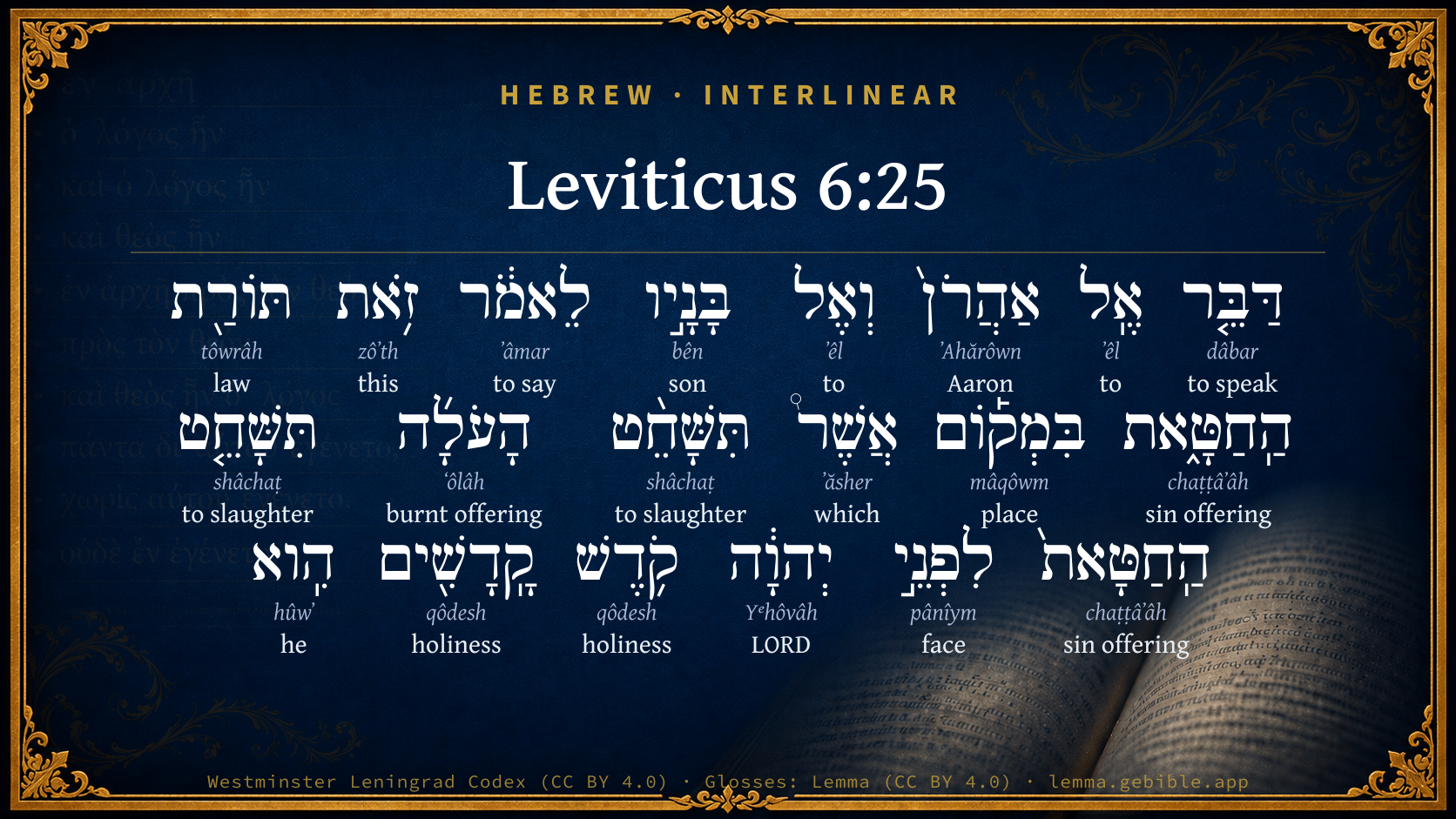
Hebrew (Westminster Leningrad Codex) Leviticus 6:25 appears in the Hebrew Old Testament. The text above is from the Westminster Leningrad Codex. Each word links to its Strong’s number, a concise gloss, and parsing drawn from the Open Scriptures Hebrew Bible morphology. Click any word for its full Brown-Driver-Briggs (BDB) entry.
Download image
Cite this verse

Leviticus 6:25 (World English Bible). Public Domain. Lemma interlinear Bible study tool, https://lemma.gebible.app/v/leviticus/6/25.

Show BibTeX & RIS
BibTeX
RIS
English Translation
"Speak to Aaron and to his sons, saying, 'This is the law of the sin offering: in the place where the burnt offering is killed, the sin offering shall be killed before Yahweh. It is most holy.
World English Bible · Public Domain
Download a study sheet

One document with this verse’s original text, its word-by-word gloss line, the meaning frame, cross-references with their text, attributed commentary, and full source and license credits — printable, and it pastes into notes with its structure intact.

This verse Autodidact and up

Study sheet (.html) Plain text (.txt)

A passage Seminary Student

Up to 50 verses in one chapter. A passage sheet keeps up to 6 commentary sources and 12 cross-references per verse, in the order this page ranks them, and says so on the sheet whenever that leaves anything out. Ask for a single verse and you get the Autodidact verse sheet above.

Everything on this page stays free to read, with no account — the sheet is a download of what is already on screen, not access to it.

Want to remove ads? Support Godless Engineer
Compare translations 3

The same verse in 3 English versions, stacked beneath the original-language interlinear above. Click any original word for its lexicon entry.

Each is an independent rendering of the whole verse — the interlinear is not word-aligned to these translations.

Highlighted words mark where these versions differ — a whole-verse word diff, not a word-by-word alignment.

  • World English Bible Public Domain
    "Speak to Aaron and to his sons, saying, 'This is the law of the sin offering: in the place where the burnt offering is killed, the sin offering shall be killed before Yahweh. It is most holy.
  • King James Version Public Domain
    Speak unto Aaron and to his sons, saying, This is the law of the sin offering: In the place where the burnt offering is killed shall the sin offering be killed before the LORD: it is most holy.
  • unfoldingWord Literal Text CC BY-SA 4.0
    “Speak to Aaron and to his sons, saying, ‘This the law of the sin offering: in the place where the burnt offering is slaughtered, the sin offering shall be slaughtered to the face of Yahweh. It a holy thing of holy things.

unfoldingWord Literal Text — © unfoldingWord, licensed CC BY-SA 4.0. Word-aligned USFM3 via Door43 (git.door43.org/unfoldingWord/en_ult).

Versions to compare (up to 4)

3 of 4 selected

Show all 16 translations

Every available English version of this verse, each an independent rendering of the whole verse.

  • World English Bible Public Domain
    "Speak to Aaron and to his sons, saying, 'This is the law of the sin offering: in the place where the burnt offering is killed, the sin offering shall be killed before Yahweh. It is most holy.
  • Berean Standard Bible Public Domain
    “Tell Aaron and his sons that this is the law of the sin offering: In the place where the burnt offering is slaughtered, the sin offering shall be slaughtered before the LORD; it is most holy.
  • Majority Standard Bible Public Domain
    “Tell Aaron and his sons that this is the law of the sin offering: In the place where the burnt offering is slaughtered, the sin offering shall be slaughtered before the LORD; it is most holy.
  • King James Version Public Domain
    Speak unto Aaron and to his sons, saying, This is the law of the sin offering: In the place where the burnt offering is killed shall the sin offering be killed before the LORD: it is most holy.
  • American Standard Version (1901) Public Domain
    Speak unto Aaron and to his sons, saying, This is the law of the sin-offering: in the place where the burnt-offering is killed shall the sin-offering be killed before Jehovah: it is most holy.
  • Revised Version (1885) Public Domain
    Speak unto Aaron and to his sons, saying, This is the law of the sin offering: in the place where the burnt offering is killed shall the sin offering be killed before the LORD: it is most holy.
  • Geneva Bible (1599) Public Domain
    Speake vnto Aaron, and vnto his sonnes, and say, This is the Lawe of the sinne offering, In the place where the burnt offring is killed, shall the sinne offring be killed before the Lord, for it is most holy.
  • Douay-Rheims (1899) Public Domain
    Say to Aaron and his sons: This is the law of the victim for sin: in the place where the holocaust is offered, it shall be immolated before the Lord. It is holy of holies.
  • Young's Literal Translation Public Domain
    `Speak unto Aaron and unto his sons, saying, This `is' a law of the sin-offering: in the place where the burnt-offering is slaughtered is the sin-offering slaughtered before Jehovah; it `is' most holy.
  • Literal Standard Version CC BY-SA 4.0
    “Speak to Aaron and to his sons, saying, This [is] a law of the sin-offering: in the place where the burnt-offering is slaughtered, the sin-offering is slaughtered before YHWH; it [is] most holy.
  • Unlocked Literal Bible CC BY-SA 4.0
    “Speak to Aaron and to his sons, saying, 'This is the law of the sin offering: The sin offering must be killed at the place where the burnt offering is killed before Yahweh. It is most holy.
  • unfoldingWord Literal Text CC BY-SA 4.0
    “Speak to Aaron and to his sons, saying, ‘This the law of the sin offering: in the place where the burnt offering is slaughtered, the sin offering shall be slaughtered to the face of Yahweh. It a holy thing of holy things.
  • Darby Bible Public Domain
    Speak unto Aaron and to his sons, saying, This is the law of the sin-offering. At the place where the burnt-offering is slaughtered shall the sin-offering be slaughtered before Jehovah: it is most holy.
  • World Messianic Bible Public Domain
    “Speak to Aaron and to his sons, saying, ‘This is the law of the sin offering: in the place where the burnt offering is killed, the sin offering shall be killed before the LORD. It is most holy.
  • Free Bible Version CC BY-SA 4.0
    “Tell Aaron and his sons that these are the regulations for the sin offering. The sin offering is to be killed where the burnt offering is killed before the Lord, and it is most holy.
  • JPS Tanakh (1917) Public Domain
    (6-18) Speak unto Aaron and to his sons, saying: This is the law of the sin-offering: in the place where the burnt-offering is killed shall the sin-offering be killed before the LORD; it is most holy.

Literal Standard Version (2020), Covenant Press — licensed CC BY-SA 4.0. Text via the HelloAO Bible API (eBible.org). Unlocked Literal Bible (unfoldingWord) — licensed CC BY-SA 4.0. Text via the HelloAO Bible API (eBible.org). unfoldingWord Literal Text — © unfoldingWord, licensed CC BY-SA 4.0. Word-aligned USFM3 via Door43 (git.door43.org/unfoldingWord/en_ult). Free Bible Version, Dr. Jonathan Gallagher — licensed CC BY-SA 4.0. Text via the HelloAO Bible API (eBible.org).

Word by word

More ways to search: Search by grammar → Find every occurrence → Compare this word →

Practice this passage: Drill this verse → Learn its vocabulary →

תִּשָּׁחֵ֨ט
shâchaṭ
H7819
“to slaughter”
Verb, Niphal, Imperfect, 3rd Person, Feminine, Singular
Part of Speech
Verb
Stem
Niphal
Form
Imperfect
Person
3rd Person
Gender
Feminine
Number
Singular
Full BDB Definition

Origin: a primitive root

TWOT: 2362

to kill, slaughter, beat (verb) - (Qal) - to slaughter - beast for food - sacrifice - person in human sacrifice - beaten, hammered (of shekels) - (Niphal) to be slaughtered, be slain (of food or sacrifice) - (BDB) slaughtering (noun feminine) - word doubtful
  1. דַּבֵּ֤ר dâbar H1696 “speak” Verb, Piel, Imperative, 2nd Person, Masculine, Singular
  2. אֶֽל ʼêl H413 “to” Preposition
  3. אַהֲרֹן֙ ʼAhărôwn H175 “Aaron” Noun, Proper
  4. וְאֶל ʼêl H413 “and · to” Conjunction + Preposition
  5. בָּנָ֣יו bên H1121 “sons · his” Noun, Common, Masculine, Plural, Construct + Suffix, Personal, 3rd Person, Masculine, Singular
  6. לֵאמֹ֔ר ʼâmar H559 “to say” Preposition + Verb, Qal, Infinitive Construct
  7. זֹ֥את zôʼth H2063 “this” Pronoun, Demonstrative, Feminine, Singular
  8. תּוֹרַ֖ת tôwrâh H8451 “law of” Noun, Common, Feminine, Singular, Construct
  9. הַֽחַטָּ֑את chaṭṭâʼâh H2403 “the · sin offering” Particle, Definite Article + Noun, Common, Feminine, Singular, Absolute
  10. בִּמְק֡וֹם mâqôwm H4725 “in/at · place of” Preposition + Noun, Common, Masculine, Singular, Construct
  11. אֲשֶׁר֩ ʼăsher H834 “which” Particle, Relative
  12. הָעֹלָ֜ה ʻôlâh H5930 “the · burnt offering” Particle, Definite Article + Noun, Common, Feminine, Singular, Absolute
  13. תִּשָּׁחֵ֤ט shâchaṭ H7819 “to slaughter” Verb, Niphal, Imperfect, 3rd Person, Feminine, Singular
  14. הַֽחַטָּאת֙ chaṭṭâʼâh H2403 “the · sin offering” Particle, Definite Article + Noun, Common, Feminine, Singular, Absolute
  15. לִפְנֵ֣י pânîym H6440 “to/for · face(s) of” Preposition + Noun, Common, Both, Plural, Construct
  16. יְהוָ֔ה Yᵉhôvâh H3068 “LORD” Noun, Proper
  17. קֹ֥דֶשׁ qôdesh H6944 “holiness of” Noun, Common, Masculine, Singular, Construct
  18. קָֽדָשִׁ֖ים qôdesh H6944 “holy things” Noun, Common, Masculine, Plural, Absolute
  19. הִֽוא hûwʼ H1931 “he” Pronoun, Personal, 3rd Person, Feminine, Singular

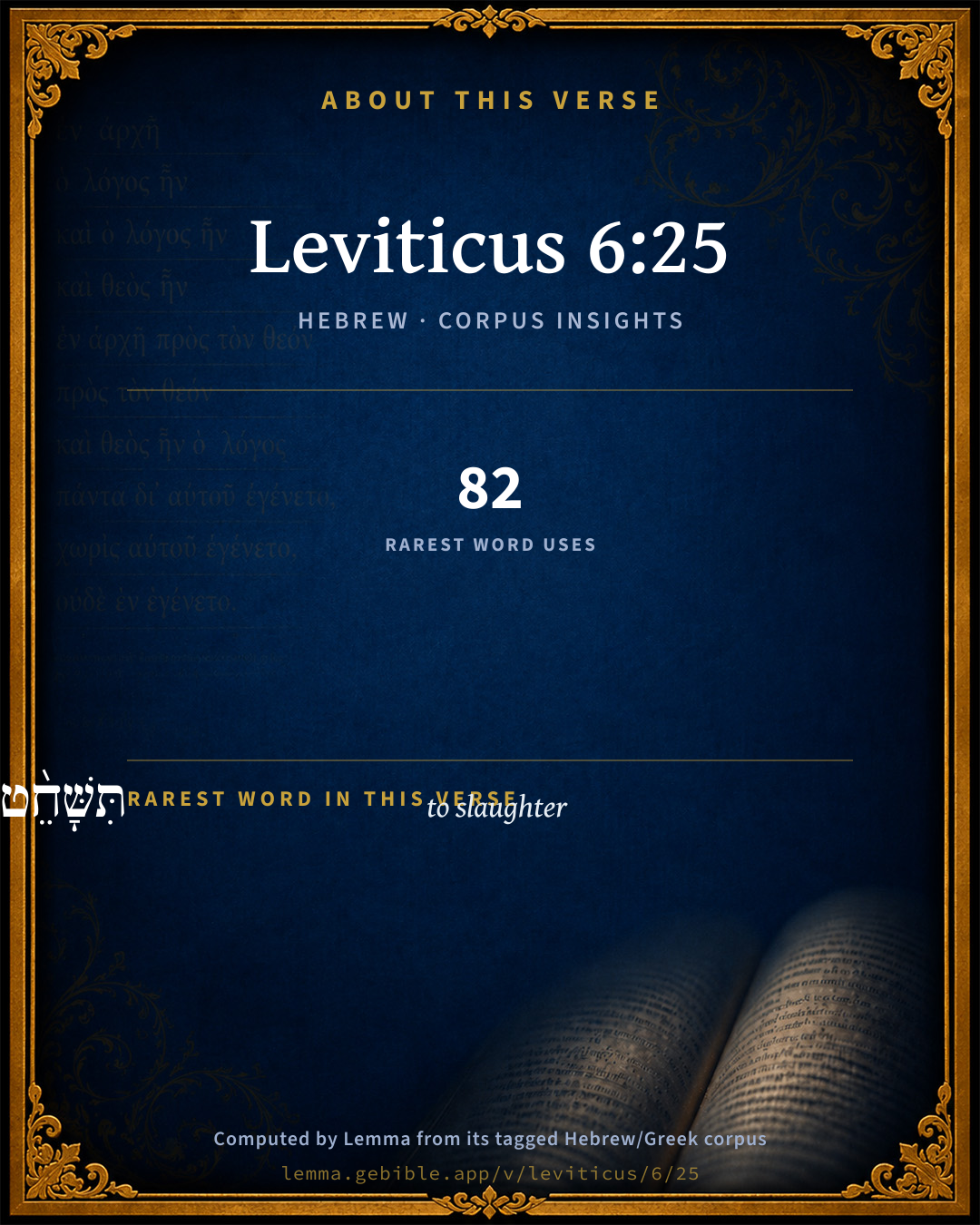
About this verse

These counts appear in no published source. They are computed here, from the morphology-tagged text and Lemma’s own curated glosses. What Lemma adds →

20
words
16
distinct lemmas
Pentateuch
section

Grammatical profile

  • 4 verbs
  • 11 nouns
  • 2 pronouns
  • 2 prepositions
  • 1 particle

Verb forms

  • דַּבֵּ֤ר Piel · Imperative
  • לֵאמֹ֔ר Qal · Infinitive Construct
  • תִּשָּׁחֵ֨ט Niphal · Imperfect
  • תִּשָּׁחֵ֤ט Niphal · Imperfect

Repetition

Words recur within this verse — often emphatic in Hebrew:

  • הַֽחַטָּ֑את sin offering H2403 ×2
  • תִּשָּׁחֵ֨ט to slaughter H7819 ×2
  • קֹ֥דֶשׁ holiness H6944 ×2
  • אֶֽל to H413 ×2

Hebrew & Septuagint length

In English translation the verse runs 37 words from the Hebrew and 37 from the Septuagint (LXX English) — the same length.

A rough comparison of the two English renderings, which tokenize alike — not a word-level alignment.

Word counts can differ between the Hebrew and the Greek without any difference in meaning — e.g. the Hebrew direct-object marker אֵת has no separate Greek word, and Greek often adds the article ὁ.

Cross-references

9

Topical passages linked to Leviticus 6:25 in the Treasury of Scripture Knowledge — connected by theme and wording, ordered by reader-vote popularity; previews shown in the World English Bible.

  • Leviticus 4:24 He shall lay his hand on the head of the goat, and kill it in the place where they kill the burnt offering before Yahweh. It is a sin offering.
  • Leviticus 1:11 He shall kill it on the north side of the altar before Yahweh. Aaron's sons, the priests, shall sprinkle its blood around on the altar.
  • Leviticus 1:3 "'If his offering is a burnt offering from the herd, he shall offer a male without blemish. He shall offer it at the door of the Tent of Meeting, that he may be accepted before Yahweh.
  • Leviticus 1:5 He shall kill the bull before Yahweh. Aaron's sons, the priests, shall present the blood and sprinkle the blood around on the altar that is at the door of the Tent of Meeting.
  • Leviticus 4:29 He shall lay his hand on the head of the sin offering, and kill the sin offering in the place of burnt offering.
  • Leviticus 4:2–21 "Speak to the children of Israel, saying, 'If anyone sins unintentionally, in any of the things which Yahweh has commanded not to be done, and does any one of them:
  • Leviticus 4:33–34 He shall lay his hand on the head of the sin offering, and kill it for a sin offering in the place where they kill the burnt offering.
  • Leviticus 6:17 It shall not be baked with yeast. I have given it as their portion of my offerings made by fire. It is most holy, as the sin offering, and as the trespass offering.
  • Leviticus 21:22 He shall eat the bread of his God, both of the most holy, and of the holy.

Cross-references courtesy of OpenBible.info (CC BY 4.0).

Hebrew and Greek witnesses Masoretic Hebrew ↔ Greek Septuagint

The same verse in the two great witnesses to the Old Testament, shown verse-for-verse.

These are two independent witnesses, not word-aligned to each other, and the Septuagint is shown in lemma (dictionary) form.

Hebrew Leviticus 6:25 Masoretic · Westminster Leningrad Codex

דַּבֵּ֤ר אֶֽל אַהֲרֹן֙ וְאֶל בָּנָ֣יו לֵאמֹ֔ר זֹ֥את תּוֹרַ֖ת הַֽחַטָּ֑את בִּמְק֡וֹם אֲשֶׁר֩ תִּשָּׁחֵ֨ט הָעֹלָ֜ה תִּשָּׁחֵ֤ט הַֽחַטָּאת֙ לִפְנֵ֣י יְהוָ֔ה קֹ֥דֶשׁ קָֽדָשִׁ֖ים הִֽוא

"Speak to Aaron and to his sons, saying, 'This is the law of the sin offering: in the place where the burnt offering is killed, the sin offering shall be killed before Yahweh. It is most holy.

World English Bible · Public Domain

Greek LXX Leviticus 6:25 Septuagint · lemma form
Speak to Aaron and to his sons, saying, This is the law of the sin-offering; —in the place where they kill the whole burnt offering, they shall kill the sin-offerings before the Lord: they are most holy.

LXX2012 (modern English Septuagint) · Public Domain

Hebrew: Westminster Leningrad Codex (CC BY 4.0). Greek: Septuagint (public domain); English from LXX2012 (modern English Septuagint) (Public Domain). How the Septuagint differs from the Hebrew →

Commentary

Notes on Leviticus 6:25 from classic Christian and Jewish commentators (each source and its license shown beneath its notes). The classic Christian expositions comment on the surrounding passage and are grouped to its opening verse, so a note may address several verses; the Jewish commentaries on the Tanakh (Rashi and others) are per-verse, so they appear only where the commentator wrote on this verse.

Lemma curates 59 commentaries, every one of them public domain or Creative Commons licensed, each selected and text-cleaned for this edition rather than reprinted as found. About our sources →

Trapp's Complete Commentary

John Trapp

Lev 6:25 Speak unto Aaron and to his sons, saying, This [is] the law of the sin offering: In the place where the burnt offering is killed shall the sin offering be killed before the LORD: it [is] most holy.

Ver. 25. In the place,] i.e., At the north side of the altar. And why {See Trapp on "Lev 5:9"}

John Trapp, A Commentary or Exposition upon All the Books of the Old and New Testament (1647–1656) — public domain. Text from a community e-Sword module.

Jamieson, Fausset & Brown

Robert Jamieson, A. R. Fausset & David Brown

THE LAW OF THE SIN OFFERING. (Lev 6:21-30)

This is the law of the sin offering--It was slain, and the fat and inwards, after being washed and salted, were burnt upon the altar. But the rest of the carcass belonged to the officiating priest. He and his family might feast upon it--only, however, within the precincts of the tabernacle; and none else were allowed to partake of it but the members of a priestly family--and not even they, if under any ceremonial defilement. The flesh on all occasions was boiled or sodden, with the exception of the paschal lamb, which was roasted [Exo 12:8-9]; and if an earthen vessel had been used, it being porous and likely to imbibe some of the liquid particles, it was to be broken; if a metallic pan had been used it was to be scoured and washed with the greatest care, not because the vessels had been defiled, but the reverse--because the flesh of the sin offering having been boiled in them, those vessels were now too sacred for ordinary use. The design of all these minute ceremonies was to impress the minds, both of priests and people, with a sense of the evil nature of sin and the care they should take to prevent the least taint of its impurities clinging to them.

Next: Leviticus Chapter 7

Jamieson, Fausset & Brown — Commentary Critical and Explanatory on the Whole Bible (1871) — public domain (CC PDM 1.0). Text via the HelloAO Bible API.

Adam Clarke's Commentary

Verse 25. In the place where the burnt-offering is killed, &c.] The place here referred to was the north side of the altar. See Le 1:11.

Adam Clarke's Commentary on the Bible (1810–1826) — public domain. Text from a community e-Sword/MySword module.

Ellicott's Commentary for English Readers

(25) In the place where the burnt offering is killed.—That is, the north side of the altar. (See Lev_1:11.)

It is most holy.—That is, the sin offering belongs to the class of sacrifices which is most holy. (See Lev_2:3.)

A Bible Commentary for English Readers, edited by Charles John Ellicott (1878–1897) — public domain. Text from a community e-Sword module.

The Cambridge Bible for Schools and Colleges

gen. ed. J. J. S. Perowne

25. The Sin-Offering must be killed in the same place as the Burnt-Offering (cp. Lev_1:11). This precept has already been given in Lev_4:24; Lev_4:29; Lev_4:33, and is here extended to all Sin-Offerings.

The Cambridge Bible for Schools and Colleges (gen. ed. J. J. S. Perowne; Cambridge University Press, 1878–1918) — public domain. Text from a community e-Sword module.

John Gill's Exposition

The priest that offereth it for sin shall eat it,.... Thereby signifying that he bore the sin of the person that brought the offering, and made atonement for it; as a type of Christ, who bore the sins of his people in his own body on the tree, and made satisfaction for them; see Lev 10:17. This is to be understood not of that single individual priest only that was the offerer, but of him and his family; for, as Ben Gersom observes, it was impossible for one man to eat all the flesh of a beast at one meal or two; but it means, as he says, the family of the priest that then officiated, the male part:

in the holy place shall it be eaten, in the court of the tabernacle of the congregation; within the hangings, as Ben Gersom's note is, with which the court of the tabernacle was hung and made; in some room in that part of the sanctuary did the priest, with his sons, eat of the holy offerings that were appropriated to them; an emblem of spiritual priests, believers in Christ, feeding in the church upon the provisions of his house, the goodness and fatness of it.

John Gill's Exposition of the Whole Bible (1746–1763) — public domain (CC PDM 1.0). Text via the HelloAO Bible API.

Albert Barnes' Notes on the Bible

The place where ... - See Lev 1:11.

It is most holy - See Lev 2:3. The key to the special sanctity of the flesh of the sin-offering, as set forth in Lev 6:26-30, must, it would seem, be found in the words of Moses to the priests Lev 10:17. The flesh of the victim, which represented the sinner for whom atonement was now made, was to be solemnly, and most exclusively, appropriated by those who were appointed to mediate between the sinner and the Lord. The far-reaching symbolism of the act met its perfect fulfillment in the One Mediator who took our nature upon Himself. Phi 2:7.

Albert Barnes' Notes on the Bible (1834–1885) — public domain. Text from a community e-Sword/MySword module.

Haydock's Catholic Bible Commentary

Sin of individuals. The victims offered by the priest, or by the whole people, were to be burnt, chap. iv. 7.

George Leo Haydock (1774–1849), Haydock's Catholic Family Bible and Commentary, 1859 edition — public domain. Excludes Psalms (Douay-Rheims chapter numbering differs from Protestant) and Deuterocanonical books (Catholic canon only).

Whedon's Commentary on the Bible

Daniel D. Whedon

25. Sin offering — See Leviticus 4, notes.

Before the Lord — See Lev_1:3, note.

It is most holy — Literally, it is holiness of holinesses; a strong form of Hebrew superlative. See Lev_2:3, note.

Daniel D. Whedon (gen. ed.), Commentary on the Old and New Testaments (1874–1909) — public domain. Text from a community e-Sword module.

The Pulpit Commentary

Vers. 25-29. The holiness of the sin offering.

This offering was to expiate offenses committed directly against God, and which involved, therefore, the deeper wrong. A peculiar sacredness attached to the sacrifice. Only the priests might partake of it, for it was "most holy." As all Christians are made "priests unto God," it is permitted them to feed upon him who died to save them from sin. They live by faith in the Son of God. Union with their Divine Lord consecrates them, imperishable principles sustain them.

I WHAT IS OFFERED UNTO GOD ACQUIRES THEREBY A SACRED CHARACTER. It is set apart, belongs to him henceforth. He accepts the gift, and his holiness is imparted to all his possessions. His people are holy, and so are his house and his statutes. Christ, having dedicated himself to the Father, could declare "I sanctify myself." It is no light matter for a man to take upon himself allegiance to a holy God, to "vow to be his, yea, his alone." God himself must sanctify us wholly, that body, soul, and spirit may be preserved blameless. Some article of furniture that is owned by a celebrated monarch is invested with importance by that fact, and numbers view it with eager interest. The servant wearing his famous master"s livery is regarded with attention. Surely, then, those are worth our notice who are consecrated to the service of the King of kings, vessels meet for his use.

II HOLINESS TENDS TO COMMUNICATE ITSELF TO ALL THAT IS BROUGHT INTO CONTACT WITH IT. Whoever touches the sin offering shall be holy. Like leaven, the sacredness spreads. The prospect of the world"s improvement lies in the hope of its permeation by Christian principle. By touching the Saviour, the sick were healed, and by placing the hand of faith now upon Christ"s bleeding body, the sinner is sanctified in the sight of God. That holiness extends is recognized in the apostle"s declaration, that "the unbelieving husband is sanctified by the wife." Continual contact with sacred rites and offerings renewed the holiness of the priests. So let us seek to draw near unto our God by the Living Way, having our hearts sprinkled and bodies washed.

III In spite of this consecrating power, WHAT IS HOLY MUST NOT BE THOUGHTLESSLY PLACED IN PROPINQUITY WITH WHAT IS DEFILING. Let blood from the offering stain the garment, and it must be cleansed "in the holy place," not carried without into the region of things common and unclean. If the flesh was boiled in an earthen vessel, the fat might penetrate through the porous surface, so that no after rinsing or scouring would remove it, as in the case of copper ("brazen") vessels. The earthen pot must consequently be broken, to prevent all risk of any portion of a sin offering being contaminated by touching subsequent food. Learn from this not to profane what is dedicated to God. Our Lord"s words to Mary after his resurrection are significant: "Touch me not." The precept of Paul was, "Be ye not unequally yoked together with unbelievers: for what fellowship hath righteousness with unrighteousness?" We must not cast pearls before swine. Let us not commingle sordid motives and methods with the worship of the sanctuary. Jests founded upon the Word of God are to be shunned. Previous prayer will not sanction worldly entertainments and amusements. In many directions the regulations of Leviticus may be remembered with advantage to-day. S.R.A.

The Pulpit Commentary (1880–1919), ed. H.D.M. Spence-Jones & Joseph S. Exell — public domain. Text from a community e-Sword module.

Lesson kit

Teaching starters — assembled from the data on this page, not authored interpretation. Every prompt links to the verse data it draws on. Edit before teaching.

Leviticus, in the Pentateuch, opens this verse with 20 words (16 distinct Hebrew lemmas). Its most distinctive word is shâchaṭ (“to slaughter”). A historical commentator’s framing appears above. Read the whole chapter for the surrounding context.

Discussion questions

  1. What does “to slaughter” (shâchaṭ) contribute to the verse as a whole?
  2. How does Leviticus 4:24, which shares this passage’s theme, read alongside this verse?
  3. What does the repetition of “sin offering” (2× in this one verse) do in this verse?
  4. These translations render this verse differently. What is at stake in choosing one wording over another?
  5. «דַּבֵּ֤ר» is a Piel Imperative verb. How does that grammatical form shape the action described?
  6. Compare how Trapp's Complete Commentary and Jamieson, Fausset & Brown read this verse. Where do they agree or differ?

Things to notice

  • These translations choose different wording for 9 words in this verse.
  • “sin offering” occurs 2× in this single verse.
  • 16 distinct Hebrew lemmas span 20 words in this verse.

Reading settings

Reading text

Shown beneath each verse's original-language words.

Old Testament
Old Testament edition

Read the OT as the Masoretic Hebrew (MT) or the Greek Septuagint (LXX).

English shown for the Greek Septuagint (in the Hebrew ↔ Greek comparison).

Comparing translations? Open the Compare panel on any verse page to stack up to four side by side.