
Exodus 13:14

Hebrew (Westminster Leningrad Codex) Exodus 13:14 appears in the Hebrew Old Testament. The text above is from the Westminster Leningrad Codex. Each word links to its Strong’s number, a concise gloss, and parsing drawn from the Open Scriptures Hebrew Bible morphology. Click any word for its full Brown-Driver-Briggs (BDB) entry.
Download image
Cite this verse

Exodus 13:14 (World English Bible). Public Domain. Lemma interlinear Bible study tool, https://lemma.gebible.app/v/exodus/13/14.

Show BibTeX & RIS
BibTeX
RIS
English Translation
It shall be, when your son asks you in time to come, saying, 'What is this?' that you shall tell him, 'By strength of hand Yahweh brought us out from Egypt, from the house of bondage;
World English Bible · Public Domain
Download a study sheet

One document with this verse’s original text, its word-by-word gloss line, the meaning frame, cross-references with their text, attributed commentary, and full source and license credits — printable, and it pastes into notes with its structure intact.

This verse Autodidact and up

Study sheet (.html) Plain text (.txt)

A passage Seminary Student

Up to 50 verses in one chapter. A passage sheet keeps up to 6 commentary sources and 12 cross-references per verse, in the order this page ranks them, and says so on the sheet whenever that leaves anything out. Ask for a single verse and you get the Autodidact verse sheet above.

Everything on this page stays free to read, with no account — the sheet is a download of what is already on screen, not access to it.

Want to remove ads? Support Godless Engineer
Compare translations 3

The same verse in 3 English versions, stacked beneath the original-language interlinear above. Click any original word for its lexicon entry.

Each is an independent rendering of the whole verse — the interlinear is not word-aligned to these translations.

Highlighted words mark where these versions differ — a whole-verse word diff, not a word-by-word alignment.

  • World English Bible Public Domain
    It shall be, when your son asks you in time to come, saying, 'What is this?' that you shall tell him, 'By strength of hand Yahweh brought us out from Egypt, from the house of bondage;
  • King James Version Public Domain
    And it shall be when thy son asketh thee in time to come, saying, What is this? that thou shalt say unto him, By strength of hand the LORD brought us out from Egypt, from the house of bondage:
  • unfoldingWord Literal Text CC BY-SA 4.0
    And so it will be, when your son asks you later, saying, ‘What is this?’ then you shall say to him, ‘With a strong hand Yahweh brought us out from Egypt, from the house of slaves.

unfoldingWord Literal Text — © unfoldingWord, licensed CC BY-SA 4.0. Word-aligned USFM3 via Door43 (git.door43.org/unfoldingWord/en_ult).

Versions to compare (up to 4)

3 of 4 selected

Show all 18 translations

Every available English version of this verse, each an independent rendering of the whole verse.

  • World English Bible Public Domain
    It shall be, when your son asks you in time to come, saying, 'What is this?' that you shall tell him, 'By strength of hand Yahweh brought us out from Egypt, from the house of bondage;
  • Berean Standard Bible Public Domain
    In the future, when your son asks you, ‘What does this mean?’ you are to tell him, ‘With a mighty hand the LORD brought us out of Egypt, out of the house of slavery.
  • Majority Standard Bible Public Domain
    In the future, when your son asks you, ‘What does this mean?’ you are to tell him, ‘With a mighty hand the LORD brought us out of Egypt, out of the house of slavery.
  • King James Version Public Domain
    And it shall be when thy son asketh thee in time to come, saying, What is this? that thou shalt say unto him, By strength of hand the LORD brought us out from Egypt, from the house of bondage:
  • American Standard Version (1901) Public Domain
    And it shall be, when thy son asketh thee in time to come, saying, What is this? that thou shalt say unto him, By strength of hand Jehovah brought us out from Egypt, from the house of bondage:
  • Revised Version (1885) Public Domain
    And it shall be when thy son asketh thee in time to come, saying, What is this? that thou shalt say unto him, By strength of hand the LORD brought us out from Egypt, from the house of bondage:
  • Geneva Bible (1599) Public Domain
    And when thy sonne shall aske thee to morowe, saying, What is this? thou shalt then say vnto him, With a mightie hande the Lord brought vs out of Egypt, out of the house of bondage.
  • Douay-Rheims (1899) Public Domain
    And when thy son shall ask thee to morrow, saying: What is this? thou shalt answer him: With a strong hand did the Lord bring us forth out of the land of Egypt, out of the house of bondage.
  • Young's Literal Translation Public Domain
    `And it hath been, when thy son asketh thee hereafter, saying, What `is' this? that thou hast said unto him, By strength of hand hath Jehovah brought us out from Egypt, from a house of servants;
  • Literal Standard Version CC BY-SA 4.0
    And it has been, when your son asks you hereafter, saying, What [is] this? That you have said to him, By strength of hand YHWH has brought us out from Egypt, from a house of servants;
  • Unlocked Literal Bible CC BY-SA 4.0
    When your son asks you later, 'What does this mean?' then you are to tell him, 'It was by a strong hand that Yahweh brought us out from Egypt, from the house of slavery.
  • unfoldingWord Literal Text CC BY-SA 4.0
    And so it will be, when your son asks you later, saying, ‘What is this?’ then you shall say to him, ‘With a strong hand Yahweh brought us out from Egypt, from the house of slaves.
  • Darby Bible Public Domain
    And it shall be when thy son asketh thee in time to come, saying, What is this? that thou shalt say to him, With a powerful hand Jehovah brought us out from Egypt, out of the house of bondage.
  • World Messianic Bible Public Domain
    It shall be, when your son asks you in time to come, saying, ‘What is this?’ that you shall tell him, ‘By strength of hand the LORD brought us out from Egypt, from the house of bondage.
  • Webster's Bible Public Domain
    And it shall be when thy son asketh thee in time to come, saying, What is this? that thou shalt say to him, By strength of hand the LORD brought us out from Egypt, from the house of bondage:
  • Free Bible Version CC BY-SA 4.0
    When in the future your children come to you and ask, ‘Why is this ceremony important to you?’ you are to tell them, ‘The Lord led us out of Egypt, the land of our slavery, by his amazing power.
  • Bible in Basic English Public Domain
    And when your son says to you in time to come, What is the reason for this? say to him, By the strength of his hand the Lord took us out of Egypt, out of the prison-house:
  • JPS Tanakh (1917) Public Domain
    And it shall be when thy son asketh thee in time to come, saying: What is this? that thou shalt say unto him: By strength of hand the LORD brought us out from Egypt, from the house of bondage;

Literal Standard Version (2020), Covenant Press — licensed CC BY-SA 4.0. Text via the HelloAO Bible API (eBible.org). Unlocked Literal Bible (unfoldingWord) — licensed CC BY-SA 4.0. Text via the HelloAO Bible API (eBible.org). unfoldingWord Literal Text — © unfoldingWord, licensed CC BY-SA 4.0. Word-aligned USFM3 via Door43 (git.door43.org/unfoldingWord/en_ult). Free Bible Version, Dr. Jonathan Gallagher — licensed CC BY-SA 4.0. Text via the HelloAO Bible API (eBible.org).

Word by word

More ways to search: Search by grammar → Find every occurrence → Compare this word →

Practice this passage: Drill this verse → Learn its vocabulary →

בְּחֹ֣זֶק
chôzeq
H2392
“in/at · strength of”
Preposition + Noun, Common, Masculine, Singular, Construct
Part of Speech
Preposition + Noun
Type
Common
Gender
Masculine
Number
Singular
State
Construct
Full BDB Definition

Origin: from H2388

TWOT: 636c

strength
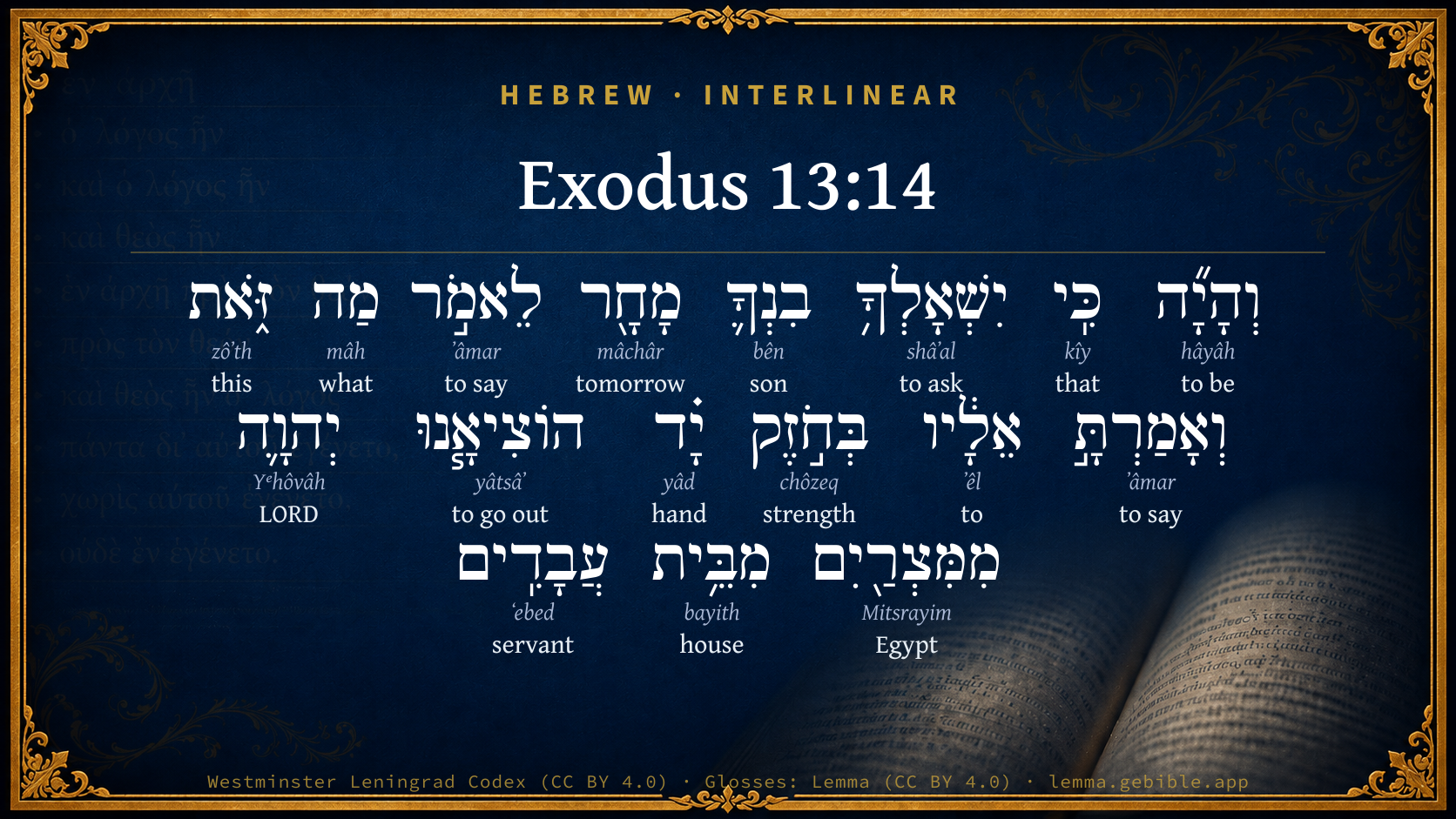
  1. וְהָיָ֞ה hâyâh H1961 “and · to be” Conjunction + Verb, Qal, Sequential Perfect, 3rd Person, Masculine, Singular
  2. כִּֽי kîy H3588 “that” Conjunction
  3. יִשְׁאָלְךָ֥ shâʼal H7592 “to ask · you” Verb, Qal, Imperfect, 3rd Person, Masculine, Singular + Suffix, Personal, 2nd Person, Masculine, Singular
  4. בִנְךָ֛ bên H1121 “son · your” Noun, Common, Masculine, Singular, Construct + Suffix, Personal, 2nd Person, Masculine, Singular
  5. מָחָ֖ר mâchâr H4279 “tomorrow” Noun, Common, Masculine, Singular, Absolute
  6. לֵאמֹ֣ר ʼâmar H559 “to say” Preposition + Verb, Qal, Infinitive Construct
  7. מַה mâh H4100 “what” Particle, Interrogative
  8. זֹּ֑את zôʼth H2063 “this” Pronoun, Demonstrative, Feminine, Singular
  9. וְאָמַרְתָּ֣ ʼâmar H559 “and · to say” Conjunction + Verb, Qal, Sequential Perfect, 2nd Person, Masculine, Singular
  10. אֵלָ֔יו ʼêl H413 “to · him” Preposition + Suffix, Personal, 3rd Person, Masculine, Singular
  11. יָ֗ד yâd H3027 “hand” Noun, Common, Both, Singular, Absolute
  12. הוֹצִיאָ֧נוּ yâtsâʼ H3318 “to go out · us” Verb, Hiphil, Perfect, 3rd Person, Masculine, Singular + Suffix, Personal, 1st Person, Common, Plural
  13. יְהוָ֛ה Yᵉhôvâh H3068 “LORD” Noun, Proper
  14. מִמִּצְרַ֖יִם Mitsrayim H4714 “from · Egypt” Preposition + Noun, Proper
  15. מִבֵּ֥ית bayith H1004 “from · house of” Preposition + Noun, Common, Masculine, Singular, Construct
  16. עֲבָדִֽים ʻebed H5650 “servants” Noun, Common, Masculine, Plural, Absolute

About this verse

These counts appear in no published source. They are computed here, from the morphology-tagged text and Lemma’s own curated glosses. What Lemma adds →

17
words
16
distinct lemmas
Pentateuch
section

Notable vocabulary

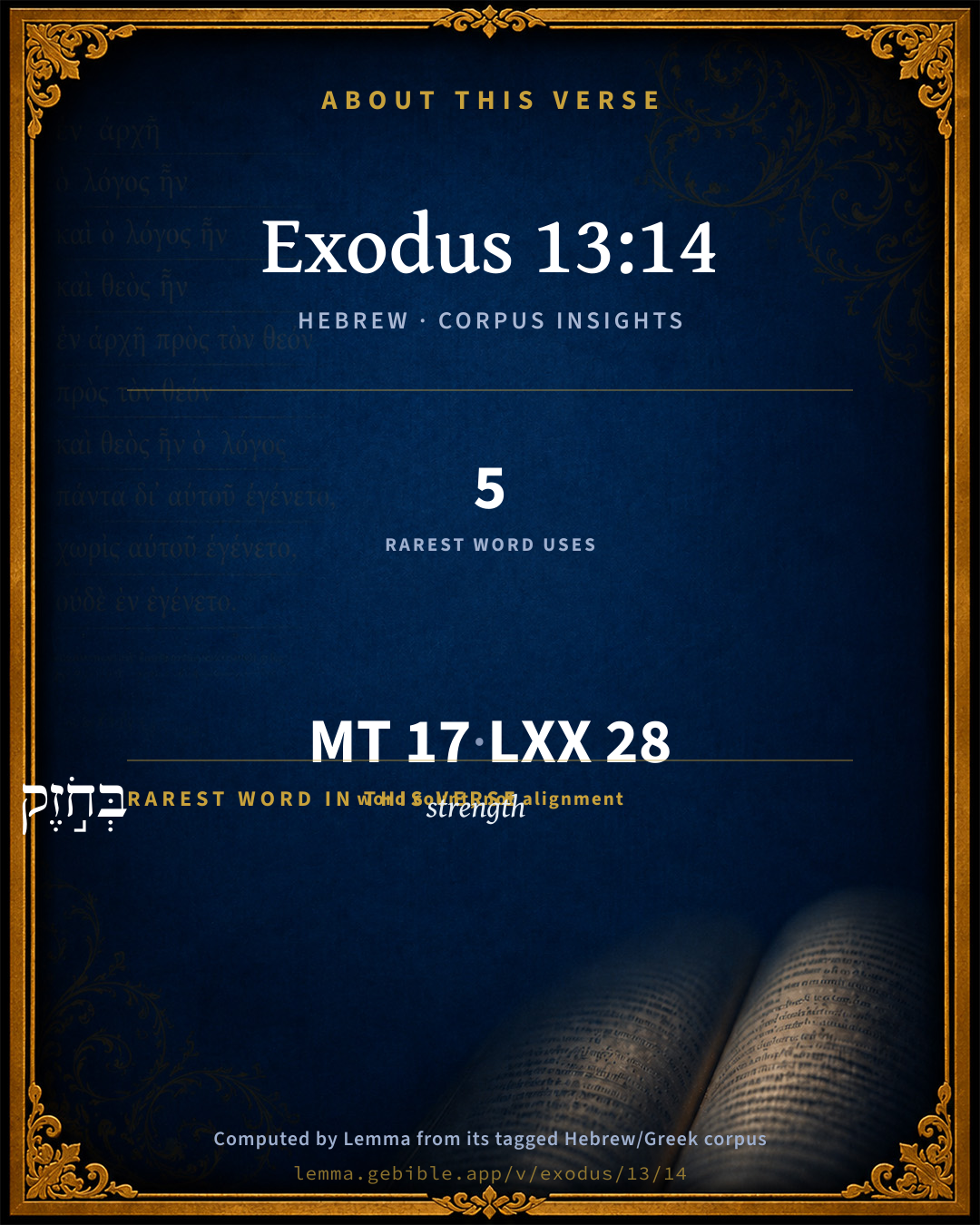
The rarest word here is בְּחֹ֣זֶק strength H2392 — appearing just 5 times in the whole Hebrew Bible.

Shared distinctive vocabulary

בְּחֹ֣זֶק strength H2392 occurs in 5 verses of the Hebrew Bible. Also found in:

Grammatical profile

  • 5 verbs
  • 8 nouns
  • 1 pronoun
  • 1 preposition
  • 1 conjunction
  • 1 particle

Verb forms

  • וְהָיָ֞ה Qal · Sequential Perfect
  • יִשְׁאָלְךָ֥ Qal · Imperfect
  • לֵאמֹ֣ר Qal · Infinitive Construct
  • וְאָמַרְתָּ֣ Qal · Sequential Perfect
  • הוֹצִיאָ֧נוּ Hiphil · Perfect

Repetition

A word recurs within this verse — often emphatic in Hebrew:

  • לֵאמֹ֣ר to say H559 ×2

Hebrew & Septuagint length

In English translation the verse runs 36 words from the Hebrew and 35 from the Septuagint (LXX English) — closely comparable.

A rough comparison of the two English renderings, which tokenize alike — not a word-level alignment.

Word counts can differ between the Hebrew and the Greek without any difference in meaning — e.g. the Hebrew direct-object marker אֵת has no separate Greek word, and Greek often adds the article ὁ.

In the original languages it is 17 Hebrew tokens and 28 Greek tokens — but the two are counted differently (Hebrew bundles its prefixes and suffixes into one token; the Greek is in lemma form), so that isn’t a like-for-like length.

Cross-references

10

Topical passages linked to Exodus 13:14 in the Treasury of Scripture Knowledge — connected by theme and wording, ordered by reader-vote popularity; previews shown in the World English Bible.

  • Exodus 13:3 Moses said to the people, "Remember this day, in which you came out from Egypt, out of the house of bondage; for by strength of hand Yahweh brought you out from this place. No leavened bread shall be eaten.
  • Joshua 4:6 that this may be a sign among you, that when your children ask in time to come, saying, What do you mean by these stones?
  • Psalms 145:4 One generation will commend your works to another, And will declare your mighty acts.
  • Exodus 12:26–27 It will happen, when your children ask you, 'What do you mean by this service?'
  • Exodus 13:9 It shall be for a sign to you on your hand, and for a memorial between your eyes, that the law of Yahweh may be in your mouth; for with a strong hand Yahweh has brought you out of Egypt.
  • Deuteronomy 6:20–24 When your son asks you in time to come, saying, What mean the testimonies, and the statutes, and the ordinances, which Yahweh our God has commanded you?
  • Genesis 30:33 So my righteousness will answer for me hereafter, when you come concerning my hire that is before you. Everyone that is not speckled and spotted among the goats, and black among the sheep, that might be with me, will be counted stolen."
  • Exodus 10:2 and that you may tell in the hearing of your son, and of your son's son, what things I have done to Egypt, and my signs which I have done among them; that you may know that I am Yahweh."
  • Joshua 4:21–24 He spoke to the children of Israel, saying, When your children shall ask their fathers in time to come, saying, What mean these stones?
  • Joshua 22:24 and if we have not [rather] out of carefulness done this, [and] of purpose, saying, In time to come your children might speak to our children, saying, What have you to do with Yahweh, the God of Israel?

Cross-references courtesy of OpenBible.info (CC BY 4.0).

Hebrew and Greek witnesses Masoretic Hebrew ↔ Greek Septuagint

The same verse in the two great witnesses to the Old Testament, shown verse-for-verse.

These are two independent witnesses, not word-aligned to each other, and the Septuagint is shown in lemma (dictionary) form.

Hebrew Exodus 13:14 Masoretic · Westminster Leningrad Codex

וְהָיָ֞ה כִּֽי יִשְׁאָלְךָ֥ בִנְךָ֛ מָחָ֖ר לֵאמֹ֣ר מַה זֹּ֑את וְאָמַרְתָּ֣ אֵלָ֔יו בְּחֹ֣זֶק יָ֗ד הוֹצִיאָ֧נוּ יְהוָ֛ה מִמִּצְרַ֖יִם מִבֵּ֥ית עֲבָדִֽים

It shall be, when your son asks you in time to come, saying, 'What is this?' that you shall tell him, 'By strength of hand Yahweh brought us out from Egypt, from the house of bondage;

World English Bible · Public Domain

Greek LXX Exodus 13:14 Septuagint · lemma form

ἐάν δέ ἐρωτάω σύ ὁ υἱός σύ μετά οὗτος λέγω τίς οὗτος καί εἶπον αὐτός ὅτι ἐν χείρ κραταιός ἐκἄγω ἐγώ κύριος ἐκ γῆ αἴγυπτος ἐκ οἶκος δουλεία

And if your son should ask you hereafter, saying, What is this? then you shall say to him, With a strong hand the Lord brought us out of Egypt, out of the house of bondage.

LXX2012 (modern English Septuagint) · Public Domain

Hebrew: Westminster Leningrad Codex (CC BY 4.0). Greek: Septuagint (public domain); English from LXX2012 (modern English Septuagint) (Public Domain). How the Septuagint differs from the Hebrew →

Targum (Aramaic paraphrase)

2

The Targum is the ancient Jewish Aramaic paraphrase of the Hebrew Scriptures — an interpretive translation, not the Hebrew text itself. Onkelos (literal) and Pseudo-Jonathan (expansive) render the Torah, and Jonathan the Prophets. Coverage is partial: where no permissively-licensed English translation exists for a verse, only the Aramaic is shown. This is verse-level text, not a word-by-word alignment to the Hebrew.

  1. Targum Onkelos Torah (Genesis–Deuteronomy)
    וִיהֵי אֲרֵי יִשְׁאֲלִנָךְ בְּנָךְ מְחָר לְמֵימַר מָא דָא וְתֵימַר לֵהּ בִּתְקוֹף יְדָא אַפְּקָנָא יְיָ מִמִצְרַיִם מִבֵּית עַבְדוּתָא:

    (no public-domain English translation for this verse)

    Targum Onkelos — Aramaic: “Onkelos Genesis” (public domain); “Onkelos Exodus” (public domain); “Onkelos Leviticus” (public domain); “Onkelos Numbers” (public domain); “Onkelos Deuteronomy” (public domain). English: “Sefaria Community Translation” (CC0 1.0 (public-domain dedication)); “J.W. Etheridge. The Targums of Onkelos and Jonathan Ben Uzziel on the Pentateuch. London: Longmans, Green, 1862” (public domain). Text via Sefaria.

  2. Targum Pseudo-Jonathan Torah (Genesis–Deuteronomy)
    וִיהֵי אֲרוּם יְשַׁיְילִינָךְ בְּרָךְ מְחַר לְמֵימַר מַה דָּא מִצְוָותָא דְבוּכְרַיָיא וְתֵימַר לֵיהּ בִּתְקוֹף יְדָא אַפְקָנָא יְיָ מִמִּצְרַיִם פְּרִיקִין מִבֵּית שִׁעֲבּוּד עַבְדַיָא

    And when in future thy son shall ask thee, saying, What is this ordinance of the firstborn? thou shalt tell him: By the power of a mighty hand the Lord delivered us from Mizraim, redeeming us from the house of the servitude of slaves.

    Targum Pseudo-Jonathan — Aramaic: “Targum Jonathan on Genesis” (public domain); “Targum Jonathan on Exodus” (public domain); “Targum Jonathan on Leviticus” (public domain); “Targum Jonathan on Numbers” (public domain); “Targum Jonathan on Deuteronomy” (public domain). English: “The Targum of Jonathan ben Uzziel, trans. J. W. Etheridge, London, 1862” (public domain). Text via Sefaria.

Commentary

Notes on Exodus 13:14 from classic Christian and Jewish commentators (each source and its license shown beneath its notes). The classic Christian expositions comment on the surrounding passage and are grouped to its opening verse, so a note may address several verses; the Jewish commentaries on the Tanakh (Rashi and others) are per-verse, so they appear only where the commentator wrote on this verse.

Lemma curates 59 commentaries, every one of them public domain or Creative Commons licensed, each selected and text-cleaned for this edition rather than reprinted as found. About our sources →

Trapp's Complete Commentary

John Trapp

Exo 13:14 And it shall be when thy son asketh thee in time to come, saying, What [is] this? that thou shalt say unto him, By strength of hand the LORD brought us out from Egypt, from the house of bondage:

Ver. 14. That thou shalt say unto him.] Plantas tenellas frequentius adaguare proderit, young plants must be often watered. {a}

{a} Primas. Greg. Mag.

John Trapp, A Commentary or Exposition upon All the Books of the Old and New Testament (1647–1656) — public domain. Text from a community e-Sword module.

The Biblical Illustrator

Joseph S. Exell

Exo_13:14-16

When thy son asketh thee.

The Book of Exodus introduces that new epoch in the scriptural history of sacrifices when they began to be regulated by fixed laws, to be part of a national economy.

I. The offering of the firstborn was the deification and consecration of the whole Jewish nation. The firstborn represented its strength, its vitality, its endurance. This act signified that its strength lay only in its dependence on Gods strength, that its vitality came from the life which is in Him, that it would endure from generation to generation, because He is the same and His years fail not. The calling of the Israelites was the calling to confess a Redeemer of Israel, a righteous Being who had brought out their fathers from the house of bondage.

II. Moses taught the people that by looking upon themselves as beings surrendered and sacrificed to the God of truth, the Deliverer of men, by feeling that they held all the powers of their minds and bodies as instruments for the great work in which He is engaged, thus they might be a nation indeed, one which would be a pattern to the nations, one which, in due time, would break the chains which bound them to visible and invisible oppressors.

III. When once we understand that we are witnesses for God, and do His work, self-sacrifice can never be an ambitious thing--a fine way to get the reputation of saints or the rewards of another world. It will be regarded as the true ground of all action; that on which all the blessed relations of life stand; that which is at the same time the only impulse to and security for the hard and rough work of the world. (F. D. Maurice, M. A.)

Meaning of ordinances to be explained

1. Ancient ordinances may be justly questioned in succeeding ages to know the meaning of them.

2. Reason is to be given of our religion to such as reasonably demand it.

3. Children may ask of parents and they must inform them of the ordinances of God.

4. Redemption-mercies are to be recorded and reported as just ground of Gods ordinance (verse 14).

5. Opposition against redemptions are justly declared to make the work glorious, and Gods people obedient.

6. Vengeance upon the enemies of the Churchs redemption is fit to be known to quicken them to duty.

7. The Churchs reason for its religion to God is rightly taken from its redemption (verse 15).

8. Gods redeeming mercies ought to work in the Church eternal memorials of Him (verse 16). (G. Hughes, B. D.)

Lessons

1. After redemption of His Church God provideth for guiding them in the way to rest.

2. Nearest ways to rest with men are not always approved by God for His people.

3. Gods foreknowledge of dangerous ways to His Church doth prevent them.

4. God will not put His people upon war or hard trials until He have fitted them for it.

5. Gods special care of His Church is to keep them from a retreat to bondage after redemption (verse 17). (G. Hughes, B. D.)

Imparting knowledge

Knowledge cannot be stolen by or from you. It cannot be sold or bought. You may be poor, and be troubled by the sheriff on the journey of life. He may break into your house and sell your furniture at auction; drive away your cow; take away your ewe lamb, and leave you homeless and penniless; but he cannot lay the laws hand upon the jewellery of your mind. This cannot be taken for debt; neither can you give it away, though you give enough of it to fill a million minds. In getting rich in the things which perish with the using, men have often obeyed to the letter that first commandment of selfishness: Keep what you can get, and get what you can. In filling your minds with the wealth of knowledge, you must reverse this rule, and obey this law: Keep what you give, and give what you can. The fountain of knowledge is filled by its outlets, not by its inlets. You can learn nothing which you do not teach; you can acquire nothing of intellectual wealth except by giving. (Elihu Burritt.)

The Biblical Illustrator, edited by Joseph S. Exell (c. 1880s–1900s) — public domain. Text from a community e-Sword module.

Rashi

Rabbi Shlomo Yitzchaki (Rashi)

כי ישאלך בנך מחר WHEN THY SON ASKETH THEE מחר — There is a usage of the word מחר that refers to “now” (i. e. to the period of time that is nearest to “now” viz., to-morrow), and there is another usage of מחר that refers to a day following after the lapse of some time, as, for example, this מחר here and as, for example, (Joshua 22:27) “That your children may not say to our children in time to come (מחר)” which occurs in the chapter about the sons of Gad and the sons of Reuben (Mekhilta).

מה זאת WHAT IS THIS? — This is the question of a dull child who has not sufficient understanding to question very profoundly and who therefore asks in an indefinite fashion, “What is this?” In another passage (Deuteronomy 6:20) it states, “[When thy son asketh thee…], What mean the testimonies and the statutes and the judgments … [which the Lord our God hath commanded you?]” This, however, is the question of a wise son. The Torah in mentioning four different explanations of the Passover sacrifice-rite to be given by a father to his children, is speaking in reference to four different types of son: the wicked son (12:25 and in the second half of 13:8), and one who has not sufficient understanding how to ask (in the first half of 13:8), and one who asks in an indefinite manner (13:14), and one who asks in a wise fashion (Deuteronomy 6:20) (cf. Mekhilta; Jerusalem Talmud Pesachim 10:4).

Rashi on the Tanakh — English translations: “The Judaica Press complete Tanach with Rashi, translated by A. J. Rosenberg” (CC BY 4.0); “Pentateuch with Rashi's commentary by M. Rosenbaum and A.M. Silbermann, 1929-1934” (public domain); “The Metsudah Tanach series, Lakewood, N.J” (CC BY 4.0); and “The Book of Joshua, Metsudah Publications, 1997” (CC BY 4.0). Text via Sefaria.

Geneva Bible (1599)

Geneva Bible translators

Or, hereafterwards.

Geneva Bible (1599) marginal notes — public domain. Text via Bolls.life.

The Cambridge Bible for Schools and Colleges

gen. ed. J. J. S. Perowne

14. in time to come] Heb. to-morrow: so Gen_30:33, Deu_6:20, Jos_4:6; Jos_4:21; Jos_22:24; Jos_22:27-28 †.

By strength of hand, &c.] See on v. 3.

14–15. The children to be instructed (as in v. 8) on the meaning of the observance: it is a memorial of the deliverance from Egypt, and of Jehovah’s slaughter of the firstborn of the Egyptians at the time.

The Cambridge Bible for Schools and Colleges (gen. ed. J. J. S. Perowne; Cambridge University Press, 1878–1918) — public domain. Text from a community e-Sword module.

John Gill's Exposition

And it shall be when thy son asketh thee in time to come,.... Or "on the morrow" (h), the day following such a separation of the firstborn of clean creatures, or such a redemption of the firstborn of unclean ones, and of man, or in any later time:

saying, what is this? what is the meaning of this? for what reason are such things done?

that thou shall say unto him, by strength of hand the Lord brought us out of Egypt from the house of bondage: by laying his mighty hand upon the firstborn of Egypt, and destroying them, which made the king of Egypt, and his people, willing to let Israel go; See Gill on Exo 13:3.

(h) "eras", Pagninus, Montanus, Tiguriue version.

John Gill's Exposition of the Whole Bible (1746–1763) — public domain (CC PDM 1.0). Text via the HelloAO Bible API.

Haydock's Catholic Bible Commentary

To-morrow. At any future period, Matthew vi. 2. (Menochius)

George Leo Haydock (1774–1849), Haydock's Catholic Family Bible and Commentary, 1859 edition — public domain. Excludes Psalms (Douay-Rheims chapter numbering differs from Protestant) and Deuterocanonical books (Catholic canon only).

Matthew Poole's English Annotations

Which is added to teach parents in all succeeding ages, that it is their duty to instruct their children in the word and works of God, and in the nature and reasons of every particular kind or part of God’s worship and service. See Deu 15:5; Psa 66:4; Hos 2:14.

Matthew Poole's English Annotations on the Holy Bible (1683–1685) — public domain. Text from a community e-Sword/MySword module.

The Pulpit Commentary

When thy son asketh thee. Compare Exo_12:26, and the comment ad loc.

The Pulpit Commentary (1880–1919), ed. H.D.M. Spence-Jones & Joseph S. Exell — public domain. Text from a community e-Sword module.

unfoldingWord translationNotes

Door43 World Missions Community

When your son asks you later, 'What does this mean?' then you are to tell him

The first quotation can be stated as an indirect quotation. AT: "When your son asks you later what this means, then you are to tell him" (See: Direct and Indirect Quotations)

strong hand

The word "hand" here represents God's actions or works. See how you translated this in Exodus 6:1. AT: "the power I show in my works" (See: Metonymy)

the house of slavery

Moses speaks of Egypt as if it were a house where people keep slaves. See how you translated this in Exodus 13:3. AT: "the place where you were slaves" (See: Metaphor)

become a reminder on your hands, and a reminder on your forehead

This expresses two ways to remember the importance of the passover event. See how you translated a similar phrase in Exodus 13:8-10. (See: Parallelism)

translationWords

house

servant

Pharaoh

stiff-necked

firstborn

sacrifice

unfoldingWord translationNotes — © Distant Shores Media and the Door43 World Missions Community, licensed CC BY-SA 4.0. Source: git.door43.org/Door43/en_tn.

Lesson kit

Teaching starters — assembled from the data on this page, not authored interpretation. Every prompt links to the verse data it draws on. Edit before teaching.

Exodus, in the Pentateuch, opens this verse with 17 words (16 distinct Hebrew lemmas). Its most distinctive word is chôzeq (“strength”). A historical commentator’s framing appears above. Read the whole chapter for the surrounding context.

Discussion questions

  1. The word chôzeq carries the sense “strength.” How does it shape the verse?
  2. How does Exodus 13:3, which shares the word «strength», read alongside this verse?
  3. What does the repetition of “to say” (2× in this one verse) do in this verse?
  4. These translations render this verse differently. What is at stake in choosing one wording over another?
  5. «וְהָיָ֞ה» is a Qal Sequential Perfect verb. How does that grammatical form shape the action described?
  6. Compare how Trapp's Complete Commentary and The Biblical Illustrator read this verse. Where do they agree or differ?

Things to notice

Reading settings

Reading text

Shown beneath each verse's original-language words.

Old Testament
Old Testament edition

Read the OT as the Masoretic Hebrew (MT) or the Greek Septuagint (LXX).

English shown for the Greek Septuagint (in the Hebrew ↔ Greek comparison).

Comparing translations? Open the Compare panel on any verse page to stack up to four side by side.