
Deuteronomy 4:44

Hebrew (Westminster Leningrad Codex) Deuteronomy 4:44 appears in the Hebrew Old Testament. The text above is from the Westminster Leningrad Codex. Each word links to its Strong’s number, a concise gloss, and parsing drawn from the Open Scriptures Hebrew Bible morphology. Click any word for its full Brown-Driver-Briggs (BDB) entry.
Download image
Cite this verse

Deuteronomy 4:44 (World English Bible). Public Domain. Lemma interlinear Bible study tool, https://lemma.gebible.app/v/deuteronomy/4/44.

Show BibTeX & RIS
BibTeX
RIS
English Translation
This is the law which Moses set before the children of Israel:
World English Bible · Public Domain
Download a study sheet

One document with this verse’s original text, its word-by-word gloss line, the meaning frame, cross-references with their text, attributed commentary, and full source and license credits — printable, and it pastes into notes with its structure intact.

This verse Autodidact and up

Study sheet (.html) Plain text (.txt)

A passage Seminary Student

Up to 50 verses in one chapter. A passage sheet keeps up to 6 commentary sources and 12 cross-references per verse, in the order this page ranks them, and says so on the sheet whenever that leaves anything out. Ask for a single verse and you get the Autodidact verse sheet above.

Everything on this page stays free to read, with no account — the sheet is a download of what is already on screen, not access to it.

Want to remove ads? Support Godless Engineer
Compare translations 3

The same verse in 3 English versions, stacked beneath the original-language interlinear above. Click any original word for its lexicon entry.

Each is an independent rendering of the whole verse — the interlinear is not word-aligned to these translations.

Highlighted words mark where these versions differ — a whole-verse word diff, not a word-by-word alignment.

  • World English Bible Public Domain
    This is the law which Moses set before the children of Israel:
  • King James Version Public Domain
    And this is the law which Moses set before the children of Israel:
  • unfoldingWord Literal Text CC BY-SA 4.0
    And this the law that Moses placed to the faces of the sons of Israel.

unfoldingWord Literal Text — © unfoldingWord, licensed CC BY-SA 4.0. Word-aligned USFM3 via Door43 (git.door43.org/unfoldingWord/en_ult).

Versions to compare (up to 4)

3 of 4 selected

Show all 18 translations

Every available English version of this verse, each an independent rendering of the whole verse.

  • World English Bible Public Domain
    This is the law which Moses set before the children of Israel:
  • Berean Standard Bible Public Domain
    This is the law that Moses set before the Israelites.
  • Majority Standard Bible Public Domain
    This is the law that Moses set before the Israelites.
  • King James Version Public Domain
    And this is the law which Moses set before the children of Israel:
  • American Standard Version (1901) Public Domain
    And this is the law which Moses set before the children of Israel:
  • Revised Version (1885) Public Domain
    And this is the law which Moses set before the children of Israel:
  • Geneva Bible (1599) Public Domain
    So this is the law which Moses set before the children of Israel.
  • Douay-Rheims (1899) Public Domain
    This is the law, that Moses set before the children of Israel,
  • Young's Literal Translation Public Domain
    And this `is' the law which Moses hath set before the sons of Israel;
  • Literal Standard Version CC BY-SA 4.0
    And this [is] the law which Moses has set before the sons of Israel;
  • Unlocked Literal Bible CC BY-SA 4.0
    This is the law that Moses placed before the people of Israel;
  • unfoldingWord Literal Text CC BY-SA 4.0
    And this the law that Moses placed to the faces of the sons of Israel.
  • Darby Bible Public Domain
    And this is the law which Moses set before the children of Israel:
  • World Messianic Bible Public Domain
    This is the law which Moses set before the children of Israel.
  • Webster's Bible Public Domain
    And this is the law which Moses set before the children of Israel.
  • Free Bible Version CC BY-SA 4.0
    This is the law that Moses placed before the Israelites.
  • Bible in Basic English Public Domain
    This is the law which Moses put before the children of Israel:
  • JPS Tanakh (1917) Public Domain
    And this is the law which Moses set before the children of Israel;

Literal Standard Version (2020), Covenant Press — licensed CC BY-SA 4.0. Text via the HelloAO Bible API (eBible.org). Unlocked Literal Bible (unfoldingWord) — licensed CC BY-SA 4.0. Text via the HelloAO Bible API (eBible.org). unfoldingWord Literal Text — © unfoldingWord, licensed CC BY-SA 4.0. Word-aligned USFM3 via Door43 (git.door43.org/unfoldingWord/en_ult). Free Bible Version, Dr. Jonathan Gallagher — licensed CC BY-SA 4.0. Text via the HelloAO Bible API (eBible.org).

Word by word

More ways to search: Search by grammar → Find every occurrence → Compare this word →

Practice this passage: Drill this verse → Learn its vocabulary →

הַתּוֹרָ֑ה
tôwrâh
H8451
“the · law”
Particle, Definite Article + Noun, Common, Feminine, Singular, Absolute
Part of Speech
Particle + Noun
Type
Common
Gender
Feminine
Number
Singular
State
Absolute
Full BDB Definition

Origin: from H3384

TWOT: 910d

law, direction, instruction - instruction, direction (human or divine) - body of prophetic teaching - instruction in Messianic age - body of priestly direction or instruction - body of legal directives - law - law of the burnt offering - of special law, codes of law - custom, manner - the Deuteronomic or Mosaic Law
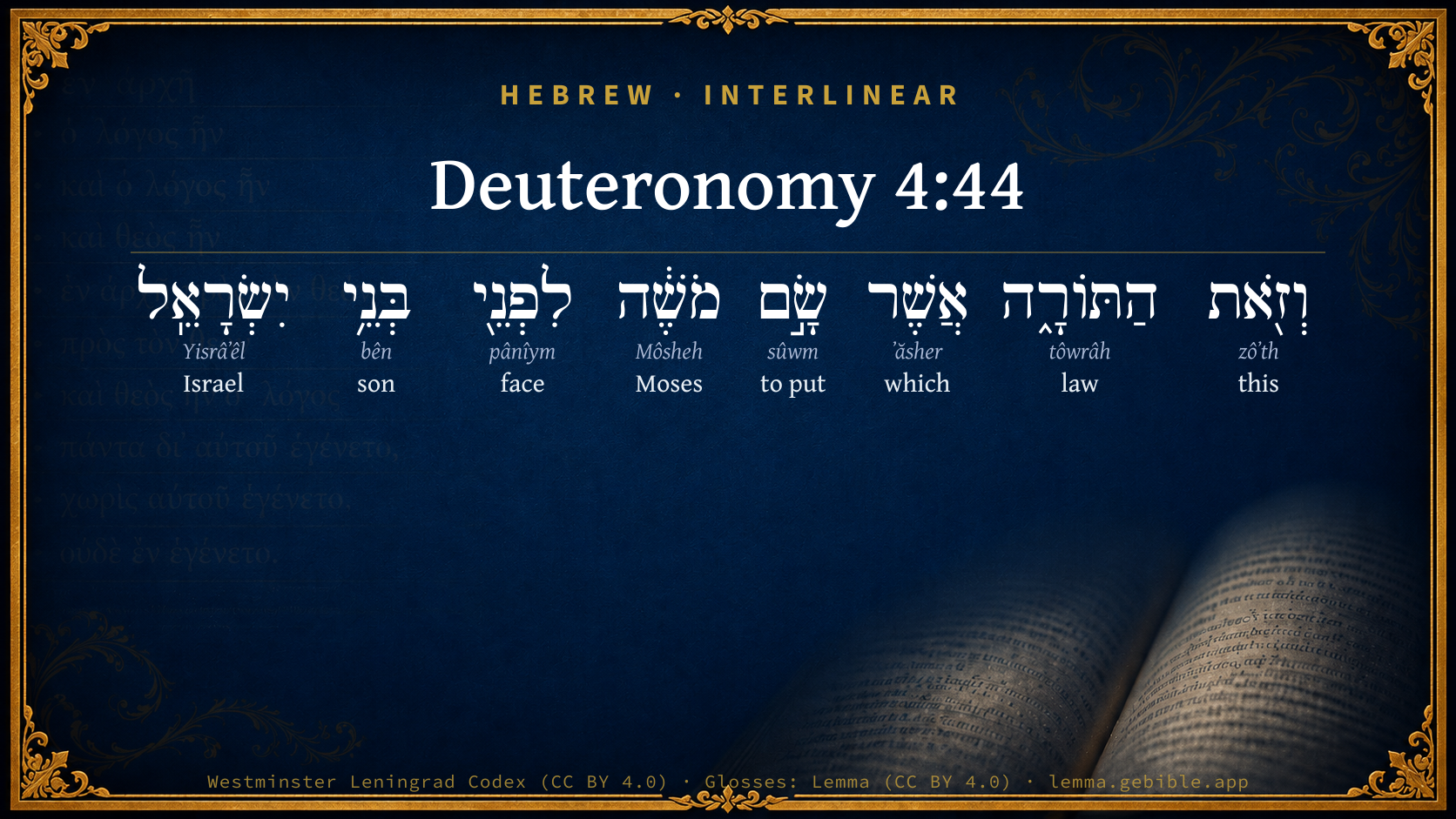
  1. וְזֹ֖את zôʼth H2063 “and · this” Conjunction + Pronoun, Demonstrative, Feminine, Singular
  2. אֲשֶׁר ʼăsher H834 “which” Particle, Relative
  3. שָׂ֣ם sûwm H7760 “to put” Verb, Qal, Perfect, 3rd Person, Masculine, Singular
  4. מֹשֶׁ֔ה Môsheh H4872 “Moses” Noun, Proper
  5. לִפְנֵ֖י pânîym H6440 “to/for · face(s) of” Preposition + Noun, Common, Both, Plural, Construct
  6. בְּנֵ֥י bên H1121 “sons of” Noun, Common, Masculine, Plural, Construct
  7. יִשְׂרָאֵֽל Yisrâʼêl H3478 “Israel” Noun, Proper

About this verse

These counts appear in no published source. They are computed here, from the morphology-tagged text and Lemma’s own curated glosses. What Lemma adds →

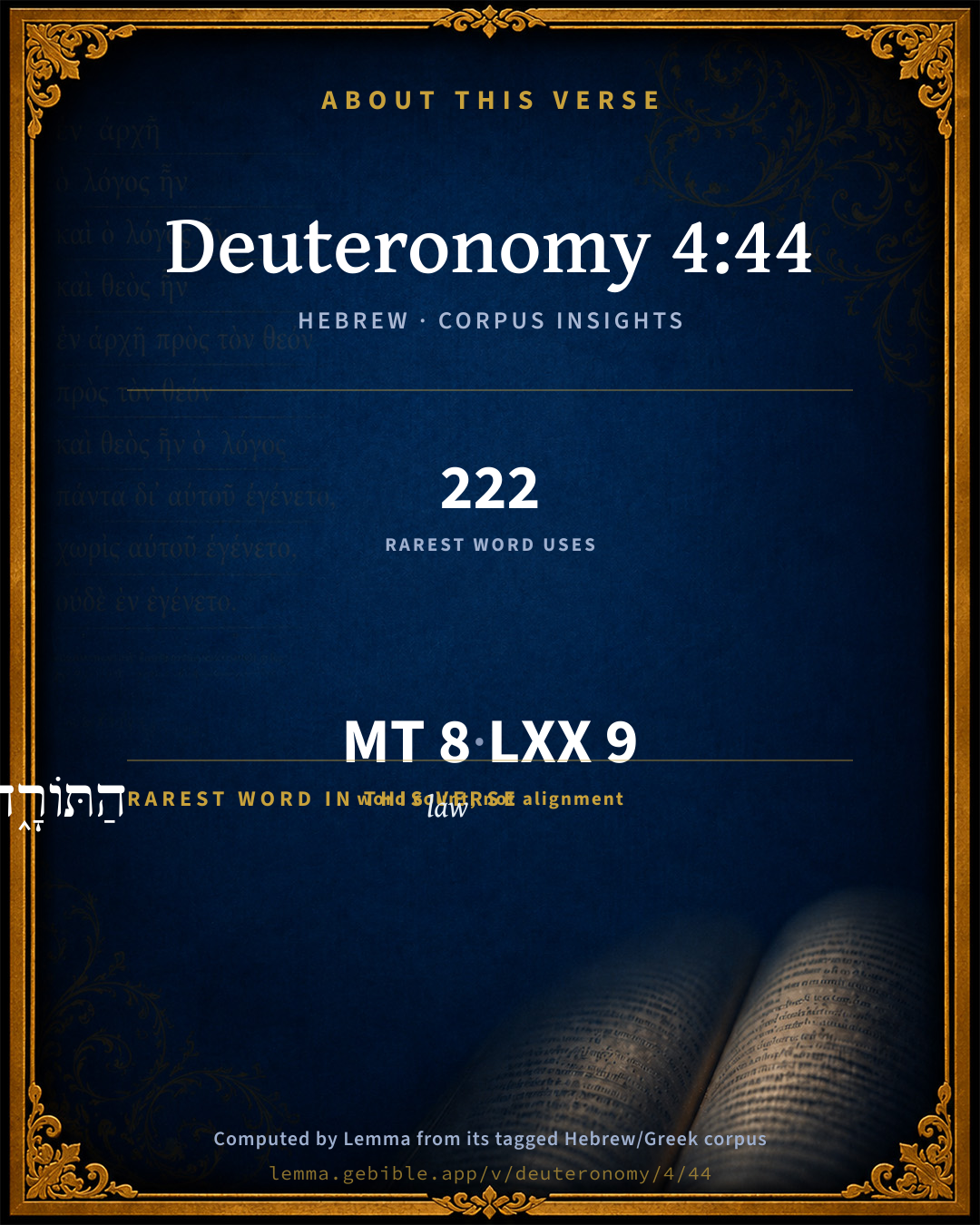
8
words
8
distinct lemmas
Pentateuch
section

Grammatical profile

  • 1 verb
  • 5 nouns
  • 1 pronoun
  • 1 particle

Verb forms

  • שָׂ֣ם Qal · Perfect

Hebrew & Septuagint length

In English translation the verse runs 12 words from the Hebrew and 12 from the Septuagint (LXX English) — the same length.

A rough comparison of the two English renderings, which tokenize alike — not a word-level alignment.

Word counts can differ between the Hebrew and the Greek without any difference in meaning — e.g. the Hebrew direct-object marker אֵת has no separate Greek word, and Greek often adds the article ὁ.

In the original languages it is 8 Hebrew tokens and 9 Greek tokens — but the two are counted differently (Hebrew bundles its prefixes and suffixes into one token; the Greek is in lemma form), so that isn’t a like-for-like length.

Cross-references

10

Topical passages linked to Deuteronomy 4:44 in the Treasury of Scripture Knowledge — connected by theme and wording, ordered by reader-vote popularity; previews shown in the World English Bible.

  • Deuteronomy 27:26 Cursed be he who doesn't confirm the words of this law to do them. All the people shall say, Amen.
  • Leviticus 27:34 These are the commandments which Yahweh commanded Moses for the children of Israel on Mount Sinai.
  • Deuteronomy 1:5 Beyond the Jordan, in the land of Moab, began Moses to declare this law, saying,
  • Deuteronomy 17:18–19 It shall be, when he sits on the throne of his kingdom, that he shall write him a copy of this law in a book, out of [that which is] before the priests the Levites:
  • Deuteronomy 27:3 and you shall write on them all the words of this law, when you are passed over; that you may go in to the land which Yahweh your God gives you, a land flowing with milk and honey, as Yahweh, the God of your fathers, has promised you.
  • Deuteronomy 27:8 You shall write on the stones all the words of this law very plainly.
  • Deuteronomy 33:4 Moses commanded us a law, An inheritance for the assembly of Jacob.
  • Malachi 4:4 "Remember the law of Moses my servant, which I commanded to him in Horeb for all Israel, even statutes and ordinances.
  • John 1:17 For the law was given through Moses. Grace and truth came through Jesus Christ.
  • Numbers 36:13 These are the commandments and the ordinances which Yahweh commanded by Moses to the children of Israel in the plains of Moab by the Jordan at Jericho.

Cross-references courtesy of OpenBible.info (CC BY 4.0).

Hebrew and Greek witnesses Masoretic Hebrew ↔ Greek Septuagint

The same verse in the two great witnesses to the Old Testament, shown verse-for-verse.

These are two independent witnesses, not word-aligned to each other, and the Septuagint is shown in lemma (dictionary) form.

Hebrew Deuteronomy 4:44 Masoretic · Westminster Leningrad Codex

וְזֹ֖את הַתּוֹרָ֑ה אֲשֶׁר שָׂ֣ם מֹשֶׁ֔ה לִפְנֵ֖י בְּנֵ֥י יִשְׂרָאֵֽל

This is the law which Moses set before the children of Israel:

World English Bible · Public Domain

Greek LXX Deuteronomy 4:44 Septuagint · lemma form

οὗτος ὁ νόμος ὅς παρατίθημι μωυσῆς ἐνώπιον υἱός ἰσραήλ

This is the law which Moses set before the children of Israel.

LXX2012 (modern English Septuagint) · Public Domain

On this verse, The Cambridge Bible for Schools and Colleges discusses the Septuagint’s reading. Read the note in Commentary ↓

Hebrew: Westminster Leningrad Codex (CC BY 4.0). Greek: Septuagint (public domain); English from LXX2012 (modern English Septuagint) (Public Domain). How the Septuagint differs from the Hebrew →

Targum (Aramaic paraphrase)

2

The Targum is the ancient Jewish Aramaic paraphrase of the Hebrew Scriptures — an interpretive translation, not the Hebrew text itself. Onkelos (literal) and Pseudo-Jonathan (expansive) render the Torah, and Jonathan the Prophets. Coverage is partial: where no permissively-licensed English translation exists for a verse, only the Aramaic is shown. This is verse-level text, not a word-by-word alignment to the Hebrew.

  1. Targum Onkelos Torah (Genesis–Deuteronomy)
    וְדָא אוֹרַיְתָא דִי סַדַר מֹשֶׁה קֳדָם בְּנֵי יִשְׂרָאֵל

    (no public-domain English translation for this verse)

    Targum Onkelos — Aramaic: “Onkelos Genesis” (public domain); “Onkelos Exodus” (public domain); “Onkelos Leviticus” (public domain); “Onkelos Numbers” (public domain); “Onkelos Deuteronomy” (public domain). English: “Sefaria Community Translation” (CC0 1.0 (public-domain dedication)); “J.W. Etheridge. The Targums of Onkelos and Jonathan Ben Uzziel on the Pentateuch. London: Longmans, Green, 1862” (public domain). Text via Sefaria.

  2. Targum Pseudo-Jonathan Torah (Genesis–Deuteronomy)
    וְדָא אַחְוָיַת אוֹרַיְיתָא דִי סַדֵּר משֶׁה קֳדָם בְּנֵי יִשְרָאֵל

    This is the declaration of the law which Mosheh set in order before the sons of Israel

    Targum Pseudo-Jonathan — Aramaic: “Targum Jonathan on Genesis” (public domain); “Targum Jonathan on Exodus” (public domain); “Targum Jonathan on Leviticus” (public domain); “Targum Jonathan on Numbers” (public domain); “Targum Jonathan on Deuteronomy” (public domain). English: “The Targum of Jonathan ben Uzziel, trans. J. W. Etheridge, London, 1862” (public domain). Text via Sefaria.

Commentary

Notes on Deuteronomy 4:44 from classic Christian and Jewish commentators (each source and its license shown beneath its notes). The classic Christian expositions comment on the surrounding passage and are grouped to its opening verse, so a note may address several verses; the Jewish commentaries on the Tanakh (Rashi and others) are per-verse, so they appear only where the commentator wrote on this verse.

Lemma curates 59 commentaries, every one of them public domain or Creative Commons licensed, each selected and text-cleaned for this edition rather than reprinted as found. About our sources →

Ellicott's Commentary for English Readers

SECOND DISCOURSE.

(44-49) These words form an introduction to the second discourse, which occupies the larger portion of the book—from Deu_5:1 to the end of Deuteronomy 26. There is no real break between. The present introduction differs from what we find in Deu_1:1. There is no intimation that this portion of Deuteronomy was a repetition of what had been delivered between Sinai and Kadesh-barnea. What follows is said to have been spoken in the land of Sihon and Og, after the conquest by Israel.

(46) On this side Jordan.—Literally, on the other side. The same expression in Deu_4:47 is defined by the addition, “toward the sun-rising.”

The whole passage (Deu_4:44-49) may be editorial, and added by Joshua in Canaan. But there is no necessity for this view.

(48) Mount Sion.—See Note on Deu_3:9.

A Bible Commentary for English Readers, edited by Charles John Ellicott (1878–1897) — public domain. Text from a community e-Sword module.

The Cambridge Bible for Schools and Colleges

gen. ed. J. J. S. Perowne

44. And this is the law] So too Sam.; LXX, Vg. and Pesh. omit and. A slight symptom of the fact that this title once stood at the very beginning of an edition of D, the conjunction having been added when other matter was prefixed to it. On law, Tôrah, see Deu_1:5, Deu_31:1, etc.

set before] Heb. sam liphne instead of the synonymous nathan liphne usual in D.

children of Israel] Heb. bne Yisra’el. So E, Deu_10:6; JE (?), Deu_31:19; Deu_31:22 f.; P, Deu_1:3, Deu_32:51, Deu_34:8 f. and in titles here, Deu_4:45-46, Deu_29:1 (Deut 28:69). In D the usual term is all Israel. (Bne Yisra’el in Deu_3:18, Deu_23:18 is no exception, for there and probably also in Deu_24:7 it means only sons, i.e. males, of Israel.)

44–49. Introduction (or Introductions) to the following Discourses and Laws (5–26)

The appearance of a fresh heading at this point—between the two distinct sets of discourses Deu_1:6 to Deu_4:40 and Deuteronomy 5-11, which are further separated by the historical fragment, Deu_4:41-43—raises questions at the heart of the problem of the structure of the book of Deuteronomy. Does it signify that once the book began here and consisted only of the discourses 5–11 and the laws 12–26; Deu_1:6 to Deu_4:40 having been prefixed later? So Graf, Kue., Wellh., König, etc. Or is the appearance of the heading just here compatible with the theory that the whole of 1–26 is the work of one author? So Dillm. and Driver on the ground that a new title would not be unnatural where the actual exposition of the law at last begins (Deu_1:6 to Deu_4:40 having been mainly historical). Other alternatives arise from the structure of the heading. Like that in Deu_1:1-5 it is apparently composite. Deu_4:44-45 seem two independent titles; Deu_4:46-49 not only accumulate details after the manner of some other titles in the O.T. but contain a slight difference of style: in 47 D’s towards the sunrising, but in 49 P’s shorter form of the same (see on Deu_4:41 and the notes below). Other non-deuteronomic phrases are set before and children of Israel, thrice (see below on Deu_4:44); but both the contents, and with one exception the language, of 46–49 closely recall parts of chs. 2 and 3. Recently there has been a general disposition to break up the heading. Steuernagel supposes 44 and 45 to be respectively the titles of the two documents, in the Sg. and in the Pl. form of address, which he traces throughout chs. 5 ff.; Bertholet takes 44 as the transition from the first introductory address, 1–3, to the legislation proper, 12–26; and 45–49 as an introduction to ch. 5; Cullen takes 44 with 45c, 46a as the title to the original environment of the Law code or ‘Torah,’ but 45ab, 46bc as that of the first combined edition of the ‘Miṣwah’ and ‘Torah’ (see Introd. § 1). The variety of these hypotheses alone shows their precariousness; and there is this further objection to finding in the double title, 44 and 45, headings to the original documents of D, viz. that even in these verses non-deuteronomic phrases occur. The whole passage looks editorial: one piece (Dillmann) in the cumulative style beloved by later scribes rather than a growth from an original nucleus (Driver). Why then was it inserted just here? Dillm.’s and Driver’s answer, because at last with ch. 5 begins the actual exposition of the law, is hardly relevant; because in that case Deu_4:44 or Deu_4:45 would have contained some such verb as the expound which we find in the title Deu_1:5. Indeed, that title is more suitable here than where it stands, for it describes better the expository and hortatory character of 5 ff. than the prevailing historical style of Deu_1:6 to Deu_4:40.—On a review of the data and these arguments it seems to the present writer more possible, and even probable, that part of Deu_1:1-5 (and more particularly 5) originally formed the introduction to the combined discourses and laws, 5–26; that it was divorced from these by the prefixing to them of Deu_1:6 to Deu_4:40; and that when the whole book 1–26 was thus constituted, it was found convenient for its practical use to supply a new heading to chs. 5 ff. (Deu_5:1 being too slight for the purpose), which should at once indicate that a new set of discourses begins here, and at the same time furnish a summary of the historical situation in which the discourses and legislation were delivered as described in chs. 2, 3. Such a suggestion is at least suitable to the salient features of Deu_4:45-49 : that the language is partly post-deuteronomic and that part of the substance is based on chs. 2, 3.

The Cambridge Bible for Schools and Colleges (gen. ed. J. J. S. Perowne; Cambridge University Press, 1878–1918) — public domain. Text from a community e-Sword module.

Trapp's Complete Commentary

John Trapp

Deu 4:44 And this [is] the law which Moses set before the children of Israel:

Ver. 44. And this is the law.] That is, This that followeth in the next chapter, whereunto these verses serve for a preface.

John Trapp, A Commentary or Exposition upon All the Books of the Old and New Testament (1647–1656) — public domain. Text from a community e-Sword module.

Albert Barnes' Notes on the Bible

These verses would be more properly assigned to the next chapter. They are intended to serve as the announcement and introduction of the address now to be commenced. Deu 4:44 gives a kind of general title to the whole of the weighty address, including in fact the central part and substance of the book, which now follows in 22 chapters, divided into two groups:

(a) Deut. 5–11,

(b) Deut. 12–26.

The address was delivered when they had already received the first-fruits of those promises Deu 4:46, the full fruition of which was to be consequent on their fulfillment of that covenant now again about to be rehearsed to them in its leading features.

Deu 4:48

Sion must not be confounded with Zion (compare Psa 48:2.).

Albert Barnes' Notes on the Bible (1834–1885) — public domain. Text from a community e-Sword/MySword module.

Joseph Benson's Commentary

Deu 4:44. This is the law — More particularly and fully expressed in the following chapter, to which these words are an introduction.

Joseph Benson's Commentary on the Old and New Testaments (1811–1818) — public domain. Text from a community e-Sword module.

Whedon's Commentary on the Bible

Daniel D. Whedon

Second Discourse, Deu_4:44 to Deu_16:19.

INTRODUCTION.

44. This is the law — Thorah (law) is the word that brought to the mind of Israel the ten words spoken by Jehovah on Sinai, together with the legislation and comments of Moses.

Daniel D. Whedon (gen. ed.), Commentary on the Old and New Testaments (1874–1909) — public domain. Text from a community e-Sword module.

The Pulpit Commentary

PART IISECOND ADDRESS OF MOSES. CHAPTER 4:44-CHAPTER 26:19.

THIS address is introduced by a general notice of what is to form the subject of it, viz. the Law, with a more especial description of that in its different parts, as consisting of ordinances, statutes, and rights; together with a reference to the place and time when this address was delivered.

This is the Law the Torahwhich Moses set before the children of Israel. "He meaneth that which hereafter followeth; so this belongeth to the next chapter, where the repetition of the laws begins" (Ainsworth); cf. Deu_4:1 Deu_6:1; Lev_6:9 Lev_7:1, etc.

Vers. 44, 45. The Law: its value. (See Homiletics, Deu_5:22-33)

Vers. 44-49. The territory of Sihon and Og occupied by others.

(See Homiletics, Deu_2:24-37; Deu_3:1-11)

Vers. 44-49. The circumstances under which the Law was reiterated.

These verses are manifestly introductory to the discourse of the succeeding chapters. Moses is about to declare the "testimonies" (tdoeh;), what comes forth from God to indicate his will; and the "statutes" ( the defined duties of moral obligation; and the "judgments" ( or mutual rights of men. The conditions of his speech are here detailed.

I THE ISRAELITES HAD RECEIVED AN EARNEST OF THE PROMISED INHERITANCE. They had got, as we have seen, the land of the Amorites. The kingdoms of Og and of Sihon were already in the hands of the two and a half tribes. Moses had a vantage-ground, therefore, from which to plead the claims of God. And so, when we get an earnest of the promised inheritance in the gift of the Spirit, we are more likely to yield ourselves to the Divine demands. (Eph_1:14) We have an inheritance on this side the Jordan of death, more important than the pastures of Bashan, and God, having given us this, may well make demands upon us.

II THE EXPERIENCE THROUGH WHICH THEY HAD PASSED WAS ALSO MOST IMPORTANT. For the temporal inheritance in Moab and Bashan was a minor part of their gifts from God. Their fellowship at Sinai, their wanderings through the wilderness, the chequered experience of judgment and of mercy, all combined to make the Israelites in Moab a favored people. No other nation had had such an experience and history.

III THE REITERATION OF THE LAW WAS IN THE MIDST OF HAPPIER CONDITIONS. At Sinai their fathers and themselves had witnessed awe-inspiring wonders. The mount was the center of quaking and fear. Even Moses had to yield to the panorama of terror, and to say, "I exceedingly fear and quake." But now in Moab all around them is bright and hopeful. Mercy encompassed them, and so they were more likely to enter into the spirit of the Law, which Moses makes out to be love . (Deu_6:1-5)

IV WE LEARN FROM THIS THAT GOD FIRST GIVES BLESSINGS AND THEN ASKS OBEDIENCE. It is here that we see plainly the essence of the gospel. The glad tidings consist of the offer of a full and free salvation to the sinner, on the ground that he is a sinner and cannot save himself. The salvation is saddled with no condition. This is the trouble it is too good news to be true, in the sinner"s sight. He can hardly credit such free gift he would rather pay something for it. But God is firm, and will make no half bargains. But when the sinner has been redeemed from Egypt and brought to God, he is expected in gratitude to obey God"s Law. It is his rule of life, and he renders obedience to it willingly. People "put the cart before the horse," and fancy God will take something in part payment, and could not think of refusing them! Nothing is so important just now as clear views about the plan of salvation. R.M.E.

The Pulpit Commentary (1880–1919), ed. H.D.M. Spence-Jones & Joseph S. Exell — public domain. Text from a community e-Sword module.

Keil & Delitzsch

C. F. Keil & F. Delitzsch

Announcement of the Discourse upon the Law. - First of all, in Deu 4:44, we have the general notice in the form of a heading: "This is the Thorah which Moses set before the children of Israel;" and then, in Deu 4:45, Deu 4:46, a fuller description of the Thorah according to its leading features, "testimonies, statutes, and rights" (see at Deu 4:1), together with a notice of the place and time at which Moses delivered this address. "On their coming out of Egypt," i.e., not "after they had come out," but during the march, before they had reached the goal of their journeyings, viz., (Deu 4:46) when they were still on the other side of the Jordan. "In the valley," as in Deu 3:29. "In the land of Sihon," and therefore already upon ground which the Lord had given them for a possession. The importance of this possession as the first-fruit and pledge of the fulfilment of the further promises of God, led Moses to mention again, though briefly, the defeat of the two kings of the Amorites, together with the conquest of their land, just as he had done before in Deu 2:32-36 and 3:1-17. On Deu 4:48, cf. Deu 3:9, Deu 3:12-17. Sion, for Hermon (see at Deu 3:9).

Keil & Delitzsch — Biblical Commentary on the Old Testament (1861–1891) — public domain (CC PDM 1.0). Text via the HelloAO Bible API. (Old Testament only.)

Lange's Commentary on the Holy Scriptures

Title introductory to the second discourse

Deu_4:44-49

44, 45And this is the law which Moses set before the children of Israel: These are the testimonies, and the statutes, and the judgments, which Moses spake unto the 46children of Israel, after they came forth out of Egypt, On this [that] side Jordan, in the valley over against Beth-peor, in the land of Sihon king of the Amorites, who dwelt at Heshbon, whom Moses and the children of Israel smote, after [as they came]1 they were come forth out of Egypt: 47And they possessed his land, and the land of Og, king of Bashan, two kings of the Amorites, which were on this [that] side Jordan, toward the sun-rising; 48From Aroer, which is by the bank of the river Arnon, even unto Mount Sion, which is Hermon, 49And all the plain on this [that] side Jordan eastward, even unto the sea of the plain, under the springs [slopes] of Pisgah.

EXEGETICAL AND CRITICAL

Since the second discourse constitutes peculiarly Deuteronomy, it is proper that it should be preceded by a general introductory title, analogous in its form to that in Deu_1:1-5. As to its form the progress from the declaration, Deu_1:5, to the setting it before the children of Israel, is worthy of notice. Deuteronomy is thus the renewed, and in a certain measure a second lawgiving. Then, in order to bring out fully that which corresponds to the title, he adds to the all-comprehensive designation law, Deu_4:44, now (Deu_4:45) testimonies, and indeed before statutes, and judgments, because these two sides of the law of God, in His revelation, in its demands, penalties, promises, are designed to testify to men in Israel His gracious, holy, righteous, good-will, Deu_6:17; Deu_6:20; Deu_31:26-27. [Bib. Com.: “Testimonies, statutes, and judgments, i.e., commandments considered first as manifestations or attestations of the will of God, next as duties of moral obligation, and thirdly as precepts securing the mutual rights of men.”—A. G.]. What was presupposed in the time announcement, Deu_1:3, is here and in Deu_4:46, expressly declared in the בְּצֵאתָס־; the auditory after the terminus a quo, and at the same time according to the obligatory grounds or reasons, as in Exo_20:2; Exo_19:1. Comp. also upon Deu_1:1; Deu_3:29; Deu_1:4. For Deu_4:47, see Deu_2:33 sq.; Deu_3:1 sq. For Deu_4:48, see Deu_2:36; Deu_3:12; Deu_3:8-9. For Deu_4:49, see Deu_3:17. “It is not strange that the geographical and historical elements which form the basis of the narrative should be presented again in this title, since these stand in the closest connection with the subjects of the discourse, which now first takes its right course.”—Baumgarten.

HOMILETICAL AND PRACTICAL

Deu_4:44-45. Calvin: “Moses shows, with how many words also, that he has only explained to them the law in its integrity.” Deu_4:46 sq. Calvin: “The taste of grace received should lead us to press more eagerly forward.” Deu_4:49. Richter: “Every look at Pisgah was for Moses a reminder of his approaching death (Deu_3:27) therefore he hastens to arrange all things with and for Israel.” The law Isaiah , 1) for a testimony, and thus it is doctrine; 2) for a support, and thus an ordinance for Church, State, family; 3) for justice, and thus a seal, as also a glass and restraint. If God makes demands upon man He has first given to him, and will give, so that he may have all fulness.

Footnotes:

[1][Deu_4:46. Lit., in their coming.—A. G.].

Lange's Commentary on the Holy Scriptures (Critical, Doctrinal, and Homiletical), ed. John Peter Lange, English translation edited by Philip Schaff (1864–1880) — public domain. Text from a community e-Sword module.

The Annotated Bible

Arno C. Gaebelein

II. THE EXPOSITION OF THE LAW, EXHORTATIONS AND WARNINGS, BLESSING AND CURSE

1. The Proclamation of the Decalogue

CHAPTERS 4:44-5:33

1. The introductory words (Deu 4:44-49)

2. The law proclaimed (Deu 5:1-21)

3. Moses, the mediator (Deu 5:22-33)

First a general announcement is given of the discourse on the law. The fact is emphasized, that it was set before them after they came forth out of Egypt. Then the victories over Sihon and Og are mentioned once more and that they now possessed their land. Why this repetition? It was to remind them of the goodness and faithfulness of Jehovah, whose law they were about to hear expounded. It was to be a helpful encouragement to them and stimulate their obedience, while it also was the pledge of greater victories and blessings to come. Jehovah would keep His promise.

All Israel is gathered about Moses. The aged servant, so soon to leave their midst, now solemnly begins to utter the main discourse, which composes this book. The first verse of the fifth chapter contains the four words, which are found so often in this book of moral responsibility and practical obedience. These words are “hear” (over thirty times); “learn” (seven times); “keep” (thirty-nine times); “do” (almost one hundred times). These are therefore characteristic words of this great book. They were to hear, and hearing to learn, and learning to keep, and keeping to do. And this is still Jehovah’s demand of us His people. All who have a spiritual nature love to have it so. What is more delightful and blessed, than to hear Him speak, to learn of Him, to keep His Word and to do what He tells us!

Jehovah had made a covenant with them, not with their fathers, the patriarchs. The law covenant was made 430 years after Abraham. Moses then speaks in their hearing the words of the Decalogue. The words differ somewhat from the twentieth chapter in Exodus, showing again that Deuteronomy is not a mechanical repetition of previous history. Higher criticism with its confused and confusing theories has made the best of this difference. Upon this difference critics claim that Moses could not have been the author of both. Says a critic: “Indeed he could not have written either in its present form, because that in Exodus is Jehovistic, and older than the record in Deuteronomy” (Dr. Davidson). Such an assertion simply shows the blindness of these men of supposed learning and scholarship. Anyone can see that the records in Exodus and Deuteronomy differ. We do not need scholarship for that. The mysterious person, whom the critics call “Deuteronomist” certainly possessed the record in Exodus and could have easily copied the exact words. But why is there a difference? Exodus gives the history; Deuteronomy does not repeat that history, but in restating the Decalogue, Moses makes such comments which are in perfect keeping with the object of Deuteronomy. If Deuteronomy claimed to be a literal repetition of the history recorded in Exodus and Numbers, then one might speak of discrepancy.

“Deuteronomy proves that we have here a grave and instructive reference to the commandments formally given in the second book of Moses. Such moral motives as are added are therefore as appropriate in Deuteronomy as they could not, ought not to, be in Exodus. The remembrance of their own estate as slaves in Egypt till delivered by Jehovah is most suitable in verse 15; but it is certain that this is an appeal to their hearts, not the ground stated by God in promulgating the fourth commandment. All is perfect in its own place, and the imputation of self contradiction as baseless as it is malicious and irreverent. But one must only expect this from men whose aim is to reduce the inspired writers to their own level, and who think that piety can co-exist with fraud, yea, with fraudulent falsehood about God.”

Moses left out purposely certain statements he uttered when the law was given through him in Exodus; and he added by way of comment other words in fullest keeping with the moral purpose of his message to the people. This is most evident in connection with the commandment to keep the Sabbath-day holy. In Exodus 20 we find the words “for in six days the LORD made heaven and earth, the sea, and all that in them is, and rested the seventh day; wherefore the LORD blessed the Sabbath-day and hallowed it.” This reference to creation is omitted now by Moses, but he adds another spiritual motive to keep that day. “And remember that thou wast a servant in the land of Egypt, and that the LORD thy God brought thee out thence through a mighty hand and by a stretched out arm; therefore, the LORD thy God commanded thee to keep the Sabbath-day” (verse 15). We see at once that the characteristic of Deuteronomy is maintained. The people are reminded of the faithfulness and goodness of Jehovah, His gracious dealing with them, and that is made the ground of their responsibility to obey His Word. See in connection with the Sabbath Exo 31:12-17. It was a sign between Jehovah and Israel. We refer the reader to our remarks on the Sabbath in the analysis of Exodus.

Moses then confirms the record in Exodus. “And He wrote them in two tables of stone, and delivered them unto me.” They possessed them. Moses was also appointed as mediator, the type of Him, who is mediator between God and man, our Lord Jesus Christ. And He has done more than Moses did; He made atonement. The people had recognized their sinful distance from God as well as their merited condemnation (that which is the purpose of the law), and therefore had asked for the mediator. Note verse 29: Jehovah speaks, the One who searches the heart and knows what is in man. Absolute obedience is again demanded in the closing verses of this chapter.

Arno C. Gaebelein, The Annotated Bible (1913–1922) — public domain. Text from a community e-Sword module.

F. W. Grant's Numerical Bible

Subdivision 1. (Deu 4:44-49; Deu 5:1-33; Deu 6:1-25; Deu 7:1-26; Deu 8:1-20; Deu 9:1-29; Deu 10:1-22; Deu 11:1-32.)

The governing principle, or the law in its essence.

In the first subdivision there are five sections; in which we find, first, the law itself, and in the repetition of this we are called back to the manner and circumstances of its first announcement. In the first two commandments of the law, by which God is enthroned in the affections of His people, the spirit of the whole is seen. For this, the testimony to Him, and to the salvation He has wrought for them, is to be constantly maintained, -kept before their own eyes, and taught their children. For this also all toleration of the false gods of the heathen and of their worship is forbidden: they are to be a people holy to their God, the only true God. Then they are to beware of self-righteousness, which the enjoyment of His favor might engender; and in this, the lessons of the wilderness -of their humbling and discipline there, and of their need of it, -are to have their permanent use. Then responsibility is finally insisted on, and the issue of their conduct in blessing or in curse.

1. (1) The exposition of the law begins with the place in which and the circumstances under which it is given, -after their deliverance from Egypt, Jordan reached, the land of the two Amorite kings already in possession. It is evident that these are motives and encouragements to obedience, -pledges of the full blessing yet to come.

In a similar interest, Israel are carried back to Horeb, and placed amid the solemn surroundings of the first giving of the law. Many of the eyes which were upon Moses now had beheld the glory of the fiery mount, as he reminds them. Face to face, out of the midst of the fire, God had talked with them. They needed no argument as to His being or power; but that power had been used in their behalf, and the first words of Him who spake declared Him their Deliverer out of Egyptian bondage. He did not claim their love without having done that which would secure it for Him. But this love must have reverence in it also: nothing is more offensive than that familiar tone assumed toward God by some who have been moulded upon the lax gospel often preached to-day. Yet God would have us near Him, -truly near, -the nearer, the more His majesty will impress us, the infinite distance between ourselves and Him will penetrate us.

True, it was here the fiery mount: for the people had accepted law, and put themselves under it; yet the fear with which God sought to impress them was preservative, and in that sense gracious. And there remains for us, after grace has fully come, a "fear of the Lord" which is not terror, but which allows no levity, and along with which "the comfort of the Holy Ghost" is ever found. (Act 9:31.)

Spoken before written, the law of the Lord is a living reality; and while it may be a "ministry of death," is never a dead letter. Our hearts may well delight to recognize in it all through, indeed, a "ministry" meant to blight only the pretentious pride and self-righteousness of man, and thus deliver him, -to shut him up among those "lost" for whom a Saviour is provided.

In the recapitulation of the law, it is evident, as especially in the fourth commandment, that Moses does not confine himself to a literal quoting of the divine words. The ground for the observance of the Sabbath is here, not the six days’ making of heaven and earth, but the redemption of the people out of Egypt. Of course, the one reason does not conflict with the other; and indeed the latter is a needed supplement to the former. Man as the creature of God can only now by grace be sustained in this place, and at rest and after his wilderness-history is closed, as it is in Deuteronomy, this comes in more naturally than in Exodus, where the people stand as yet under the unbroken covenant. God’s Word is perfect and divine in every part.

In the fifth commandment, the words, "as Jehovah thy God commanded thee," brought in, show clearly that Moses is not simply repeating. The same words are found in the fourth commandment, but might be thought in that place to refer to the first institution of the Sabbath, when the manna fell. He adds here also, "that it may be well with thee." Except in the fourth commandment, the differences are, however, slight.

(2) Moses, after the recapitulation of the law, dwells upon their need of a mediator, -a need met, obviously, only typically in himself. A greater than Moses speaks to us here through him and we see how Deuteronomy presents to us the great features of the history as suited to us. Owning that Jehovah had actually spoken to them, and they lived, they yet declare this impossible to last and God owns this (from their stand-point) as true. But then the legal covenant was plainly hopeless. One only reason can there be why God and His creature should not meet together in security. No necessary distance between finitude and the Infinite One could make His presence destructive to what His hands had fashioned. No, it is sin which absolutely demands judgment, unless Another can intervene in righteousness in his behalf and here Moses can make no real atonement, as we know. He is a shadow, not the substance. Man’s refuge is not from God, but in God Himself.

2. Such is the text, and now we come to the exposition. Moses sums up in two brief sentences what the law implies in its first table. First, the unity and immutability of God: "Jehovah our God is one Jehovah" founded upon this, His claim to the undivided allegiance of man, -"Thou shalt love Jehovah thy God with all thy heart, and with all thy soul, and with all thy might." If there be but one God, there is none beside to divide the heart with; and Jehovah claims in the most absolute way the whole of it. The words stand for the inner man, with all his affections, and in their full energy. And this is the reasonable claim of the Creator to the full answer of the heart to Him who created him, and in whose service alone all his faculties find their full occupation, rest, and satisfaction. All freedom apart from this is only slavery. All slavery here is only freedom as he knew well who could say, "To me, to live is Christ," and who in his epistle to the Romans signs himself His "bondsman," -"Paul, bondsman of Jesus Christ." (Rom 1:1, Greek.) Yet none can insist more earnestly that "we have not received the spirit of bondage." (Rom 8:15.) To live in love, and serve Him who is love, is indeed the opposite.

(2) Whose they were, they were to remind themselves and others at all times, and on all occasions. Their confession of God was to be of the most open character. How great a help and strength to the soul itself is this conspicuous putting God foremost! "I have set the Lord always before me" has necessarily for its companion-word, "He is at my right hand: I shall not be moved." (Psa 16:8.) God’s seal is for the forehead, not the back of the head; and how many are saved by it from the devil’s locusts! (Rev 9:4.) Nor does the apostle hesitate to say, "With the mouth confession is made unto salvation." (Rom 10:10.) Let us not think it legal to insist upon commandment, and to write upon every available space a "Thus saith the Lord." Such a consecration of things is the way to prevent the devil’s scribbling, who has not the least hesitation or delicacy in appropriating every vacant spot. God’s word is no intrusion, and never out of place. By it the heavens were framed, and the earth established; and still it establishes, harmonizes, gives fullest meaning, character, beauty, to every thing. It is no more out of place any where than a ray of sunshine is; and, like it, glorifies what it rests upon.

(3) But, alas! then as now, and now as then, the very fullness of the blessing enjoyed might cause forgetfulness of the gracious hand from which it came. "Fullness of bread" had of old been the destruction of Sodom. Trial and necessity awake the consciousness of man’s need of God, while without want he may lose easily the sense of his still existing dependence. Egypt, the type of the world away from Him, we have seen to be fed by her unfailing river. Mercies thus may through our pride and willfulness become that plagues shall have to become our mercies. In this condition the gods which man’s own heart has devised are more attractive than the glorious God who is our Creator, not our creature; and Israel can go after the idols of Canaan -of the nations they have seen driven out before Jehovah -away from Him who had given them these for a possession.

Of this, then, they are warned beforehand, that they may retain Him in their fear, serve Him, and swear by His name. The God who loves them is jealous of their affections. They must choose between that love heretofore so fruitful to them and the wrath which will alike be fruitful; for indifferent He cannot be.

(4) They must not tempt Jehovah, then, as they tempted Him in Massah. There, it was, in fact, belief in His indifference. They said, "Is the Lord among us, or not?" He had been, surely; but in their change of circumstances, they. had imagined fickleness in Him, and that His shoulder had thrown off the burden it had assumed. How little we judge it our sin that we have not counted on Him, that we have judged Him capable of abandoning the objects of His choice! No: He would fill His place; let it be only their care to fill theirs. Let them diligently observe His commandments, which were also His testimonies, and the result could not but follow -that it should be well with them, and that they should go in to possess the land.

One blessed experience they had, and which was to be their testimony to the generations following. They had been bond-slaves in Egypt, and Jehovah had broken their bonds to bring them forth. This He had enshrined for their remembrance in those ordinances which, as they abode, should be testimonies that He abode still, their changeless God and Saviour. Thus was perpetuated among them the memory of a love which in all else manifested itself for them, -statutes which would be righteousness to those who observed them, and for their good alway: assurances of what He who gave them was in His own nature, as loving righteousness, -who commands love, because He loves. So in man also does conscience testify to the one of these, as the heart of parent, brother, friend testify to the other. In these, man cannot but be, however feebly, the reflection of his Maker.

3. So far as to Israel, simply looked at as from within: a sterner duty awaited them as to the land into which Jehovah was about to bring them. They were completely to destroy out of it the Canaanite inhabitants, showing them no mercy, making no covenant or alliance with them. Over and over again the cause of this has been explained. They were a people whose iniquity was now full, as in Abraham’s time it yet was not. (Gen 15:1-21.) The land itself was spuing them out for their abominations, and Israel was in this respect but the executioner of divine judgment, not of their own passion or lust of acquisition. Instead of destroying them, as He might, by plague or famine, He chose Israel to perform this office, and thus gave His people themselves the most solemn lesson that could be given them, in the holiness of His own nature, and in what sin is before Him. They themselves would incur similar awful judgments if they followed them in their sin, of which their loathsome gods of lust and murder were the full outcome and expression. There must be no dalliance with this evil, no league of any kind with those infected with it. Axe and fire must deal with all its symbols, and Israel must be wholly devoted to Him who had set His love upon them in all their insignificance, and in that love, and faithful to His promise to their fathers, had now redeemed them to Himself. Thus they knew God, this true and faithful God, -faithful in holy judgment as in loving mercy.

How needful all this reiteration Israel’s after-history shows abundantly. Here, therefore, follows the detail of various blessing, just such things as every man values, which would go with obedience; while the power of God, which they had witnessed in Egypt, would be against their enemies and consume them if slowly, even this in tender mercy to them, lest the wild beasts should increase too much in the vacant land.

4. Again, Moses returns to enforce all this with the ever-fruitful wilderness-lessons; -we too, in eternity, shall return to feast upon harvests gathered out of such barren soil. If these are lessons of humiliation, it is just this that is so needful for the proud heart of man. To the meek and contrite of heart God looks, -yea, dwells with these. Humility is the true undoing of the fall in one main feature; and thus the forty years of discipline have their justification.

(1) They were to remember, then, all the way by which God had led them, -a way which had brought out for them, as His way still does for all, all that was in their hearts. This in its design was but their Father’s care, whether He suffered them to hunger, or fed them with His strange food, still by man so little appreciated. Patient weaning from self it was, patient instilling of lessons of dependence, so easy-seeming, so hard to acquire. Ah, in the life that He has taught us to be our possession, how sure that God’s Word is that which sustains it! -"By every word that proceedeth out of the mouth of God doth man live."

If there was trial, how God’s tenderness was shown! Raiment never growing old; feet never swelling as they trod that flinty soil. We too have a robe of beauty that is fresh eternally; "feet shod with the preparation of the gospel, of peace," of which the rough places only prove the abiding comfort. Discipline, -yes! but the tender discipline of a father for the son in whom he delighteth.

Beyond, the good land beckoning them, -"a land of water-brooks, of fountains and depths that spring out of valleys and hills," reminding us of the fullness of the Spirit which abounds at all levels for us; a land of grain and fruits, and stored within with precious metals. Alas! there lay for them dangers which the wilderness was meant to prepare them for; and they might say, "My power, and the might of my hand, have gotten me this wealth." Into our laud, thank God! we shall enter with this lesson learnt; and yet how in this the wilderness may still be remembered as our teacher, and its teachings still be treasured up for endless blessing!

(2) Not only might there be the thought that their own hand had gained them what they had, a subtler one might use the very acknowledgment of God as having bestowed it to foster a spirit of self-righteousness. Moses goes on, therefore, to review their course, as far back as Horeb itself, the place of covenant, and where it was so soon and so terribly broken through. When Jehovah’s power had cast out before them nations mightier than themselves, they might impute it to their own credit that He had thus manifestly favored them. No; but on account of the wickedness of these nations He had cast them out. And as to themselves, they had always been a stiff-necked people. And again he recites how he had gone up at first into the mount to receive the tables of the law, and how in that short space in which he had remained there, they had forfeited every thing, and provoked Jehovah so that His wrath threatened to destroy them all. Yet He had hearkened to his intercession both for them and Aaron. And from there to Kadesh-barnea they had constantly rebelled.

(3) It was divine mercy only that had restored every thing. In that extremity of theirs, the promise to their fathers and the glory of His own name had given Him ground to take them up again. The tables had been renewed, and this time to be received into the ark for safe-keeping and there they still abode. Aaron died long after, transmitting the priesthood to Eleazar his son. While the whole tribe of Levi were separated to God to minister to him and to bless the people in His name, having Jehovah alone for their portion and inheritance.

The statement as to Aaron is quite intelligible as showing the answer to Moses’ prayer, to which without any doubt it stands related, the section closing as it began with this, and the reiteration that God had answered it. But there are, at first sight, difficulties nevertheless connected with it, which furnish a pretext for cavil by those ready to find it.

The main difficulty is, that the passage reads like a part of the itinerary of the wilderness, beginning before Mosera, at which Aaron died, and going on beyond to Gudgodah and Jotbath. The only other that can be really called so is that the time of the separation of the Levites seems to come after Aaron’s death, which in fact it preceded thirty-eight years. But this is founded only upon the expression "at that time," coming after the account of Aaron’s death, which it does, but does not necessarily refer to it. It is the "time" of his great intercession that is in Moses’ mind; and to this he has before returned after going beyond it (as Deu 9:24-25).

But the first difficulty needs more attention. It will be perceived at once that the death of Aaron, and the succession of Eleazar are the central points quite evidently; and that these are indeed in such relation to the whole history here, we have seen in Numbers. In Eleazar the priesthood of Aaron is maintained, spite of his death, and in the power of resurrection; and this connects significantly with the rapid advance of the people, who now press on through all opposition triumphantly to the very border of the land. Our great High-Priest, His work accomplished, and risen out of death, is able thus to lead on His people. In the passage before us indeed but a few stages of the journey are given: they are however a good sample; and those who realize the connection of the smitten Rock with the outflowing waters, and of Christ dead and risen with the gift of the Spirit, will mark with interest, as others have done, the record (surely not purposeless) of what was indeed so important for their journey, the water which they found. First, before Aaron’s death, and giving perhaps the meaning of the commencement here -the "wells of the (Horite) sons of Jaakan." After Mosera and when Eleazar has succeeded Aaron, Gudgodah, which has been said to mean "a well with much water." Then Jotbath, which (it is openly stated) is "a land of water-brooks." Thus there is progress: has there not at least been corresponding progress since Christ our High-Priest has entered the heavens? From the wells which indeed furnish water, but in Horite hands -they were cave-dwellers, as we know, these Horites -to first the rise of many waters in that of Pentecost, and then the far and wide-flowing streams among the nations?

5. This part is now closed with a solemn reminder of their responsibility to God. (1) What did God require of them but a loving obedience to commandments which were always for their good? love to One who while infinitely great, heaven and earth belonging to Him, had nevertheless chosen them above all people in His love to them? Here was what made them so responsible beyond all men, while it should have made their duty easy of fulfillment. They had but to wear the light yoke of love, a thing which is indeed the moral power of the gospel: "We love Him, because He first loved us." How far, then, does our responsibility exceed that of Israel?

(2) They indeed knew God in His wonderful work for them, as well as in the commandments which displayed His character. They were called to imitate Him. If He cared for the fatherless and widows, and for the stranger, they too must care. And had they not known what it was to be strangers in that land out of which (marvelously multiplied amid all their suffering) He had delivered them with an outstretched arm?

(3) In Egypt and at the Red Sea they had seen His signs, His anger, the more terrible for its holiness. And in the wilderness, when the earth acted for Him, and swallowed up the insolence of the stubborn transgressor. Now, the good land before them waited to receive them, and welcome them with all its wealth. But they must enjoy it holily or not enjoy it.

(4) Indeed, this land was a land not like the land of Egypt. There, independent, as they might think, of heaven, the overflowing river both watered and fertilized it, needing but guidance upon man,s part, who with his foot could guide it as he would. Not so Israel’s land of hills and valleys and rain from heaven. Here God had chosen for them the better part of creature-dependence, therefore of the Creator’s care. "A land which Jehovah thy God careth for: the eyes of Jehovah thy God are continually upon it, from the beginning of the year even to the end of the year." Could those vigilant eyes overlook their need? No, assuredly; but their need might be, alas! of chastening, and He would give it. Israel’s land might thus suffer where Egypt escaped. It is the secret of the seventy-third psalm, only to be read aright, and acquiesced in joyfully, in the presence of God, in the sanctuary. If the wicked are "not in trouble as other men, neither are they plagued as other men," -if, on the other hand, "all the day long have I been plagued, and chastened every morning," -here is the meaning of it, that "I am continually with thee; thou hast holden me with Thy right hand." How blessed a reason! how glorious a compensation! "Whom have I in heaven but Thee? and there is none upon earth that I desire in respect of Thee." The presence of the Holy One with us necessarily implies discipline; but it is a Father’s discipline of the "son in whom He delighteth."

This, then, is what God appoints for Israel. They are perpetually to be upon His arm. They are to know the "living God" in the constant display of His resources for them, even as their land is to be not a dead level such as Egypt’s, but a land of valley and hill, such as must needs have the direct "rain from heaven" upon it. And then with it what Pisgah prospects, and what a place for a hardy race such as mountaineers are! And what mines of wealth in the bowels of these hills, -"a land whose stones are iron, and out of whose hills thou shalt dig copper"! what "fountains and depths that spring out of valleys and hills"!

This is the creature-place -not a hard one, at its worst, when the opened eye beholds Him on whom all things wait. And at last its full meaning shall come out, how blessed! for in the creature it has been God’s will to manifest Himself; and into the creature-place the Creator Himself has been pleased to come, and to know fully all that dependence upon Him which to us only unbelief makes hard. "I was cast upon Thee from the womb," is the word of Him, whom yet all nature shall put on its bridal dress to welcome, -the "MAN," God’s "fellow"! (Zec 13:7.)

Let Israel keep only in the place of dependence, taking from no hand but that of their God, serving Him with the only service fitting for Him to receive, then they have pledged a word that shall never be broken, for their full deliverance in the land. It is also pledged -and the pledge has been redeemed -that if they go away from Him, they shall learn in a closed heaven and a barren earth His faithfulness to the covenant they have despised. Let them only lay up in their hearts His word, and confess it in their lives, in multiplied days they and their children shall enjoy the fullness of a blessing, of which He who knows heaven can say, "As the days of heaven upon the earth."

(5) A career of conquest was now before them, and the land is conditionally made over to them, not merely in the extent to which they actually possessed it, but expressly all Lebanon and the wilderness -east of it -as far as the Euphrates itself. In David’s time a shadow of this was reached, but only in the way of supremacy over the nations that filled these countries. Israel is yet to have this in possession, and much more, for the southern limit is not defined here according to promise, and Edom, Moab, and Ammon were at present, as we have seen, excepted from the land assigned them. By and by these also are to be their own. Meanwhile, a large and plentiful land was put before them, which they did not possess, simply because of their own rapid declension and apostasy, their non-observance of the conditions so again and again insisted on.

The blessing and the curse were to be solemnly rehearsed in the centre of the land when God should give it them, from the slopes respectively of Gerizim and Ebal. The last words which point out the site, "beside the oaks of Moreh," -full of touching recollections for an Israelite, -show that this is the place where Abraham first rested upon entering Canaan. "Moreh" means "teacher," as the oak itself suits well with the robustness of growth where the Word of God is that which teaches. The connection of Moreh with Shechem is seen in Genesis, and this lies between Ebal and Gerizim. "Shechem" means "shoulder," and there Israel as a nation, now brought into the land, were finally to take up the burden of the law; a law which is commonly torah, or "teaching," from the same root as Moreh. These are links which show us how God would carry back His people to the position of their great ancestor, so definitely the man of faith, and set them where he had been. Alas, they had accepted law, to stand in covenant-relation to Jehovah on that ground; and the shadow of this falls darkly over them. Ebal o’ertops Gerizim. Even this should have been but a voice of recall to Abraham’s blessing through a faith like his: some surely heard it.

F. W. Grant, The Numerical Bible (4th ed., 1903) — public domain. Text from a community e-Sword module.

Tyndale Open Study Notes

Tyndale Open Resources

4:44 body of instruction (Hebrew torah): The Hebrew noun is derived from the verb yarah, “to teach”; its basic meaning is instruction. The Greek Old Testament understands the term to mean “law.” In this context, the term introduces the body of instruction in the remainder of Deuteronomy (see study note on 5:1–26:19).

Tyndale Open Study Notes — © Tyndale Open Resources, licensed CC BY-SA 4.0. Text via the HelloAO Bible API.

Jamieson, Fausset & Brown

Robert Jamieson, A. R. Fausset & David Brown

this is the law which Moses set before the children of Israel--This is a preface to the rehearsal of the law, which, with the addition of various explanatory circumstances, the following chapters contain.

Jamieson, Fausset & Brown — Commentary Critical and Explanatory on the Whole Bible (1871) — public domain (CC PDM 1.0). Text via the HelloAO Bible API.

John Gill's Exposition

And this is the law which Moses set before the children of Israel. Not the law concerning the cities of refuge, but the law of the ten commands repeated in the following chapter; so Jarchi remarks,"this which he should set in order after this section;''as he does in the next chapter, where he repeats in order the ten precepts, and makes observations on the manner of the delivery of them, and urges obedience to them.

And this is the law which Moses set before the children of Israel. Not the law concerning the cities of refuge, but the law of the ten commands repeated in the following chapter; so Jarchi remarks,"this which he should set in order after this section;''as he does in the next chapter, where he repeats in order the ten precepts, and makes observations on the manner of the delivery of them, and urges obedience to them.

Deuteronomy 4:45

deu 4:45

deu 4:45

deu 4:45These are the testimonies, and the statutes, and the judgments,.... The laws, moral, ceremonial, and judicial, delivered in the following chapters; which are renewed, repeated, and explained: which Moses spake unto the children of Israel, after they came forth out of Egypt; in the third month after they came from thence these laws were delivered to him at Mount Sinai, and he declared them to them; and now afresh, near forty years after, repeated them to them in the plains of Moab.

John Gill's Exposition of the Whole Bible (1746–1763) — public domain (CC PDM 1.0). Text via the HelloAO Bible API.

Matthew Poole's English Annotations

Which hath been generally intimated already, but is more particularly and punctually expressed in the following chapter, to which these words are a preface.

Matthew Poole's English Annotations on the Holy Bible (1683–1685) — public domain. Text from a community e-Sword/MySword module.

John Wesley's Explanatory Notes

This is the law - More punctually expressed in the following chapter, to which these words are a preface.

John Wesley, Explanatory Notes Upon the Whole Bible (1754–1765) — public domain. Text via the GEBible commentary corpus.

unfoldingWord translationNotes

Door43 World Missions Community

This is the law

This refers to the laws Moses will give in the following chapters.

Beth Peor

This is the name of a town in Moab near Mount Pisgah. See how you translated this in Deuteronomy 3:29. (See: How to Translate Names)

Sihon ... Amorites ... Heshbon

"King Sihon ... Amorite people ... town of Heshbon." See how you translated these names in Deuteronomy 1:4.

translationWords

law

Israel

covenant

decree

law, laws

Egypt

Jordan River

king

Amorite

life

unfoldingWord translationNotes — © Distant Shores Media and the Door43 World Missions Community, licensed CC BY-SA 4.0. Source: git.door43.org/Door43/en_tn.

Rashi

Rabbi Shlomo Yitzchaki (Rashi)

וזאת התורה AND THIS IS THE LAW — this which he was about to set forth after this chapter.

Rashi on the Tanakh — English translations: “The Judaica Press complete Tanach with Rashi, translated by A. J. Rosenberg” (CC BY 4.0); “Pentateuch with Rashi's commentary by M. Rosenbaum and A.M. Silbermann, 1929-1934” (public domain); “The Metsudah Tanach series, Lakewood, N.J” (CC BY 4.0); and “The Book of Joshua, Metsudah Publications, 1997” (CC BY 4.0). Text via Sefaria.

Lesson kit

Teaching starters — assembled from the data on this page, not authored interpretation. Every prompt links to the verse data it draws on. Edit before teaching.

Deuteronomy, in the Pentateuch, opens this verse with 8 words (8 distinct Hebrew lemmas). Its most distinctive word is tôwrâh (“law”). A historical commentator’s framing appears above. Read the whole chapter for the surrounding context.

Discussion questions

  1. The word tôwrâh carries the sense “law.” How does it shape the verse?
  2. How does Deuteronomy 27:26, which shares this passage’s theme, read alongside this verse?
  3. The translations on this page render this verse differently — a whole-verse word diff, not a word-by-word alignment. What might account for the different wordings?
  4. «שָׂ֣ם» is a Qal Perfect verb. How does that grammatical form shape the action described?
  5. Compare how Ellicott's Commentary for English Readers and The Cambridge Bible for Schools and Colleges read this verse. Where do they agree or differ?

Things to notice

Reading settings

Reading text

Shown beneath each verse's original-language words.

Old Testament
Old Testament edition

Read the OT as the Masoretic Hebrew (MT) or the Greek Septuagint (LXX).

English shown for the Greek Septuagint (in the Hebrew ↔ Greek comparison).

Comparing translations? Open the Compare panel on any verse page to stack up to four side by side.