Joshua 13:7

Hebrew (Westminster Leningrad Codex) Joshua 13:7 appears in the Hebrew Old Testament. The text above is from the Westminster Leningrad Codex. Each word links to its Strong’s number, a concise gloss, and parsing drawn from the Open Scriptures Hebrew Bible morphology. Click any word for its full Brown-Driver-Briggs (BDB) entry.
Download image
Cite this verse

Joshua 13:7 (World English Bible). Public Domain. Lemma interlinear Bible study tool, https://lemma.gebible.app/v/joshua/13/7.

Show BibTeX & RIS
BibTeX
RIS
English Translation
Now therefore divide this land for an inheritance to the nine tribes, and the half-tribe of Manasseh.
World English Bible · Public Domain
Download a study sheet

One document with this verse’s original text, its word-by-word gloss line, the meaning frame, cross-references with their text, attributed commentary, and full source and license credits — printable, and it pastes into notes with its structure intact.

This verse Autodidact and up

Study sheet (.html) Plain text (.txt)

A passage Seminary Student

Up to 50 verses in one chapter. A passage sheet keeps up to 6 commentary sources and 12 cross-references per verse, in the order this page ranks them, and says so on the sheet whenever that leaves anything out. Ask for a single verse and you get the Autodidact verse sheet above.

Everything on this page stays free to read, with no account — the sheet is a download of what is already on screen, not access to it.

Want to remove ads? Support Godless Engineer
Compare translations 3

The same verse in 3 English versions, stacked beneath the original-language interlinear above. Click any original word for its lexicon entry.

Each is an independent rendering of the whole verse — the interlinear is not word-aligned to these translations.

Highlighted words mark where these versions differ — a whole-verse word diff, not a word-by-word alignment.

  • World English Bible Public Domain
    Now therefore divide this land for an inheritance to the nine tribes, and the half-tribe of Manasseh.
  • King James Version Public Domain
    Now therefore divide this land for an inheritance unto the nine tribes, and the half tribe of Manasseh,
  • unfoldingWord Literal Text CC BY-SA 4.0
    And now divide this land as an inheritance to the nine tribes and half of the tribe of Manasseh.”

unfoldingWord Literal Text — © unfoldingWord, licensed CC BY-SA 4.0. Word-aligned USFM3 via Door43 (git.door43.org/unfoldingWord/en_ult).

Versions to compare (up to 4)

3 of 4 selected

Show all 18 translations

Every available English version of this verse, each an independent rendering of the whole verse.

  • World English Bible Public Domain
    Now therefore divide this land for an inheritance to the nine tribes, and the half-tribe of Manasseh.
  • Berean Standard Bible Public Domain
    Now therefore divide this land as an inheritance to the nine tribes and the half-tribe of Manasseh.”
  • Majority Standard Bible Public Domain
    Now therefore divide this land as an inheritance to the nine tribes and the half-tribe of Manasseh.”
  • King James Version Public Domain
    Now therefore divide this land for an inheritance unto the nine tribes, and the half tribe of Manasseh,
  • American Standard Version (1901) Public Domain
    Now therefore divide this land for an inheritance unto the nine tribes, and the half-tribe of Manasseh.
  • Revised Version (1885) Public Domain
    Now therefore divide this land for an inheritance unto the nine tribes, and the half tribe of Manasseh.
  • Geneva Bible (1599) Public Domain
    Nowe therefore deuide this lande to inherite, vnto the nine tribes, and to the halfe tribe of Manasseh.
  • Douay-Rheims (1899) Public Domain
    And now divide the land in possession to the nine tribes, and to the half tribe of Manasses,
  • Young's Literal Translation Public Domain
    `And now, apportion this land for an inheritance to the nine tribes, and the half of the tribe of Manasseh,' --
  • Literal Standard Version CC BY-SA 4.0
    And now, apportion this land for an inheritance to the nine tribes, and half of the tribe of Manasseh.”
  • Unlocked Literal Bible CC BY-SA 4.0
    Divide this land as an inheritance to the nine tribes and to the half tribe of Manasseh.”
  • unfoldingWord Literal Text CC BY-SA 4.0
    And now divide this land as an inheritance to the nine tribes and half of the tribe of Manasseh.”
  • Darby Bible Public Domain
    And now divide this land for an inheritance to the nine tribes, and to half the tribe of Manasseh;
  • World Messianic Bible Public Domain
    Now therefore divide this land for an inheritance to the nine tribes and the half-tribe of Manasseh.”
  • Webster's Bible Public Domain
    Now therefore divide this land for an inheritance to the nine tribes, and the half tribe of Manasseh,
  • Free Bible Version CC BY-SA 4.0
    So divide this land among the nine tribes and the half-tribe of Manasseh for them to own.”
  • Bible in Basic English Public Domain
    So now make division of this land for a heritage to the nine tribes, and the half-tribe of Manasseh.
  • JPS Tanakh (1917) Public Domain
    Now therefore divide this land for an inheritance unto the nine tribes, and the half-tribe of Manasseh.'

Literal Standard Version (2020), Covenant Press — licensed CC BY-SA 4.0. Text via the HelloAO Bible API (eBible.org). Unlocked Literal Bible (unfoldingWord) — licensed CC BY-SA 4.0. Text via the HelloAO Bible API (eBible.org). unfoldingWord Literal Text — © unfoldingWord, licensed CC BY-SA 4.0. Word-aligned USFM3 via Door43 (git.door43.org/unfoldingWord/en_ult). Free Bible Version, Dr. Jonathan Gallagher — licensed CC BY-SA 4.0. Text via the HelloAO Bible API (eBible.org).

Word by word

More ways to search: Search by grammar → Find every occurrence → Compare this word →

Practice this passage: Drill this verse → Learn its vocabulary →

לְתִשְׁעַ֣ת
têshaʻ
H8672
“to/for · nine”
Preposition + Adjective, Cardinal number, Masculine, Singular, Construct
Part of Speech
Preposition + Adjective
Type
Cardinal number
Gender
Masculine
Number
Singular
State
Construct
Full BDB Definition

Origin: perhaps from H8159 through the idea of a turn to the next or full number ten

TWOT: 2550

nine, nonad - nine (as cardinal number) - ninth (as ordinal number) - in combination with other numbers
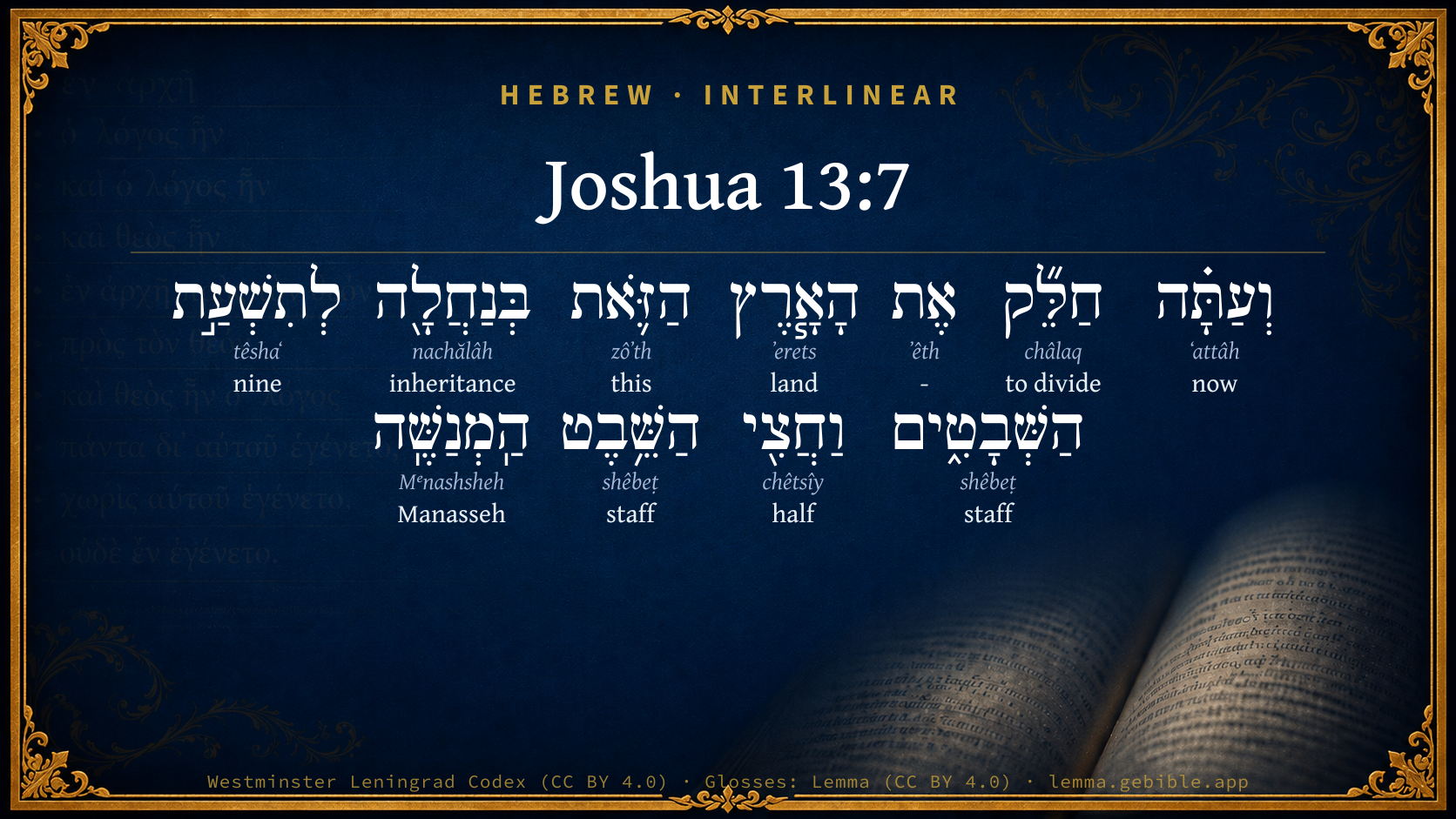
  1. וְעַתָּ֗ה ʻattâh H6258 “and · now” Conjunction + Adverb
  2. חַלֵּ֞ק châlaq H2505 “divide” Verb, Piel, Imperative, 2nd Person, Masculine, Singular
  3. אֶת ʼêth H853 “-” Particle, Direct Object
  4. הָאָ֧רֶץ ʼerets H776 “the · land” Particle, Definite Article + Noun, Common, Both, Singular, Absolute
  5. הַזֹּ֛את zôʼth H2063 “the · this” Particle, Definite Article + Pronoun, Demonstrative, Feminine, Singular
  6. בְּנַחֲלָ֖ה nachălâh H5159 “in/at · inheritance” Preposition + Noun, Common, Feminine, Singular, Absolute
  7. הַשְּׁבָטִ֑ים shêbeṭ H7626 “the · staffs” Particle, Definite Article + Noun, Common, Masculine, Plural, Absolute
  8. וַחֲצִ֖י chêtsîy H2677 “and · half of” Conjunction + Noun, Common, Masculine, Singular, Construct
  9. הַשֵּׁ֥בֶט shêbeṭ H7626 “the · staff” Particle, Definite Article + Noun, Common, Masculine, Singular, Absolute
  10. הַֽמְנַשֶּֽׁה Mᵉnashsheh H4519 “the · Manasseh” Particle, Definite Article + Noun, Proper

About this verse

These counts appear in no published source. They are computed here, from the morphology-tagged text and Lemma’s own curated glosses. What Lemma adds →

11
words
10
distinct lemmas
Historical
section

Shared distinctive vocabulary

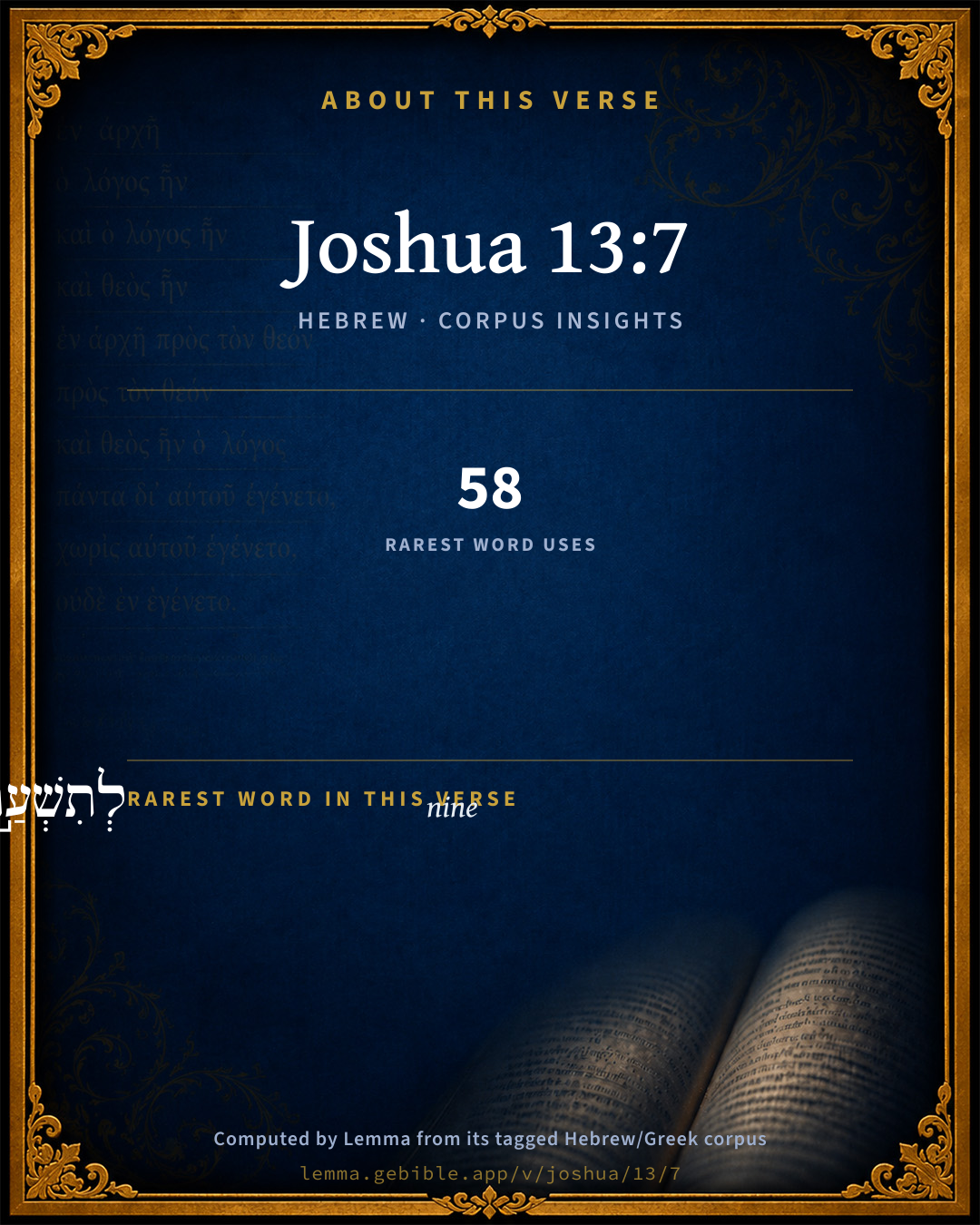
לְתִשְׁעַ֣ת nine H8672 occurs in 57 verses of the Hebrew Bible. Also found in:

Grammatical profile

  • 1 verb
  • 6 nouns
  • 1 adjective
  • 1 pronoun
  • 1 adverb
  • 1 particle

Verb forms

  • חַלֵּ֞ק Piel · Imperative

Repetition

A word recurs within this verse — often emphatic in Hebrew:

  • הַשְּׁבָטִ֑ים staff H7626 ×2

Hebrew & Septuagint length

In English translation the verse runs 17 words from the Hebrew and 18 from the Septuagint (LXX English) — closely comparable.

A rough comparison of the two English renderings, which tokenize alike — not a word-level alignment.

Word counts can differ between the Hebrew and the Greek without any difference in meaning — e.g. the Hebrew direct-object marker אֵת has no separate Greek word, and Greek often adds the article ὁ.

Cross-references

5

Topical passages linked to Joshua 13:7 in the Treasury of Scripture Knowledge — connected by theme and wording, ordered by reader-vote popularity; previews shown in the World English Bible.

  • Numbers 26:53–56 To these the land shall be divided for an inheritance according to the number of names.
  • Numbers 32:2–14 the children of Gad and the children of Reuben came and spoke to Moses, and to Eleazar the priest, and to the princes of the congregation, saying,
  • Numbers 33:54 You shall inherit the land by lot according to your families; to the more you shall give the more inheritance, and to the fewer you shall give the less inheritance: wherever the lot falls to any man, that shall be his; according to the tribes of your fathers shall you inherit.
  • Ezekiel 47:13–23 Thus says the Lord Yahweh: This shall be the border, by which you shall divide the land for inheritance according to the twelve tribes of Israel: Joseph [shall have two] portions.
  • Ezekiel 48:23–29 As for the rest of the tribes: from the east side to the west side, Benjamin, one [portion].

Cross-references courtesy of OpenBible.info (CC BY 4.0).

Hebrew and Greek witnesses Masoretic Hebrew ↔ Greek Septuagint

The same verse in the two great witnesses to the Old Testament, shown verse-for-verse.

These are two independent witnesses, not word-aligned to each other, and the Septuagint is shown in lemma (dictionary) form.

Hebrew Joshua 13:7 Masoretic · Westminster Leningrad Codex

וְעַתָּ֗ה חַלֵּ֞ק אֶת הָאָ֧רֶץ הַזֹּ֛את בְּנַחֲלָ֖ה לְתִשְׁעַ֣ת הַשְּׁבָטִ֑ים וַחֲצִ֖י הַשֵּׁ֥בֶט הַֽמְנַשֶּֽׁה

Now therefore divide this land for an inheritance to the nine tribes, and the half-tribe of Manasseh.

World English Bible · Public Domain

Greek LXX Joshua 13:7 Septuagint · lemma form

καί νῦν μερίζω ὁ γῆ οὗτος ἐν κληρονομία ὁ ἐννέα φυλή καί ὁ ἥμισυς φυλή μανασσή ἀπό ὁ ἰορδάνης ἕως ὁ θάλασσα ὁ μέγας κατά δυσμή ἥλιος δίδωμι αὐτός ὁ θάλασσα ὁ μέγας ὁρίζω

And now divide this land by lot to the nine tribes, and to the half tribe of Manasse.

LXX2012 (modern English Septuagint) · Public Domain

Hebrew: Westminster Leningrad Codex (CC BY 4.0). Greek: Septuagint (public domain); English from LXX2012 (modern English Septuagint) (Public Domain). How the Septuagint differs from the Hebrew →

Targum (Aramaic paraphrase)

1

The Targum is the ancient Jewish Aramaic paraphrase of the Hebrew Scriptures — an interpretive translation, not the Hebrew text itself. Onkelos (literal) and Pseudo-Jonathan (expansive) render the Torah, and Jonathan the Prophets. Coverage is partial: where no permissively-licensed English translation exists for a verse, only the Aramaic is shown. This is verse-level text, not a word-by-word alignment to the Hebrew.

  1. Targum Jonathan Prophets (Joshua–Malachi)
    וּכְעַן פַּלֵיג יַת אַרְעָא הָדָא בְּאַחְסָנָא לְתִשְׁעָה שִׁבְטִין וּפַלְגוּת שִׁבְטָא דִמְנַשֶׁה:

    (no public-domain English translation for this verse)

    Targum Jonathan — Aramaic: “Mikraot Gedolot” (public domain). English: “Sefaria Community Translation” (CC0 1.0 (public-domain dedication)); “London "Chaldee Paraphrase," 1871” (public domain). Text via Sefaria.

Commentary

Notes on Joshua 13:7 from classic Christian and Jewish commentators (each source and its license shown beneath its notes). The classic Christian expositions comment on the surrounding passage and are grouped to its opening verse, so a note may address several verses; the Jewish commentaries on the Tanakh (Rashi and others) are per-verse, so they appear only where the commentator wrote on this verse.

Lemma curates 59 commentaries, every one of them public domain or Creative Commons licensed, each selected and text-cleaned for this edition rather than reprinted as found. About our sources →

Matthew Henry's Commentary

Here we have, I. Orders given to Joshua to assign to each tribe its portion of this land, including that which was yet unsubdued, which must be brought into the lot, in a believing confidence that it should be conquered when Israel was multiplied so as to have occasion for it (Jos 13:7): Now divide this land. Joshua thought all must be conquered before any must be divided. "No," said, God, "there is as much conquered as will serve your turn for the present; divide this, and make your best of it, and wait for the remainder hereafter." Note, We must take the comfort of what we have, though we cannot compass all we would have. Observe,

1. The land must be divided among the several tribes, and they must not always live in common, as now they did. Which way soever a just property is acquired, it is the will of that God who has given the earth to the children of men that there should be such a thing, and that every man should know his own, and not invade that which is another's. The world must be governed, not by force, but right, by the law of equity, not of arms.

2. That it must be divided for an inheritance, though they got it by conquest. (1.) The promise of it came to them as an inheritance from their fathers; the land of promise pertained to the children of promise, who were thus beloved for their fathers' sakes, and in performance of the covenant with them. (2.) The possession of it was to be transmitted by them, as an inheritance to their children. Frequently, what is got by force is soon lost again; but Israel, having an incontestable title to this land by the divine grant, might see it hereby secured as an inheritance to their seed after them, and that God kept this mercy for thousands.

3. That Joshua must not divide it by his own will. Though he was a very wise, just, and good man, it must not be left to him to give what he pleased to each tribe; but he must do it by lot, which referred the matter wholly to God, and to his determination, for he it is that appoints the bounds of our habitation, and every man's judgment must proceed from him. But Joshua must preside in this affair, must manage this solemn appeal to Providence, and see that the lot was drawn fairly and without fraud, and that every tribe did acquiesce in it. The lot indeed causeth contention to cease, Pro 18:18. But, if upon this lot any controversy should arise, Joshua by his wisdom and authority must determine it, and prevent any ill consequences of it. Joshua must have the honour of dividing the land, (1.) Because he had undergone the fatigue of conquering it: and when, through his hand, each tribe received its allotment, they would thereby be made the more sensible of their obligations to him. And what a pleasure must it needs be to a man of such a public spirit as Joshua was to see the people that were so dear to him eating of the labour of his hands! (2.) That he might be herein a type of Christ, who has not only conquered for us the gates of hell, but has opened to us the gates of heaven, and, having purchased the eternal inheritance for all believers, will in due time put them all in possession of it.

II. An account is here given of the distribution of the land on the other side Jordan among the Reubenites, and Gadites, and half the tribe of Manasseh. Observe,

1. How this account is introduced. It comes in, (1.) As the reason why this land within Jordan must be divided only to the nine tribes and a half, because the other two and a half were already provided for. (2.) As a pattern to Joshua in the work he had now to do. He had seen Moses distribute that land, which would give him some aid in distributing this, and thence he might take his measure; only this was to be done by lot, but it should seem Moses did that himself, according to the wisdom given unto him. (3.) As an inducement to Joshua to hasten the dividing of this land, that the nine tribes and a half might not be kept any longer than was necessary out of their possession, since their brethren of the two tribes and a half were so well settled in theirs; and God their common Father would not have such a difference made between his children.

2. The particulars of this account.

(1.) Here is a general description of the country that was given to the two tribes and a half, which Moses gave them, even as Moses gave them, Jos 13:8. The repetition implies a ratification of the grant by Joshua. Moses settled this matter, and, as Moses settled it, so shall it rest; Joshua will not, under any pretence whatsoever, go about to alter it. And a reason is intimated why he would not, because Moses was the servant of the Lord, and acted in this matter by secret direction from him and was faithful as a servant. Here we have, [1.] The fixing of the boundaries of this country, by which they were divided from the neighbouring nations, Jos 13:9, etc. Israel must know their own and keep to it, and may not, under pretence of their being God's peculiar people, encroach upon their neighbours, and invade their rights and properties, to which they had a good and firm title by providence, though not, as Israel, a title by promise. [2.] An exception of one part of this country from Israel's possession, though it was in their grant, namely, the Geshurites and the Maachathites, Jos 13:13. They had not leisure to reduce all the remote and obscure corners of the country in Moses's time, and afterwards they had no mind to it, being easy with what they had. Thus those who are not straitened in God's promises are yet straitened in their own faith, and prayers, and endeavours.

(2.) A very particular account of the inheritances of these two tribes and a half, how they were separated from each other, and what cites, with the towns, villages, and fields, commonly known and reputed to be appurtenances to them, belonged to each tribe. This is very fully and exactly set down in order that posterity might, in reading this history, be the more affected with the goodness of God to their ancestors, when they found what a large and fruitful country, and what abundance of great and famous cities, he put them in possession of (God's grants look best when we descend to the particulars); and also that the limits of every tribe being punctually set down in this authentic record disputes might be prevented, and such contests between the tribes as commonly happen where boundaries have not been adjusted nor this matter brought to a certainty. And we have reason to think that the register here prescribed and published of the lot of each tribe was of great use to Israel in after-ages, was often appealed to, and always acquiesced in, for the determining of meum and tuum - mine and thine.

[1.] We have here the lot of the tribe of Reuben, Jacob's first-born, who, though he had lost the dignity and power which pertained to the birthright, yet, it seems, had the advantage of being first served. Perhaps those of that tribe had an eye to this in desiring to be seated on that side Jordan, that, since they could not expect the benefit of the best lot, they might have the credit of the first. Observe, First, In the account of the lot of this tribe mention is made of the slaughter, 1. Of Sihon, king of the Amorites, who reigned in this country, and might have kept it and his life if he would have been neighbourly, and have suffered Israel to pass through his territories, but, by attempting to oppose them, justly brought ruin upon himself, Num 21:21, etc. 2. Of the princes of Midian, who were slain afterwards in another war (Num 31:8), and yet are here called dukes of Sihon, and are said to be smitten with him, because they were either tributaries to him, or, in his opposition to Israel, confederates with him, and hearty in his interests, and his fall made way for theirs not long after. 3. Of Balaam particularly, that would, if he could, have cursed Israel, and was soon after recompensed according to the wickedness of his endeavour (Psa 28:4), for he fell with those that set him on. This was recorded before (Num 31:8), and is here repeated, because the defeating of Balaam's purpose to curse Israel was the turning of that curse into a blessing, and was such an instance of the power and goodness of God as was fit to be had in everlasting remembrance. See Mic 6:5. Secondly, Within the lot of this tribe was that Mount Pisgah from the top of which Moses took his view of the earthly Canaan and his flight to the heavenly. And not far off thence Elijah was when he was fetched up to heaven in a chariot of fire. The separation of this tribe from the rest, by the river Jordan, was that which Deborah lamented; and the preference they gave to their private interests above the public was what she censured, Jdg 5:15, Jdg 5:16. In this tribe lay Heshbon and Sibmah, famed for their fruitful fields and vineyards. See Isa 16:8, Isa 16:9; Jer 48:32. This tribe, with that of Gad, was sorely shaken by Hazael king of Syria (Kg2 10:33), and afterwards dislodged and carried into captivity, twenty years before the general captivity of the ten tribes by the king of Assyria, Ch1 5:26.

[2.] The lot of the tribe of Gad, Jos 13:24-28. This lay north of Reuben's lot; the country of Gilead lay in this tribe, so famous for its balm that it is thought strange indeed if there be no balm in Gilead, and the cities of Jabesh-Gilead and Ramoth-Gilead which we often read of in scripture. Succoth and Penuel, which we read of in the story of Gideon, were in this tribe; and that forest which is called the wood of Ephraim (from the slaughter Jephthah made there of the Ephraimites), in which Absalom's rebellious army was beaten, while his father David lay at Mahanaim, one of the frontier-cities of this tribe, Jos 13:26. Sharon, famous for roses, was in this tribe. And within the limits of this tribe lived those Gadarenes that loved their swine better than their Saviour, fitter to be called Girgashites than Israelites.

[3.] The lot of the half-tribe of Manasseh, Jos 13:29-31. Bashan, the kingdom of Og, was in this allotment, famous for the best timber, witness the oaks of Bashan - and the best breed of cattle, witness the bulls and rams of Bashan. This tribe lay north of Gad, reached to Mount Hermon, and had in it part of Gilead. Mispeh was in this half-tribe, and Jephthah was one of its ornaments; so was Elijah, for in this tribe was Thisbe, whence he is called the Tishbite; and Jair was another. In the edge of the tribe stood Chorazin, honoured with Christ's wondrous works, but ruined by his righteous woe for not improving them.

[4.] Twice in this chapter it is taken notice of that to the tribe of Levi Moses gave no inheritance (Jos 13:14, Jos 13:33), for so God had appointed, Num 18:20. If they had been appointed to a lot entire by themselves, Moses would have served them first, not because it was his own tribe, but because it was God's; but they must be provided for in another manner; their habitations must be scattered in all the tribes, and their maintenance brought out of all the tribes, and God himself was the portion both of their inheritance and of their cup, Deu 10:9; Deu 18:2.

Matthew Henry's Commentary on the Whole Bible (1708–1710) — public domain (CC PDM 1.0). Text via the HelloAO Bible API.

Trapp's Complete Commentary

John Trapp

Jos 13:7 Now therefore divide this land for an inheritance unto the nine tribes, and the half tribe of Manasseh,

Ver. 7. Now therefore divide this land.] Even those parts thereof also that are yet unsubdued; for it is theirs, but so as they must win it before they wear it. Sic petitur caelum. The kingdom of heaven suffereth violence.

John Trapp, A Commentary or Exposition upon All the Books of the Old and New Testament (1647–1656) — public domain. Text from a community e-Sword module.

Joseph Benson's Commentary

Jos 13:7. Now, therefore, divide this land — Both that which was conquered and that which remained unconquered was to be divided, that every tribe might know what belonged to them by God’s gift, and be encouraged to attempt the conquest of it when they were able; might be preserved from entering into any covenant or society with those who kept their inheritance from them; and likewise with a view to hinder the unconquered people from joining their forces together to recover their country, the Israelites inhabiting the cities and fields that lay between them.

Joseph Benson's Commentary on the Old and New Testaments (1811–1818) — public domain. Text from a community e-Sword module.

Whedon's Commentary on the Bible

Daniel D. Whedon

THE TRANS-JORDANIC ALLOTMENTS REVIEWED, Jos_13:7-14.

8. With whom — That is, with the half tribe of Manasseh — not the same half which received its portion of territory west of the Jordan, opposite their Eastern brethren, but the other half.

Daniel D. Whedon (gen. ed.), Commentary on the Old and New Testaments (1874–1909) — public domain. Text from a community e-Sword module.

Adam Clarke's Commentary

Verse 7. The nine tribes, and the half tribe of Manasseh] The other half tribe of Manasseh, and the two tribes of Reuben and Gad, had got their inheritance on the other side of Jordan, in the land formerly belonging to Og king of Bashan, and Sihon king of the Amorites.

Adam Clarke's Commentary on the Bible (1810–1826) — public domain. Text from a community e-Sword/MySword module.

The Cambridge Bible for Schools and Colleges

gen. ed. J. J. S. Perowne

7. Now therefore divide] Here we have a more definite statement of the tribes amongst whom western Palestine was to be divided.

The Cambridge Bible for Schools and Colleges (gen. ed. J. J. S. Perowne; Cambridge University Press, 1878–1918) — public domain. Text from a community e-Sword module.

John Gill's Exposition

Now therefore divide this land for an inheritance,.... Having the command and authority of God for it, he was to set about it at once, with all diligence and application:

unto the nine tribes: of Judah, Simeon, Benjamin, Dan, Ephraim, Zebulun, Issachar, Asher, and Naphtali, in which order they are placed, when the Lord gave to Moses the names of the men that should divide the land under Eleazar and Joshua, Num 34:16,

and the half tribe of Manasseh; that half which had no inheritance on the other side Jordan, and for which a prince of the children of Joseph was appointed to divide, Num 34:23.

John Gill's Exposition of the Whole Bible (1746–1763) — public domain (CC PDM 1.0). Text via the HelloAO Bible API.

Lesson kit

Teaching starters — assembled from the data on this page, not authored interpretation. Every prompt links to the verse data it draws on. Edit before teaching.

Joshua, in the Historical, opens this verse with 11 words (10 distinct Hebrew lemmas). Its most distinctive word is têshaʻ (“nine”). A historical commentator’s framing appears above. Read the whole chapter for the surrounding context.

Discussion questions

  1. How does “nine” (têshaʻ) shape what this verse is saying?
  2. How does Genesis 5:5, which shares the word «nine», read alongside this verse?
  3. What does the repetition of “staff” (2× in this one verse) do in this verse?
  4. These translations render this verse differently; the difference is in the English rendering, not the original. What questions does that raise?
  5. «חַלֵּ֞ק» is a Piel Imperative verb. How does that grammatical form shape the action described?
  6. Compare how Matthew Henry's Commentary and Trapp's Complete Commentary read this verse. Where do they agree or differ?

Things to notice

Reading settings

Reading text

Shown beneath each verse's original-language words.

Old Testament
Old Testament edition

Read the OT as the Masoretic Hebrew (MT) or the Greek Septuagint (LXX).

English shown for the Greek Septuagint (in the Hebrew ↔ Greek comparison).

Comparing translations? Open the Compare panel on any verse page to stack up to four side by side.