
Leviticus 12:7

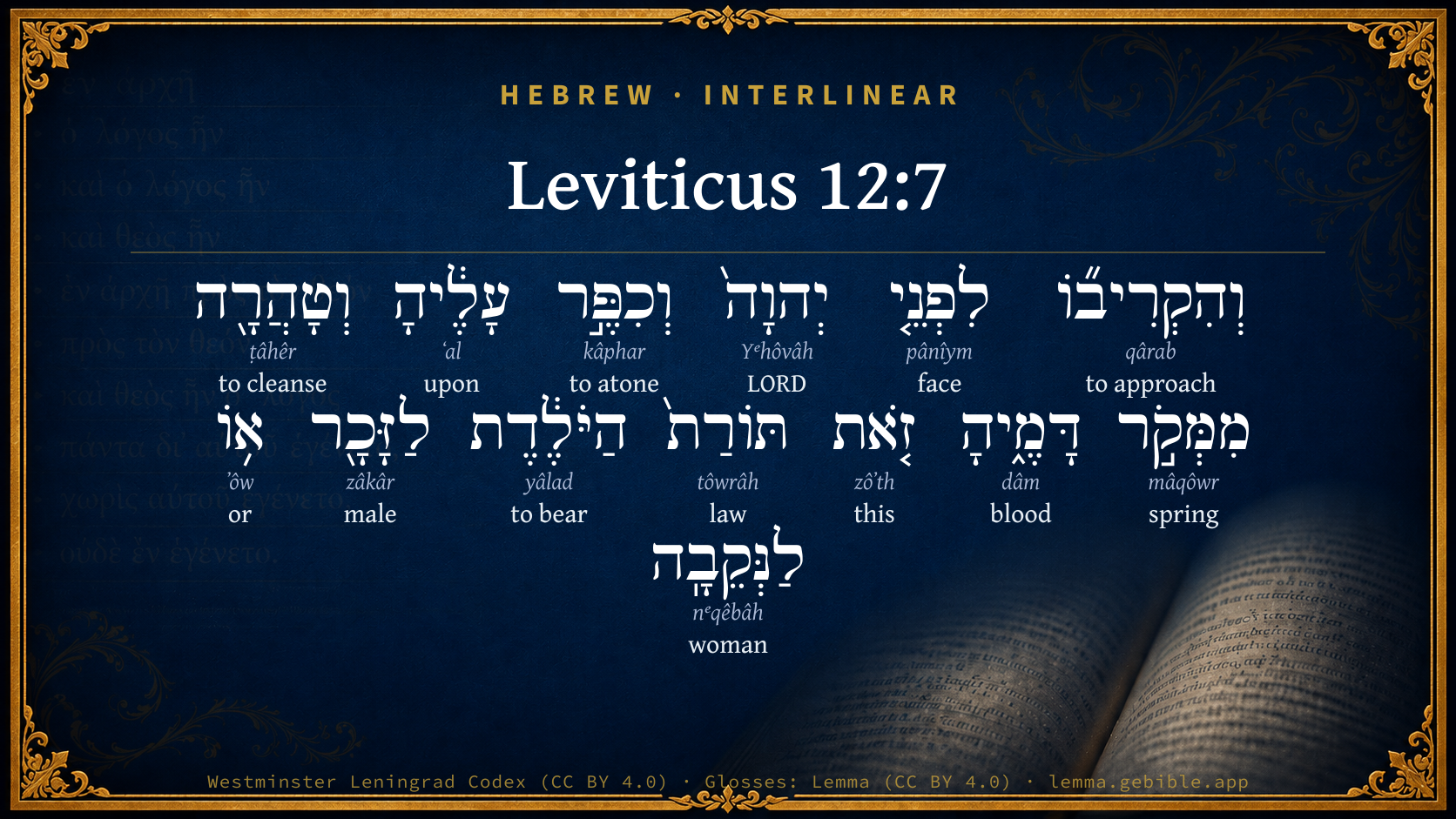
Hebrew (Westminster Leningrad Codex) Leviticus 12:7 appears in the Hebrew Old Testament. The text above is from the Westminster Leningrad Codex. Each word links to its Strong’s number, a concise gloss, and parsing drawn from the Open Scriptures Hebrew Bible morphology. Click any word for its full Brown-Driver-Briggs (BDB) entry.
Download image
Cite this verse

Leviticus 12:7 (World English Bible). Public Domain. Lemma interlinear Bible study tool, https://lemma.gebible.app/v/leviticus/12/7.

Show BibTeX & RIS
BibTeX
RIS
English Translation
and he shall offer it before Yahweh, and make atonement for her; and she shall be cleansed from the fountain of her blood. "'This is the law for her who bears, whether a male or a female.
World English Bible · Public Domain
Highlights
  • 1 first appearance in the Hebrew Bible
Full analysis ↓
Download a study sheet

One document with this verse’s original text, its word-by-word gloss line, the meaning frame, cross-references with their text, attributed commentary, and full source and license credits — printable, and it pastes into notes with its structure intact.

This verse Autodidact and up

Study sheet (.html) Plain text (.txt)

A passage Seminary Student

Up to 50 verses in one chapter. A passage sheet keeps up to 6 commentary sources and 12 cross-references per verse, in the order this page ranks them, and says so on the sheet whenever that leaves anything out. Ask for a single verse and you get the Autodidact verse sheet above.

Everything on this page stays free to read, with no account — the sheet is a download of what is already on screen, not access to it.

Want to remove ads? Support Godless Engineer
Compare translations 3

The same verse in 3 English versions, stacked beneath the original-language interlinear above. Click any original word for its lexicon entry.

Each is an independent rendering of the whole verse — the interlinear is not word-aligned to these translations.

Highlighted words mark where these versions differ — a whole-verse word diff, not a word-by-word alignment.

  • World English Bible Public Domain
    and he shall offer it before Yahweh, and make atonement for her; and she shall be cleansed from the fountain of her blood. "'This is the law for her who bears, whether a male or a female.
  • King James Version Public Domain
    Who shall offer it before the LORD, and make an atonement for her; and she shall be cleansed from the issue of her blood. This is the law for her that hath born a male or a female.
  • unfoldingWord Literal Text CC BY-SA 4.0
    And he shall present it to the face of Yahweh, and he shall make atonement for her. And she will be purified from the flow of her blood. This the law of the who bears a male or a female.

unfoldingWord Literal Text — © unfoldingWord, licensed CC BY-SA 4.0. Word-aligned USFM3 via Door43 (git.door43.org/unfoldingWord/en_ult).

Versions to compare (up to 4)

3 of 4 selected

Show all 18 translations

Every available English version of this verse, each an independent rendering of the whole verse.

  • World English Bible Public Domain
    and he shall offer it before Yahweh, and make atonement for her; and she shall be cleansed from the fountain of her blood. "'This is the law for her who bears, whether a male or a female.
  • Berean Standard Bible Public Domain
    And the priest will present them before the LORD and make atonement for her; and she shall be ceremonially cleansed from her flow of blood. This is the law for a woman giving birth, whether to a male or to a female.
  • Majority Standard Bible Public Domain
    And the priest will present them before the LORD and make atonement for her; and she shall be ceremonially cleansed from her flow of blood. This is the law for a woman giving birth, whether to a male or to a female.
  • King James Version Public Domain
    Who shall offer it before the LORD, and make an atonement for her; and she shall be cleansed from the issue of her blood. This is the law for her that hath born a male or a female.
  • American Standard Version (1901) Public Domain
    and he shall offer it before Jehovah, and make atonement for her; and she shall be cleansed from the fountain of her blood. This is the law for her that beareth, whether a male or a female.
  • Revised Version (1885) Public Domain
    and he shall offer it before the LORD, and make atonement for her; and she shall be cleansed from the fountain of her blood. This is the law for her that beareth, whether a male or a female.
  • Geneva Bible (1599) Public Domain
    Who shall offer it before the Lord, and make an atonement for her: so she shalbe purged of the issue of her blood this is the law for her that hath borne a male or female.
  • Douay-Rheims (1899) Public Domain
    Who shall offer them before the Lord, and shall pray for her, and so she shall be cleansed from the issue of her blood. This is the law for her that beareth a man child or a maid child.
  • Young's Literal Translation Public Domain
    and he hath brought it near before Jehovah, and hath made atonement for her, and she hath been cleansed from the fountain of her blood; this `is' the law of her who is bearing, in regard to a male or to a female.
  • Literal Standard Version CC BY-SA 4.0
    and he has brought it near before YHWH, and has made atonement for her, and she has been cleansed from the fountain of her blood; this [is] the law of her who is bearing, in regard to a male or to a female.
  • Unlocked Literal Bible CC BY-SA 4.0
    Then he will offer it before Yahweh and make atonement for her, and she will be cleansed from the flow of her blood. This is the law regarding a woman who gives birth to either a male or a female child.
  • unfoldingWord Literal Text CC BY-SA 4.0
    And he shall present it to the face of Yahweh, and he shall make atonement for her. And she will be purified from the flow of her blood. This the law of the who bears a male or a female.
  • Darby Bible Public Domain
    And he shall present it before Jehovah, and make atonement for her; and she shall be clean from the flux of her blood. This is the law for her that hath borne a male or a female.
  • World Messianic Bible Public Domain
    He shall offer it before the LORD, and make atonement for her; then she shall be cleansed from the fountain of her blood. “‘This is the law for her who bears, whether a male or a female.
  • Webster's Bible Public Domain
    Who shall offer it before the LORD, and make an atonement for her; and she shall be cleansed from the issue of her blood. This is the law for her that hath borne a male or a female.
  • Free Bible Version CC BY-SA 4.0
    The priest will then present them to the Lord to purify her so she will be clean from her bleeding. These are the regulations for a woman after she's had a son or a daughter.
  • Bible in Basic English Public Domain
    And the priest is to make an offering of it before the Lord and take away her sin, and she will be made clean from the flow of her blood. This is the law for a woman who gives birth to a male or a female.
  • JPS Tanakh (1917) Public Domain
    And he shall offer it before the LORD, and make atonement for her; and she shall be cleansed from the fountain of her blood. This is the law for her that beareth, whether a male or a female.

Literal Standard Version (2020), Covenant Press — licensed CC BY-SA 4.0. Text via the HelloAO Bible API (eBible.org). Unlocked Literal Bible (unfoldingWord) — licensed CC BY-SA 4.0. Text via the HelloAO Bible API (eBible.org). unfoldingWord Literal Text — © unfoldingWord, licensed CC BY-SA 4.0. Word-aligned USFM3 via Door43 (git.door43.org/unfoldingWord/en_ult). Free Bible Version, Dr. Jonathan Gallagher — licensed CC BY-SA 4.0. Text via the HelloAO Bible API (eBible.org).

Word by word

More ways to search: Search by grammar → Find every occurrence → Compare this word →

Practice this passage: Drill this verse → Learn its vocabulary →

מִמְּקֹ֣ר
mâqôwr
H4726
“from · spring of”
Preposition + Noun, Common, Masculine, Singular, Construct
Part of Speech
Preposition + Noun
Type
Common
Gender
Masculine
Number
Singular
State
Construct
Full BDB Definition

Origin: from H6979

TWOT: 2004a

spring, fountain - spring - of source of life, joy, purification (figuratively) - of the eye (figuratively) - source (of menstruous blood) - flow (of blood after child birth)
  1. וְהִקְרִיב֞וֹ qârab H7126 “and · to approach · him” Conjunction + Verb, Hiphil, Sequential Perfect, 3rd Person, Masculine, Singular + Suffix, Personal, 3rd Person, Masculine, Singular
  2. לִפְנֵ֤י pânîym H6440 “to/for · face(s) of” Preposition + Noun, Common, Both, Plural, Construct
  3. יְהוָה֙ Yᵉhôvâh H3068 “LORD” Noun, Proper
  4. וְכִפֶּ֣ר kâphar H3722 “and · to atone” Conjunction + Verb, Piel, Sequential Perfect, 3rd Person, Masculine, Singular
  5. עָלֶ֔יהָ ʻal H5921 “upon · her” Preposition + Suffix, Personal, 3rd Person, Feminine, Singular
  6. וְטָהֲרָ֖ה ṭâhêr H2891 “and · to cleanse” Conjunction + Verb, Qal, Sequential Perfect, 3rd Person, Feminine, Singular
  7. דָּמֶ֑יהָ dâm H1818 “blood · her” Noun, Common, Masculine, Plural, Construct + Suffix, Personal, 3rd Person, Feminine, Singular
  8. זֹ֤את zôʼth H2063 “this” Pronoun, Demonstrative, Feminine, Singular
  9. תּוֹרַת֙ tôwrâh H8451 “law of” Noun, Common, Feminine, Singular, Construct
  10. הַיֹּלֶ֔דֶת yâlad H3205 “the · bearing” Particle, Definite Article + Verb, Qal, Participle Active, Feminine, Singular, Absolute
  11. לַזָּכָ֖ר zâkâr H2145 “to/for the · male” Preposition, Determined + Noun, Common, Masculine, Singular, Absolute
  12. א֥וֹ ʼôw H176 “or” Conjunction
  13. לַנְּקֵבָֽה nᵉqêbâh H5347 “to/for the · woman” Preposition, Determined + Noun, Common, Feminine, Singular, Absolute

About this verse

These counts appear in no published source. They are computed here, from the morphology-tagged text and Lemma’s own curated glosses. What Lemma adds →

14
words
14
distinct lemmas
Pentateuch
section

Notable vocabulary

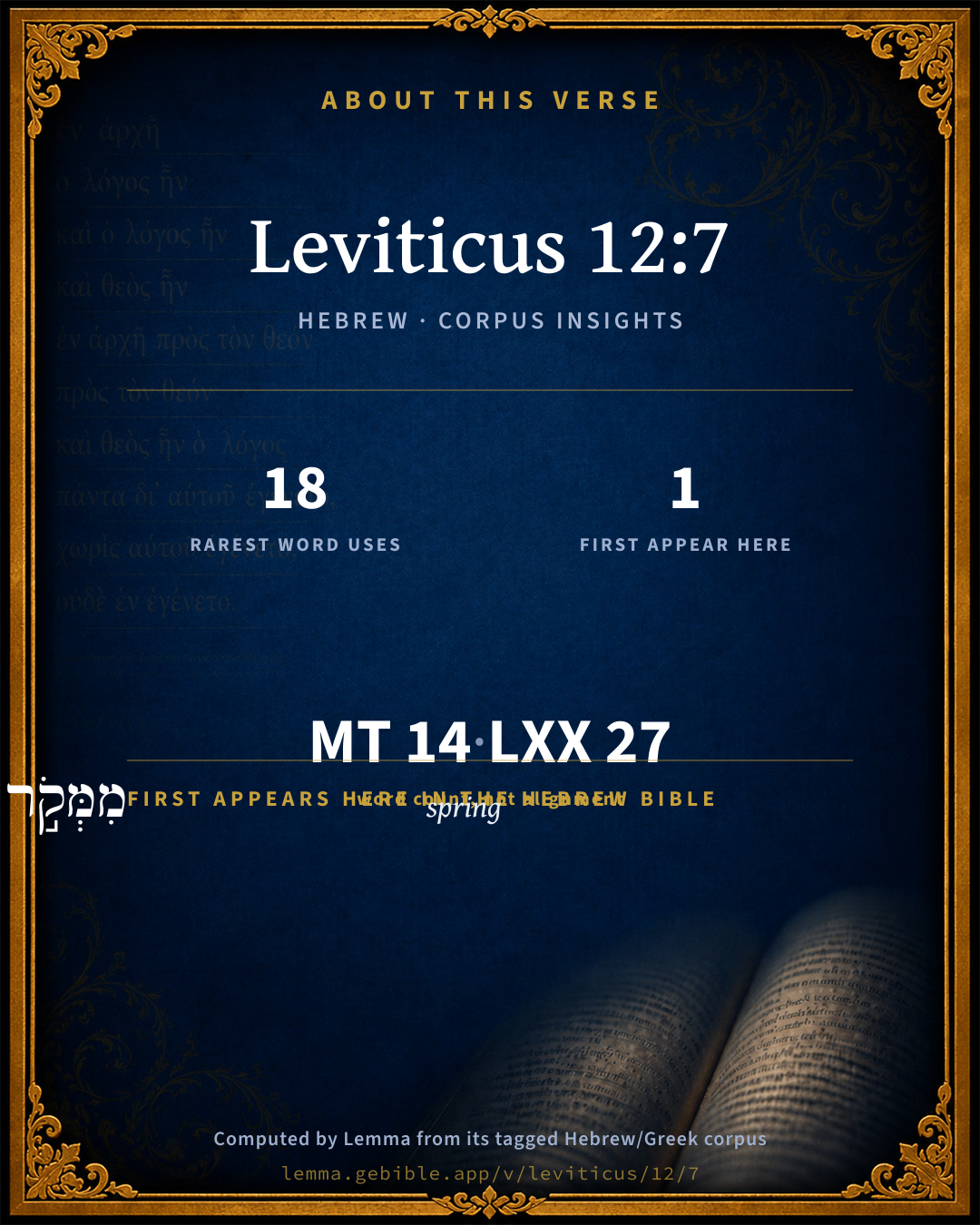
The rarest word here is מִמְּקֹ֣ר spring H4726 — appearing just 18 times in the whole Hebrew Bible.

First appearance in Scripture

This word makes its first canonical appearance in the Hebrew Bible here:

  • מִמְּקֹ֣ר spring H4726

Shared distinctive vocabulary

מִמְּקֹ֣ר spring H4726 occurs in 17 verses of the Hebrew Bible. Also found in:

Grammatical profile

  • 4 verbs
  • 7 nouns
  • 1 pronoun
  • 1 preposition
  • 1 conjunction

Verb forms

  • וְהִקְרִיב֞וֹ Hiphil · Sequential Perfect
  • וְכִפֶּ֣ר Piel · Sequential Perfect
  • וְטָהֲרָ֖ה Qal · Sequential Perfect
  • הַיֹּלֶ֔דֶת Qal · Participle Active

Hebrew & Septuagint length

In English translation the verse runs 37 words from the Hebrew and 39 from the Septuagint (LXX English) — closely comparable.

A rough comparison of the two English renderings, which tokenize alike — not a word-level alignment.

Word counts can differ between the Hebrew and the Greek without any difference in meaning — e.g. the Hebrew direct-object marker אֵת has no separate Greek word, and Greek often adds the article ὁ.

In the original languages it is 14 Hebrew tokens and 27 Greek tokens — but the two are counted differently (Hebrew bundles its prefixes and suffixes into one token; the Greek is in lemma form), so that isn’t a like-for-like length.

Cross-references

13

Topical passages linked to Leviticus 12:7 in the Treasury of Scripture Knowledge — connected by theme and wording, ordered by reader-vote popularity; previews shown in the World English Bible.

  • Leviticus 1:4 He shall lay his hand on the head of the burnt offering, and it shall be accepted for him to make atonement for him.
  • Leviticus 4:20 Thus shall he do with the bull; as he did with the bull of the sin offering, so shall he do with this; and the priest shall make atonement for them, and they shall be forgiven.
  • Leviticus 4:26 All its fat he shall burn on the altar, like the fat of the sacrifice of peace offerings; and the priest shall make atonement for him concerning his sin, and he will be forgiven.
  • Leviticus 4:31 All its fat he shall take away, like the fat is taken away from off of the sacrifice of peace offerings; and the priest shall burn it on the altar for a sweet savor to Yahweh; and the priest shall make atonement for him, and he will be forgiven.
  • Leviticus 4:35 All its fat he shall take away, like the fat of the lamb is taken away from the sacrifice of peace offerings; and the priest shall burn them on the altar, on the offerings of Yahweh made by fire; and the priest shall make atonement for him concerning his sin that he has sinned, and he will be forgiven.
  • Leviticus 15:28–30 "'But if she is cleansed of her discharge, then she shall count to herself seven days, and after that she shall be clean.
  • Job 1:5 It was so, when the days of their feasting had run their course, that Job sent and sanctified them, and rose up early in the morning, and offered burnt offerings according to the number of them all. For Job said, "It may be that my sons have sinned, and renounced God in their hearts." Thus did Job continually.
  • Job 14:4 Who can bring a clean thing out of an unclean? Not one.
  • Romans 3:23 for all have sinned, and fall short of the glory of God;
  • Romans 3:26 to demonstrate his righteousness at this present time; that he might himself be just, and the justifier of him who has faith in Jesus.
  • 1 Corinthians 7:14 For the unbelieving husband is sanctified in the wife, and the unbelieving wife is sanctified in the husband. Otherwise your children would be unclean, but now are they holy.
  • Galatians 3:28 There is neither Jew nor Greek, there is neither slave nor free man, there is neither male nor female; for you are all one in Christ Jesus.
  • Hebrews 9:12–14 nor yet through the blood of goats and calves, but through his own blood, entered in once for all into the Holy Place, having obtained eternal redemption.

Cross-references courtesy of OpenBible.info (CC BY 4.0).

Hebrew and Greek witnesses Masoretic Hebrew ↔ Greek Septuagint

The same verse in the two great witnesses to the Old Testament, shown verse-for-verse.

These are two independent witnesses, not word-aligned to each other, and the Septuagint is shown in lemma (dictionary) form.

Hebrew Leviticus 12:7 Masoretic · Westminster Leningrad Codex

וְהִקְרִיב֞וֹ לִפְנֵ֤י יְהוָה֙ וְכִפֶּ֣ר עָלֶ֔יהָ וְטָהֲרָ֖ה מִמְּקֹ֣ר דָּמֶ֑יהָ זֹ֤את תּוֹרַת֙ הַיֹּלֶ֔דֶת לַזָּכָ֖ר א֥וֹ לַנְּקֵבָֽה

and he shall offer it before Yahweh, and make atonement for her; and she shall be cleansed from the fountain of her blood. "'This is the law for her who bears, whether a male or a female.

World English Bible · Public Domain

Greek LXX Leviticus 12:7 Septuagint · lemma form

καί προςφέρω ἔναντι κύριος καί ἐκἱλάσκομαι περί αὐτός ὁ ἱερεύς καί καθαρίζω αὐτός ἀπό ὁ πηγή ὁ αἷμα αὐτός οὗτος ὁ νόμος ὁ τίκτω ἄρσην ἤ θῆλυς

And he shall present it before the Lord, and the priest shall make atonement for her, and shall purge her from the fountain of her blood; this is the law of her who bears a male or a female.

LXX2012 (modern English Septuagint) · Public Domain

Hebrew: Westminster Leningrad Codex (CC BY 4.0). Greek: Septuagint (public domain); English from LXX2012 (modern English Septuagint) (Public Domain). How the Septuagint differs from the Hebrew →

Targum (Aramaic paraphrase)

2

The Targum is the ancient Jewish Aramaic paraphrase of the Hebrew Scriptures — an interpretive translation, not the Hebrew text itself. Onkelos (literal) and Pseudo-Jonathan (expansive) render the Torah, and Jonathan the Prophets. Coverage is partial: where no permissively-licensed English translation exists for a verse, only the Aramaic is shown. This is verse-level text, not a word-by-word alignment to the Hebrew.

  1. Targum Onkelos Torah (Genesis–Deuteronomy)
    וִיקָרְבִנֵהּ קֳדָם יְיָ וִיכַפֵּר עֲלַהּ וְתִדְכֵּי מִסוֹאֲבַת דְמָהָא דָא אוֹרַיְתָא דְיַלֶדְתָּא לְדוּכְרָא אוֹ לִנְקֻבְתָא

    (no public-domain English translation for this verse)

    Targum Onkelos — Aramaic: “Onkelos Genesis” (public domain); “Onkelos Exodus” (public domain); “Onkelos Leviticus” (public domain); “Onkelos Numbers” (public domain); “Onkelos Deuteronomy” (public domain). English: “Sefaria Community Translation” (CC0 1.0 (public-domain dedication)); “J.W. Etheridge. The Targums of Onkelos and Jonathan Ben Uzziel on the Pentateuch. London: Longmans, Green, 1862” (public domain). Text via Sefaria.

  2. Targum Pseudo-Jonathan Torah (Genesis–Deuteronomy)
    וִיקַרְבִינָהּ קֳדָם יְיָ וִיכַפֵּר עֲלָהּ כַּהֲנָא וְתִידְכֵּי מַבּוּעַ תְּרֵין דְמָהָא דָא הוּא אוֹרַיְיתָא דִיְלִידְתָּא לִדְכַר אוֹ לְנוּקְבָא

    and the priest shall offer it before the Lord and make atonement for her; then shall she be purified from either source of (her) blood. This is the law of the purification of her who hath borne a son or a daughter.

    Targum Pseudo-Jonathan — Aramaic: “Targum Jonathan on Genesis” (public domain); “Targum Jonathan on Exodus” (public domain); “Targum Jonathan on Leviticus” (public domain); “Targum Jonathan on Numbers” (public domain); “Targum Jonathan on Deuteronomy” (public domain). English: “The Targum of Jonathan ben Uzziel, trans. J. W. Etheridge, London, 1862” (public domain). Text via Sefaria.

Commentary

Notes on Leviticus 12:7 from classic Christian and Jewish commentators (each source and its license shown beneath its notes). The classic Christian expositions comment on the surrounding passage and are grouped to its opening verse, so a note may address several verses; the Jewish commentaries on the Tanakh (Rashi and others) are per-verse, so they appear only where the commentator wrote on this verse.

Lemma curates 59 commentaries, every one of them public domain or Creative Commons licensed, each selected and text-cleaned for this edition rather than reprinted as found. About our sources →

Trapp's Complete Commentary

John Trapp

Lev 12:7 Who shall offer it before the LORD, and make an atonement for her; and she shall be cleansed from the issue of her blood. This [is] the law for her that hath born a male or a female.

Ver. 7. And make an atonement.] Whereby her faith was confirmed, that by Christ her sin was remitted and the curse removed. {1Ti 2:15}

John Trapp, A Commentary or Exposition upon All the Books of the Old and New Testament (1647–1656) — public domain. Text from a community e-Sword module.

Tyndale Open Study Notes

Tyndale Open Resources

12:7 to purify her: “Atonement” can be understood in this context to stress ceremonial cleansing and reconciliation of the worshiper (see 4:20; see also study note on 1:4).

Tyndale Open Study Notes — © Tyndale Open Resources, licensed CC BY-SA 4.0. Text via the HelloAO Bible API.

Ellicott's Commentary for English Readers

(7) Who shall offer it.—Better, and he shall offer it, that is, the priest shall offer the sin offering. Though two sacrifices were brought—a burnt offering and a sin offering—yet stress is laid on the sin offering, for on it depended the purification and atonement of the mother. Even if the mother gave birth to twins, the administrators of the law during the second Temple decided that the one sin offering here prescribed sufficed.

A Bible Commentary for English Readers, edited by Charles John Ellicott (1878–1897) — public domain. Text from a community e-Sword module.

John Gill's Exposition

And if she be not able to bring a lamb,.... As everyone was not in circumstances sufficient to be at the expense of buying a lamb for this purpose, having none of their own:

then she shall bring two turtles, or two young pigeons; which was a kind and merciful provision for the poorer sort; since it was necessary that by them the favour received should be acknowledged, as well as the sin attending them in such circumstances should be atoned for. This being the offering brought by the mother of our Lord, shows the state of poverty in which she was; and by this, and the circumcision of her child, and the presentation of it before the Lord at the time of her purification, it appears that they were both under the law, and obedient to it:

the one for a burnt offering, and the other for a sin offering; Jarchi observes, that in oblations the sin offering goes before the burnt offering, for sin being atoned for, the gift was accepted; but here the burnt offering went first, the reason is not very apparent:

and the priest shall make an atonement for her, and she shall be clean; equally the same as if she had brought a lamb, instead of young pigeons, or turtledoves.

Next: Leviticus Chapter 13

John Gill's Exposition of the Whole Bible (1746–1763) — public domain (CC PDM 1.0). Text via the HelloAO Bible API.

Haydock's Catholic Bible Commentary

Blood, which has caused her legal uncleanness.

George Leo Haydock (1774–1849), Haydock's Catholic Family Bible and Commentary, 1859 edition — public domain. Excludes Psalms (Douay-Rheims chapter numbering differs from Protestant) and Deuterocanonical books (Catholic canon only).

Matthew Poole's English Annotations

For though there was a difference in the time of her uncleanness for the one and for the other, yet both were to be purl fled one and the same way; to note, that though all sins and sinners were not equal, yet all were to be cleansed by the same means, to wit, by Christ, and by faith. See 1Co 7:14; Gal 3:28.

Matthew Poole's English Annotations on the Holy Bible (1683–1685) — public domain. Text from a community e-Sword/MySword module.

Whedon's Commentary on the Bible

Daniel D. Whedon

7. Atonement… cleansed — Expiation for the soul and cleansing for the body are accomplished by the same act. Heb_10:22. Jehovah requires physical as well as spiritual sanctification. 2Co_7:1.

Daniel D. Whedon (gen. ed.), Commentary on the Old and New Testaments (1874–1909) — public domain. Text from a community e-Sword module.

Scofield Reference Notes

C. I. Scofield

atonement

(See Scofield "Exo 29:33").

The Scofield Reference Bible (1917 edition), notes by C. I. Scofield — public domain. Text from a community e-Sword module.

unfoldingWord translationNotes

Door43 World Missions Community

she will be cleansed from the flow of her blood

This can be translated in active form. AT: "this will cleanse her from her bleeding occurring during childbirth" (See: Active or Passive)

If she is not able to afford a lamb

Translate this so it clarifies the woman's inability to purchase a sacrificial animal. AT: "If she does not have enough money to buy a lamb" (See: Assumed Knowledge and Implicit Information)

then she will be clean

A woman whom other people may touch is spoken of as if she were physically clean. (See: Metaphor)

translationWords

Yahweh

atonement

clean

law, laws

children

lamb

dove

burnt offering

sin offering

priest

clean

unfoldingWord translationNotes — © Distant Shores Media and the Door43 World Missions Community, licensed CC BY-SA 4.0. Source: git.door43.org/Door43/en_tn.

Rashi

Rabbi Shlomo Yitzchaki (Rashi)

והקריבו AND HE SHALL OFFER IT — Two offerings have been mentioned, a lamb and a bird, but it states here,and he shall offer it and so make an atonement for her” — this teaches you that only the omission to sacrifice a particular one of these two precludes her from eating the sacrificial food. And which is this? It is the sin-offering, because it is stated immediately afterwards: “he shall make expiation for her and she shall be clean” — that which is intended as expiation (i. e. the sin-offering), upon it does the purification depend (Sifra, Tazria Parashat Yoledet, Chapter 3 4).

וטהרה AND SHE SHALL BE CLEAN — it follows, therefore, that until now (until she has brought the atonement offering) she is termed ‘‘unclean” (i.e. she is regarded as טמאה) although she is actually טהרה.

Rashi on the Tanakh — English translations: “The Judaica Press complete Tanach with Rashi, translated by A. J. Rosenberg” (CC BY 4.0); “Pentateuch with Rashi's commentary by M. Rosenbaum and A.M. Silbermann, 1929-1934” (public domain); “The Metsudah Tanach series, Lakewood, N.J” (CC BY 4.0); and “The Book of Joshua, Metsudah Publications, 1997” (CC BY 4.0). Text via Sefaria.

Ramban (Nachmanides)

Rabbi Moshe ben Nachman (Ramban / Nachmanides)

AND HE SHALL OFFER IT BEFORE THE ETERNAL, AND MAKE ATONEMENT FOR HER; AND SHE SHALL BE CLEANSED FROM THE FOUNTAIN OF HER BLOOD. Scripture is stating that she shall offer a ransom for her soul before the Eternal so that she shall be cleansed from the fountain of her blood, for a woman in childbirth has a troubled fountain and a tainted spring, and after she has completed the number of days of becoming clean [as explained above in Verse 4], or the days of the formation of the child, male or female, ) — she shall then bring etc. she shall then bring a ransom for her soul so that her fountain should be stayed, and that she should become cleansed, for G-d, praised be He, “heals all flesh and does wondrously.” Now our Rabbis have said that [the reason for these offerings is] that at the moment that she bends down to give birth she rashly swears [because of the pains of childbirth]: “I will no longer have relationships with my husband” [so as not to conceive again]. The main purport of this statement of the Rabbis is that since she only swears on account of her pain, and the oath is moreover not capable of fulfillment, because she is subject to her husband, therefore the Torah wished for her to atone for that which came into her mind [and therefore commanded her to bring these offerings]. G-d’s thoughts, blessed be He, are deep, and His mercies are bountiful, for it is His desire to justify His creatures.

Ramban (Nachmanides) on the Tanakh — English translation: “Commentary on the Torah by Ramban (Nachmanides). Translated and annotated by Charles B. Chavel. New York, Shilo Pub. House, 1971-1976” (CC BY 4.0). Text via Sefaria.

Lesson kit

Teaching starters — assembled from the data on this page, not authored interpretation. Every prompt links to the verse data it draws on. Edit before teaching.

Leviticus, in the Pentateuch, opens this verse with 14 words (14 distinct Hebrew lemmas). Its most distinctive word is mâqôwr (“spring”). A historical commentator’s framing appears above. Read the whole chapter for the surrounding context.

Discussion questions

  1. How does “spring” (mâqôwr) shape what this verse is saying?
  2. The word “spring” first appears here in Scripture. What is being introduced at this debut?
  3. Leviticus 20:18 shares the word «spring» with this verse. How do the two illuminate each other?
  4. The translations on this page render this verse differently — a whole-verse word diff, not a word-by-word alignment. What might account for the different wordings?
  5. The verb «וְהִקְרִיב֞וֹ» is Hiphil Sequential Perfect. How does its form color the action?
  6. Reading how Trapp's Complete Commentary and Tyndale Open Study Notes read this verse, where do the two commentators agree and where do they part?

Things to notice

Reading settings

Reading text

Shown beneath each verse's original-language words.

Old Testament
Old Testament edition

Read the OT as the Masoretic Hebrew (MT) or the Greek Septuagint (LXX).

English shown for the Greek Septuagint (in the Hebrew ↔ Greek comparison).

Comparing translations? Open the Compare panel on any verse page to stack up to four side by side.