
Deuteronomy 31:12

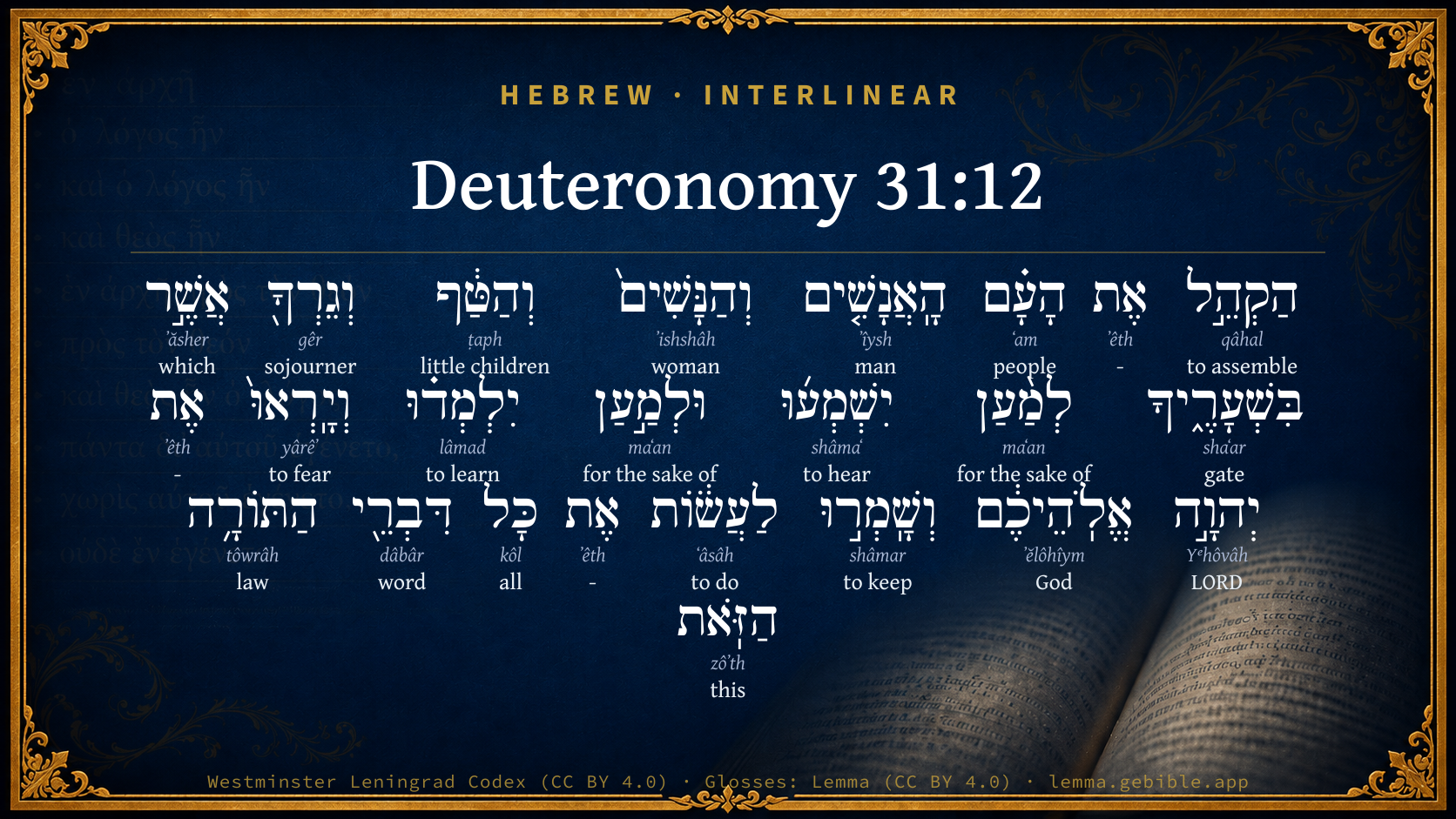
Hebrew (Westminster Leningrad Codex) Deuteronomy 31:12 appears in the Hebrew Old Testament. The text above is from the Westminster Leningrad Codex. Each word links to its Strong’s number, a concise gloss, and parsing drawn from the Open Scriptures Hebrew Bible morphology. Click any word for its full Brown-Driver-Briggs (BDB) entry.
Download image
Cite this verse

Deuteronomy 31:12 (World English Bible). Public Domain. Lemma interlinear Bible study tool, https://lemma.gebible.app/v/deuteronomy/31/12.

Show BibTeX & RIS
BibTeX
RIS
English Translation
Assemble the people, the men and the women and the little ones, and your foreigner who is within your gates, that they may hear, and that they may learn, and fear Yahweh your God, and observe to do all the words of this law;
World English Bible · Public Domain
Download a study sheet

One document with this verse’s original text, its word-by-word gloss line, the meaning frame, cross-references with their text, attributed commentary, and full source and license credits — printable, and it pastes into notes with its structure intact.

This verse Autodidact and up

Study sheet (.html) Plain text (.txt)

A passage Seminary Student

Up to 50 verses in one chapter. A passage sheet keeps up to 6 commentary sources and 12 cross-references per verse, in the order this page ranks them, and says so on the sheet whenever that leaves anything out. Ask for a single verse and you get the Autodidact verse sheet above.

Everything on this page stays free to read, with no account — the sheet is a download of what is already on screen, not access to it.

Want to remove ads? Support Godless Engineer
Compare translations 3

The same verse in 3 English versions, stacked beneath the original-language interlinear above. Click any original word for its lexicon entry.

Each is an independent rendering of the whole verse — the interlinear is not word-aligned to these translations.

Highlighted words mark where these versions differ — a whole-verse word diff, not a word-by-word alignment.

  • World English Bible Public Domain
    Assemble the people, the men and the women and the little ones, and your foreigner who is within your gates, that they may hear, and that they may learn, and fear Yahweh your God, and observe to do all the words of this law;
  • King James Version Public Domain
    Gather the people together, men and women, and children, and thy stranger that is within thy gates, that they may hear, and that they may learn, and fear the LORD your God, and observe to do all the words of this law:
  • unfoldingWord Literal Text CC BY-SA 4.0
    Assemble the people, the men and the women and the children and your foreigner who is within your gates, so that they may hear and so that they may learn and fear Yahweh your God and keep doing all the words of this law.

unfoldingWord Literal Text — © unfoldingWord, licensed CC BY-SA 4.0. Word-aligned USFM3 via Door43 (git.door43.org/unfoldingWord/en_ult).

Versions to compare (up to 4)

3 of 4 selected

Show all 18 translations

Every available English version of this verse, each an independent rendering of the whole verse.

  • World English Bible Public Domain
    Assemble the people, the men and the women and the little ones, and your foreigner who is within your gates, that they may hear, and that they may learn, and fear Yahweh your God, and observe to do all the words of this law;
  • Berean Standard Bible Public Domain
    Assemble the people—men, women, children, and the foreigners within your gates—so that they may listen and learn to fear the LORD your God and to follow carefully all the words of this law.
  • Majority Standard Bible Public Domain
    Assemble the people—men, women, children, and the foreigners within your gates—so that they may listen and learn to fear the LORD your God and to follow carefully all the words of this law.
  • King James Version Public Domain
    Gather the people together, men and women, and children, and thy stranger that is within thy gates, that they may hear, and that they may learn, and fear the LORD your God, and observe to do all the words of this law:
  • American Standard Version (1901) Public Domain
    Assemble the people, the men and the women and the little ones, and thy sojourner that is within thy gates, that they may hear, and that they may learn, and fear Jehovah your God, and observe to do all the words of this law;
  • Revised Version (1885) Public Domain
    Assemble the people, the men and the women and the little ones, and thy stranger that is within thy gates, that they may hear, and that they may learn, and fear the LORD your God, and observe to do all the words of this law;
  • Geneva Bible (1599) Public Domain
    Gather the people together: men, and women, and children, and thy stranger that is within thy gates, that they may heare, and that they may learne, and feare the Lord your God, and keepe and obserue all the wordes of this Lawe,
  • Douay-Rheims (1899) Public Domain
    And the people being all assembled together, both men and women, children and strangers, that are within thy gates: that hearing they may learn, and fear the Lord your God, and keep, and fulfil all the words of this law:
  • Young's Literal Translation Public Domain
    `Assemble the people, the men, and the women, and the infants, and thy sojourner who `is' within thy gates, so that they hear, and so that they learn, and have feared Jehovah your God, and observed to do all the words of this law;
  • Literal Standard Version CC BY-SA 4.0
    Assemble the people, the men, and the women, and the infants, and your sojourner who [is] within your gates, so that they hear, and so that they learn, and have feared your God YHWH, and observed to do all the words of this law;
  • Unlocked Literal Bible CC BY-SA 4.0
    Assemble the people, the men, the women, and the little ones, and your foreigner who is within your city gates, so that they may hear and learn, and so that they may honor Yahweh your God and keep all the words of this law.
  • unfoldingWord Literal Text CC BY-SA 4.0
    Assemble the people, the men and the women and the children and your foreigner who is within your gates, so that they may hear and so that they may learn and fear Yahweh your God and keep doing all the words of this law.
  • Darby Bible Public Domain
    Gather the people together, the men, and the women, and the children, and thy stranger that is within thy gates, that they may hear, and that they may learn, and fear Jehovah your God, and take heed to do all the words of this law;
  • World Messianic Bible Public Domain
    Assemble the people, the men and the women and the little ones, and the foreigners who are within your gates, that they may hear, learn, fear the LORD your God, and observe to do all the words of this law,
  • Webster's Bible Public Domain
    Convene the people, men, and women, and children, and thy stranger that is within thy gates, that they may hear, and that they may learn, and fear the LORD your God, and observe to do all the words of this law:
  • Free Bible Version CC BY-SA 4.0
    Have the people gather together—the men, women, children, and the foreigners living with you—so that they can listen and learn to respect the Lord your God and to carefully observe all the instructions of this law.
  • Bible in Basic English Public Domain
    Make all the people come together, men and women and children, and anyone from another country who is with you, so that hearing they may become wise in the fear of the Lord your God, and take care to do all the words of this law;
  • JPS Tanakh (1917) Public Domain
    Assemble the people, the men and the women and the little ones, and thy stranger that is within thy gates, that they may hear, and that they may learn, and fear the LORD your God, and observe to do all the words of this law;

Literal Standard Version (2020), Covenant Press — licensed CC BY-SA 4.0. Text via the HelloAO Bible API (eBible.org). Unlocked Literal Bible (unfoldingWord) — licensed CC BY-SA 4.0. Text via the HelloAO Bible API (eBible.org). unfoldingWord Literal Text — © unfoldingWord, licensed CC BY-SA 4.0. Word-aligned USFM3 via Door43 (git.door43.org/unfoldingWord/en_ult). Free Bible Version, Dr. Jonathan Gallagher — licensed CC BY-SA 4.0. Text via the HelloAO Bible API (eBible.org).

Word by word

More ways to search: Search by grammar → Find every occurrence → Compare this word →

Practice this passage: Drill this verse → Learn its vocabulary →

הַקְהֵ֣ל
qâhal
H6950
“assemble”
Verb, Hiphil, Imperative, 2nd Person, Masculine, Singular
Part of Speech
Verb
Stem
Hiphil
Form
Imperative
Person
2nd Person
Gender
Masculine
Number
Singular
Full BDB Definition

Origin: a primitive root

TWOT: 1991

to assemble, gather - (Niphal) to assemble - for religious reasons - for political reasons - (Hiphil) to summon an assembly - for war, judgment - for religious purposes
  1. אֶת ʼêth H853 “-” Particle, Direct Object
  2. הָעָ֗ם ʻam H5971 “the · people” Particle, Definite Article + Noun, Common, Masculine, Singular, Absolute
  3. הָֽאֲנָשִׁ֤ים ʼîysh H376 “the · men” Particle, Definite Article + Noun, Common, Masculine, Plural, Absolute
  4. וְהַנָּשִׁים֙ ʼishshâh H802 “and · the · women” Conjunction + Particle, Definite Article + Noun, Common, Feminine, Plural, Absolute
  5. וְהַטַּ֔ף ṭaph H2945 “and · the · little children” Conjunction + Particle, Definite Article + Noun, Common, Masculine, Singular, Absolute
  6. וְגֵרְךָ֖ gêr H1616 “and · sojourner · your” Conjunction + Noun, Common, Masculine, Singular, Construct + Suffix, Personal, 2nd Person, Masculine, Singular
  7. אֲשֶׁ֣ר ʼăsher H834 “which” Particle, Relative
  8. בִּשְׁעָרֶ֑יךָ shaʻar H8179 “in/at · gates · your” Preposition + Noun, Common, Masculine, Plural, Construct + Suffix, Personal, 2nd Person, Masculine, Singular
  9. לְמַ֨עַן maʻan H4616 “for the sake of” Preposition
  10. יִשְׁמְע֜וּ shâmaʻ H8085 “to hear” Verb, Qal, Imperfect, 3rd Person, Masculine, Plural
  11. וּלְמַ֣עַן maʻan H4616 “and · for the sake of” Conjunction + Preposition
  12. יִלְמְד֗וּ lâmad H3925 “to learn” Verb, Qal, Imperfect, 3rd Person, Masculine, Plural
  13. וְיָֽרְאוּ֙ yârêʼ H3372 “and · to fear” Conjunction + Verb, Qal, Sequential Perfect, 3rd Person, Common, Plural
  14. אֶת ʼêth H853 “-” Particle, Direct Object
  15. יְהוָ֣ה Yᵉhôvâh H3068 “LORD” Noun, Proper
  16. אֱלֹֽהֵיכֶ֔ם ʼĕlôhîym H430 “God(s) · your” Noun, Common, Masculine, Plural, Construct + Suffix, Personal, 2nd Person, Masculine, Plural
  17. וְשָֽׁמְר֣וּ shâmar H8104 “and · to keep” Conjunction + Verb, Qal, Sequential Perfect, 3rd Person, Common, Plural
  18. לַעֲשׂ֔וֹת ʻâsâh H6213 “to do” Preposition + Verb, Qal, Infinitive Construct
  19. אֶת ʼêth H853 “-” Particle, Direct Object
  20. כָּל kôl H3605 “all of” Noun, Common, Masculine, Singular, Construct
  21. דִּבְרֵ֖י dâbâr H1697 “words of” Noun, Common, Masculine, Plural, Construct
  22. הַתּוֹרָ֥ה tôwrâh H8451 “the · law” Particle, Definite Article + Noun, Common, Feminine, Singular, Absolute
  23. הַזֹּֽאת zôʼth H2063 “the · this” Particle, Definite Article + Pronoun, Demonstrative, Feminine, Singular

About this verse

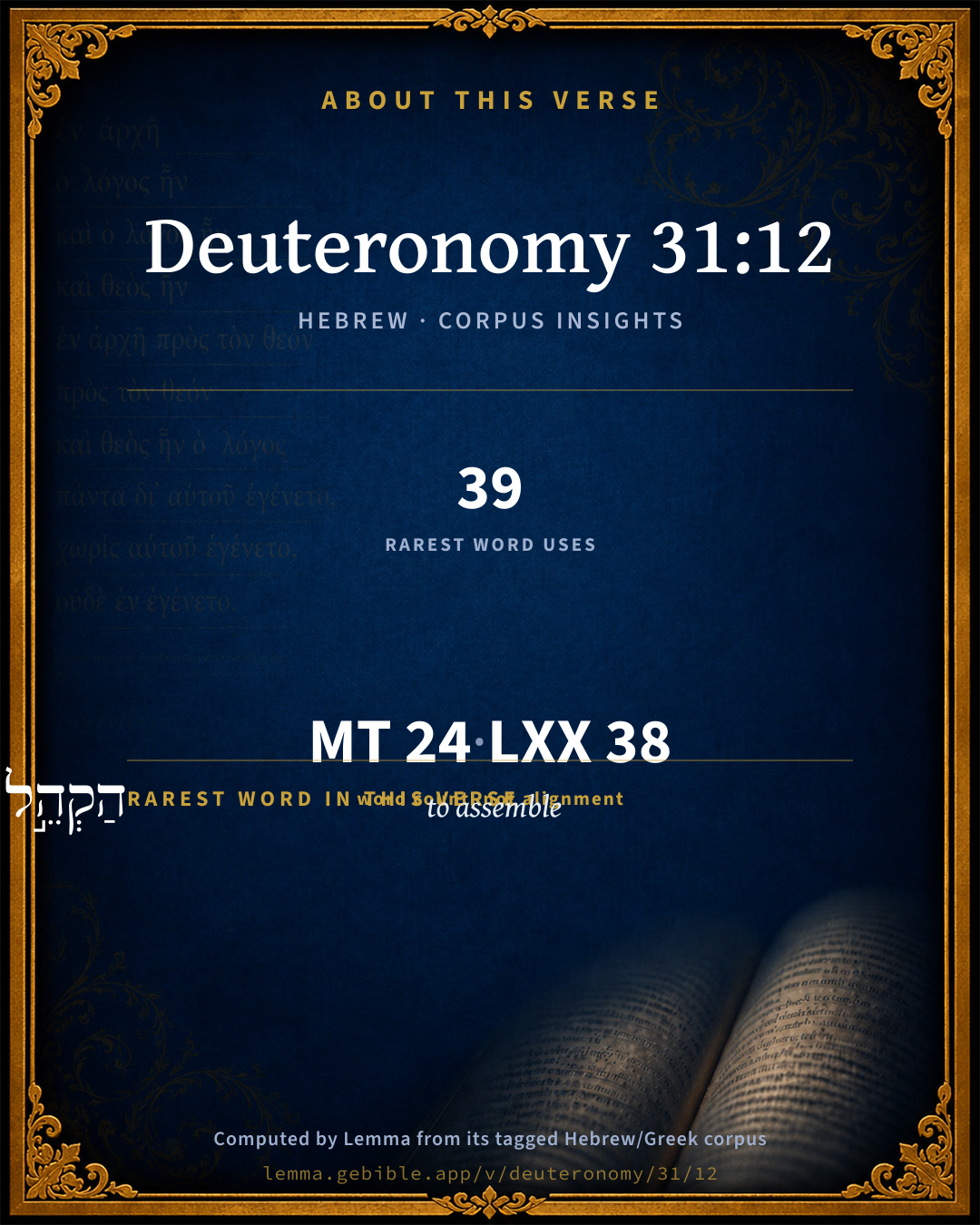
These counts appear in no published source. They are computed here, from the morphology-tagged text and Lemma’s own curated glosses. What Lemma adds →

24
words
21
distinct lemmas
Pentateuch
section

Shared distinctive vocabulary

הַקְהֵ֣ל to assemble H6950 occurs in 39 verses of the Hebrew Bible. Also found in:

Grammatical profile

  • 6 verbs
  • 11 nouns
  • 1 pronoun
  • 2 prepositions
  • 4 particles

Verb forms

  • הַקְהֵ֣ל Hiphil · Imperative
  • יִשְׁמְע֜וּ Qal · Imperfect
  • יִלְמְד֗וּ Qal · Imperfect
  • וְיָֽרְאוּ֙ Qal · Sequential Perfect
  • וְשָֽׁמְר֣וּ Qal · Sequential Perfect
  • לַעֲשׂ֔וֹת Qal · Infinitive Construct

Repetition

A word recurs within this verse — often emphatic in Hebrew:

  • לְמַ֨עַן for the sake of H4616 ×2

Hebrew & Septuagint length

In English translation the verse runs 44 words from the Hebrew and 47 from the Septuagint (LXX English) — closely comparable.

A rough comparison of the two English renderings, which tokenize alike — not a word-level alignment.

Word counts can differ between the Hebrew and the Greek without any difference in meaning — e.g. the Hebrew direct-object marker אֵת has no separate Greek word, and Greek often adds the article ὁ.

In the original languages it is 24 Hebrew tokens and 38 Greek tokens — but the two are counted differently (Hebrew bundles its prefixes and suffixes into one token; the Greek is in lemma form), so that isn’t a like-for-like length.

Cross-references

8

Topical passages linked to Deuteronomy 31:12 in the Treasury of Scripture Knowledge — connected by theme and wording, ordered by reader-vote popularity; previews shown in the World English Bible.

  • Deuteronomy 4:10 the day that you stood before Yahweh your God in Horeb, when Yahweh said to me, Assemble me the people, and I will make them hear my words, that they may learn to fear me all the days that they live on the earth, and that they may teach their children.
  • Deuteronomy 6:6–7 These words, which I command you this day, shall be on your heart;
  • Psalms 19:7–11 Yahweh's law is perfect, restoring the soul. Yahweh's testimony is sure, making wise the simple.
  • Psalms 34:11–14 Come, you children, listen to me. I will teach you the fear of Yahweh.
  • Ezra 10:1 Now while Ezra prayed and made confession, weeping and casting himself down before the house of God, there was gathered together to him out of Israel a very great assembly of men and women and children; for the people wept very sore.
  • 2 Timothy 3:15–17 From infancy, you have known the sacred writings which are able to make you wise for salvation through faith, which is in Christ Jesus.
  • Deuteronomy 29:29 The secret things belong to Yahweh our God; but the things that are revealed belong to us and to our children forever, that we may do all the words of this law.
  • John 5:39 "You search the Scriptures, because you think that in them you have eternal life; and these are they which testify about me.

Cross-references courtesy of OpenBible.info (CC BY 4.0).

Hebrew and Greek witnesses Masoretic Hebrew ↔ Greek Septuagint

The same verse in the two great witnesses to the Old Testament, shown verse-for-verse.

These are two independent witnesses, not word-aligned to each other, and the Septuagint is shown in lemma (dictionary) form.

Hebrew Deuteronomy 31:12 Masoretic · Westminster Leningrad Codex

הַקְהֵ֣ל אֶת הָעָ֗ם הָֽאֲנָשִׁ֤ים וְהַנָּשִׁים֙ וְהַטַּ֔ף וְגֵרְךָ֖ אֲשֶׁ֣ר בִּשְׁעָרֶ֑יךָ לְמַ֨עַן יִשְׁמְע֜וּ וּלְמַ֣עַן יִלְמְד֗וּ וְיָֽרְאוּ֙ אֶת יְהוָ֣ה אֱלֹֽהֵיכֶ֔ם וְשָֽׁמְר֣וּ לַעֲשׂ֔וֹת אֶת כָּל דִּבְרֵ֖י הַתּוֹרָ֥ה הַזֹּֽאת

Assemble the people, the men and the women and the little ones, and your foreigner who is within your gates, that they may hear, and that they may learn, and fear Yahweh your God, and observe to do all the words of this law;

World English Bible · Public Domain

Greek LXX Deuteronomy 31:12 Septuagint · lemma form

ἐκκλησιάζω ὁ λαός ὁ ἀνήρ καί ὁ γυνή καί ὁ ἔκγονος καί ὁ προσήλυτος ὁ ἐν ὁ πόλις σύ ἵνα ἀκούω καί ἵνα μανθάνω φοβέω κύριος ὁ θεός σύ καί ἀκούω ποιέω πᾶς ὁ λόγος ὁ νόμος οὗτος

having assembled the people, the men, and the women, and the children, and the stranger that is in your cities, that they may hear, and that they may learn to fear the Lord your God; and they shall listen to do all the words of this law.

LXX2012 (modern English Septuagint) · Public Domain

On this verse, The Cambridge Bible for Schools and Colleges discusses the Septuagint’s reading. Read the note in Commentary ↓

Hebrew: Westminster Leningrad Codex (CC BY 4.0). Greek: Septuagint (public domain); English from LXX2012 (modern English Septuagint) (Public Domain). How the Septuagint differs from the Hebrew →

Targum (Aramaic paraphrase)

2

The Targum is the ancient Jewish Aramaic paraphrase of the Hebrew Scriptures — an interpretive translation, not the Hebrew text itself. Onkelos (literal) and Pseudo-Jonathan (expansive) render the Torah, and Jonathan the Prophets. Coverage is partial: where no permissively-licensed English translation exists for a verse, only the Aramaic is shown. This is verse-level text, not a word-by-word alignment to the Hebrew.

  1. Targum Onkelos Torah (Genesis–Deuteronomy)
    כְּנוֹשׁ יָת עַמָא גֻבְרַיָא וּנְשַׁיָא וְטַּפְלָא וְגִיוֹרָךְ דִי בְקִרְוָיךְ בְּדִיל דְיִשְׁמְעוּן וּבְדִיל דְיַלְפוּן (נ''א דְיֵלְפוּן) וְיִדְחֲלוּן מֵקֳדָם יְיָ אֱלָהֲכוֹן וְיִטְרוּן לְמֶעְבַּד יָת כָּל פִּתְגָמֵי אוֹרַיְתָא הָדָא

    (no public-domain English translation for this verse)

    Targum Onkelos — Aramaic: “Onkelos Genesis” (public domain); “Onkelos Exodus” (public domain); “Onkelos Leviticus” (public domain); “Onkelos Numbers” (public domain); “Onkelos Deuteronomy” (public domain). English: “Sefaria Community Translation” (CC0 1.0 (public-domain dedication)); “J.W. Etheridge. The Targums of Onkelos and Jonathan Ben Uzziel on the Pentateuch. London: Longmans, Green, 1862” (public domain). Text via Sefaria.

  2. Targum Pseudo-Jonathan Torah (Genesis–Deuteronomy)
    כְּנוּשׁוּ יַת עַמָא גוּבְרַיָא לְמֵילַף וּנְשַׁיָא לְמִשְׁמַע אוּלְפָנָא וְטַפְלַיָא לְקִיבּוּלֵי עֲלֵיהוֹן אַגְרָא דְמַיְיתִין יַתְהוֹן וְגִיוֹרַיָא דִבְקִירְוֵיכוֹן דְיֶחֱמוּן אִיקַר אוֹרַיְיתָא וִידַחֲלוּן כֻּלְהוֹן מִן קֳדָם מֵימְרָא דַיְיָ אֱלָהָכוֹן וְיִטְרוּן לְמֶעֱבַד יַת כָּל פִּתְגָמֵי אוֹרַיְיתָא הָדָא

    Assemble the people, the men, that they may learn, the women, that they may hear instruction, the children, that they may partake the benefit (reward) of those who bring them, and your sojourners who are in your cities, that they may behold the majesty of the law, and be reverent all of them before the Word of the Lord your God, and observe to do all the words of this law.

    Targum Pseudo-Jonathan — Aramaic: “Targum Jonathan on Genesis” (public domain); “Targum Jonathan on Exodus” (public domain); “Targum Jonathan on Leviticus” (public domain); “Targum Jonathan on Numbers” (public domain); “Targum Jonathan on Deuteronomy” (public domain). English: “The Targum of Jonathan ben Uzziel, trans. J. W. Etheridge, London, 1862” (public domain). Text via Sefaria.

Commentary

Notes on Deuteronomy 31:12 from classic Christian and Jewish commentators (each source and its license shown beneath its notes). The classic Christian expositions comment on the surrounding passage and are grouped to its opening verse, so a note may address several verses; the Jewish commentaries on the Tanakh (Rashi and others) are per-verse, so they appear only where the commentator wrote on this verse.

Lemma curates 59 commentaries, every one of them public domain or Creative Commons licensed, each selected and text-cleaned for this edition rather than reprinted as found. About our sources →

Tyndale Open Study Notes

Tyndale Open Resources

31:12 Even foreigners living among the Israelites were to submit to the requirements of the covenant law. Despite their disadvantaged status, the Lord would provide for them (see 10:18).

Tyndale Open Study Notes — © Tyndale Open Resources, licensed CC BY-SA 4.0. Text via the HelloAO Bible API.

The Cambridge Bible for Schools and Colleges

gen. ed. J. J. S. Perowne

12. Assemble the people] Again Sg. confirmed by Sam. though LXX codd. have Pl. Cp. Deu_4:10, assemble me the people. On assemble see Deu_5:22. It is not necessary to take Assemble … gates as a later intrusion (Marti) on the grounds that the command to assemble the people is out of order after the previous v., for this may be explained by the looseness of the writer’s style and by the writer’s use of the Sg., for as we have seen there are reasons for supposing that this is original. On men, women … gates see Deu_29:11.

hear … learn … fear, etc.] See Deu_4:10, Deu_14:23, Deu_17:19.

observe to do] Deu_5:1; all the words of this law, Deu_5:9.

The Cambridge Bible for Schools and Colleges (gen. ed. J. J. S. Perowne; Cambridge University Press, 1878–1918) — public domain. Text from a community e-Sword module.

John Gill's Exposition

And that their children, which have not known anything,.... Of God and of his law and of their duty to God, to their parents, and the rest of their fellow creatures:

may hear, and learn to fear the Lord your God; hear the law of God, learn the meaning of it, and so be brought up in the fear, nurture, and admonition of the Lord, and serve him their Creator in the days of their youth:

as long as ye live in the land whither ye go over Jordan to possess it; this being a means to continue the fear, service, and worship of God in their posterity, and so of their long continuance in the land of Canaan.

John Gill's Exposition of the Whole Bible (1746–1763) — public domain (CC PDM 1.0). Text via the HelloAO Bible API.

Haydock's Catholic Bible Commentary

Children, (parvulis.) Those who were above 12 years of age, attended the festivals as much as possible, particularly the three great ones. Even little children came to the temple, when they did not live at too great a distance. The lawgiver knew of what importance it was to inspire their tender minds with a love and respect for religion, and for the laws. (Calmet)

George Leo Haydock (1774–1849), Haydock's Catholic Family Bible and Commentary, 1859 edition — public domain. Excludes Psalms (Douay-Rheims chapter numbering differs from Protestant) and Deuterocanonical books (Catholic canon only).

Matthew Poole's English Annotations

Gather the people together; not into one place, where all could not hear, but into divers assemblies or synagogues.

Women hereby are required to go to Jerusalem at this solemnity, as they were permitted to do in other solemnities, when the males only were enjoined to go, Exo 23:17.

Children, to wit, such of them as could understand, as appears from Neh 8:2,3.

Thy stranger, i.e. the proselytes, though others also were admitted.

That they may learn; that they may then certainly and constantly do so, though they had also other opportunities to do so, as upon the sabbath days, Act 15:21, and other solemn feasts, yea, even in their private houses.

Matthew Poole's English Annotations on the Holy Bible (1683–1685) — public domain. Text from a community e-Sword/MySword module.

Whedon's Commentary on the Bible

Daniel D. Whedon

12. Gather the people together — Not the men alone, but the whole families were to listen to the solemn repetition of this law. What a deep and abiding impression this would produce!

Nothing was better calculated to keep alive the remembrance of Jehovah’s warnings and Jehovah’s promises.

Daniel D. Whedon (gen. ed.), Commentary on the Old and New Testaments (1874–1909) — public domain. Text from a community e-Sword module.

John Wesley's Explanatory Notes

Together - Not in one place. But into divers assemblies or synagogues. Women who hereby are required to go to Jerusalem at this solemnity, as they were permitted to do in other solemnities. Children - Such of them as could understand, as appears from Neh. viii, 2, 3, the pious Jews doubtless read it daily in their houses, and Moses of old time was read in the synagogues every sabbath day. But once in seven years, the law was thus to be read in public, to magnify it and make it honourable.

John Wesley, Explanatory Notes Upon the Whole Bible (1754–1765) — public domain. Text via the GEBible commentary corpus.

Scofield Reference Notes

C. I. Scofield

fear

(See Scofield "Psa 19:9").

The Scofield Reference Bible (1917 edition), notes by C. I. Scofield — public domain. Text from a community e-Sword module.

unfoldingWord translationNotes

Door43 World Missions Community

General Information:

Moses continues speaking to the priests and the elders.

your foreigner who is within your city gates

Here "city gates" represents the cities themselves. Moses speaks to the Israelites as if they were one man, so the instances of "your" here are singular. AT: "your foreigners who live in your cities" (See: Synecdoche and Forms of You)

keep all the words of this law

"carefully obey all the commands in this law"

translationWords

assembly

alien

gate

honor

word

law

life

Jordan River

possess

unfoldingWord translationNotes — © Distant Shores Media and the Door43 World Missions Community, licensed CC BY-SA 4.0. Source: git.door43.org/Door43/en_tn.

Rashi

Rabbi Shlomo Yitzchaki (Rashi)

האנשים [ASSEMBLE THE PEOPLE,] MEN [WOMEN, AND LITTLE ONES] — the men, in order to learn,

והנשים THE WOMEN, in order to listen to the words of the Law,

והטף AND THE LITTLE ONES — Why did they come? For no other purpose than that a reward should be given to those who bring them (Chagigah 3a).

Rashi on the Tanakh — English translations: “The Judaica Press complete Tanach with Rashi, translated by A. J. Rosenberg” (CC BY 4.0); “Pentateuch with Rashi's commentary by M. Rosenbaum and A.M. Silbermann, 1929-1934” (public domain); “The Metsudah Tanach series, Lakewood, N.J” (CC BY 4.0); and “The Book of Joshua, Metsudah Publications, 1997” (CC BY 4.0). Text via Sefaria.

Ramban (Nachmanides)

Rabbi Moshe ben Nachman (Ramban / Nachmanides)

THAT THEY MAY HEAR, AND THAT THEY MAY LEARN — that is, the men and the women [mentioned in the first part of the verse], for the women, too, heard and learned to fear the Eternal.

Ramban (Nachmanides) on the Tanakh — English translation: “Commentary on the Torah by Ramban (Nachmanides). Translated and annotated by Charles B. Chavel. New York, Shilo Pub. House, 1971-1976” (CC BY 4.0). Text via Sefaria.

Sforno

Rabbi Ovadia Sforno

In order for them to hear. The wise people will understand.

And in order for them to learn. In order that those who cannot understand will learn from them.

To fear Hashem, your God. When they understand His greatness, which comes through His Torah with rational signs.

Sforno on the Tanakh — English translation: “Yalkut, Sifsei Chachomim Chumash, Metsudah Publications, 2009” (CC BY 4.0). Text via Sefaria.

Lesson kit

Teaching starters — assembled from the data on this page, not authored interpretation. Every prompt links to the verse data it draws on. Edit before teaching.

Deuteronomy, in the Pentateuch, opens this verse with 24 words (21 distinct Hebrew lemmas). Its most distinctive word is qâhal (“to assemble”). A historical commentator’s framing appears above. Read the whole chapter for the surrounding context.

Discussion questions

  1. What does “to assemble” (qâhal) contribute to the verse as a whole?
  2. Exodus 32:1 shares the word «to assemble» with this verse. How do the two illuminate each other?
  3. “for the sake of” occurs 2× in this one verse. What is the effect of the repetition?
  4. These translations render this verse differently; the difference is in the English rendering, not the original. What questions does that raise?
  5. The verb «הַקְהֵ֣ל» is Hiphil Imperative. How does its form color the action?
  6. Reading how Tyndale Open Study Notes and The Cambridge Bible for Schools and Colleges read this verse, where do the two commentators agree and where do they part?

Things to notice

Reading settings

Reading text

Shown beneath each verse's original-language words.

Old Testament
Old Testament edition

Read the OT as the Masoretic Hebrew (MT) or the Greek Septuagint (LXX).

English shown for the Greek Septuagint (in the Hebrew ↔ Greek comparison).

Comparing translations? Open the Compare panel on any verse page to stack up to four side by side.