2 Kings 5:4

Hebrew (Westminster Leningrad Codex) 2 Kings 5:4 appears in the Hebrew Old Testament. The text above is from the Westminster Leningrad Codex. Each word links to its Strong’s number, a concise gloss, and parsing drawn from the Open Scriptures Hebrew Bible morphology. Click any word for its full Brown-Driver-Briggs (BDB) entry.
Download image
Cite this verse

2 Kings 5:4 (World English Bible). Public Domain. Lemma interlinear Bible study tool, https://lemma.gebible.app/v/2-kings/5/4.

Show BibTeX & RIS
BibTeX
RIS
English Translation
One went in, and told his lord, saying, Thus and thus said the maiden who is of the land of Israel.
World English Bible · Public Domain
Download a study sheet

One document with this verse’s original text, its word-by-word gloss line, the meaning frame, cross-references with their text, attributed commentary, and full source and license credits — printable, and it pastes into notes with its structure intact.

This verse Autodidact and up

Study sheet (.html) Plain text (.txt)

A passage Seminary Student

Up to 50 verses in one chapter. A passage sheet keeps up to 6 commentary sources and 12 cross-references per verse, in the order this page ranks them, and says so on the sheet whenever that leaves anything out. Ask for a single verse and you get the Autodidact verse sheet above.

Everything on this page stays free to read, with no account — the sheet is a download of what is already on screen, not access to it.

Want to remove ads? Support Godless Engineer
Compare translations 3

The same verse in 3 English versions, stacked beneath the original-language interlinear above. Click any original word for its lexicon entry.

Each is an independent rendering of the whole verse — the interlinear is not word-aligned to these translations.

Highlighted words mark where these versions differ — a whole-verse word diff, not a word-by-word alignment.

  • World English Bible Public Domain
    One went in, and told his lord, saying, Thus and thus said the maiden who is of the land of Israel.
  • King James Version Public Domain
    And one went in, and told his lord, saying, Thus and thus said the maid that is of the land of Israel.
  • unfoldingWord Literal Text CC BY-SA 4.0
    And one came and declared to his master, saying, “Like this and like this the girl spoke who from the land of Israel.”

unfoldingWord Literal Text — © unfoldingWord, licensed CC BY-SA 4.0. Word-aligned USFM3 via Door43 (git.door43.org/unfoldingWord/en_ult).

Versions to compare (up to 4)

3 of 4 selected

Show all 18 translations

Every available English version of this verse, each an independent rendering of the whole verse.

  • World English Bible Public Domain
    One went in, and told his lord, saying, Thus and thus said the maiden who is of the land of Israel.
  • Berean Standard Bible Public Domain
    And Naaman went and told his master what the girl from the land of Israel had said.
  • Majority Standard Bible Public Domain
    And Naaman went and told his master what the girl from the land of Israel had said.
  • King James Version Public Domain
    And one went in, and told his lord, saying, Thus and thus said the maid that is of the land of Israel.
  • American Standard Version (1901) Public Domain
    And one went in, and told his lord, saying, Thus and thus said the maiden that is of the land of Israel.
  • Revised Version (1885) Public Domain
    And one went in, and told his lord, saying, Thus and thus said the maid that is of the land of Israel.
  • Geneva Bible (1599) Public Domain
    And he went in, and tolde his lorde, saying, Thus and thus saith the mayde that is of the land of Israel.
  • Douay-Rheims (1899) Public Domain
    Then Naaman went in to his lord, and told him, saying: Thus and thus said tile girl from the land of Israel.
  • Young's Literal Translation Public Domain
    And `one' goeth in and declareth to his lord, saying, `Thus and thus she hath spoken, the damsel who `is' from the land of Israel.'
  • Literal Standard Version CC BY-SA 4.0
    And [one] goes in and declares [it] to his lord, saying, “Thus and thus the girl who [is] from the land of Israel has spoken.”
  • Unlocked Literal Bible CC BY-SA 4.0
    So Naaman went in and told the king what the little girl from the land of Israel had said.
  • unfoldingWord Literal Text CC BY-SA 4.0
    And one came and declared to his master, saying, “Like this and like this the girl spoke who from the land of Israel.”
  • Darby Bible Public Domain
    And he went and told his lord saying, Thus and thus said the maid that is of the land of Israel.
  • World Messianic Bible Public Domain
    Someone went in and told his lord, saying, “The girl who is from Eretz-Israel said this.”
  • Webster's Bible Public Domain
    And one went in, and told his lord, saying, Thus and thus said the maid that is of the land of Israel.
  • Free Bible Version CC BY-SA 4.0
    Naaman went to his master and explained what the Israelite girl had said.
  • Bible in Basic English Public Domain
    And someone went and said to his lord, This is what the girl from the land of Israel says.
  • JPS Tanakh (1917) Public Domain
    And he went in, and told his lord, saying: 'Thus and thus said the maid that is of the land of Israel.'

Literal Standard Version (2020), Covenant Press — licensed CC BY-SA 4.0. Text via the HelloAO Bible API (eBible.org). Unlocked Literal Bible (unfoldingWord) — licensed CC BY-SA 4.0. Text via the HelloAO Bible API (eBible.org). unfoldingWord Literal Text — © unfoldingWord, licensed CC BY-SA 4.0. Word-aligned USFM3 via Door43 (git.door43.org/unfoldingWord/en_ult). Free Bible Version, Dr. Jonathan Gallagher — licensed CC BY-SA 4.0. Text via the HelloAO Bible API (eBible.org).

Word by word

More ways to search: Search by grammar → Find every occurrence → Compare this word →

Practice this passage: Drill this verse → Learn its vocabulary →

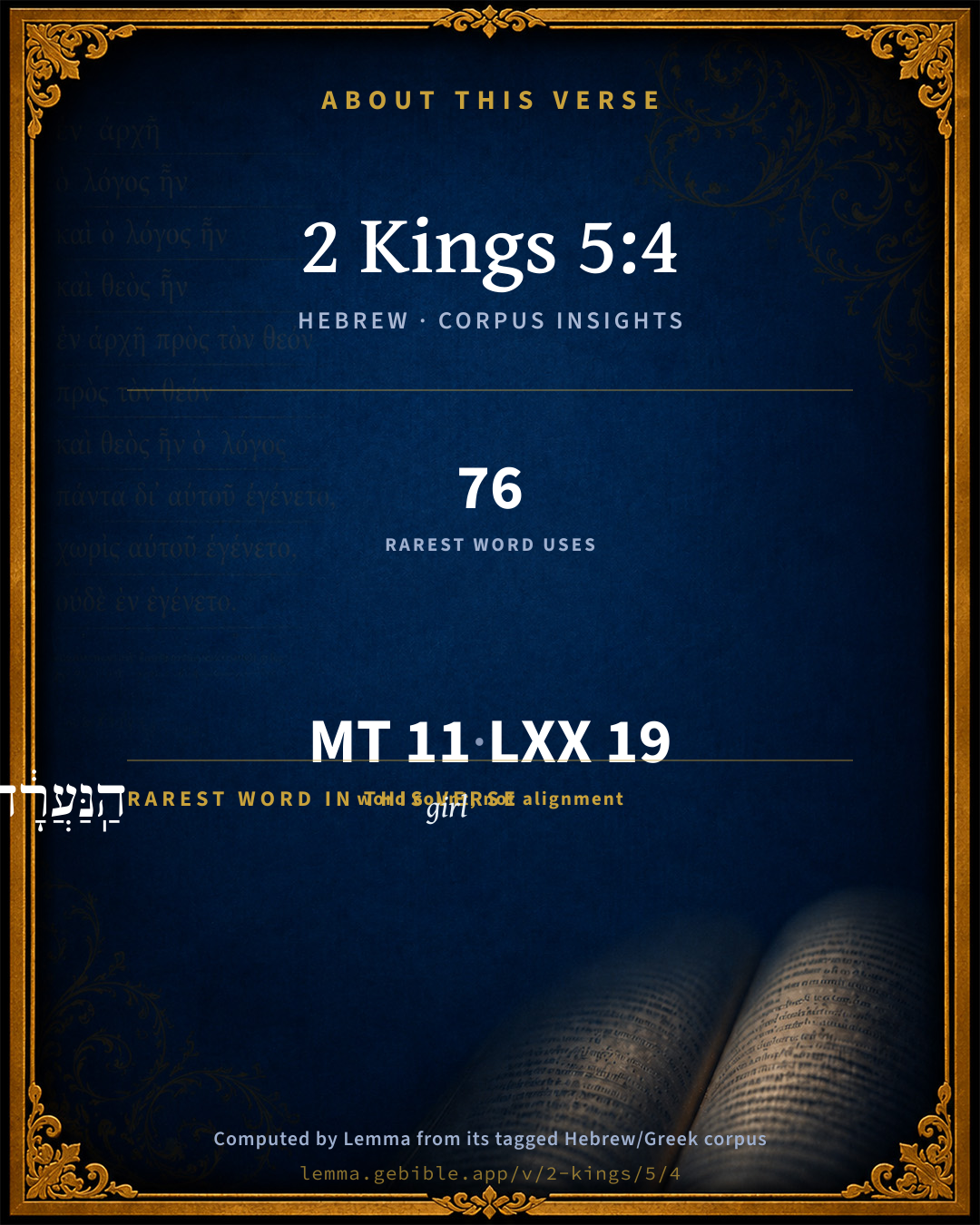
הַֽנַּעֲרָ֔ה
naʻărâh
H5291
“the · girl”
Particle, Definite Article + Noun, Common, Feminine, Singular, Absolute
Part of Speech
Particle + Noun
Type
Common
Gender
Feminine
Number
Singular
State
Absolute
Full BDB Definition

Origin: from H5288

TWOT: 1389c

girl, damsel, female servant - girl, damsel, little girl - of young woman, marriageable young woman, concubine, prostitute - maid, female attendant, female servant
  1. וַיָּבֹ֕א bôwʼ H935 “and · to enter” Conjunction + Verb, Qal, Sequential Imperfect, 3rd Person, Masculine, Singular
  2. וַיַּגֵּ֥ד nâgad H5046 “and · to make known” Conjunction + Verb, Hiphil, Sequential Imperfect, 3rd Person, Masculine, Singular
  3. לַאדֹנָ֖יו ʼâdôwn H113 “to/for · lords · his” Preposition + Noun, Common, Masculine, Plural, Absolute + Suffix, Personal, 3rd Person, Masculine, Singular
  4. לֵאמֹ֑ר ʼâmar H559 “to say” Preposition + Verb, Qal, Infinitive Construct
  5. כָּזֹ֤את zôʼth H2063 “like/as · this” Preposition + Pronoun, Demonstrative, Feminine, Singular
  6. וְכָזֹאת֙ zôʼth H2063 “and · like/as · this” Conjunction + Preposition + Pronoun, Demonstrative, Feminine, Singular
  7. דִּבְּרָ֣ה dâbar H1696 “to speak” Verb, Piel, Perfect, 3rd Person, Feminine, Singular
  8. אֲשֶׁ֖ר ʼăsher H834 “which” Particle, Relative
  9. מֵאֶ֥רֶץ ʼerets H776 “from · land of” Preposition + Noun, Common, Both, Singular, Construct
  10. יִשְׂרָאֵֽל Yisrâʼêl H3478 “Israel” Noun, Proper

About this verse

These counts appear in no published source. They are computed here, from the morphology-tagged text and Lemma’s own curated glosses. What Lemma adds →

11
words
10
distinct lemmas
Historical
section

Grammatical profile

  • 4 verbs
  • 4 nouns
  • 2 pronouns
  • 1 particle

Verb forms

  • וַיָּבֹ֕א Qal · Sequential Imperfect
  • וַיַּגֵּ֥ד Hiphil · Sequential Imperfect
  • לֵאמֹ֑ר Qal · Infinitive Construct
  • דִּבְּרָ֣ה Piel · Perfect

Repetition

A word recurs within this verse — often emphatic in Hebrew:

  • כָּזֹ֤את this H2063 ×2

Hebrew & Septuagint length

In English translation the verse runs 21 words from the Hebrew and 21 from the Septuagint (LXX English) — the same length.

A rough comparison of the two English renderings, which tokenize alike — not a word-level alignment.

Word counts can differ between the Hebrew and the Greek without any difference in meaning — e.g. the Hebrew direct-object marker אֵת has no separate Greek word, and Greek often adds the article ὁ.

In the original languages it is 11 Hebrew tokens and 19 Greek tokens — but the two are counted differently (Hebrew bundles its prefixes and suffixes into one token; the Greek is in lemma form), so that isn’t a like-for-like length.

Cross-references

6

Topical passages linked to 2 Kings 5:4 in the Treasury of Scripture Knowledge — connected by theme and wording, ordered by reader-vote popularity; previews shown in the World English Bible.

  • 1 Corinthians 1:26–27 For you see your calling, brothers, that not many are wise according to the flesh, not many mighty, and not many noble;
  • 2 Kings 7:9–11 Then they said one to another, We aren't doing right. This day is a day of good news, and we hold our peace: if we wait until the morning light, punishment will overtake us; now therefore come, let us go and tell the king's household.
  • Mark 5:19 He didn't allow him, but said to him, "Go to your house, to your friends, and tell them what great things the Lord has done for you, and how he had mercy on you."
  • Mark 16:9–10 Now when he had risen early on the first day of the week, he appeared first to Mary Magdalene, from whom he had cast out seven demons.
  • John 1:42–46 He brought him to Jesus. Jesus looked at him, and said, "You are Simon the son of Jonah. You shall be called Cephas" (which is by interpretation, Peter).
  • John 4:28–29 So the woman left her water pot, and went away into the city, and said to the people,

Cross-references courtesy of OpenBible.info (CC BY 4.0).

Hebrew and Greek witnesses Masoretic Hebrew ↔ Greek Septuagint

The same verse in the two great witnesses to the Old Testament, shown verse-for-verse.

These are two independent witnesses, not word-aligned to each other, and the Septuagint is shown in lemma (dictionary) form.

Hebrew 2 Kings 5:4 Masoretic · Westminster Leningrad Codex

וַיָּבֹ֕א וַיַּגֵּ֥ד לַאדֹנָ֖יו לֵאמֹ֑ר כָּזֹ֤את וְכָזֹאת֙ דִּבְּרָ֣ה הַֽנַּעֲרָ֔ה אֲשֶׁ֖ר מֵאֶ֥רֶץ יִשְׂרָאֵֽל

One went in, and told his lord, saying, Thus and thus said the maiden who is of the land of Israel.

World English Bible · Public Domain

Greek LXX 2 Kings 5:4 Septuagint · lemma form

καί εἰςἔρχομαι καί ἀποἀγγέλλω ὁ κύριος ἑαυτοῦ καί εἶπον οὕτως καί οὕτως λαλέω ὁ νεᾶνις ὁ ἐκ γῆ ἰσραήλ

And she went in and told her lord, and said, Thus and thus spoke the maid from the land of Israel.

LXX2012 (modern English Septuagint) · Public Domain

On this verse, The Cambridge Bible for Schools and Colleges discusses the Septuagint’s reading. Read the note in Commentary ↓

Hebrew: Westminster Leningrad Codex (CC BY 4.0). Greek: Septuagint (public domain); English from LXX2012 (modern English Septuagint) (Public Domain). How the Septuagint differs from the Hebrew →

Targum (Aramaic paraphrase)

1

The Targum is the ancient Jewish Aramaic paraphrase of the Hebrew Scriptures — an interpretive translation, not the Hebrew text itself. Onkelos (literal) and Pseudo-Jonathan (expansive) render the Torah, and Jonathan the Prophets. Coverage is partial: where no permissively-licensed English translation exists for a verse, only the Aramaic is shown. This is verse-level text, not a word-by-word alignment to the Hebrew.

  1. Targum Jonathan Prophets (Joshua–Malachi)
    וַאֲתָא וְחַוֵי לְרִבּוֹנֵיהּ לְמֵימָר כְּדֵין וּכְדֵין מַלְלַת עוּלֵמְתָּא דִי מֵאַרְעָא דְיִשְׂרָאֵל:

    (no public-domain English translation for this verse)

    Targum Jonathan — Aramaic: “Mikraot Gedolot” (public domain). English: “Sefaria Community Translation” (CC0 1.0 (public-domain dedication)); “London "Chaldee Paraphrase," 1871” (public domain). Text via Sefaria.

Commentary

Notes on 2 Kings 5:4 from classic Christian and Jewish commentators (each source and its license shown beneath its notes). The classic Christian expositions comment on the surrounding passage and are grouped to its opening verse, so a note may address several verses; the Jewish commentaries on the Tanakh (Rashi and others) are per-verse, so they appear only where the commentator wrote on this verse.

Lemma curates 59 commentaries, every one of them public domain or Creative Commons licensed, each selected and text-cleaned for this edition rather than reprinted as found. About our sources →

Trapp's Complete Commentary

John Trapp

2Ki 5:4 And [one] went in, and told his lord, saying, Thus and thus said the maid that [is] of the land of Israel.

Ver. 4. And one went and told his lord.] Told the king of Syria, who thereupon sent to the king of Israel, out of his love to Naaman, whom he slighted not, though a leper; nor the wench’s words, though a captive.

John Trapp, A Commentary or Exposition upon All the Books of the Old and New Testament (1647–1656) — public domain. Text from a community e-Sword module.

Joseph Benson's Commentary

2Ki 5:4. And one went in and told his lord — One of Naaman’s servants, hearing this, told it to Naaman, and he to the king of Syria, begging his leave to go to the prophet in Israel. For though he neither loved nor honoured the Jewish nation, yet if one of that nation can but heal him of his leprosy, he will gladly and thankfully accept the cure. And he hopes that one can, from the intelligence he has received, which he does not despise because of the meanness of her that gave it. O that they who are spiritually diseased would hearken thus readily to the tidings brought them of the great Physician!

Joseph Benson's Commentary on the Old and New Testaments (1811–1818) — public domain. Text from a community e-Sword module.

Geneva Bible (1599)

Geneva Bible translators

That is, Naaman told it to the king of Syria.

Geneva Bible (1599) marginal notes — public domain. Text via Bolls.life.

Adam Clarke's Commentary

Verse 4. Thus and thus said the maid] So well had this little pious maid conducted herself, that her words are credited; and credited so fully, that an embassy from the king of Syria to the king of Israel is founded upon them!

Adam Clarke's Commentary on the Bible (1810–1826) — public domain. Text from a community e-Sword/MySword module.

Ellicott's Commentary for English Readers

(4) And one went in.—And he (i.e., Naaman) went in: scil., into the palace. Some MSS.: “and she went in and told.”

Thus and thus.—To avoid repetition of her actual words.

A Bible Commentary for English Readers, edited by Charles John Ellicott (1878–1897) — public domain. Text from a community e-Sword module.

The Cambridge Bible for Schools and Colleges

gen. ed. J. J. S. Perowne

4. And one went in] On the margin the R.V. has ‘he’. But it is better to insert an indefinite nominative. It is not likely that Naaman himself was the reporter.

and told his lord] i.e., Naaman’s lord, the king of Syria. The LXX. disregarding the gender of the verbal form has ‘She went in and told her lord’: i.e. Naaman’s wife brought him word of the damsel’s story.

The Cambridge Bible for Schools and Colleges (gen. ed. J. J. S. Perowne; Cambridge University Press, 1878–1918) — public domain. Text from a community e-Sword module.

John Gill's Exposition

And one went in and told his lord,.... What the girl had said to her mistress; one of the servants of the house that overheard it; or rather, Naaman went and told his lord the king of Syria; for as this was said to his wife, no doubt she told it to her husband, and not a servant; and the following words require this sense, and is the sense of most Jewish commentators:

saying, thus and thus said the maid that is of the land of Israel; who for her wit and beauty might be well known at court by the name of the Israelitish girl.

John Gill's Exposition of the Whole Bible (1746–1763) — public domain (CC PDM 1.0). Text via the HelloAO Bible API.

Albert Barnes' Notes on the Bible

One went in - Rather, “he went in,” i. e. Naaman went and told his lord, the king of Syria.

Albert Barnes' Notes on the Bible (1834–1885) — public domain. Text from a community e-Sword/MySword module.

Matthew Poole's English Annotations

One of Naaman’s servants hearing this, went in and told it to Naaman, and he to the king of Syria, which is implied. Or,

And he went in, & c., i.e. Naaman, mentioned 2Ki 5:1, hearing this from his wife, told it to the king of Syria, as the next words intimate.

Matthew Poole's English Annotations on the Holy Bible (1683–1685) — public domain. Text from a community e-Sword/MySword module.

The Pulpit Commentary

And one went in, and told his lord, saying. "One went in" is a possible translation; but it is simpler and more natural to translate "he went in," i.e. Naaman went in, and told his lord, Ben-hadad, the King of Syria. Thus and thus said the maid that is of the land of Israel. Being "of the land of Israel," her words had a certain weight she had means of knowing she ought to know whether such a thing as the cure of leprosy by the intervention of a prophet was a possible occurrence in her country.

Vers. 4-19. Naaman the Syrian.

This case of Naaman is an illustration of the imperfection that there is in all things human. Naaman was commander-in-chief of the Syrian army. Not only so, but he had seen service. He had won his spurs in active warfare. He had led his troops to victory. "By him the Lord had given deliverance to Syria" Hence, as we read, "he was a great man with his master, and honorable." No doubt he had been greeted on his return from battle, as victorious generals were greeted then and are greeted still, with the triumphant shouts of a joyful and exultant multitude. His cup of happiness was almost full. But there was one element of trouble that mingled with his joy. "But he was a leper." That little word "but," how significant it is! We should all be happy, but for something. Our plans would all be successful, but for something. We should all be very good, but for some inconsistency, some failing, some besetting sin. Here is a very good man, but he has such a bad temper. There is a very kind woman, but she has such a bitter tongue. Here is a very good man, but he is so stingy and so selfish. Here is a man who would be very useful in the Church of Christ, but he is so worldly minded. Here is a good preacher, but he doesn"t just practice what he preaches. These little "buts" have their uses. They keep us, or they ought to keep us, humble. We ought not to be very proud of ourselves, we ought not to be very hard on others, when we think of that ugly sin of our own. But most of all, these "buts" ought to be the means of driving us, as Naaman"s leprosy was the means of driving him, nearer to God. That almighty hand can alone weed the evil forces out of our nature, and bring us into conformity to his own heavenly likeness.

I NAAMAN"S PRIDE. Kings sometimes, like other people, do stupid things. The Hebrew maid had spoken of the prophet that was in Israel, as being able to cure her master of his leprosy. But the King of Syria sends a letter to the King of Israel, saying, "I have sent Naaman my servant unto thee, that thou mayest recover him of his leprosy." The King of Syria may have meant nothing more than this, that the King of Israel might bring about Naaman"s recovery by sending him to the prophet; but the King of Israel took the words as an attempt to pick a quarrel with him, and rent his clothes in anger and passion. Very often great and destructive wars have arisen from much more trifling causes from the folly or incapacity, the rashness or stubbornness, the pride or the passion, of rulers. How thankful we should be for a wise and prudent sovereign, when we think how much harm a foolish sovereign can do! After Elisha heard of the King of Israel"s absurd and childish display of anger and dismay, he sent to him, saying, "Wherefore bast thou rent thy clothes? let him come now to me, and he shall know that there is a prophet in Israel." So Naaman came with all the pomp and grandeur of a great Oriental general, and stood at the door of Elisha"s house. Elisha is not overawed by this display of magnificence. He does not hasten forth and make a humble obeisance to the man of rank. He knew what respect was due to authority and station; but just then he had to do with Naaman the man, with Naaman the leper, and not with Naaman the general, As the servant of God, it is his duty to benefit Naaman"s soul as well as his body, and the first thing he must do is to humble him. Naaman"s leprosy was an enemy to his happiness. But he had a far worse enemy in his own heart. That was pride. How hard it was to expel it we shall see. Elisha did not go himself to speak to Naaman, but sent a messenger. That was bad enough for Naaman"s pride. And this was the message that he sent: Go and wash in Jordan seven times, and thy flesh shall come again to thee, and thou shalt be clean." That was worse. How keenly Naaman felt it we see in his action and his words. He turned away from the place in a rage, perhaps swearing at his servants to get out of his way, and said, "Behold, I thought, He will surely come out to me, and stand, and call on the Name of the Lord his God, and strike his hand over the place, and recover the leper." His leprosy had not humbled his pride. Here he was-come all the way from Syria just for the one purpose of getting cured; and yet he turns away from the only person who could cure him, because he does not pay him sufficient court, and does not flatter his vanity. How unreasonable was Naaman"s pride! How unreasonable is pride in any one! And yet it is a common failing. There are very few of us without a little of it. Bishop Hooker says, "Pride is a vice which cleaveth so fast unto the hearts of men, that if we were to strip ourselves of all faults, one by one, we should undoubtedly find it the very last and hardest to put off." What have any of us to be proud of? Has the sinner any reason to be proud? He is walking on the broad way that leadeth to destruction. Not a journey, not a prospect, to be proud of, certainly! Has the saint any reason to be proud? Surely not. It is by the grace of God he is what he is. "Not of works, lest any man should boast." No true child of God has ever had a proud heart. Look at the humility of the Apostle Paul. Early in his Epistles he speaks of himself as "the least of the apostles;" later on he calls himself "less than the least of all saints;" while the latest description he gives of himself is "the chief of sinners." Such was Paul"s estimate of his own character, the more he looked at it in the light of God"s holy Law, and in the light of the cross of Jesus. The longer he lived, the more humble he became. "God resisteth the proud, but giveth grace to the humble." Away, then, with pride! Away with pride of riches! away with pride of rank! away with pride of learning! away with pride of beauty in the face that is made of clay! away with pride from every Christian heart! away with pride from the house of God! away with pride from all departments of Christian work! away with pride towards our fellow-men! Let us follow in the footsteps of him who was meek and lowly in heart.

II NAAMAN"S CURE. Observe the simplicity of the cure. "Go and wash in Jordan seven times, and thy flesh shall come again to thee, and thou shalt be clean." It was the very simplicity of the cure that was the stumbling-block to Naaman. So it is with the sinner still. The simplicity of the gospel offer prevents many a one from accepting it. The servants of Naaman expressed this weakness of the human heart when they said, "My father, if the prophet had bid thee do some great thing, wouldest thou not have done it?" The simple thing, strange though it may seem, is often the hardest to do. The great thing, the thing which costs most labor, in which there is most room for our own effort, is the thing which many find it easiest to do. This is one of the reasons why the heathen religions, and the Roman Catholic religion, have so strong a hold upon the human heart. Their religion is justification by works. They afford large scope for human exertions, for penances, for pilgrimages. There is scope for good works in Protestantism too, in true Christianity. "Be careful to maintain good works," says the "apostle. "We are his workmanship, created in Christ Jesus unto good works." But good works are the result, and not the cause, of our justification. We can never by any pilgrimages, by any penances, by any lastings, work out a salvation, a righteousness, for ourselves. "Not by works of righteousness which we have done, but according to his mercy he saved us, by the washing of regeneration and renewing of the Holy Ghost, which he shed on us abundantly through Jesus Christ our Savior." Was it not a foolish thing for Naaman, a poor, miserable leper, with his life a burden to him, to be questioning the method of his cure? Is it not a foolish thing for any sinner, with death at every moment staring him in the face, and a dark and hopeless eternity yawning before him, to question God"s plan of salvation? A man who is seized with a dangerous illness does not spend a whole day in discussing what remedies the physician has ordered, but, if he has common sense, he uses the remedies at once. Sinner, the cure for your disease is a simple one. "Believe on the Lord Jesus Christ, and thou shalt be saved" It is the only one. "There is none other Name under heaven given among men whereby we can be saved," except the Name of Jesus. Naaman, at last, persuaded by his servants" entreaty, believed the prophet"s promise, and acted in obedience to his instructions. He went and washed in Jordan, and, as the prophet said, he was made whole. God promises to every sinner that if you believe on the Lord Jesus Christ you shall receive everlasting life. Did you ever know God"s promise to fail? Why, then, should you hesitate, as a lost soul, to take the way of salvation provided for you through the mercy of God and the infinite love of Christ?

There is a fountain filled with blood Drawn from Immanuel"s veins; And sinners, plunged beneath that flood, Lose all their guilty stains.

The dying thief rejoiced to see That fountain in his day; And there may I, though vile as he, Wash all my sins away.

III NAAMAN"S GRATITUDE. Naaman"s marvelous cure made him a believer in the God of Israel. He returned to Elisha with gratitude in his heart. How different the spirit in which he now approaches the prophet!

No longer proud and haughty, waiting at the door for Elisha to come out to him, he enters the prophet"s house, and humbly stands before him. He shows a spirit of gratitude to God and to his prophet. He asks Elisha to give him a quantity of earth, that he may raise an altar unto the God of Israel, saying that he will henceforth sacrifice to no other god. You whom God has raised up again from beds of sickness-have you shown in any practical way your gratitude to him? Do you ever count up your mercies when you calculate how much you will subscribe to some religious object? If you did, there would not be much difficulty in clearing off church debts. We are, all of us, every day we live, dependent on God"s mercy and bounty. In his hand our breath is. "In him we live, and move, and have our being." Many of us are saved sinners, redeemed through the precious blood of Christ. What have we done to show our thankfulness to God, who called us out of darkness into his marvelous light? Naaman, though a changed man and no longer an idolater, was still wanting in decision. He asked to be pardoned for bowing in the temple of the god Rimmon, when his master, the king, went in to worship there. Some have thought that Elisha"s answer, Go in peace," gave permission to Naaman to go through this outward form of idolatry. But the prophet did not mean this at all. His words were but the Eastern form of saying "good-bye." He neither condemned nor approved Naaman"s action. He left it as a matter for his own conscience. And so it must be in many things. We cannot lay down hard-and-fast lines for others. Beginners in the Christian life, especially, should be tenderly dealt with. But while we make every allowance for Naaman, who had spent all his life in heathenism, let us not imitate him in his want of decision. He owed allegiance to a higher King than to the King of Syria. In matters of conscience, let no man be our master but Christ. Let us never sacrifice principle for expediency, or obey the call of popularity rather than the call of duty. A far higher example is that of John Knox, who, when rebuked for his outspoken words before Queen Mary and her council, said, "I am in the place where I am demanded of conscience to speak the truth; and therefore the truth I speak, impugn it whoso list. C.H.I.

The Pulpit Commentary (1880–1919), ed. H.D.M. Spence-Jones & Joseph S. Exell — public domain. Text from a community e-Sword module.

Rashi

Rabbi Shlomo Yitzchaki (Rashi)

He came. Na’amon.

And told his master. The king of Arom.

Rashi on the Tanakh — English translations: “The Judaica Press complete Tanach with Rashi, translated by A. J. Rosenberg” (CC BY 4.0); “Pentateuch with Rashi's commentary by M. Rosenbaum and A.M. Silbermann, 1929-1934” (public domain); “The Metsudah Tanach series, Lakewood, N.J” (CC BY 4.0); and “The Book of Joshua, Metsudah Publications, 1997” (CC BY 4.0). Text via Sefaria.

Lesson kit

Teaching starters — assembled from the data on this page, not authored interpretation. Every prompt links to the verse data it draws on. Edit before teaching.

2 Kings, in the Historical, opens this verse with 11 words (10 distinct Hebrew lemmas). Its most distinctive word is naʻărâh (“girl”). A historical commentator’s framing appears above. Read the whole chapter for the surrounding context.

Discussion questions

  1. The word naʻărâh carries the sense “girl.” How does it shape the verse?
  2. How does 1 Corinthians 1:26–27, which shares this passage’s theme, read alongside this verse?
  3. What does the repetition of “this” (2× in this one verse) do in this verse?
  4. These translations render this verse differently; the difference is in the English rendering, not the original. What questions does that raise?
  5. «וַיָּבֹ֕א» is a Qal Sequential Imperfect verb. How does that grammatical form shape the action described?
  6. Compare how Trapp's Complete Commentary and Joseph Benson's Commentary read this verse. Where do they agree or differ?

Things to notice

Reading settings

Reading text

Shown beneath each verse's original-language words.

Old Testament
Old Testament edition

Read the OT as the Masoretic Hebrew (MT) or the Greek Septuagint (LXX).

English shown for the Greek Septuagint (in the Hebrew ↔ Greek comparison).

Comparing translations? Open the Compare panel on any verse page to stack up to four side by side.