Joshua 1:13

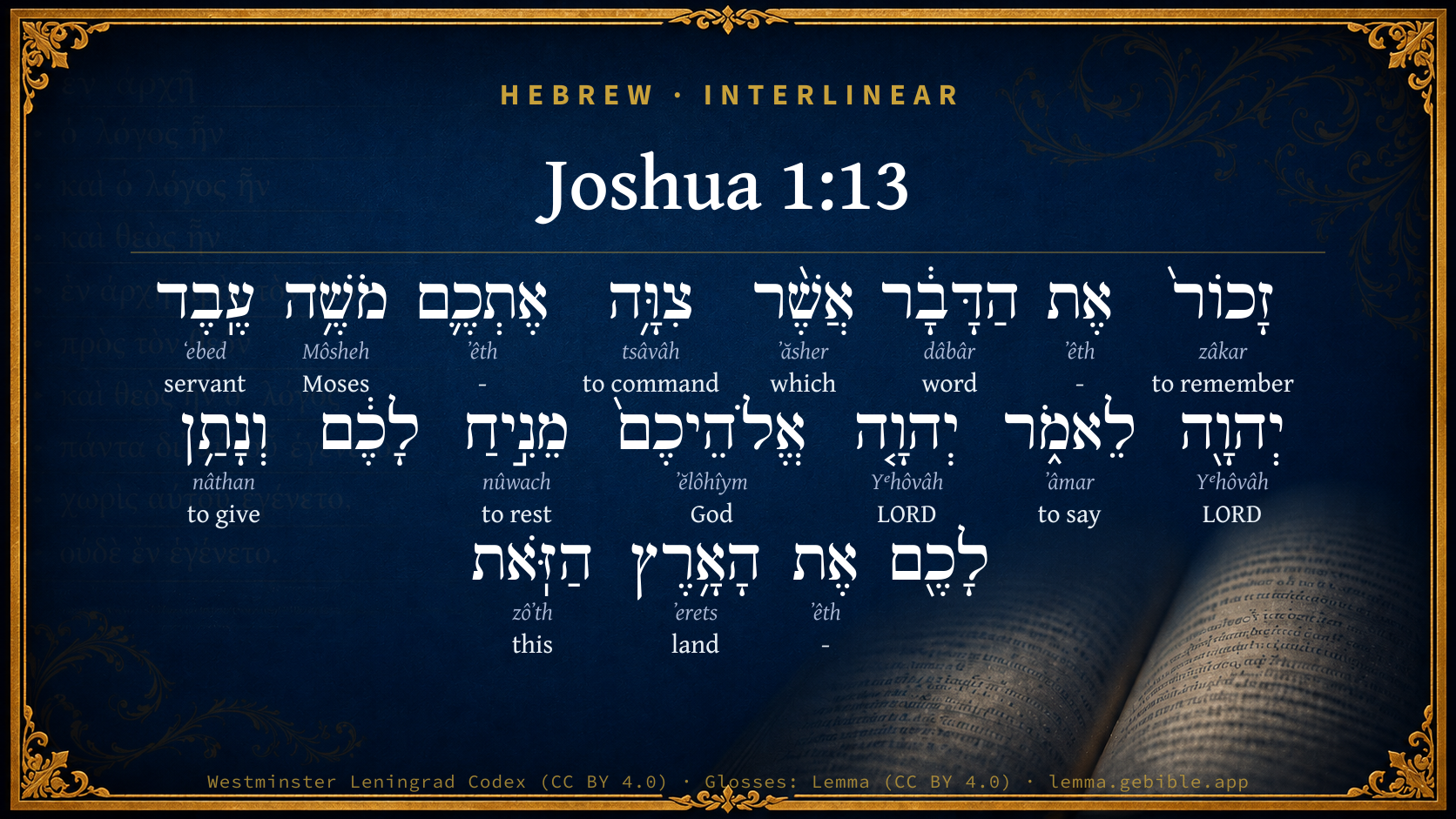
Hebrew (Westminster Leningrad Codex) Joshua 1:13 appears in the Hebrew Old Testament. The text above is from the Westminster Leningrad Codex. Each word links to its Strong’s number, a concise gloss, and parsing drawn from the Open Scriptures Hebrew Bible morphology. Click any word for its full Brown-Driver-Briggs (BDB) entry.
Download image
Cite this verse

Joshua 1:13 (World English Bible). Public Domain. Lemma interlinear Bible study tool, https://lemma.gebible.app/v/joshua/1/13.

Show BibTeX & RIS
BibTeX
RIS
English Translation
Remember the word which Moses the servant of Yahweh commanded you, saying, Yahweh your God gives you rest, and will give you this land.
World English Bible · Public Domain
Download a study sheet

One document with this verse’s original text, its word-by-word gloss line, the meaning frame, cross-references with their text, attributed commentary, and full source and license credits — printable, and it pastes into notes with its structure intact.

This verse Autodidact and up

Study sheet (.html) Plain text (.txt)

A passage Seminary Student

Up to 50 verses in one chapter. A passage sheet keeps up to 6 commentary sources and 12 cross-references per verse, in the order this page ranks them, and says so on the sheet whenever that leaves anything out. Ask for a single verse and you get the Autodidact verse sheet above.

Everything on this page stays free to read, with no account — the sheet is a download of what is already on screen, not access to it.

Want to remove ads? Support Godless Engineer
Compare translations 3

The same verse in 3 English versions, stacked beneath the original-language interlinear above. Click any original word for its lexicon entry.

Each is an independent rendering of the whole verse — the interlinear is not word-aligned to these translations.

Highlighted words mark where these versions differ — a whole-verse word diff, not a word-by-word alignment.

  • World English Bible Public Domain
    Remember the word which Moses the servant of Yahweh commanded you, saying, Yahweh your God gives you rest, and will give you this land.
  • King James Version Public Domain
    Remember the word which Moses the servant of the LORD commanded you, saying, The LORD your God hath given you rest, and hath given you this land.
  • unfoldingWord Literal Text CC BY-SA 4.0
    “Remember the word that Moses the servant of Yahweh commanded you, saying, ‘Yahweh your God giving rest to you, and he will give to you this land.’

unfoldingWord Literal Text — © unfoldingWord, licensed CC BY-SA 4.0. Word-aligned USFM3 via Door43 (git.door43.org/unfoldingWord/en_ult).

Versions to compare (up to 4)

3 of 4 selected

Show all 18 translations

Every available English version of this verse, each an independent rendering of the whole verse.

  • World English Bible Public Domain
    Remember the word which Moses the servant of Yahweh commanded you, saying, Yahweh your God gives you rest, and will give you this land.
  • Berean Standard Bible Public Domain
    “Remember what Moses the servant of the LORD commanded you when he said, ‘The LORD your God will give you rest, and He will give you this land.’
  • Majority Standard Bible Public Domain
    “Remember what Moses the servant of the LORD commanded you when he said, ‘The LORD your God will give you rest, and He will give you this land.’
  • King James Version Public Domain
    Remember the word which Moses the servant of the LORD commanded you, saying, The LORD your God hath given you rest, and hath given you this land.
  • American Standard Version (1901) Public Domain
    Remember the word which Moses the servant of Jehovah commanded you, saying, Jehovah your God giveth you rest, and will give you this land.
  • Revised Version (1885) Public Domain
    Remember the word which Moses the servant of the LORD commanded you, saying, The LORD your God giveth you rest, and will give you this land.
  • Geneva Bible (1599) Public Domain
    Remember the worde, which Moses the seruant of the Lord commanded you, saying, The Lord your God hath giuen you rest, and hath giuen you this land.
  • Douay-Rheims (1899) Public Domain
    Remember the word, which Moses the servant of the Lord commanded you, saying: The Lord your God hath given you rest, and all this land.
  • Young's Literal Translation Public Domain
    `Remember the word which Moses, servant of Jehovah, commanded you, saying, Jehovah your God is giving rest to you, and He hath given to you this land;
  • Literal Standard Version CC BY-SA 4.0
    “Remember the word which Moses, servant of YHWH, commanded you, saying, Your God YHWH is giving rest to you, and He has given this land to you;
  • Unlocked Literal Bible CC BY-SA 4.0
    “Call to mind the word that Moses the servant of Yahweh, commanded you when he said, 'Yahweh your God is giving you rest, and he is giving you this land.'
  • unfoldingWord Literal Text CC BY-SA 4.0
    “Remember the word that Moses the servant of Yahweh commanded you, saying, ‘Yahweh your God giving rest to you, and he will give to you this land.’
  • Darby Bible Public Domain
    Remember the word that Moses the servant of Jehovah commanded you, saying, Jehovah your God has given you rest and has given you this land.
  • World Messianic Bible Public Domain
    “Remember the word which Moses the servant of the LORD commanded you, saying, ‘The LORD your God gives you rest, and will give you this land.
  • Webster's Bible Public Domain
    Remember the word which Moses the servant of the LORD commanded you, saying, The LORD your God hath given you rest, and hath given you this land.
  • Free Bible Version CC BY-SA 4.0
    “Remember what Moses, the servant of the Lord, ordered you to do: ‘The Lord your God is giving you rest, and will give you this land.’
  • Bible in Basic English Public Domain
    Keep in mind what Moses, the servant of the Lord, said to you, The Lord your God is sending you rest and will give you this land.
  • JPS Tanakh (1917) Public Domain
    'Remember the word which Moses the servant of the LORD commanded, you, saying: The LORD your God giveth you rest, and will give you this land.

Literal Standard Version (2020), Covenant Press — licensed CC BY-SA 4.0. Text via the HelloAO Bible API (eBible.org). Unlocked Literal Bible (unfoldingWord) — licensed CC BY-SA 4.0. Text via the HelloAO Bible API (eBible.org). unfoldingWord Literal Text — © unfoldingWord, licensed CC BY-SA 4.0. Word-aligned USFM3 via Door43 (git.door43.org/unfoldingWord/en_ult). Free Bible Version, Dr. Jonathan Gallagher — licensed CC BY-SA 4.0. Text via the HelloAO Bible API (eBible.org).

Word by word

More ways to search: Search by grammar → Find every occurrence → Compare this word →

Practice this passage: Drill this verse → Learn its vocabulary →

מֵנִ֣יחַ
nûwach
H5117
“resting”
Verb, Hiphil, Participle Active, Masculine, Singular, Absolute
Part of Speech
Verb
Stem
Hiphil
Form
Participle Active
Gender
Masculine
Number
Singular
State
Absolute
Full BDB Definition

Origin: a primitive root

TWOT: 1323

to rest - (Qal) - to rest, settle down and remain - to repose, have rest, be quiet - (Hiphil) - to cause to rest, give rest to, make quiet - to cause to rest, cause to alight, set down - to lay or set down, deposit, let lie, place - to let remain, leave - to leave, depart from - to abandon - to permit - (Hophal) - to obtain rest, be granted rest - to be left, be placed - open space (substantive)
  1. זָכוֹר֙ zâkar H2142 “to remember” Verb, Qal, Infinitive Absolute
  2. אֶת ʼêth H853 “-” Particle, Direct Object
  3. הַדָּבָ֔ר dâbâr H1697 “the · word” Particle, Definite Article + Noun, Common, Masculine, Singular, Absolute
  4. אֲשֶׁ֨ר ʼăsher H834 “which” Particle, Relative
  5. צִוָּ֥ה tsâvâh H6680 “to command” Verb, Piel, Perfect, 3rd Person, Masculine, Singular
  6. אֶתְכֶ֛ם ʼêth H853 “- · you” Particle, Direct Object + Suffix, Personal, 2nd Person, Masculine, Plural
  7. מֹשֶׁ֥ה Môsheh H4872 “Moses” Noun, Proper
  8. עֶֽבֶד ʻebed H5650 “servant of” Noun, Common, Masculine, Singular, Construct
  9. יְהוָ֖ה Yᵉhôvâh H3068 “LORD” Noun, Proper
  10. לֵאמֹ֑ר ʼâmar H559 “to say” Preposition + Verb, Qal, Infinitive Construct
  11. יְהוָ֤ה Yᵉhôvâh H3068 “LORD” Noun, Proper
  12. אֱלֹהֵיכֶם֙ ʼĕlôhîym H430 “God(s) · your” Noun, Common, Masculine, Plural, Construct + Suffix, Personal, 2nd Person, Masculine, Plural
  13. וְנָתַ֥ן nâthan H5414 “and · to give” Conjunction + Verb, Qal, Sequential Perfect, 3rd Person, Masculine, Singular
  14. אֶת ʼêth H853 “-” Particle, Direct Object
  15. הָאָ֥רֶץ ʼerets H776 “the · land” Particle, Definite Article + Noun, Common, Both, Singular, Absolute
  16. הַזֹּֽאת zôʼth H2063 “the · this” Particle, Definite Article + Pronoun, Demonstrative, Feminine, Singular

About this verse

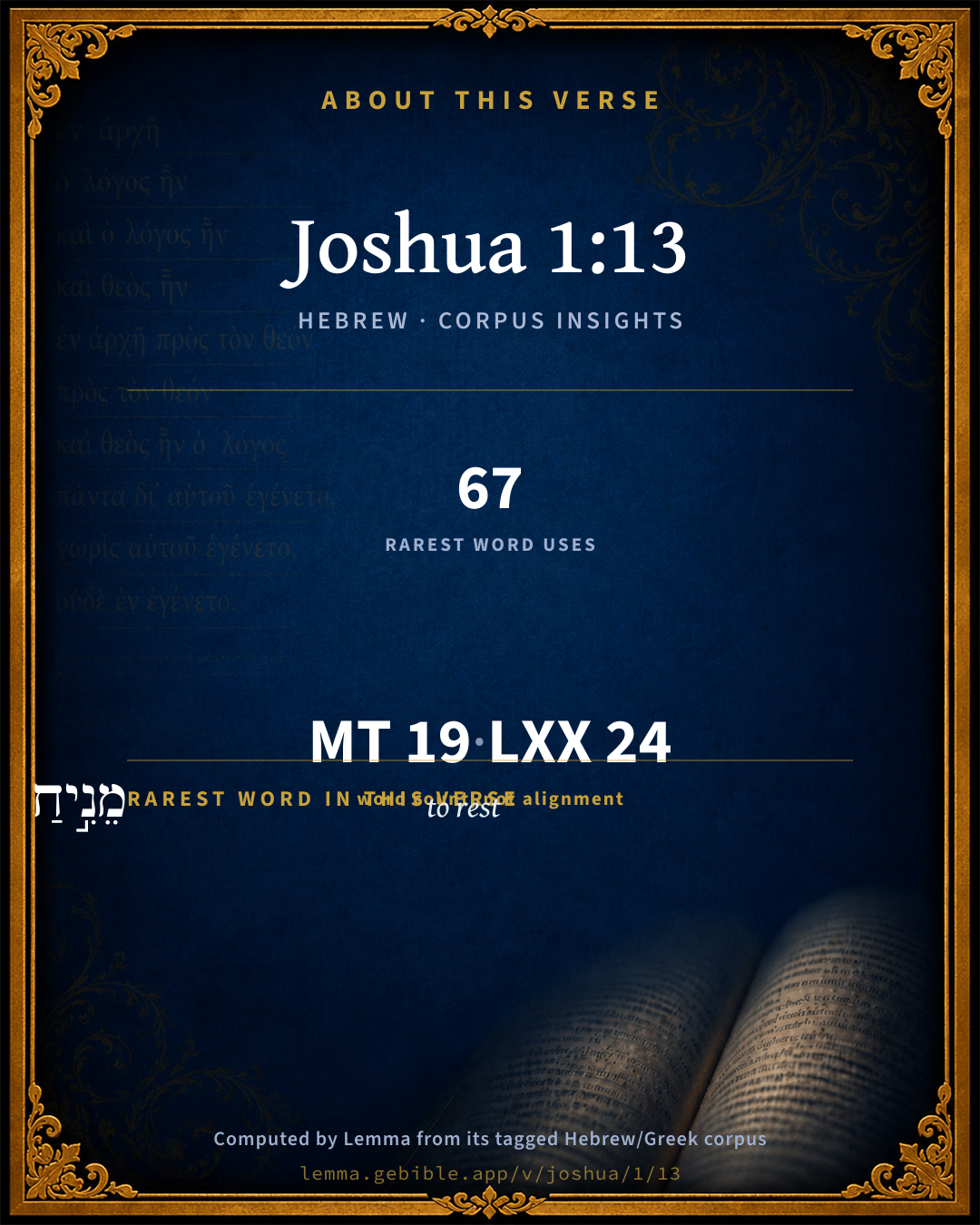
These counts appear in no published source. They are computed here, from the morphology-tagged text and Lemma’s own curated glosses. What Lemma adds →

19
words
14
distinct lemmas
Historical
section

Grammatical profile

  • 5 verbs
  • 7 nouns
  • 1 pronoun
  • 2 prepositions
  • 4 particles

Verb forms

  • זָכוֹר֙ Qal · Infinitive Absolute
  • צִוָּ֥ה Piel · Perfect
  • לֵאמֹ֑ר Qal · Infinitive Construct
  • מֵנִ֣יחַ Hiphil · Participle Active
  • וְנָתַ֥ן Qal · Sequential Perfect

Repetition

A word recurs within this verse — often emphatic in Hebrew:

  • יְהוָ֖ה LORD H3068 ×2

Hebrew & Septuagint length

In English translation the verse runs 24 words from the Hebrew and 28 from the Septuagint (LXX English) — closely comparable.

A rough comparison of the two English renderings, which tokenize alike — not a word-level alignment.

Word counts can differ between the Hebrew and the Greek without any difference in meaning — e.g. the Hebrew direct-object marker אֵת has no separate Greek word, and Greek often adds the article ὁ.

In the original languages it is 19 Hebrew tokens and 24 Greek tokens — but the two are counted differently (Hebrew bundles its prefixes and suffixes into one token; the Greek is in lemma form), so that isn’t a like-for-like length.

Cross-references

3

Topical passages linked to Joshua 1:13 in the Treasury of Scripture Knowledge — connected by theme and wording, ordered by reader-vote popularity; previews shown in the World English Bible.

  • Numbers 32:20–28 Moses said to them, If you will do this thing, if you will arm yourselves to go before Yahweh to the war,
  • Deuteronomy 3:18–20 I commanded you at that time, saying, Yahweh your God has given you this land to possess it: you shall pass over armed before your brothers the children of Israel, all the men of valor.
  • Joshua 22:1–4 Then Joshua called the Reubenites, and the Gadites, and the half-tribe of Manasseh,

Cross-references courtesy of OpenBible.info (CC BY 4.0).

Hebrew and Greek witnesses Masoretic Hebrew ↔ Greek Septuagint

The same verse in the two great witnesses to the Old Testament, shown verse-for-verse.

These are two independent witnesses, not word-aligned to each other, and the Septuagint is shown in lemma (dictionary) form.

Hebrew Joshua 1:13 Masoretic · Westminster Leningrad Codex

זָכוֹר֙ אֶת הַדָּבָ֔ר אֲשֶׁ֨ר צִוָּ֥ה אֶתְכֶ֛ם מֹשֶׁ֥ה עֶֽבֶד יְהוָ֖ה לֵאמֹ֑ר יְהוָ֤ה אֱלֹהֵיכֶם֙ מֵנִ֣יחַ לָכֶ֔ם וְנָתַ֥ן לָכֶ֖ם אֶת הָאָ֥רֶץ הַזֹּֽאת

Remember the word which Moses the servant of Yahweh commanded you, saying, Yahweh your God gives you rest, and will give you this land.

World English Bible · Public Domain

Greek LXX Joshua 1:13 Septuagint · lemma form

μιμνήσκω ὁ ῥῆμα κύριος ὅς ἐντέλλομαι σύ μωυσῆς ὁ παῖς κύριος λέγω κύριος ὁ θεός σύ καταπαύω σύ καί δίδωμι σύ ὁ γῆ οὗτος

Remember the word which Moses the servant of the Lord commanded you, saying, the Lord your God has caused you to rest, and has given you this land.

LXX2012 (modern English Septuagint) · Public Domain

On this verse, The Pulpit Commentary discusses the Septuagint’s reading. Read the note in Commentary ↓

Hebrew: Westminster Leningrad Codex (CC BY 4.0). Greek: Septuagint (public domain); English from LXX2012 (modern English Septuagint) (Public Domain). How the Septuagint differs from the Hebrew →

Targum (Aramaic paraphrase)

1

The Targum is the ancient Jewish Aramaic paraphrase of the Hebrew Scriptures — an interpretive translation, not the Hebrew text itself. Onkelos (literal) and Pseudo-Jonathan (expansive) render the Torah, and Jonathan the Prophets. Coverage is partial: where no permissively-licensed English translation exists for a verse, only the Aramaic is shown. This is verse-level text, not a word-by-word alignment to the Hebrew.

  1. Targum Jonathan Prophets (Joshua–Malachi)
    הֲווֹ דְכִירִין יַת פִּתְגָמָא דִפַקֵיד יַתְכוֹן מֹשֶׁה עַבְדָא דַייָ לְמֵימָר יְיָ אֱלָהָכוֹן מַנִיחַ לְכוֹן וִיהַב לְכוֹן יַת אַרְעָא הָדָא:

    (no public-domain English translation for this verse)

    Targum Jonathan — Aramaic: “Mikraot Gedolot” (public domain). English: “Sefaria Community Translation” (CC0 1.0 (public-domain dedication)); “London "Chaldee Paraphrase," 1871” (public domain). Text via Sefaria.

Commentary

Notes on Joshua 1:13 from classic Christian and Jewish commentators (each source and its license shown beneath its notes). The classic Christian expositions comment on the surrounding passage and are grouped to its opening verse, so a note may address several verses; the Jewish commentaries on the Tanakh (Rashi and others) are per-verse, so they appear only where the commentator wrote on this verse.

Lemma curates 59 commentaries, every one of them public domain or Creative Commons licensed, each selected and text-cleaned for this edition rather than reprinted as found. About our sources →

Trapp's Complete Commentary

John Trapp

Jos 1:13 Remember the word which Moses the servant of the LORD commanded you, saying, The LORD your God hath given you rest, and hath given you this land.

Ver. 13. Remember the word.] Your engagement to Moses, Num 32:17; Num 32:22.

“ Pollicitis dives quilibet est potest. ”

John Trapp, A Commentary or Exposition upon All the Books of the Old and New Testament (1647–1656) — public domain. Text from a community e-Sword module.

Joseph Benson's Commentary

Jos 1:13-14. Which Moses commanded you — His charge to you, and your promise to him. Rest — That is, a place of rest, as that word signifies. Before your brethren — In the front of all of them; which was but reasonable; because they had the advantage of their brethren, having actually received their portion, which their brethren had only in hope; because they were freed from those impediments which the rest were exposed to, their wives, and children, and estates being safely lodged; and to prevent their withdrawing themselves from the present service, which they otherwise would have had temptations to do, because of the nearness of their habitations. Armed — For by this time they were well furnished with arms, which they had either from the Egyptians, Amalekites, or Amorites, from whom they had taken them; or, by purchase, from those people by whose borders they passed. Men of valour — All such were obliged to go over, if occasion required it, but Joshua took only some of them, because they were sufficient for his purpose, and because it was proper some should be left, both to secure their own wives, children, and possessions, and to prevent their enemies on that side from giving them disturbance while engaged in their enterprise upon Canaan.

Joseph Benson's Commentary on the Old and New Testaments (1811–1818) — public domain. Text from a community e-Sword module.

Tyndale Open Study Notes

Tyndale Open Resources

1:13 God wanted the people of Israel to experience the spiritual, cultural, and emotional rest of a right relationship with him and each other, not just the physical rest of living in a secure and abundant land (see Heb 4:1-11).

Tyndale Open Study Notes — © Tyndale Open Resources, licensed CC BY-SA 4.0. Text via the HelloAO Bible API.

Geneva Bible (1599)

Geneva Bible translators

Which belonged to Sihon the king of the Amorites, and Og king of Bashan.

Geneva Bible (1599) marginal notes — public domain. Text via Bolls.life.

Adam Clarke's Commentary

Verse 13. Remember the word] He puts the Reubenites, &c., in remembrance of the engagements they had made with Moses (See Nu 32:20) when he granted them their portion on the east side of Jordan.

Adam Clarke's Commentary on the Bible (1810–1826) — public domain. Text from a community e-Sword/MySword module.

Ellicott's Commentary for English Readers

(13) Hath given you rest.—Observe this phrase. as applied to the settlement of Israel in the land of promise, on either side of Jordan. Those who condemn the two and a half tribes (or the persons whom they suppose to be spiritually represented by them) for not going far enough, should notice that on both sides of Jordan equally there was the “rest of God.” But this “rest” is only the first stage of several in Israel’s history. We find it again in the reign of David (2Sa_7:1), Solomon (1Ch_22:9), Esther (Jos_9:16-18; Jos_9:22), and we must not forget the comment in Hebrews 4, obtained from Psalms 95 : “For if Joshua had given them rest, then would He not afterward have spoken of another day.” “These all received not the promise.” “There remaineth therefore a rest to the people of God.” The last rest is Sabbatical; the rests that precede it are halting-places on the way.

A Bible Commentary for English Readers, edited by Charles John Ellicott (1878–1897) — public domain. Text from a community e-Sword module.

The Cambridge Bible for Schools and Colleges

gen. ed. J. J. S. Perowne

13. Remember the word] Num_32:20-24 is quoted, not literally, but freely according to the sense.

hath given you rest] Comp. Deu_25:19, “It shall be, when the Lord thy God hath given thee rest from all thine enemies round about, in the land which the Lord thy God giveth thee for an inheritance to possess it.” Into this “rest” the disobedient did not enter (Num_14:28-30; Psa_95:7-11; Heb_3:11-18), but the true “Rest,” the complete “Sabbath-keeping,” still remaineth for “the people of God” (Heb_4:9).

this land] Compare Jos_1:2 and Deu_3:18, the land in which the whole people as yet and the speaker also were, the land east of the Jordan.

The Cambridge Bible for Schools and Colleges (gen. ed. J. J. S. Perowne; Cambridge University Press, 1878–1918) — public domain. Text from a community e-Sword module.

John Gill's Exposition

Remember the word which Moses the servant of the Lord commanded you,.... In Num 32:29; and to which they had solemnly agreed; and, now the time was come to put it into execution, Joshua reminds them of it:

saying, the Lord your God hath given you rest: from their travels, and a settlement in a country agreeably to their own desire:

and hath given you this land; where they now were, and which they had taken from Sihon and Og, kings of the Amorites, and joined to Moab, on the borders of which Israel lay encamped; and by this it appears, that the settlement of these tribes, on the other side Jordan, was according to the will of God; he gave it to them.

John Gill's Exposition of the Whole Bible (1746–1763) — public domain (CC PDM 1.0). Text via the HelloAO Bible API.

Matthew Poole's English Annotations

Remember his charge to you, and your promise to him, which they were obliged to keep; and Joshua was to see that they did so. Rest i.e. a place of rest, as that word signifies: See Poole "Gen 49:15".

Matthew Poole's English Annotations on the Holy Bible (1683–1685) — public domain. Text from a community e-Sword/MySword module.

Whedon's Commentary on the Bible

Daniel D. Whedon

13. The Lord… hath given you rest — He has permitted you to settle your families in fixed abodes on the express condition that you should assist in the subjugation of the land on the western side of Jordan.

Num_32:16-22. The promise of these two and a half tribes, solemnly made to Moses, must now be fulfilled.

This land — Like the expressions this Jordan and this Lebanon, (Jos_1:2; Jos_1:4,) the land immediately around them east of Jordan, in which all Israel was yet encamped.

Daniel D. Whedon (gen. ed.), Commentary on the Old and New Testaments (1874–1909) — public domain. Text from a community e-Sword module.

The Pulpit Commentary

Remember the word. The substance, and not the ipsissima verba, of the directions of Moses in Nu 32 is here given. (see also Deu_3:16-20) Hath given you rest. Perhaps, rather, hath caused you to rest hath permitted you to settle; though the LXX here has katepausen , and the Vulgate, dedit vobis requiem. (cf. Heb_3:11-18 Heb_4:1-11; and Psa_95:11) This land, i.e., that in which they then were, on what we call the further side of Jordan.

HOMILIES BY S.R. ALDRIDGE Ver. 13. An agreement remembered.

The latter part of this chapter recounts the preparations made for the entrance of the Israelites into Canaan. Joshua was already showing himself "the right man in the right place." Having given orders with respect to the food necessary for the next march, he now addresses the tribes who had been permitted to choose an inheritance on the east of the Jordan. He reminds them of their promise to send their armed men as a van-guard to the people. Though under the sheltering wings of the Almighty no prudent precautions must be neglected, no vigilance relaxed, the honour of God demands that reasonable care should be exercised to prevent surprise and the consequent disgrace that would attach to His holy name. God helps us not only outwardly but inwardly, teaching us how to live a sober, righteous, and godly life, and so to vanquish the machinations of the enemy.

I A COVENANT REMEMBERED. If the Reubenites and Gadites had forgotten it, not so Joshua. Nor does God fail to recollect the vows we have made. As He recalled Jacob to a sense of his ingratitude and remissness, (Gen_35:1) so He will not have us treat our promises lightly. It is part of the functions of a faithful leader to bring to light forgotten duties. A minister reminds his people of their engagements. What declarations of devoted adherence to Christ were uttered at conversion! how they bound themselves henceforth to live to the glory of God! The people"s promises to God must be insisted on, as won as the cheering promises which God has made to them. Let us not be angry nor revile such admonitions as the preaching of the law instead of the gospel. An appeal was made to authority. The agreement had been a commandment on the part of Moses. Joshua enforced compliance therewith. On the same grounds we draw attention to the precepts of prophets and apostles, as well as to the direct dictates of the Lord. These holy men were inspired, and to dispute their utterances is to call in question the authority of the Master whose servants they were. Joshua thus sanctioned Moses as Peter afterwards bore witness to Paul. (2Pe_3:15)

II PRINCIPLES RECOGNISED IN THE COVENANT.

1. Favours merit some grateful return. The land of Gilead and Bashan was desired by these two and a half tribes on account of its fruitful pasturage. It was adapted for flocks and herds, and the sight of such fertile territory caused the owners of much sheep and cattle to be willing to settle down at once, rather than to occupy soft in the "land of promise" itself. Their request was not pleasing to Moses, as it seemed to put a slight upon Canaan, and to threaten a relapse into idolatry, beside the imminent danger of discouraging the rest of the Israelites, and so effecting by the wrath of God the utter extinction of the nation. Yet on the condition to which reference has been made the petition was ultimately granted. As they had achieved their desire it was rightly expected that they would render some proportionate recompense. And in similar method our heavenly Father deals with us today. We must be ready to cry with the Psalmist, "What shall I render unto the Lord for all his benefits toward me?" If more than others we have received, of us will more be required. Health and strength, wealth and position, learning and influence not one of these gifts but entails a corresponding responsibility. If the conditions have not been stated in so many words, yet they are easily discoverable.

2. The priority of duty to pleasure. Before these armed men could lawfully enjoy their inheritance they must fulfil their engagement. We do not oppose duty to pleasure, strictly speaking, for it is obvious that only when mindful of the former can the latter be truly known. But the two may be distinguished, and it is clear that there are cases in which selfish inclination would lead one way and obligation calls us another. The rule to be adopted is plain. Listen to "I ought," and follow whither it directs; there will be a satisfaction gendered which will go far to repay us for any sacrifice; and then when the period of relaxation has really arrived our delight will be embittered by no stings of reproachful conscience, but enhanced by the remembrance of duty discharged. Let this be noted and acted upon by the young, and there will be fewer wasted lives. Let Church members consult their obligations before their convenience and there will be fewer vacancies crying out for occupants.

3. The obligations of fraternal love. The dislike of Moses to the request of these tribes was akin to the grief of a father who witnesses the separation of some members of the family from the rest. The river Jordan was in itself but a small dividing line, but it might be significant of a wide and deep estrangement. Evidently perceiving the fear of Moses, the Reubenites, etc., offered to prove by their conduct that they were still at one with their brethren and intended so to remain. The offer was approved of and established as a covenant between the whole nation and these special tribes. It affirmed a participation in the common hopes and risks. The New Testament speaks not less clearly of the relationship between all the children of God. The members of the body. of Christ axe bound to feel with and for one another. (1Co_12:25, 1Co_12:26) "Let brotherly love continue." So forcible was the impulse of the first preaching of the gospel that it led the Christians of Jerusalem to a commonalty of goods. It is required of the rich to help the poor, the strong must assist in bearing the burdens of the weak, the settled in position and faith must stretch out the hand to those who axe still searching for a place of rest, and those who have leisure must devote a portion at least to the succour of the busily employed. The Jewish Paul having obtained the privileges of Christianity could wish himself to be "accursed for his brethren, his kinsmen according to the flesh." We are selfish indeed if we pray not and labour not for the salvation of our friends till they become possessed likewise of an eternal inheritance. Briefly note

III THE RATIFICATION OF THE COVENANT. The covenanters assented immediately to the command of Joshua. They were ready to keep their word. No excuses urged, no pleas of misunderstanding, no subtle equivocations, no attempts to secure a remission of their engagement, but downright honest confirmation of their pledged promise. They did not desire their sin to find them out. (Num_32:23) The covenant had been really made with the Lord, and He would be certain to punish its violation. God give us grace to imitate their example! Like Jephthah, we have "opened our mouth to the Lord and cannot go back." We have declared that our bodies shall be living sacrifices, that our mouths shall show forth the Redeemer"s praise, that as for us we will serve the Lord.

Very shame should bind us to our word; we must not, dare not, "keep back part of the price." And love to God and man draws us onward to our "reasonable service. A.

The Pulpit Commentary (1880–1919), ed. H.D.M. Spence-Jones & Joseph S. Exell — public domain. Text from a community e-Sword module.

John Wesley's Explanatory Notes

Commanded you - His charge to you, and your promise to him. Rest - That is, a place of rest, as that word signifies.

John Wesley, Explanatory Notes Upon the Whole Bible (1754–1765) — public domain. Text via the GEBible commentary corpus.

Lesson kit

Teaching starters — assembled from the data on this page, not authored interpretation. Every prompt links to the verse data it draws on. Edit before teaching.

Joshua, in the Historical, opens this verse with 19 words (14 distinct Hebrew lemmas). Its most distinctive word is nûwach (“to rest”). A historical commentator’s framing appears above. Read the whole chapter for the surrounding context.

Discussion questions

  1. The word nûwach carries the sense “to rest.” How does it shape the verse?
  2. How does Numbers 32:20–28, which shares this passage’s theme, read alongside this verse?
  3. What does the repetition of “LORD” (2× in this one verse) do in this verse?
  4. The translations on this page render this verse differently — a whole-verse word diff, not a word-by-word alignment. What might account for the different wordings?
  5. «זָכוֹר֙» is a Qal Infinitive Absolute verb. How does that grammatical form shape the action described?
  6. Compare how Trapp's Complete Commentary and Joseph Benson's Commentary read this verse. Where do they agree or differ?

Things to notice

Reading settings

Reading text

Shown beneath each verse's original-language words.

Old Testament
Old Testament edition

Read the OT as the Masoretic Hebrew (MT) or the Greek Septuagint (LXX).

English shown for the Greek Septuagint (in the Hebrew ↔ Greek comparison).

Comparing translations? Open the Compare panel on any verse page to stack up to four side by side.