Genesis 24:8

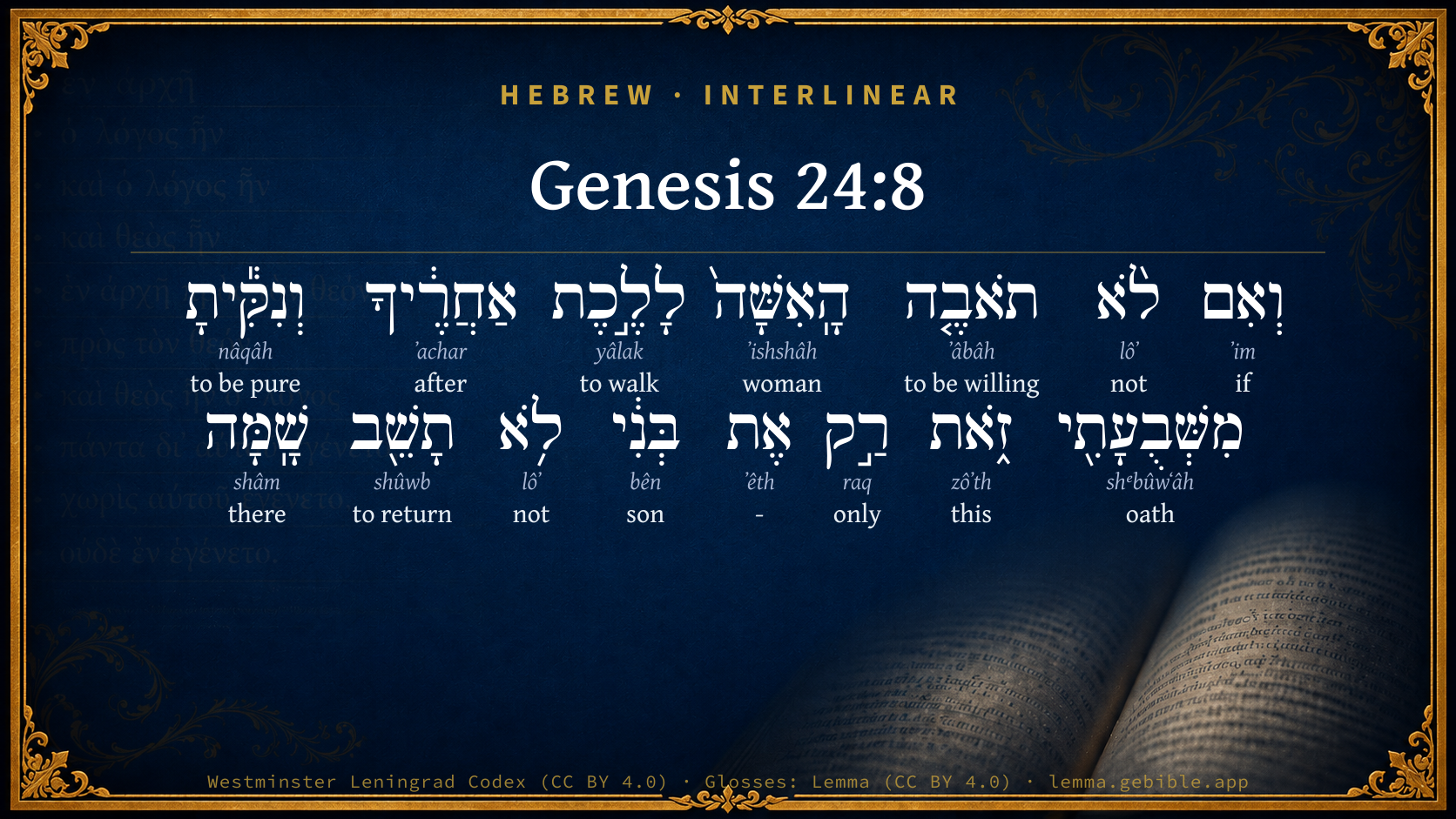
Hebrew (Westminster Leningrad Codex) Genesis 24:8 appears in the Hebrew Old Testament. The text above is from the Westminster Leningrad Codex. Each word links to its Strong’s number, a concise gloss, and parsing drawn from the Open Scriptures Hebrew Bible morphology. Click any word for its full Brown-Driver-Briggs (BDB) entry.
Download image
Cite this verse

Genesis 24:8 (World English Bible). Public Domain. Lemma interlinear Bible study tool, https://lemma.gebible.app/v/genesis/24/8.

Show BibTeX & RIS
BibTeX
RIS
English Translation
If the woman isn't willing to follow you, then you shall be clear from this my oath. Only you shall not bring my son there again."
World English Bible · Public Domain
Highlights
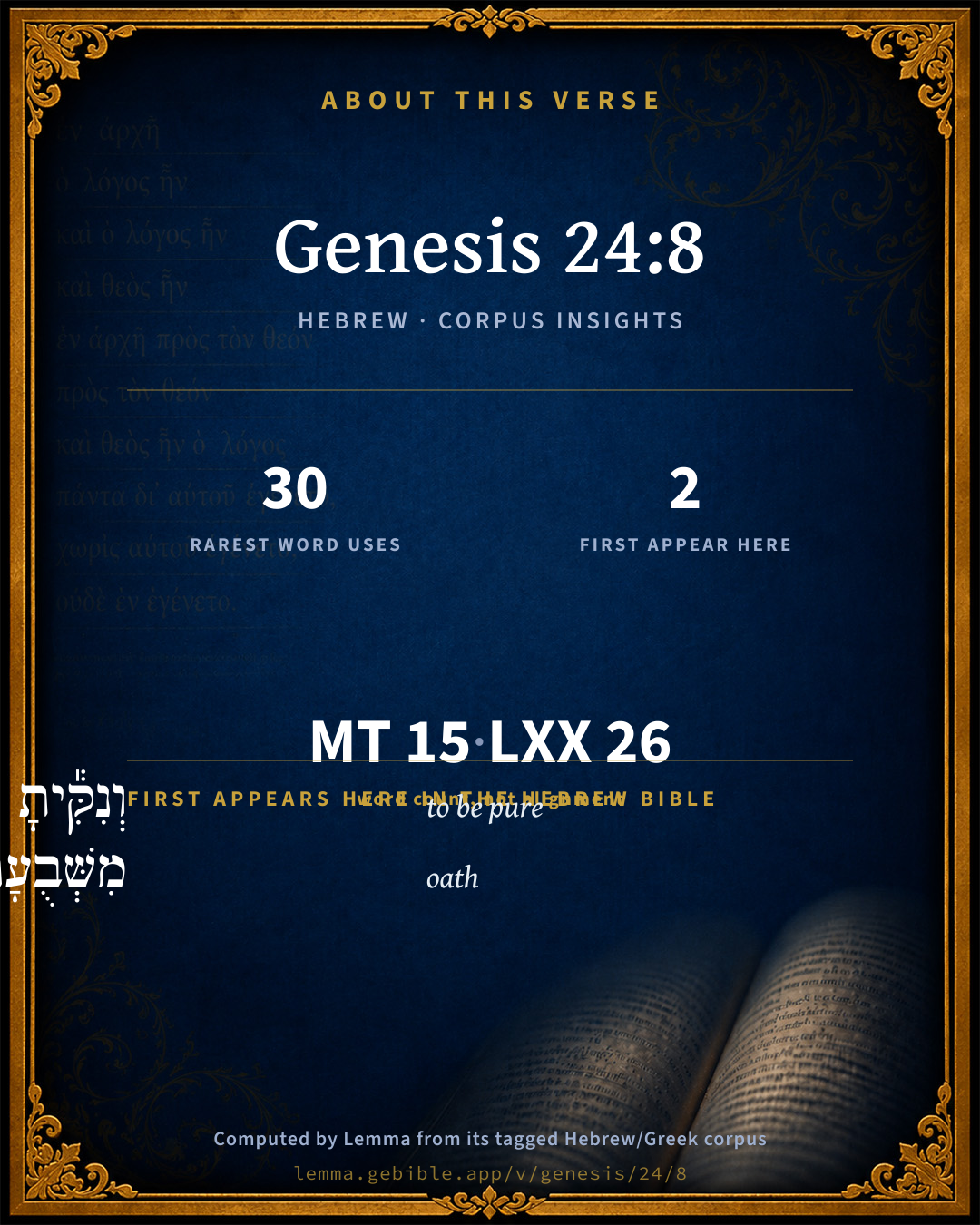
  • 2 first appearances in the Hebrew Bible
Full analysis ↓
Download a study sheet

One document with this verse’s original text, its word-by-word gloss line, the meaning frame, cross-references with their text, attributed commentary, and full source and license credits — printable, and it pastes into notes with its structure intact.

This verse Autodidact and up

Study sheet (.html) Plain text (.txt)

A passage Seminary Student

Up to 50 verses in one chapter. A passage sheet keeps up to 6 commentary sources and 12 cross-references per verse, in the order this page ranks them, and says so on the sheet whenever that leaves anything out. Ask for a single verse and you get the Autodidact verse sheet above.

Everything on this page stays free to read, with no account — the sheet is a download of what is already on screen, not access to it.

Want to remove ads? Support Godless Engineer
Compare translations 3

The same verse in 3 English versions, stacked beneath the original-language interlinear above. Click any original word for its lexicon entry.

Each is an independent rendering of the whole verse — the interlinear is not word-aligned to these translations.

Highlighted words mark where these versions differ — a whole-verse word diff, not a word-by-word alignment.

  • World English Bible Public Domain
    If the woman isn't willing to follow you, then you shall be clear from this my oath. Only you shall not bring my son there again."
  • King James Version Public Domain
    And if the woman will not be willing to follow thee, then thou shalt be clear from this my oath: only bring not my son thither again.
  • unfoldingWord Literal Text CC BY-SA 4.0
    But if the woman is not willing to come with you, then you are clear from this oath of mine. Only do not take my son back there!”

unfoldingWord Literal Text — © unfoldingWord, licensed CC BY-SA 4.0. Word-aligned USFM3 via Door43 (git.door43.org/unfoldingWord/en_ult).

Versions to compare (up to 4)

3 of 4 selected

Show all 18 translations

Every available English version of this verse, each an independent rendering of the whole verse.

  • World English Bible Public Domain
    If the woman isn't willing to follow you, then you shall be clear from this my oath. Only you shall not bring my son there again."
  • Berean Standard Bible Public Domain
    And if the woman is unwilling to follow you, then you are released from this oath of mine. Only do not take my son back there.”
  • Majority Standard Bible Public Domain
    And if the woman is unwilling to follow you, then you are released from this oath of mine. Only do not take my son back there.”
  • King James Version Public Domain
    And if the woman will not be willing to follow thee, then thou shalt be clear from this my oath: only bring not my son thither again.
  • American Standard Version (1901) Public Domain
    And if the woman be not willing to follow thee, then thou shalt be clear from this my oath. Only thou shalt not bring my son thither again.
  • Revised Version (1885) Public Domain
    And if the woman be not willing to follow thee, then thou shalt be clear from this my oath; only thou shalt not bring my son thither again.
  • Geneva Bible (1599) Public Domain
    Neuertheles if the woman wil not follow thee, then shalt thou bee discharged of this mine othe: onely bring not my sonne thither againe.
  • Douay-Rheims (1899) Public Domain
    But if the woman will not follow thee, thou shalt not be bound by the oath; only bring not my son back thither again.
  • Young's Literal Translation Public Domain
    and if the woman be not willing to come after thee, then thou hast been acquitted from this mine oath: only my son thou dost not cause to turn back thither.'
  • Literal Standard Version CC BY-SA 4.0
    and if the woman is not willing to come after you, then you have been acquitted from this my oath: only you do not cause my son to return there.”
  • Unlocked Literal Bible CC BY-SA 4.0
    But if the woman is not willing to follow you, then you will be free from this oath of mine. Only you are not to take my son back there.”
  • unfoldingWord Literal Text CC BY-SA 4.0
    But if the woman is not willing to come with you, then you are clear from this oath of mine. Only do not take my son back there!”
  • Darby Bible Public Domain
    And if the woman be not willing to follow thee, then thou shalt be quit of this my oath: only, bring not my son thither again.
  • World Messianic Bible Public Domain
    If the woman isn’t willing to follow you, then you shall be clear from this oath to me. Only you shall not bring my son there again.”
  • Webster's Bible Public Domain
    And if the woman shall not be willing to follow thee, then thou shalt be clear from this my oath; only bring not my son thither again.
  • Free Bible Version CC BY-SA 4.0
    However, if the woman refuses to return here with you, then you are released from this oath. But make sure you don't take my son back there.”
  • Bible in Basic English Public Domain
    And if the woman will not come with you, then you are free from this oath; only do not take my son back there.
  • JPS Tanakh (1917) Public Domain
    And if the woman be not willing to follow thee, then thou shalt be clear from this my oath; only thou shalt not bring my son back thither.'

Literal Standard Version (2020), Covenant Press — licensed CC BY-SA 4.0. Text via the HelloAO Bible API (eBible.org). Unlocked Literal Bible (unfoldingWord) — licensed CC BY-SA 4.0. Text via the HelloAO Bible API (eBible.org). unfoldingWord Literal Text — © unfoldingWord, licensed CC BY-SA 4.0. Word-aligned USFM3 via Door43 (git.door43.org/unfoldingWord/en_ult). Free Bible Version, Dr. Jonathan Gallagher — licensed CC BY-SA 4.0. Text via the HelloAO Bible API (eBible.org).

Word by word

More ways to search: Search by grammar → Find every occurrence → Compare this word →

Practice this passage: Drill this verse → Learn its vocabulary →

מִשְּׁבֻעָתִ֖י
shᵉbûwʻâh
H7621
“from · oath · my”
Preposition + Noun, Common, Feminine, Singular, Construct + Suffix, Personal, 1st Person, Common, Singular
Part of Speech
Preposition + Noun
Type
Common
Gender
Feminine
Number
Singular
State
Construct
Full BDB Definition

Origin: pass part of H7650

TWOT: 2319a

oath, curse - oath - attesting of innocence - curse - oath (of Jehovah)
  1. וְאִם ʼim H518 “and · if” Conjunction + Conjunction
  2. לֹ֨א lôʼ H3808 “not” Particle, Negative
  3. תֹאבֶ֤ה ʼâbâh H14 “to be willing” Verb, Qal, Imperfect, 3rd Person, Feminine, Singular
  4. הָֽאִשָּׁה֙ ʼishshâh H802 “the · woman” Particle, Definite Article + Noun, Common, Feminine, Singular, Absolute
  5. לָלֶ֣כֶת yâlak H3212 “to walk” Preposition + Verb, Qal, Infinitive Construct
  6. אַחֲרֶ֔יךָ ʼachar H310 “after · you” Preposition + Suffix, Personal, 2nd Person, Masculine, Singular
  7. וְנִקִּ֕יתָ nâqâh H5352 “and · to be pure” Conjunction + Verb, Niphal, Perfect, 2nd Person, Masculine, Singular
  8. זֹ֑את zôʼth H2063 “this” Pronoun, Demonstrative, Feminine, Singular
  9. רַ֣ק raq H7535 “only” Particle, Accusative
  10. אֶת ʼêth H853 “-” Particle, Direct Object
  11. בְּנִ֔י bên H1121 “son · my” Noun, Common, Masculine, Singular, Construct + Suffix, Personal, 1st Person, Common, Singular
  12. לֹ֥א lôʼ H3808 “not” Particle, Negative
  13. תָשֵׁ֖ב shûwb H7725 “to return” Verb, Hiphil, Imperfect, 2nd Person, Masculine, Singular
  14. שָֽׁמָּה shâm H8033 “there · toward” Adverb + Suffix, Demonstrative

About this verse

These counts appear in no published source. They are computed here, from the morphology-tagged text and Lemma’s own curated glosses. What Lemma adds →

15
words
14
distinct lemmas
Pentateuch
section

First appearance in Scripture

These words make their first canonical appearance in the Hebrew Bible here:

  • וְנִקִּ֕יתָ to be pure H5352
  • מִשְּׁבֻעָתִ֖י oath H7621

Shared distinctive vocabulary

מִשְּׁבֻעָתִ֖י oath H7621 occurs in 29 verses of the Hebrew Bible. Also found in:

Grammatical profile

  • 4 verbs
  • 3 nouns
  • 1 pronoun
  • 1 preposition
  • 1 conjunction
  • 1 adverb
  • 4 particles

Verb forms

  • תֹאבֶ֤ה Qal · Imperfect
  • לָלֶ֣כֶת Qal · Infinitive Construct
  • וְנִקִּ֕יתָ Niphal · Perfect
  • תָשֵׁ֖ב Hiphil · Imperfect

Repetition

A word recurs within this verse — often emphatic in Hebrew:

Hebrew & Septuagint length

In English translation the verse runs 26 words from the Hebrew and 29 from the Septuagint (LXX English) — closely comparable.

A rough comparison of the two English renderings, which tokenize alike — not a word-level alignment.

Word counts can differ between the Hebrew and the Greek without any difference in meaning — e.g. the Hebrew direct-object marker אֵת has no separate Greek word, and Greek often adds the article ὁ.

In the original languages it is 15 Hebrew tokens and 26 Greek tokens — but the two are counted differently (Hebrew bundles its prefixes and suffixes into one token; the Greek is in lemma form), so that isn’t a like-for-like length.

Cross-references

7

Topical passages linked to Genesis 24:8 in the Treasury of Scripture Knowledge — connected by theme and wording, ordered by reader-vote popularity; previews shown in the World English Bible.

  • Joshua 2:17–20 The men said to her, We will be guiltless of this your oath which you have made us to swear.
  • Numbers 30:5 But if her father disallow her in the day that he hears, none of her vows, or of her bonds with which she has bound her soul, shall stand: and Yahweh will forgive her, because her father disallowed her.
  • Numbers 30:8 But if her husband disallow her in the day that he hears it, then he shall make void her vow which is on her, and the rash utterance of her lips, with which she has bound her soul: and Yahweh will forgive her.
  • Genesis 24:4–6 But you shall go to my country, and to my relatives, and take a wife for my son Isaac."
  • Joshua 9:20 This we will do to them, and let them live; lest wrath be on us, because of the oath which we swore to them.
  • John 8:32 You will know the truth, and the truth will make you free."
  • Acts 7:2 He said, "Brothers and fathers, listen. The God of glory appeared to our father Abraham, when he was in Mesopotamia, before he lived in Haran,

Cross-references courtesy of OpenBible.info (CC BY 4.0).

Hebrew and Greek witnesses Masoretic Hebrew ↔ Greek Septuagint

The same verse in the two great witnesses to the Old Testament, shown verse-for-verse.

These are two independent witnesses, not word-aligned to each other, and the Septuagint is shown in lemma (dictionary) form.

Hebrew Genesis 24:8 Masoretic · Westminster Leningrad Codex

וְאִם לֹ֨א תֹאבֶ֤ה הָֽאִשָּׁה֙ לָלֶ֣כֶת אַחֲרֶ֔יךָ וְנִקִּ֕יתָ מִשְּׁבֻעָתִ֖י זֹ֑את רַ֣ק אֶת בְּנִ֔י לֹ֥א תָשֵׁ֖ב שָֽׁמָּה

If the woman isn't willing to follow you, then you shall be clear from this my oath. Only you shall not bring my son there again."

World English Bible · Public Domain

Greek LXX Genesis 24:8 Septuagint · lemma form

ἐάν δέ μή θέλω ὁ γυνή πορεύομαι μετά σύ εἰς ὁ γῆ οὗτος καθαρός εἰμί ἀπό ὁ ὅρκος οὗτος μόνον ὁ υἱός ἐγώ μή ἀποστρέφω ἐκεῖ

And if the woman should not be willing to come with you into this land, you shall be clear from my oath, only carry not my son there again.

LXX2012 (modern English Septuagint) · Public Domain

Hebrew: Westminster Leningrad Codex (CC BY 4.0). Greek: Septuagint (public domain); English from LXX2012 (modern English Septuagint) (Public Domain). How the Septuagint differs from the Hebrew →

Targum (Aramaic paraphrase)

2

The Targum is the ancient Jewish Aramaic paraphrase of the Hebrew Scriptures — an interpretive translation, not the Hebrew text itself. Onkelos (literal) and Pseudo-Jonathan (expansive) render the Torah, and Jonathan the Prophets. Coverage is partial: where no permissively-licensed English translation exists for a verse, only the Aramaic is shown. This is verse-level text, not a word-by-word alignment to the Hebrew.

  1. Targum Onkelos Torah (Genesis–Deuteronomy)
    וְאִם לָא תֵיבֵי אִתְּתָא לְמֵיתֵי בַתְרָךְ וּתְהֵי זַכָּאָה מִמּוֹמָתִי דָּא לְחוֹד יָת בְּרִי לָא תָתֵב לְתַמָּן

    (no public-domain English translation for this verse)

    Targum Onkelos — Aramaic: “Onkelos Genesis” (public domain); “Onkelos Exodus” (public domain); “Onkelos Leviticus” (public domain); “Onkelos Numbers” (public domain); “Onkelos Deuteronomy” (public domain). English: “Sefaria Community Translation” (CC0 1.0 (public-domain dedication)); “J.W. Etheridge. The Targums of Onkelos and Jonathan Ben Uzziel on the Pentateuch. London: Longmans, Green, 1862” (public domain). Text via Sefaria.

  2. Targum Pseudo-Jonathan Torah (Genesis–Deuteronomy)
    וְאִם לֵית צְבוּת אִתְּתָא לְמֵיתֵי בַּתְרָךְ וְתִזְדְכִי מִמוֹמָתִי דָא לְחוֹד יַת בְּרִי לָא תָתֵיב לְתַמָן

    But if the woman be not willing to come after thee, thou shalt be innocent from this my oath; only make not my son return thither.

    Targum Pseudo-Jonathan — Aramaic: “Targum Jonathan on Genesis” (public domain); “Targum Jonathan on Exodus” (public domain); “Targum Jonathan on Leviticus” (public domain); “Targum Jonathan on Numbers” (public domain); “Targum Jonathan on Deuteronomy” (public domain). English: “The Targum of Jonathan ben Uzziel, trans. J. W. Etheridge, London, 1862” (public domain). Text via Sefaria.

Commentary

Notes on Genesis 24:8 from classic Christian and Jewish commentators (each source and its license shown beneath its notes). The classic Christian expositions comment on the surrounding passage and are grouped to its opening verse, so a note may address several verses; the Jewish commentaries on the Tanakh (Rashi and others) are per-verse, so they appear only where the commentator wrote on this verse.

Lemma curates 59 commentaries, every one of them public domain or Creative Commons licensed, each selected and text-cleaned for this edition rather than reprinted as found. About our sources →

Trapp's Complete Commentary

John Trapp

Gen 24:8 And if the woman will not be willing to follow thee, then thou shalt be clear from this my oath: only bring not my son thither again.

Ver. 8. Only bring not my son thither again.] This second time he lays charge on his servant not to do it. Better no wife, than displease God, than violate conscience. He purchaseth his pleasure at too dear a rate, that pays his honesty to get it. He hath less of the ballast, and more of the sail, makes more haste than good speed, that thus speeds himself.

John Trapp, A Commentary or Exposition upon All the Books of the Old and New Testament (1647–1656) — public domain. Text from a community e-Sword module.

Geneva Bible (1599)

Geneva Bible translators

Hebrew, innocent.

Geneva Bible (1599) marginal notes — public domain. Text via Bolls.life.

The Cambridge Bible for Schools and Colleges

gen. ed. J. J. S. Perowne

8. thou shalt be clear from this my oath] Cf. Gen_24:41. The word “clear” is used in the sense of “innocent,” or “guiltless,” as in Jos_2:17, “we will be guiltless of this thine oath.” “Clear” in this sense is old English. Cf. Shakespeare, Macb. i. 7, “… this Duncan … hath been so clear in his great office, that his virtues will plead like angels.”

The Cambridge Bible for Schools and Colleges (gen. ed. J. J. S. Perowne; Cambridge University Press, 1878–1918) — public domain. Text from a community e-Sword module.

John Gill's Exposition

And if the woman will not be willing to follow thee,.... Or "but" if (m), which is said by Abraham, not as doubting she would be willing, of which he was satisfied, being persuaded that that God that had made him willing to leave his own country, and his father's house, would make her willing to do the like, and come and settle with his son in the land that God had given him; but this, and what follows, he said to make the mind of his servant easy, who had some doubt about it, or however was desirous of knowing how he must act should that be the case; and what it was he was to take an oath to do, and how far, and how far not, that would oblige him:

then thou shalt be clear from this my oath; which he enjoined his servant to take; the sense is, when he had done all he could to get the consent of the damsel, and her friends, to go with him and marry his master's son; and after all she could not be prevailed upon to come with him, then he was free from his oath, having done all that that obliged him to, and he not attempting to take one from any other quarter:

only bring not my son thither again; neither agree with the damsel and her parents, that he shall come to them, nor persuade him to comply with such terms.

(m) "sin autem", V. L.

John Gill's Exposition of the Whole Bible (1746–1763) — public domain (CC PDM 1.0). Text via the HelloAO Bible API.

Matthew Poole's English Annotations

Thou shalt be clear from the obligation of this oath, and from the penalties of the violation of it.

Matthew Poole's English Annotations on the Holy Bible (1683–1685) — public domain. Text from a community e-Sword/MySword module.

unfoldingWord translationNotes

Door43 World Missions Community

General Information:

Verse 8 is a continuation of the instructions Abraham gave his servant.

But if the woman is not willing to follow you

"But if the woman refuses to come with you." Abraham was answering the servant's question from Genesis 24:5. (See: Hypothetical Situations)

you will be free from this oath of mine

"you will be released from the oath you made to me." Not having to fulfill an oath is spoken of as if the person is free from an object to which he was bound. AT: "you will not have to do what you swore to me that you would do" (See: Metaphor)

put his hand under the thigh of Abraham his master

This was to show that he would certainly do what he was swearing to do. (See: Symbolic Action)

swore to him

"made an oath to him"

concerning this matter

"concerning Abraham's request" or "that he would do what Abraham said"

translationWords

oath

servant

Abraham

lord

unfoldingWord translationNotes — © Distant Shores Media and the Door43 World Missions Community, licensed CC BY-SA 4.0. Source: git.door43.org/Door43/en_tn.

Rashi

Rabbi Shlomo Yitzchaki (Rashi)

'ונקית משבעתי וגו THEN SHALT THOU BE CLEAR FROM THIS MY OATH etc. — and take a wife for him from the daughters of Aner or Eshcol or Mamre.

רק את בני וגו ONLY [BRING NOT] MY SON [THITHER] etc. — The word רק narrows and limits (מעוט) the sense: it is only my son who may not go back there, but Jacob, my son’s son, in the end will go back there to find a wife (Genesis Rabbah 59:10).

Rashi on the Tanakh — English translations: “The Judaica Press complete Tanach with Rashi, translated by A. J. Rosenberg” (CC BY 4.0); “Pentateuch with Rashi's commentary by M. Rosenbaum and A.M. Silbermann, 1929-1934” (public domain); “The Metsudah Tanach series, Lakewood, N.J” (CC BY 4.0); and “The Book of Joshua, Metsudah Publications, 1997” (CC BY 4.0). Text via Sefaria.

Ramban (Nachmanides)

Rabbi Moshe ben Nachman (Ramban / Nachmanides)

THEN THOU SHALT BE CLEAR FROM THIS MY OATH. Abraham did not permit him to take a wife for Isaac from the daughters of Canaan, but he would be free [from the oath if Isaac were to do it on his own] and the Eternal do that which is good in His sight. But Rashi wrote, “And take a wife for him from the daughters of Aner, Eshkol or Mamre.” Now if they were Canaanites, far be it from him! And in truth they were of the seed of Canaan for Scripture says, Mamre the Amorite, brother of Eshkol, and brother of Aner. And in Bereshith Rabbah, the Rabbis have said: “That thou shalt not take a wife, etc. He warned him against the daughters of Canaan, Aner, Eshkol, and Mamre.” For it was with reference to Aner, Eshkol, and Mamre that Abraham said, Among whom I dwell, since he did not dwell among all the Canaanites as they were many nations. But he warned him against these his confederates, and all the more against the others. But the verse, Then thou shalt be clear from this my oath, means that the servant would be free from the oath if Isaac would want to do it on his own, and Abraham relied on his knowledge that his righteous son Isaac would listen to his father and that he would beware of them and go instead to Ishmael or to Lot and the other nations.It is possible that from this my oath is a hint to that which he said, And thou shalt take a wife unto my son from there, since perhaps the oath was for everything, [meaning that the oath covered two points: a) that he should not take for him a wife from the daughters of Canaan, and b) that he should go to his family. In case they refused, he would be free from the second oath, while the first oath would always remain in effect]. Accordingly, then thou shalt be clear from this my oath does not allude to that which Abraham told him, Thou shalt not take a wife unto my son of the daughters of the Canaanites, [since he never freed him from this oath]. This explains the word zoth (this) — [thou shalt be clear from ‘this’ my oath — implying there was another oath from which he was not freed]. Therefore, the servant said, That I may turn to the right hand, or to the left, and he did not say, “I would return [to the land of Canaan,” since he was not freed from the oath not to take a wife from the daughters of Canaan].

Ramban (Nachmanides) on the Tanakh — English translation: “Commentary on the Torah by Ramban (Nachmanides). Translated and annotated by Charles B. Chavel. New York, Shilo Pub. House, 1971-1976” (CC BY 4.0). Text via Sefaria.

Radak

Rabbi David Kimhi (Radak)

ואם לא, the meaning is clear.

Radak on the Tanakh — English translations: “Sefaria Community Translation” (CC0 1.0 (public-domain dedication)); “Eliyahu Munk, HaChut Hameshulash” (CC BY 4.0); “Rabbi Mike Feuer, Jerusalem Anthology” (CC BY 4.0); and “R. David Kimhi on the first book of Psalms, Translated by R.G. Finch, London, 1919” (public domain). Text via Sefaria.

Lesson kit

Teaching starters — assembled from the data on this page, not authored interpretation. Every prompt links to the verse data it draws on. Edit before teaching.

Genesis, in the Pentateuch, opens this verse with 15 words (14 distinct Hebrew lemmas). Its most distinctive word is shᵉbûwʻâh (“oath”). A historical commentator’s framing appears above. Read the whole chapter for the surrounding context.

Discussion questions

  1. The word shᵉbûwʻâh carries the sense “oath.” How does it shape the verse?
  2. 2 words here appear for the first time in Scripture. What is being introduced at this debut?
  3. Genesis 26:3 shares the word «oath» with this verse. How do the two illuminate each other?
  4. “not” occurs 2× in this one verse. What is the effect of the repetition?
  5. These translations render this verse differently; the difference is in the English rendering, not the original. What questions does that raise?
  6. The verb «תֹאבֶ֤ה» is Qal Imperfect. How does its form color the action?
  7. Reading how Trapp's Complete Commentary and Geneva Bible (1599) read this verse, where do the two commentators agree and where do they part?

Things to notice

Reading settings

Reading text

Shown beneath each verse's original-language words.

Old Testament
Old Testament edition

Read the OT as the Masoretic Hebrew (MT) or the Greek Septuagint (LXX).

English shown for the Greek Septuagint (in the Hebrew ↔ Greek comparison).

Comparing translations? Open the Compare panel on any verse page to stack up to four side by side.