
Numbers 7:84

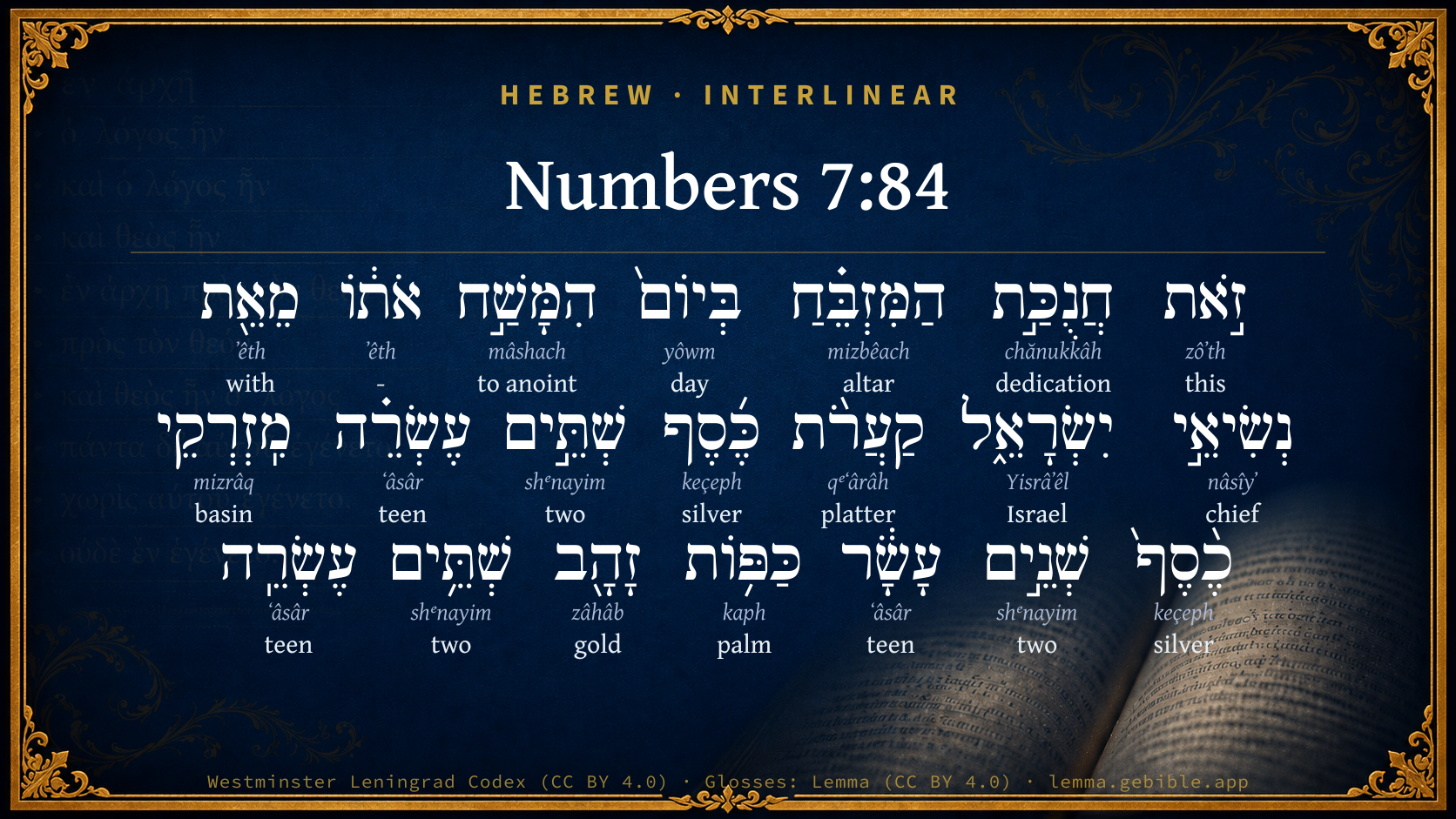
Hebrew (Westminster Leningrad Codex) Numbers 7:84 appears in the Hebrew Old Testament. The text above is from the Westminster Leningrad Codex. Each word links to its Strong’s number, a concise gloss, and parsing drawn from the Open Scriptures Hebrew Bible morphology. Click any word for its full Brown-Driver-Briggs (BDB) entry.
Download image
Cite this verse

Numbers 7:84 (World English Bible). Public Domain. Lemma interlinear Bible study tool, https://lemma.gebible.app/v/numbers/7/84.

Show BibTeX & RIS
BibTeX
RIS
English Translation
This was the dedication of the altar, on the day when it was anointed, by the princes of Israel: twelve silver platters, twelve silver bowls, twelve golden ladles;
World English Bible · Public Domain
Download a study sheet

One document with this verse’s original text, its word-by-word gloss line, the meaning frame, cross-references with their text, attributed commentary, and full source and license credits — printable, and it pastes into notes with its structure intact.

This verse Autodidact and up

Study sheet (.html) Plain text (.txt)

A passage Seminary Student

Up to 50 verses in one chapter. A passage sheet keeps up to 6 commentary sources and 12 cross-references per verse, in the order this page ranks them, and says so on the sheet whenever that leaves anything out. Ask for a single verse and you get the Autodidact verse sheet above.

Everything on this page stays free to read, with no account — the sheet is a download of what is already on screen, not access to it.

Want to remove ads? Support Godless Engineer
Compare translations 3

The same verse in 3 English versions, stacked beneath the original-language interlinear above. Click any original word for its lexicon entry.

Each is an independent rendering of the whole verse — the interlinear is not word-aligned to these translations.

Highlighted words mark where these versions differ — a whole-verse word diff, not a word-by-word alignment.

  • World English Bible Public Domain
    This was the dedication of the altar, on the day when it was anointed, by the princes of Israel: twelve silver platters, twelve silver bowls, twelve golden ladles;
  • King James Version Public Domain
    This was the dedication of the altar, in the day when it was anointed, by the princes of Israel: twelve chargers of silver, twelve silver bowls, twelve spoons of gold:
  • unfoldingWord Literal Text CC BY-SA 4.0
    This the dedication of the altar on the day of its being anointed from with the leaders of Israel: 12 dishes of silver, 12 basins of silver, 12 palm-sized bowls of gold.

unfoldingWord Literal Text — © unfoldingWord, licensed CC BY-SA 4.0. Word-aligned USFM3 via Door43 (git.door43.org/unfoldingWord/en_ult).

Versions to compare (up to 4)

3 of 4 selected

Show all 18 translations

Every available English version of this verse, each an independent rendering of the whole verse.

  • World English Bible Public Domain
    This was the dedication of the altar, on the day when it was anointed, by the princes of Israel: twelve silver platters, twelve silver bowls, twelve golden ladles;
  • Berean Standard Bible Public Domain
    So these were the offerings from the leaders of Israel for the dedication of the altar when it was anointed: twelve silver platters, twelve silver bowls, and twelve gold dishes.
  • Majority Standard Bible Public Domain
    So these were the offerings from the leaders of Israel for the dedication of the altar when it was anointed: twelve silver platters, twelve silver bowls, and twelve gold dishes.
  • King James Version Public Domain
    This was the dedication of the altar, in the day when it was anointed, by the princes of Israel: twelve chargers of silver, twelve silver bowls, twelve spoons of gold:
  • American Standard Version (1901) Public Domain
    This was the dedication of the altar, in the day when it was anointed, by the princes of Israel: twelve silver platters, twelve silver bowls, twelve golden spoons;
  • Revised Version (1885) Public Domain
    This was the dedication of the altar, in the day when it was anointed, by the princes of Israel: twelve silver chargers, twelve silver bowls, twelve golden spoons:
  • Geneva Bible (1599) Public Domain
    This was the dedication of the Altar by the princes of Israel, whe it was anointed: twelue chargers of siluer, twelue siluer boules, twelue incense cuppes of golde,
  • Douay-Rheims (1899) Public Domain
    An ox of the herd, and a ram, and a lamb of a year old for a holocaust:
  • Young's Literal Translation Public Domain
    This `is' the dedication of the altar, in the day of its being anointed, by the princes of Israel: twelve silver dishes, twelve silver bowls, twelve golden spoons;
  • Literal Standard Version CC BY-SA 4.0
    This [is] the dedication of the altar, in the day of its being anointed by the princes of Israel: twelve silver dishes, twelve silver bowls, twelve golden spoons;
  • Unlocked Literal Bible CC BY-SA 4.0
    The leaders of Israel set all these apart on the day that Moses anointed the altar. They set apart the twelve silver platters, twelve silver bowls, and twelve gold dishes.
  • unfoldingWord Literal Text CC BY-SA 4.0
    This the dedication of the altar on the day of its being anointed from with the leaders of Israel: 12 dishes of silver, 12 basins of silver, 12 palm-sized bowls of gold.
  • Darby Bible Public Domain
    This was the dedication-gift of the altar, on the day when it was anointed, from the princes of Israel: twelve silver dishes, twelve silver bowls, twelve cups of gold:
  • World Messianic Bible Public Domain
    This was the dedication offering of the altar, on the day when it was anointed, by the princes of Israel: twelve silver platters, twelve silver bowls, twelve golden ladles;
  • Webster's Bible Public Domain
    This was the dedication of the altar (in the day when it was anointed) by the princes of Israel: twelve chargers of silver, twelve silver bowls, twelve spoons of gold:
  • Free Bible Version CC BY-SA 4.0
    So on the day the altar was anointed, the dedicatory offerings brought by the Israelite leaders were twelve silver plates, twelve silver bowls, and twelve gold dishes.
  • Bible in Basic English Public Domain
    These were the offerings given for the altar by the chiefs of Israel, when the holy oil was put on it: twelve silver plates, twelve silver basins, twelve gold spoons;
  • JPS Tanakh (1917) Public Domain
    This was the dedication-offering of the altar, in the day when it was anointed, at the hands of the princes of Israel: twelve silver dishes, twelve silver basins, twelve golden pans;

Literal Standard Version (2020), Covenant Press — licensed CC BY-SA 4.0. Text via the HelloAO Bible API (eBible.org). Unlocked Literal Bible (unfoldingWord) — licensed CC BY-SA 4.0. Text via the HelloAO Bible API (eBible.org). unfoldingWord Literal Text — © unfoldingWord, licensed CC BY-SA 4.0. Word-aligned USFM3 via Door43 (git.door43.org/unfoldingWord/en_ult). Free Bible Version, Dr. Jonathan Gallagher — licensed CC BY-SA 4.0. Text via the HelloAO Bible API (eBible.org).

Word by word

More ways to search: Search by grammar → Find every occurrence → Compare this word →

Practice this passage: Drill this verse → Learn its vocabulary →

חֲנֻכַּ֣ת
chănukkâh
H2598
“dedication of”
Noun, Common, Feminine, Singular, Construct
Part of Speech
Noun
Type
Common
Gender
Feminine
Number
Singular
State
Construct
Full BDB Definition

Origin: from H2596

TWOT: TWOT- 693b

dedication, consecration
  1. זֹ֣את zôʼth H2063 “this” Pronoun, Demonstrative, Feminine, Singular
  2. הַמִּזְבֵּ֗חַ mizbêach H4196 “the · altar” Particle, Definite Article + Noun, Common, Masculine, Singular, Absolute
  3. בְּיוֹם֙ yôwm H3117 “in/at · day” Preposition + Noun, Common, Masculine, Singular, Absolute
  4. הִמָּשַׁ֣ח mâshach H4886 “to anoint” Verb, Niphal, Infinitive Construct
  5. אֹת֔וֹ ʼêth H853 “- · him” Particle, Direct Object + Suffix, Personal, 3rd Person, Masculine, Singular
  6. מֵאֵ֖ת ʼêth H854 “from · with” Preposition + Preposition
  7. נְשִׂיאֵ֣י nâsîyʼ H5387 “chiefs of” Noun, Common, Masculine, Plural, Construct
  8. יִשְׂרָאֵ֑ל Yisrâʼêl H3478 “Israel” Noun, Proper
  9. קַעֲרֹ֨ת qᵉʻârâh H7086 “platters of” Noun, Common, Feminine, Plural, Construct
  10. כֶּ֜סֶף keçeph H3701 “silver” Noun, Common, Masculine, Singular, Absolute
  11. שְׁתֵּ֣ים shᵉnayim H8147 “two” Adjective, Cardinal number, Feminine, Dual, Absolute
  12. עֶשְׂרֵ֗ה ʻâsâr H6240 “teen” Adjective, Cardinal number, Feminine, Singular, Absolute
  13. מִֽזְרְקֵי mizrâq H4219 “basins of” Noun, Common, Masculine, Plural, Construct
  14. כֶ֨סֶף֙ keçeph H3701 “silver” Noun, Common, Masculine, Singular, Absolute
  15. שְׁנֵ֣ים shᵉnayim H8147 “two” Adjective, Cardinal number, Masculine, Dual, Absolute
  16. עָשָׂ֔ר ʻâsâr H6240 “teen” Adjective, Cardinal number, Masculine, Singular, Absolute
  17. כַּפּ֥וֹת kaph H3709 “palms of” Noun, Common, Feminine, Plural, Construct
  18. זָהָ֖ב zâhâb H2091 “gold” Noun, Common, Masculine, Singular, Absolute
  19. שְׁתֵּ֥ים shᵉnayim H8147 “two” Adjective, Cardinal number, Feminine, Dual, Absolute
  20. עֶשְׂרֵֽה ʻâsâr H6240 “teen” Adjective, Cardinal number, Feminine, Singular, Absolute

About this verse

These counts appear in no published source. They are computed here, from the morphology-tagged text and Lemma’s own curated glosses. What Lemma adds →

21
words
16
distinct lemmas
Pentateuch
section

Notable vocabulary

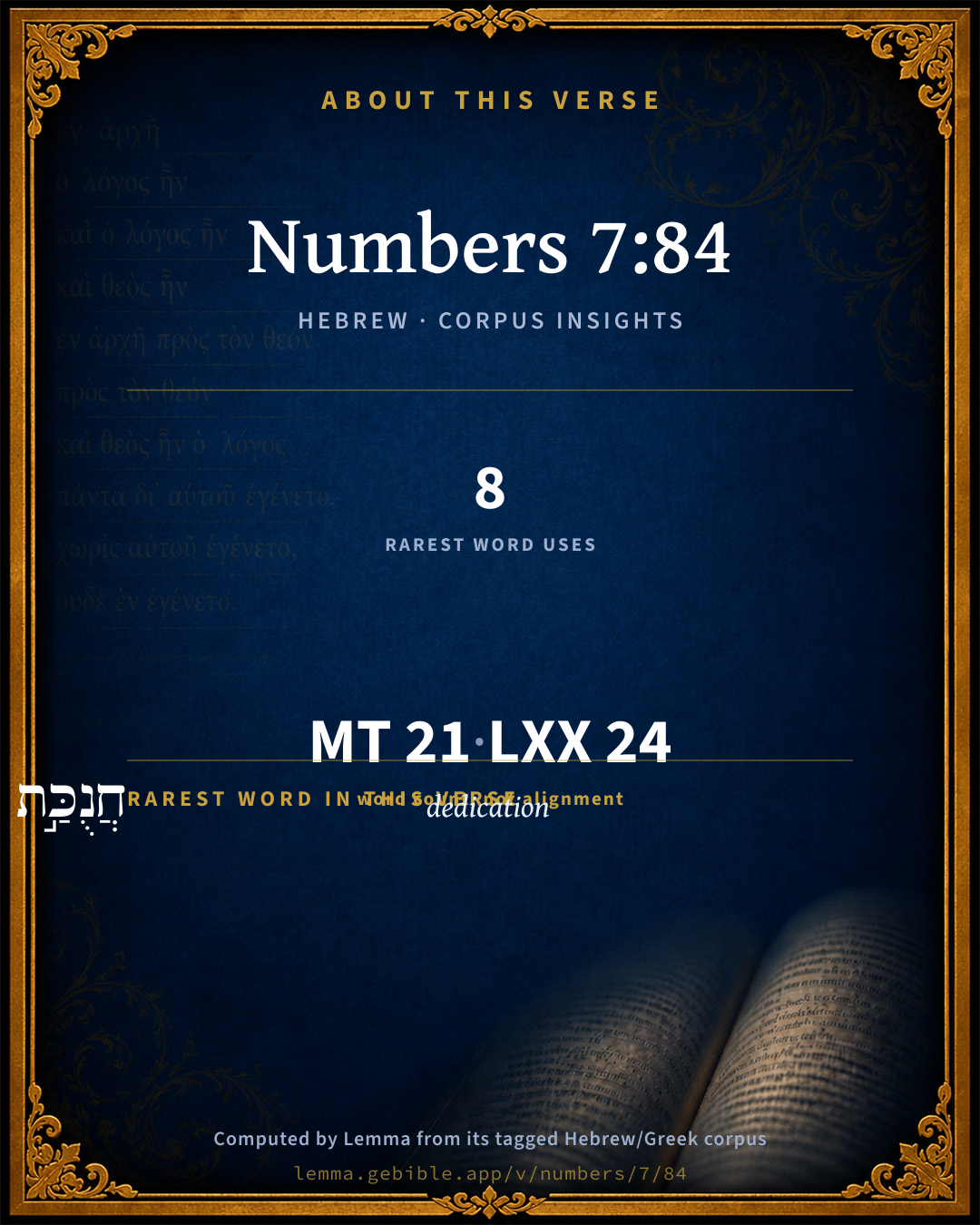
The rarest word here is חֲנֻכַּ֣ת dedication H2598 — appearing just 8 times in the whole Hebrew Bible.

Shared distinctive vocabulary

חֲנֻכַּ֣ת dedication H2598 occurs in 7 verses of the Hebrew Bible. Also found in:

Grammatical profile

  • 1 verb
  • 11 nouns
  • 6 adjectives
  • 1 pronoun
  • 1 preposition
  • 1 particle

Verb forms

  • הִמָּשַׁ֣ח Niphal · Infinitive Construct

Repetition

Words recur within this verse — often emphatic in Hebrew:

  • שְׁתֵּ֣ים two H8147 ×3
  • עֶשְׂרֵ֗ה teen H6240 ×3
  • כֶּ֜סֶף silver H3701 ×2

Hebrew & Septuagint length

In English translation the verse runs 28 words from the Hebrew and 32 from the Septuagint (LXX English) — closely comparable.

A rough comparison of the two English renderings, which tokenize alike — not a word-level alignment.

Word counts can differ between the Hebrew and the Greek without any difference in meaning — e.g. the Hebrew direct-object marker אֵת has no separate Greek word, and Greek often adds the article ὁ.

In the original languages it is 21 Hebrew tokens and 24 Greek tokens — but the two are counted differently (Hebrew bundles its prefixes and suffixes into one token; the Greek is in lemma form), so that isn’t a like-for-like length.

Cross-references

8

Topical passages linked to Numbers 7:84 in the Treasury of Scripture Knowledge — connected by theme and wording, ordered by reader-vote popularity; previews shown in the World English Bible.

  • Numbers 7:10 The princes gave offerings for the dedication of the altar in the day that it was anointed, even the princes gave their offerings before the altar.
  • Numbers 7:1 It happened on the day that Moses had finished setting up the tabernacle, and had anointed it and sanctified it, with all its furniture, and the altar with all its vessels, and had anointed and sanctified them;
  • 1 Chronicles 29:6–8 Then the princes of the fathers' [houses], and the princes of the tribes of Israel, and the captains of thousands and of hundreds, with the rulers over the king's work, offered willingly;
  • Ezra 2:68–69 Some of the heads of fathers' [houses], when they came to the house of Yahweh which is in Jerusalem, offered willingly for the house of God to set it up in its place:
  • Nehemiah 7:70–72 Some from among the heads of fathers' [houses] gave to the work. The governor gave to the treasury one thousand darics of gold, fifty basins, and five hundred thirty priests' garments.
  • Isaiah 60:6–10 The multitude of camels shall cover you, the dromedaries of Midian and Ephah; all they from Sheba shall come; they shall bring gold and frankincense, and shall proclaim the praises of Yahweh.
  • Hebrews 13:10 We have an altar from which those who serve the holy tabernacle have no right to eat.
  • Revelation 21:14 The wall of the city had twelve foundations, and on them twelve names of the twelve Apostles of the Lamb.

Cross-references courtesy of OpenBible.info (CC BY 4.0).

Hebrew and Greek witnesses Masoretic Hebrew ↔ Greek Septuagint

The same verse in the two great witnesses to the Old Testament, shown verse-for-verse.

These are two independent witnesses, not word-aligned to each other, and the Septuagint is shown in lemma (dictionary) form.

Hebrew Numbers 7:84 Masoretic · Westminster Leningrad Codex

זֹ֣את חֲנֻכַּ֣ת הַמִּזְבֵּ֗חַ בְּיוֹם֙ הִמָּשַׁ֣ח אֹת֔וֹ מֵאֵ֖ת נְשִׂיאֵ֣י יִשְׂרָאֵ֑ל קַעֲרֹ֨ת כֶּ֜סֶף שְׁתֵּ֣ים עֶשְׂרֵ֗ה מִֽזְרְקֵי כֶ֨סֶף֙ שְׁנֵ֣ים עָשָׂ֔ר כַּפּ֥וֹת זָהָ֖ב שְׁתֵּ֥ים עֶשְׂרֵֽה

This was the dedication of the altar, on the day when it was anointed, by the princes of Israel: twelve silver platters, twelve silver bowls, twelve golden ladles;

World English Bible · Public Domain

Greek LXX Numbers 7:84 Septuagint · lemma form

οὗτος ὁ ἐγκαινισμός ὁ θυσιαστήριον ὅς ἡμέρα χρίω αὐτός παρά ὁ ἄρχων ὁ υἱός ἰσραήλ τρυβλίον ἀργυροῦς δώδεκα φιάλη ἀργυροῦς δώδεκα θυΐσκη χρυσοῦς δώδεκα

This was the dedication of the altar in the day in which Moses anointed it, by the princes of the sons of Israel; twelve silver chargers, twelve silver bowls, twelve golden censers:

LXX2012 (modern English Septuagint) · Public Domain

Hebrew: Westminster Leningrad Codex (CC BY 4.0). Greek: Septuagint (public domain); English from LXX2012 (modern English Septuagint) (Public Domain). How the Septuagint differs from the Hebrew →

Targum (Aramaic paraphrase)

2

The Targum is the ancient Jewish Aramaic paraphrase of the Hebrew Scriptures — an interpretive translation, not the Hebrew text itself. Onkelos (literal) and Pseudo-Jonathan (expansive) render the Torah, and Jonathan the Prophets. Coverage is partial: where no permissively-licensed English translation exists for a verse, only the Aramaic is shown. This is verse-level text, not a word-by-word alignment to the Hebrew.

  1. Targum Onkelos Torah (Genesis–Deuteronomy)
    דָא חֲנֻכַּת מַדְבְּחָא בְּיוֹמָא דְרַבִּיוּ יָתֵהּ מִן רַבְרְבֵי יִשְׂרָאֵל מְגִיסֵי כַסְפָּא תַּרְתָּא עַשְׂרֵי מִזְרְקֵי כַסְפָּא תְּרֵין עֲשַׂר בָּזִיכֵי דְדַהֲבָא תַּרְתָּא עַשְׂרֵי

    (no public-domain English translation for this verse)

    Targum Onkelos — Aramaic: “Onkelos Genesis” (public domain); “Onkelos Exodus” (public domain); “Onkelos Leviticus” (public domain); “Onkelos Numbers” (public domain); “Onkelos Deuteronomy” (public domain). English: “Sefaria Community Translation” (CC0 1.0 (public-domain dedication)); “J.W. Etheridge. The Targums of Onkelos and Jonathan Ben Uzziel on the Pentateuch. London: Longmans, Green, 1862” (public domain). Text via Sefaria.

  2. Targum Pseudo-Jonathan Torah (Genesis–Deuteronomy)
    דָא חֲנֻכַּת רְבוּתֵיהּ דְמַדְבְּחָא בְּיוֹם דְרַבִּיוּ יָתֵיהּ מִנִכְסֵי רַבְרְבֵי יִשְרָאֵל פַּיְילֵי דִכְסַף תַּרְתֵּי סְרֵי כָּל קֳבֵיל תְּרֵיסַר שִׁבְטַיָא מַזִירְקֵי דִכְסַף תְּרֵיסַר כָּל קֳבֵיל נְשִיאָה דִבְנֵי יִשְרָאֵל בָּזִיכֵי דְדַהֲבָא תְּרֵיסַר כָּל קֳבֵיל תְּרֵיסַר מַזָלַיָא

    This is the oblation at the anointing of the altar, on the day that they anointed it, from the riches of the princes of Israel: twelve silver bowls, answering to the twelve tribes; twelve silver vases, answering to the twelve princes of the Beni Israel; twelve golden pans, answering to the twelve signs (mazalia).

    Targum Pseudo-Jonathan — Aramaic: “Targum Jonathan on Genesis” (public domain); “Targum Jonathan on Exodus” (public domain); “Targum Jonathan on Leviticus” (public domain); “Targum Jonathan on Numbers” (public domain); “Targum Jonathan on Deuteronomy” (public domain). English: “The Targum of Jonathan ben Uzziel, trans. J. W. Etheridge, London, 1862” (public domain). Text via Sefaria.

Commentary

Notes on Numbers 7:84 from classic Christian and Jewish commentators (each source and its license shown beneath its notes). The classic Christian expositions comment on the surrounding passage and are grouped to its opening verse, so a note may address several verses; the Jewish commentaries on the Tanakh (Rashi and others) are per-verse, so they appear only where the commentator wrote on this verse.

Lemma curates 59 commentaries, every one of them public domain or Creative Commons licensed, each selected and text-cleaned for this edition rather than reprinted as found. About our sources →

Tyndale Open Study Notes

Tyndale Open Resources

7:84-88 The gifts and offerings of each tribe having been described, this paragraph tabulates these expensive containers, their offerings and incense, and the sacrificial animals. These large and costly gifts and sacrifices drew attention to the importance of the altar, the Tabernacle, and the God who was served there. The sacrifices were required by law; the Hebrews presented the special gifts with a generous spirit.

Tyndale Open Study Notes — © Tyndale Open Resources, licensed CC BY-SA 4.0. Text via the HelloAO Bible API.

Geneva Bible (1599)

Geneva Bible translators

This was the offering of the princes, when Aaron did dedicate the Altar.

Geneva Bible (1599) marginal notes — public domain. Text via Bolls.life.

Jamieson, Fausset & Brown

Robert Jamieson, A. R. Fausset & David Brown

This was the dedication of the altar--The inspired historian here sums up the separate items detailed in the preceding narrative, and the aggregate amount is as follows: 12 silver chargers, each weighing 130 shekels equals 1560; 12 silver bowls, each 70 shekels equals 840: total weight. A silver charger at 130 shekels, reduced to troy weight, made 75 ounces, 9 pennyweights, 168.31 grains; and a silver bowl at 70 shekels amounts to 40 ounces, 12 pennyweights, 2121.31 grains. The total weight of the 12 chargers is therefore 905 ounces, 16 pennyweights, 33.11 grains; and that of the 12 bowls 487 ounces, 14 pennyweights, 204.31 grains; making the total weight of silver vessels 1393 ounces, 10 pennyweights, 237.31 grains; which at 5s. per ounce, is equal to £383 1s. 81/2d. The 12 golden spoons, allowing each to be 5 ounces, 16 pennyweights, 3.31 grains, amount to 69 ounces, 3 pennyweights, 135.31 grains, which, at £4 per ounce, is equal to £320 14s. 101/2d., and added to the amount of the silver, makes a total of £703 16s. 61/2d. Besides these the offerings comprised twelve bullocks, twelve rams, twelve lambs, twenty-four goats, sixty rams, sixty he-goats, sixty lambs--amounting in all to 240. So large a collection of cattle offered for sacrifice on one occasion proves both the large flocks of the Israelites and the abundance of pastures which were then, and still are, found in the valleys that lie between the Sinaitic Mountains. All travellers attest the luxuriant verdure of those extensive wadies; and that they were equally or still more rich in pasture anciently, is confirmed by the numerous flocks of the Amalekites, as well as of Nabal, which were fed in the wilderness of Paran (Sa1 15:9).

Jamieson, Fausset & Brown — Commentary Critical and Explanatory on the Whole Bible (1871) — public domain (CC PDM 1.0). Text via the HelloAO Bible API.

Adam Clarke's Commentary

Verse 84. This was the dedication of the altar, in the day, c.] Meaning here the time in which it was dedicated for as each tribe had a whole day for its representative or prince to present the offerings it had provided, consequently the dedication, in which each had his day, must have lasted twelve days: the words therefore, in this text, refer to the last day or twelfth, in which this dedication was completed.

Adam Clarke's Commentary on the Bible (1810–1826) — public domain. Text from a community e-Sword/MySword module.

Albert Barnes' Notes on the Bible

The aggregate worth, by weight, of the whole of the offerings was about 438 British pounds: But the real worth of such a sum, when measured by the prices of clothing and food at that time, must have been vastly greater.

Albert Barnes' Notes on the Bible (1834–1885) — public domain. Text from a community e-Sword/MySword module.

Matthew Poole's English Annotations

When it was anointed: this is again repeated, to show why it is called the dedication of the altar. because it was the first offering made by any particular persons or tribes.

Matthew Poole's English Annotations on the Holy Bible (1683–1685) — public domain. Text from a community e-Sword/MySword module.

The Pulpit Commentary

This was the dedication of the altar. The sacrificial gifts for present sacrifice, and for the use of the altar, were its dedication.

The Pulpit Commentary (1880–1919), ed. H.D.M. Spence-Jones & Joseph S. Exell — public domain. Text from a community e-Sword module.

unfoldingWord translationNotes

Door43 World Missions Community

set all these apart

The phrase "set apart" means to be dedicated to a specific purpose. In this case, the offerings were dedicated to Yahweh. (See: Idiom)

on the day that Moses anointed the altar

Here the word "day" refers to a general period of time. The leaders of Israel dedicated these things over the course of 12 days. AT: "when Moses anointed the altar"

Each silver platter weighed 130 shekels

If necessary, these weights can be written in modern measurements. See how you translated this same weight in Numbers 7:13. AT: "each silver platter weighed nearly one and a half kilograms" or "each silver platter weighed one kilogram and 430 grams" (See: Biblical Weight and Numbers)

each bowl weighed seventy shekels

"each bowl weighted 70 shekels." If necessary, these weight can be written in modern measurements. See how you translated this same weight in Numbers 7:13. AT: "each bowl weighed nearly eight tenths of a kilogram" or "each bowl weighed 770 grams" (See: Biblical Weight and Numbers)

2,400 shekels

"two thousand four hundred shekels" or "twenty-four hundred shekels" (See: Numbers)

by the standard weight of the sanctuary shekel

There were shekels of different weights. This is the one that people had to use in the sanctuary of the sacred tent. See how you translated this phrase in Numbers 7:13. AT: "measured by the standard weights used in the sanctuary" (See: Biblical Weight)

All the silver vessels weighed ... All the gold dishes weighed

"All the silver vessels together weighed ... All the gold dishes together weighed"

the silver vessels

This refers to all of the offerings that were made of silver, both the platters and the bowls.

Each of the twelve gold dishes ... weighed ten shekels

"Each of the 12 gold dishes ... weighed 10 shekels." If necessary, this can be written in modern measurements. See how you translated these same weights in Numbers 7:14. AT: "Each of the 12 gold dishes ... weighed one tenth of a kilogram" or "Each of the 12 gold dishes ... weighed 110 grams" (See: Biblical Weight and Numbers)

120 shekels

"one hundred and twenty shekels" (See: Numbers)

translationWords

Israel

day

Moses

anoint

altar

silver

gold

sanctuary

incense

unfoldingWord translationNotes — © Distant Shores Media and the Door43 World Missions Community, licensed CC BY-SA 4.0. Source: git.door43.org/Door43/en_tn.

Rashi

Rabbi Shlomo Yitzchaki (Rashi)

ביום המשח אתו [THIS WAS THE DEDICATION OFFERING OF THE ALTAR] IN THE DAY WHEN IT WAS ANOINTED — This implies that on the very same day that it was anointed an offering was brought; but how, then, can I explain, (v. 88) “[This was dedication of the altar] after that it was anointed”? As intimating that it was first anointed and afterwards — but still on the same day — the offering was brought. Or, perhaps, these words אחרי המשח mean “some time (i.e. many days) after it was anointed”, and the phrase here ביום המשח אתו is merely intended to intimate that it was anointed during the day-time (and not at night)! This cannot be so, because when it states, (Leviticus 7:36) “In the day that he anointed them (Aaron and his sons)” we learn that it (the altar) was anointed during the day-time. What, then, must be the meaning of ביום המשח here? What we first suggested — that on the very same day that it was anointed the offering was brought (cf. Sifrei Bamidbar 53).

קערת כסף שתים עשרה TWELVE CHARGERS OF SILVER — This intimates: these are the same chargers which they had brought as free-will gifts and nothing to disqualify them had happened to them in the meantime (Sifrei Bamidbar 53).

Rashi on the Tanakh — English translations: “The Judaica Press complete Tanach with Rashi, translated by A. J. Rosenberg” (CC BY 4.0); “Pentateuch with Rashi's commentary by M. Rosenbaum and A.M. Silbermann, 1929-1934” (public domain); “The Metsudah Tanach series, Lakewood, N.J” (CC BY 4.0); and “The Book of Joshua, Metsudah Publications, 1997” (CC BY 4.0). Text via Sefaria.

Lesson kit

Teaching starters — assembled from the data on this page, not authored interpretation. Every prompt links to the verse data it draws on. Edit before teaching.

Numbers, in the Pentateuch, opens this verse with 21 words (16 distinct Hebrew lemmas). Its most distinctive word is chănukkâh (“dedication”). A historical commentator’s framing appears above. Read the whole chapter for the surrounding context.

Discussion questions

  1. How does “dedication” (chănukkâh) shape what this verse is saying?
  2. How does Numbers 7:10, which shares the word «dedication», read alongside this verse?
  3. What does the repetition of “two” (3× in this one verse) do in this verse?
  4. The translations on this page render this verse differently — a whole-verse word diff, not a word-by-word alignment. What might account for the different wordings?
  5. «הִמָּשַׁ֣ח» is a Niphal Infinitive Construct verb. How does that grammatical form shape the action described?
  6. Compare how Tyndale Open Study Notes and Geneva Bible (1599) read this verse. Where do they agree or differ?

Things to notice

Reading settings

Reading text

Shown beneath each verse's original-language words.

Old Testament
Old Testament edition

Read the OT as the Masoretic Hebrew (MT) or the Greek Septuagint (LXX).

English shown for the Greek Septuagint (in the Hebrew ↔ Greek comparison).

Comparing translations? Open the Compare panel on any verse page to stack up to four side by side.