Leviticus 14:32

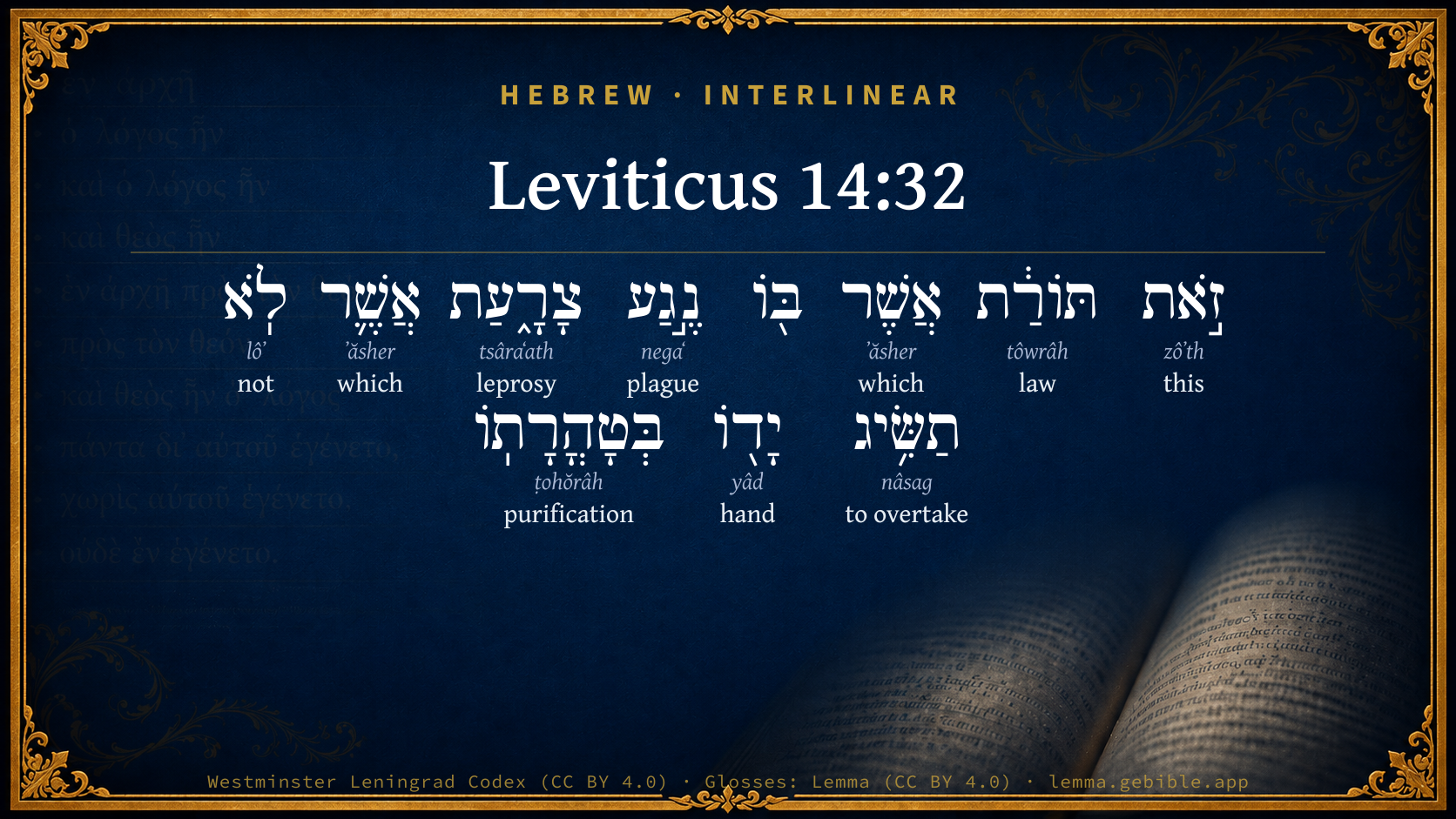
Hebrew (Westminster Leningrad Codex) Leviticus 14:32 appears in the Hebrew Old Testament. The text above is from the Westminster Leningrad Codex. Each word links to its Strong’s number, a concise gloss, and parsing drawn from the Open Scriptures Hebrew Bible morphology. Click any word for its full Brown-Driver-Briggs (BDB) entry.
Download image
Cite this verse

Leviticus 14:32 (World English Bible). Public Domain. Lemma interlinear Bible study tool, https://lemma.gebible.app/v/leviticus/14/32.

Show BibTeX & RIS
BibTeX
RIS
English Translation
This is the law for him in whom is the plague of leprosy, who is not able to afford the sacrifice for his cleansing.
World English Bible · Public Domain
Download a study sheet

One document with this verse’s original text, its word-by-word gloss line, the meaning frame, cross-references with their text, attributed commentary, and full source and license credits — printable, and it pastes into notes with its structure intact.

This verse Autodidact and up

Study sheet (.html) Plain text (.txt)

A passage Seminary Student

Up to 50 verses in one chapter. A passage sheet keeps up to 6 commentary sources and 12 cross-references per verse, in the order this page ranks them, and says so on the sheet whenever that leaves anything out. Ask for a single verse and you get the Autodidact verse sheet above.

Everything on this page stays free to read, with no account — the sheet is a download of what is already on screen, not access to it.

Want to remove ads? Support Godless Engineer
Compare translations 3

The same verse in 3 English versions, stacked beneath the original-language interlinear above. Click any original word for its lexicon entry.

Each is an independent rendering of the whole verse — the interlinear is not word-aligned to these translations.

Highlighted words mark where these versions differ — a whole-verse word diff, not a word-by-word alignment.

  • World English Bible Public Domain
    This is the law for him in whom is the plague of leprosy, who is not able to afford the sacrifice for his cleansing.
  • King James Version Public Domain
    This is the law of him in whom is the plague of leprosy, whose hand is not able to get that which pertaineth to his cleansing.
  • unfoldingWord Literal Text CC BY-SA 4.0
    This the law of whoever on him an infection of skin disease whose hand does not reach his cleansing.”

unfoldingWord Literal Text — © unfoldingWord, licensed CC BY-SA 4.0. Word-aligned USFM3 via Door43 (git.door43.org/unfoldingWord/en_ult).

Versions to compare (up to 4)

3 of 4 selected

Show all 18 translations

Every available English version of this verse, each an independent rendering of the whole verse.

  • World English Bible Public Domain
    This is the law for him in whom is the plague of leprosy, who is not able to afford the sacrifice for his cleansing.
  • Berean Standard Bible Public Domain
    This is the law for someone who has a skin disease and cannot afford the cost of his cleansing.”
  • Majority Standard Bible Public Domain
    This is the law for someone who has a skin disease and cannot afford the cost of his cleansing.”
  • King James Version Public Domain
    This is the law of him in whom is the plague of leprosy, whose hand is not able to get that which pertaineth to his cleansing.
  • American Standard Version (1901) Public Domain
    This is the law of him in whom is the plague of leprosy, who is not able to get `that which pertaineth' to his cleansing.
  • Revised Version (1885) Public Domain
    This is the law of him in whom is the plague of leprosy, who is not able to get that which pertaineth to his cleansing.
  • Geneva Bible (1599) Public Domain
    This is the lawe of him which hath the plague of leprosie, who is not able in his clensing to offer the whole.
  • Douay-Rheims (1899) Public Domain
    This is the sacrifice of a leper, that is not able to have all things that appertain to his cleansing.
  • Young's Literal Translation Public Domain
    This `is' a law of him in whom `is' a plague of leprosy, whose hand reacheth not to his cleansing.'
  • Literal Standard Version CC BY-SA 4.0
    This [is] a law of him in whom [is] a plague of leprosy, whose hand does not reach to his cleansing.”
  • Unlocked Literal Bible CC BY-SA 4.0
    This is the law for a person in whom there is an infectious skin disease, who is not able to afford the standard offerings for his cleansing.”
  • unfoldingWord Literal Text CC BY-SA 4.0
    This the law of whoever on him an infection of skin disease whose hand does not reach his cleansing.”
  • Darby Bible Public Domain
    This is the law for him in whom is the sore of leprosy, whose hand cannot get what is [regularly prescribed] in his cleansing.
  • World Messianic Bible Public Domain
    This is the law for him in whom is the plague of leprosy, who is not able to afford the sacrifice for his cleansing.
  • Webster's Bible Public Domain
    This is the law of him in whom is the plague of leprosy, whose hand is not able to get that which pertaineth to his cleansing.
  • Free Bible Version CC BY-SA 4.0
    These are the regulations for those who have a skin disease and can't afford the usual offerings to make people clean.”
  • Bible in Basic English Public Domain
    This is the law for the man who has the disease of the leper on him, and who is not able to get that which is necessary for making himself clean.
  • JPS Tanakh (1917) Public Domain
    This is the law of him in whom is the plague of leprosy, whose means suffice not for that which pertaineth to his cleansing.

Literal Standard Version (2020), Covenant Press — licensed CC BY-SA 4.0. Text via the HelloAO Bible API (eBible.org). Unlocked Literal Bible (unfoldingWord) — licensed CC BY-SA 4.0. Text via the HelloAO Bible API (eBible.org). unfoldingWord Literal Text — © unfoldingWord, licensed CC BY-SA 4.0. Word-aligned USFM3 via Door43 (git.door43.org/unfoldingWord/en_ult). Free Bible Version, Dr. Jonathan Gallagher — licensed CC BY-SA 4.0. Text via the HelloAO Bible API (eBible.org).

Word by word

More ways to search: Search by grammar → Find every occurrence → Compare this word →

Practice this passage: Drill this verse → Learn its vocabulary →

בְּטָהֳרָתֽוֹ
ṭohŏrâh
H2893
“in/at · purification · his”
Preposition + Noun, Common, Both, Singular, Construct + Suffix, Personal, 3rd Person, Masculine, Singular
Part of Speech
Preposition + Noun
Type
Common
Gender
Both
Number
Singular
State
Construct
Full BDB Definition

Origin: from H2892

TWOT: 792c

purifying, cleansing, purification, purity, cleanness - purifying, menstruation - cleansing, purification
  1. זֹ֣את zôʼth H2063 “this” Pronoun, Demonstrative, Feminine, Singular
  2. תּוֹרַ֔ת tôwrâh H8451 “law of” Noun, Common, Feminine, Singular, Construct
  3. אֲשֶׁר ʼăsher H834 “which” Particle, Relative
  4. נֶ֣גַע negaʻ H5061 “plague of” Noun, Common, Masculine, Singular, Construct
  5. צָרָ֑עַת tsâraʻath H6883 “leprosy” Noun, Common, Feminine, Singular, Absolute
  6. אֲשֶׁ֛ר ʼăsher H834 “which” Particle, Relative
  7. לֹֽא lôʼ H3808 “not” Particle, Negative
  8. תַשִּׂ֥יג nâsag H5381 “to overtake” Verb, Hiphil, Imperfect, 3rd Person, Feminine, Singular
  9. יָד֖וֹ yâd H3027 “hand · his” Noun, Common, Both, Singular, Construct + Suffix, Personal, 3rd Person, Masculine, Singular

About this verse

These counts appear in no published source. They are computed here, from the morphology-tagged text and Lemma’s own curated glosses. What Lemma adds →

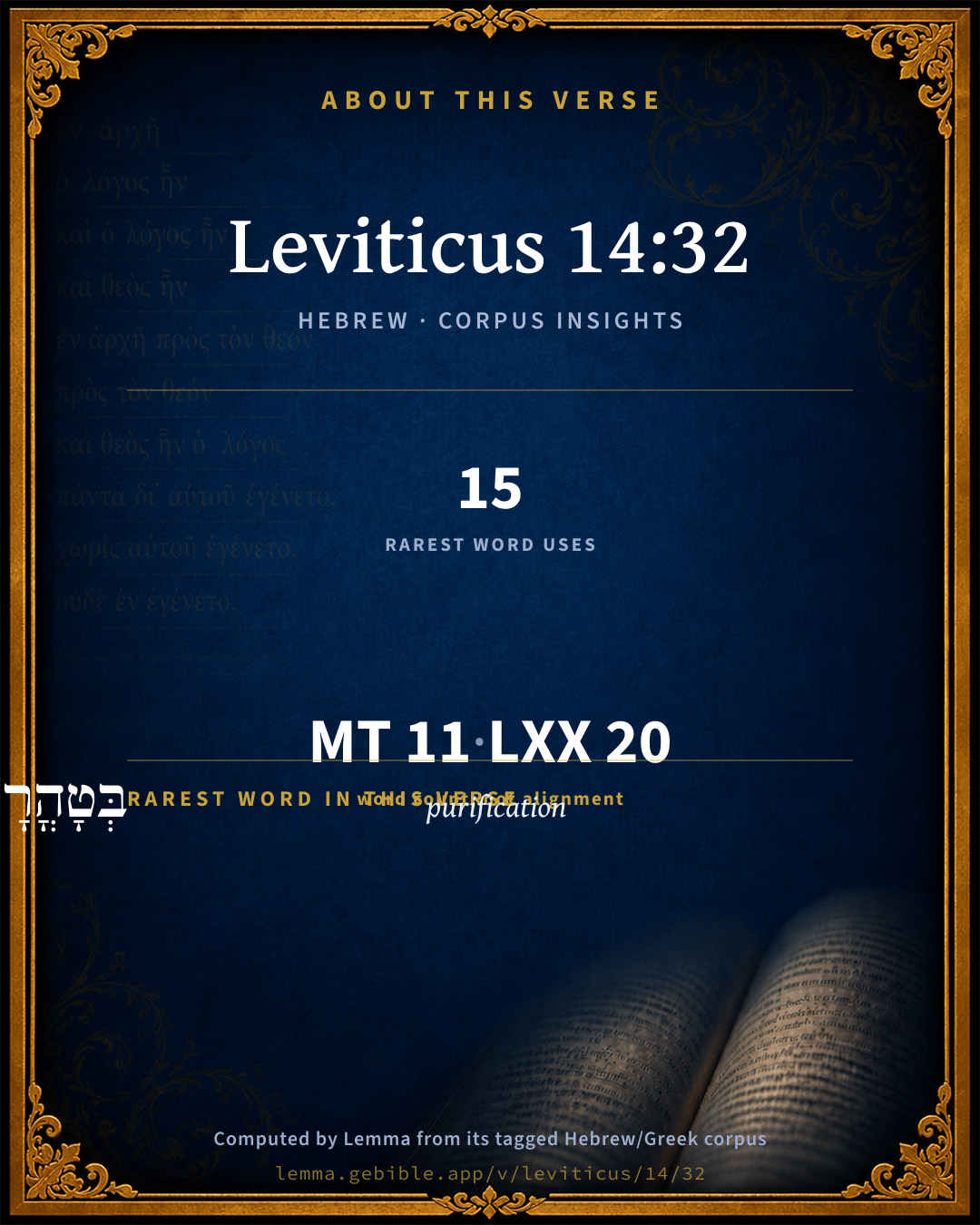
11
words
9
distinct lemmas
Pentateuch
section

Notable vocabulary

The rarest word here is בְּטָהֳרָתֽוֹ purification H2893 — appearing just 15 times in the whole Hebrew Bible.

Shared distinctive vocabulary

בְּטָהֳרָתֽוֹ purification H2893 occurs in 14 verses of the Hebrew Bible. Also found in:

Grammatical profile

  • 1 verb
  • 5 nouns
  • 1 pronoun
  • 1 preposition
  • 3 particles

Verb forms

  • תַשִּׂ֥יג Hiphil · Imperfect

Repetition

A word recurs within this verse — often emphatic in Hebrew:

  • אֲשֶׁר which H834 ×2

Hebrew & Septuagint length

In English translation the verse runs 24 words from the Hebrew and 22 from the Septuagint (LXX English) — closely comparable.

A rough comparison of the two English renderings, which tokenize alike — not a word-level alignment.

Word counts can differ between the Hebrew and the Greek without any difference in meaning — e.g. the Hebrew direct-object marker אֵת has no separate Greek word, and Greek often adds the article ὁ.

In the original languages it is 11 Hebrew tokens and 20 Greek tokens — but the two are counted differently (Hebrew bundles its prefixes and suffixes into one token; the Greek is in lemma form), so that isn’t a like-for-like length.

Cross-references

9

Topical passages linked to Leviticus 14:32 in the Treasury of Scripture Knowledge — connected by theme and wording, ordered by reader-vote popularity; previews shown in the World English Bible.

  • Leviticus 14:10 "On the eighth day he shall take two male lambs without blemish, and one ewe lamb a year old without blemish, and three tenths of an ephah of fine flour for a meal offering, mingled with oil, and one log of oil.
  • Leviticus 14:21 "If he is poor, and can't afford so much, then he shall take one male lamb for a trespass offering to be waved, to make atonement for him, and one tenth of an ephah of fine flour mingled with oil for a meal offering, and a log of oil;
  • Leviticus 13:59 This is the law of the plague of mildew in a garment of wool or linen, either in the warp, or the woof, or in anything of skin, to pronounce it clean, or to pronounce it unclean.
  • Leviticus 14:2 "This shall be the law of the leper in the day of his cleansing. He shall be brought to the priest,
  • Leviticus 14:54–57 This is the law for any plague of leprosy, and for an itch,
  • Psalms 72:12–14 For he will deliver the needy when he cries; The poor, who has no helper.
  • Psalms 136:23 Who remembered us in our low estate; For his loving kindness endures forever;
  • Matthew 11:5 the blind receive their sight, the lame walk, the lepers are cleansed, the deaf hear, the dead are raised up, and the poor have good news preached to them.
  • 1 Corinthians 1:27–28 but God chose the foolish things of the world that he might put to shame those who are wise. God chose the weak things of the world, that he might put to shame the things that are strong;

Cross-references courtesy of OpenBible.info (CC BY 4.0).

Hebrew and Greek witnesses Masoretic Hebrew ↔ Greek Septuagint

The same verse in the two great witnesses to the Old Testament, shown verse-for-verse.

These are two independent witnesses, not word-aligned to each other, and the Septuagint is shown in lemma (dictionary) form.

Hebrew Leviticus 14:32 Masoretic · Westminster Leningrad Codex

זֹ֣את תּוֹרַ֔ת אֲשֶׁר בּ֖וֹ נֶ֣גַע צָרָ֑עַת אֲשֶׁ֛ר לֹֽא תַשִּׂ֥יג יָד֖וֹ בְּטָהֳרָתֽוֹ

This is the law for him in whom is the plague of leprosy, who is not able to afford the sacrifice for his cleansing.

World English Bible · Public Domain

Greek LXX Leviticus 14:32 Septuagint · lemma form

οὗτος ὁ νόμος ἐν ὅς εἰμί ὁ ἁφή ὁ λέπρα καί ὁ μή εὑρίσκω ὁ χείρ εἰς ὁ καθαρισμός αὐτός

This is the law for him in whom is the plague of leprosy, and who can’t afford the offerings for his purification.

LXX2012 (modern English Septuagint) · Public Domain

Hebrew: Westminster Leningrad Codex (CC BY 4.0). Greek: Septuagint (public domain); English from LXX2012 (modern English Septuagint) (Public Domain). How the Septuagint differs from the Hebrew →

Targum (Aramaic paraphrase)

2

The Targum is the ancient Jewish Aramaic paraphrase of the Hebrew Scriptures — an interpretive translation, not the Hebrew text itself. Onkelos (literal) and Pseudo-Jonathan (expansive) render the Torah, and Jonathan the Prophets. Coverage is partial: where no permissively-licensed English translation exists for a verse, only the Aramaic is shown. This is verse-level text, not a word-by-word alignment to the Hebrew.

  1. Targum Onkelos Torah (Genesis–Deuteronomy)
    דָא אוֹרַיְתָא דִי בֵהּ מַכְתַּשׁ סְגִירוּ דִי לָא תַדְבֵּק יְדֵהּ בְּדָכוּתֵהּ

    (no public-domain English translation for this verse)

    Targum Onkelos — Aramaic: “Onkelos Genesis” (public domain); “Onkelos Exodus” (public domain); “Onkelos Leviticus” (public domain); “Onkelos Numbers” (public domain); “Onkelos Deuteronomy” (public domain). English: “Sefaria Community Translation” (CC0 1.0 (public-domain dedication)); “J.W. Etheridge. The Targums of Onkelos and Jonathan Ben Uzziel on the Pentateuch. London: Longmans, Green, 1862” (public domain). Text via Sefaria.

  2. Targum Pseudo-Jonathan Torah (Genesis–Deuteronomy)
    דָא תִּיהֲוֵי גְזֵירַת אַחֲוָיַית דְבֵיהּ מַכְתַּשׁ צוֹרַעְתָּא אִין לָא סְפִּיקַת בֵּין יְדוֹי לְמַיְיתַיָא מִן קָרְבָּנַיָא רַבְרְבַיָא יַיְתֵי מִן קָרְבָּנַיָא קְלִילַיָיא הָאִילֵין דְמִיפַרְשִׁין הָכָא לְיוֹם דְכוּתֵיהּ

    This is the decree of instruction for him in whom is the plague of leprosy. If there be not sufficiency in his hands to bring the greater oblations, let him bring of these oblations which are easier (and) which are here explained, on the day of his purification.

    Targum Pseudo-Jonathan — Aramaic: “Targum Jonathan on Genesis” (public domain); “Targum Jonathan on Exodus” (public domain); “Targum Jonathan on Leviticus” (public domain); “Targum Jonathan on Numbers” (public domain); “Targum Jonathan on Deuteronomy” (public domain). English: “The Targum of Jonathan ben Uzziel, trans. J. W. Etheridge, London, 1862” (public domain). Text via Sefaria.

Commentary

Notes on Leviticus 14:32 from classic Christian and Jewish commentators (each source and its license shown beneath its notes). The classic Christian expositions comment on the surrounding passage and are grouped to its opening verse, so a note may address several verses; the Jewish commentaries on the Tanakh (Rashi and others) are per-verse, so they appear only where the commentator wrote on this verse.

Lemma curates 59 commentaries, every one of them public domain or Creative Commons licensed, each selected and text-cleaned for this edition rather than reprinted as found. About our sources →

Trapp's Complete Commentary

John Trapp

Lev 14:32 This [is] the law [of him] in whom [is] the plague of leprosy, whose hand is not able to get [that which pertaineth] to his cleansing.

Ver. 32. Whose hand is not able to get.] This is often urged, to show that the best that can be got must not be thought too good for God: and that if through carelessness or niggardice men do not their utmost, that is a just exception.

John Trapp, A Commentary or Exposition upon All the Books of the Old and New Testament (1647–1656) — public domain. Text from a community e-Sword module.

Geneva Bible (1599)

Geneva Bible translators

This order is appointed for the poor man.

Geneva Bible (1599) marginal notes — public domain. Text via Bolls.life.

Ellicott's Commentary for English Readers

(32) This is the law of him . . . whose hand is not able to get.—That is, that which is laid down in Lev_14:21-31 constitutes the law for the restored leper who is too poor to offer the sacrifices prescribed in Lev_14:10-20.

A Bible Commentary for English Readers, edited by Charles John Ellicott (1878–1897) — public domain. Text from a community e-Sword module.

John Gill's Exposition

Then the priest shall command that they empty the house,.... Clear it of all persons and things; everybody was obliged to go out of it; and all the furniture of it, all the household goods in it, were to be removed from it:

before the priest go into it to see the plague, that all that is in the house be not made clean; as would be the case should the priest view it, and pronounce it unclean before the removal of them; agreeably to which is the Jewish tradition (k), before a priest comes to see the plague, not anything in the house is defiled; but after he is come to see it, even bundles of sticks, and of reeds, are defiled, which are not reckoned under the uncleanness to be removed: so that this was a kindness to the owner of the house, that his loss might not be so great as it otherwise would be, if he did not take care to get his goods out previous to the inspection of the priest:

and afterward the priest shall go in to see the house; to examine it, whether the signs of leprosy are in it.

(k) Misn. Nagaim, c. 12. sect. 5.

John Gill's Exposition of the Whole Bible (1746–1763) — public domain (CC PDM 1.0). Text via the HelloAO Bible API.

Lesson kit

Teaching starters — assembled from the data on this page, not authored interpretation. Every prompt links to the verse data it draws on. Edit before teaching.

Leviticus, in the Pentateuch, opens this verse with 11 words (9 distinct Hebrew lemmas). Its most distinctive word is ṭohŏrâh (“purification”). A historical commentator’s framing appears above. Read the whole chapter for the surrounding context.

Discussion questions

  1. What does “purification” (ṭohŏrâh) contribute to the verse as a whole?
  2. Leviticus 12:4 shares the word «purification» with this verse. How do the two illuminate each other?
  3. “which” occurs 2× in this one verse. What is the effect of the repetition?
  4. The translations on this page render this verse differently — a whole-verse word diff, not a word-by-word alignment. What might account for the different wordings?
  5. The verb «תַשִּׂ֥יג» is Hiphil Imperfect. How does its form color the action?
  6. Reading how Trapp's Complete Commentary and Geneva Bible (1599) read this verse, where do the two commentators agree and where do they part?

Things to notice

Reading settings

Reading text

Shown beneath each verse's original-language words.

Old Testament
Old Testament edition

Read the OT as the Masoretic Hebrew (MT) or the Greek Septuagint (LXX).

English shown for the Greek Septuagint (in the Hebrew ↔ Greek comparison).

Comparing translations? Open the Compare panel on any verse page to stack up to four side by side.