Joshua 19:31

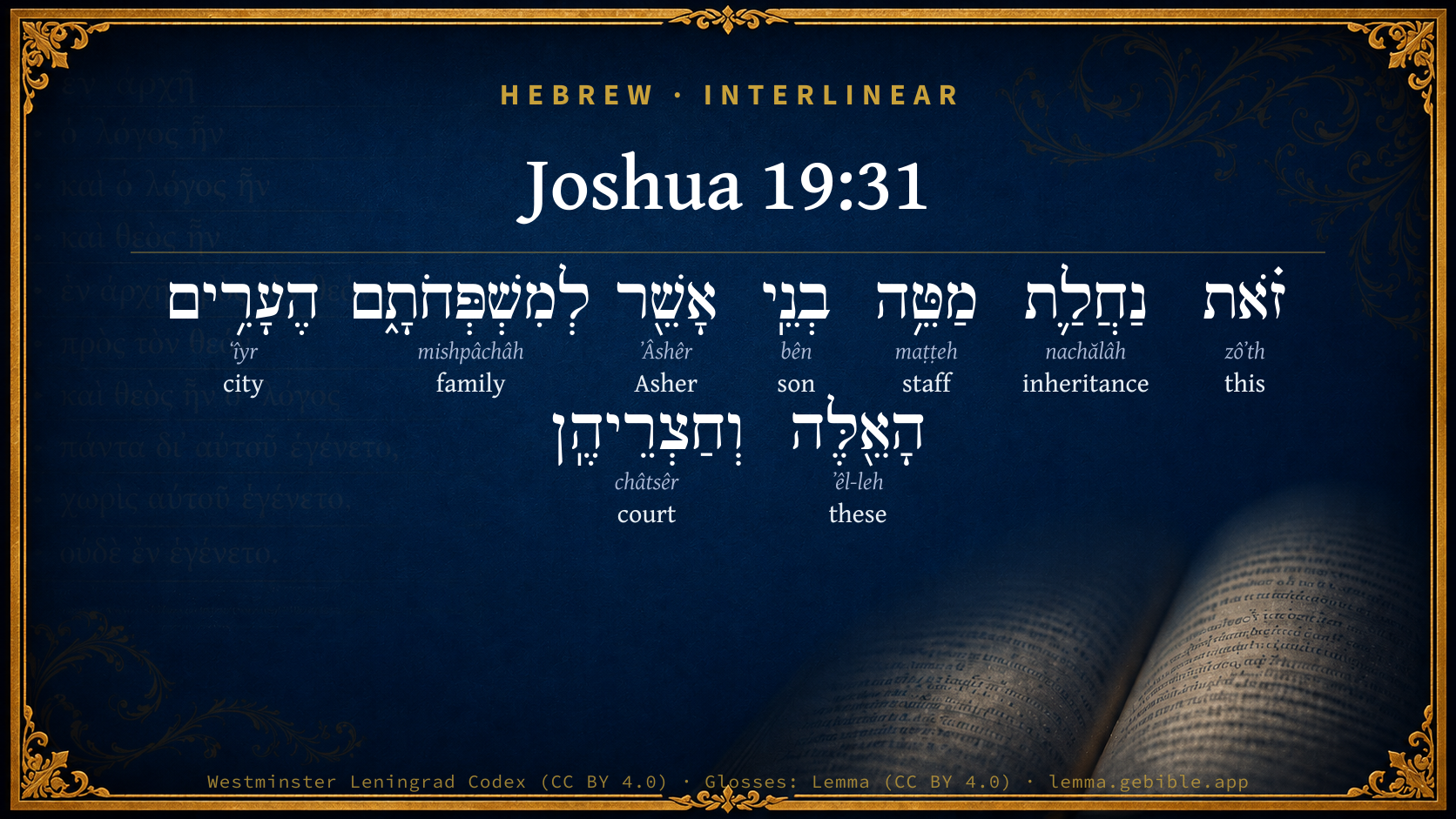
Hebrew (Westminster Leningrad Codex) Joshua 19:31 appears in the Hebrew Old Testament. The text above is from the Westminster Leningrad Codex. Each word links to its Strong’s number, a concise gloss, and parsing drawn from the Open Scriptures Hebrew Bible morphology. Click any word for its full Brown-Driver-Briggs (BDB) entry.
Download image
Cite this verse

Joshua 19:31 (World English Bible). Public Domain. Lemma interlinear Bible study tool, https://lemma.gebible.app/v/joshua/19/31.

Show BibTeX & RIS
BibTeX
RIS
English Translation
This is the inheritance of the tribe of the children of Asher according to their families, these cities with their villages.
World English Bible · Public Domain
Download a study sheet

One document with this verse’s original text, its word-by-word gloss line, the meaning frame, cross-references with their text, attributed commentary, and full source and license credits — printable, and it pastes into notes with its structure intact.

This verse Autodidact and up

Study sheet (.html) Plain text (.txt)

A passage Seminary Student

Up to 50 verses in one chapter. A passage sheet keeps up to 6 commentary sources and 12 cross-references per verse, in the order this page ranks them, and says so on the sheet whenever that leaves anything out. Ask for a single verse and you get the Autodidact verse sheet above.

Everything on this page stays free to read, with no account — the sheet is a download of what is already on screen, not access to it.

Want to remove ads? Support Godless Engineer
Compare translations 3

The same verse in 3 English versions, stacked beneath the original-language interlinear above. Click any original word for its lexicon entry.

Each is an independent rendering of the whole verse — the interlinear is not word-aligned to these translations.

Highlighted words mark where these versions differ — a whole-verse word diff, not a word-by-word alignment.

  • World English Bible Public Domain
    This is the inheritance of the tribe of the children of Asher according to their families, these cities with their villages.
  • King James Version Public Domain
    This is the inheritance of the tribe of the children of Asher according to their families, these cities with their villages.
  • unfoldingWord Literal Text CC BY-SA 4.0
    This was the inheritance of the tribe of the sons of Asher according to their clans, these cities, and their villages.

unfoldingWord Literal Text — © unfoldingWord, licensed CC BY-SA 4.0. Word-aligned USFM3 via Door43 (git.door43.org/unfoldingWord/en_ult).

Versions to compare (up to 4)

3 of 4 selected

Show all 18 translations

Every available English version of this verse, each an independent rendering of the whole verse.

  • World English Bible Public Domain
    This is the inheritance of the tribe of the children of Asher according to their families, these cities with their villages.
  • Berean Standard Bible Public Domain
    This was the inheritance of the clans of the tribe of Asher, including these cities and their villages.
  • Majority Standard Bible Public Domain
    This was the inheritance of the clans of the tribe of Asher, including these cities and their villages.
  • King James Version Public Domain
    This is the inheritance of the tribe of the children of Asher according to their families, these cities with their villages.
  • American Standard Version (1901) Public Domain
    This is the inheritance of the tribe of the children of Asher according to their families, these cities with their villages.
  • Revised Version (1885) Public Domain
    This is the inheritance of the tribe of the children of Asher according to their families, these cities with their villages.
  • Geneva Bible (1599) Public Domain
    This is the inheritance of the tribe of the children of Asher according to their families: that is, these cities and their villages.
  • Douay-Rheims (1899) Public Domain
    This is the possession of the children of Aser by their kindreds, and the cities and their villages.
  • Young's Literal Translation Public Domain
    This `is' the inheritance of the tribe of the sons of Asher, for their families, these cities and their villages.
  • Literal Standard Version CC BY-SA 4.0
    This [is] the inheritance of the tribe of the sons of Asher, for their families, these cities and their villages.
  • Unlocked Literal Bible CC BY-SA 4.0
    This was the inheritance of the tribe of Asher, clan by clan—the cities, including their villages.
  • unfoldingWord Literal Text CC BY-SA 4.0
    This was the inheritance of the tribe of the sons of Asher according to their clans, these cities, and their villages.
  • Darby Bible Public Domain
    This was the inheritance of the tribe of the children of Asher according to their families, these cities and their hamlets.
  • World Messianic Bible Public Domain
    This is the inheritance of the tribe of the children of Asher according to their families, these cities with their villages.
  • Webster's Bible Public Domain
    This is the inheritance of the tribe of the children of Asher according to their families, these cities with their villages.
  • Free Bible Version CC BY-SA 4.0
    This was the allocation—the land, towns, and villages—given to the tribe of Asher, by families.
  • Bible in Basic English Public Domain
    This is the heritage of the tribe of the children of Asher by their families, these towns with their unwalled places.
  • JPS Tanakh (1917) Public Domain
    This is the inheritance of the tribe of the children of Asher according to their families, these cities with their villages.

Literal Standard Version (2020), Covenant Press — licensed CC BY-SA 4.0. Text via the HelloAO Bible API (eBible.org). Unlocked Literal Bible (unfoldingWord) — licensed CC BY-SA 4.0. Text via the HelloAO Bible API (eBible.org). unfoldingWord Literal Text — © unfoldingWord, licensed CC BY-SA 4.0. Word-aligned USFM3 via Door43 (git.door43.org/unfoldingWord/en_ult). Free Bible Version, Dr. Jonathan Gallagher — licensed CC BY-SA 4.0. Text via the HelloAO Bible API (eBible.org).

Word by word

More ways to search: Search by grammar → Find every occurrence → Compare this word →

Practice this passage: Drill this verse → Learn its vocabulary →

About this verse

These counts appear in no published source. They are computed here, from the morphology-tagged text and Lemma’s own curated glosses. What Lemma adds →

9
words
9
distinct lemmas
Historical
section

Shared distinctive vocabulary

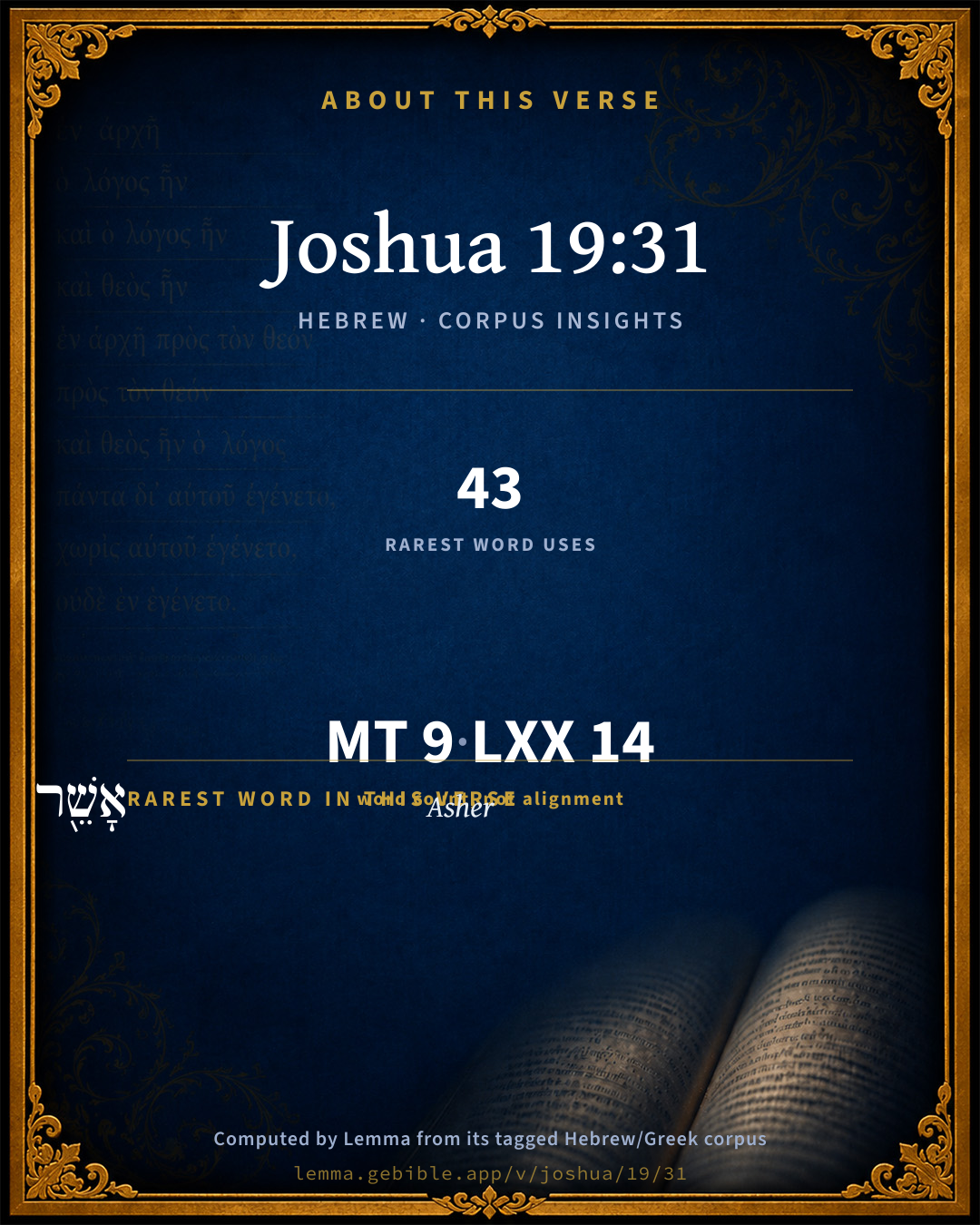
אָשֵׁ֖ר Asher H836 occurs in 41 verses of the Hebrew Bible. Also found in:

Grammatical profile

  • 7 nouns
  • 2 pronouns

Hebrew & Septuagint length

In English translation the verse runs 21 words from the Hebrew and 21 from the Septuagint (LXX English) — the same length.

A rough comparison of the two English renderings, which tokenize alike — not a word-level alignment.

Word counts can differ between the Hebrew and the Greek without any difference in meaning — e.g. the Hebrew direct-object marker אֵת has no separate Greek word, and Greek often adds the article ὁ.

In the original languages it is 9 Hebrew tokens and 14 Greek tokens — but the two are counted differently (Hebrew bundles its prefixes and suffixes into one token; the Greek is in lemma form), so that isn’t a like-for-like length.

Cross-references

2

Topical passages linked to Joshua 19:31 in the Treasury of Scripture Knowledge — connected by theme and wording, ordered by reader-vote popularity; previews shown in the World English Bible.

  • Genesis 49:20 Out of Asher his bread will be fat, He will yield royal dainties.
  • Deuteronomy 33:24–25 Of Asher he said, Blessed be Asher with children; Let him be acceptable to his brothers, Let him dip his foot in oil.

Cross-references courtesy of OpenBible.info (CC BY 4.0).

Hebrew and Greek witnesses Masoretic Hebrew ↔ Greek Septuagint

The same verse in the two great witnesses to the Old Testament, shown verse-for-verse.

These are two independent witnesses, not word-aligned to each other, and the Septuagint is shown in lemma (dictionary) form.

Hebrew Joshua 19:31 Masoretic · Westminster Leningrad Codex

זֹ֗את נַחֲלַ֛ת מַטֵּ֥ה בְנֵֽי אָשֵׁ֖ר לְמִשְׁפְּחֹתָ֑ם הֶעָרִ֥ים הָאֵ֖לֶּה וְחַצְרֵיהֶֽן

This is the inheritance of the tribe of the children of Asher according to their families, these cities with their villages.

World English Bible · Public Domain

Greek LXX Joshua 19:31 Septuagint · lemma form

οὗτος ὁ κληρονομία φυλή υἱός ασηρ κατά δῆμος αὐτός πόλις καί ὁ κώμη αὐτός

This is the inheritance of the tribe of the sons of Aser according to their families, the cities and their villages.

LXX2012 (modern English Septuagint) · Public Domain

Hebrew: Westminster Leningrad Codex (CC BY 4.0). Greek: Septuagint (public domain); English from LXX2012 (modern English Septuagint) (Public Domain). How the Septuagint differs from the Hebrew →

Targum (Aramaic paraphrase)

1

The Targum is the ancient Jewish Aramaic paraphrase of the Hebrew Scriptures — an interpretive translation, not the Hebrew text itself. Onkelos (literal) and Pseudo-Jonathan (expansive) render the Torah, and Jonathan the Prophets. Coverage is partial: where no permissively-licensed English translation exists for a verse, only the Aramaic is shown. This is verse-level text, not a word-by-word alignment to the Hebrew.

  1. Targum Jonathan Prophets (Joshua–Malachi)
    דָא אַחֲסָנַת שִׁבְטָא דִבְנֵי אָשֵׁר לְזַרְעֲיַתְהוֹן קִרְוַיָא הָאִלֵין וּפַצְחֵיהֶן:

    (no public-domain English translation for this verse)

    Targum Jonathan — Aramaic: “Mikraot Gedolot” (public domain). English: “Sefaria Community Translation” (CC0 1.0 (public-domain dedication)); “London "Chaldee Paraphrase," 1871” (public domain). Text via Sefaria.

Commentary

Notes on Joshua 19:31 from classic Christian and Jewish commentators (each source and its license shown beneath its notes). The classic Christian expositions comment on the surrounding passage and are grouped to its opening verse, so a note may address several verses; the Jewish commentaries on the Tanakh (Rashi and others) are per-verse, so they appear only where the commentator wrote on this verse.

Lemma curates 59 commentaries, every one of them public domain or Creative Commons licensed, each selected and text-cleaned for this edition rather than reprinted as found. About our sources →

The Cambridge Bible for Schools and Colleges

gen. ed. J. J. S. Perowne

31. the inheritance of the tribe of the children of Asher] The territory of Asher extended from the Nahr Zerka on the south, to Zidon on the north, and contained some of the richest soil of the country, and the maritime portion of the fertile plain of Esdraelon, and commanded all approaches to Palestine from the sea on the north. Its soil well fulfilled the prophetic descriptions of Jacob and Moses. Here Asher could “dip his foot” in the oil of his luxuriant olive-groves (Deu_33:24) such as still distinguish this region, and fatten on the bread, the fruit of the rich plain of Phœnicia and his fertile upland valleys (Gen_49:20). Here he could “yield royal dainties” (Gen_49:20), “oil and wine from his olives and vineyards, and milk and butter from his pastures;” while under his shoes (Deu_33:25) was the iron ore of the southern slopes of Lebanon, and the brass or copper of the neighbouring Phœnician territory. See Stanley’s S. and P., p. 362; Pusey’s Lectures on the Book of Daniel, p. 294; Porter’s Handbook of Sinai and Palestine, ii. p. 363. But to the richness of his soil and the proximity of the Phœnician towns the degeneracy and subsequent obscurity of Asher may be mainly traced. At the numbering of Israel at Sinai, the tribe was more numerous than either Ephraim, Manasseh, or Benjamin (Num_1:32-41), “but in the reign of David, so insignificant had it become, that its name is altogether omitted from the list of the chief rulers” (1Ch_27:16-22). “The Asherites dwelt among the Canaanites” (Jdg_1:32), and “though not nominally, or even really, a subject people, they were so thoroughly checked in their plans of conquest, and dashed their strength so uselessly against the strong rock of Phœnician power, that in the shock of failure they settled down as a people admitted to be strong, and allowed to exist side by side with the Phœnicians, under certain statutes and arrangements mutually entered into.” Ritter’s Compar. Geo. of Palestine, iii. 187, 188. With the exception of the aged widow, “Anna, the daughter of Phanuel” (Luk_2:36), no name “shines out of the general obscurity” of the tribe. “The contemptuous allusion in the Song of Deborah sums up this whole history, when in the great gathering of the tribes against Sisera, Asher continued on the sea-shore and abode in his creeks,” So insignificant was the tribe to which was assigned the fortress which Napoleon called the key of Palestine. Stanley’s S. and P., p. 265.

The Cambridge Bible for Schools and Colleges (gen. ed. J. J. S. Perowne; Cambridge University Press, 1878–1918) — public domain. Text from a community e-Sword module.

John Gill's Exposition

The sixth lot came out to the children of Naphtali,.... The tribe of Naphtali, and directed what should be the inheritance of this tribe:

even for the children of Naphtali, according to their families; which was to be divided among them, according to the number of their, families.

John Gill's Exposition of the Whole Bible (1746–1763) — public domain (CC PDM 1.0). Text via the HelloAO Bible API.

The Pulpit Commentary

This is the inheritance of the tribe of Asher. Asher appears to have been allotted a long but narrow strip of territory between Naphtali and the sea. The natural advantages of the territory must have been great. Not only was it described prophetically by Jacob (Gen_49:20) and by Moses, (Deu_33:24, Deu_33:25) but the prosperity of the two great maritime cities of Tyro and Sidon was due to the immense commercial advantages the neighbourhood afforded. St. Jean d"Acre, within the territory once assigned to Asher, has inherited the prosperity, so far as anything under the Turkish rule can be prosperous, once enjoyed by her two predecessors. Maundrell, the acute English chaplain at Aleppo, who visited Palestine in 1696, describes the plain of Acre in his day as about six hours" journey from north to south, and two from west to east; as being well watered, and possessing "everything else that might render it both pleasant and fruitful. But," he adds, "this delicious plain is now almost desolate, being suffered, for want of culture, to run up to rank weeds, as high as our horses" backs." Asher, however, never employed the advantages its situation offered. They never subdued the Canaanites around them, but, unquestionably at a very early date (see Jud_1:5:17) preferred a life of compromise and ignoble ease to the national welfare. But it would be incorrect to suppose that because the tribe is omitted in the list of rulers given in 1Ch 27, it had ceased to be a power in Israel. For Gad is also omitted in that list, while among the warriors who came to greet David when he became undisputed king of Israel, Asher sent 40, 000 trained warriors, a number exceeding the men of Ephraim, and those of Simeon, of Dan, and of the half tribe of Manasseh, (see 1Ch 12) and far exceeding the numbers of Benjamin, which had never recovered the war of almost extermination waged against it, in consequence of the atrocity at Gibeah. (Jud_1:20) Possibly the reason why so few are mentioned of the tribe of Judah on that occasion is because so many were already with David. There seems no ground for the idea of Dean Stanley, that the allusion to Asher in Jud_1:5:17 is any more contemptuous than the allusion to any other tribe.

The Pulpit Commentary (1880–1919), ed. H.D.M. Spence-Jones & Joseph S. Exell — public domain. Text from a community e-Sword module.

unfoldingWord translationNotes

Door43 World Missions Community

This was the inheritance of the tribe of Asher

The land and cities that the tribe of Asher received are spoken of as if they were an inheritance that they received as a permanent possession. AT: "This was the land and the cities that the tribe of Asher received as an inheritance" (See: Metaphor)

translationWords

inherit

tribe

Asher

clan

unfoldingWord translationNotes — © Distant Shores Media and the Door43 World Missions Community, licensed CC BY-SA 4.0. Source: git.door43.org/Door43/en_tn.

Lesson kit

Teaching starters — assembled from the data on this page, not authored interpretation. Every prompt links to the verse data it draws on. Edit before teaching.

Joshua, in the Historical, opens this verse with 9 words (9 distinct Hebrew lemmas). Its most distinctive word is ʼÂshêr (“Asher”). A historical commentator’s framing appears above. Read the whole chapter for the surrounding context.

Discussion questions

  1. The word ʼÂshêr carries the sense “Asher.” How does it shape the verse?
  2. Genesis 30:13 shares the word «Asher» with this verse. How do the two illuminate each other?
  3. The translations on this page render this verse differently — a whole-verse word diff, not a word-by-word alignment. What might account for the different wordings?
  4. Reading how The Cambridge Bible for Schools and Colleges and John Gill's Exposition read this verse, where do the two commentators agree and where do they part?

Things to notice

Reading settings

Reading text

Shown beneath each verse's original-language words.

Old Testament
Old Testament edition

Read the OT as the Masoretic Hebrew (MT) or the Greek Septuagint (LXX).

English shown for the Greek Septuagint (in the Hebrew ↔ Greek comparison).

Comparing translations? Open the Compare panel on any verse page to stack up to four side by side.