
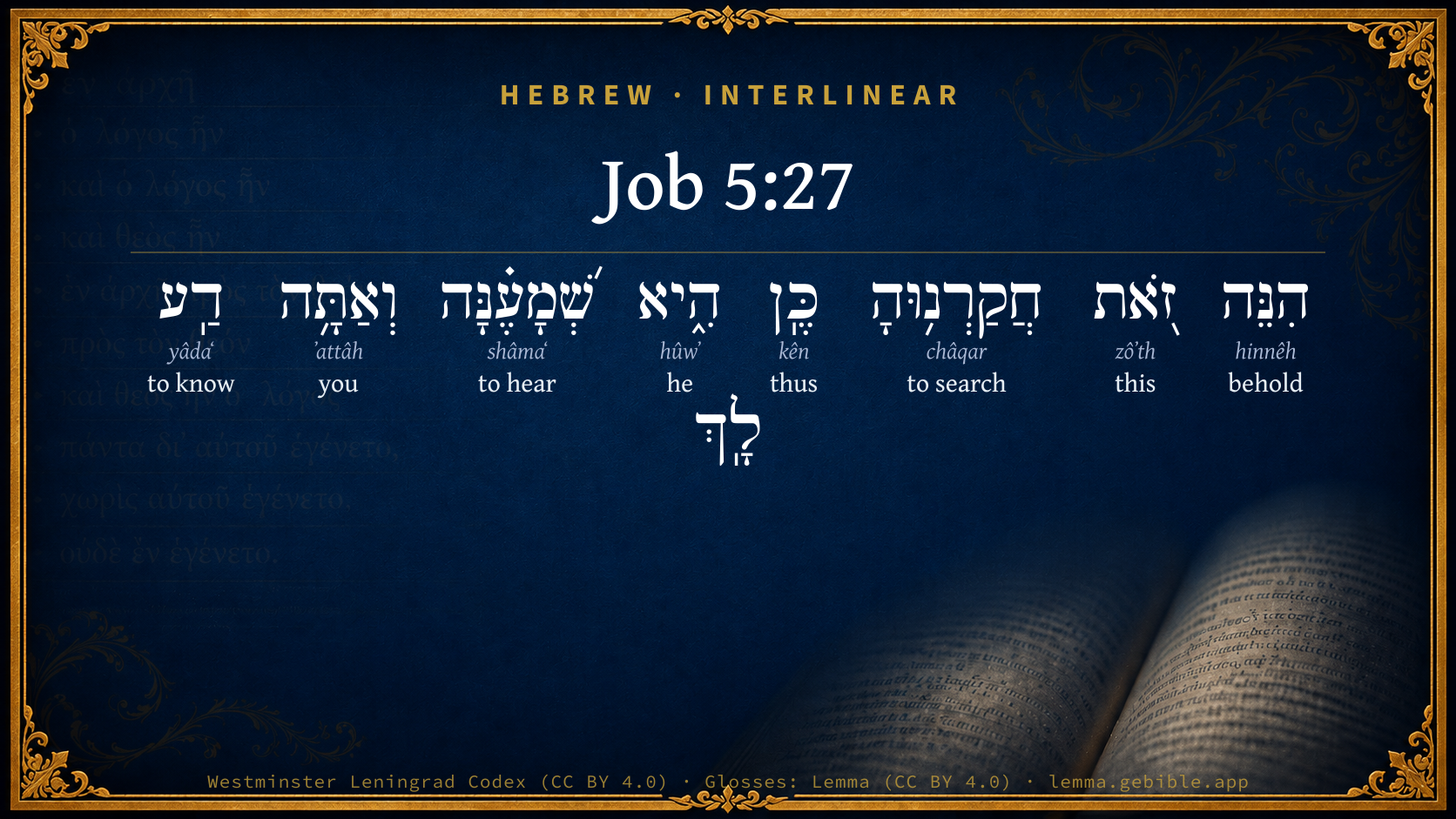
Job 5:27

Hebrew (Westminster Leningrad Codex) Job 5:27 appears in the Hebrew Old Testament. The text above is from the Westminster Leningrad Codex. Each word links to its Strong’s number, a concise gloss, and parsing drawn from the Open Scriptures Hebrew Bible morphology. Click any word for its full Brown-Driver-Briggs (BDB) entry.
Download image
Cite this verse

Job 5:27 (World English Bible). Public Domain. Lemma interlinear Bible study tool, https://lemma.gebible.app/v/job/5/27.

Show BibTeX & RIS
BibTeX
RIS
English Translation
Look this, we have searched it, so it is; Hear it, and know it for your good."
World English Bible · Public Domain
Download a study sheet

One document with this verse’s original text, its word-by-word gloss line, the meaning frame, cross-references with their text, attributed commentary, and full source and license credits — printable, and it pastes into notes with its structure intact.

This verse Autodidact and up

Study sheet (.html) Plain text (.txt)

A passage Seminary Student

Up to 50 verses in one chapter. A passage sheet keeps up to 6 commentary sources and 12 cross-references per verse, in the order this page ranks them, and says so on the sheet whenever that leaves anything out. Ask for a single verse and you get the Autodidact verse sheet above.

Everything on this page stays free to read, with no account — the sheet is a download of what is already on screen, not access to it.

Want to remove ads? Support Godless Engineer
Compare translations 3

The same verse in 3 English versions, stacked beneath the original-language interlinear above. Click any original word for its lexicon entry.

Each is an independent rendering of the whole verse — the interlinear is not word-aligned to these translations.

Highlighted words mark where these versions differ — a whole-verse word diff, not a word-by-word alignment.

  • World English Bible Public Domain
    Look this, we have searched it, so it is; Hear it, and know it for your good."
  • King James Version Public Domain
    Lo this, we have searched it, so it is; hear it, and know thou it for thy good.
  • unfoldingWord Literal Text CC BY-SA 4.0
    Behold this: We have examined it, thus it; listen to it and know for yourself.”

unfoldingWord Literal Text — © unfoldingWord, licensed CC BY-SA 4.0. Word-aligned USFM3 via Door43 (git.door43.org/unfoldingWord/en_ult).

Versions to compare (up to 4)

3 of 4 selected

Show all 18 translations

Every available English version of this verse, each an independent rendering of the whole verse.

  • World English Bible Public Domain
    Look this, we have searched it, so it is; Hear it, and know it for your good."
  • Berean Standard Bible Public Domain
    Indeed, we have investigated, and it is true! So hear it and know for yourself.”
  • Majority Standard Bible Public Domain
    Indeed, we have investigated, and it is true! So hear it and know for yourself.”
  • King James Version Public Domain
    Lo this, we have searched it, so it is; hear it, and know thou it for thy good.
  • American Standard Version (1901) Public Domain
    Lo this, we have searched it, so it is; Hear it, and know thou it for thy good.
  • Revised Version (1885) Public Domain
    Lo this, we have searched it, so it is; hear it, and know thou it for thy good.
  • Geneva Bible (1599) Public Domain
    Lo, thus haue we inquired of it, and so it is: heare this and knowe it for thy selfe.
  • Douay-Rheims (1899) Public Domain
    Behold, this is even so, as we have searched oat: which thou having heard, consider it thoroughly in thy mind.
  • Young's Literal Translation Public Domain
    Lo, this -- we searched it out -- it `is' right, hearken; And thou, know for thyself!
  • Literal Standard Version CC BY-SA 4.0
    Behold, this—we searched it out—it [is] right, listen; And you, know for yourself!”
  • Unlocked Literal Bible CC BY-SA 4.0
    See, we have examined this matter; it is like this; listen to it, and know it for yourself.”
  • unfoldingWord Literal Text CC BY-SA 4.0
    Behold this: We have examined it, thus it; listen to it and know for yourself.”
  • Darby Bible Public Domain
    Behold this, we have searched it out, so it is; hear it, and know thou it for thyself.
  • World Messianic Bible Public Domain
    Behold, we have researched it. It is so. Hear it, and know it for your good.”
  • Webster's Bible Public Domain
    Lo this, we have searched it, so it is; hear it, and know thou it for thy good.
  • Free Bible Version CC BY-SA 4.0
    Look, we've examined it, and it's true! Listen to what I'm saying and apply it to yourself!”
  • Bible in Basic English Public Domain
    See, we have made search with care, and it is so; it has come to our ears; see that you take note of it for yourself.
  • JPS Tanakh (1917) Public Domain
    Lo this, we have searched it, so it is; hear it, and know thou it for thy good.

Literal Standard Version (2020), Covenant Press — licensed CC BY-SA 4.0. Text via the HelloAO Bible API (eBible.org). Unlocked Literal Bible (unfoldingWord) — licensed CC BY-SA 4.0. Text via the HelloAO Bible API (eBible.org). unfoldingWord Literal Text — © unfoldingWord, licensed CC BY-SA 4.0. Word-aligned USFM3 via Door43 (git.door43.org/unfoldingWord/en_ult). Free Bible Version, Dr. Jonathan Gallagher — licensed CC BY-SA 4.0. Text via the HelloAO Bible API (eBible.org).

Word by word

More ways to search: Search by grammar → Find every occurrence → Compare this word →

Practice this passage: Drill this verse → Learn its vocabulary →

חֲקַרְנ֥וּהָ
châqar
H2713
“to search · her”
Verb, Qal, Perfect, 1st Person, Common, Plural + Suffix, Personal, 3rd Person, Feminine, Singular
Part of Speech
Verb
Stem
Qal
Form
Perfect
Person
1st Person
Gender
Common
Number
Plural
Full BDB Definition

Origin: a primitive root

TWOT: 729

to search, search for, search out, examine, investigate - (Qal) - to search (for) - to search through, explore - to examine thoroughly - (Niphal) - to be searched out, be found out, be ascertained, be examined - (Piel) to search out, seek out
  1. הִנֵּה hinnêh H2009 “behold” Particle, Demonstrative
  2. זֹ֭את zôʼth H2063 “this” Pronoun, Demonstrative, Feminine, Singular
  3. כֶּֽן kên H3651 “thus” Adverb
  4. הִ֑יא hûwʼ H1931 “he” Pronoun, Personal, 3rd Person, Feminine, Singular
  5. שְׁ֝מָעֶ֗נָּה shâmaʻ H8085 “hear · her” Verb, Qal, Imperative, 2nd Person, Masculine, Singular + Suffix, Personal, 3rd Person, Feminine, Singular
  6. וְאַתָּ֥ה ʼattâh H859 “and · you” Conjunction + Pronoun, Personal, 2nd Person, Masculine, Singular
  7. דַֽע yâdaʻ H3045 “know” Verb, Qal, Imperative, 2nd Person, Masculine, Singular

About this verse

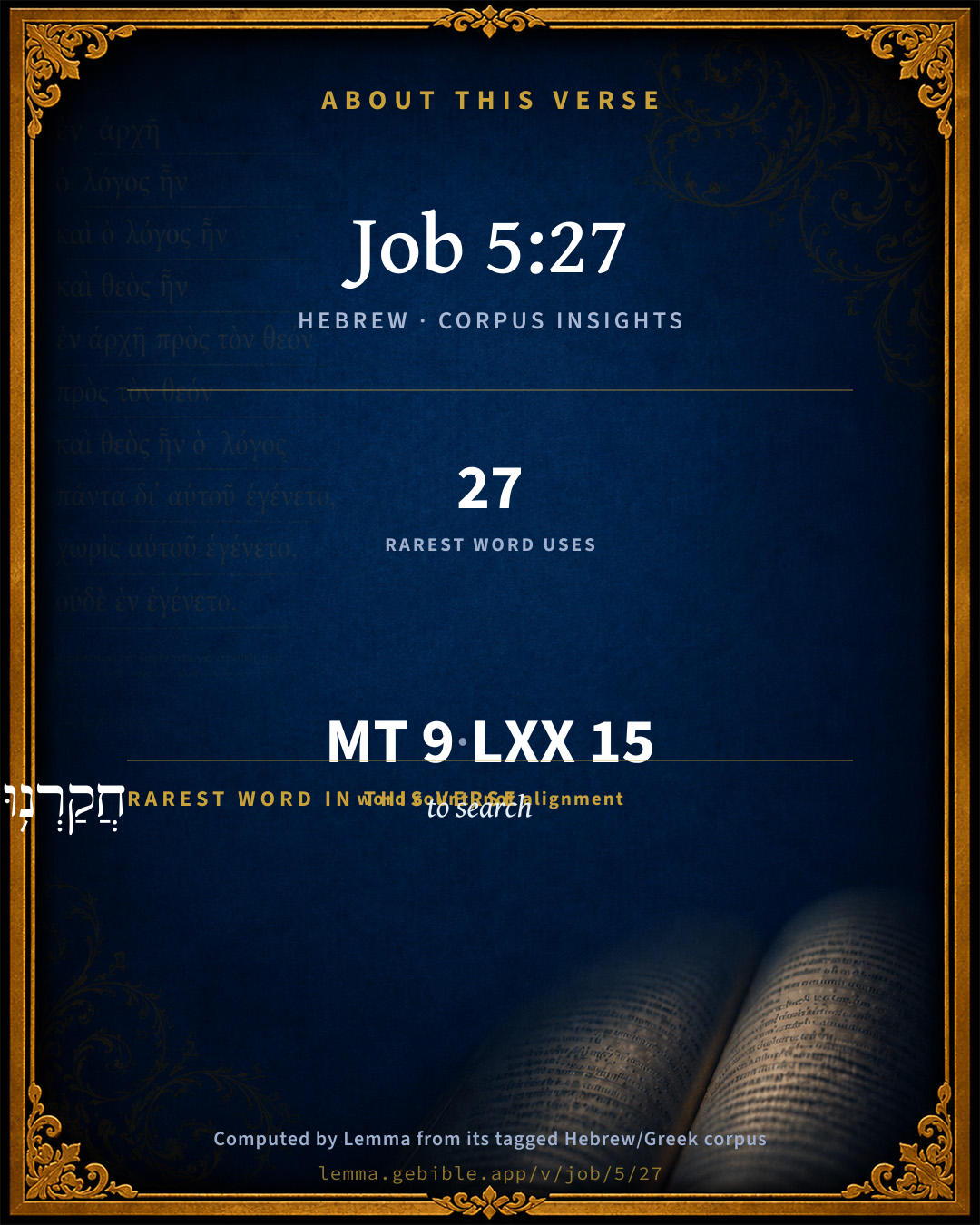
These counts appear in no published source. They are computed here, from the morphology-tagged text and Lemma’s own curated glosses. What Lemma adds →

9
words
8
distinct lemmas
Wisdom
section

Shared distinctive vocabulary

חֲקַרְנ֥וּהָ to search H2713 occurs in 26 verses of the Hebrew Bible. Also found in:

Grammatical profile

  • 3 verbs
  • 3 pronouns
  • 1 preposition
  • 1 adverb
  • 1 particle

Verb forms

  • חֲקַרְנ֥וּהָ Qal · Perfect
  • שְׁ֝מָעֶ֗נָּה Qal · Imperative
  • דַֽע Qal · Imperative

Hebrew & Septuagint length

In English translation the verse runs 17 words from the Hebrew and 26 from the Septuagint (LXX English) — the Septuagint runs noticeably longer here. See the side-by-side →

A rough comparison of the two English renderings, which tokenize alike — not a word-level alignment.

Word counts can differ between the Hebrew and the Greek without any difference in meaning — e.g. the Hebrew direct-object marker אֵת has no separate Greek word, and Greek often adds the article ὁ.

In the original languages it is 9 Hebrew tokens and 15 Greek tokens — but the two are counted differently (Hebrew bundles its prefixes and suffixes into one token; the Greek is in lemma form), so that isn’t a like-for-like length.

Cross-references

10

Topical passages linked to Job 5:27 in the Treasury of Scripture Knowledge — connected by theme and wording, ordered by reader-vote popularity; previews shown in the World English Bible.

  • Psalms 111:2 Yahweh's works are great, Pondered by all those who delight in them.
  • Job 32:11–12 "Behold, I waited for your words, And I listened for your reasoning, While you searched out what to say.
  • Proverbs 9:12 If you are wise, you are wise for yourself. If you mock, you alone will bear it.
  • Deuteronomy 10:13 to keep the commandments of Yahweh, and his statutes, which I command you this day for your good?
  • Proverbs 2:3–5 Yes, if you call out for discernment, And lift up your voice for understanding;
  • Job 8:8–10 "Please inquire of past generations, Find out about the learning of their fathers.
  • Job 12:2 "No doubt, but you are the people, And wisdom shall die with you.
  • Job 15:9–10 What do you know, that we don't know? What do you understand, which is not in us?
  • Job 15:17 "I will show you, listen to me; That which I have seen I will declare:
  • Job 22:2 "Can a man be profitable to God? Surely he who is wise is profitable to himself.

Cross-references courtesy of OpenBible.info (CC BY 4.0).

Hebrew and Greek witnesses Masoretic Hebrew ↔ Greek Septuagint

The same verse in the two great witnesses to the Old Testament, shown verse-for-verse.

Here the Septuagint runs noticeably longer than the Hebrew — LXX2012 (modern English Septuagint) 26 words vs World English Bible 17. A rough length comparison of the two English translations, not a word-level alignment — read both below.

These are two independent witnesses, not word-aligned to each other, and the Septuagint is shown in lemma (dictionary) form.

Hebrew Job 5:27 Masoretic · Westminster Leningrad Codex

הִנֵּה זֹ֭את חֲקַרְנ֥וּהָ כֶּֽן הִ֑יא שְׁ֝מָעֶ֗נָּה וְאַתָּ֥ה דַֽע לָֽךְ

Look this, we have searched it, so it is; Hear it, and know it for your good."

World English Bible · Public Domain

Greek LXX Job 5:27 Septuagint · lemma form

ἰδού οὗτος οὕτως ἐκἰχνιάζω οὗτος εἰμί ὅς ἀκούω σύ δέ γιγνώσκω σεαυτοῦ εἰ τις πράσσω

Behold, we have thus sought out these matters; these are what we have heard: but do you reflect with yourself, if you have done anything wrong.

LXX2012 (modern English Septuagint) · Public Domain

On this verse, Haydock's Catholic Bible Commentary discusses the Septuagint’s reading. Read the note in Commentary ↓

Hebrew: Westminster Leningrad Codex (CC BY 4.0). Greek: Septuagint (public domain); English from LXX2012 (modern English Septuagint) (Public Domain). How the Septuagint differs from the Hebrew →

Commentary

Notes on Job 5:27 from classic Christian and Jewish commentators (each source and its license shown beneath its notes). The classic Christian expositions comment on the surrounding passage and are grouped to its opening verse, so a note may address several verses; the Jewish commentaries on the Tanakh (Rashi and others) are per-verse, so they appear only where the commentator wrote on this verse.

Lemma curates 59 commentaries, every one of them public domain or Creative Commons licensed, each selected and text-cleaned for this edition rather than reprinted as found. About our sources →

Trapp's Complete Commentary

John Trapp

Job 5:27 Lo this, we have searched it, so it [is]; hear it, and know thou [it] for thy good.

Ver. 27. Lo this, we have searched it, so it is] We are sure that all this is true, and may be trusted to, for we have tried it; we have not it only by tradition, neither take we it up upon trust from others; but we believe and know, as Peter spake, Joh 6:69; we believe, and therefore speak it, as Paul (after David), 2Co 4:13 Psa 116:10. Thou mayest write upon this whole chapter, as those ancients did upon their oracles, φεος, φεος, God, God; or as John the divine did upon his Revelation, "These sayings are faithful and true," Rev 22:6. Vera tanquam ex tripode, As true as gospel, as we say. Those that take upon them to teach others should go upon sure ground, and be masters of what they teach: how else will they teach with authority? Those also that come to hear must strive to find out that which St Luke calleth the certainty of things, Luk 1:4, and not be led by conjectural suppositions, or the tenets of their teachers, but be fully persuaded, Job 5:1.

Hear it] With utmost attention of body, intention of mind, retention of memory and practice: else all is lost.

And know thou it for thy good] Make thy best use of this our diligence and experience so freely and friendly communicated unto thee. Let not all this that hath been spoken be spilt upon thee, but prove every whit as profitable to thee as I conceive it seasonable for thee. Some knowing men are not a button the better for all they know. The devils are full of objective knowledge; but they get no good by it; no more do graceless men, that draw not their knowledge into practice, but detain the truth in unrighteousness: it swimmeth in their heads, but sinketh not into their hearts; it maketh them giddy, as wine fuming all up into the head, but never coming at the heart to cheer it. Such a man may cast out devils, and yet be cast to the devil; he may go to hell with all his unprofitable knowledge; like as a bull with a coronet aud garland goes to the slaughter. Unless a man hear and know for himself, he shall find no more comfort of it than a man doth of the sun when it shineth not in his own horizon; or than a traveller doth of the fatness of a far country which he only passeth through, and taketh a view of. If therefore thou be wise, be wise for thyself, Pro 9:12. Let thy knowledge be not only apprehensive, but effective, illightening, but transforming, {2Co 3:18} discursive, but experimental and practical. "For thereby we know that we know him, if we keep his commandments," 1Jn 2:3.

John Trapp, A Commentary or Exposition upon All the Books of the Old and New Testament (1647–1656) — public domain. Text from a community e-Sword module.

The Biblical Illustrator

Joseph S. Exell

Job_5:27

Lo this, we have searched it, so it is; hear It, and know thou it for thy good.

So it is

Thus closed a forcible speech by Eliphaz the Temanite; it may be called his summing up. He virtually says, What I have testified in the name of my friends is no dream of theirs. Upon this matter we are specialists; and bear witness to truth which we have made the subject of research and experience. Lo this, we have searched it, so it is; hear it, and know thou it for thy good. By this declaration he sets forth his teaching with authority, and presses it home. He persuades Job to consider what he had said, for it was no hasty opinion, but the ripe fruit of experience. I shall not follow Eliphaz; I am only going to borrow his closing words, and use them in reference to Gospel testimony; which is to us a thing known and searched out.

I. To begin with, these words may well describe the qualification of the teacher. He will be poorly furnished if he cannot run in the line which Eliphaz draws in the words of our text.

1. He should have an intimate knowledge of his subject. How can he teach what he does not know? When we come to talk about God, and the soul, and sin, and the precious blood of Jesus, and the new birth, and holiness and eternal fife, the speaker who knows nothing about these things personally must be a poor driveller. A blind man, who is teaching others about colour and vision? A preacher of an unknown God? A dead man sent with messages of life? You are in a strange position.

2. I must add that he should have a personal experience of it, so that he can say, Lo this, we have searched it, so it is. It is unseemly that an ignorant man should keep a school. It is not meet that a dumb man should teach singing. Shall an impenitent man preach repentance? Shall an unbelieving man preach faith? Shall an unholy man preach obedience to the Divine will? He who would learn to plough, must not be apprenticed to one who never turned a furrow. We must know the Lord, or we cannot teach His way.

3. What is wanted in a successful teacher is a firm conviction of the truth of these things, growing out of his having tested them for himself. He must say, with emphasis, So it is. The Lords Word must be true. Why do you hope about it? Believe it and enjoy it. But people will go hoping and hoping and limping; as if to be lame were the proper thing. A ministry of hesitation must be ruinous to souls. When Divine truth is held fast, then let it be held forth, and not till then.

4. Once more a needful qualification for a teacher of the Word is earnestness and goodwill to the hearer. We must implore each one of our hearers to give earnest heed. We must cry to him with our whole heart, Hear it, and know thou it for thy good. Without love, there can be no real eloquence. The great Saviours heart is love, and those who are to be saviours for Him must be of a loving spirit. True love will do the work when everything else has failed. Knowledge of our subject avails not without love to our hearers. There are three ways of knowing, but only one sort is truly worth the having. Many labour to know, merely that they may know. These are like misers, who gather gold that they may count it, and hide it away in holes and corners. This is the avarice of knowledge. Such knowledge turns stagnant, like water shut up in a close pond--above mantled with rank weed, and below putrid, or full of loathsome fife. A second class aspire to know that others may know that they know. To be reputed wise is the heaven of most mortals. One does not eat merely that others may know that you have had your dinner, and one should not know merely to have it known that you know. The third kind of knowledge is the one worth having. Learn to know that you may make other people know. This is not the avarice but the commerce of knowledge. Acquire knowledge that you may distribute it. Light the candle, but put it not under a bushel. Be taught that you may teach. This trading is gainful to all who engage in it.

II. The argument for the hearer. Lo this, we have searched it, so it is. The argument directed to the hearer is the experience of many, confirming the statement of one. We have searched it, so it is. I should like to bear my own personal witness to a few things about which I am fully persuaded. Lo this, we have searched it, so it is.

1. And my first witness is that sin is an evil and a bitter thing. I think I may speak for you and say, We have searched this out, and we know that it is so. We have seen sin prove injurious to our fellow men.

2. I wish to testify to the fact that repentance of sin, and faith in the Lord Jesus Christ, bring a wonderful rest to the heart, and work a marvellous change in the whole life and character.

3. Next, we beg to bear our witness to the fact that prayer is heard of God. God does hear prayer. We bear our witness to that fact with all our strength, and therefore we say about it, Lo this, we have searched it, so it is; hear it, and know thou it for thy good.

4. Another testimony we would like to bear, namely, that obedience to the Lord, though it may involve present loss, is sure to be the most profitable course for the believing man to take.

5. We beg to say that the old-fashioned Gospel is able to save men, and to arouse enthusiasm in their souls.

III. We have here the exhortation to the inquirer.

1. This, we have searched it, so it is; hear it. But oh, if you wish to be saved, hear the Gospel! Let nothing keep you away from Gods sanctuary, where the real Gospel is proclaimed. Hear it! If it is not preached exactly in the style which you would prefer, nevertheless, hear it. Faith cometh by hearing.

2. The next thing that he says is, Know it. Hear it and know it; go on hearing it until you know it. To know Christ is life eternal.

3. Our text means--know it in a particular way. Know thou it for thy good. The devil knows a great deal. He knows more than the most intelligent of us; but he knows nothing for his good. All that he knows sours into evil within his rebellious nature.

(1) How is a man to know anything for his good? This knowledge must first be a practical knowledge. Does the Word say Repent? If you want to know what repentance means, repent at once. If you want to know what faith is, believe in the Lord Jesus Christ, and when you have believed, you will know what believing is. The best way to know a virtue is to practise it.

(2) To know a thing for our good is to know it for ourselves. Know it for thy good. I find that one rendering is, Know it for thyself. Another mans God is no God to me; he must be my Lord and my God.

(3) I must add that we only know things for our good when we know them believingly. To a sinner a promise is as dark as a threatening, if he does not believe it. (C. H. Spurgeon.)

.

The Biblical Illustrator, edited by Joseph S. Exell (c. 1880s–1900s) — public domain. Text from a community e-Sword module.

Joseph Benson's Commentary

Job 5:27. Lo this, we have searched out — It is not my single opinion, but my brethren concur with me, as thou wilt hear from their own mouths. And it is no rash or hasty conceit, but what we have learned by deep consideration, long experience, and diligent observation. Know thou it for thy good — Know it for thyself, (so the word is,) make application of it to thine own case. That which we thus hear and know for ourselves, we hear and know for our good.

Joseph Benson's Commentary on the Old and New Testaments (1811–1818) — public domain. Text from a community e-Sword module.

Geneva Bible (1599)

Geneva Bible translators

We have learned these points by experience, that God punisheth not the innocent, that man cannot compare in justice with him, that the hypocrites shall not long prosper, and that the affliction which man sustaineth, cometh for his own sin.

Geneva Bible (1599) marginal notes — public domain. Text via Bolls.life.

Jamieson, Fausset & Brown

Robert Jamieson, A. R. Fausset & David Brown

searched it . . . for thy good--literally, "for thyself" (Psa 111:2; Pro 2:4; Pro 9:12).

Next: Job Chapter 6

Jamieson, Fausset & Brown — Commentary Critical and Explanatory on the Whole Bible (1871) — public domain (CC PDM 1.0). Text via the HelloAO Bible API.

Adam Clarke's Commentary

Verse 27. Lo this, we have searched it] What I have told thee is the sum of our wisdom and experience on these important points. These are established maxims, which universal experience supports. Know - understand, and reduce them to practice for thy good. Thus ends Eliphaz, the Temanite, "full of wise saws and ancient instances;" but he miserably perverted them in his application of them to Job's case and character. They contain, however, many wholesome truths, of which the wise in heart may make a very advantageous practical use.

THE predatory excursions referred to in Job 5:23 were not unfrequent among our own barbarous ancestors. An affecting picture of this kind is drawn by Shakespeare, from Holinshed's Chronicles, of the case of Macduff, whose castle was attacked in his absence by Macbeth and his wife and all his children murdered. A similar incident was the ground of the old heroic ballad of Hardicanute. When the veteran heard that a host of Norwegians had landed to pillage the country, he armed, and posted to the field to meet the invading foe. He slew the chief in battle, and routed his pillaging banditti. While this was taking place, another party took the advantage of his absence, attacked his castle, and carried off or murdered his lovely wife and family; which, being perceived on his return by the war and age-worn chief, is thus affectingly described by the unknown poet: -

Loud and chill blew the westlin wind,

Sair beat the heavy shower,

Mirk grew the nicht eir Hardyknute

Wan neir his stately tower:

His tower that us'd with torches bleise

To shine sae far at night,

Seim'd now as black as mourning weid,

Nae marvel, sair he sich'd.

"Thair's nae light in my lady's bowir,

Thair's nae light in my hall;

Nae blink shynes round my Fairly fair,

Nor ward stands on my wall.

"What bodes it, Thomas! Robert! say?"

Nae answer - speaks their dreid;

"Stand back, my sons, I'll be your gyde;"

But bye they pass'd with speid.

"As fast I haif sped owr Scotland's foes"

There ceis'd his brag of weir.

Sair schamt to mind ocht but his dame,

And maiden Fairly fair.

Black feir he felt; but what to feir

He wist not yet with dreid;

Sair schook his body, sair his limbs,

And all the warrior fled.

The ending of this poem is lost; but we here see that the castle of Hardicanute was surprised, and his family destroyed, or carried off, while he and his sons had been employed in defeating the invading Norwegians. Thank God! civilization, the offspring of the spread of Christianity, has put an end to these barbarous practices among us; but in the East, where Christianity is not, they flourish still. Britons! send out your Bible and your missionaries to tame these barbarians; for whom heathenism has done nothing, and the Koran next to nothing. Civilization itself, without the Bible, will do as little; for the civilized Greeks and Romans were barbarians, fell and murderous; living in envy and malice, hateful, hating one another, and offering hundreds at a time of human victims to their ruthless deities. Nothing but Christianity ever did, or even can, cure these evils.

Adam Clarke's Commentary on the Bible (1810–1826) — public domain. Text from a community e-Sword/MySword module.

Ellicott's Commentary for English Readers

(27) So it is.—It is the boastful confidence of Eliphaz which is so hard to bear. He speaks as though Job’s experience were as nothing to his. “This is mine: take it to thyself, and make it thine.”

A Bible Commentary for English Readers, edited by Charles John Ellicott (1878–1897) — public domain. Text from a community e-Sword module.

John Gill's Exposition

Lo this, we have searched it,.... This is the concluding part of Eliphaz's first oration or speech to Job; and in order to engage his attention to it, observes, that what he had said was not his own single opinion, but the sentiment of the rest of his friends; and that it was the result of laborious and diligent investigation; that they had searched the records of former times, and inquired of ancient people, as well as had made the strictest observations on things during their course of life;

so it is; and the sum and amount of all was what he had declared, and which they had found to be sure and certain, the truth of the matter; that it is an undoubted truth, which should not be disputed and called in question, but to be held as a first principle, which was this; that wicked men are punished for their sins, and that good men are never greatly afflicted, at least not to such a degree as to be stripped of all the necessaries of life, and to be in a most desolate and perishing condition; and since this had been so thoroughly investigated by them, and such "a probatum est" was written upon it, he exhorts Job to

hear it; agree to it, believe it, receive it, and make a proper use of it, as he hoped he would:

and know thou it for thy good; or "for thyself" (s); take it to thyself, as belonging to thee, as suitable to thy case; apply it to thyself, learn some lessons from it, and make good use of it; which is what is proposed by all that has been said.

(s) "scito tibi", Montanus, Mercerus, &c.

Next: Job Chapter 6

John Gill's Exposition of the Whole Bible (1746–1763) — public domain (CC PDM 1.0). Text via the HelloAO Bible API.

Albert Barnes' Notes on the Bible

Lo this - All this that I have said; the truth of all the remarks which I have made.

We have searched it - We have by careful observation of the course of events come to these conclusions. These are our views of the providence of God, and of the principles of his government, as far as we have had the opportunity of observing, and they are well worthy of your attention. The sentiments in these two chapters indicate close and accurate observation; and if we think that the observation was not always wholly accurate, or that the principles were carried further than facts would warrant, or that Eliphaz applied them with somewhat undue severity to the case of Job, we are to remember that this was in the infancy of the world, that they had few historical records, and that they had no written revelation. If they were favored with occasional revelations, as Eliphaz claimed (Job 4:12 ff), yet they were few in number, and at distant intervals, and the divine communications pertained to but few points.

Though it may without impropriety be maintained that some of the views of Eliphaz and his friends were not wholly accurate, yet we may safely ask, Where among the Greek and Roman sages can views of the divine government be found that equal these in correctness, or that are expressed with equal force and beauty? For profound and accurate observation, for beauty of thought and sublimity of expression, the sage of Teman will not fall behind the sages of Athens; and not the least interesting thing in the contemplation of the book of Job, is the comparison which we are almost of necessity compelled to make between the observations on the course of events which were made in Arabia, and those which were made by the philosophers of the ancient pagan world. Is it improper to suppose that one design of this book was to show how far the human mind could go, with the aid of occasional revelations on a few points, in ascertaining the principles of the divine administration, and to demonstrate that, after all, the mind needed a fuller revelation to enable man to comprehend the truths pertaining to the kingdom of God? “Hear it for thy good.” Margin, as in Hebrew “thyself.” These principles are such that they are of importance for you to understand and to apply.

Albert Barnes' Notes on the Bible (1834–1885) — public domain. Text from a community e-Sword/MySword module.

Haydock's Catholic Bible Commentary

Which thou. Septuagint, "And what we have heard: but do thou reflect with thyself what thou hast done." (Haydock) --- What had been revealed to Eliphaz was very true. Yet his conclusions were unwarrantable. (Calmet) --- How confidently does he speak of his own knowledge, and how great must have been his disappointment, when God condemned him of folly, and sent him to be the prayers of that very man whom he now considered as a wretched sinner! (Haydock)

George Leo Haydock (1774–1849), Haydock's Catholic Family Bible and Commentary, 1859 edition — public domain. Excludes Psalms (Douay-Rheims chapter numbering differs from Protestant) and Deuterocanonical books (Catholic canon only).

Matthew Poole's English Annotations

It is not my single opinion, but my brethren concur with me, as thou wilt hear from their own mouths. This is no rash or hasty conceit, but what we have learned by deep consideration and hard study, long experience and diligent observation, both of God’s word, so far as he hath been pleased to reveal himself, and of the course and methods of his providence and dealing with men in the world.

Know thou it; for to us thou seemest by thy words and carriage to be wholly, or in a great part, ignorant of these things. For thy good; let the advantage which will come unto thee by following this counsel remove thy prejudice against it.

Matthew Poole's English Annotations on the Holy Bible (1683–1685) — public domain. Text from a community e-Sword/MySword module.

Whedon's Commentary on the Bible

Daniel D. Whedon

27. We have searched it — He thus commits the two other friends to the sentiments he has expressed, and they by their silence assent. Job assumes this in his reply.

For thy good — As in the margin, for thyself. These principles, proved by experience, Job may take to himself. The frigid want of sympathy accompanies the speech to its bitter end. The galled jade may wince — Job is in the hands of a righteous God, let him suffer. “Eliphaz blames Job for his murmuring, and bids him receive his affliction with a recognition of human sinfulness and the divine purpose for good. Thus the controversy begins.” — Delitzsch.

Daniel D. Whedon (gen. ed.), Commentary on the Old and New Testaments (1874–1909) — public domain. Text from a community e-Sword module.

The Pulpit Commentary

Lo this, we have searched it, so it is. Eliphaz does not claim to be delivering a Divine message, or in any way stating results which he has learnt from revelation. Rather is he declaring what he has "searched out;" i.e. gathered with much trouble from inquiry, observation, and experience. He is, however, quite confident that he has arrived at a true conclusion, and expects Job to accept it and act upon it. Hear it, and know thou it for thy good; literally, for thyself. Make the knowledge, i.e. which I have communicated to thee, thine own. Professor Lee observes, "Them is nothing in all this savouring of any asperity, as far as I can see, beyond the anxieties of true friendship. The sentiments delivered from ver. 17 to the end of the chapter are not only most excellent in themselves, but perfectly applicable to Job"s case; and were, in the event, made good in every respect. It is true, we have not much sympathy expressed for Job"s bereavements and afflictions. And, in this respect, Eliphaz was, no doubt, to blame" ("Book of the Patriarch Job" p. 216).

The Pulpit Commentary (1880–1919), ed. H.D.M. Spence-Jones & Joseph S. Exell — public domain. Text from a community e-Sword module.

John Wesley's Explanatory Notes

Searched - This is no rash or hasty conceit, but what both I and my brethren have learned by deep consideration, long experience, and diligent observation. Know thou - Know it for thyself; (So the word is) with application to thy own case. That which we thus hear and know for ourselves, we hear and know for our good.

John Wesley, Explanatory Notes Upon the Whole Bible (1754–1765) — public domain. Text via the GEBible commentary corpus.

Lesson kit

Teaching starters — assembled from the data on this page, not authored interpretation. Every prompt links to the verse data it draws on. Edit before teaching.

Job, in the Wisdom, opens this verse with 9 words (8 distinct Hebrew lemmas). Its most distinctive word is châqar (“to search”). The Greek Septuagint runs longer here. A historical commentator’s framing appears above. Read the whole chapter for the surrounding context.

Discussion questions

  1. What does “to search” (châqar) contribute to the verse as a whole?
  2. How does Deuteronomy 13:14, which shares the word «to search», read alongside this verse?
  3. The Septuagint runs longer here than the Hebrew. What might account for the difference?
  4. These translations render this verse differently; the difference is in the English rendering, not the original. What questions does that raise?
  5. «חֲקַרְנ֥וּהָ» is a Qal Perfect verb. How does that grammatical form shape the action described?
  6. Compare how Trapp's Complete Commentary and The Biblical Illustrator read this verse. Where do they agree or differ?

Things to notice

Reading settings

Reading text

Shown beneath each verse's original-language words.

Old Testament
Old Testament edition

Read the OT as the Masoretic Hebrew (MT) or the Greek Septuagint (LXX).

English shown for the Greek Septuagint (in the Hebrew ↔ Greek comparison).

Comparing translations? Open the Compare panel on any verse page to stack up to four side by side.