Psalms 27:3

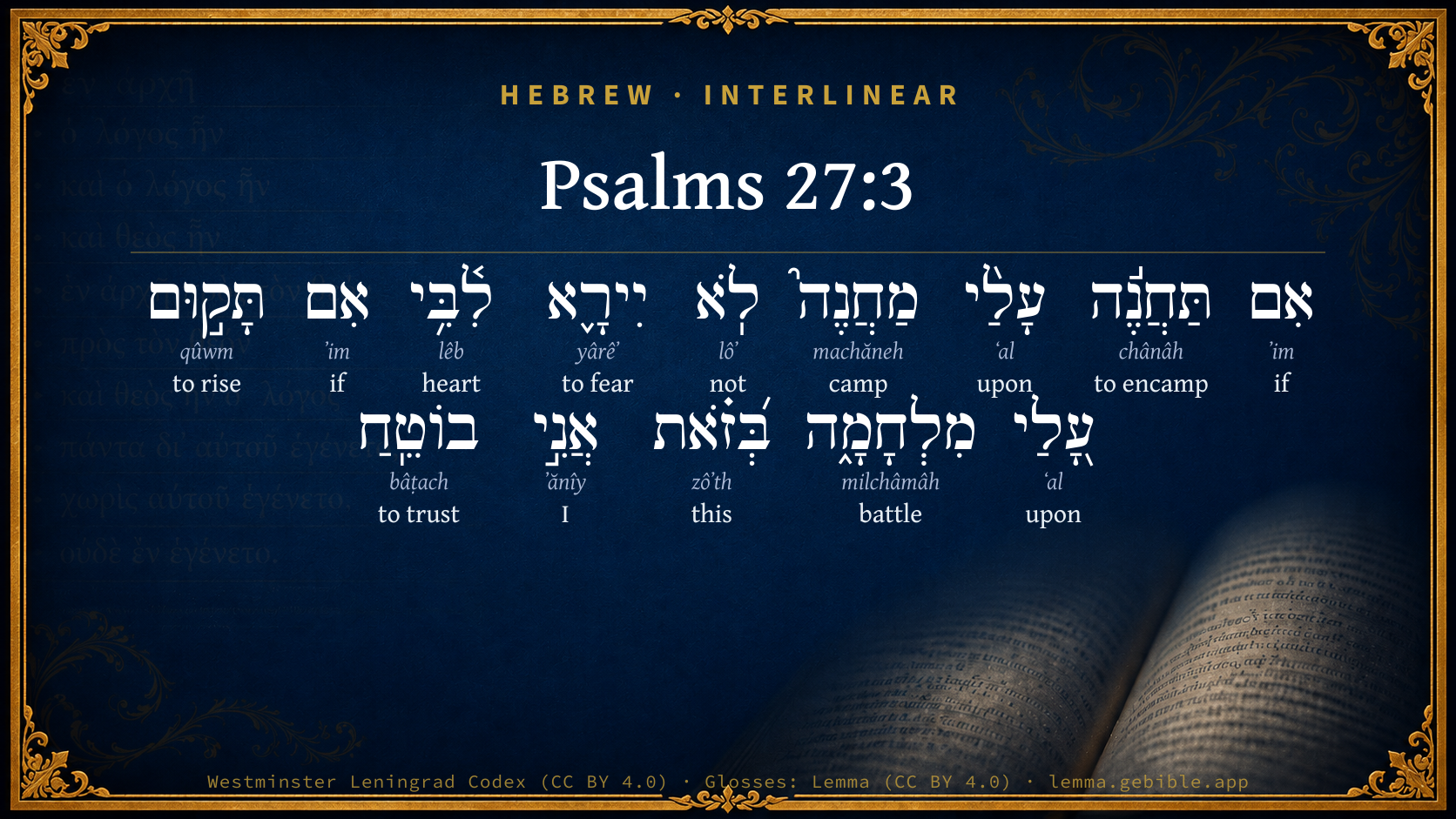
Hebrew (Westminster Leningrad Codex) Psalms 27:3 appears in the Hebrew Old Testament. The text above is from the Westminster Leningrad Codex. Each word links to its Strong’s number, a concise gloss, and parsing drawn from the Open Scriptures Hebrew Bible morphology. Click any word for its full Brown-Driver-Briggs (BDB) entry.
Download image
Cite this verse

Psalms 27:3 (World English Bible). Public Domain. Lemma interlinear Bible study tool, https://lemma.gebible.app/v/psalms/27/3.

Show BibTeX & RIS
BibTeX
RIS
English Translation
Though a host should encamp against me, My heart shall not fear. Though war should rise against me, Even then I will be confident.
World English Bible · Public Domain
Download a study sheet

One document with this verse’s original text, its word-by-word gloss line, the meaning frame, cross-references with their text, attributed commentary, and full source and license credits — printable, and it pastes into notes with its structure intact.

This verse Autodidact and up

Study sheet (.html) Plain text (.txt)

A passage Seminary Student

Up to 50 verses in one chapter. A passage sheet keeps up to 6 commentary sources and 12 cross-references per verse, in the order this page ranks them, and says so on the sheet whenever that leaves anything out. Ask for a single verse and you get the Autodidact verse sheet above.

Everything on this page stays free to read, with no account — the sheet is a download of what is already on screen, not access to it.

Want to remove ads? Support Godless Engineer
Compare translations 3

The same verse in 3 English versions, stacked beneath the original-language interlinear above. Click any original word for its lexicon entry.

Each is an independent rendering of the whole verse — the interlinear is not word-aligned to these translations.

Highlighted words mark where these versions differ — a whole-verse word diff, not a word-by-word alignment.

  • World English Bible Public Domain
    Though a host should encamp against me, My heart shall not fear. Though war should rise against me, Even then I will be confident.
  • King James Version Public Domain
    Though an host should encamp against me, my heart shall not fear: though war should rise against me, in this will I be confident.
  • unfoldingWord Literal Text CC BY-SA 4.0
    Though an army encamps against me, my heart will not fear; though war arises against me, in this I will be confident.

unfoldingWord Literal Text — © unfoldingWord, licensed CC BY-SA 4.0. Word-aligned USFM3 via Door43 (git.door43.org/unfoldingWord/en_ult).

Versions to compare (up to 4)

3 of 4 selected

Show all 18 translations

Every available English version of this verse, each an independent rendering of the whole verse.

  • World English Bible Public Domain
    Though a host should encamp against me, My heart shall not fear. Though war should rise against me, Even then I will be confident.
  • Berean Standard Bible Public Domain
    Though an army encamps around me, my heart will not fear; though a war breaks out against me, I will keep my trust.
  • Majority Standard Bible Public Domain
    Though an army encamps around me, my heart will not fear; though a war breaks out against me, I will keep my trust.
  • King James Version Public Domain
    Though an host should encamp against me, my heart shall not fear: though war should rise against me, in this will I be confident.
  • American Standard Version (1901) Public Domain
    Though a host should encamp against me, My heart shall not fear: Though war should rise against me, Even then will I be confident.
  • Revised Version (1885) Public Domain
    Though an host should encamp against me, my heart shall not fear: though war should rise against me, even then will I be confident.
  • Geneva Bible (1599) Public Domain
    Though an hoste pitched against me, mine heart should not be afraide: though warre be raised against me, I will trust in this.
  • Douay-Rheims (1899) Public Domain
    If armies in camp should stand together against me, my heart shall not fear. If a battle should rise up against me, in this will I be confident.
  • Young's Literal Translation Public Domain
    Though a host doth encamp against me, My heart doth not fear, Though war riseth up against me, In this I `am' confident.
  • Literal Standard Version CC BY-SA 4.0
    Though a host encamps against me, || My heart does not fear, || Though war rises up against me, || In this I [am] confident.
  • Unlocked Literal Bible CC BY-SA 4.0
    Though an army encamps against me, my heart will not fear; though war rises up against me, even then I will remain confident.
  • unfoldingWord Literal Text CC BY-SA 4.0
    Though an army encamps against me, my heart will not fear; though war arises against me, in this I will be confident.
  • Darby Bible Public Domain
    If a host encamp against me, my heart shall not fear; if war rise against me, in this will I be confident.
  • World Messianic Bible Public Domain
    Though an army should encamp against me, my heart shall not fear. Though war should rise against me, even then I will be confident.
  • Webster's Bible Public Domain
    Though a host should encamp against me, my heart shall not fear: though war should rise against me, in this will I be confident.
  • Free Bible Version CC BY-SA 4.0
    Even if an army surrounds me, I won't be frightened. Even if I am attacked, I will still trust in God.
  • Bible in Basic English Public Domain
    Even if an army came against me with its tents, my heart would have no fear: if war was made on me, my faith would not be moved.
  • JPS Tanakh (1917) Public Domain
    Though a host should encamp against me, my heart shall not fear; though war should rise up against me, even then will I be confident.

Literal Standard Version (2020), Covenant Press — licensed CC BY-SA 4.0. Text via the HelloAO Bible API (eBible.org). Unlocked Literal Bible (unfoldingWord) — licensed CC BY-SA 4.0. Text via the HelloAO Bible API (eBible.org). unfoldingWord Literal Text — © unfoldingWord, licensed CC BY-SA 4.0. Word-aligned USFM3 via Door43 (git.door43.org/unfoldingWord/en_ult). Free Bible Version, Dr. Jonathan Gallagher — licensed CC BY-SA 4.0. Text via the HelloAO Bible API (eBible.org).

Word by word

More ways to search: Search by grammar → Find every occurrence → Compare this word →

Practice this passage: Drill this verse → Learn its vocabulary →

בוֹטֵֽחַ
bâṭach
H982
“trusting”
Verb, Qal, Participle Active, Masculine, Singular, Absolute
Part of Speech
Verb
Stem
Qal
Form
Participle Active
Gender
Masculine
Number
Singular
State
Absolute
Full BDB Definition

Origin: a primitive root

TWOT: 233

to trust - (Qal) - to trust, trust in - to have confidence, be confident - to be bold - to be secure - (Hiphil) - to cause to trust, make secure - (TWOT) to feel safe, be careless
  1. אִם ʼim H518 “if” Conjunction
  2. תַּחֲנֶ֬ה chânâh H2583 “to encamp” Verb, Qal, Imperfect, 3rd Person, Feminine, Singular
  3. עָלַ֨י ʻal H5921 “upon · me” Preposition + Suffix, Personal, 1st Person, Common, Singular
  4. מַחֲנֶה֮ machăneh H4264 “camp” Noun, Common, Both, Singular, Absolute
  5. לֹֽא lôʼ H3808 “not” Particle, Negative
  6. יִירָ֪א yârêʼ H3372 “to fear” Verb, Qal, Imperfect, 3rd Person, Masculine, Singular
  7. לִ֫בִּ֥י lêb H3820 “heart · my” Noun, Common, Masculine, Singular, Construct + Suffix, Personal, 1st Person, Common, Singular
  8. אִם ʼim H518 “if” Conjunction
  9. תָּק֣וּם qûwm H6965 “to rise” Verb, Qal, Imperfect, 3rd Person, Feminine, Singular
  10. עָ֭לַי ʻal H5921 “upon · me” Preposition + Suffix, Personal, 1st Person, Common, Singular
  11. מִלְחָמָ֑ה milchâmâh H4421 “battle” Noun, Common, Feminine, Singular, Absolute
  12. בְּ֝זֹ֗את zôʼth H2063 “in/at · this” Preposition + Pronoun, Demonstrative, Feminine, Singular
  13. אֲנִ֣י ʼănîy H589 “I” Pronoun, Personal, 1st Person, Common, Singular

About this verse

These counts appear in no published source. They are computed here, from the morphology-tagged text and Lemma’s own curated glosses. What Lemma adds →

14
words
12
distinct lemmas
Wisdom
section

Grammatical profile

  • 4 verbs
  • 3 nouns
  • 2 pronouns
  • 2 prepositions
  • 2 conjunctions
  • 1 particle

Verb forms

  • תַּחֲנֶ֬ה Qal · Imperfect
  • יִירָ֪א Qal · Imperfect
  • תָּק֣וּם Qal · Imperfect
  • בוֹטֵֽחַ Qal · Participle Active

Repetition

Words recur within this verse — often emphatic in Hebrew:

  • עָלַ֨י upon H5921 ×2
  • אִם if H518 ×2

Hebrew & Septuagint length

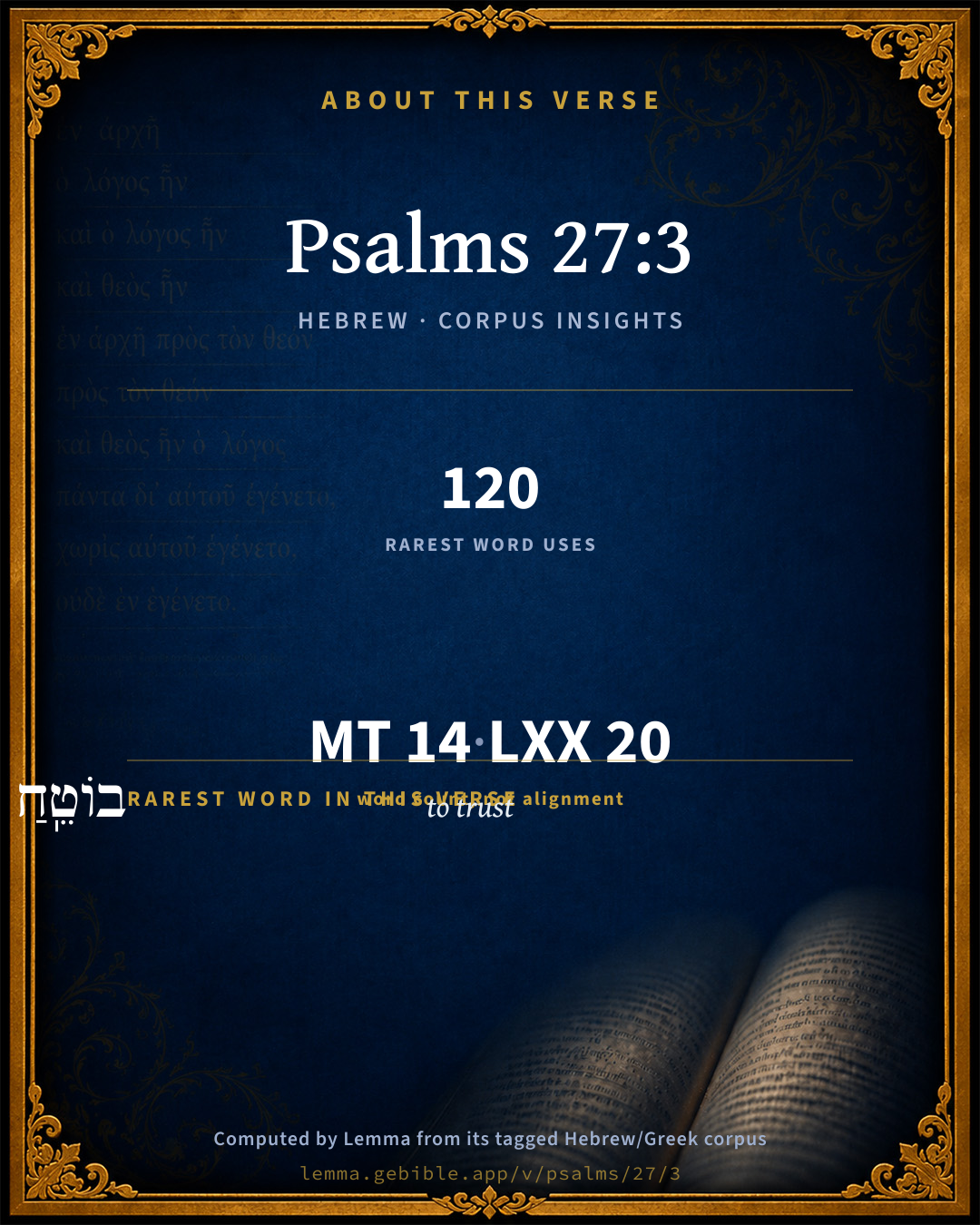
In English translation the verse runs 24 words from the Hebrew and 28 from the Septuagint (LXX English) — closely comparable.

A rough comparison of the two English renderings, which tokenize alike — not a word-level alignment.

Word counts can differ between the Hebrew and the Greek without any difference in meaning — e.g. the Hebrew direct-object marker אֵת has no separate Greek word, and Greek often adds the article ὁ.

In the original languages it is 14 Hebrew tokens and 20 Greek tokens — but the two are counted differently (Hebrew bundles its prefixes and suffixes into one token; the Greek is in lemma form), so that isn’t a like-for-like length.

Cross-references

14

Topical passages linked to Psalms 27:3 in the Treasury of Scripture Knowledge — connected by theme and wording, ordered by reader-vote popularity; previews shown in the World English Bible.

  • Psalms 3:6 I will not be afraid of tens of thousands of people Who have set themselves against me on every side.
  • 1 Peter 3:14 But even if you should suffer for righteousness' sake, you are blessed. "Don't fear what they fear, neither be troubled."
  • Romans 8:35–37 Who shall separate us from the love of Christ? Could oppression, or anguish, or persecution, or famine, or nakedness, or peril, or sword?
  • Philippians 1:28 and in nothing frightened by the adversaries, which is for them a proof of destruction, but to you of salvation, and that from God.
  • 2 Corinthians 5:6–8 Being therefore always of good courage, and knowing that, while we are at home in the body, we are absent from the Lord;
  • Isaiah 54:16–17 Behold, I have created the smith who blows the fire of coals, and brings forth a weapon for his work; and I have created the waster to destroy.
  • Revelation 2:10 Don't be afraid of the things which you are about to suffer. Behold, the devil is about to throw some of you into prison, that you may be tested; and you will have oppression for ten days. Be faithful to death, and I will give you the crown of life.
  • 2 Kings 6:15–17 When the servant of the man of God was risen early, and gone forth, behold, a host with horses and chariots was round about the city. His servant said to him, Alas, my master! how shall we do?
  • Isaiah 41:11–12 Behold, all those who are incensed against you shall be disappointed and confounded: those who strive with you shall be as nothing, and shall perish.
  • 1 Samuel 28:15–16 Samuel said to Saul, Why have you disquieted me, to bring me up? Saul answered, I am sore distressed; for the Philistines make war against me, and God is departed from me, and answers me no more, neither by prophets, nor by dreams: therefore I have called you, that you may make known to me what I shall do.
  • 2 Chronicles 20:15 and he said, Listen you, all Judah, and you inhabitants of Jerusalem, and you king Jehoshaphat: Thus says Yahweh to you, Don't be afraid you, neither be dismayed by reason of this great multitude; for the battle is not yours, but God's.
  • Job 4:6 Isn't your piety your confidence, The integrity of your ways your hope?
  • Psalms 52:6 The righteous also will see it, and fear, And laugh at him, saying,
  • Revelation 12:7–11 There was war in the sky. Michael and his angels made war on the dragon. The dragon and his angels made war.

Cross-references courtesy of OpenBible.info (CC BY 4.0).

Hebrew and Greek witnesses Masoretic Hebrew ↔ Greek Septuagint

The same verse in the two great witnesses to the Old Testament, shown verse-for-verse.

You’re reading Greek Psalm 26 (Hebrew Psalm 27). The Septuagint counts the superscription, so verse numbers can differ from the Hebrew — chapter-level alignment, not verse-by-verse. Numbering follows Rahlfs.

These are two independent witnesses, not word-aligned to each other, and the Septuagint is shown in lemma (dictionary) form.

Hebrew Psalms 27:3 Masoretic · Westminster Leningrad Codex

אִם תַּחֲנֶ֬ה עָלַ֨י מַחֲנֶה֮ לֹֽא יִירָ֪א לִ֫בִּ֥י אִם תָּק֣וּם עָ֭לַי מִלְחָמָ֑ה בְּ֝זֹ֗את אֲנִ֣י בוֹטֵֽחַ

Though a host should encamp against me, My heart shall not fear. Though war should rise against me, Even then I will be confident.

World English Bible · Public Domain

Greek LXX Greek Psalm 26:3 Septuagint · lemma form

ἐάν παρατάσσω ἐπί ἐγώ παρεμβολή οὐ φοβέω ὁ καρδία ἐγώ ἐάν ἐπι ἀναἵστημι ἐπί ἐγώ πόλεμος ἐν οὗτος ἐγώ ἐλπίζω

Though an army should set itself in array against me, my heart shall not be afraid: though war should rise up against me, in this am I confident.

LXX2012 (modern English Septuagint) · Public Domain

On this verse, Ellicott's Commentary for English Readers discusses the Septuagint’s reading. Read the note in Commentary ↓

Hebrew: Westminster Leningrad Codex (CC BY 4.0). Greek: Septuagint (public domain); English from LXX2012 (modern English Septuagint) (Public Domain). How the Septuagint differs from the Hebrew →

Commentary

Notes on Psalms 27:3 from classic Christian and Jewish commentators (each source and its license shown beneath its notes). The classic Christian expositions comment on the surrounding passage and are grouped to its opening verse, so a note may address several verses; the Jewish commentaries on the Tanakh (Rashi and others) are per-verse, so they appear only where the commentator wrote on this verse.

Lemma curates 59 commentaries, every one of them public domain or Creative Commons licensed, each selected and text-cleaned for this edition rather than reprinted as found. About our sources →

Trapp's Complete Commentary

John Trapp

Psa 27:3 Though an host should encamp against me, my heart shall not fear: though war should rise against me, in this [will] I [be] confident.

Ver. 3. Though an host should encamp against me] See Psa 3:6, {See Trapp on "Psa 3:6"} We should propound the worst to ourselves (the best will bring with it, as we say), especially if we find our faith to be in heart and vigour, as here David’s was.

Though war should rise against me] War is a complex evil, and is, therefore, called so by a specialty: Isa 45:7, "I make peace, and create evil," that is, war. Sin, Satan, and war have all one name, saith a learned divine; evil is the best of them: the best of sin is deformity; of Satan, enmity; of war, misery.

In this will I be confident] In this? In what? In this one ensuing petition, saith Aben Ezra; or, in this that I have said before, "The Lord is my light and my salvation"; in this confident gloriation of mine, which is such as an unbeliever is a perfect stranger unto.

John Trapp, A Commentary or Exposition upon All the Books of the Old and New Testament (1647–1656) — public domain. Text from a community e-Sword module.

The Biblical Illustrator

Joseph S. Exell

Psa_27:3

My heart shall not fear.

A stout heart

These are the words of a veteran, not of a raw recruit in the battle of life. A first disaster brings consternation; a ripened experience alone can take calamity calmly. God educates His servants by hard discipline, in conflict with the forces of evil; and He educates the world by calling it to watch the contest.

I. in the strife between good and evil, the good seems to be fearfully overmatched. The host of Midian were as grasshoppers for multitude, but the Israelitish army consisted of three hundred picked men. The Christians in workshops are but a feeble minority. Temples of vice are more crowded and longer open than Christian churches. The Devils recruits far outnumber those of the Prince of Peace.

II. evil ever appears to be hanging over the heads of the godly. To take a Christian stand is to expose oneself to ridicule and to danger. The struggle seems to be a hopeless one, both against the evil without and the evil within. Many an earnest Christian is fearful at times, lest the evil within should finally overmaster him. There seem to be times when the spirit of the lotos-eaters takes possession of us, and we feel that we must take a rest, and let sin sweep over us. Were it not better to make peace with powerful evils rather than contend longer against them?

III. but the threat of disaster is worse than the reality. The Devils bark is more frequent than his bite. Many a dark cloud passes without bursting with the threatening storm. The darkest hour is often that before the dawn. In any case, to treat a threatening evil as an actual one is to suffer needlessly. The coward dies a thousand deaths before he dies once. Courage! Do not yield to evil because the siege is a strait one.

IV. apparent odds are no test of ultimate victory. He who has not lost courage is master of the future. It is not true to say that God is on the side of the biggest battalions. What of Gideons three hundred, and the ten thousand Greeks at Marathon? What, too, of the immense hosts of the Spanish Armada? Gods greatest victories have been won by the smallest and apparently most feeble forces.

V. the suffering of apparent defeat in the cause of right is but sharing the burden of God. The hermit who stopped the gladiatorial contests at the cost of his own life, chose a nobler lot than they did who occupied seats of honour in the amphitheatre; and we all see it now, though few saw it then. We may do more for Gods cause by our suffering than we could by our prosperity. How can man die better?

VI. the calm endurance of calamity brings its own blessings. A regiment is of but little use in battle until it has been shot over. The tried man is the blessed man. By such endurance we bring a nobler ideal nearer to men. And we secure the sympathy of the noblest souls for truth and righteousness. (R. C. Ford, M. A.)

Fortitude

Fortitude is opposed to timidity, irresolution, a feeble and wavering spirit. It is placed, like other virtues, between two extremes: at an equal distance from rashness on the one hand, and pusillanimity on the other.

I. the high importance of fortitude.

1. Without some degree of fortitude, there can be no happiness; because, amidst the thousand uncertainties of life, there can be no enjoyment of tranquillity. The man of feeble and timorous spirit lives under perpetual alarms. On the first shock of adversity he desponds. On the other hand, firmness of mind is the parent of tranquillity. It enables one to enjoy the present without disturbance; and to look calmly on dangers that approach, or evils that threaten in future. It suggests good hopes. It supplies resources. It allows a man to retain the full possession of himself, in every situation of fortune.

2. If fortitude be thus essential to the enjoyment of life, it is equally so to the proper discharge of all its most important duties. He who is of a cowardly mind is, and must be, a slave to the world. He fashions his whole conduct according to its hopes and fears. He smiles, and fawns, and betrays, from abject considerations of personal safety. He can neither stand the clamour of the multitude, nor the frowns of the mighty. The wind of popular favour, or the threats of power, are sufficient to shake his most determined purpose.

3. Without this temper of mind, no man can be a thorough Christian. For his profession, as such, requires him to be superior to that fear of man which bringeth a snare; enjoins him, for the sake of a good conscience, to encounter every danger; and to be prepared, if called, even to lay down his life in the cause of religion and truth.

II. the proper foundations of fortitude.

1. A good conscience. There can be no true courage, no regular persevering constancy, but what is connected with principle, and founded on a consciousness of rectitude of intention. This, and this only, erects that brazen wall which we can oppose to every hostile attack. It clothes us with an armour, on which fortune will spend its shafts in vain. What has he to fear, who not only acts on a plan which his conscience approves, but who knows that every good man, nay, the whole unbiassed world, if they could trace his intentions, would justify and approve his conduct?

2. He knows, at the same time, that he is acting under the immediate eye and protection of the Almighty. The consciousness of such an illustrious spectator invigorates and animates him. He trusts that the eternal Lover of righteousness not only beholds and approves, but will strengthen and assist; will not suffer him to be unjustly oppressed, and will reward his constancy in the end, with glory, honor, and immortality.

III. considerations which may prove auxiliary to the exercise of virtuous fortitude in the midst of dangers.

1. It is of high importance to every one, who wishes to act his part with becoming resolution, to cultivate a religious principle, and to be inspired with trust in God. The more firmly this belief is rooted in the heart, its influence will be more powerful in surmounting the fears which arise from a sense of our own weakness or danger. The records of all nations afford a thousand remarkable instances of the effect of this principle, both on individuals and on bodies of men. Animated by the strong belief of a just cause, and a protecting God, the feeble have waxed strong, and despised dangers, sufferings, death.

2. Let him who would preserve fortitude in difficult situations, fill his mind with a sense of what constitutes the true honour of man. It consists not in the multitude of riches, or the elevation of rank; for experience shows that these may be possessed by the worthless, as well as by the deserving. It consists in being deterred by no danger when duty calls us forth; in fulfilling our allotted part, whatever it may be, with faithfulness, bravery, and constancy of mind. These qualities never fail to stamp distinction on the character.

3. But in order to acquire habits of fortitude, what is of the highest consequence is to have formed a just estimate of the goods and evils of life, and of the value of life itself. For here lies the chief source of our weakness and pusillanimity. We over-value the advantages of fortune; rank and riches, ease and safety. (H. Blair, D. D.)

Dauntless courage

A Dutch fleet once drew near to Chatham. Fearing it might effect a landing, the Duke of Albemarle determined to prevent it, and endeavoured to inspire his men with his own dauntless spirit. Calmly he took his position in the front, thus exposing himself to the hottest fire from the hostile ships. An affectionate but over-cautious friend, seeing him in such danger, darted forward, seized him by the arm, and exclaimed, Retire, I beseech you, from this fierce shower of bullets, or you will be a dead man! The Duke, releasing himself from his grasp, turned coldly on the man who would tempt him to cowardice in the hour of his countrys need, and replied, Sir, if I had been afraid of bullets I should have given up the profession of a soldier long ago. (Quiver.)

The Biblical Illustrator, edited by Joseph S. Exell (c. 1880s–1900s) — public domain. Text from a community e-Sword module.

The Treasury of David

Charles H. Spurgeon

Ver. 3-4. The favourite grows great by the many favours, gifts, jewels, offices, the prince bestows upon him. The Christian grows rich in experiences, which he wears as bracelets, and keeps as his richest jewels. He calls one Ebenezer "hitherto God hath helped; "and other Naphtali "I have wrestled with God and prevailed; "another Gershom "I was a stranger; "another Joseph "God will yet add more; "and another, Peniel "I have seen the face of God." 1Sa 7:12 Ge 30:8 Ex 2:22 Ge 30:24 Ge 32:30. I have been delivered from the lion, therefore shall be from the bear; from lion and bear, therefore from the Philistine; from the Philistine, therefore from Saul; from Saul, therefore God will deliver me from every evil work, and preserve me blameless to his heavenly kingdom. John Sheffield.

Ver. 3 Christian peace.

1. Exhibited in the calm foresight of trouble.

2. Displayed in the confident endurance of affliction.

3. Sustained by divine help and past experience Ps 27:1-2.

4. Producing the richest results, glory to God, etc.

Psalms 27:4*

Ver. 3-4. See Psalms on "Ps 27:3" for further information.

Charles H. Spurgeon's The Treasury of David (1869–1885) — public domain. Psalms only. Text from a community e-Sword/MySword module.

Tyndale Open Study Notes

Tyndale Open Resources

27:3 remain confident: See 25:2; 26:1.

Tyndale Open Study Notes — © Tyndale Open Resources, licensed CC BY-SA 4.0. Text via the HelloAO Bible API.

Geneva Bible (1599)

Geneva Bible translators

That God will deliver me and give my faith the victory.

Geneva Bible (1599) marginal notes — public domain. Text via Bolls.life.

Jamieson, Fausset & Brown

Robert Jamieson, A. R. Fausset & David Brown

In the greatest dangers.

in this--that is, then, in such extremity.

Jamieson, Fausset & Brown — Commentary Critical and Explanatory on the Whole Bible (1871) — public domain (CC PDM 1.0). Text via the HelloAO Bible API.

Adam Clarke's Commentary

Verse 3. Though a host should encamp against me] I am so confident of the Almighty's protection, that were I alone, and encompassed by a host, I would not fear. I am in the hand of God; and while in that hand, I am safe.

Adam Clarke's Commentary on the Bible (1810–1826) — public domain. Text from a community e-Sword/MySword module.

John Calvin's Commentaries

3. Though armies should encamp. He infers from his former experience, as I have already mentioned, that whatever adversity may befall him, he ought to hope well, and to have no misgivings about the divine protection, which had been so effectually vouchsafed to him in his former need. He had asserted this, indeed, in the first verse, but now, upon farther proof of it, he repeats it. Under the terms, camps and armies, he includes whatever is most formidable in the world: as if he had said, Although all men should conspire for my destruction, I will disregard their violence, because the power of God, which I know is on my side, is far above theirs. But when he declares, My heart shall not fear, this does not imply that he would be entirely devoid of fear, — for that would have been more worthy of the name of insensibility than of virtue; but lest his heart should faint under the terrors which he had to encounter, he opposed to them the shield of faith. Some transfer the word translated in this to the following verse, meaning that he was confident that he would dwell in God’s house; but I am of opinion that it belongs rather to the preceding doctrine. For then does faith bring forth its fruit in due season, when we remain firm and fearless in the midst of dangers. David, therefore, intimates, that when the trial comes, his faith will prove invincible, because it relies on the power of God.

John Calvin's Commentaries (1540-1563) — public domain. Text from the Calvin Translation Society English edition (1840s-50s) via the Christian Classics Ethereal Library (ccel.org). Calvin's coverage is partial (roughly two-thirds of the Bible); uncommented books and verses are honest gaps, never fabricated. The 19th-century editor's footnotes and remarks are omitted so the notes are faithfully Calvin's own voice.

Ellicott's Commentary for English Readers

(3) Though an host.—Literally, Though a camp should encamp.

In this.—Either in this circumstance or in spite of this. (Comp. Psa_78:32.) The LXX. ἐν ταύτῃ, followed by μίαν in the next clause, seems to refer it to the hope about to be expressed. The Rabbinical commentators (e.g., Aben Ezra and Rashi) refer back to the beginning of the psalm. “In this”—viz., that Jehovah is my light—“do I trust.” Rosenmiiller refers it to “the battle” just mentioned, in ipsa pugna.

A Bible Commentary for English Readers, edited by Charles John Ellicott (1878–1897) — public domain. Text from a community e-Sword module.

The Cambridge Bible for Schools and Colleges

gen. ed. J. J. S. Perowne

3. The language may be figurative, but is more natural, if the writer was, like David, actually exposed to war’s alarms. Cp. Psa_3:6.

in this] In the truth of Psa_27:1. But it is better to render with R.V., even then, in spite of opposing armies.

The Cambridge Bible for Schools and Colleges (gen. ed. J. J. S. Perowne; Cambridge University Press, 1878–1918) — public domain. Text from a community e-Sword module.

John Gill's Exposition

Though an host should encamp against me,.... An host of the ungodly, as the Targum; though ever so many of them, even ten thousands of them, as in Psa 3:6; should beset him on every side;

my heart shall not fear; for not only the angels of the Lord encamped about him, as they do about all that fear the Lord; but salvation was appointed for walls and bulwarks about him; yea, the Lord himself was a wall of fire around him, and he was kept as in a garrison by the power of God;

though war should rise against me: in all its terrible shapes:

in this will I be confident; either in this war, in the midst of it; or in this that he had expressed, Psa 27:1; that the Lord was his light, his salvation, and the strength of his life; so the Jewish writers (e): or as others (f), in this one thing, desired in Psa 27:4; but either of the former senses is best, especially the latter of them. Saints need not be afraid, though there is a war within them between the flesh and spirit; and though without are fightings with Satan and his principalities and powers; since they may be confident of victory, and that they are more than conquerors, through Christ that has loved them.

(e) Jarchi, Kimchi, & Aben Ezra in loc. (f) Some in Aben Ezra in loc.

John Gill's Exposition of the Whole Bible (1746–1763) — public domain (CC PDM 1.0). Text via the HelloAO Bible API.

Albert Barnes' Notes on the Bible

Though an host - Though an “army;” that is, any army, or any number of men in battle array. The past interposition of God in similar times of trouble and danger was to him a sufficient security that he had nothing to fear.

Should encamp against me - In battle array, or prepared for battle.

My heart shall not fear - He would not tremble; he would not feel that there was anything of which to be afraid. God had shown Himself superior to the power of hostile armies, and the psalmist felt assured that he might confide in Him.

Though war should rise against me - Though it should be proclaimed, and though all preparation should be made for it, I will not be afraid.

In this will I be confident - In such a case, in such an extremity or emergency, I would calmly trust in God. He would apprehend no danger, for he had seen that the Lord could deliver him.

Albert Barnes' Notes on the Bible (1834–1885) — public domain. Text from a community e-Sword/MySword module.

Matthew Poole's English Annotations

In that which I have now said, that God is my light, &c., Psa 27:1, and in the experience of his favour and protection, Psa 27:2.

Matthew Poole's English Annotations on the Holy Bible (1683–1685) — public domain. Text from a community e-Sword/MySword module.

Whedon's Commentary on the Bible

Daniel D. Whedon

3. Though a host—See Psa_3:6, on same occasion.

In this will I be confident—In spite of this, or for all this, I will trust. These first three verses are an outbreathing of the courage of faith.

Daniel D. Whedon (gen. ed.), Commentary on the Old and New Testaments (1874–1909) — public domain. Text from a community e-Sword module.

The Pulpit Commentary

Though a host should encamp against me, my heart shall not fear. In the first burst of joy at his recent victory, the "host" which remains unconquered seems of light account let them advance let them "encamp against him his heart will not be afraid; but when the joy has had full vent, there is a reaction; the enemies then appear more formidable, and God"s aid is besought against them (see vers. 9-12). Though war should rise against me, in this will I be confident . "In this" may be either "in the fact that the Lord is my Light and my Salvation" (ver. 1), or "in case of such an event as war and attack on the part of the enemy."

The Pulpit Commentary (1880–1919), ed. H.D.M. Spence-Jones & Joseph S. Exell — public domain. Text from a community e-Sword module.

John Wesley's Explanatory Notes

In this - That God is my light.

John Wesley, Explanatory Notes Upon the Whole Bible (1754–1765) — public domain. Text via the GEBible commentary corpus.

Rashi

Rabbi Shlomo Yitzchaki (Rashi)

in this I trust In what is stated above: “The Lord is the stronghold of my life.”

Rashi on the Tanakh — English translations: “The Judaica Press complete Tanach with Rashi, translated by A. J. Rosenberg” (CC BY 4.0); “Pentateuch with Rashi's commentary by M. Rosenbaum and A.M. Silbermann, 1929-1934” (public domain); “The Metsudah Tanach series, Lakewood, N.J” (CC BY 4.0); and “The Book of Joshua, Metsudah Publications, 1997” (CC BY 4.0). Text via Sefaria.

Lesson kit

Teaching starters — assembled from the data on this page, not authored interpretation. Every prompt links to the verse data it draws on. Edit before teaching.

Psalms, in the Wisdom, opens this verse with 14 words (12 distinct Hebrew lemmas). Its most distinctive word is bâṭach (“to trust”). A historical commentator’s framing appears above. Read the whole chapter for the surrounding context.

Discussion questions

  1. What does “to trust” (bâṭach) contribute to the verse as a whole?
  2. Psalms 3:6 shares this passage’s theme. How do the two illuminate each other?
  3. “upon” occurs 2× in this one verse. What is the effect of the repetition?
  4. The translations on this page render this verse differently — a whole-verse word diff, not a word-by-word alignment. What might account for the different wordings?
  5. The verb «תַּחֲנֶ֬ה» is Qal Imperfect. How does its form color the action?
  6. Reading how Trapp's Complete Commentary and The Biblical Illustrator read this verse, where do the two commentators agree and where do they part?

Things to notice

Reading settings

Reading text

Shown beneath each verse's original-language words.

Old Testament
Old Testament edition

Read the OT as the Masoretic Hebrew (MT) or the Greek Septuagint (LXX).

English shown for the Greek Septuagint (in the Hebrew ↔ Greek comparison).

Comparing translations? Open the Compare panel on any verse page to stack up to four side by side.