
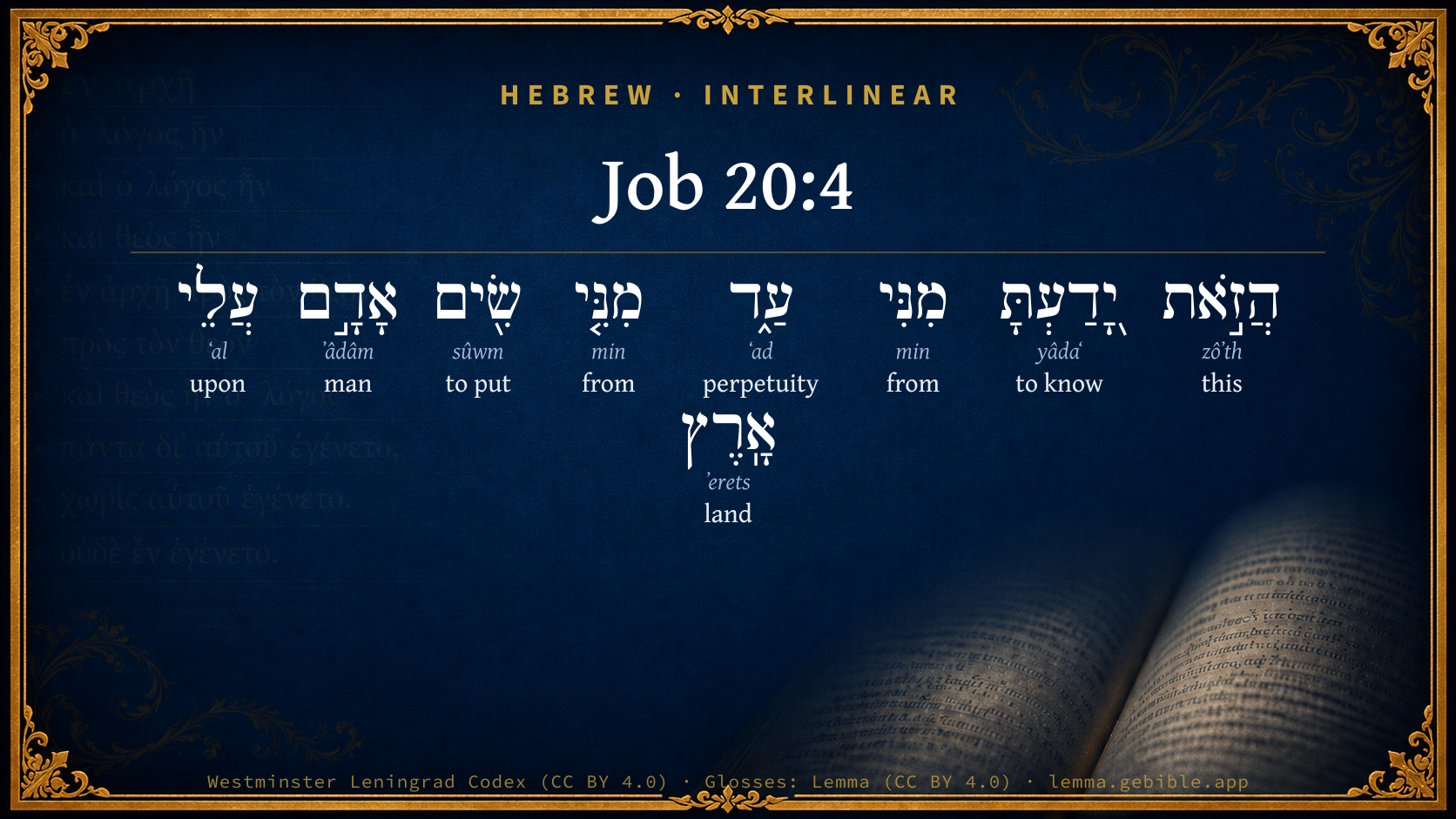
Job 20:4

Hebrew (Westminster Leningrad Codex) Job 20:4 appears in the Hebrew Old Testament. The text above is from the Westminster Leningrad Codex. Each word links to its Strong’s number, a concise gloss, and parsing drawn from the Open Scriptures Hebrew Bible morphology. Click any word for its full Brown-Driver-Briggs (BDB) entry.
Download image
Cite this verse

Job 20:4 (World English Bible). Public Domain. Lemma interlinear Bible study tool, https://lemma.gebible.app/v/job/20/4.

Show BibTeX & RIS
BibTeX
RIS
English Translation
Don't you know this from old time, Since man was placed on earth,
World English Bible · Public Domain
Download a study sheet

One document with this verse’s original text, its word-by-word gloss line, the meaning frame, cross-references with their text, attributed commentary, and full source and license credits — printable, and it pastes into notes with its structure intact.

This verse Autodidact and up

Study sheet (.html) Plain text (.txt)

A passage Seminary Student

Up to 50 verses in one chapter. A passage sheet keeps up to 6 commentary sources and 12 cross-references per verse, in the order this page ranks them, and says so on the sheet whenever that leaves anything out. Ask for a single verse and you get the Autodidact verse sheet above.

Everything on this page stays free to read, with no account — the sheet is a download of what is already on screen, not access to it.

Want to remove ads? Support Godless Engineer
Compare translations 3

The same verse in 3 English versions, stacked beneath the original-language interlinear above. Click any original word for its lexicon entry.

Each is an independent rendering of the whole verse — the interlinear is not word-aligned to these translations.

Highlighted words mark where these versions differ — a whole-verse word diff, not a word-by-word alignment.

  • World English Bible Public Domain
    Don't you know this from old time, Since man was placed on earth,
  • King James Version Public Domain
    Knowest thou not this of old, since man was placed upon earth,
  • unfoldingWord Literal Text CC BY-SA 4.0
    Do you know this from long ago, from the placing of man upon the earth,

unfoldingWord Literal Text — © unfoldingWord, licensed CC BY-SA 4.0. Word-aligned USFM3 via Door43 (git.door43.org/unfoldingWord/en_ult).

Versions to compare (up to 4)

3 of 4 selected

Show all 18 translations

Every available English version of this verse, each an independent rendering of the whole verse.

  • World English Bible Public Domain
    Don't you know this from old time, Since man was placed on earth,
  • Berean Standard Bible Public Domain
    Do you not know that from antiquity, since man was placed on the earth,
  • Majority Standard Bible Public Domain
    Do you not know that from antiquity, since man was placed on the earth,
  • King James Version Public Domain
    Knowest thou not this of old, since man was placed upon earth,
  • American Standard Version (1901) Public Domain
    Knowest thou `not' this of old time, Since man was placed upon earth,
  • Revised Version (1885) Public Domain
    Knowest thou not this of old time, since man was placed upon earth,
  • Geneva Bible (1599) Public Domain
    Knowest thou not this of olde? and since God placed man vpon the earth,
  • Douay-Rheims (1899) Public Domain
    This I know from the beginning, since man was placed upon the earth,
  • Young's Literal Translation Public Domain
    This hast thou known from antiquity? Since the placing of man on earth?
  • Literal Standard Version CC BY-SA 4.0
    Have you known this from antiquity? Since the placing of man on earth?
  • Unlocked Literal Bible CC BY-SA 4.0
    Do you not know this fact from ancient times, when God placed man on earth:
  • unfoldingWord Literal Text CC BY-SA 4.0
    Do you know this from long ago, from the placing of man upon the earth,
  • Darby Bible Public Domain
    Knowest thou [not] this, that of old, since man was placed upon earth,
  • World Messianic Bible Public Domain
    Don’t you know this from old time, since man was placed on earth,
  • Webster's Bible Public Domain
    Knowest thou not this of old, since man was placed upon earth,
  • Free Bible Version CC BY-SA 4.0
    Don't you know that since ancient times, since human beings were put on this earth,
  • Bible in Basic English Public Domain
    Have you knowledge of this from early times, when man was placed on the earth,
  • JPS Tanakh (1917) Public Domain
    Knowest thou not this of old time, since man was placed upon earth,

Literal Standard Version (2020), Covenant Press — licensed CC BY-SA 4.0. Text via the HelloAO Bible API (eBible.org). Unlocked Literal Bible (unfoldingWord) — licensed CC BY-SA 4.0. Text via the HelloAO Bible API (eBible.org). unfoldingWord Literal Text — © unfoldingWord, licensed CC BY-SA 4.0. Word-aligned USFM3 via Door43 (git.door43.org/unfoldingWord/en_ult). Free Bible Version, Dr. Jonathan Gallagher — licensed CC BY-SA 4.0. Text via the HelloAO Bible API (eBible.org).

Word by word

More ways to search: Search by grammar → Find every occurrence → Compare this word →

Practice this passage: Drill this verse → Learn its vocabulary →

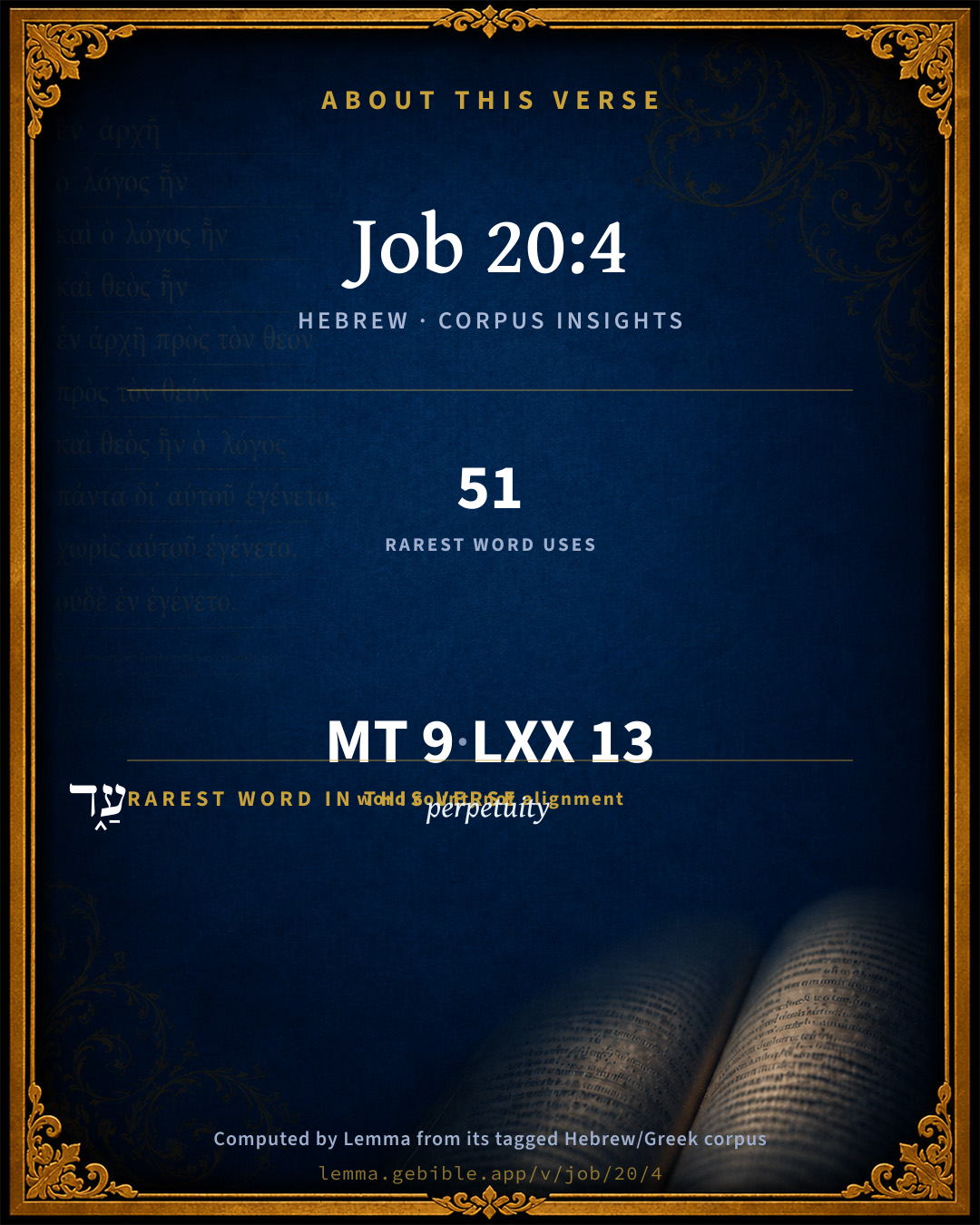
About this verse

These counts appear in no published source. They are computed here, from the morphology-tagged text and Lemma’s own curated glosses. What Lemma adds →

9
words
8
distinct lemmas
Wisdom
section

Shared distinctive vocabulary

עַ֑ד perpetuity H5703 occurs in 49 verses of the Hebrew Bible. Also found in:

Grammatical profile

  • 2 verbs
  • 3 nouns
  • 1 pronoun
  • 3 prepositions

Verb forms

  • יָ֭דַעְתָּ Qal · Perfect
  • שִׂ֖ים Qal · Infinitive Construct

Repetition

A word recurs within this verse — often emphatic in Hebrew:

  • מִנִּי from H4480 ×2

Hebrew & Septuagint length

In English translation the verse runs 13 words from the Hebrew and 18 from the Septuagint (LXX English) — closely comparable.

A rough comparison of the two English renderings, which tokenize alike — not a word-level alignment.

Word counts can differ between the Hebrew and the Greek without any difference in meaning — e.g. the Hebrew direct-object marker אֵת has no separate Greek word, and Greek often adds the article ὁ.

In the original languages it is 9 Hebrew tokens and 13 Greek tokens — but the two are counted differently (Hebrew bundles its prefixes and suffixes into one token; the Greek is in lemma form), so that isn’t a like-for-like length.

Cross-references

6

Topical passages linked to Job 20:4 in the Treasury of Scripture Knowledge — connected by theme and wording, ordered by reader-vote popularity; previews shown in the World English Bible.

  • Genesis 1:28 God blessed them. God said to them, "Be fruitful, multiply, fill the earth, and subdue it. Have dominion over the fish of the sea, over the birds of the sky, and over every living thing that moves on the earth."
  • Genesis 9:1–3 God blessed Noah and his sons, and said to them, "Be fruitful, and multiply, and replenish the earth.
  • Job 8:8–9 "Please inquire of past generations, Find out about the learning of their fathers.
  • Job 15:10 With us are both the gray-headed and the very aged men, Much elder than your father.
  • Job 32:7 I said, 'Days should speak, And multitude of years should teach wisdom.'
  • Psalms 115:16 The heavens are the heavens of Yahweh; But the earth has he given to the children of men.

Cross-references courtesy of OpenBible.info (CC BY 4.0).

Hebrew and Greek witnesses Masoretic Hebrew ↔ Greek Septuagint

The same verse in the two great witnesses to the Old Testament, shown verse-for-verse.

These are two independent witnesses, not word-aligned to each other, and the Septuagint is shown in lemma (dictionary) form.

Hebrew Job 20:4 Masoretic · Westminster Leningrad Codex

הֲזֹ֣את יָ֭דַעְתָּ מִנִּי עַ֑ד מִנִּ֤י שִׂ֖ים אָדָ֣ם עֲלֵי אָֽרֶץ

Don't you know this from old time, Since man was placed on earth,

World English Bible · Public Domain

Greek LXX Job 20:4 Septuagint · lemma form

μή οὗτος γιγνώσκω ἀπό ὁ ἔτι ἀπό ὅς τίθημι ἄνθρωπος ἐπί ὁ γῆ

Have you not known these things of old, from the time that man was set upon the earth?

LXX2012 (modern English Septuagint) · Public Domain

On this verse, Haydock's Catholic Bible Commentary discusses the Septuagint’s reading. Read the note in Commentary ↓

Hebrew: Westminster Leningrad Codex (CC BY 4.0). Greek: Septuagint (public domain); English from LXX2012 (modern English Septuagint) (Public Domain). How the Septuagint differs from the Hebrew →

Commentary

Notes on Job 20:4 from classic Christian and Jewish commentators (each source and its license shown beneath its notes). The classic Christian expositions comment on the surrounding passage and are grouped to its opening verse, so a note may address several verses; the Jewish commentaries on the Tanakh (Rashi and others) are per-verse, so they appear only where the commentator wrote on this verse.

Lemma curates 59 commentaries, every one of them public domain or Creative Commons licensed, each selected and text-cleaned for this edition rather than reprinted as found. About our sources →

Trapp's Complete Commentary

John Trapp

Job 20:4 Knowest thou [not] this of old, since man was placed upon earth,

Ver. 4. Knowest thou not this of old] Whether Zophar intended his own conscience or not before, he here appealeth to Job’s; and secretly taxeth him of going against it, or, at least, of gross ignorance; knowest thou not this, which every one knoweth that is not a mere novice, and which is proved by the examples and experiences of all ages? to wit, Malis male esse, that it shall be ill with the wicked. This is a generally received maxim, and the histories of all ages do plainly and plentifully confirm it. Hinc collige, diligenter observanda esse, &c. (Merlin). Hence we may well gather, that God’s judgments against wicked persons are to be diligently observed out of the histories of all ages, both divine and human.

Since man was placed upon the earth] Heb. Since he placed man upon the earth, viz. in that earthly paradise, the garden of Eden, planted for purpose of man’s pleasure; where, nevertheless, he stayed not one night, as some gather from Psa 49:12, but soon by his sin became like the beasts that perish ( pecoribus morticinis), that die of the murrain, saith Junius, and so are good for nothing. Cain for like cause was cast out, the old world drowned, Sodom and her sisters consumed with fire, &c. There cannot be one instance given to the contrary of that which is here affirmed, viz.

John Trapp, A Commentary or Exposition upon All the Books of the Old and New Testament (1647–1656) — public domain. Text from a community e-Sword module.

The Biblical Illustrator

Joseph S. Exell

Job_20:4-5

That the triumphing of the wicked is short.

The triumph of the wicked

The words of the text are indisputably true, though misapplied. In the world there is, alas! very often a triumphing of the wicked. Sometimes We see it on a grand scale, as in the cases of Pharaoh, or of Nero. Sometimes we see it on a small scale. There is great mystery in this apparent triumph of evil. Many a suffering saint has been perplexed by this feature of the Divine government (Psa_23:1-6).

I. Some thoughts as to why the wicked should be allowed to triumph for a season.

1. God is a God of patience and long-suffering. He does not cut short the day of grace, even of the most ungodly, but gives them space for repentance. And even if this is of no avail, yet it is a display of His own attributes, and leaves the impenitent more completely without excuse.

2. This triumph may be permitted for a time, as a chastisement to His people, or to His world. God uses the wicked as unconscious instruments in executing His will, and especially in inflicting chastisement on His backsliding people.

II. There is another, and how different a triumph, the triumph of the Christian. His triumph is not over the weak and suffering, but over the strong--the world, the flesh, the devil. (George Wagner.)

The triumphing of the wicked short

I. The triumph mentioned. The term used by Zophar is of very general meaning. It signifies the joy which is displayed by the conqueror on account of the successes which have attended him. It is to be understood as referring to the boast which ungodly men often make of their achievements. The term applies to the general conduct of all those who set Gods laws at defiance, and by their life show who take pleasure in the ways of sin. The enjoyment of transgression is the triumph of ungodliness.

II. The shortness of the triumphs of man.

1. In regard to the object itself. It is a conquest which circumstances put into their hands. But see how unstable is war.

2. The expression is also true as it regards the term of human life. The period allotted to man, even the longest period, is only a small portion of time. Death will soon overtake the ungodly, and put a final termination to all his plans and purposes; he will hurry the soul before the Judge of quick and dead, to give account of the deeds done in the body. Then will appear the value of the one thing needful. This subject teaches the people of God not to despond, not to judge or conclude that the wicked are happy, because they seem to prosper and triumph. It teaches the believer the obligations under which he lies to God for grace--grace which has enlightened his mind--grace which has led him to Christ, to believe in Him, and find mercy and peace--grace which has guided his steps, and enabled him to bear patiently all the ills of life, in the hope of a triumph forever. (F. Rogers Blackley.)

And the joy of the hypocrite but for a moment.

Against hypocrisy

Prejudice or passion will miserably warp the judgment. It will hide from us what we know not, and cause us to pervert what we do know. This is exemplified in the friends of Job. Job had hinted to them the evil and danger of their conduct (Job_19:28-29). And Zophar, irritated at the caution, replies with great severity. His words, however, though misapplied, suggest to us two very important truths respecting sinners.

I. Their prosperity is transient. Of sinners, some make no profession of religion, and others a false profession. Each of these characters may enjoy, for a while, great prosperity the profane are often exalted to places of dignity and power. They prosper in all their labours for wealth and preferment. They triumph, as though no evil should ever happen unto them (Psa_73:3-12). Hypocrites also frequently are held in estimation (Rev_3:1). They are objects of envy to many an humble and contrite soul. They will boast of experiences which might well be coveted. And even attain considerable heights of joy (Mat_13:20). But their prosperity will be of short duration. The hypocrite shall have a period put to his dissimulation. He shall soon appear in his proper character (Deu_32:35). In comparison of eternity, the duration of his joy will be but a moment.

II. their ruin will be tremendous. The ungodly will in due time be visited for their offences. They will then perish.

1. To their own eternal shame.

2. To the astonishment of all that knew them. The question Where is he? refers primarily to the utter extinction of the ungodly. Address--Know you not this? Know you not that this has been so from the beginning of the world? Does not the Word of God assert that it shall be ill with the wicked? (Isa_3:11; Psa_9:17.) Does not the most authentic history in the world prove it to have been so? (Sketches of Sermons.)

The Biblical Illustrator, edited by Joseph S. Exell (c. 1880s–1900s) — public domain. Text from a community e-Sword module.

Joseph Benson's Commentary

Job 20:4-5. Knowest thou not this — Which I am now about to say; of old — From the experience of all former ages; since man was placed upon the earth — Since the world was made, and there were any men to observe God’s government of it; that the triumphing of the wicked is short — Hebrew, מקרוב, mikarob, is from near, that is, from, or for a little time; they have not long enjoyed it, and it will shortly vanish. And the joy of the hypocrite but for a moment — This he adds by way of reflection upon Job, who, though he cleared himself of gross wickedness, yet, he judged, was guilty of deep hypocrisy.

Joseph Benson's Commentary on the Old and New Testaments (1811–1818) — public domain. Text from a community e-Sword module.

Adam Clarke's Commentary

Verse 4. Knowest thou not this of old] This is a maxim as ancient as the world; it began with the first man: A wicked man shall triumph but a short time; God will destroy the proud doer.

Since man was placed upon earth] Literally, since ADAM was placed on the earth; that is, since the fall, wickedness and hypocrisy have existed; but they have never triumphed long. Thou hast lately been expressing confidence in reference to a general judgment; but such is thy character, that thou hast little reason to anticipate with any joy the decisions of that day.

Adam Clarke's Commentary on the Bible (1810–1826) — public domain. Text from a community e-Sword/MySword module.

The Cambridge Bible for Schools and Colleges

gen. ed. J. J. S. Perowne

4–10. The prosperity of the wicked is brief

4. Knowest thou not this old] i. e. knowest thou not this to be or to have been of old, lit. from for ever. “This” which is from of old and from the time man has been upon the earth is the fact that the felicity of the wicked is brief (Job_20:5). On “hypocrite” see ch. Job_8:13.

The Cambridge Bible for Schools and Colleges (gen. ed. J. J. S. Perowne; Cambridge University Press, 1878–1918) — public domain. Text from a community e-Sword module.

John Gill's Exposition

Knowest thou not this of old,.... Or "from eternity" (g), from the beginning of time, ever since the world was; as if he should say, if you are the knowing man you pretend to be, you must know this I am about to observe; and if you do not know it, you must be an ignorant man, since it is an ancient truth, confirmed by all experience from the creation; not that Job could know it so early, he was not the first man that was born, nor was he made before the hills, but was of yesterday, and comparatively knew nothing; but the sense is, that this about to be delivered was an old established maxim, of which there had been numerous instances,

since man, or "Adam",

was placed upon earth; referring to the putting of Adam in Eden to dress the garden, and keep it; and every man, ever since, is placed on earth by the ordination, and according to the will of God, where and for purposes he pleases: the instances Zophar might have in view are perhaps the expulsion of our first parents out of paradise, the vagabond state of Cain, the destruction of the old world by a flood, and of Sodom and Gomorrah by fire from heaven; which show that God, sooner or later, gives manifest tokens of his displeasure at sin and sinners, by his punishment of them for it. What he means is as follows.

(g) "ab aeterno", Junius & Tremellius, Drusius, Codurcus, Schmidt, Michaelis.

John Gill's Exposition of the Whole Bible (1746–1763) — public domain (CC PDM 1.0). Text via the HelloAO Bible API.

Albert Barnes' Notes on the Bible

Knowest thou not this of old - That is, dost thou not know that this has always happened from the beginning of the world, or that this is the invariable course of events. His purpose is to show that it was the settled arrangement of Providence that the wicked would be overtaken with signal calamity. It was “so” settled that Job ought not to be surprised that it had occurred in “his” case. Zophar goes on to show that though a wicked man might rise high in honor, and obtain great wealth, yet that the fall would certainly come, and he would sink to a depth of degradation corresponding to the former prosperity.

Since man was placed upon earth - Since the creation; that is, it has always been so.

Albert Barnes' Notes on the Bible (1834–1885) — public domain. Text from a community e-Sword/MySword module.

Haydock's Catholic Bible Commentary

I know. Hebrew and Septuagint, "dost thou not know?"

George Leo Haydock (1774–1849), Haydock's Catholic Family Bible and Commentary, 1859 edition — public domain. Excludes Psalms (Douay-Rheims chapter numbering differs from Protestant) and Deuterocanonical books (Catholic canon only).

Matthew Poole's English Annotations

i.e. This which I am now about to say. How canst thou,

thou, I say, who pretendest to such an exact and universal knowledge of men and things, be ignorant of so notorious a thing, which wicked men sensibly feel, and good men diligently observe, and all men are forced to acknowledge, one time or other?

Of old, i.e. from the experience of all former ages.

Since man was placed upon earth, i.e. since the world was made, and there were any men to observe God’s government of it.

Matthew Poole's English Annotations on the Holy Bible (1683–1685) — public domain. Text from a community e-Sword/MySword module.

Whedon's Commentary on the Bible

Daniel D. Whedon

4. Knowest thou this — This gives the only sign of a reply that either he or his friends deign to make to the grand confession of faith, I know, etc. (Job_19:25-27.) Zophar regarded Job as a consummate hypocrite, and worthy of fiercest rebuke, rather than of “the communion of saints.” In this lies, probably, their profound silence with regard to Job’s proposed inscription on the rock. Or, if Zophar reply at all, it is to remind Job that the coming of the Goel shall be to take vengeance on the wicked, such as Job, (Job_20:26,) and hence the greater reason why he should repent. Job’s wisdom is not “from eternity,” nor does it date back to the creation of man, as is evident from his not knowing that the triumphing of the wicked is short. The question is intensely ironical. Job knows so much of what will take place after death, and yet knows nothing of this world. He knows that God cares for “the dust” of such hypocrites as he, and yet does not know that the triumphing of the wicked is for a moment. If with his “understanding” he grasp the eternity to come, he must have been from eternity himself.

Daniel D. Whedon (gen. ed.), Commentary on the Old and New Testaments (1874–1909) — public domain. Text from a community e-Sword module.

The Pulpit Commentary

Knowest thou not this of old, since man was placed upon earth? These words scarcely "imply cognizance of the record (of the creation of man) in Genesis," as Canon Cook suggests; but they do imply belief in a creation of man, not an evolution; and in the existence of a continuous tradition, extending from that time to Job"s. The passage is among those which make for the high antiquity of the book.

The Pulpit Commentary (1880–1919), ed. H.D.M. Spence-Jones & Joseph S. Exell — public domain. Text from a community e-Sword module.

John Wesley's Explanatory Notes

This - Which I am now about to say. Since - Since the world was made.

John Wesley, Explanatory Notes Upon the Whole Bible (1754–1765) — public domain. Text via the GEBible commentary corpus.

unfoldingWord translationNotes

Door43 World Missions Community

General Information:

Zophar continues speaking with Job.

Do you not know this fact from ancient times ... for a moment?

Zophar uses a rhetorical question to cause Job to think deeply about what he will now say. This can be translated as a statement. AT: "Surely you know what has been true since the ancient times ... for a moment." (See: Rhetorical Question)

the triumph of a wicked man is short

The abstract noun "triumph" can be expressed with the verbs "triumph" or "celebrate." AT: "the wicked man triumphs only a short time" or "the wicked person celebrates for only a little while" (See: Abstract Nouns)

the joy of a godless man lasts only for a moment

The abstract noun "joy" can be expressed with the verb "rejoice" or the adjective "happy." The word "moment" is an exaggeration to emphasize that the time is very short. AT: "a godless man rejoices for only a moment" or "the godless man is happy for only a very short time" (See: Abstract Nouns and Hyperbole and Generalization)

translationWords

God

evil

joy

godly

unfoldingWord translationNotes — © Distant Shores Media and the Door43 World Missions Community, licensed CC BY-SA 4.0. Source: git.door43.org/Door43/en_tn.

Rashi

Rabbi Shlomo Yitzchaki (Rashi)

Do...this Heb. הזאת. This is a wonder. Do you know the manner in which this has been conducted throughout all generations since time immemorial?

Rashi on the Tanakh — English translations: “The Judaica Press complete Tanach with Rashi, translated by A. J. Rosenberg” (CC BY 4.0); “Pentateuch with Rashi's commentary by M. Rosenbaum and A.M. Silbermann, 1929-1934” (public domain); “The Metsudah Tanach series, Lakewood, N.J” (CC BY 4.0); and “The Book of Joshua, Metsudah Publications, 1997” (CC BY 4.0). Text via Sefaria.

Lesson kit

Teaching starters — assembled from the data on this page, not authored interpretation. Every prompt links to the verse data it draws on. Edit before teaching.

Job, in the Wisdom, opens this verse with 9 words (8 distinct Hebrew lemmas). Its most distinctive word is ʻad (“perpetuity”). A historical commentator’s framing appears above. Read the whole chapter for the surrounding context.

Discussion questions

  1. The word ʻad carries the sense “perpetuity.” How does it shape the verse?
  2. How does Exodus 15:18, which shares the word «perpetuity», read alongside this verse?
  3. What does the repetition of “from” (2× in this one verse) do in this verse?
  4. The translations on this page render this verse differently — a whole-verse word diff, not a word-by-word alignment. What might account for the different wordings?
  5. «יָ֭דַעְתָּ» is a Qal Perfect verb. How does that grammatical form shape the action described?
  6. Compare how Trapp's Complete Commentary and The Biblical Illustrator read this verse. Where do they agree or differ?

Things to notice

Reading settings

Reading text

Shown beneath each verse's original-language words.

Old Testament
Old Testament edition

Read the OT as the Masoretic Hebrew (MT) or the Greek Septuagint (LXX).

English shown for the Greek Septuagint (in the Hebrew ↔ Greek comparison).

Comparing translations? Open the Compare panel on any verse page to stack up to four side by side.